


 Back to other articles


 Last updated: September 28, 2026


 Interviews
 Deeply researched
The FAANG interview process is one of the most demanding hiring gauntlets in the tech industry. Strong experience alone rarely gets you through.
What separates candidates who succeed from those who don't is usually preparation. Specifically, knowing what each stage looks like and what interviewers are evaluating.
This guide covers the full FAANG interview process from application to offer, with notes on where each company differs so you can prepare for your specific target. It's written to apply across roles (e.g., SWE, PM, EM, and TPM) with role-specific callouts throughout.
To put it together, we talked to three coaches who've sat on the other side of the table: Kyle (ex-Google Sr. SWE), Archana (Google Technical Account Manager, ex-Amazon), and Tali (ex-Meta Product Lead).
Not sure how to prepare for your FAANG interview? Check out our FAANG+ interview prep guide.
Click here to practice 1-on-1 with FAANG ex-interviewers
1. About FAANG ↑
FAANG is an acronym for five of the most influential tech companies in the world. These are Meta (formerly Facebook), Apple, Amazon, Netflix, and Google. The term has since expanded to "FAANG+" to capture other elite companies (like Microsoft, NVIDIA, and others) that set a similarly high hiring bar and compete for the same talent pool.
Here’s what you can expect across most FAANG companies:
- Structured, multi-stage interview processes that typically span four weeks to five months
- Top-of-market compensation, with some of the highest total pay packages in the industry
- Assessment on both technical skills and behavioral fit, though the balance varies by company and role
If you already know which company you're targeting, we have detailed process guides for each one. These cover the exact stages, timelines, and what interviewers evaluate at every step.
Big 5:
- Meta interview process
- Google interview process
- Amazon interview process
- Apple interview process
- Netflix interview process
Emerging tech companies and AI labs:
- NVIDIA interview process
- Anthropic interview process
- OpenAI interview process
- TikTok interview process
- Stripe interview process
- Microsoft interview process
- DoorDash interview process
If you're still deciding where to apply or preparing to apply to multiple companies at once, keep reading. The rest of this guide walks through the full process step by step.
1.1 What core competencies are tested across FAANG?
The specific evaluation criteria vary by company and role, but there's a consensus among FAANG interviewers about the core competencies every candidate is assessed on.
Based on insights from our expert coaches, Kyle (ex-Google Sr. SWE), Archana (Google Technical Account Manager, ex-Amazon), and Tali (ex-Meta Product Lead), here are some of the most common competencies assessed across FAANG interviews:
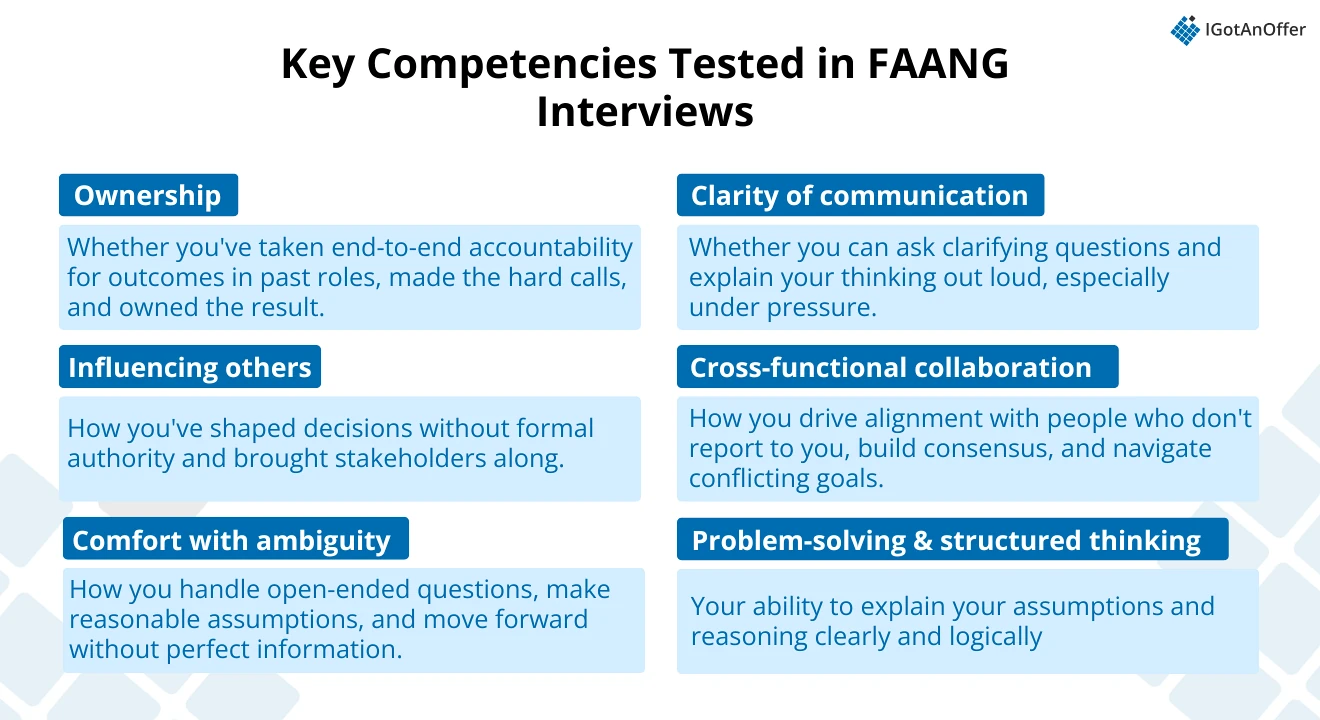
- Ownership: whether you've taken end-to-end accountability for outcomes in past roles, made the hard calls, and owned the result
- Influencing others: how you've shaped decisions without formal authority and brought stakeholders along. This carries more weight at senior levels and for EM, TPM, and PM roles.
- Comfort with ambiguity: how you handle open-ended questions, make reasonable assumptions, and move forward without perfect information
- Clarity of communication: whether you can ask clarifying questions and explain your thinking out loud, especially under pressure
- Cross-functional collaboration: how you drive alignment with people who don't report to you, build consensus, and navigate conflicting goals
- Problem-solving and structured thinking: how you break down ambiguous problems, weigh tradeoffs, and reason toward a defensible answer
Each FAANG company weighs these competencies differently, so tailor your prep to your target. You can refer to the company-specific guides linked above for more insights on what to focus on at each company.
1.2 How FAANG interviews differ from other companies
The interview process at FAANG companies differs in several ways from smaller or emerging tech companies. So to help manage your expectations, here's what to expect from FAANG, based on insights from our expert coaches, Kyle, Archana, and Tali:
- Interviews are structured around your title, not your team. At FAANG, you're often interviewing for a level (e.g., "Software Engineer L4") rather than a role on a particular team. Interview questions can cover a wide range of topics, even outside the technologies you use day to day. That means your prep needs to cover breadth, not just your current tech stack.
- Hiring decisions are designed to reduce bias. Each interview round assesses a specific skill area, and interviewers submit independent feedback before any group discussion. Final decisions are typically reviewed collectively, which helps ensure that no single interviewer can push a candidate through or reject them on their own.
- FAANG weighs how your work scales. Interviewers want to see that you can build a feature, but also that you can reason about how it behaves when a billion users interact with it, what might break first, and how you'd design around those challenges.
1.3 Common myths about FAANG interviews
There are several misconceptions about FAANG interviews circulating online that can lead candidates to prepare incorrectly. Below, we've listed some of the most common ones, based on insights from Kyle and Archana, who have experience on both sides of the hiring process.
1. You need to know everything about your domain. Candidates aren't expected to have all the answers. At Google, for example, interviewers value candidates who can admit when they don't know something and know when to ask for help. Google explicitly discourages “hero behavior,” where one person tries to handle everything alone. “This prevents others' growth and becomes a single point of failure,” says Kyle.
2. Coding is everything. At mid and senior levels, system design and behavioral rounds often carry more weight than coding. Candidates who over-prepare for LeetCode and under-prepare for everything else regularly fail interviews they could have passed.
3. You have to ace every single interview. FAANG hiring teams understand that candidates may perform better in some rounds than others. However, your overall feedback still needs to be consistently strong, without major concerns across interviews.
4. There's a perfect answer to every question. There is no one “perfect” answer in FAANG interviews. Interviewers care more about how you approach problems, explain tradeoffs, respond to feedback, and communicate your thinking. A solution doesn’t need to be perfect to pass.
5. Referrals are a golden ticket. Referrals can help you get past the resume screen, but they don't lower the bar once you're in the process. You still have to clear the same evaluation criteria as every other candidate.
6. Passing one FAANG loop means you're ready for all of them. The processes are different enough that preparation needs to be company-specific. Someone who clears a Google loop may struggle at Amazon without dedicated practice in behavioral storytelling.
Coaches who contributed to this guide










2. The FAANG interview process: 7 steps ↑
FAANG hiring is among the most competitive in tech. Acceptance rates sit below 1% at most of the Big 5, and even reaching the full loop is no guarantee.
Based on Kyle and Archana's personal interviewing and hiring experience, only 4–5% of candidates make it to the offer stage at Google, and roughly 1–3% across FAANG companies overall.
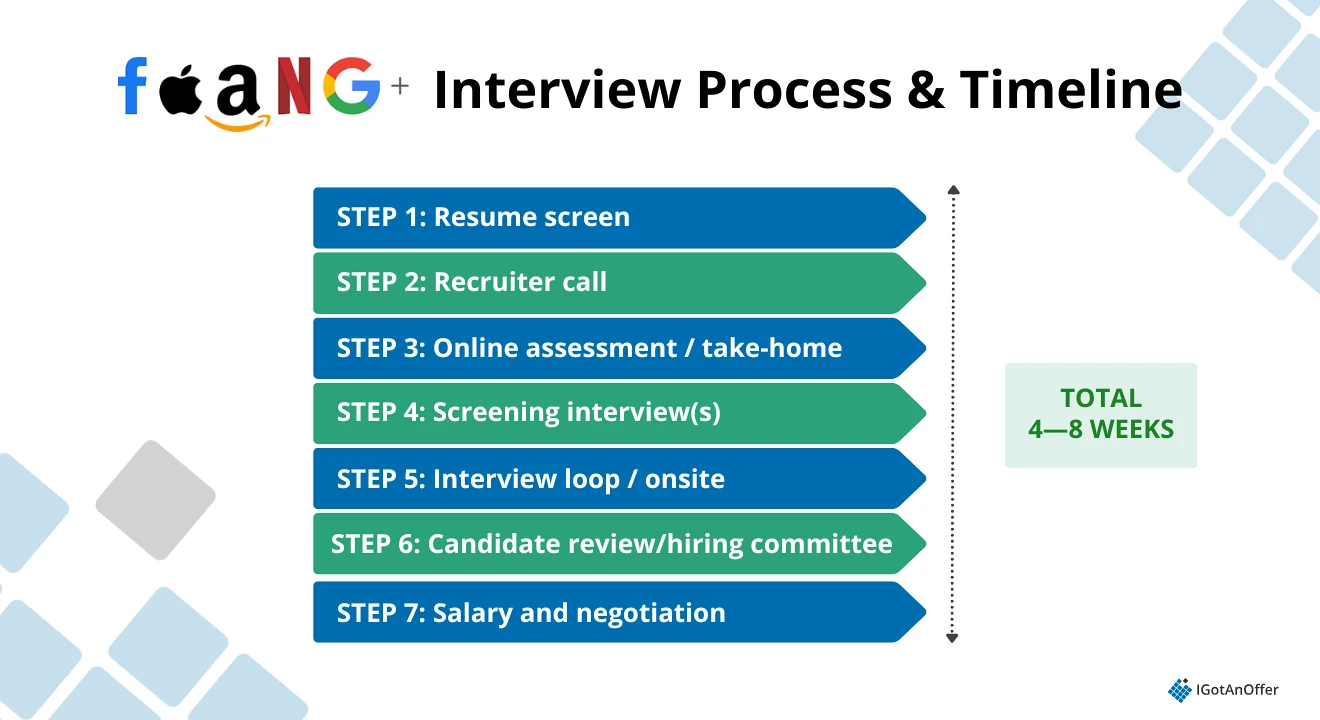
The good news is that with the right preparation, you can significantly improve your chances of getting an offer. Based on our analysis of Glassdoor reports across top roles at FAANG companies, as well as our experience coaching thousands of candidates through FAANG interviews, the process generally follows the seven steps below.
We'll cover each step in detail, flag company-specific differences, and share what to focus on at each stage.
Step 1: Resume screen
The process begins with a resume screen. After you submit your application (either through the company's jobs portal or in response to a recruiter reaching out on LinkedIn), your resume is evaluated against the requirements of the open role.
This stage filters out most applicants. Roughly 90% don't make it through, which means the resume screen is often more consequential than candidates expect.
Tips for a competitive FAANG resume:
- Match the job description. The experience you highlight should map to the role's specific requirements, not just your general career history.
- Lead with quantified impact. Specific numbers like revenue affected, team size managed, latency improved, and users reached carry far more weight than descriptions of responsibilities.
- Emphasize ownership. FAANG companies weigh candidates who drove outcomes and made decisions.
- Keep it concise. One page is the standard for most roles. Two pages may be appropriate for senior candidates with extensive experience. Emphasize roles and achievements that make you stand out.
If you want a more structured approach to resume preparation, these guides go deeper:
By role:
- Tech resume guide
- Software engineer resume guide
- Senior software engineer resume guide
- Product manager resume guide
- Engineering manager resume guide
- Technical program manager resume guide
- Data science resume guide
- Machine learning engineer resume guide
By company:
Google-specific note: Google does not require cover letters and admits that they “may or may not be considered.” So, unless you have a highly untraditional profile that needs to be explained, we recommend focusing on your resume.
Step 2: Recruiter call
If your resume passes the screen, a recruiter will reach out to schedule a call. This is usually 20 to 30 minutes and non-technical. The recruiter's goal is to confirm your background, assess general fit, and walk you through what the rest of the process looks like.
You should expect questions about your recent experience and what you're looking for in your next role. Expect “Why X company?” questions too, like:
The recruiter will also ask about your timeline and, often, what stage you’re at if you're interviewing at other companies (if applicable).
Don't give a salary number or share what other companies have offered at this stage. Discussing compensation too early usually works against you. If the recruiter asks, it's fine to say you'd like to learn more about the role before discussing compensation.
This call is also your opportunity to ask questions. Use it to clarify the interview format, the level being assessed, and any other logistics. Recruiters at most FAANG companies will also share prep materials or links to internal resources, so take advantage of them.
Step 3: Online assessment / take-home challenge
Not every company or role uses this step, but it's common enough that you should prepare for it. An online assessment (OA) typically comes after the recruiter call and before any live interviews. It's used to filter candidates at scale before moving to the main interview rounds.
How each company handles it:
- Meta: SWE and MLE candidates receive a proctored 90-minute coding assessment on CodeSignal, conducted with video and mic on. It consists of a single base problem across four progressive stages. Coding difficulty here is comparable to medium LeetCode. See our Meta coding interview guide to learn more.
- Amazon: SDE candidates receive an OA on HackerRank consisting of two coding problems and a work style survey, to be completed within 90 minutes. The coding section targets data structures and algorithms at an easy to medium level. See our Amazon SDE interview guide for a full breakdown.
- Google: SWE candidates receive two assessments: a general work style survey and a coding assessment, typically delivered via HackerRank or Google Docs. Coding difficulty starts at an easier level and increases through the process. See our Google online assessment guide for specifics.
- Apple: No standard OA. Apple's process moves directly from the recruiter call to technical phone screens for most roles.
- Netflix: No OA. The process moves directly from the recruiter call to live interviews.
- NVIDIA: No standalone OA. The first technical evaluation is a live phone screen where software engineers work through coding challenges on HackerRank or via screen share.
- OpenAI: Engineering candidates typically receive a one-hour coding assessment. The format varies by team and may include a live pair coding session, a take-home project, or an asynchronous test on HackerRank or CoderPad. Questions are more practical and real-world focused than standard LeetCode problems. See our OpenAI SWE interview guide for more.
- Anthropic: SWE candidates receive a timed coding assessment on CodeSignal, typically 70 to 90 minutes. Rather than multiple separate problems, Anthropic gives you a single problem that grows in complexity across four progressive levels, often resembling a small system-building task (such as an in-memory database). It's less about algorithms and more about writing clean, modular code that adapts to changing requirements. See our Anthropic interview process guide for more.
Tips for online assessments:
- Practice on a plain text editor, since most OA platforms don't offer syntax highlighting or autocomplete.
- Time yourself. Many candidates underestimate how much slower they code without IDE support.
- Prioritize a working brute-force solution before optimizing. Try to find a solution that works, then iterate to refine your answer.
Step 4: Screening interview(s)
The screening interview is the first live interview in the process, and it matters more than many candidates give it credit for. A strong performance here can accelerate the process; a weak one can end it before the main loop. Depending on the company and role, you'll have one or two screening rounds before advancing.
Screens are usually 45 to 60 minutes via video call. The format varies by role:
- Engineering roles: expect a coding problem on a shared editor (no autocomplete, usually CoderPad or similar) and occasionally a light system design question for senior candidates.
- PM roles: expect product sense or analytical thinking questions, similar in style to the full loop but lighter in depth.
- EM and TPM roles: expect a mix of technical and leadership questions, with interviewers probing both your people management instincts and technical credibility.
Some companies also weave behavioral questions into the screening stage. At Meta, for example, phone screens for certain roles include behavioral questions alongside the technical component. Don't assume behavioral prep only matters for the full loop.
What to expect at each company:
- Meta: Screening interviews are typically 45-minutes and combine behavioral questions with a technical component specific to the role you're applying for. SWEs, for example, get a coding screen focused on data structures and algorithms, while PMs face separate product sense and analytical thinking screens. See our Meta phone screen interview guide for a full breakdown.
- Google: Screens typically last 45 to 60 minutes and are tailored to your role. Engineers face one or two coding problems, while PMs and other roles get questions matched to their domain. Across all roles, how you think through the problem matters as much as whether you solve it. Interviewers are explicitly trained to assess reasoning.
- Amazon: Every screening interview, regardless of role, can include behavioral questions tied to Amazon's Leadership Principles. The technical component varies by position (coding for SWEs, product questions for PMs, leadership scenarios for EMs), but candidates across the board often underestimate how seriously Amazon weighs the behavioral component at this stage.
- Apple: Screens vary significantly by team and role. Non-engineering roles tend to get conversational interviews focused on depth of experience, while engineers face live coding on a shared platform. Apple's screens are generally less standardized than those at Meta or Google, so researching the specific team matters.
- Netflix: Screening interviews are typically with a hiring manager rather than a dedicated interviewer, regardless of role. Expect a high-bar conversation that probes both your domain expertise and cultural fit. Netflix moves candidates through quickly if they're a clear yes, and equally quickly if they're not.
- NVIDIA: Screens for engineering roles involve coding and, depending on the team, domain-specific technical discussion. Non-engineering candidates can expect role-relevant technical questions with a focus on NVIDIA's product and technology areas.
- OpenAI: The format varies by team and role. Engineering candidates typically get a 60-minute live coding session on CoderPad with practical, real-world problems rather than standard LeetCode. Other roles may receive a take-home project, a pair coding session, or an asynchronous assessment on HackerRank. See our OpenAI SWE interview guide for details.
- Anthropic: After the CodeSignal OA, most candidates move to a hiring manager call that doubles as a technical screen. The format covers a mix of technical discussion, questions about your past work, and your motivation for joining Anthropic. Across all roles, expect the conversation to probe AI safety awareness and mission alignment alongside domain-specific depth. See our Anthropic interview process guide for details.
Step 5: Interview loop / onsite
The interview loop is the core of the FAANG hiring process. It's the stage that determines whether you get an offer. Most loops consist of three to six rounds, each 45 to 60 minutes, conducted either in a single day or across multiple sessions over a week or two.
Before getting into what each company does, it helps to understand the types of rounds you might face in the loop. Not every role includes all of them, but across FAANG+, these are the main categories.
Note that the breakdown below applies to the most common roles: software engineer, product manager, and engineering manager.
Behavioral and resume questions
These appear in every role and at nearly every stage, from screens through to the final loop.
- General behavioral questions assess how you've handled real situations in the past. At most FAANG companies, these are structured around a specific framework (e.g., Amazon uses Leadership Principles, Google uses "Googleyness and leadership"). See our behavioral interview guide for more info.
- Culture fit questions evaluate alignment with the company's values and working style. These are especially prominent at Netflix, Anthropic, and Amazon.
- Leadership questions probe how you've managed people, influenced without authority, and made decisions under ambiguity. These carry more weight at senior levels and for EM roles.
Role-specific technical questions
The format here depends on the specific role you're interviewing for.
- Engineering roles (SWE, MLE): expect coding interviews focused on data structures and algorithms, and system design interviews at mid-to-senior levels that assess your knowledge of distributed systems, trade-offs, and scalability.
- Product manager roles: expect product sense interviews that evaluate how you think about building products (defining goals, identifying user needs, prioritizing features), and execution / analytical interviews that test your comfort with metrics, A/B testing, and product trade-offs.
- EM and TPM roles: expect a mix of system design, leadership scenarios, and technical credibility questions. Some companies also include a coding round or code review for EMs.
Regardless of role, candidates preparing for mid-level and senior interviews should avoid focusing too heavily on coding at the expense of other areas. "System design and behavioral interviews often carry more weight at these levels," says Archana.
Project retrospective
For experienced and leadership candidates (senior SWEs, EMs, senior PMs), some companies like Meta include a project restrospective round where you walk through a past project in depth. Interviewers assess how you made decisions, handled trade-offs, and drove outcomes. This is different from general behavioral questions because it focuses on a single project, end-to-end, rather than isolated situations.
5.1 What the loop looks like at each company
- Meta: SWE loops include two coding rounds, a system design round, and a behavioral round focused on Meta's core values. PM loops include product sense, analytical thinking / execution, and a leadership and drive round. See our behavioral interview guide for how to prepare.
- Google: Engineers typically face two coding rounds, one or two system design rounds, and a Googleyness and leadership round. Google is explicitly a "how you think" company, so behavioral questions are woven throughout.
- Amazon: The loop heavily incorporates Leadership Principles throughout. Most rounds for any role include at least some behavioral questioning, and engineering loops typically dedicate one or two full rounds to LP-focused interviews. One interviewer in the loop is designated as the "bar raiser", a senior employee from outside the hiring team who acts as an independent evaluator and can block an offer even if the rest of the panel recommends hire.
- Apple: Apple's loops are detailed and conversational, with interviewers probing depth of past work rather than asking standard LeetCode problems. Some roles involve presenting or walking through technical designs. Candidates targeting Apple should research the specific team as carefully as possible.
- Netflix: Netflix loops are direct, thorough, and probe judgment and long-term impact as much as technical ability. Candidates are often assessed on whether they can operate effectively with minimal oversight, as Netflix's culture values high autonomy and high accountability.
- Microsoft: Loops typically include coding, system design (for senior engineering roles), and behavioral questions. Microsoft falls in the middle of the FAANG process-predictability range (more standardized than Apple or Netflix, less so than Meta). The company operates with an "as appropriate" (AA) hiring model, where multiple interviewers must align on a hire recommendation.
- NVIDIA: Loops for engineering roles include coding, system design, and technical depth discussions relevant to NVIDIA's domain. Depending on the team, this may include GPU architecture, parallel computing, or AI infrastructure topics.
- OpenAI: Final loops span four to six hours over one to two days, with four to six interviewers. Expect coding rounds with practical, real-world problems (not textbook LeetCode), at least one system design session on Excalidraw, and behavioral interviews focused on collaboration and mission alignment. Senior candidates may also be asked to prepare a technical presentation on a past project. The process is decentralized, so loop composition varies by team.
- Anthropic: Final loops typically consist of five sessions: a hiring manager call, a coding round on CodeSignal, a system design round, a behavioral/collaboration round, and a culture fit and values round. Coding problems tend to be practical system-building tasks with progressive complexity. System design questions often involve AI-specific challenges like distributed LLM inference at scale. The values round is distinctive to Anthropic and probes how candidates think about AI safety, risk, and long-term impact.
Each of those company processes plays out differently depending on your role. The guides below go deeper into what to expect by company and role.
Company and role-specific interview guides:
Meta
- Meta software engineer interview guide
- Meta engineering manager interview guide
- Meta product manager interview guide
- Meta technical program manager interview guide
- Meta embedded software engineer interview guide
- Meta interview process
- Meta interview questions
- Google software engineer interview guide
- Google engineering manager interview guide
- Google product manager interview guide
- Google technical program manager interview guide
- Google interview questions
- Google interview prep guide
Amazon
- Amazon software development engineer interview guide
- Amazon software development manager interview guide
- Amazon product manager interview guide
- Amazon technical program manager interview guide
- Amazon business intelligence engineer interview guide
- Amazon interview process
Apple
- Apple engineering manager interview guide
- Apple machine learning engineer interview guide
- Apple interview process
- Apple product manager interview guide
- Apple technical program manager interview guide
Netflix
- Netflix interview process
- Netflix interview questions
- Netflix product manager interview guide
- Netflix engineering manager interview guide
Microsoft
- Microsoft interview process
- Microsoft software engineer interview guide
- Microsoft engineering manager interview guide
- Microsoft product manager interview guide
NVIDIA
- NVIDIA interview process
- NVIDIA software engineer interview guide
- NVIDIA product manager interview guide
- NVIDIA site reliability engineer interview guide
OpenAI
Anthropic
- Anthropic interview process
- Anthropic interview questions
- Anthropic software engineer interview guide
- Anthropic engineering manager interview guide
Stripe
- Stripe interview process
- Stripe product manager interview guide
- Stripe engineering manager interview guide
DataBricks
DoorDash
- DoorDash interview process
- DoorDash product manager interview guide
- DoorDash engineering manager interview guide
Capital One
- Capital One software engineer interview guide
- Capital One product manager interview guide
- Capital One business analyst interview guide
More resources
We regularly publish new guides, question breakdowns, and expert insights across our content channels. These are good places to go deeper on specific topics or stay up to date as interview processes change.
- Tech interview blog for engineering roles
- IGotAnOffer Engineering on YouTube for mock interview walkthroughs and expert tips
- IGotAnOffer PM on YouTube for product manager interview prep and frameworks
5.2 Before your loop
If you're not fully prepared when your loop is scheduled, consider asking to reschedule. Most FAANG companies are fine with a short delay, and it's far better than rushing in underprepared.
If you fail the loop, many companies impose a waiting period of six months to a year before you can reapply. That is a much bigger setback than a two-week delay.
If you're unsure whether you're ready, our guide on how to get into big tech companies walks through what "prepared enough" actually looks like.
Step 6: Candidate review/hiring committee
Once you complete your loop, your interviewers each write a debrief summarizing what they observed and submit a hiring recommendation. The typical scale runs from "strong hire" down through "hire," "leaning hire," "no hire," and "strong no hire."
These debriefs are then reviewed, either in a group debrief meeting or by a hiring committee made up of senior employees who didn't interview you. The goal is to assess your candidacy without the bias of personal interaction.
There are three possible outcomes:
- Your profile advances to an offer (typically when a clear majority recommends hire).
- You're called back for follow-up interviews to address gaps in one or two specific areas.
- Your candidacy ends (typically with multiple no-hire recommendations).
Passing the debrief is not the same as receiving an offer. A few more steps may sit between those two events, depending on the company. At Meta and Google, for example, team matching happens after you've cleared the review but before you receive a formal offer, which can add a few weeks.
If you haven't heard back within one to two weeks of your final round, following up with your recruiter is appropriate and expected.
Step 7: Salary negotiation
Finally, once you’ve passed each of the six steps above, you’ll receive your offer package.
The offer you receive first is rarely the best offer available. Recruiters have ranges, and the initial number is typically not the top of that range.
So, you can negotiate your offer. Your recruiter will get in touch with you about the details, likely scheduling one final call to clarify and discuss the terms. If they have not scheduled a call, you can ask for one.
Of course, salary discussions can be difficult and a bit uncomfortable, especially if you are not used to them. Below are some tips to help you navigate your salary negotiations.
Salary negotiation tips:
- Be polite: Remember that the person you’re negotiating with is just doing their job, and that the two of you are not enemies. You’ll get much farther in your negotiations if you approach the conversation with grace.
- Use data to anchor your counter: Levels.fyi is a reliable source for total comp benchmarks by company and level. Blind has candid peer reports on negotiated outcomes. Use both.
- Don’t give a number right away: Whenever possible, it’s better to wait until you receive an offer to start negotiating. This reduces the risk of giving a number that is lower than what the company otherwise would have paid, or giving a number that is so high that they are reluctant to interview you.
- Start high: To start the conversation, name a compensation number that is higher than your goal, and the Google negotiator will likely end up negotiating it down to a number that is closer to your original goal.
- Negotiate the full package: If base salary is fixed, push on equity grant size, signing bonus, or RSU vesting schedule. These are often more flexible than the base.
- Competing offers help significantly: If you have offers from other FAANG companies, sharing them (strategically) often unlocks more room to negotiate than any other single tactic.
For even more salary negotiation tips, check out our company-specific guides:
- Meta offer negotiation guide
- Google offer negotiation guide
- Amazon offer negotiation guide
- Apple offer negotiation guide
Once you’re ready to put your negotiation skills to the test, get salary negotiation coaching from ex-FAANG recruiters so you can practice with and get instant feedback from a real expert.
Are you prepared for your FAANG interviews? ↑
We've coached more than 20,000 people for interviews since 2018. In our experience, the candidates who succeed at FAANG are the ones who get targeted prep. Knowing the company's process, practicing under real-time pressure, and getting feedback from someone who has sat on the other side of the table makes a measurable difference.
Find a FAANG interview coach so you can:
- Test yourself under real interview conditions
- Get accurate feedback from a real expert
- Build your confidence
- Get company-specific insights
- Learn how to tell the right stories, better
- Save time by focusing your preparation
Landing a job at a FAANG company often results in a $50,000+ annual increase in total compensation. In our experience, three or four coaching sessions, around $500, make a significant difference in your ability to land the offer. That's an ROI of 100x.
Click here to book mock interviews with experienced FAANG interviewers.



 Front-end engineer

 Behavioral