

 Back to other articles
  Last updated: October 14, 2026

 Interviews
 Software engineer
 Deeply researched
This guide covers everything you need to know about the OpenAI software engineer interview. You’ll learn the full interview process and what OpenAI looks for, plus sample questions and a preparation plan.
With its rapid growth, above-industry pay, and central role in the AI industry, OpenAI attracts the world’s top engineering talent. So if you’ve managed to score an interview, prepare for a rigorous process with multiple rounds of hands-on coding and system design, and deep dives into your past projects and experience.
To put together this guide, we gathered insights from hundreds of real OpenAI candidate reports on Glassdoor and Blind, plus resources like Levels.fyi and OpenAI's own interview guide.
- Role and salary
- Interview process and timeline
- Example OpenAI software engineer interview questions
- Interviewing tips
- Preparation plan
Click here to practice 1-on-1 with expert OpenAI interview coaches.
If you're applying for an AI-focused SWE role, check out our guide to AI engineer interview questions.
1. OpenAI software engineer role and salary↑
Before we dive into the interview process and questions, let's quickly cover some basics about the role you're applying for.
1.1 What does an OpenAI software engineer do?
OpenAI software engineers build and maintain the systems behind products like its own API and ChatGPT, infrastructure used by millions of people on a daily basis.
As an OpenAI software engineer, your work may span a wide range of areas, depending on the team you’re in:
- Model training infrastructure and compute optimization. Engineers are in charge of building and scaling OpenAI’s model training systems, managing GPU clusters, and reducing model training costs
- Product engineering (consumer and API-facing). Engineers are in charge of developing features and backend that power ChatGPT and the OpenAI API
- Safety and alignment systems. Engineers here build technical safeguards to ensure reliable and predictable model behavior, in line with OpenAI's mission
- Developer platform and tooling. Engineers build the APIs, SDKs, and internal tools used by internal teams and external developers
Being an engineer at OpenAI means you need to be ready to tackle novel problems constantly. Much of what OpenAI's engineers work on has no established playbook. You'll regularly encounter situations where the right solution isn't obvious and where your judgment matters as much as your technical ability.
Many engineering roles at OpenAI carry the title "member of technical staff" (MTS) instead of "software engineer." Both refer to the same type of role at the company, and the interview process and questions are substantively identical. Everything in this guide applies to both.
1.2 How much does an OpenAI software engineer make?
OpenAI’s generous compensation package is probably one of the reasons you’re interested in working at the company.
Here are the average salaries and compensation for the different software engineer levels at OpenAI. This is based on the reported data from Levels.fyi as of October 2026.
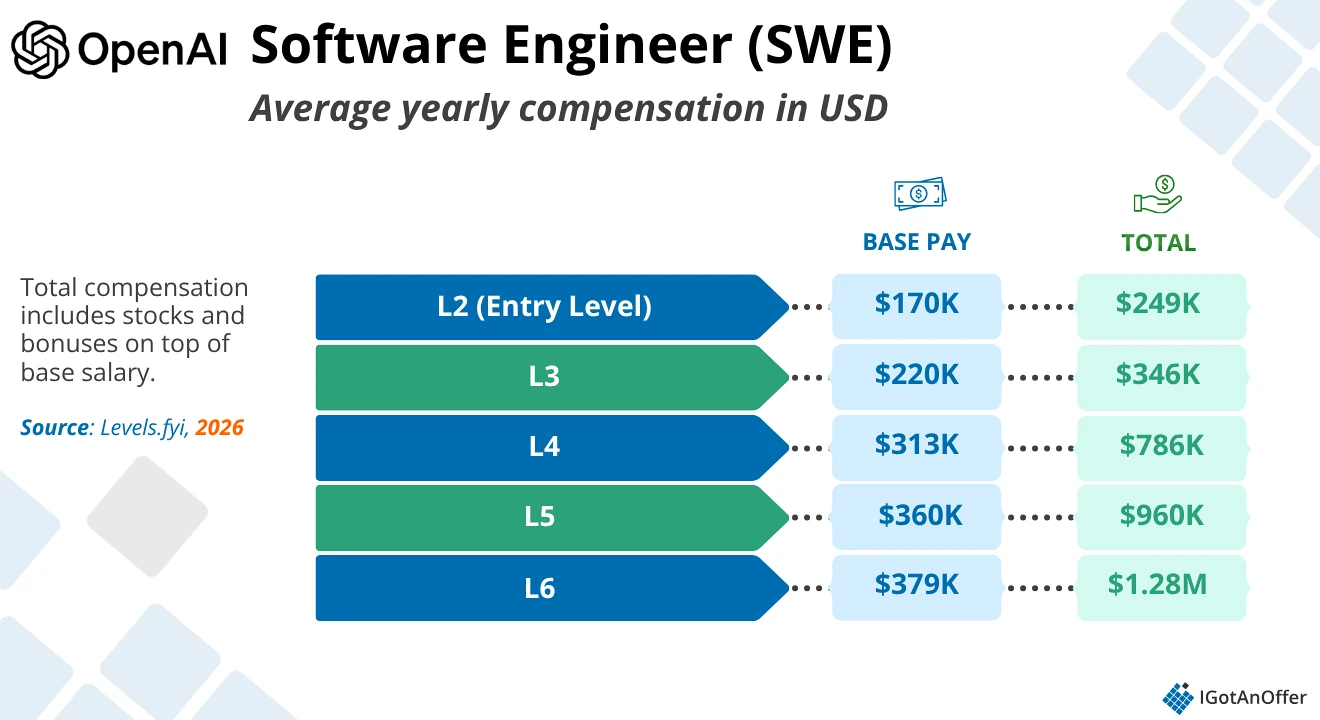
Compensation depends on many factors, but it typically increases with seniority. Equity packages are a particularly significant part of total compensation at OpenAI, given the company's growth trajectory in recent years.
Ultimately, your interview performance will largely determine your offer, which is why working with our SWE interview coaches can be a smart investment.
As with all top tech companies, compensation is negotiable. If you receive an offer, don't be afraid to ask for more. If it's your first time negotiating, work directly with one of our salary negotiation coaches to get in-depth and personalized advice.
2. OpenAI software engineer interview process and timeline ↑
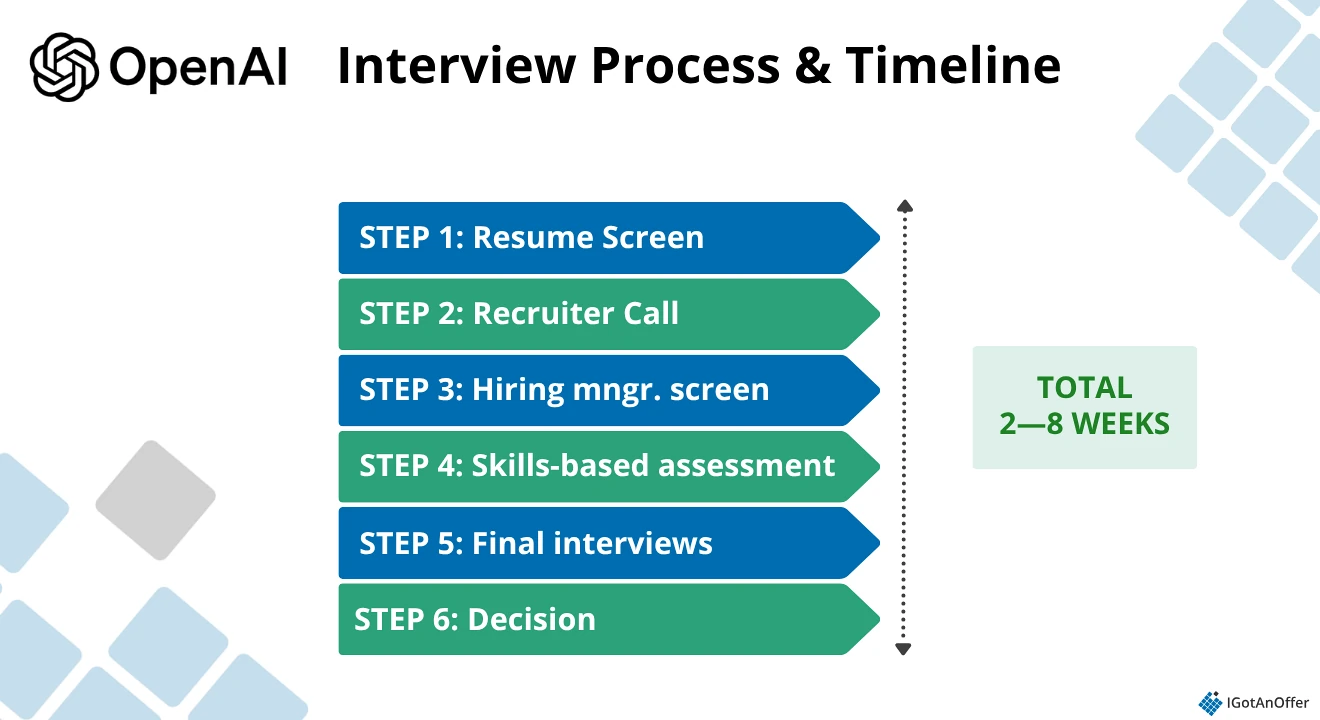
OpenAI's software engineer interview process typically takes two to eight weeks and follows these steps:
- Resume screen
- Recruiter call
- Hiring manager screen
- Skills-based assessment
- Final interviews (4 to 6 rounds)
- Decision and offer
One thing to know upfront: OpenAI’s software engineer interview process is decentralised. The steps above reflect the most common process for software engineers. You may also get a similar process if you’re applying for applied AI engineer, full-stack engineer, and security engineer roles.
Your recruiter should let you know exactly what your specific loop will look like. They'll typically brief you before each stage.
For a full breakdown of every stage, see our OpenAI interview process guide. If you’re targeting the forward deployed engineer role, our guide on the OpenAI FDE interview will be more relevant.
2.1 Resume screen
The first step of OpenAI's interview process is the resume screen.
This is an extremely competitive step. Like at other FAANG companies, the vast majority of candidates don't make it past the resume screen.
Here, after you've submitted your application through the OpenAI careers portal, or been contacted directly via email or LinkedIn, recruiters will evaluate your resume to see if your experience aligns with the open position.
To help you put together a targeted resume that stands out, follow the tips below:
Tips on crafting a resume
- Study the job description: The work experience you showcase on your resume should directly relate to the role qualifications. For software engineers applying to infrastructure teams, emphasize systems-level work and scale.
- Be specific: Use data to back up your claims. How many servers did you manage? How much did you improve latency? Quantify as much as you can.
- Emphasize impact and scale: OpenAI values people who have worked on systems and problems at a significant scale. Highlight work affecting millions of users, massive data processing, or complex distributed systems.
- Be concise: Recruiters often don't have much time to study a resume in depth, so keep it clear and concise, emphasizing roles and achievements that make you stand out.
For practical guidance and real examples, see our software engineer resume guide. Or, get expert feedback from our team of former FAANG recruiters, who will cover what achievements to focus on (or ignore), how to fine-tune your bullet points, and more.
2.2 Recruiter call
If your resume passes the resume screen, an OpenAI recruiter will reach out to you to schedule a call. This generally lasts 30–45 minutes.
This call is non-technical in most cases. You should expect questions like "Tell me about yourself," "Why OpenAI?" and "Walk me through your resume." Be prepared to discuss your previous experience and explain your motivation for applying to OpenAI.
You may be asked to discuss your work and academic experience, motivations, and goals. Familiarize yourself with OpenAI's recent work, too, especially updates related to the team you're interviewing for. You can find OpenAI's latest research and product updates on their blog.
During this call, the recruiter should tell you how the overall interview process will work and may answer your questions about the timeline, location, or job description. This is when you should ask about which teams are hiring and express any role preferences.
Your recruiter should also provide you with helpful interview prep materials. If all goes well, they will get back in touch to schedule the skills-based assessment.
2.3 Hiring manager screen
This is a 20- to 30-minute virtual call, typically with the engineering manager for the team you'd be joining. Expect questions about your background as well as your long-term career goals.
Your interviewer could also ask you about your experience with a specific technology relevant to the team or about past systems you've designed. Be ready to discuss how you handled technical trade-offs.
If you're applying for a role with a research or applied AI component, prepare to talk about a relevant research output or project in depth.
2.4 Skills-based assessment
Assuming there’s a fit, you may progress to the technical skills-based assessment a week or so after your previous screenings. Your recruiter will provide prep materials before this stage, so be sure to maximize those materials when you prepare.
There’s not a single standard format for the technical assessment based on reports from candidates online. SWE candidates typically report getting one of the following:
- Coding / pair coding challenge: A practical coding problem on a platform like HackerRank or CoderPad. OpenAI's coding problems are more practical and real-world focused. For example, debugging an existing function or optimizing code for readability and efficiency. You may also get a pair coding session where an engineer observes your problem-solving approach. Learn more in our OpenAI coding interview guide.
- System design interview: For more senior roles, you may face a system design problem where you architect a solution to a technical challenge, including API design, database schema, and overall architecture. These questions can be highly detailed, with specifications and mockups provided. Learn more in our OpenAI system design interview guide.
- Take-home assignment: This format typically involves a self-contained engineering problem delivered via HackerRank. You’ll be given a deadline to complete the task. Expect tasks such as designing and implementing a small system or refactoring a piece of code. In some cases, interviewers will do a deep dive on your output during one of the onsite rounds.
You can expect to hear back within about a week after completing your assessment. If you advance, the recruiting team will schedule your final interviews.
To see a breakdown of the kind of questions you're likely to face in your skills-based interviews, check out our comprehensive guide to OpenAI interview questions by role (with answers).
2.5 Final interviews
Candidates who pass the skills-based assessment advance to the final interview round.
According to OpenAI's official interview guide, this stage typically involves 4 to 6 hours of interviews with 4 to 6 people over one to two days. Interviews are conducted virtually by default, though you can choose to interview on site at OpenAI's San Francisco office.
You can expect to go through the following interview types:
- Coding / code refactoring
- System design or architecture
- Behavioral & culture fit
If you’re up for a senior or staff role, you may be asked to prepare a short technical presentation on a significant past project. Be prepared to discuss your decision-making process, the trade-offs you had to make, and the impact of your work. Interviewers want to see your thought process and whether you can communicate complex engineering work clearly.
We’ll discuss the interview question types in detail in Section 3.
Once you clear the final interviews, it's time to wait for the decision.
2.6 Decision and offer
OpenAI typically moves quickly after the final round. Most candidates report hearing back within a week or longer. Some even say OpenAI moves even faster if you tell them that you have competing offers. So don’t hesitate to reach out to your recruiter about an offer deadline elsewhere.
If you advance, you will move into offer and negotiation. Team matching can occasionally add some time to this stage before a formal offer is extended.
3. OpenAI software engineer interview questions ↑
We analyzed the questions reported by real OpenAI software engineer candidates on Glassdoor, Blind, and other candidate forums.
Based on our research, these are the types of interview questions you’ll get as an OpenAI software engineer candidate:
Below, you will find curated lists of sample questions for each interview type.
IMPORTANT: Even if you solve a problem correctly, your technical interviews are considered a failure at OpenAI if the interviewer has to give you multiple substantive hints or point out logical flaws you missed. You need to demonstrate independent problem-solving and attention to detail.
Let’s get started.
3.1 Coding questions ↑
OpenAI’s coding round runs 45 to 60 minutes and involves practical engineering problems simulating real-world tasks. It's given on CoderPad.
At OpenAI, interviewers look for production-quality code and thinking. This means they expect clean and logically organized code with clear variable naming, explicit edge-case handling, and proactive test coverage.
Expect a lot more hands-on coding than your usual FAANG coding interview and be mentally ready for follow-up questions and extension tasks even mid-implementation.
Senior SWE candidates may face a code refactoring round, where you're asked to improve, refactor, or optimize existing code. Unlike a standard coding interview, the focus is on your ability to read and improve someone else's work under time pressure.
Some teams allow AI assistance during coding rounds, but most of the reports we've seen do not mention the use of AI tools.
Below is a list of coding questions OpenAI candidates have reported on Glassdoor. We’ve divided them by type to help you organize your prep.
Example coding questions asked at OpenAI software engineer interviews
1. Hash tables and caching
- Implement an LRU cache that supports get(key) and put(key, value), evicting the least recently used entry when capacity is exceeded.
- Implement a key-value store with get, set, and delete operations where values are lists of tuples. Follow-up: add sorting and merging across entries.
- Implement a versioned key value store that supports put(key, value), get(key), and get(key, timestamp), returning the value for a key as it existed at a given point in time.
2. Graphs and trees
- Given a list of words sorted according to the rules of an alien language, determine the order of characters in that language.
- Given an n×n grid of 1s and 0s, return the number of islands.
- Given the root of a tree, count the number of nodes that satisfy a given condition.
- Topologically sort a directed acyclic graph and detect cycles.
3. Practical utilities and parsing
- Implement a cd command. Given a current working directory and a target path that may include . and .. components, return the resulting absolute path. Follow-up: add symbolic link resolution using a provided mapping dictionary.
- Implement a dependency version checker. Given a set of packages and their version constraints, determine which versions satisfy all constraints.
- Implement an Excel-style formula evaluator that handles cell references such as =A1+B2. Follow-up: detect and handle circular references.
- Given a user's GPU usage data and a pricing rules table, implement a calculator that returns their remaining credit balance.
- Given a UI mockup with CSS and a data API already provided, implement the interface in code.
4. Object-oriented programming
- Implement a simple ORM layer with classes and methods to save, query, update, and delete objects from a database.
- Implement a resumable iterator for a large dataset that supports next(), pause(), and resume(), pausing mid-traversal and resuming from the exact position it left off.
- Implement a data loader class and write the tests necessary to validate its behavior.
5. Concurrency
- The following code has a race condition. Identify it, fix it, and explain your choice of synchronization primitive.
- Implement a concurrent web crawler. Starting from a seed URL, fetch pages using multiple worker threads, avoid visiting any URL more than once, and handle fetch failures gracefully.
6. Debugging and refactoring
Note: This topic tends to appear more at senior levels, where you're expected to reason about someone else's code under time pressure.
- You are given a function that parses log files but runs in O(n²) time. Debug it, improve its time complexity, and refactor for clarity without changing its behavior. Walk through how you would test your changes.
Learn more about OpenAI coding interviews here. For more coding practice and tips, see our coding interview prep guide.
3.2 System design questions ↑
If you’re being considered for an L4+ position, expect a system design interview round. The rule of thumb is, the more senior you are, the more system design questions you’ll get. Each round lasts 45 to 60 minutes.
OpenAI system design interviews start with an open-ended prompt just like at any FAANG interview. But interviewers here tend to push for precision. Expect to reason about scalability, reliability, concurrency, trade-offs, and other real-world production concerns.
If you’re a new grad or early career SWE candidate (L2-L3), you won’t face a full system design round at OpenAI. Still, a basic familiarity with concepts will help, as some interviewers may ask lighter architecture questions as part of a broader technical conversation.
Example system design questions asked at OpenAI software engineer interviews
1. Consumer-scale product systems
- Design Slack.
- Design TikTok.
- Design Yelp or a notifications service?
2. Platform and infrastructure systems
- Design GitHub Actions from scratch.
- Design a webhook delivery system. Cover URL delivery, caching, database schema, and failure handling with a retry mechanism.
- Design an API for an in-memory database.
- Design a rate limiter for a public API service.
- Design a fault-tolerant web crawling service that scales to 10 million requests per second.
- Design a devbox system (CI/CD pipeline).
3. AI native systems
- Design the infrastructure to serve ChatGPT at hundreds of millions of weekly users.
- Design an LLM-powered enterprise search system that supports natural language queries across internal documents with role-based access control.
- Design a GPU scheduling system to allocate compute resources across competing workloads at scale.
- Design a vector database to store and search billions of embeddings efficiently.
- Design a system to detect NSFW content in real-time ChatGPT outputs. Address model selection, latency requirements, and the feedback loop.
- Design a system for AI video generation based on text input.
For a detailed breakdown of how to approach this round, including example answer outlines specific to OpenAI, see our OpenAI system design interview guide.
If you're targeting a Staff-level role, we recommend checking out our Staff system design interview guide for a deeper dive into what interviewers expect at this level.
3.3 Behavioral questions ↑
You’ll get behavioral questions at the start of most of your rounds and also have a dedicated session for them.
These questions focus on your past work experience, your qualifications, and your motivation for applying to OpenAI. In other words, it's a way for your interviewer to get to know you better and how you’ll perform based on how you’ve behaved in the past.
OpenAI interviewers typically look for these traits in engineers:
- Ability to navigate disagreements with peers, managers, and external teams constructively and without escalation
- A growth mindset and openness to listen and act on feedback
- Comfort with ambiguity, or knowing how to bring structure to unclear situations and make decisions without waiting for complete information
- Resilience, or sustained focus even under repetitive obstacles or shifting priorities
- Clear, efficient communication with peers, cross-functional partners, and the wider team across different levels of technical depth
You’ll likely get asked "Why OpenAI?" multiple times. Go beyond the obvious and state why you believe in what the company is doing and how its mission aligns with what you want to do in your career.
Be ready to drill down into the technical details of the projects on your resume and discuss the types of projects you'd like to work on in the future. This will help you make a strong impression in behavioral interviews.
Example behavioral questions asked at OpenAI software engineer interviews
1. General
- Tell me about yourself.
- Tell me about a project or accomplishment you are most proud of.
- Why do you want to work at OpenAI?
- Walk me through a large technical program or initiative you have led or been heavily involved in.
2. Technical problem-solving
- Tell me about a time you solved a particularly complex technical problem. What was your approach?
- Describe a situation where you had to make a difficult technical trade-off decision.
- Tell me about a time you influenced a technical decision without having direct authority over it.
3. Collaboration and conflict resolution
- Tell me about a time you made a mistake. What happened and what did you take away from it?
- How do you manage multiple conflicting priorities?
- Tell me about a time you and a cross-functional partner disagreed. How did you resolve it?
Learn more in our OpenAI behavioral interview guide. Then, get more practice with our general behavioral interview questions guide, which includes sample answers to the most common behavioral questions and an answer framework.
4. OpenAI software engineer interviewing tips ↑
You might be an excellent software engineer, but that alone won't be enough to ace your interviews at OpenAI. Interviewing is a skill in itself that you need to develop deliberately. Plus, OpenAI's interviews operate a bit differently, so you'll need to build some muscles for that as well.
Let’s look at some key tips to make sure you approach your interviews the right way.
4.1 Ask clarifying questions
OpenAI's technical questions are ambiguous by design because interviewers want to see how you handle ambiguity.
Whether you’re working on a coding or system design challenge, spend the first few minutes clarifying the requirements and narrowing down your scope. This demonstrates how you work to fully understand a problem before taking action.
4.2 Write code like it’s going into production
OpenAI's coding bar is higher than at most companies. Interviewers are looking for clean structure, clear variable naming, explicit edge case handling, and good test coverage, so prioritize those over being fast.
4.3 Think out loud and be collaborative
OpenAI wants to understand how you think under pressure, so talk through your problem-solving process. State your assumptions, explain your decisions, and call out the trade-offs you’re making as you go.
4.4 Center your behavioral answers around OpenAI’s mission
Prepare stories from your professional experience that show your genuine alignment with OpenAI’s mission. Read the Charter, learn about the company’s latest initiatives (the OpenAI research blog is a good place to start), and talk about one that piqued your interest.
4.5 Know your past projects in depth
If you’ve highlighted a relevant past project in your resume, be ready to discuss it in depth. Talk about its impact, the architecture decisions you made (and if you’d do anything differently given what you know now) and how you chose your success metrics. Interviewers will probe hard, so choose a project you know inside out.
4.6 Communicate efficiently
During your technical interviews, you’ll be assessed on your communication skills by how you talk through your problem-solving process. Use this as your opportunity to show how well you communicate and collaborate with colleagues by treating your technical interviews like a conversation.
In system design interviews, start by stating your assumptions to make sure you’re aligned with your interviewer. And in behavioral interviews, set up your situation quickly before diving into your actions and results.
A great way to improve this skill is to familiarize yourself with answer frameworks, such as IGotAnOffer’s SPSIL framework (Situation, Problem, Solution, Impact, Learning) for behavioral interviews, or the 4-step system design framework we recommend to candidates for tackling system design questions.
5. How to prepare for your OpenAI SWE interview ↑
Now that you know what questions to expect, let's focus on preparing as efficiently as possible. Below are the four steps we recommend.
5.1 Deep dive into OpenAI's culture and mission
Before investing hours in technical prep, take the time to understand the company you have your eye on.
OpenAI is a prestigious company, but don’t apply for that reason alone. Make sure you genuinely align with its mission and values.
If you can talk to engineers who currently or formerly worked at OpenAI, ask them about the culture to decide whether it’s a good fit for you. Glassdoor and Blind also have candid employee reviews that give a realistic picture of day-to-day life at the company.
Here are some resources you can check out to learn more about the company.
- OpenAI Charter
- OpenAI research and product blog
- OpenAI's interview guide
- OpenAI careers and culture page
If you know engineers who currently or formerly worked at OpenAI, speaking with them directly is worth the effort. Glassdoor and Blind also have candid employee reviews that give a realistic picture of day-to-day life at the company.
5.2 Practice by yourself
As we've outlined above, you will have three types of interviews at OpenAI: coding, system design, and behavioral. The first step in your preparation should be to build a solid foundation in each area and practice answering questions independently.
For coding interviews:
Practice in CoderPad or a plain text editor without autocomplete; that's the environment you'll be working in. Focus especially on data structures, OOP design, concurrency, and debugging:
For system design interviews:
- How to answer system design questions
- OpenAI system design guide
- Machine learning system design interview
- GenAI system design interview
- Staff system design interview
For behavioral interviews:
- How to answer "Why OpenAI?"
- OpenAI behavioral interview questions
- Common software engineer behavioral questions
For OpenAI-specific preparation:
A great complement to written practice is answering questions out loud. It sounds unusual, but it will significantly improve how you communicate under pressure during the real interview.
5.3 Practice with peers
If you have friends or colleagues who can do mock interviews with you, that is a worthwhile option to explore. The experience of performing in front of another person is genuinely useful and is free. That said, peer practice does have its limitations:
- It’s hard to know whether the feedback you receive is accurate.
- Your peers are unlikely to have any inside knowledge of OpenAI's specific interview style.
- On peer platforms, people often waste your time by not showing up
For those reasons, many candidates move straight to practicing with an expert.
5.4 Practice with experienced OpenAI interview coaches
In our experience, practicing real interviews with experts who can give you company-specific feedback makes a huge difference.
Find an OpenAI SWE interview coach so you can:
- Test yourself under real interview conditions
- Get accurate feedback from a real expert
- Build your confidence
- Get company-specific insights
- Learn how to tell the right stories, better
- Save time by keeping your preparation focused
Landing a software engineering role at OpenAI often results in a $50,000 per year or more increase in total compensation. In our experience, three or four coaching sessions at around $500 make a meaningful difference in your ability to get the offer. That is an ROI of 100x.
Click here to book mock interviews with experienced OpenAI interview coaches




 AI system design