

 Back to other articles
 Last updated: June 09, 2026

 Interviews
 Software engineer
 Deeply researched
Software engineer interviews at Anthropic are among the most competitive in tech. The company is growing fast, compensation is well above industry average, and the work sits at the center of the AI industry's most consequential developments.
To put together this guide, we gathered insights from 45 candidate reports on Glassdoor, Anthropic's careers page, and our existing Anthropic interview guides. Here is what you will find inside:
- Role and salary
- Interview process and timeline
- Example interview questions
- Interviewing tips
- Preparation plan
Practice 1-on-1 with expert SWE interviewers.
Let’s get started.
1. Anthropic software engineer role and salary↑
Before diving into the Anthropic software engineer interview process and questions, here is a quick overview of the role itself.
1.1 What does an Anthropic software engineer do?
Anthropic software engineers build the systems and infrastructure that power Claude and Anthropic's broader research. The work spans a wide range of teams, from product-facing engineering on claude.ai to foundational platform work on inference, training, and reliability systems.
Unlike many big tech engineering roles, the boundary between research and engineering at Anthropic is deliberately thin. As an Anthropic engineer, you'll contribute to research papers, help design experiments, and work alongside researchers on the same projects.
All technical hires, regardless of background, share a single title: Member of Technical Staff. The title reflects Anthropic's belief that research and engineering are closely intertwined, with technical contributors operating as a unified group rather than within traditional roles or hierarchies.
Across teams, the role typically involves:
- Building and maintaining distributed systems at scale, including training infrastructure, inference pipelines, and internal developer tooling
- Partnering with research and product teams to ship features and systems reliably
- Taking full ownership from design through deployment and ongoing operations
- Contributing to Anthropic's safety and reliability standards across the stack
1.2 Anthropic's work culture
Anthropic describes itself as a high-trust, low-ego organization. The company moves fast, ships frequently, and expects engineers to take initiative without waiting for tight direction.
According to Anthropic's careers page, engineers are expected to "pick up slack, even if it goes outside your job description."
Anthropic's seven stated principles include acting for the global good, holding light and shade on AI's risks and benefits, and igniting a race to the top on safety.
Candidates who engage seriously with these values perform better in the culture round than those who treat them as a box to check.
1.3 Anthropic software engineer salary and compensation
Anthropic software engineers are among the most highly compensated engineers in the industry. The table below shows average annual salaries by level, based on data reported on Levels.fyi.
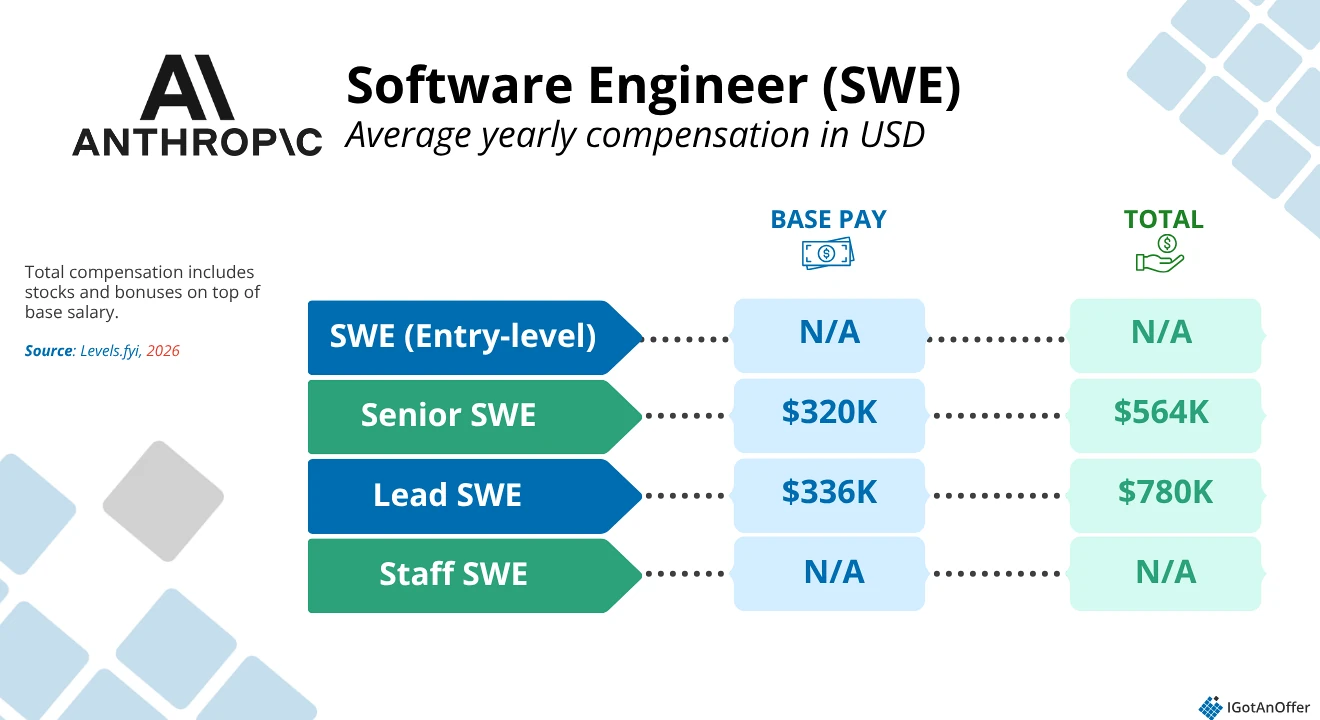
According to Levels.fyi, equity grants vest over four years with 25% in year one. The job postings we reviewed showed salary ranges of $300K–$405K per year for platform and research data platform roles.
Ultimately, how you do in your Anthropic software engineer interviews will help determine what you will be offered, which is why working with our tech interview coaches can be a smart investment.
As with all top tech companies, compensation is negotiable. If you receive an offer, don't be afraid to ask for more. If it's your first time negotiating, work directly with one of our salary negotiation coaches to get in-depth and personalized advice.
1.4 What Anthropic looks for in software engineer candidates
Anthropic does not publish a formal evaluation rubric. Based on our analysis of Anthropic's hiring philosophy, job postings, and what candidates consistently report on Glassdoor, here are the qualities that come up most often.
- Production-quality thinking, not just correct output. Anthropic's coding problems test how you structure code, name variables, and handle edge cases. A working solution is not enough. Interviewers want to see code that teammates can read and maintain.
- First-principles reasoning. One candidate described the loop as "completely different from the standard FAANG pipeline. The entire process is built around first-principles thinking and writing extremely robust and safe code." Speed-running algorithms are not what Anthropic is evaluating.
- Comfort with ambiguity. Anthropic's problems are deliberately open-ended. Interviewers expect you to clarify requirements, make assumptions explicit, and make progress without waiting for complete information.
- Mission alignment. The culture fit round is one of the hardest parts of the loop. Anthropic looks for candidates who can engage critically with questions about AI safety and responsible development, not recite the corporate line.
- Communication. Every round assesses how clearly you explain your reasoning, respond to follow-up questions, and adapt your level of technical depth depending on who you are talking to.
Coaches who contributed to this guide





2. Anthropic software engineer interview process and timeline↑
Here is what to expect from the Anthropic software engineer interview process, from your first application to the offer stage. For a complete breakdown across all Anthropic roles, see our Anthropic interview process guide.
2.1 What steps to expect
The Anthropic software engineer interview process typically takes four weeks to three months from application to offer, depending largely on team matching and reference check timing. Most candidates go through these steps:
- Resume screen
- CodeSignal online assessment (90 minutes)
- Recruiter call (30 minutes)
- Hiring manager screen (1 hour)
- Technical interview loops (4–5 rounds, 55 minutes each, via Google Meet)
- Reference checks and team matching (2–4 weeks)
Note that the order of Steps 2 and 3 can vary. Some candidates receive the CodeSignal link before ever speaking with a recruiter. Your recruiter will confirm the sequence during initial outreach.
Step 1: Resume screen↑
Anthropic's recruiting team reviews your application against the requirements of the open role. This is an extremely competitive step, and the vast majority of candidates do not progress past it.
Anthropic does not explicitly require prior machine learning experience, according to the Anthropic careers page. About half of its technical staff had no ML background before joining.
If you have done independent research, written a technical blog post, or made substantial contributions to open-source software, Anthropic recommends putting that at the top of your resume.
For tips on structuring your application, see our software engineer resume guide. You can also work with one of our coaches on a resume review if you want expert feedback from former FAANG and AI lab recruiters.
Step 2: CodeSignal online assessment↑
The CodeSignal assessment is Anthropic's automated filter for technical roles. You receive a single complex problem divided into four levels, with 90 minutes to complete it. Each level builds on the previous one, and you unlock the next only after passing the current level's test cases.
The problems are not LeetCode-style algorithmic puzzles. They are real-world, object-oriented engineering problems. Common types include building an in-memory database, a banking system, a task scheduler, and a URL crawler.
Each problem type starts with a simple spec and expands in complexity with each level.
Python is the strongly preferred language. Multiple candidates reported being told to prepare in Python, and several noted that being unfamiliar with the language cost them significant time during the assessment.
A high CodeSignal score is necessary but not sufficient to move forward to the next round. Several candidates reported near-perfect scores and still did not advance. Anthropic appears to evaluate the score alongside your resume and overall profile.
Pro tip: According to candidate reports, Anthropic's review process can identify CodeSignal submissions written to game test cases rather than solve the underlying problem.
Focus on code that handles edge cases, uses clear structure, and reflects how you would write it in a real codebase. If you cannot complete level 4, finishing levels 1 through 3 cleanly still demonstrates meaningful ability.
Step 3: Recruiter call↑
This is a 30-minute non-technical call with the recruiter. Expect questions about your background, your motivation for applying, and your interest in Anthropic specifically. The recruiter will typically brief you on the rest of the process and answer questions about timeline and team placement.
This is also a good moment to ask about team matching early. Anthropic places candidates on teams after the technical loop, not before. If you have a preference, raise it here.
Step 4: Hiring manager screen↑
A one-hour virtual call, usually with the engineering manager for the team you would be joining. The conversation will involve questions about your technical background, past systems you have built, and your long-term goals.
Be ready to discuss architectural decisions in past projects and what you would do differently today.
Step 5: Technical interview loops↑
The virtual onsite consists of four to five rounds, each roughly 55 minutes, all conducted over Google Meet. You are allowed to look things up during interviews, but Anthropic expects you to be comfortable with basic syntax, standard libraries, and common idioms in your chosen language.
Based on candidate reports, the typical breakdown is:
- Two coding rounds (implementation, OOP, concurrency)
- One system design round (architecture, distributed systems)
- One culture fit round (values, behavioral questions, AI safety)
- One hiring manager round (background, motivation, technical discussion)
Step 6: Reference checks and team matching↑
At most AI labs, you interview for a specific team from the start. Anthropic works differently. Team placement happens only after you clear the technical loop and reference checks.
You’ll then be matched based on your interests and where the company has open needs. This process can take two to four weeks or longer.
Multiple candidates flagged poor communication during this period on Glassdoor. Ask your recruiter which teams are currently hiring during the initial call, and check in proactively on the timeline once you reach this stage.
3. Example Anthropic software engineer interview questions↑
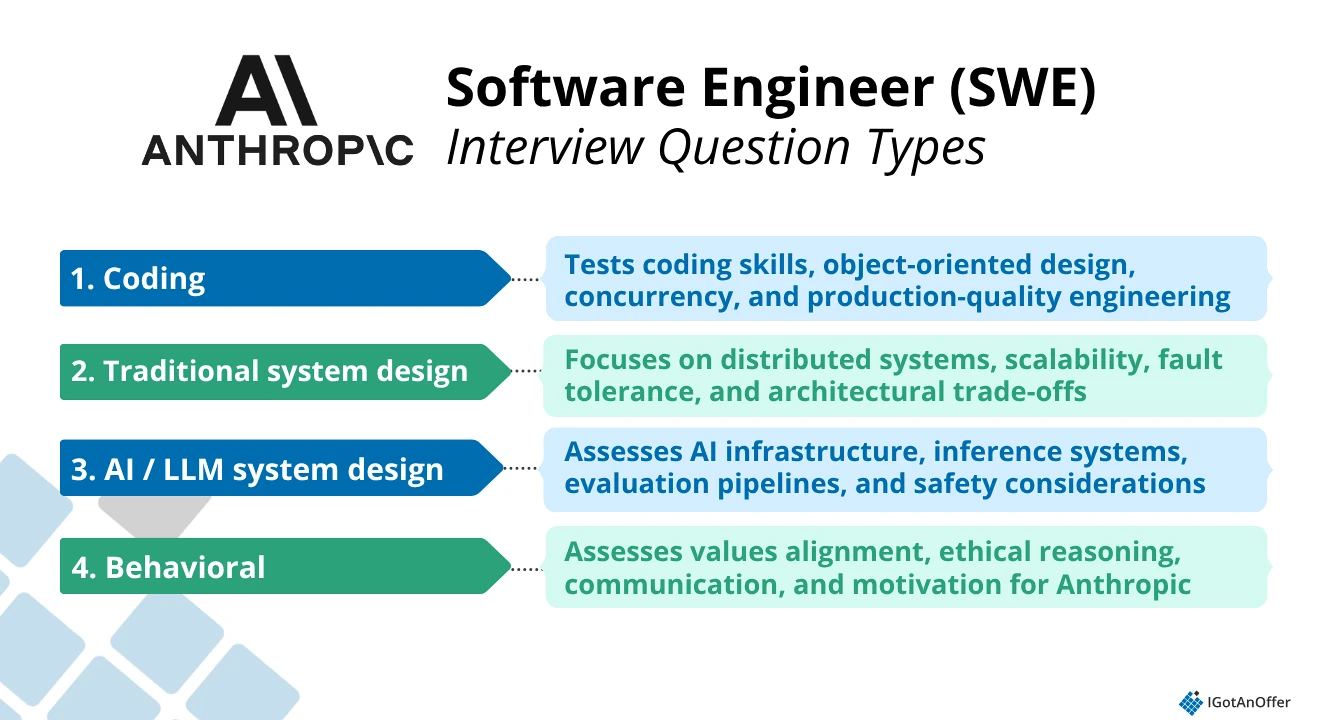
Anthropic software engineer interviews cover four main areas:
The questions below come from our analysis of 45 candidate reports on Glassdoor, supplemented with questions from our Anthropic system design interview guide and Anthropic culture interview guide.
Where Glassdoor data was thin, we supplemented with questions from other IGotAnOffer SWE guides. All borrowed questions are labeled with the source company in parentheses.
3.1 Coding questions↑
Anthropic's coding interview questions are practical, work-oriented problems that simulate real engineering tasks. They appear in the CodeSignal online assessment and in at least two onsite coding rounds, each running approximately 55 minutes.
The questions consistently test three themes: object-oriented design, concurrency and multithreading, and incremental complexity. Many problems start with a simple spec and expand through multiple stages, requiring you to refactor and extend your solution as requirements grow.
You should also expect follow-up questions throughout each round, as interviewers probe your reasoning, design decisions, and ability to adapt as the problem evolves.
A working solution is not enough to pass these rounds. Interviewers are specifically looking for production-quality thinking, including clean code structure, meaningful variable names, proactive edge-case handling, and at least some test coverage.
Here are examples reported by Anthropic software engineer candidates on Glassdoor:
Example Anthropic software engineer interview questions: Coding
- Build a web crawler / concurrent web crawler
- Given a domain name and main URL, parse all URLs on the site and return a count of those matching the given domain
- Build a banking application: implement deposits, withdrawals, transfers, and ranking accounts by transaction volume
- Implement a message ingestion component that handles streaming data with unpredictable latency spikes
- Implement a concurrent system component and make it fault-tolerant under specific failure modes
- Write a concurrent and multithreaded solution with a focus on async programming and file systems
- Implement an in-memory database in Python
- Build an OOP system where each stage builds on the last, requiring careful refactoring and design decisions
For more on how to approach coding interviews, see our coding interview prep guide for more practice questions and how to best approach the interview.
3.2 Traditional system design questions↑
System design interviews at Anthropic focus on large-scale distributed systems, fault tolerance, and architectural reasoning. They appear in at least one onsite round and can run as a hybrid with coding elements.
Interviewers are not looking for a textbook answer. They care more about how you reason through architectural choices than whether you arrive at a specific design.
One candidate noted that "unlike other big tech loops, Anthropic expects you to reason through high-scale distributed systems with a focus on safety and reliability." Follow-up questions probe memory safety, race conditions, and failure modes in depth.
Here are examples reported by Anthropic software engineer candidates, supplemented with questions from our OpenAI and Google SWE guides:
Example Anthropic software engineer interview questions: System design
- Design a file cache system
- Design a file store system (set, get, filter, backup, restore, and related operations)
- Design a web crawler (part coding, part system design)
- Design a rate limiter (OpenAI)
- Design a distributed key-value store (Google)
- Design a URL shortener service (Google)
For a detailed breakdown of how to approach system design rounds at Anthropic, including sample answer outlines and level-by-level expectations, see our Anthropic system design interview guide.
If you're specifically targeting a staff-level SWE role, we also recommend checking out our staff system design interview guide for a deeper dive into what interviewers expect at this level.
3.3 AI and LLM system design questions↑
Alongside standard system design, Anthropic tests candidates on AI-specific infrastructure. According to Tarek (ex-FAANG interviewer) who’s coached candidates for Anthropic interviews, "the focus here is less on scaling standard web applications and more on designing systems around AI and ML workloads."
Expect prompts tied to inference infrastructure, evaluation pipelines, and safety monitoring rather than generic web service design. Tarek also notes that the format is more collaborative than presentation-heavy.
"Interviewers will actively discuss trade-offs and constraints with you throughout the session. They care less about drawing the 'perfect' diagram and more about how you reason through system interactions, data flow, safety, and deployment decisions," he says.
LLM experience is not required to answer these questions well. Reports describe prompts as "practical systems design questions related to LLMs" where deep LLM knowledge is not a prerequisite.
Here are examples reported by Anthropic software engineer candidates:
Example Anthropic software engineer interview questions: AI and LLM system design
- Design Anthropic's Claude chat service
- Design a practical LLM-related system (specific prompt varies by team and candidate background)
- Design a high-concurrency inference API and parallel processing pipeline
- Design a model evaluation and monitoring system
- Design a prompt caching and retrieval system
For more AI and LLM system design questions with sample answer outlines, see our Anthropic system design interview guide and our GenAI system design guide.
3.4 Behavioral questions↑
Behavioral and culture fit interviews appear in at least two rounds in the Anthropic loop: a dedicated culture fit round and the hiring manager screen. These rounds are not a formality. Multiple candidates have described the culture round as one of the hardest parts of the process.
While you'll still get the typical "Why Anthropic?" and "Tell me about a time..." style questions, this is not a behavioral interview in the traditional FAANG sense. Some reports say that heavily scripted STAR answers can do more harm than good.
Be prepared to discuss your personal ethical framework and real-life examples of when your values were tested. Interviewers want to know how you think about AI safety, handle moral dilemmas, and demonstrate humility.
You must also show a healthy degree of skepticism. If asked "What do you think about Anthropic's mission?", don't simply echo the corporate line. Anthropic expects you to think critically and feel comfortable challenging their methodologies.
Here are examples reported by Anthropic software engineer candidates:
Example Anthropic software engineer interview questions: Behavioral
- Why do you want to join Anthropic?
- Talk about a past project you have worked on
- Describe the experience you are most proud of
- Tell me about a time you had to make a decision with incomplete or ambiguous information
- Tell me about a time you had to balance moving fast with maintaining quality or safety
- What does responsible AI development mean to you?
For more behavioral question examples and preparation tips specific to Anthropic's culture round, see our Anthropic culture interview guide and our 11 most-asked SWE behavioral interview questions.
4. Anthropic software engineer interviewing tips↑
Here are the most important things to keep in mind as you prepare for your Anthropic software engineer interview.
4.1 Write code as if it is going into production
Anthropic's coding bar is higher than at most companies. A working solution alone is not enough. Interviewers want to see clean code structure, sensible variable naming, explicit edge case handling, and at least some test coverage.
Think of each round as a code review rather than a simple correctness check. Code that passes all test cases but is hard to read, maintain, or extend will be unlikely to score well.
4.2 Master Python before your CodeSignal assessment
Python is the expected language for the CodeSignal assessment. Multiple candidates noted that switching languages mid-assessment or spending time looking up syntax cost them significantly.
Prepare specifically in Python, and be fluent with standard libraries relevant to OOP, concurrency (threading, asyncio), and file I/O. You should also know how to structure multi-class solutions quickly, as CodeSignal problems are multi-stage, and each stage extends the code you have already written.
4.3 Think out loud, especially on follow-up questions
Anthropic interviewers ask a lot of follow-up questions to evaluate how well your solution holds up as requirements evolve. Once you have a working solution, interviewers push on edge cases, failure modes, memory safety, and race conditions.
The most common mistake candidates make is to go silent and code privately. Be sure to narrate your reasoning as you go and treat the interview as a collaborative engineering session, not a solo exam.
4.4 Prepare for system design at scale with a safety lens
Standard system design preparation is a starting point, not the finish line. Anthropic expects you to reason about reliability, fault tolerance, and safety at the architecture level, not just performance and throughput.
When designing a system, address what happens when components fail, how you would monitor for unexpected behavior, and what tradeoffs you are accepting. These dimensions come up in follow-up questions even when they are not explicitly asked upfront.
4.5 Engage with AI safety critically, not diplomatically
The culture round probes your genuine views on AI safety and Anthropic's mission. Interviewers are not looking for candidates who agree with everything Anthropic says. One of Anthropic's stated principles is to challenge the status quo and avoid the "dream company" trap.
If you are asked what you think about Anthropic's approach to safety, give an honest, reasoned answer that acknowledges real tradeoffs. A candidate who can identify genuine risks in the technology is more interesting to Anthropic than one who mirrors the corporate talking points back.
See our guide to answering "Why Anthropic?" for how to frame this authentically.
4.6 Prepare specific stories for the hiring manager round
The hiring manager screen is more technical than a typical behavioral round. Be ready to walk through specific past systems in detail, including the architectural decisions you made, the tradeoffs you accepted, and what you would change today.
Vague project summaries do not land well. Prepare two or three strong examples in depth rather than a broad catalog of everything you have built. For guidance on structuring these stories, see our sample answer to the "project you're most proud of" question.
4.7 Communicate efficiently using a clear structure
Clear and efficient communication matters as much as technical ability across every round. Using a framework can help keep your responses focused and give interviewers the signal they need without requiring them to extract it through follow-up questions.
You can use IGotAnOffer's SPSIL method (Situation, Problem, Solution, Impact, Learning) to structure your answers to behavioral questions.
It’s similar to STAR but fixes two common pitfalls candidates often face: (1) candidates often struggle to clearly distinguish between “task” and “action,” and (2) it includes a “learning” step, which STAR often overlooks, even though it’s one of the most important parts of your answer.
For technical rounds, state your assumptions before diving into code and summarize your approach before you start typing. For a consistent answer method, see our coding interview framework and system design framework.
5. How to prepare for Anthropic software engineer interviews↑
Here are the steps we recommend to prepare for your Anthropic software engineer interview.
5.1 Deep dive into Anthropic’s culture and mission
Before investing dozens of hours in technical prep, take the time to understand what Anthropic is actually building, why it matters, and whether it genuinely aligns with what you want to work on.
This matters at Anthropic because the mission is not just a marketing statement. It shapes how the company hires, how teams operate, and how the culture round is evaluated. Interviewers will probe your alignment with it directly, and vague answers about being excited by AI will not be convincing.
Here are some resources to get you started:
- Anthropic's core views on AI safety
- Anthropic's careers page and values
- Anthropic's research
- Anthropic news
- Anthropic interview process guide
- How to get a job at Anthropic
- 30+ common Anthropic interview questions and answers
If you know engineers who currently or formerly worked at Anthropic, speaking with them directly is worth the effort. Glassdoor and Blind also have candid candidate reports that give a realistic picture of what each round is actually like.
5.2 Learn by yourself
As you have probably figured out from the example questions above, Anthropic's interviews require preparation across three distinct areas: coding, system design, and behavioral. Start with the free prep resources on the IGotAnOffer blog.
Coding interviews
Practice in a plain text editor or CoderPad without autocomplete, since that is the environment you will be working in. Focus on OOP design, concurrency, and building multi-stage systems from scratch:
- Coding interview examples: 47 examples with answers in Python and other languages
- Coding interview tips: practical tips for performing well under interview conditions
- AI-assisted coding interview guide: relevant given Anthropic's use of AI to evaluate CodeSignal submissions
- LeetCode: practice concurrency and OOP problems at medium and hard difficulty
- NeetCode: structured roadmap for systems and OOP coding patterns
System design interviews
Anthropic's questions often require familiarity with ML infrastructure at scale. These guides will help you go beyond generic prep:
- Anthropic system design interview guide: question breakdowns and tips specific to what Anthropic asks
- Machine learning system design interview: how to approach ML-specific design questions, which come up regularly at Anthropic
- Generative AI system design interview: directly relevant for Anthropic's AI and LLM system design round
- Staff system design interview: types of questions and performance expectations at the staff level
Behavioral interviews
Prepare specific stories for the questions in Section 3.4. Treat "Why Anthropic?" as one of the most important to get right, since a vague or generic answer is one of the clearest red flags in the culture round:
- How to answer "Why Anthropic?"
- Anthropic culture interview guide: detailed breakdown of the culture round with example questions
- 11 most-asked SWE behavioral interview questions: the questions that come up most often in SWE interviews, with sample answers
If you're looking into other AI/ML-forward tech companies, we also recommend reading the following company guides:
- OpenAI interview process
- How to get a job at OpenAI
- OpenAI system design interviews
- OpenAI coding interviews
- OpenAI behavioral interviews
- OpenAI product manager interview
- OpenAI software engineer interview
- OpenAI data scientist interview
- 30+ common OpenAI interview questions + answers (by role)
- How to answer the “Why OpenAI?” interview and application question
- NVIDIA software engineer interview
- NVIDIA PM interview process
5.3 Practice with peers
Once you have a solid foundation in the material, the next step is practicing under real conditions. By yourself, you cannot simulate thinking on your feet or the pressure of performing in front of a stranger. There are no unexpected follow-up questions and no feedback.
Practicing with friends or peers is an option worth trying. It is free, but be aware of the following problems:
- It is hard to know if the feedback you are getting is accurate
- Your practice partner is unlikely to have insider knowledge of Anthropic interviews
- On peer platforms, people often waste your time by not showing up
5.4 Practice with experienced software engineer interviewers
We have coached more than 20,000 people for interviews at top tech companies since 2018. In our experience, practicing real interviews with experts who can give you company-specific feedback makes a significant difference.
Find an Anthropic SWE interview coach so you can:
- Test yourself under real interview conditions
- Get accurate feedback from a real expert
- Build your confidence
- Get company-specific insights
- Learn how to tell the right stories, better
- Save time by focusing your preparation
Landing a job at Anthropic typically results in a significant increase in total compensation. Three or four coaching sessions worth around $500 can make a real difference in your ability to land the role.
Click here to book coding mock interviews with experienced SWE interviewers.

 System design