

 Back to other articles
 Last updated: September 27, 2026
 Interviews
 Deeply researched
Microsoft is one of the most sought-after employers in tech, and its interview process reflects that. The bar is high, the loop is thorough, and behavioral questions carry more weight than at other FAANG+ companies. If you only prepare for coding, you will likely struggle in the loop.
The full process typically takes three to eight weeks and covers six steps, which we’ll get into in the guide.
We have researched dozens of real candidate reports on Glassdoor and Blind, combined with insights from ex-Microsoft TPM Philip, to understand what the company actually looks for. In this article, we walk you through each stage of the process and how to prepare for it.
Here is an overview of Microsoft's full interview process:
- Step 1: Resume screen
- Step 2: Recruiter call
- Step 3: Online assessment
- Step 4: First-round interviews
- Step 5: Interview loop
- Step 6: Offer and negotiation
Click here to practice with ex-Microsoft interviewers
Before we get into each step, let's get to know Microsoft.
1. About Microsoft ↑
Microsoft was founded in 1975 by Bill Gates and Paul Allen, initially building BASIC interpreters for early microcomputers. Over the following five decades, the company grew into one of the world's most valuable technology businesses, responsible for:
- Windows
- Microsoft Office
- Azure
- Xbox
- Developer ecosystem spanning GitHub, VS Code, and LinkedIn (acquired in 2016).
Today, Microsoft is valued at approximately $3.1 trillion as a public company. As of its FY2025 10-K filing, Microsoft employs approximately 228,000 people on a full-time basis: 125,000 in the US and 103,000 internationally. The company is headquartered in Redmond, Washington, with major offices worldwide.
Its most recent strategic shift has been toward AI. Microsoft's partnership with OpenAI and the rollout of Copilot across its product suite (Teams, Word, Excel, Azure, and more) have made AI central to the company's current direction, and this is reflected in the kinds of roles and teams it is actively hiring for.
2. Working at Microsoft
Microsoft's culture has changed significantly over the past decade. When Satya Nadella became CEO in 2014, he pushed the company to move from what employees described as a "know-it-all" culture to a "learn-it-all" one. This switch reshaped how the company evaluates performance, makes hiring decisions, and runs its interview process.
Microsoft interviewers explicitly assess candidates for what the company calls a growth mindset, which is:
- The willingness to embrace challenges
- Learn from failure
- And seek out feedback rather than avoid it
Philip (ex-Microsoft TPM) saw this firsthand from the hiring manager side. He describes a culture where being open to feedback and changing your approach based on new information is seen as a strength, not a weakness.
Employees are encouraged to speak up and contribute ideas regardless of seniority. That mindset carries into the interview process.
Microsoft operates with a relatively decentralized structure compared to companies like Meta. Different product groups (Azure, Microsoft 365, Xbox, GitHub, AI) have meaningful autonomy over how they hire, what teams look like, and how priorities are set. This means the interview experience can vary more by team than at companies with a more standardized process.
3. Microsoft's four core cultural attributes
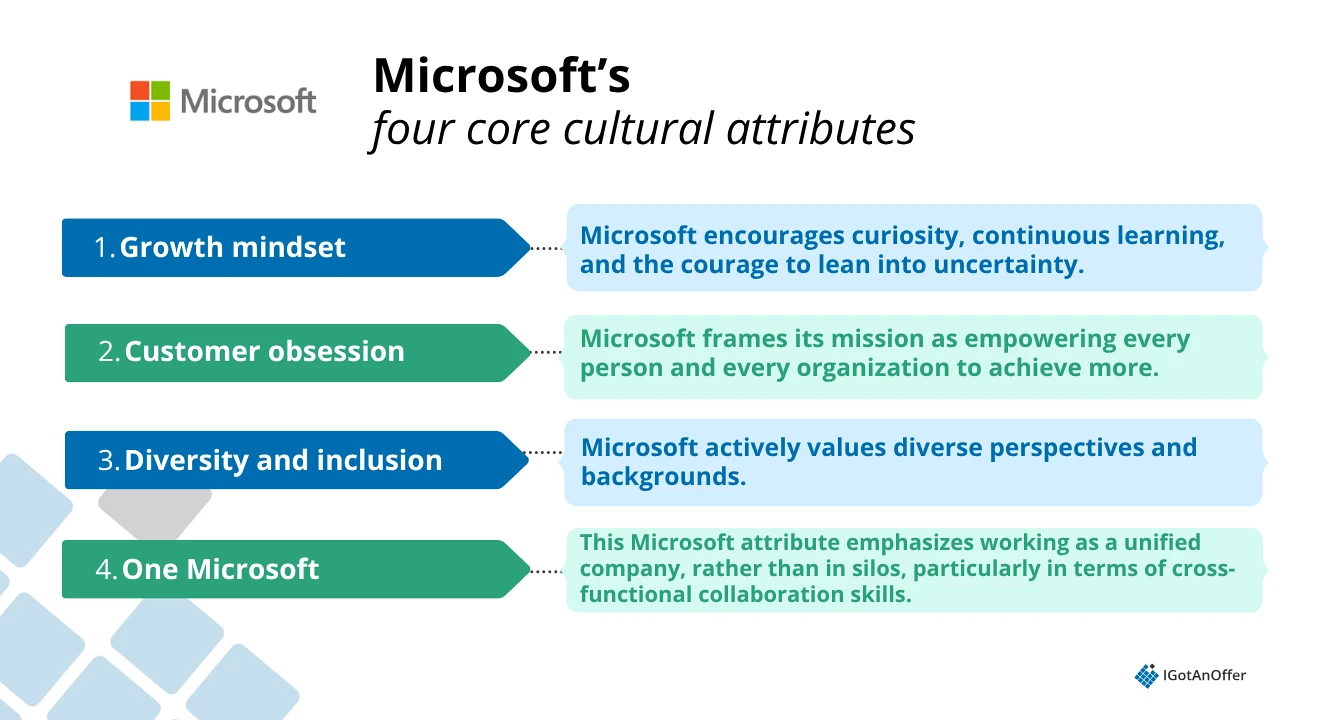
Microsoft's careers page describes four attributes that define its culture. These attributes shape what interviewers probe for and how your performance is evaluated. Understanding them before your interviews matters.
- Growth mindset. Microsoft believes potential is something to be developed, not predetermined. The company encourages curiosity, continuous learning, and the courage to lean into uncertainty. In interviews, this means you should expect questions like "Tell me about a time you were wrong" or "Describe a situation where you changed your approach based on feedback." Interviewers want to see openness to being challenged, not just a polished success story.
- Customer obsession. Microsoft frames its mission as empowering every person and every organization to achieve more. This shows up in interviews as questions about how your past work created value for users, how you prioritize user needs against technical constraints, and how you think about the downstream impact of product decisions.
- Diversity and inclusion. Microsoft actively values diverse perspectives and backgrounds. In interviews, this can surface through collaboration-oriented behavioral questions: how you have worked with people who think differently from you, how you have created space for underrepresented voices, or how you handle disagreement within a team.
- One Microsoft. This attribute is about working as a unified company rather than in silos. Interviewers probe for cross-functional collaboration skills, your ability to influence without authority, and your ability to balance team priorities against broader company goals. If you have experience shipping work that required alignment across multiple teams, those stories will resonate here.
Coaches who contributed to this guide


4. Microsoft interview process and timeline ↑
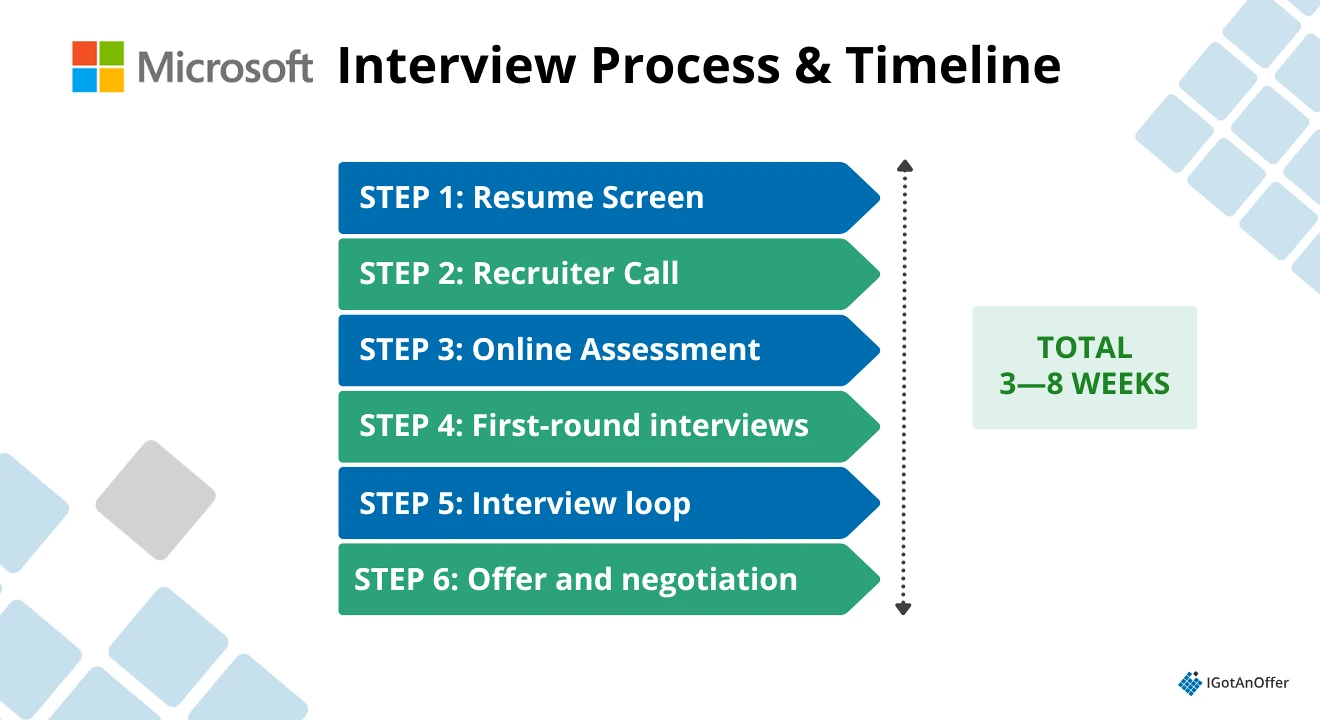
The steps can vary by role, but most candidates go through these main stages:
- Resume screen
- Recruiter call
- Online assessment
- First-round interviews
- Interview loop
- Offer and negotiation
Your recruiter may clarify your specific process during the initial call.
Step 1: Resume screen ↑
The first step of Microsoft's interview process is the resume screen. After you submit your application through the Microsoft Careers portal or are contacted directly via email or LinkedIn, recruiters will review your resume against the requirements of the open position.
This is an extremely competitive step. Microsoft uses applicant tracking systems (ATS) to filter applications at volume, so tailoring your resume to the specific job description matters more here than at a smaller company. A few things that tend to help:
Tips on crafting a resume
- Match the language of the job description. If the role mentions Azure, specific Microsoft product lines, or particular frameworks, your resume should reflect relevant experience with those products, where applicable.
- Quantify your impact. Microsoft recruiters look for specific, measurable achievements rather than general descriptions of responsibilities. Numbers and concrete outcomes stand out.
- Get a referral if you can. According to Glassdoor data, around 13% of candidates who received Microsoft interviews came through employee referrals, and referrals meaningfully increase the chance of your resume being reviewed.
- Keep it concise. Recruiters reviewing high volumes of applications spend limited time per resume. Clear, focused formatting matters.
For more detailed guidance on crafting a competitive resume, take a look at one of our resume guides below:
- Software engineer resume guide
- Engineering manager resume guide
- Product manager resume guide
- Tech resume guide
- Machine learning engineer resume guide
- Data science resume guide
- Technical program manager resume guide
If you want more personalized feedback from people who understand what Microsoft looks for, you can also get input from our resume coaches.
Step 2: Recruiter call ↑
If your resume passes the initial screen, a Microsoft recruiter will reach out to schedule a call. This typically lasts 30 to 45 minutes.
The call is primarily a background and fit conversation. You can expect questions like:
- Tell me about yourself.
- Why Microsoft?
- Walk me through your resume.
The recruiter is assessing whether your experience broadly matches the position and whether you communicate clearly.
For technical roles, some recruiters ask light conceptual questions around data structures and algorithms during this call, particularly for software engineers. This varies by team, so treat it as a possibility worth preparing for.
Your recruiter will also walk you through how the overall interview process will work. If you have any specific questions about the timeline, the team, or clarification about the job description, now is the time to ask.
One thing you should clarify early is the level you’re being considered for. According to Philip, interview expectations can vary significantly by level and team, even for the same job title. In some cases, strong candidates fail simply because they were evaluated at the wrong level.
If all goes well, the recruiter will schedule your next steps: either an online assessment, a first-round interview, or both.
Step 3: Online assessment ↑
Not every role includes an online assessment, but it is a standard step in many engineering positions, particularly at entry- to mid-level. Microsoft typically delivers this through Codility, a timed coding platform.
The assessment usually runs for around 90 minutes and includes two problems, with the second meaningfully harder than the first. The difficulty of these assessments ranges from LeetCode medium to hard. You code directly within the Codility platform, without an IDE's autocomplete or syntax highlighting, so practicing in a plain text environment beforehand is worth the effort.
For non-engineering roles, this stage may not apply or may involve a different type of assessment. Your recruiter will clarify what to expect.
Step 4: First-round interviews ↑
After the recruiter call (and online assessment, where applicable), candidates move into one or two first-round interviews. These are typically conducted over video call, with each round lasting 45 to 60 minutes each.
You will usually speak with a peer or a hiring manager. You'll get a mix of technical and behavioral questions, and the balance depends on the role.
Microsoft's first-round interviews tend to devote more time to behavioral questions than equivalent rounds at Meta or Google. This holds across engineering roles, not just management positions, so come prepared even if you are interviewing for an IC track.
Some candidates pass one first-round interview before moving to the loop. Others have two: one focused on leadership and management experience, and the other on technical depth. Your recruiter will let you know which format to expect so you can prepare accordingly.
If your first-round interviews go well, you will be invited to the full interview loop.
Step 5: Interview loop ↑
The loop is the most important stage of the process. You will have four to six back-to-back interviews, each lasting 45 to 60 minutes, with a mix of peers, the hiring manager, and occasionally a senior leader from the team.
The types of questions vary considerably by role:
- Software development engineers can expect coding questions covering data structures and algorithms, system design rounds, and behavioral interviews. The coding questions are typically at medium to hard difficulty. You might also get an AI coding round. For a detailed breakdown, see our Microsoft SDE interview guide.
- Engineering managers face a heavier behavioral component alongside system design and, in some cases, light coding. The emphasis is on people management, cross-functional collaboration, and technical leadership rather than raw coding ability. See our Microsoft engineering manager interview guide.
- Product managers are assessed primarily on problem-solving, product thinking, and behavioral questions. Questions like "What is your favorite Microsoft product and how would you improve it?" are common, alongside deeper product sense, estimation, and strategy questions. There is typically no coding component. See our Microsoft product manager interview guide.
For senior roles, Philip says a common mistake candidates make is spending too much time preparing for coding and system design while underpreparing for behavioral interviews. Behavioral rounds carry significant weight at senior levels because companies are also assessing leadership, communication, and decision-making skills.
In addition to that, Philip flagged three competencies he looks for in every candidate during the interview loop, regardless of role:
- Structured problem framing. Strong candidates take a moment to clarify and frame the problem before jumping into an answer. They often restate the question, confirm assumptions, and explain how they plan to approach it.
- Clear communication. Strong candidates adjust how they explain things depending on who they’re speaking to. For example, an engineer should explain a technical decision differently to another engineer versus a PM or senior leader who may not have the same technical background.
- Demonstrated ownership. Be prepared to share specific examples where you kept working on a problem even when it wasn't your job anymore. Philip says to show concrete examples of your work instead of simply saying you are ‘proactive’ or ‘hardworking’.
We have created in-depth guides to the interviews for top Microsoft roles. In each guide, you'll find a breakdown of the interview loop specific to the role you're applying for, plus example questions gathered from real candidate reports on Glassdoor.
- Microsoft software engineer interview guide
- Microsoft engineering manager interview guide
- Microsoft product manager interview guide
- Microsoft data scientist interview guide
- Microsoft technical program manager interview guide
We also have skill-specific guides that cover the question types you'll face across these roles:
Engineering
- Coding interview prep
- AI-assisted coding interview
- Data structure interview questions
- System design interview questions
- Staff system design interview questions
- ML system design interview questions
- GenAI system design interview questions
- Behavioral interview questions
- People management primer
- Engineering management leadership interview guide
Product management
- Product sense interview guide
- Product strategy interview guide
- Estimation interview questions
- Product metrics interview guide
5.1 The "as appropriate" interview
For many loops, a final interview is conducted by a senior executive, typically the hiring manager's manager or a VP-level leader. This is referred to internally as the "as appropriate" (AA or ASAPP) interview. It only happens if earlier rounds went well.
The AA interview serves two purposes:
- It fills any gaps in your assessment. If the earlier interviewers established your technical credibility but were less certain about cultural fit, the AA round will lean heavily into behavioral questions to close that gap.
- If things look strong across the board, the AA interviewer will use part of the session to sell you on the team and the role. Microsoft wants to make sure strong candidates will accept if they receive an offer.
5.2 What happens after the loop
After completing the loop, each interviewer files their feedback into an internal system. This includes the questions they asked, a summary of your answers, their assessment of specific competencies, and a hiring recommendation: "Strong hire," "Hire," "No hire," or "Strong no hire."
The feedback forms are visible across the interviewer panel, and each interviewer can flag topics for subsequent rounds to probe. So a weak answer in round two can attract a follow-up question in round three.
You typically need hire recommendations across the board to receive an offer, though the AA interviewer or hiring manager can sometimes override a single borderline "no hire." Your recruiter will usually give you a timeline for the decision.
If you have not heard back within a week of completing your loop, it is reasonable to follow up.
Step 6: Offer and negotiation ↑
Once the hiring decision is made, your recruiter will present an offer package. Microsoft offers typically include a base salary, an annual bonus, and equity in the form of restricted stock units (RSUs) that vest over a four-year schedule.
To give you a sense of the numbers: according to Levels.fyi, the median total compensation across all Microsoft roles is approximately $217,000. At specific levels, software engineers at the SDE level see a median total compensation of around $160,000, while senior engineers typically sit between $300,000 and $400,000 and above. Engineering managers have a median total compensation of approximately $404,000.
While your offer may look top band, you don't have to accept the first one. Microsoft recruiters anticipate that candidates will negotiate, and there is typically room to move. A few practical tips:
Salary negotiation tips
- Be polite: Remember that the person you’re negotiating with is just doing their job, and that the two of you are not enemies. You’ll get much further in your negotiations if you approach the conversation with grace.
- Don’t give a number right away: Whenever possible, it’s better to wait until you receive an offer to start negotiating. This reduces the risk of giving a number that is lower than what the company otherwise would have paid, or giving a number that is so high that they'll be reluctant to interview you.
- Do your research: Have a number in mind before the conversation begins, and back it up with data. Research your position and level on Levels.fyi, ask around on professional social networking sites like Blind, factor in the cost of living where you are, and, ideally, get some input from a current Microsoft employee.
- Start high: To start the conversation, name a compensation number that is higher than your goal, and the Microsoft negotiator will likely end up negotiating it down to a number that is closer to your original goal.
- Negotiate everything: Your offer will include more than a base salary and stock options. You also have bonuses, vacation days, location, work from home, and other aspects to consider. If the salary won’t budge, there may be some wiggle room around the other perks.
Once you are ready to practice, you can get salary negotiation coaching from coaches who know how Microsoft structures its offers.
Once you have completed this step and accepted your offer, congratulations. It is time to start your career at Microsoft.
Interviewing at other FAANG+, emerging tech, or AI labs? Check out our FAANG interview process guide for company-specific insights into the companies and different roles you’re targeting.
3. Are you prepared for your Microsoft interviews? ↑
We've coached more than 20,000 people for interviews since 2018. In our experience, practicing real interviews with experts who can give you company-specific feedback makes a huge difference.
Find a Microsoft interview coach so you can:
- Test yourself under real interview conditions
- Get accurate feedback from someone who has been on the other side of the table at Microsoft
- Build confidence ahead of the actual loop
- Get company-specific insights on what interviewers look for at your level
- Learn how to tell the right stories, better
- Save time by focusing your preparation
Landing a role at Microsoft often results in a $50,000 per year or more increase in total compensation. In our experience, three or four coaching sessions worth around $500 make a significant difference in your ability to land the job. That is an ROI of 100x.
Click here to book mock interviews with experienced Microsoft interviewers.
4. Frequently asked questions about the Microsoft interview process ↑
How many rounds of interviews does Microsoft have?
Most candidates go through four to six interviews in the loop, plus one to two first-round interviews before it. Including the recruiter call, that is typically six to nine total touchpoints. The exact number depends on the role and level.
How difficult are Microsoft interviews?
Microsoft interviews are challenging but structured. Microsoft emphasizes behavioral interviews, so technical preparation alone is usually not enough. Candidates who prepare for growth mindset-style questions tend to perform better.
Can I reapply if Microsoft rejects me?
Yes. Microsoft typically enforces a waiting period before reapplication, commonly around six months, though this can vary by role and region. Ask your recruiter for specifics if you want to keep the door open.
Does Microsoft provide interview preparation resources?
Yes. After your recruiter call, Microsoft typically shares preparation materials relevant to the role you are interviewing for. Your recruiter is also a good person to ask directly if you want more clarity on what a specific round will cover.

 Software engineer, Engineering manager

 Coding