


 Back to other articles


 Last updated: June 09, 2026
 Interviews
 Deeply researched
No matter what role you’re applying for, Google interviews are tough. Not only will you need to solve tricky technical problems and navigate domain-specific questions, but you also need to align with Google’s unique workplace culture while ensuring you’re a "culture add."
That’s where we come in. This guide will equip you with everything you need to succeed in your Google interview preparation. Step by step, we’ll show you exactly how to prepare, share expert insights, and point you to the top free resources available.
We’ve coached hundreds of candidates for engineering, product management, and other technical roles at Google. Now, we’ve distilled everything we've learned into these five key steps to help you do the same and land an offer:
- Step 1: Research the role you’re applying for
- Step 2: Prepare for all Google question types
- Step 3: Deep-dive (links to top Google resources)
- Step 4: Do free mock interviews
- Step 5: Get feedback from experts
Click here to practice 1-on-1 with Google ex-interviewers
Let’s get started.
Step 1: Research the role you’re applying for
Whether you're interviewing for a software engineer, product manager, machine learning engineer, or another technical role at Google, your interviewers will expect you to thoroughly research the company and especially the role you're applying for.
One thing you should know is that Google's workplace culture is heavily centered around Googleyness. Instead of "culture fit," the company looks for "culture add," i.e., “Will this candidate bring attitudes and character traits that will be a positive addition to Google’s working culture?”
To demonstrate this, you should familiarize yourself with Google's mission statement, core values, and product ecosystem. Take the time to understand the key responsibilities of your target role and be ready to explain how your experience can help Google achieve its goals.
"You're going to literally want to cite the company's mission back at them. If you're interviewing remotely, write it on a post-it note and stick it on your laptop!" Mark, ex-Google Senior PM.
You also need to know that the interview process can vary significantly depending on the role you're applying for. However, most Google interviews follow a similar 7-step process that you can learn more about in our Google interview process guide.
If you want to dive deeper into role-specific interview requirements, we've put together the free guides below. In each, we go into the interview process in detail, outline the types of questions you can expect, and give tips on how to best prepare.
- Google Product Manager interview
- Google Associate Product Manager interview
- Google Product Marketing Manager interview
- Google Program Manager interview
- Google Technical Program Manager interview
- Google Software Engineer interview
- Google Engineering Manager interview
- Google Data Scientist interview
- Google Data Engineer interview
- Google Machine Learning Engineer interview
- Google Site Reliability Engineer interview
- Google L4 Engineer interview
- Google Strategy & Operations interview
- Google (Technical) Account Manager interview
- Google DeepMind Research Engineer interview
- Google Product Designer interview
Beyond interview prep, we’ve also covered other topics that may be helpful as you navigate Google’s hiring process:
- How to navigate Google internal transfers
- Google interview rejection (why you failed and what to do next)
- How to move from Amazon to Google
- Google interview experiences (from real candidates)
Not applying to any of the roles listed above? No problem. This guide is still 100% relevant if you're interviewing for another technical role at Google.
Coaches who contributed to this guide










Step 2: Prepare for all Google question types ↑
Google interviews are notoriously tough because they cover a wide range of question types.
The exact questions you face will depend on the specific role you are applying for. To keep this guide focused, we will narrow it down to the most common questions used for engineering roles, which represent the most demanding technical tracks at Google.
Here’s an overview of the most common question types:
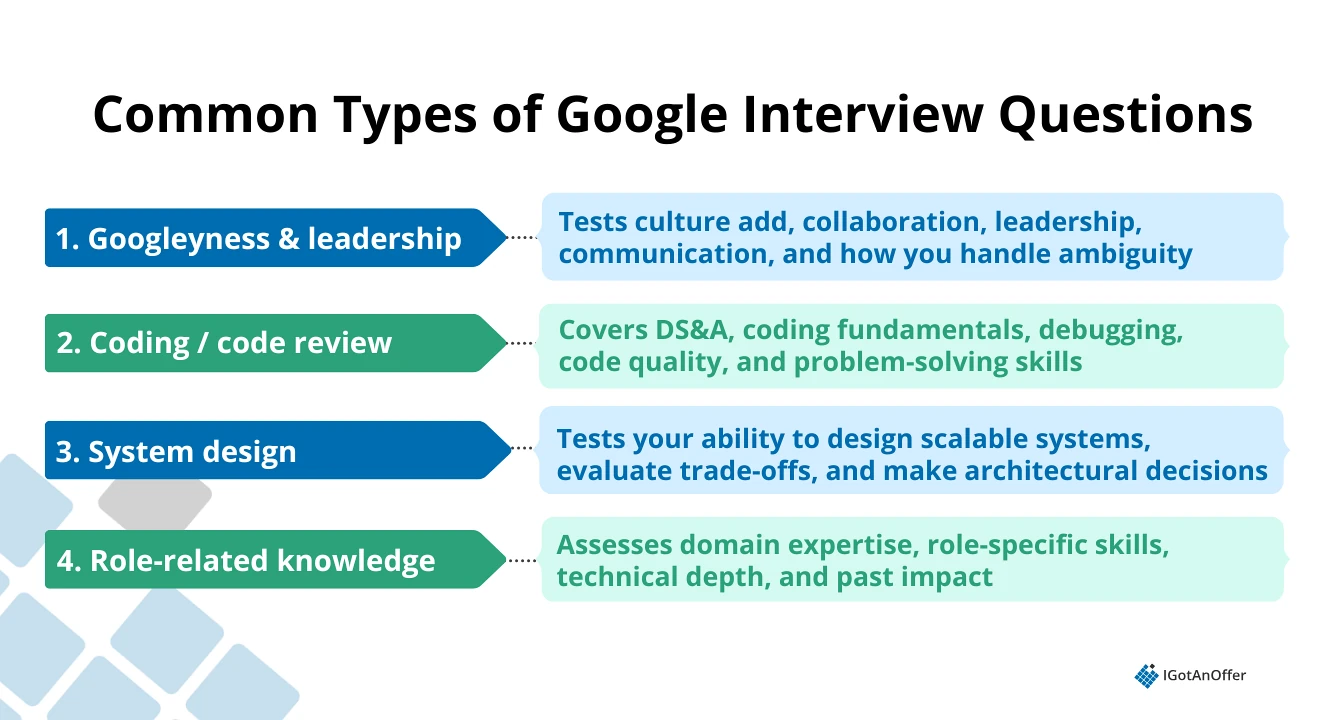
- Googleyness and leadership questions
- Coding questions / code review (for engineering managers)
- System design questions
- Role-related knowledge (RRK) questions
Let’s dive into each category.
2.1 Googleyness and leadership questions ↑
The first type of interview you can expect as a Google SWE candidate is a Googleyness and leadership interview. During this interview, you may get a mix of behavioral and hypothetical questions, designed to evaluate your alignment with Google’s values and general motivational fit for the role.
Know that interviewers give special focus on Googleyness, so it may help to familiarize yourself with this unique cultural attribute.
You’ll find that the definition of Googleyness is quite nebulous, at least compared to other companies like Amazon with its Leadership Principles. That’s by design.
According to Albert (ex-Google SWE), “Google is different in that all interviewers can leave good or bad feedback related to Googleyness, and it’s something constantly being evaluated.” This is why some have referred to Googleyness as “culture add” rather than “culture fit”.
In addition, if you're interviewing for management or senior positions (e.g., engineering manager), you'll also usually have leadership interviews where you'll be assessed on your people and project management skills.
We've listed standard behavioral interview questions that Google tends to ask for all engineering roles below:
Example Googleyness & Leadership questions asked at Google
For all software engineers
- Tell me about yourself
- Why Google?
- Tell me about a recent / interesting project you worked on
- Tell me about a time you had to resolve a conflict in a team
- What is your favorite Google product?
For management and leadership positions
People management interviews
- Tell me about a time you had to handle a late project
- Tell me about a time you had to handle trade-offs and ambiguity
- Tell me about a time you were part of an organization in transition and how you helped them move forward
Project management interviews
- Tell me about a time you demonstrated leadership even though you weren't the formal manager
- Tell me about a time you were the end-to-end owner of a project
- Tell me about a time you used data to make a critical decision
Here are some great resources for preparing for Googleyness & leadership questions:
- Read:
- Googleyness and leadership questions (by IGotAnOffer, includes tips on how to demonstrate and sample answers)
- Google behavioral interview questions (by IGotAnOffer, includes tips, methods, and Google-specific examples)
- Google hypothetical interview questions (by IGotAnOffer, includes tips, methods, and Google-specific questions with sample answers)
- Program/project management for tech interviews (by IGotAnOffer, includes competencies, questions, and resources)
- People management primer for tech interviews (by IGotAnOffer, includes competencies, questions, and resources)
- Grokking the engineering management leadership (by IGotAnOffer, a deep dive into answering leadership/behavioral questions by an ex-Google EM)
- Leadership primer for tech interviews (with Nupur D, overview of leadership topics and how to talk about them)
- 40+ most-asked behavioral questions (by IGotAnOffer, includes method, tips, and examples with sample answers)
- Watch:
- Leadership & behavioral interview tips for engineers from an ex-Google EM (by IGotAnOffer
- How to show Googleyness in Google interviews with ex-Google hiring manager (by IGotAnOffer)
- How to answer the "Why this company?" interview question (by IGotAnOffer)
2.2 Coding questions / code review
Google is the most technical and engineering-led company of all FAANG companies. To get an offer, you’ll need to demonstrate strong problem-solving skills. You’ll also want to show that you think in a structured way and efficiently write code that's accurate and bug-free.
Google typically gives LeetCode-style coding problems. These questions tend to level up in difficulty as you progress through the interview process.
There is also an increasing number of reports of candidates encountering AI-assisted coding rounds at Google, where candidates may use Gemini while working with real codebases instead of solving traditional whiteboard-style problems (more on this below).
If you’re applying for management positions, you may get the choice between a coding interview or a coding review where you identify bugs and recommend optimizations to an existing code snippet.
Either way, you'll want to brush up on the following data structures and algorithms (DS&A) topics:
Below are a few examples of coding questions you might get at Google.
Example coding questions asked at Google interviews
- Given a binary tree, find the maximum path sum. The path may start and end at any node in the tree. (Solution)
- Given an encoded string, return its decoded string. (Solution)
- Implement a SnapshotArray that supports pre-defined interfaces (note: see link for more details). (Solution)
- Given two words (beginWord and endWord), and a dictionary's word list, find the length of shortest transformation sequence from beginWord to endWord, such that: 1) Only one letter can be changed at a time and, 2) Each transformed word must exist in the word list. (Solution)
- Given a matrix of N rows and M columns. From m[i][j], we can move to m[i+1][j], if m[i+1][j] > m[i][j], or can move to m[i][j+1] if m[i][j+1] > m[i][j]. The task is to print the longest path length if we start from (0, 0). (Solution)
2.2.1 Google AI-assisted coding interviews ↑
One crucial update to Google’s full interview loop is the use of AI assistance like Gemini during coding interviews. It's still in its pilot phase, so not everyone may get them.
In a Google AI-assisted coding interview, you can expect a realistic development session in a multi-file IDE where you work alongside an AI tool like Gemini to navigate an existing codebase, debug errors, and implement new features.
The use of AI tools is optional. If you choose to use them, you should ALWAYS treat AI as a supplementary tool rather than relying too heavily on it. John (FAANG EM) says, "A useful way to frame the use of AI in coding is to look at it as a tool best used for local optimization (i.e., syntax, structure, enumeration, summarization)."
This means the candidate remains responsible for the following as they would in traditional coding rounds:
- Problem decomposition
- Architecture choices
- Correctness
- Tradeoffs
- Communication
"That ownership is exactly what interviewers evaluate in this round," says John.
Here are some great resources for preparing for Google coding questions:
- Read:
- Google coding interviews (by IGotAnOffer, includes tips, methods, and real sample questions)
- How to crack Google code reviews (by IGotAnOffer, includes process tips and best practices)
- AI-assisted coding interviews (by IGotAnOffer, includes best practices and tips on how to maximize AI in coding interviews )
- The Ultimate Data Structure Interview Questions List (by IGotAnOffer, 73 common DS&A questions with links to quality solutions)
- How to prepare for FAANG coding interviews (by IGotAnOffer with insights from expert interviewers)
- 47 coding interview examples with answers (by IGotAnOffer)
- Google GitHub: Google’s Standard of Code Review
- Google GitHub: What do code reviewers look for?
- Watch:
- How to solve Google coding interview questions (by Google)
- Coding interview tips from Google SWEs (by Google)
2.3 System design questions ↑
Many of Google’s products, such as Google Search, Gmail, Google Docs, Android, and YouTube, all have 1bn+ monthly active users. Google engineers, therefore, need to be able to design systems that are highly scalable and performant.
In system design interviews, you'll want to show that you can both be creative and structured at the same time. The questions are typically quite open-ended, and it can feel like a conversation.
In most cases, your interviewer will adapt the question to your background. For instance, if you've worked on an API product, they'll ask you to design an API. But that won't always be the case, so you should be ready to design any type of product or system at a high level.
As a rule of thumb, the more senior the role, the more system design questions you can expect. To see what interviewers typically expect at each level, check out our Google system design interview guide.
Right, let’s look at the top three most-asked system design questions at Google.
Example system design questions asked at Google interviews
- How would you design a messaging app? (Sample answer)
- How would you design a file-sharing system? (Sample answer)
- How would you design a music streaming platform? (Sample answer)
Here are some great resources for preparing for Google system design questions:
- Read:
- Google system design interviews (by IGotAnOffer, includes tips, methods, and real examples with answers)
- System Design Interview Questions & Prep (by IGotAnOffer, includes sample questions with answers, methods, and tips from FAANG experts)
- ML system design interviews (by IGotAnOffer, includes tips, methods, and real examples with answers)
- Generative AI System Design Interview (by IGotAnOffer, includes example questions, tips, and a prep plan)
- Staff system design interviews (by IGotAnOffer, includes interview expectations, examples, tips, and a prep plan)
- High-level vs. low-level system design interviews (by IGotAnOffer)
- Watch:
- Ex-Google EM shares 10 key principles to remember for system design interviews (by IGotAnOffer)
- FAANG system design mock interviews (by IGotAnOffer, includes a collection of system design mocks with current and former FAANG experts)
2.4 Role-related knowledge (RRK) questions ↑
In addition to the three main question types above, you’ll also get asked questions tied to the specific role you’re applying for. Google RRK questions evaluate whether you have the right experience, domain expertise, and competencies for the position.
For example, someone applying for a Google machine learning engineer position will likely get questions about ML domain and system design, whereas a Google site reliability engineer will get questions around Linux systems and troubleshooting.
Here is how Google describes the RRK interview: “We’re interested in how your individual strengths combine with your experience to drive impact. We don’t just look for how you can contribute today, but how you can grow into different roles—including ones that haven’t even been invented yet.”
You can show this by highlighting the strengths and expertise that make you a strong fit for the role, supporting them with examples of impact from your past experience, and showing that you can adapt and grow as the role evolves.
Example RRK questions asked at Google interviews
- What are the most important algorithms, programming terms, and theories to understand as a machine learning engineer? (Google MLE)
- Why are you an effective R&D leader? (Google EM)
- What is the function of inodes in a Linux filesystem? (Google SRE)
Here are some great resources for preparing for Google RRK questions:
- Read:
- Google RRK interviews (by IGotAnOffer includes questions categorized by role and a prep plan)
- Google interview questions with answers (by IGotAnOffer, includes a full breakdown of the common questions you’re likely to face across roles)
Step 3: Deep-dive into more resources ↑
Read
- Google's style guides. Google publishes its internal coding style guides for languages like C++, Python, Java, and JavaScript. Reviewing these gives you direct insight into the clean, maintainable code standards Google expects from its engineers.
- Google's official "How We Hire" guide. This is Google's own breakdown of their recruitment process. It outlines exactly what they look for in candidates, including their focus on structured thinking and open-ended problem-solving.
- Designing Data-Intensive Applications (Martin Kleppmann). If your interview involves systems design, this is widely considered the gold standard textbook for understanding the architecture behind scalable, reliable distributed systems like Google's.
Watch
- IGotAnOffer Engineering has around 20 videos covering system design mock interviews, coding interviews, and preparation tips from experts who have worked at Google and other FAANG+ companies.
- IGotAnOffer Product Management has around 20 mock interviews showing high-quality answers. The candidates are always PMs who've worked at Google and other FAANG+ companies.
Listen
- The Techmeme Ride Home. A daily tech news podcast that keeps you up to date on major industry shifts, cloud computing developments, and news affecting Alphabet.
- Software Engineering Daily. Features deep-dive technical interviews with software engineers and architects, often covering large-scale infrastructure topics highly relevant to Google's engineering bar.
- A16z podcast. Expert takes on tech, startups, and product trends from Andreessen Horowitz insiders.
- How I built this: inspiring founder stories and behind-the-scenes looks at how iconic companies were built.
By the way, we have zero affiliate relationships with the third-party resources above, they're just our independent recommendations!
Step 4: Do free mock interviews ↑
Learning the question types and the specific interview process for the Google role you’re targeting will go a long way in helping you prepare.
And practicing with the right resources will take you further. But it's not enough to land you a job offer at Google.
To succeed in your interviews, you're also going to need to practice under realistic interview conditions so that you'll be ready to perform when it counts.
The easiest way to start practicing under simulated interview conditions is to practice interview questions out loud or with peers.
Doing mocks with peers can be very worthwhile, but be warned: you may come up against the following problems:
- It’s hard to know if the feedback you get is accurate
- They’re unlikely to have insider knowledge of interviews at your target company
- On peer platforms, people often waste your time by not showing up
For those reasons, many candidates skip peer mock interviews and go straight to mock interviews with an expert.
Step 5: Get feedback from experts ↑
In our experience, practicing real interviews with Google interview coaches makes a huge difference, as it allows you to:
- Test yourself under real interview conditions
- Get accurate feedback from a real expert
- Build your confidence
- Get company-specific insights
- Learn how to tell the right stories better.
- Save time by focusing your preparation
Landing a job at a big tech company often results in a $50,000 per year or more increase in total compensation. In our experience, three or four coaching sessions worth ~$500 make a significant difference in your ability to land the job. That’s an ROI of 100x!
Click here to book mock interviews with experienced Google interviewers.

 Engineering manager
 Code review