


 Back to other articles


 Last updated: June 17, 2026
 Interviews
 Software engineer
 Deeply researched
Acing the Meta embedded software engineer interview means showing you can write tight, hardware-aware code, design systems under real constraints, and own your work the way Meta demands.
The loop includes a coding round, a behavioral round, a general system design round, and an in-domain design round specific to embedded roles. Each has its own preparation requirements.
This guide covers all four areas, drawing on 18 Glassdoor interview reports for this specific role and questions from our Meta SWE and system design guides. Here’s an overview of what we’ll cover:
- Role and salary
- Interview process and timeline
- Example interview questions
- Interview tips
- Preparation plan
Practice 1-on-1 with expert SWE interviewers
1. Meta embedded software engineer role and salary↑
This section covers the role, Meta’s work culture, and compensation. Already familiar with the role? Skip ahead to Section 2.
1.1 What does a Meta embedded software engineer do?
A Meta embedded software engineer writes code that runs directly on hardware: the firmware, device drivers, and real-time systems inside Meta Quest headsets, Ray-Ban smart glasses, and the wearable infrastructure coming out of Reality Labs.
The primary languages are C and C++. The constraints are real-time performance, power budgets, and hardware reliability. Because of this, you'll be expected to write code that is not only correct, but also fast, power-efficient, and stable.
That is different from what a general Meta SWE does. General SWEs build the server-side systems powering Facebook, Instagram, and WhatsApp. Their problems are about scale, latency, and distributed systems, and the code runs in data centers, not on silicon.
If you’ve written device drivers, built firmware for constrained hardware, or worked with real-time operating systems, this role is for you. If your background is web backend, distributed systems, or mobile development, the Meta SWE role might be a better match.
Demand for embedded software engineers has grown significantly in recent years, driven in part by the hardware requirements of AI-powered products. Beyond Meta, embedded SWEs are hired across automotive, robotics, spacecraft, and IoT companies.
This guide focuses specifically on the Meta interview, but if you're exploring the role more broadly, the underlying skills transfer across all of these industries.
1.2 Meta’s work culture
Meta moves fast. "Things change really fast at Meta, and hence engineers should be able to adjust to changing circumstances and priorities very quickly," says Pranav (ex-Meta engineering manager).
That expectation can show up in day-to-day work. Project priorities shift, hardware specs get revised mid-cycle, and engineers are expected to adapt without waiting for direction.
"Meta is an engineering-driven company, and engineers make most of the technical decisions," Pranav says. This means engineers are expected to own problems end-to-end, from reading hardware specifications to shipping production firmware.
That level of ownership comes with a high degree of autonomy, says Tom (ex-Meta data engineering manager). You are expected to operate independently, take initiative, and make decisions even when requirements are ambiguous.
On embedded teams, that means reading a datasheet, understanding a hardware issue, and proposing a solution without being asked. You can expect interviewers to look for this pattern throughout the process.
Read Meta’s culture page before your interviews to learn more about how the company works. You may also want to review the product area you’re interviewing for to give more specific, credible answers in behavioral rounds.
1.3 Meta embedded software engineer salary
Glassdoor puts the total pay range for a Meta embedded software engineer at $258K–$405K per year, based on 41 submitted salaries. That figure is role-specific and a useful reference point.
Levels.fyi does not track embedded software engineers as a separate title. That is because embedded SWEs sit on the same E3-E9 SWE compensation ladder as every other software engineer at the company. Your level determines your pay, not your specialization.
The table below breaks down average total compensation by level, based on Levels.fyi data. It has a much larger sample size than the Glassdoor figure and gives you a clearer picture of what to expect at each career stage.
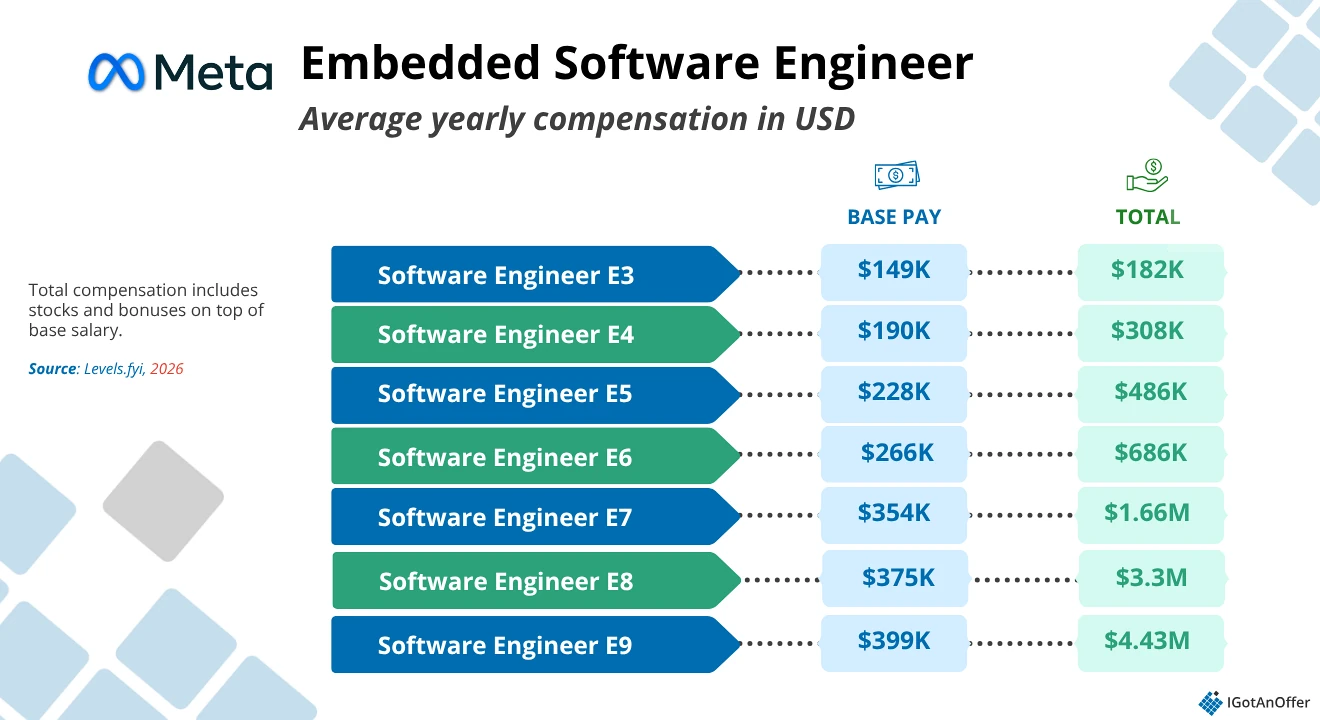
According to Glassdoor, the average Meta SWE salary is 57% higher than the US software engineer average. Compensation varies by location too. An E6 in the US earns considerably more than an E6 in India.
Ultimately, how you do in your Meta embedded software engineer interviews will help determine what you will be offered, which is why working with our Meta interview coaches can be a smart investment.
As with all top tech companies, compensation is negotiable. If you receive an offer, don’t be afraid to ask for more. Read our Meta salary negotiation guide for practical tips. If it’s your first time negotiating, work directly with one of our salary negotiation coaches to get in-depth and personalized advice.
1.4 What Meta looks for in embedded software engineers
According to Pranav (ex-Meta engineering manager), Meta looks for the following key traits in engineers across rounds:
- Conflict resolution: how do you handle disagreements with peers, managers, or external teams?
- Growth mindset: do you accept feedback openly and act on it?
- Ambiguity: how do you bring structure to a problem when none exists?
- Persistence: how do you sustain progress when things keep going wrong?
- Communication: how clearly do you share context with peers and cross-functional partners?
For embedded roles, interviewers look for hardware intuition on top of these traits. They want evidence that you understand the constraints of running software on silicon. Writing correct C is necessary but not sufficient.
This is tested most directly in the in-domain design round, where you'll be expected to reason about hardware constraints, system behavior, and engineering trade-offs.
For level-specific expectations, see our Meta E4, E5, and E6 interview guides.
Coaches who contributed to this guide











2. Meta embedded SWE interview process and timeline↑
The process follows the standard Meta SWE structure, with one addition specific to this role: the in-domain design round. We cover it in Section 3.3.
2.1 Steps to expect
The Meta embedded software engineer interview process takes four to eight weeks on average and follows these steps:
- Step 1: Resume screen
- Step 2: Recruiter call
- Step 3: Initial screen
- Step 4: Virtual onsite (full loop)
- Step 5: Debrief and hiring committee
- Step 6: Offer and salary negotiation
Step 1: Resume screen↑
Recruiters evaluate your resume against the open position. Around 90% of applicants do not make it past this stage.
A strong resume for this role highlights embedded systems experience: firmware projects, RTOS work, hardware abstraction, driver development, or low-level C/C++ at scale. See our software engineer resume guide and Meta resume examples and tips.
You can also work with one of our coaches on a resume review if you want some feedback from former Meta and FAANG recruiters.
Step 2: Recruiter call↑
If your resume clears the screen, a recruiter will reach out to schedule a 20-30 minute call. This is generally not technical. Expect questions like “Tell me about yourself” and “Why Meta?”, plus a walkthrough of the process ahead.
The recruiter may send preparation materials outlining what topics to study. Read them carefully. Some candidates report the prep list does not map perfectly to what gets asked, but it is a useful starting point.
Step 3: Initial screen↑
The initial screen is a technical coding interview on CoderPad. Based on Glassdoor reports, it runs 40-45 minutes.
Expect two coding questions, both tending toward implementation rather than pure algorithm puzzles. You should also be prepared to write logic and test cases without compiling.
Several candidates reported coding in C or C++, though the language is not formally specified for this step.
See our Meta phone screen interview guide for detailed preparation advice on this step.
Step 4: Full interview loop↑
The full loop consists of five to six 45-minute virtual interviews. Based on Glassdoor reports from embedded SWE candidates, the rounds include:
- 2 coding interviews (LeetCode-style data structures and algorithms, typically medium difficulty)
- 1 behavioral interview (“Getting to know you”)
- 1 general system design interview
- 1 in-domain system design interview (embedded-specific)
- 1 technical retrospective (reported by some candidates, not universal)
The in-domain design round tests embedded systems knowledge directly, including hardware architecture, memory management, real-time constraints, and domain-specific design decisions.
Unlike the general system design round, which focuses on distributed systems, the in-domain round is tailored to your engineering background. Prepare for both: some candidates report the general round was identical to what any Meta SWE faces, with no embedded context.
Step 5: Debrief and hiring committee↑
After the loop, interviewers submit written feedback and scores. A hiring committee reviews the full packet. The debrief and committee review typically takes two to four weeks.
Step 6: Offer and salary negotiation↑
If the committee approves, a recruiter will call with a verbal offer. Compensation includes base salary, RSUs vesting over four years, and a performance bonus.
Don’t accept the first number. Negotiate. Our Meta salary negotiation guide covers the full process.
For a detailed walkthrough of all seven steps of Meta’s hiring process, see our Meta interview process guide.
3. Meta embedded software engineer interview questions ↑
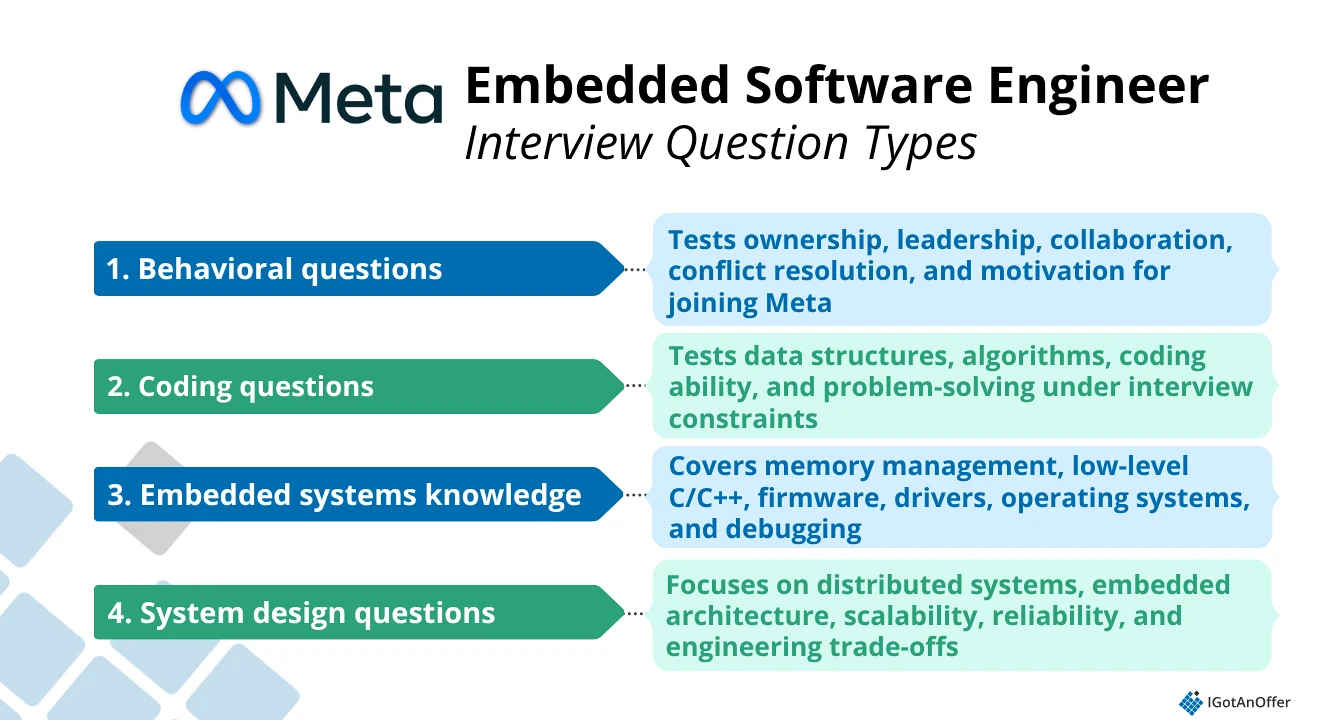
Meta embedded software engineer interviews cover four main areas:
The questions below come from our analysis of 18 Glassdoor interview reports for this role (2019-2025). Where a question type had fewer than three confirmed examples, we supplemented from our Meta SWE guide. Those questions are marked (Meta SWE).
3.1 Behavioral interview questions↑
Meta calls this the "Getting to Know You" interview. It covers past work experience, conflict resolution, growth mindset, and motivation for joining. During the full loop, it runs as a dedicated 45-minute session and may also appear as a warm-up at the start of other rounds.
Meta is a bottom-up environment. Interviewers are not looking for polished narratives. They want evidence that you own your work, handle ambiguity without prompting, and deliver under real pressure. Come prepared with specific stories, not generic talking points.
Example Meta embedded software engineer questions: behavioral
- Tell me about yourself.
- Why Meta?
- Walk me through your resume.
- Tell me about a recent or favorite project and the difficulties you had.
- Tell me about the greatest accomplishment of your career.
- Tell me about a time you struggled to work with one of your colleagues.
- Tell me about a time you had to resolve a conflict in a team.
- Describe a situation where you had to work with cross-functional teams. How did you ensure alignment?
- Tell me about a time you were given constructive feedback.
- Tell me about a time you failed and what you learned from it.
- Tell me about a time you had to step up and take responsibility for others.
- Tell me about a time you led a team.
For more example questions and our recommended answer framework, see our Meta behavioral interview guide and our guide to software engineer behavioral interview questions.
3.2 Coding interview questions↑
Meta’s coding interviews test your command of data structures and algorithms. The embedded SWE coding rounds use the same format as the general SWE loop: two problems in 40 minutes on CoderPad, medium to hard difficulty.
Several candidates noted that the coding questions were standard CS problems, not embedded-specific.
For the full loop coding rounds, you can use any language you are comfortable with. C++ is a natural choice for embedded candidates, but it is not required. Let your recruiter know your preferred language in advance.
Meta is also piloting an AI-assisted coding round for traditional SWE roles. If you encounter this format, you'll be given access to an AI tool during the CoderPad session. The format tests how effectively you use AI assistance to arrive at a solution. Not all embedded SWE candidates are sure to face it, but it is worth preparing for.
According to Thang (ex-Meta software engineer), one of the most common mistakes candidates make is not being prepared to run code manually. You will not have a compiler or autocomplete. Practice writing and tracing logic in a plain text editor before the interview.
Example Meta embedded software engineer questions: coding
Arrays & strings
- Longest repeating substring with replacement. (Solution)
- Find the number of islands in a 2D array. (Solution)
- Given a string of an arithmetic expression composed of numbers, ‘+’ and ‘*’, calculate the result. (Solution)
- Given an array nums of n integers where n > 1, return an array output such that output[i] is equal to the product of all the elements of nums except nums[i]. (Solution)
- Given a non-empty string s, you may delete at most one character. Judge whether you can make it a palindrome. (Solution)
- Given an array nums of n integers, are there elements a, b, c such that a + b + c = 0? Find all unique triplets which give a sum of zero. (Solution)
- Given a number n, set and clear the ith bit. (Solution)
Trees
- Write a function that balances a binary search tree given a root node. (Solution)
- Given the root of a binary tree, return the level order traversal of its nodes’ values. (Solution)
Graphs (BFS & DFS)
- Find the shortest path using BFS. (Solution)
- Check whether a given graph is bipartite or not. (Solution)
Stacks & queues
- Implement a circular buffer: init, write N items at a time, read N items at a time. (Solution)
- Implement 3 functions of a queue using a circular buffer (enqueue, dequeue, peek). (Solution)
- Given a string containing just the characters ‘(’, ‘)’, ‘{’, ‘}’, ‘[’ and ‘]’, determine if the input string is valid. (Solution)
Linked lists
- Merge two sorted lists in any language. (Solution)
- Reverse a linked list at the kth position. (Solution)
Hash & maps
Learn more about the Meta coding interview. For more targeted coding questions with solutions, check out our guides on arrays, trees, graphs, stacks and queues, linked lists, and maps. For full details on the AI-enabled format, see our AI-assisted coding interview guide.
3.3 Embedded systems knowledge↑
The in-domain knowledge round tests your understanding of embedded systems and hardware concepts, including memory management, firmware debugging, drivers, operating systems, and low-level C/C++ concepts. You may also be asked to write or reason through code in C/C++.
Most questions are open-ended. Talking through trade-offs (cache alignment, interrupt safety, real-time constraints) matters as much as the final implementation.
Example Meta embedded software engineer questions: embedded systems knowledge
Memory & low-level C/C++
- How would you store the left and right channel audio information of a stereo audio signal?
- What is the difference between static and volatile in C? (Solution)
- Explain the use of a 3D array allocated with calloc(). (Solution)
- Given a memory API, implement various memory read/write functions without standard library calls.
- Implement a best-effort buffer in C.
- Write a ring buffer in C to init, write, and read. (Solution)
Drivers & OS concepts
- How would you write a device driver, and where would you start?
- What is the difference between a process and a thread in an embedded OS context?
- How do you handle race conditions between an interrupt service routine (ISR) and main-thread code?
3.4 System design interview questions↑
For the Meta embedded SWE role, you may encounter two types of system design questions: traditional system design and embedded systems design.
Traditional system design focuses on distributed systems at scale. Expect questions on storage, availability, consistency, and API design. These are the same questions any Meta SWE would face.
Embedded systems design focuses on hardware-adjacent architecture. You might be asked to design an audio pipeline, a firmware update system, or a sensor aggregation system for a wearable device.
In both cases, you will be given an open-ended problem and expected to discuss architecture, components, trade-offs, and design decisions at a high level.
Example Meta embedded software engineer questions: system design
General distributed systems
- Design a distributed messaging system (e.g., Messenger). Walk through storage, delivery guarantees, and scale.
- Design a rate limiter.
- Design a URL shortener.
- General distributed systems design question (walk through your approach using a structured framework).
Embedded system architecture
- Design an audio processing pipeline for a real-time AR/VR headset. Cover buffering, latency, and fault tolerance.
- Design a firmware update system for an embedded device at scale.
- How would you design a sensor data aggregation system for a wearable device?
For more insights on how to prepare for system design interviews, see our Meta system design interview guide.
If you're specifically targeting a staff-level role, we recommend checking out our staff system design interview guide for a deeper dive into what interviewers expect at this level.
4. Meta embedded SWE interview tips↑
Being a strong embedded engineer is not enough on its own to ace these interviews. Interviewing is a separate skill. The tips below are the ones that come up most often in our coaching sessions with Meta candidates.
4.1 Ask clarifying questions before writing a single line
Meta’s coding and design questions are intentionally ambiguous. Jumping straight into an answer without clarifying is one of the most common ways candidates lose points.
Spend the first two to three minutes asking about edge cases, constraints, and expected behavior.
For embedded questions, ask about the hardware context before writing anything. Find out whether the code is targeting a real-time OS, what memory constraints exist, and whether the interviewer has a language preference. These details change your approach significantly.
This is not stalling. Meta interviewers treat clarifying questions as a signal that you think like a systems engineer, not just a code writer.
4.2 Know your C and C++ primitives cold
The in-domain round tests low-level C/C++ knowledge directly. Questions about volatile, static, memory layout, pointer arithmetic, and buffer implementations have appeared in multiple Glassdoor reports.
You should be able to explain each primitive, describe when you would use it, and identify common bugs, without looking anything up.
Pay particular attention to concurrency in embedded contexts, including how to safely share data between an interrupt service routine (ISR) and main-thread code, and why volatile alone is not sufficient for thread safety.
4.3 Prepare for both system design formats
Preparing for only one of the two design rounds is a mistake. The general round follows standard Meta conventions: clarify requirements, design high-level, then dive into components.
The in-domain round is less structured. It tests whether you can reason about hardware constraints, trade-offs between solutions, and real-time requirements in an open-ended conversation.
4.4 Treat technical interviews as a conversation
Meta recommends talking as you code so the interviewer can follow your reasoning. For embedded questions, this matters even more.
Hardware problems often have multiple valid approaches. Interviewers want to see that you understand the trade-offs, not just the destination.
4.5 Show autonomy in behavioral answers
Meta’s bottom-up culture means interviewers want evidence that you take initiative without being asked. Every story you tell should show that you identified the problem yourself, pushed the solution forward, and owned the outcome.
Pranav (ex-Meta engineering manager) says that the key traits Meta looks for in behavioral interviews are strong conflict resolution, a genuine growth mindset, comfort with ambiguity, and sustained progress through obstacles.
Come with three to five concrete stories that demonstrate each of these traits. Be ready to discuss the technical details, tradeoffs, and decisions behind the embedded projects on your resume. Meta interviewers often ask follow-up questions to understand your specific contributions and decision-making.
A useful framework for structuring behavioral answers is IGotAnOffer’s SPSIL method (Situation, Problem, Solution, Impact, Learning). It forces you to identify the core problem and articulate your impact clearly.
4.6 Run your code manually before saying you’re done
CoderPad has no compiler. Candidates who skip manual tracing tend to miss off-by-one errors, unhandled edge cases, and buffer overruns. These problems are especially visible in ring buffer and circular queue questions.
Before declaring your solution complete, walk through it with a small example input and verify the output step by step.
4.7 Get comfortable with coding on various mediums
Meta typically asks interviewees to code in CoderPad if the interview is done online. But if the interview is in person, you might be asked to code on paper or a whiteboard. You can check with your recruiter which one it will be if you’re not sure which medium to use.
4.8 Be honest
Meta does not expect its candidates to know everything, so if you get a question that’s outside of your expertise, don’t hesitate to let your interviewer know. Ask the right questions and show motivation to learn.
Similarly, when asked if you faced challenges or setbacks, don’t deny or frame your weakness as a strength. Instead, discuss how you’ve improved and learned from these challenges.
5. How to prepare for your Meta embedded software engineer interview↑
We’ve coached more than 20,000 people for interviews since 2018. There are three activities you can do to prepare. Here’s what we’ve learned about each of them.
5.1 Learn about Meta’s culture
Before investing time in technical prep, take some time to understand the company you're applying to. These resources give you a grounded picture of Meta's culture, values, and engineering environment:
- Meta's 6 core values
- Facebook’s hacker culture (by Mark Zuckerberg, via Wired)
- Meta annual reports and strategy presentations (by Meta)
- Meta's approach to tech trends (by CB Insights)
- Meta org culture analysis (by Panmore Institute)
- Engineering at Meta
5.2 Practice by question category ↑
Start with Meta's official preparation materials, and then work through the relevant guides by IGotAnOffer and others for each round you'll face:
Meta's official materials
Coding
- Meta coding interview guide
- How to get better at coding interviews
- AI-assisted coding interview guide
System design
- Meta system design interview guide
- System design interview prep guide
- Staff system design interview guide
In-domain knowledge
Behavioral
General Meta SWE prep
- Meta software engineer interview guide (baseline reference)
- Meta phone screen interview guide
- Real Meta interview experiences from candidates
5.3 Practice with peers
Once you have a working understanding of the material, practice with a peer who can run mock interviews. This forces you to think out loud and handle unexpected follow-up questions.
Be warned: peer partners usually cannot give the same level of feedback as someone who has actually run these interviews at Meta. They may lack familiarity with Meta’s scoring criteria, and they tend to be too polite to push back the way a real interviewer would.
For those reasons, many candidates skip peer mock interviews and go straight to mock interviews with an expert.
5.4 Practice with experienced SWE interviewers
In our experience, practicing with someone who has actually run these interviews at Meta and can give you honest, specific feedback makes the biggest difference.
Find a Meta software engineer coach so you can:
- Test yourself under real interview conditions
- Get accurate feedback from a real expert
- Build your confidence
- Get company-specific insights
- Learn how to tell the right stories, better
- Save time by focusing your preparation
Landing a job at a big tech company often results in a $50,000 per year or more increase in total compensation. In our experience, three or four coaching sessions worth around $500 make a real difference. That’s an ROI of 100x.
Click here to book software engineer mock interviews with experienced SWE interviewers.





 People management and Leadership