

 Back to other articles
  Last updated: June 01, 2026
 Interviews
 Machine learning engineer
 Deeply researched
Machine learning software engineer interviews at Apple are really challenging. The questions are demanding, the process is less transparent than at Meta or Google, and the bar for both ML depth and coding is high.
What makes Apple's MLE interview distinctive is its focus on on-device ML, privacy-preserving system design, and Apple's tight hardware-software ecosystem. Candidates who prepare with a generic "big tech ML" playbook often get caught off guard.
The good news is that the right preparation can make a big difference and can help you land an ML job at Apple. We have put together the ultimate guide below to help you maximize your chances of success.
Click here to practice 1-on-1 with Apple ex-interviewers
If you're interviewing for MLE roles at other companies, see our guides to the Meta MLE interview, the Amazon MLE interview, the TikTok MLE interview, and the Google MLE interview. If you're targeting an AI/ML engineer role, take a look at our guide to AI engineer interview questions.
1. Apple machine learning engineer role and salary ↑
Before getting into the interview process and questions, it's worth understanding what the role involves and what Apple pays for it.
1.1 What does an Apple machine learning engineer do?
Apple's machine learning engineers work across a remarkably wide product portfolio. ML powers some of Apple's most visible features:
- Siri
- Face ID
- Autocorrect
- Photo organization in the Photos app
- Fall detection in Apple Watch
- Health monitoring
- Apple Intelligence features introduced in iOS 18
These features land on over a billion active devices. That reach is part of what makes the role distinctive and demanding.
That scale also shapes how the work is structured. As an Apple MLE, you might be responsible for both training and deploying the models you build, rather than handing off to a separate infrastructure team. And because Apple operates on a need-to-know basis internally, your work is rarely something you can discuss publicly or add to a portfolio.
The pace is also more marathon than sprint, with most engineers working standard hours punctuated by on-call rotations. Apple requires three days per week in-office (Tuesday, Thursday, and a team-chosen day), with most ML roles based in Cupertino.
1.2 How much does an Apple machine learning engineer make?
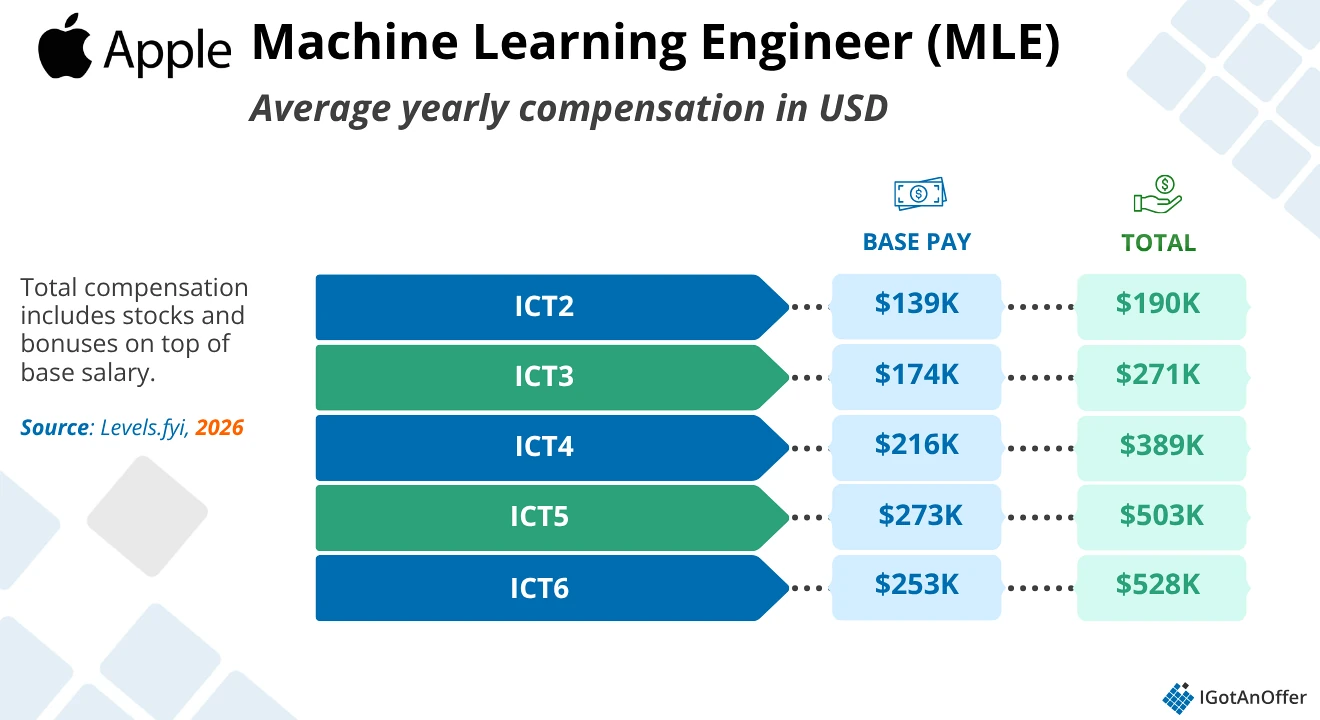
Apple's MLE compensation is competitive across the industry. Based on Levels.fyi data, the median total compensation for a machine learning engineer at Apple in the US is approximately $335K per year, with packages ranging from around $190K at ICT2 to over $528K at ICT6.
Location matters significantly. Median total compensation in the San Francisco Bay Area is around $405K, above the US-wide median of $335K.
Here's an overview of how compensation breaks down by level:
Ultimately, how you do in your interviews will help determine what you’ll be offered. That’s why hiring one of our ex-Apple interview coaches can provide such a significant return on investment.
And remember, compensation packages are always negotiable, even at Apple. So if you do get an offer, don’t be afraid to ask for more. Use this Apple offer negotiation guide to help you. If you need help negotiating, consider booking one of our salary negotiation coaches to get expert advice.
2. Apple machine learning engineer interview process and timeline↑
Apple's interview process is more decentralized than Meta's or Google's. Each team designs its own loop, which means two candidates interviewing for MLE roles at Apple in the same month can have meaningfully different experiences.
The structure below reflects what candidates consistently report, but treat it as a reliable baseline rather than a guaranteed script.
2.1 What interviews to expect
Here's an overview of the stages in the Apple MLE interview process:
- Resume screen
- Recruiter screen
- Hiring manager screen
- Technical phone screen (some teams also include a take-home)
- Full interview loop (5–8 rounds)
2.1.1 Resume screen
First, recruiters will look at your resume and assess if your experience matches the open position. This is the most competitive step in the process, as millions of candidates do not make it past this stage. So take extra care to tailor your resume to the specific position you're applying to.
Check out our free machine learning engineer resume guide with examples to help you write yours. If you’re looking for expert feedback, get input from our team of ex-FAANG recruiters who will cover what achievements to focus on (or ignore), how to fine-tune your bullet points, and more.
2.1.2 Recruiter screen
Once you’re invited to interview with Apple, you’ll first speak with a recruiter on a phone screen. This is universal across all teams.
During this call, you should expect the recruiter to ask you some typical resume and behavioral interview questions. So practice discussing your key experiences, especially those that you’ve included in your application, as well as your most impressive work accomplishments.
They'll be looking to evaluate your fit with Apple’s culture, your overall qualifications for the role, and whether you have a chance of succeeding in future interview rounds.
At this point, the recruiter will likely give you an idea of what interview steps are in store for you. You can expect role-related questions, but the steps from here on out will vary largely depending on the team you’re applying to.
Don’t hesitate to ask questions about the process ahead, especially if the recruiter doesn’t immediately provide you with the information you need to prepare.
2.1.3 Hiring manager screen
Apple's MLE process typically includes a dedicated hiring manager conversation early in the pipeline (before the technical screen) rather than reserving it for the end of the loop as some companies do. This is usually 30 to 45 minutes and focuses on your background and project experience.
One candidate reported their hiring manager screen included a 20-minute deep dive into their most recent project alongside NLP-specific questions, including transformers, LLMs, and LoRA fine-tuning, before any formal coding rounds began.
2.1.4 Technical phone screen
The technical screen is typically a 45- to 60-minute CoderPad session with an Apple engineer, usually a staff-level IC. The intent of this assignment is to see how you approach the types of problems you might encounter on the job.
Expect one or two coding problems (LeetCode-style, medium difficulty) plus possible ML fundamentals questions depending on the team.
In some cases, you will be asked to complete a written take-home assignment or challenge. This may occur after or between the interviews we’ve described above. Note that not all candidates will be assigned this exercise.
It’s best to check with your recruiter if the take-home assignment will be a part of your interviewing process so that you can prepare for it. You’ll need to clear this round before you can get to the next stage, the onsite interview.
2.1.5 Full interview loop
Candidates who pass the tech screen proceed to a full loop, typically conducted in a single day, either virtually or on-site. Most MLE loops run five to eight rounds of 45 to 60 minutes each.
The loop typically covers:
- Coding (1 to 2 rounds): Algorithm and data structure problems, often medium-to-hard LeetCode difficulty. Some rounds blend DSA with ML-specific coding (e.g., implementing cosine similarity, then extending to dynamic programming).
- ML fundamentals (1 round): Deeper theoretical discussion of ML concepts — loss functions, regularization, transformer architecture, bias-variance tradeoff, and increasingly, GenAI topics like RAG versus fine-tuning.
- ML system design (1 round): End-to-end system design, often with on-device or privacy constraints built into the problem.
- Behavioral (1 round): Past-experience questions using the STAR format, probing ownership, conflict, and technical decision-making.
- Hiring manager / senior manager (1 to 2 rounds): Resume deep-dive and team fit. Some loops include both the direct hiring manager and their manager, particularly for senior roles.
Note: Apple doesn't run a formal Bar Raiser program like Amazon. However, some loops include a senior or cross-functional engineer in an evaluative role that serves a similar purpose.
2.2 Timeline and what happens after the loop
Most candidates report completing the full process in 4 to 6 weeks. But Apple’s timeline is often longer, with Glassdoor data showing an average of 41 days end-to-end.
After the loop, interviewers submit written feedback through Apple's internal system. A response typically arrives one to three weeks later. Rejection decisions tend to come faster; a longer silence often signals the team is still deliberating or finalising a shortlist.
If the team moves forward, the recruiter will extend a verbal offer, at which point your negotiation window opens.
Once you’ve completed this step and accepted your offer: congratulations! It’s time to start your career at Apple.
3. Apple machine learning engineer example questions ↑
Apple MLE interviews cover four main areas:
Below, we've put together a summarized list of example questions for each of these interview types, along with notes to help you understand what to expect.
Most questions are drawn from firsthand Apple candidate accounts on Glassdoor and Blind. Where we've supplemented with questions from our other MLE interview guides (to give you a fuller picture of the topic areas covered), we've indicated the source company in brackets at the end of the question.
3.1 Coding interview
The coding interview tests your ability to solve algorithm and data structure problems clearly and efficiently. Apple's coding bar is high. Interviewers pay close attention to how you think through the problem and communicate your reasoning along the way.
Here are the most common question types asked in Apple MLE coding interviews:
Note: Some Apple MLE teams blur the line between coding and ML fundamentals in the same session. A 2025 first-hand account described a round that combined data structures with GenAI concepts in a single interview. Don't treat these as entirely siloed.
Example Apple machine learning engineer interview questions: coding
- Given an array of integers, determine whether any three integers in the array sum to a given target value (Solution)
- Given a custom data structure, implement add and remove operations with specific constraints (Solution)
- Merge two sorted linked lists such that the result is also sorted (Solution)
- Given two binary trees, determine whether they are structurally identical with equal node values (Solution)
- Implement cosine similarity between two vectors; extend to solving for the longest common subsequence using dynamic programming (Solution)
- Given a text corpus, clean the data and implement logic that predicts the most probable next word
- Implement a simpler version of Naive Bayes
- Solve a probability calculation problem using dynamic programming (Cheat Sheet)
See our comprehensive guide on coding interviews for a broader coding preparation framework.
3.2 Machine learning fundamentals interview
Apple often includes a dedicated ML fundamentals round that goes deeper into theory. Depending on the team, this may cover:
- Classical ML concepts (loss functions, regularization, model selection)
- Deep learning fundamentals (gradient flow, attention mechanisms)
- Applied ML problem-solving (handling imbalanced data or deciding when to stop training)
Candidates interviewing for roles on teams working on Apple Intelligence or Siri have reported getting questions about generative AI. Prepare for the full spectrum, not just one end.
Example Apple machine learning engineer interview questions: ML fundamentals
- Explain the bias-variance tradeoff and how you'd think about it when selecting a model at scale
- What is the difference between fine-tuning and retrieval-based methods like RAG? When would you use each?
- Walk through the transformer architecture and explain the self-attention mechanism
- How do you handle class imbalance in a training dataset?
- Implement the forward and backward pass of a custom function in PyTorch to enable backpropagation
- What are the tradeoffs between on-device inference and server-side inference for a feature like Siri?
- Walk through how convolution works and where you'd apply it in a model architecture
- When do you stop training a model?
- How do you deal with a large dataset where only a small fraction of examples are labeled?
3.3 Machine learning system design interview
The ML system design interview asks you to design a complete ML system from scratch. So, from problem framing through data collection, feature engineering, model selection, training, evaluation, and deployment.
This interview typically lasts 45 to 60 minutes and rewards candidates who can move fluidly across the full pipeline rather than getting stuck on any single layer.
Apple's ML system design interview is a bit different because of the expectation that you'll reason about privacy constraints and on-device deployment. Apple's products are built around keeping user data on the device, which introduces real tradeoffs that Apple interviewers actively look for candidates to acknowledge.
You don't need to be a Core ML expert, but you should be able to discuss the difference between on-device and server-side inference and when each makes sense.
Some teams, particularly those working on Siri or Apple Intelligence, have also started asking generative AI system design questions.
Example Apple machine learning engineer interview questions: ML system design
- Design a recommendation system for Apple Music
- How would you build a machine learning model to predict customer churn for Apple's subscription services (Apple TV+, iCloud+)?
- How would you build a photo classification model that runs on-device with real latency and memory constraints?
- How would you evaluate the performance of a recommendation algorithm for Apple Music?
- What features would you prioritize when building a content recommendation model for Apple Fitness+?
- How would you build, train, and deploy a system that detects if multimedia and/or ad content violates terms or contains offensive materials? (Google)
- Design autocomplete and/or spell check on a mobile device (Google)
- Design autocomplete and/or automatic responses for email (Google)
For a full framework on how to approach these questions, see our machine learning system design interview guide and generative AI system design interview guide.
3.4 Behavioral interview
Apple doesn't have a formal equivalent to Amazon's Leadership Principles or Google's Googleyness, but there are consistent themes. Interviewers tend to probe for craft and quality ("Tell me about a time you shipped something you were proud of"), cross-functional influence, and how you handled situations that didn't go as planned.
To ace your Apple behavioral interviews, make sure to demonstrate how you take ownership of outcomes, work collaboratively across teams with differing constraints, and can navigate ambiguity without being paralyzed by it.
Prepare your story bank carefully and use IGotAnOffer’s SPSIL (Situation, Problem, Solution, Impact, Lessons) method to structure your answers.
Example Apple machine learning engineer interview questions: behavioral
- Tell me about a time you had a disagreement with a manager or colleague and how you handled it (How to answer)
- What was the biggest technical challenge you've faced as an ML engineer? How did you approach it?
- Tell me about a time you brought a project or team back on track when things were going wrong (How to answer)
- Describe a situation where you had to make a decision with incomplete information. What did you do? (How to answer)
- Tell me about your worst boss and why they were bad (Meta)
- Tell me about a time you maintained an end-to-end ML pipeline in production (Meta)
- What is your proudest project, and why? (Meta)
- Tell me about the most important ML project you've worked on. What was your specific contribution?
- Describe a situation where you rebuilt an existing solution into something significantly more efficient
Check out our Apple behavioral interview guide for more example questions and company-specific insights.
4. Apple machine learning engineer interviewing tips ↑
You might be a fantastic ML engineer, but unfortunately, that won’t necessarily be enough to ace your interviews at Apple. Interviewing is a skill in itself that you need to learn.
Let’s look at some key tips to make sure you approach your interviews in the right way.
4.1 Show Apple-specific ML knowledge, even if the role doesn't require it
Generic ML interview preparation won't distinguish you at Apple. Interviewers respond well to candidates who demonstrate familiarity with the constraints that define Apple's ML environment:
- On-device deployment
- Model compression
- Quantization
- The tradeoffs of running inference on the Neural Engine versus a server.
You don't need to be an expert in Core ML, but being able to speak to these concepts and frame your past experience in similar terms signals the kind of thinking Apple values.
4.2 Bring privacy into your system design answers proactively
Privacy shapes how ML systems are architected at Apple. Interviewers notice when candidates treat privacy as an afterthought versus a first-class design constraint.
In your system design answers, proactively raise questions like: where does user data live? Could this be done on-device? What data is actually necessary?
This kind of reasoning resonates with Apple interviewers in a way that it often doesn't at other companies.
4.3 Demonstrate product thinking alongside technical depth
Apple ML engineers ship products that millions of people use. Interviewers value candidates who can think about not just whether a model performs well in evaluation, but how an ML decision affects the real user experience on an iPhone or Mac.
When you're working through a system design problem, consider the user-facing implications of your choices (latency, battery life, accessibility) and not just model accuracy.
4.4 Drive your own solutions
Interviewers are more likely to let you work through a problem on your own rather than guiding you toward the answer. Practice driving to a solution independently. Meaning, vocalizing your thinking clearly, structuring your approach before coding, and recovering gracefully when you realize a path isn't working. Candidates who wait for nudges can struggle in this format.
4.5 Start with the most optimal solution if possible
You won’t have enough time to present multiple solutions in your 45-minute interview, so if possible, present your most optimal solution first. If not, go with a correct one, then work toward optimization. Again, be sure to talk your way through your thought process during either of these cases.
4.6 Keep your code organized
Make sure to keep your code organized so your interviewer won’t have a hard time understanding what you’ve written. Apple wants to see that your code has captured the right logical structure.
5. Preparation plan ↑
Now that you know what questions to expect, let's focus on how to prepare. It's no secret that the performance bar at Apple is quite high. To help you maximize your chances of landing an offer, we've listed the four steps we recommend taking to prepare below.
5.1 Deep dive into the product/organization
Most candidates skip this step. But before pouring tens of hours into Apple interview prep, it’s worth pausing to ask if Apple is the right fit for you.
Apple’s brand and influence make it easy to assume you should apply. But prestige alone won’t make your day-to-day work fulfilling. What will matter most are the problems you’ll be solving and the people you’ll be solving them with.
If you know current or former Apple MLEs, take the time to ask them about the culture and how teams actually operate. Their perspective will give you a clearer picture than headlines ever could. You can also explore resources like:
- Apple Core Values
- Apple Investor Relations
- Apple Strategy Teardown (from CB Insights)
- Apple’s Company Culture: An Organizational Analysis (by Panmore Institute)
- Apple’s Marketing Mix: 4P Analysis (by Panmore Institute)
- Apple Mission and Vision Statement Analysis
- How Apple is Organized for Innovation (by Harvard Business Review)
- Apple's Culture Rejects the Conventional Wisdom of Product Design (by Inc)
Once you’re comfortable with the culture and team operations, the next step is practice.
5.2 Practice by yourself
Once you understand the role and what Apple is looking for, start working through the question types systematically using the resources below.
Coding
- Coding interview prep guide
- Array interview questions
- String interview questions
- Linked list interview questions
- Tree interview questions
- Dynamic programming interview questions
Focus on LeetCode medium and hard problems covering trees and graphs, arrays and strings, dynamic programming, and linked lists. Also, practice narrating your thinking out loud. Apple interviewers pay close attention to how you reason through a problem.
ML fundamentals
- Machine learning system design interview guide
- Generative AI system design interview guide
- Deep Learning Specialization — covers bias-variance tradeoff, CNNs, RNNs, and transformers
- PyTorch tutorials — for practicing forward/backward pass implementations
Go deeper than definitions. Apple interviewers probe whether you can apply concepts like regularization, loss functions, and transformer architecture to real constraints. For every system design, build privacy and on-device constraints in from the start rather than tacking them on at the end.
Behavioral
Prepare answers to the questions listed in section 3.4. If you have more time, build out a broader story bank covering ownership, cross-functional influence, and navigating ambiguity.
Other useful guides
If you're preparing for MLE roles across multiple companies, you may also find these guides useful:
- Meta machine learning engineer interview
- Amazon machine learning engineer interview
- Google machine learning engineer interview
- TikTok machine learning engineer interview
- OpenAI interview process
- Anthropic interview process
- NVIDIA interview process
Once you’re in command of the relevant subject matters, you’ll want to practice answering questions. But by yourself, you can’t simulate thinking on your feet or the pressure of performing in front of a stranger. Plus, there are no unexpected follow-up questions and no feedback.
That’s why many candidates try to practice with friends or peers.
5.3 Practice with peers
If you have friends or peers who can do mock interviews with you, that's an option worth trying. It’s free, but be warned, you may come up against the following problems:
- It’s hard to know if the feedback you get is accurate
- They’re unlikely to have insider knowledge of interviews at your target company
- On peer platforms, people often waste your time by not showing up
For those reasons, many candidates skip peer mock interviews and go straight to mock interviews with an expert.
5.4 Practice with experienced ML interviewers
In our experience, practicing real interviews with experts who can give you company-specific feedback makes a huge difference.
Find an Apple machine learning engineer interview coach so you can:
- Test yourself under real interview conditions
- Get accurate feedback from a real expert
- Build your confidence
- Get company-specific insights
- Learn how to tell the right stories, better.
- Save time by focusing your preparation
Landing a job at a big tech company often results in a $50,000 per year or more increase in total compensation. In our experience, three or four coaching sessions worth ~$500 make a significant difference in your ability to land the job. That’s an ROI of 100x!










 ML system design