

 Back to other articles

 Last updated: August 04, 2026
 Interviews
 Product manager
 Deeply researched
The first step to acing your product manager interview is to familiarize yourself with the interview process. But if you’re interviewing at several companies, keeping track of every process might be overwhelming.
That’s why we’ve written this guide. We’ve done the research for you, so you can focus on your interview prep.
In our research, we’ve found that most prestigious and up-and-coming companies follow the same PM interview process, with a few small differences. We’ll walk you through each step and give you pointers on how you can go through each round with confidence until you get an offer.
Here’s an overview of what we’ll cover:
- Role and salary
- Product manager interview process
- Types of PM interview questions
- Product manager interview tips
- How to prepare for product manager interviews
Click here to practice 1-on-1 with a PM interview expert
Let’s get started.
1. Role and salary overview
Before we get into the product manager interview process, let’s first take a quick look at the role itself.
1.1 What does a product manager do?↑
The main objective of the product manager (PM) across all tech companies is generally the same: to spearhead the development of customer-centric products and features while pushing forward the company’s strategic goals.
To achieve this overall goal, the PM role covers several responsibilities, such as:
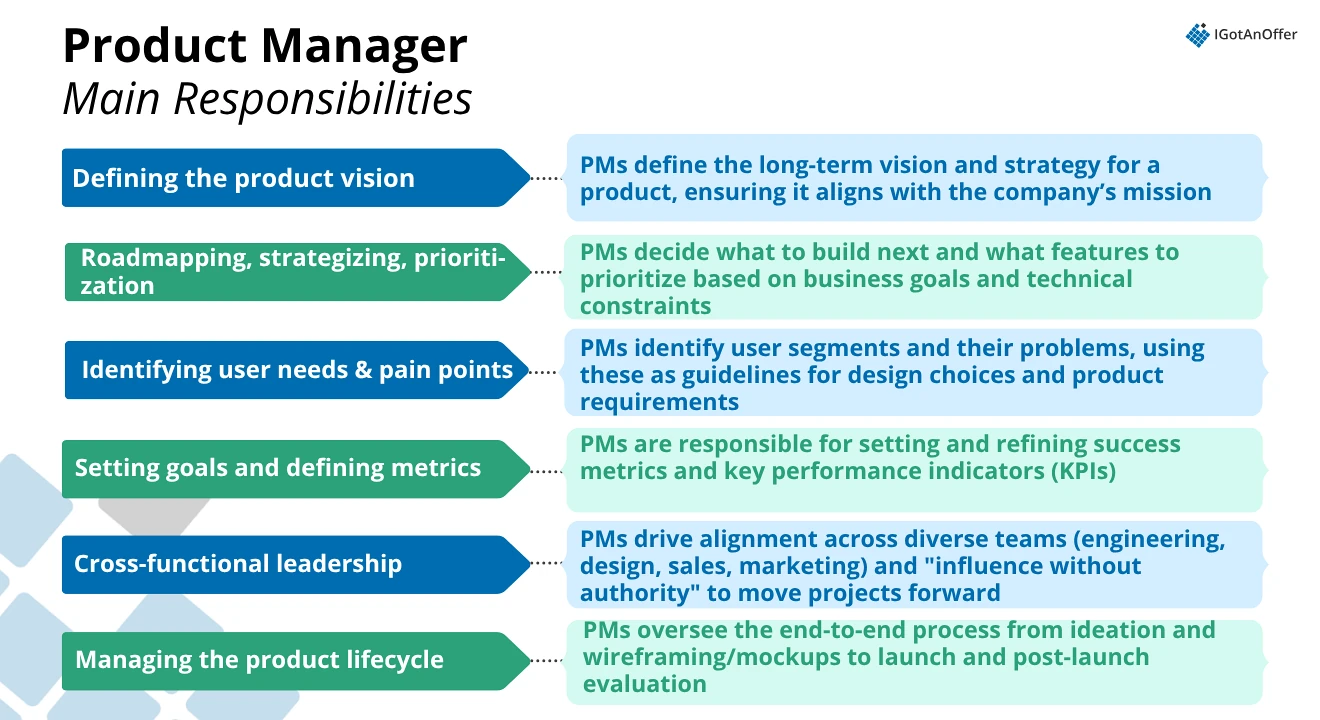
- Defining the product vision. PMs must define the long-term vision and strategy for a product, ensuring it aligns with the company’s mission (e.g., Google's "bottom-up" innovation or OpenAI’s mission-driven approach).
- Roadmapping, strategizing, and prioritization. PMs decide what to build next and what features to prioritize based on business goals and technical constraints.
- Identifying user needs and pain points. PMs identify specific user segments and their problems, using these as guidelines for design choices and product requirements.
- Setting goals and defining metrics. PMs are responsible for setting and refining success metrics (KPIs)
- Cross-functional leadership. PMs drive alignment across diverse teams (engineering, design, sales, marketing) and "influence without authority" to move projects forward.
- Managing the product lifecycle. PMs oversee the end-to-end process from ideation and wireframing/mockups to launch and post-launch evaluation.
Your level of autonomy as PM, especially in terms of strategizing, depends on the company. For instance, Meta gives PMs plenty of authority, even as it has implemented a blend of top-down and bottom-up decision-making in recent years.
The pace of the product lifecycle also differs per company. For example, Google and Apple are known for championing longer-term, more qualitative goals, while Meta encourages a ‘move fast’ mentality in terms of shipping products.
1.2 Product manager core competencies↑
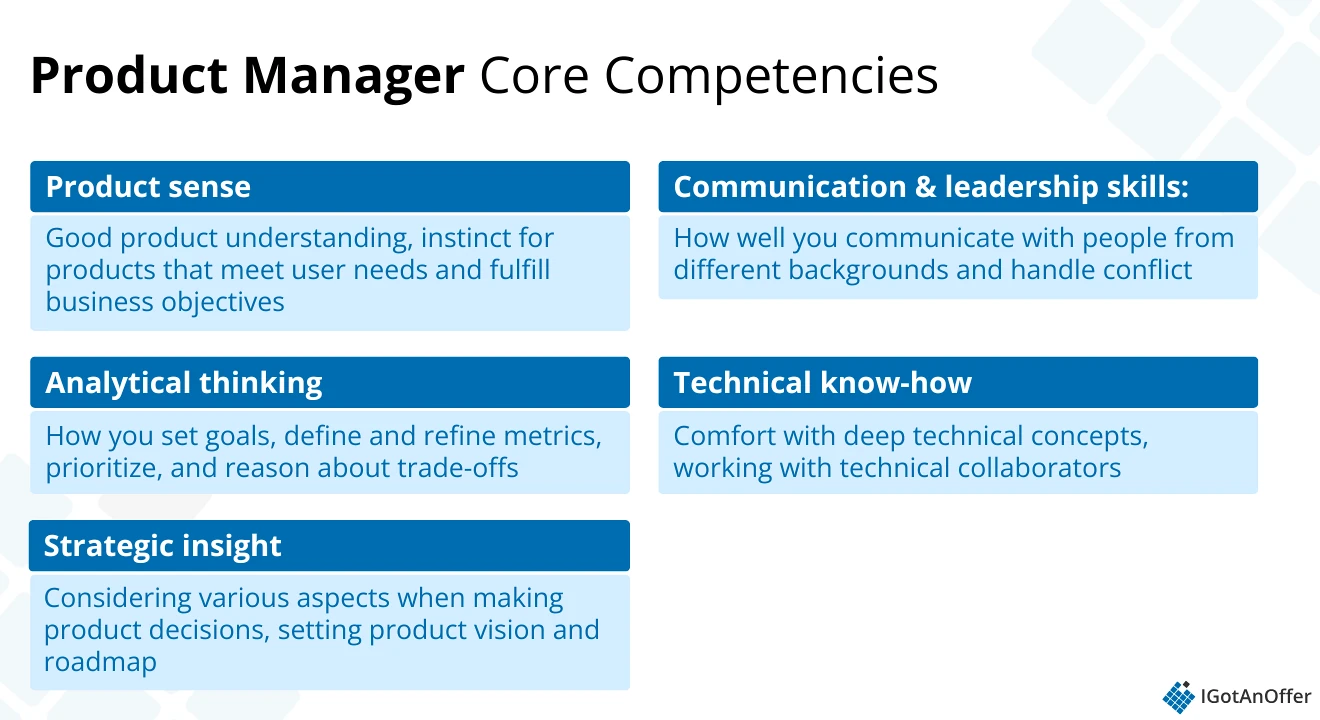
In terms of core competencies, companies tend to focus on more or less the same skills and foundational knowledge. These are:
- Product sense. Good product understanding, instincts for products that meet user needs and fulfill business objectives, awareness of the different factors and considerations at play, and enough creativity to breed innovation.
- Analytical thinking. How you execute solutions, i.e., how you set goals, define and refine metrics, prioritize, and reason about trade-offs.
- Strategic insight. How well you think about a wide range of aspects that need to be taken into account when making product decisions, such as competition, pricing, etc., as well as setting the product vision and articulating a roadmap to deliver it.
- Communication and leadership skills. How well you communicate with technical and non-technical collaborators, manage conflicts, and handle stakeholders
- Technical know-how. Comfort with deep technical concepts and working closely together with engineers, scientists, and analysts, plus your ability to translate technical concepts for non-technical stakeholders.
The level of technical depth required in PMs varies per company. Google and Stripe, for example, prefer PM candidates with a strong technical background. Amazon, not so much, unless you’re specifically applying for a technical product manager role (PM-T). These are reflected in the way they conduct interviews.
1.3 How much does a product manager earn?↑
According to Glassdoor data, the average salary for a Product Manager in the US is $149,724 per year. You can expect established and emerging top tech companies, including AI labs, to pay so much more.
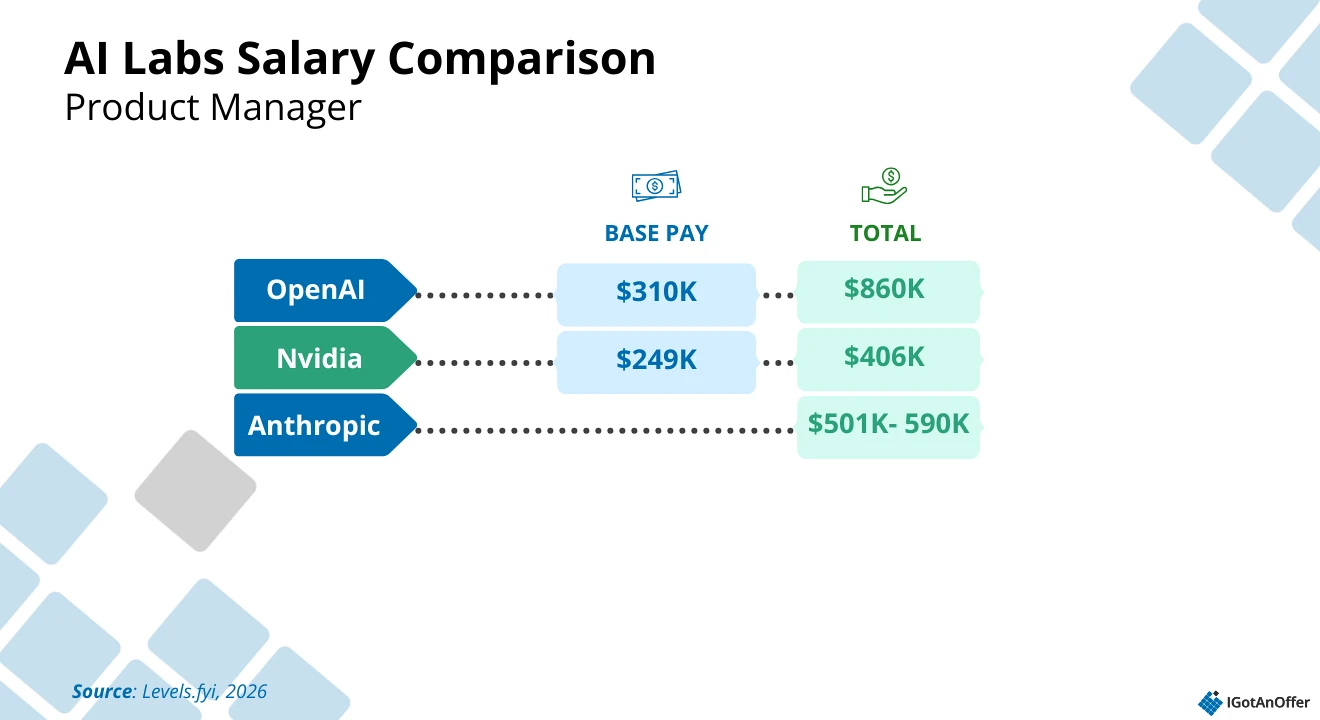
Here is a quick summary of the average salaries of PMs at the top 3 AI labs, OpenAI, NVIDIA, and Anthropic, as reported on Levels.fyi in early 2026. As of now, there's very limited data for these companies, but these figures should give you a hint as to how much they generally pay:
Below are the L5 or equivalent PM salaries across FAANG and other emerging tech companies. As you will see, the relatively new companies are not that far behind FAANG in terms of pay.
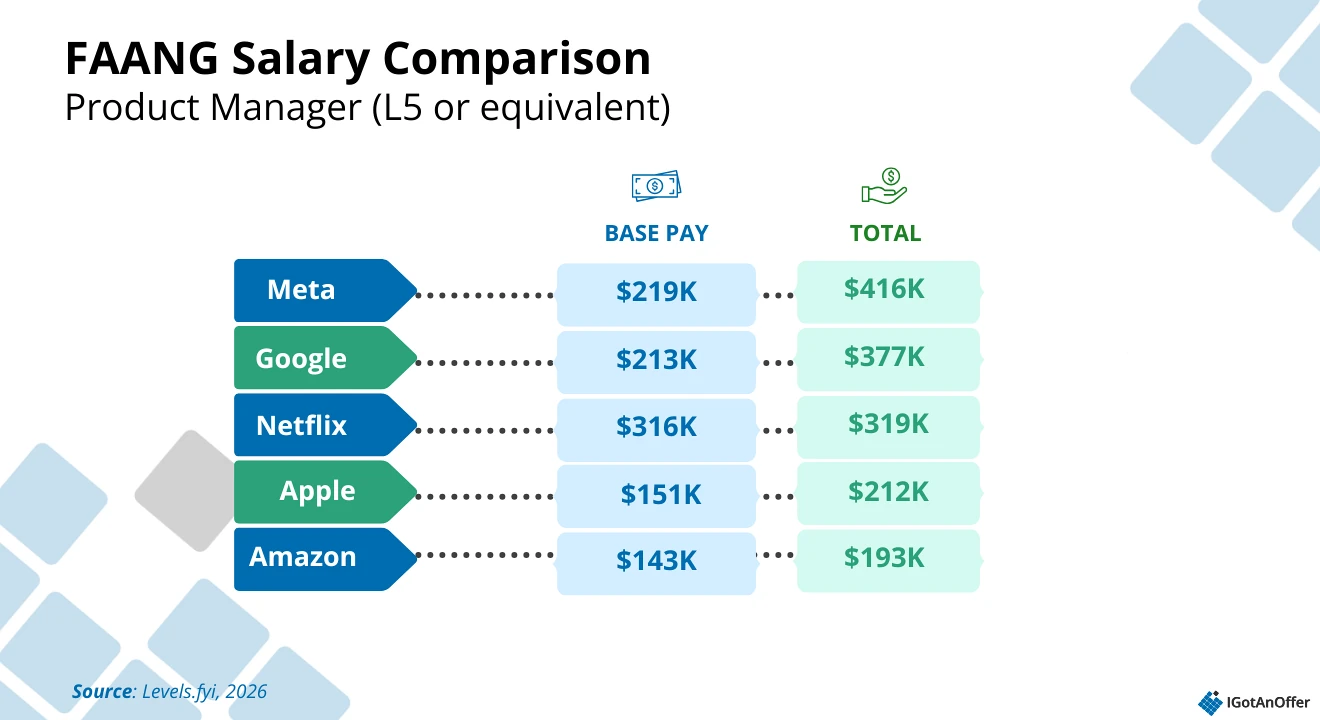
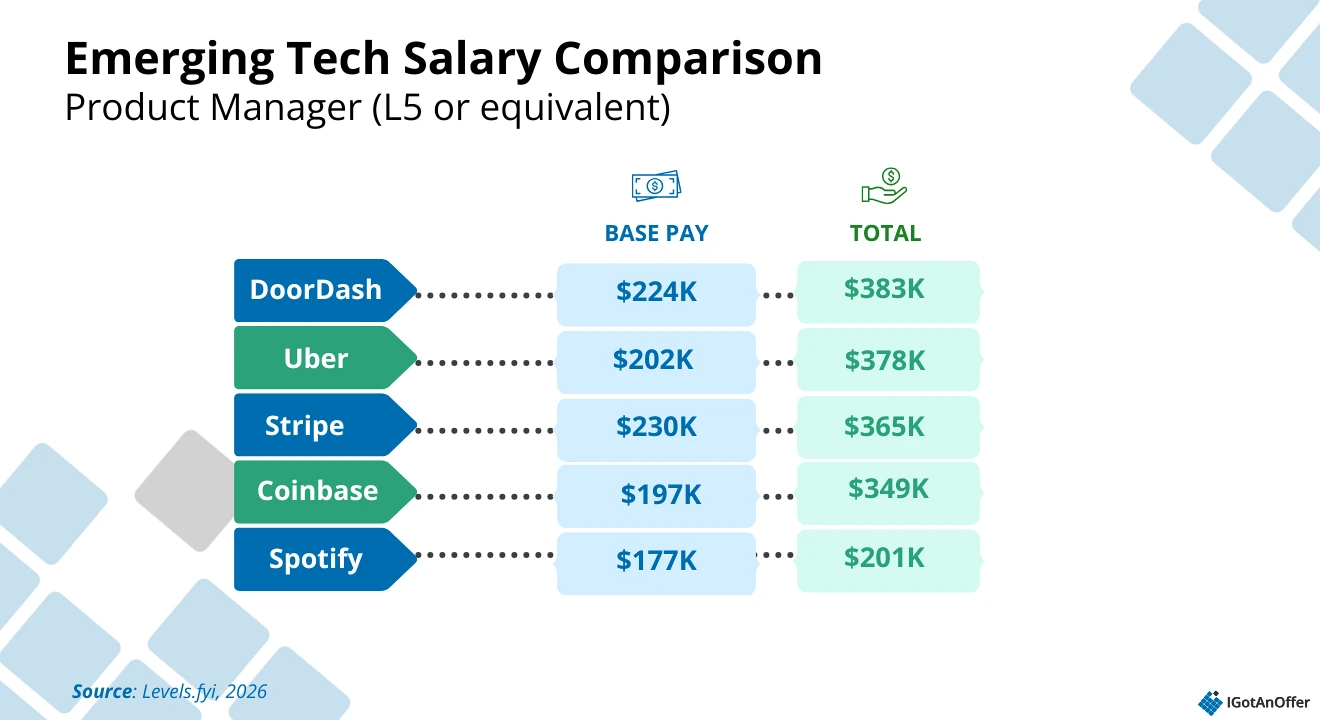
Ultimately, how you do in your interviews will determine what level you’re offered. That’s why hiring one of our PM interview coaches can provide such a significant return on investment.
And remember, compensation packages are always negotiable. So if you do get an offer, don’t be afraid to ask for more.
For tips on how to negotiate well, check out our PM salary negotiation guide. Then, consider booking a salary negotiation coaching session with one of our experts to practice what you’ve learned.
Coaches who contributed to this guide








2. Product manager interview process↑
Product manager interviews across most companies, both established and emerging, follow pretty much the same process. The differences lie mostly in the response time, the number of interviews in the final loop, and the questions in focus. But generally, they’ll follow the steps below:
- Resume screen
- Recruiter call
- Online assessment/take-home challenge
- Phone screen (peer/hiring manager)
- Full interview loop
If you are interviewing for a product leadership position (VP, Director, Group PM) or senior PM role, check out our guides: product leader interview and senior product manager interview questions to learn more about what questions to expect and how to prepare.
Let’s get into each step in detail.
2.1 Resume screen↑
First, recruiters will look at your resume and assess if your experience matches the open position.
This is the most competitive step in the process. We’ve found that ~90% of candidates don’t make it past this stage.
You can use our product manager resume guide to see examples of successful PM resumes and tips to help tailor your resume to the role you’re targeting.
For expert feedback, get input from our team of ex-FAANG recruiters, who will cover what achievements to focus on (or ignore), how to fine-tune your bullet points, and more.
2.2 Recruiter call↑
In most cases, you'll start your interview process by talking to an HR recruiter on the phone. They are looking to confirm that you've got a chance of getting the job at all, so be prepared to explain your background and why you’re a good fit at the company you’re applying to.
You should expect typical behavioral and resume questions like, "Tell me about yourself," "Why X company?" or "Tell me about a product you launched from start to finish."
This is also a good chance to know more about the rest of the interview process. Your recruiter should fill you in, but in case they don’t, feel free to ask.
2.3 Online assessment/take-home challenge↑
Companies like Apple, Amazon, DoorDash, Stripe, Spotify, and Capital One give online assessments or take-home challenges as part of their PM interview process. They may give these tasks before or after the recruiter screen, or after the initial interview.
Here’s a summary of the online assessment formats each of these companies gives:
- Apple: Take-home exercises may vary, and not everyone gets the assignment. In some cases, it’s a written problem-solving exercise focused on a typical PM question, such as a metric or technical problem. In others, it’s a presentation to be given to a panel during one of the rounds in your onsite interview.
- Amazon: Your recruiter will usually give you the writing assessment to complete 48 hours before your interview loop. Interviewers may read this during one of your interviews and ask questions about it.
- Stripe: The company has a strong writing culture, so expect a written problem-solving exercise focused on a typical PM question, such as a metric or technical problem.
- DoorDash: Assessment comes in various formats, such as a case study / product exercise, or analytical exercise / data assignment. May be submitted as slides, documents, or reports.
- Spotify: Not everyone gets this online assignment, but those who do report being given an online work trial.
- Capital One: Some candidates report getting a 20-45-minute automated assessment evaluating basic competencies relevant to the role.
2.4 Phone screen (peer/hiring manager)↑
Once you’ve cleared the above rounds, you’ll get your initial screening with a fellow PM or a hiring manager.
Most phone screens last 45 to 60 minutes. The topic varies depending on the company and the specific position/team you’ve applied for.
Generally, you’ll cover PM-specific questions on product sense and analytical thinking. If you’re targeting a PM-T role, expect additional questions on your technical depth.
You’ll also get more behavioral and resume questions, so be prepared to talk about your experience in greater detail.
2.5 Full interview loop↑
This is usually the last step in the interview process. Depending on the company, you may get up to 6 rounds of interviews, with each round lasting up to 60 minutes.
Most of the interviewers you meet will be product managers. Occasionally, you might also interview with an engineer who will assess your technical skills and ability to communicate with developers. If you're interviewing for an AI-focused PM role, you might also get a session with an ML engineer or applied scientist.
The focus of the interview loop varies per company, but generally, they ask the following types of questions:
- Behavioral
- Product sense
- Analytical thinking
- Product strategy
- Estimation
- Prioritization
- Technical
- Generic and culture fit
We’ll cover each question type in detail below.
Most companies now do virtual interview loops using their preferred online platforms. But if you do get invited onsite, one of your sessions may be over lunch with a peer. During this time, you may ask them questions. You won’t be evaluated per se, but we do recommend behaving as if you were.
After your interview loop, your interviewers will all submit their feedback and grade your answers to their questions. There’s usually a hiring committee that will deliberate whether to hire you or not. And if they do decide to hire you, they’ll also decide your offer package.
If you’ve not applied to a specific team, you’ll generally go through a team matching phase.
2.6 Additional rounds↑
Some companies have unique interview rounds for PMs.
- Uber, for instance, has a Jam Session. The format and expectations differ per career level. For candidates below Group PM level, it’s a bit of a brainstorming session. But for Group PM and above, it’s a presentation to be prepared a week in advance.
- Coinbase has a Work Trial. You’ll be given a scenario based on real-life Coinbase business challenges. Then you’ll be tasked to prepare a solution and present it to a panel for fifteen minutes. Afterwards, you’ll then be asked questions about your presentation.
3. 8 types of product manager interview questions↑
PM interviews are tough because they cover a wide range of question types. To make prep easier, we’ve broken them down into eight key categories.
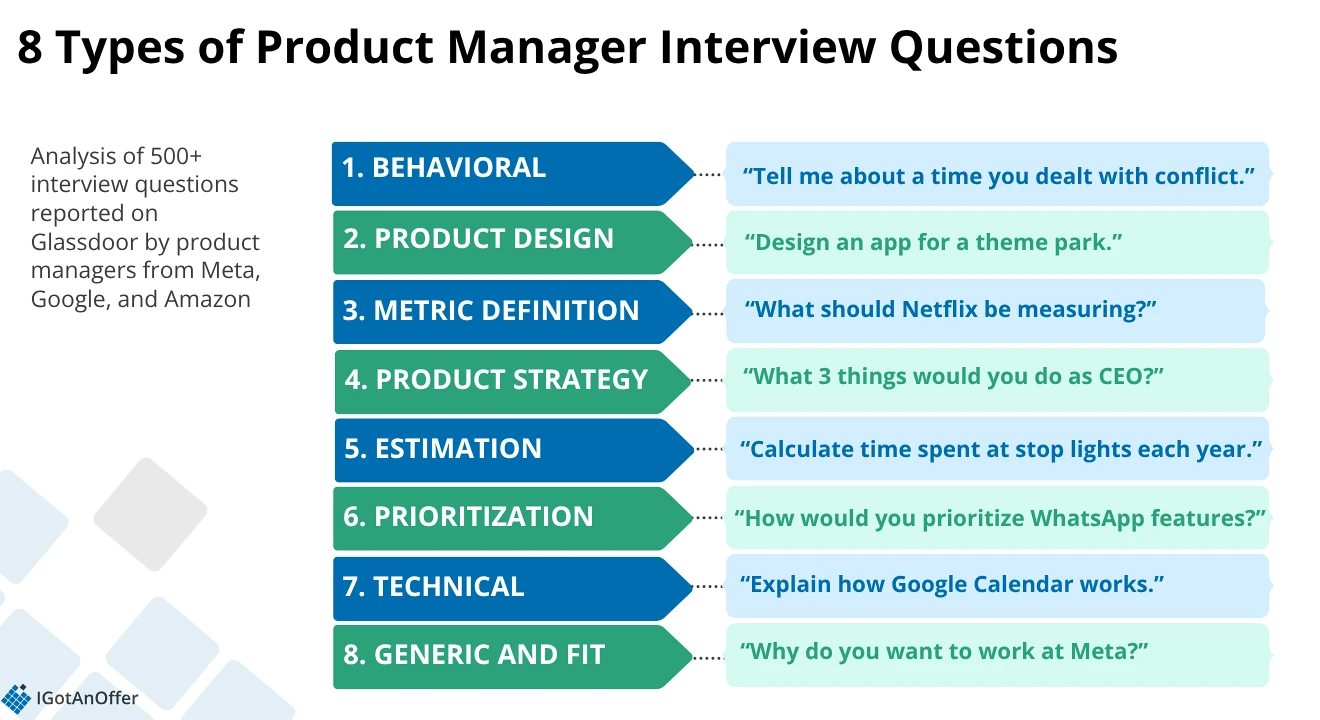
Below, you’ll find an overview of each category, along with a list of the most common questions reported on Glassdoor.
- Behavioral
- Product sense
- Analytical thinking
- Product strategy
- Estimation
- Prioritization
- Technical
- Generic and culture fit
Ready? Let’s go.
3.1 Behavioral interview questions↑
Tech companies use behavioral interviews to assess job candidates based on their past experiences. These questions typically start with “Tell me about a time you…” and focus on soft skills such as leadership, communication, teamwork, problem-solving, etc.
Below, you’ll find a list of company-specific examples you can practice with from Google, Meta, Amazon, Apple, and Capital One.
Example Google PM behavioral interview questions
- What is one accomplishment you're most proud of, at work or outside of work?
- Describe a project you managed from start to finish, including any project management tools you used.
- How do you resolve conflicting product requirements?
- What would you do when you’ve already committed to a release but your engineering team says it can’t be shipped in time?
- Your largest customer is loudly advocating for a new feature that isn’t on your roadmap. Sales has gone straight to Engineering. What do you do?
Check out our Google behavioral interview questions guide for more examples and company-specific insights.
Example Meta PM behavioral interview questions
- What's your biggest weakness?
- How do you earn the trust of your team?
- How do you motivate your team when morale is low?
- Tell me about a time you successfully navigated competing leadership priorities.
- How do you measure success after launching a product?
Check out our Meta behavioral interview questions guide for more examples and company-specific insights.
Example Amazon PM behavioral interview questions
- How have you measured customer satisfaction in the past?
- How do you decide which customer requests make it into the roadmap?
- Tell me about a time when you tried to convince your manager of a product direction and were unsuccessful.
- Describe a time when you brought different perspectives together to solve a problem.
- Tell me about a time when you took a calculated risk and what the outcome was
Check out our Amazon behavioral interview questions guide for more examples and company-specific insights.
Example Apple PM behavioral interview questions
- What three words would you use to describe Apple’s products?
- Tell me about a challenging moment in your career.
- How do you keep yourself organized?
- Tell me about a time when you felt appreciated at work.
- How do you manage people on teams with whom you may not get along?
Check out our Apple behavioral interview questions guide for more examples and company-specific insights.
Example Capital One behavioral interview questions
- Tell me about the skills that you possess that will help you succeed in this role.
- Why this position? Where do you see your career moving?
- Why are you leaving your former position?
- What are your strengths and weaknesses?
- Why did you pivot to finance?
Check out our Capital One behavioral interview questions guide for more examples and company-specific insights.
3.2 Product sense interview questions↑
“Product sense interviews are the most important part of a PM interview because top tech companies really want to assess your ability to ideate, design, and improve products,” says Mark (ex-Meta and Google PM turned coach).
This is why you’ll find that many top companies, including Meta, NVIDIA, OpenAI, and TikTok, among others, have product sense interviews for the PM role. Google also has what it calls ‘product vision interviews’ which are quite similar.
During product sense interviews, interviewers are essentially looking for you to demonstrate structured thought and communication, user empathy, methodical and reasoned approach, and analytical thinking, with bonus points for creativity.
The product sense interview is an umbrella term that encompasses three types of questions: product design, product improvement, and product strategy. Below, we’ve divided the most common product sense questions into these categories.
Example product sense interview questions
Product design
- Design a pen for an astronaut.
- Design an umbrella for kids.
- Design a phone for deaf people.
- Design a bike-based delivery service.
- Design a grocery app.
Product improvement
- How would you improve LinkedIn's user profile page?
- How would you improve engagement in Trello?
- How would you improve Google Chrome?
- Pick your favorite app. How would you improve it?
- How would you improve Google Image search?
- How would you improve coffee machines used in offices?
Product strategy
- How would you monetize Facebook Messenger?
- Imagine you’re a PM at a startup that works with big data from the NFL — what’s the first product you would ship?
- How would you sell live plants at Amazon?
- How would you bootstrap a product that helps people find apartments?
- Imagine you’re the CEO of Apple — what product would you eliminate from the lineup?
- If you were the CEO of LEGO, what new product line would you come up with to increase revenue?
Check out our guides to product sense, product design, and product improvement interview questions for more example questions and effective answer frameworks.
AI product sense interviews
FAANG companies like Google and Meta have also begun introducing new AI-focused product sense rounds into their PM interview loops.
In some cases, an AI product sense interview might involve a typical product question about an AI-focused product, as we see in this mock interview video with ex-Google Senior PM coach, Gal.
But in other cases, as in Meta’s new product sense with AI interview, you’ll be given a product sense case and asked to use AI tools to develop and prototype solutions. You are expected to vibe code, i.e., use AI as a collaborative builder to explore and prototype ideas.
Rather than writing code line by line, you use prompts to direct AI in generating solutions while actively guiding, reviewing, and refining its outputs. You’ll be evaluated based on how effectively you guide AI tools and critically evaluate their outputs.
3.3 Analytical thinking interview questions↑
Analytical thinking interview questions (also referred to as metric questions) test if candidates can perform data analysis and select key metrics that matter most to the success of a product.
There are two types of metric questions: metric definition questions and metric change questions.
- Metric definition questions focus on your ability to define metrics that provide clarity on the health of a product or feature.
- Metric change questions test if you know what to do when a key product metric (e.g., traffic, revenue, engagement, etc.) is going up or down for no apparent reason.
Below are examples of analytical thinking questions, divided into the two subcategories.
Example analytical thinking interview questions
Metric definition
- Define success metrics for Facebook Marketplace.
- Imagine you are the PM of the Facebook Feed — how would you measure retention?
- What metrics would you use to measure the success of Facebook’s “Save Item” feature?
- How would you determine post ranking in the Facebook Feed?
- Tell me what metrics you would look at as a product manager for Instagram ads.
- How would you find out if a customer is brand-agnostic or not when shopping?
- What success metrics would you use to measure a payment gateway product?
- What analysis would you use to understand if we should increase the price of an Amazon Prime Membership?
- Amazon just started a pharmacy business. How would you ensure the success of the business?
- You are the PM for Amazon’s cart page. How would you build a dashboard to measure success?
- How would you measure the success of Apple's Worldwide Developers’ Conference (WWDC) event?
- How would you measure the success of the iPad Pro?
- What are the things that Netflix should measure and analyze on a daily basis?
- Define metrics for Netflix Podcasts.
- How would you measure the success of the Netflix recommendation engine?
- What are the key metrics to be captured for a streaming service product?
- How would you measure engagement for Netflix?
- What is the most important metric for Google Docs, and why?
- How would you measure the success of Google Photos?
- What do you think is the most important metric to track in Google Search, and why?
- Define the metrics for YouTube Search.
- How would you measure the success of the new YouTube Player UI?
Metric change
- There's been a 15% drop in usage of Facebook Groups — how do you fix it?
- The usage of Facebook Event’s “Yes I’m going” dropped 30% overnight — which data would you look at to try to isolate the issue?
- You are the PM of Facebook 3rd Party Login, and you see your numbers are declining 2% week-on-week — what do you do?
- How would you change the Amazon Fresh experience, and how would you measure it?
- Imagine that in your daily routine of checking conversion funnels, you realized a 20% drop in the checkout funnel. What would you do?
- Around 40% of reviews on Amazon are fake. As an Amazon PM, how will you tackle the problem? Break your answer into 3 parts — 1. How will you identify a review is fake? 2. What action will you take? 3. If the number of fake reviews decreases, what will be the impact?
- You’re an Apple product manager for Apple Maps. What will you do to regain market share?
- A metric for a video streaming service dropped by 80%. What do you do?
- You are looking at YouTube’s Daily Active User data worldwide and notice a 10% jump compared to yesterday in Indonesia — what happened?
- Engagement is going down by 10% month on month for your product. What data /metrics would you look at?
- What are 10 important metrics for Spotify under the engagement category? Which one would you improve? Why?
Check out our guide on how to crack product metrics questions in PM interviews for more example questions and tips on how to answer.
3.4 Product strategy↑
Many top tech companies, including Google and Meta, treat PMs as product CEOs, giving them unprecedented authority over their product domain. Therefore, to qualify, you’d need to demonstrate your ability to set a product vision and a roadmap to achieve it. Product strategy questions aim to probe these fundamental skills.
Most FAANG companies ask product strategy questions at the final interview stage. Google, for example, has a round called “strategic insights,” whereas Amazon will ask you strategy questions related to its Leadership Principles. In other companies, product strategy questions will be looped in with the general product sense questions.
Here are some example questions to practice with.
Example product strategy interview questions
- How would you go about mapping an unmapped area?
- How would you double YouTube’s user base?
- What would be your 3-year strategy if you were a PM at Snapchat?
- Imagine you’re a PM in Google’s consumer hardware organization. What would you build next?
- How do you see the "creator economy" evolving over the next ten years? If Google wanted to make a major product investment within this space, what would you recommend we build?
- Pretend Google wants to acquire iRobot. What do you look for, and how would you position yourself?
- How would you revolutionize the car wash industry?
- How would you monetize [a certain product] more effectively?
- Imagine you’re the CEO of Apple—what product would you eliminate from the lineup? [TIP: don't say iCloud]
- How would you sell live plants on Amazon?
- How would you determine if a specific block in your neighborhood is suitable for a grocery store?
- How would you determine the road map for a product (assume any product or any feature)?
- How would you monetize Wikipedia?
- Should Amazon offer “Amazon Prime Lite," which offers just a few perks of Amazon Prime at a fraction of the cost? If yes, what would you include in Prime Lite, and what would be the cost?
- Should Meta enter the dating/job market?
- How would you monetize Facebook Marketplace / Messenger?
- What should Meta do next?
Click here to learn more about how to crack product strategy questions, including an effective answer framework to structure your answers.
3.5 Estimation interview questions↑
Estimate or guesstimate questions come up in quite a few product manager interviews, often in the context of market sizing.
They can be really intimidating because they often cover huge topics with a lot of variables. They also involve some quick mental math and on-the-spot data analysis. So be sure to brush up on these skills before your PM interview.
Not all companies are reported to give estimation questions, though they may occur as follow-up questions for product metrics and strategy questions. So we highly recommend including them in your prep.
Here are a few example questions from Google, Uber, and TikTok.
Example estimation/guesstimate interview questions
- Estimate the time spent at stop lights each year
- How many planes can take off from an airport in an hour?
- How many lights are on in San Francisco at 8pm on an average day?
- How many messages per second does Gmail receive?
- What is your favorite restaurant? Estimate how much money they make in a year.
- How much did taxi rides increase or decrease worldwide during COVID-19?
- Estimate the number of street lamps in New York City
- Estimate the market size for vintage watches
- How many self-driving cars would be needed to transport every person in London?
- Can you tell me how you would estimate how many riders are potentially at one spot during peak traffic?
- How many creators are there in India?
Check out our estimation interview guide for more sample questions and an answer framework to structure your answers.
3.6 Prioritization and trade-off interview questions↑
Analyzing trade-offs is key to the decision-making process for PMs, and so questions that involve some consideration of trade-offs will often come up in interviews.
You must be able to identify the downsides of your choices and why they are outweighed by the advantages.
Employers use prioritization/trade-off questions to evaluate candidates’ critical thinking and communication skills. There are many different features a PM could prioritize on a given product, as well as different conclusions as to which projects are the most impactful.
You’ll get these questions as follow-up questions to product strategy and analytical thinking rounds.
Here are some examples lifted from Meta, Google, DoorDash, Oracle, and Stripe.
Example prioritization and trade-off interview questions
- What are the biggest issues with [OpenTable, TaskRabbit]? Prioritize solving these issues.
- What are the biggest post-booking challenges with [DoorDash, OpenTable]? Prioritize solving these issues.
- How do you prioritize a backlog?
- How do you prioritize product features?
- How do you settle priorities when you have limited resources?
- Prioritize WhatsApp features
- Facebook newsfeed engagement dropped by 2% — what do you do?
- You are the PM for Facebook Newsfeed — how would you rank posts?
- How would you prioritize tasks and get things done on a new project?
- How would you prioritize features to build a moderation tool?
- How would you prioritize competing priorities?
- How would you prioritize Sales needs versus Engineering needs?
Check out our prioritization and trade-offs interview guide for more sample questions and an answer framework to structure your answers.
3.7 Technical interview questions↑
As a PM, you’ll need to work closely with engineering teams to build products. Therefore, you’d need to be comfortable working with technical concepts in general.
Most companies do not require a high level of technical proficiency among PM candidates, but some companies like Google, Stripe, Uber, Coinbase, and Oracle do. So if you’re targeting these companies, expect some technical questions in your interview loop.
If you’re applying specifically for a PM-T (Technical product manager) role, then this question type is a given.
While not usually required to code, a solid understanding of software development processes, system design, and technical challenges is crucial. You should be able to discuss technical trade-offs and work effectively with engineering teams.
Here are a few example interview questions.
Example technical PM interview questions
- How familiar are you with open-source technologies?
- Tell me how Netflix works.
- Explain how UberPool’s pooling algorithm works to a five-year-old.
- Open the Uber app and talk me through the information architecture.
- Design a leadership dashboard showing the top 10 profitable cities for Uber across all business verticals.
- Explain the workings of an ATM.
- Explain the technical benefits of certain design decisions.
- How do you calculate the sum of integers in a randomly chosen rectangle within a finite grid of numbers?
- Explain the concept of "protocol" to a 4-year-old child.
- How would you decide between launching a growth project or delaying it because of the tech debt it would create?
- Explain recursion to my grandmother.
- How does the internet work?
- What is the difference between C++ and Java?
- Explain what happens when executing mergesort.
- What is virtualization?
- How does Google Calendar work?
- Explain what APIs are to a non-technical person.
Read our guide to technical product manager interviews, which includes more sample questions to practice with and a framework to structure your answers. If you're expecting system design questions, see our guide to system design questions for PMs to learn how to approach this technical interview.
If you're looking to transition into AI product management, you will need a solid grasp of AI basics. Check out our guide to AI PM interview questions to kickstart your prep for this specific role.
3.8 Generic and culture fit↑
Some of the questions you'll be asked, especially at the early stages, will be fairly generic and could be expected in any interview process: standard questions about your experience, suitability for the role, etc.
You can also expect questions that test your motivation for the role and the company - we call these "fit" questions, though they're often referred to as "cultural fit questions".
Certain companies put a special emphasis on questions that aim to reveal your alignment with their specific culture. For instance, Amazon has Leadership Principles, Google has Googleyness, and Netflix has its Culture Memo. They use these values as parameters when evaluating your answers, so it’s best to study up on your target company’s culture beforehand.
Generic and fit questions are relatively easy to answer, but that doesn't mean you shouldn't prepare for them. While you don't want to learn a script, you should still plan and structure your answers.
Example generic and culture fit interview questions
- Tell me about yourself.
- Walk me through your resume.
- Why product management?
- Why do you want to work here?
4. Product manager interviewing tips↑
You might be a fantastic product manager, but unfortunately, that’s not necessarily enough to ace your interviews at top tech companies. Interviewing is a skill in itself that you need to learn.
Here are some tips on how to approach your PM interviews effectively.
4.1 Ask smart, clarifying questions
Some of the questions you will be asked will be quite ambiguous. In those cases, you’ll need to ask clarifying questions to get more information about the problem and to reduce its scope.
Jumping straight in without asking questions first will be a red flag to the interviewer and hinder your answer.
But don’t just ask any questions; be smart about them.
“Sometimes the strongest signal you send is what you want to know about the problem,” Laura Terheyden (former head of Recruitment at Airbnb) says.
4.2 Adapt to your interviewer’s follow-up questions
Don’t be alarmed if your interviewer asks follow-up questions; this is perfectly normal.
Listen carefully to the way your interviewer is asking these questions, as there will often be a subtle clue about the specific skills they’re looking to assess from the next part of your answer.
For example:
- "How did your team react to that?" → They're testing collaboration and influence.
- "What other options did you consider?" → They're testing judgment and the decision-making process.
- "What would you do differently now?" → They're testing self-awareness and growth.
- "How did you measure success?" → They're testing impact orientation and data-driven thinking.
If an interviewer asks 'Tell me more about X situation or project,' they're often testing whether you actually did the work or if you're speaking generally about team efforts.
4.3 Check in with your interviewer
Interviewers differ in their willingness to provide hints. Some may wait for you to ask about customer or product details, while others expect you to make assumptions on your own.
Gauge this by asking a direct question or specifying your assumptions. If the interviewer tends to offer specifics, they’ll engage. If not, limit additional questions to demonstrate your ability to make decisions independently.
4.4 Justify your choices
Your interviewer wants to see the reasoning behind your answers, so make sure to justify each decision you make. You'll need to make plenty of trade-offs as you arrive at a solution, so be sure to call them out.
“Candidates should be able to articulate the prioritization criteria and then logically apply it to the context of the conversation.” Or (ex-Coinbase PM) says.
You’ll find that most, if not all, tech companies are looking for PMs who take ownership of their choices and are comfortable making decisions in ambiguous or conflicting situations.
4.5 Be data-driven
Top tech companies are looking for product managers who can make decisions based on data and judge everything they do by relevant metrics.
In an interview situation, it's okay to make assumptions because you might not have access to the facts and data. But you need to make it clear that in real life, you would seek out that data and that your approach would be highly data-driven.
That said, like we mentioned before, PMs are expected to thrive in an environment with a high level of ambiguity. This means the data isn’t always as complete or perfect. So you want to demonstrate that your decision-making won’t be held up by analysis paralysis.
4.6 Demonstrate user empathy
Top tech companies want product managers who can empathize with their users.
When answering a PM interview question, your first instinct should be to focus on the user. Identify who uses the product, why, and what the use cases are. Avoid designing a product based solely on personal preferences.
As part of your prep, think hard about the different kinds of users across your target company’s ecosystem and be prepared to divide them into segments.
4.7. Show enterprise product experience
There are some companies or PM roles that primarily serve enterprises, like Oracle, for instance. This means their products are built for large organizations instead of individual consumers.
Enterprise customers usually have bigger budgets, more stakeholders involved in decision-making, and more complex technical and compliance requirements. This creates a different product environment compared to consumer tech.
If applying to such a role or company, be sure to demonstrate your experience with strategic accounts and long-term customer success.
In your answers, emphasize experience working with enterprise customers, managing complex stakeholder relationships, and understanding business value propositions. If you're coming from consumer tech, think about how your skills translate to enterprise contexts and communicate to your interviewer how you might adapt.
4.8 Balance creativity, innovation, and practicality
Showing a structured, coherent approach is only half the battle: try to offer creative, innovative solutions that go beyond the obvious. But also, don’t forget the practical and long-term side of things.
"The solution you offer should not only address the immediate issues but also deliver lasting strategic value to the business. Your answer should always be situated within a broader strategic and market framework." Lavina (Meta PM) says.
4.9 Emphasize cross-functional collaboration
PMs work closely with engineering, design, sales, support, and customer-facing teams. The ability to influence without authority is essential for the role across all top tech companies.
Demonstrate your ability to:
- Influence without authority: Show how you've driven alignment when you don't control resources.
- Build consensus among diverse stakeholders: Product management work requires collaboration among various teams. Prove you can navigate competing priorities.
- Communicate technical concepts to non-technical audiences: Your sales team, for example, needs to understand what you're building and why it matters.
- Navigate organizational complexity: FAANG and most emerging tech companies are large and work at a fast pace. Show you understand how to work in complex environments.
- Manage conflicting priorities across teams: Engineering wants to pay down tech debt, sales team wants new features yesterday. Show how you balance these tensions.
Make sure to prepare stories to behavioral questions that showcase these leadership and collaboration skills.
4.10 Learn a technique for answering questions
When answering PM interview questions, focus on your most relevant achievements and experiences, and communicate them in a clear way. An effective way to achieve this is to use a step-by-step method to tell your stories.
Here are some frameworks we recommend based on the question category. Click on the links for a deep dive into each framework.
- BUS framework (Business objective, User problems, Solutions) for product sense questions. It forces you to approach problems in a logical order: you only start considering solutions when you’ve first established the business objectives and have found a relevant problem that is impacting them.
- IGotAnOffer’s SPSIL framework (Situation-Problem-Solution-Impact-Lessons) for behavioral questions. It corrects some of the pitfalls we’ve observed when using the STAR method, in particular the Lesson part, which is important but tends to be forgotten.
4.11 Don’t get stuck in a framework
Frameworks are extremely helpful. However, some of our successful candidates have mentioned that excessive reliance on frameworks may hinder performance.
During the interview, trust your instinct, and don’t be afraid to deviate from the framework if needed. A framework is there to help you craft a better answer, not make you twist your answer to fit the framework.
4.12 Keep your stories concise
When answering behavioral questions, clarity matters more than detail. Whether you’re using the SPSIL or STAR method, aim to set up the situation in 30 seconds or less.
Use a timer to stay concise and avoid overexplaining (one of the most common mistakes candidates make). The thing is, in multi-round interview processes, interviewers hear dozens of stories, so keep yours focused and easy to follow.
4.13 Center on the company’s core values
We cannot stress enough how important it is to deeply study your target company’s culture page.
When answering culture fit and behavioral questions, share stories from past experiences that align with their core values. When designing a product or a strategy, consider how your answer aligns with these values.
4.14 Save questions and feedback for your interviewer
You’ll have a few minutes to ask your interviewer questions as the interview wraps up. Arriving without questions may suggest a lack of interest in the company or the role.
Prepare thoughtful questions that go beyond what you could have found out online. You can ask about career growth opportunities or specific ways of working in the company. It's your chance to showcase genuine curiosity and investment in the conversation.
Watch this video with ex-Google/Meta Sr. PM Mark for even more tips to ace your PM interviews.
5. How to prepare for product manager interviews↑
Now that you know what questions to expect, let's focus on preparation.
Below, you’ll find links to free resources and four introductory steps to help you prepare for your PM interviews.
5.1 Deep dive into the product/organization
As you've probably figured out from the example questions listed above, you’d need to be familiar with your target company’s products and its organization. You'll therefore need to do some homework before your interviews.
To kickstart your deep dive into your target company/companies, check out our company prep guides. Each includes the process per company, real example questions, and resources relevant to the company.
- Airbnb product manager interview guide
- Amazon product manager interview guide
- Apple product manager interview guide
- Capital One product manager interview guide
- Coinbase product manager interview guide
- DoorDash product manager interview guide
- Google product manager interview guide
- Google APM interview guide
- LinkedIn product manager interview guide
- Lyft product manager interview guide
- Meta product manager interview guide
- Meta RPM interview guide
- Microsoft product manager interview guide
- Netflix product manager interview guide
- NVIDIA product manager interview guide
- OpenAI product manager interview guide
- Oracle product manager interview guide
- Spotify product manager interview guide
- Stripe product manager interview guide
- TikTok product manager interview guide
- Uber product manager interview guide
- Anthropic product manager interview guide
- DataBricks product manager interview guide
5.2 Learn a consistent method for answering PM interview questions
As we mentioned previously, interviewers will ask you questions that fall into particular categories. Approaching each question with a predefined method will enable you to build strong interview habits.
Then, when it comes time for your interviews, these habits will reduce your stress and help you to make a great impression.
If you’re just looking for a jumping-off point, you can start learning about the different question types you’ll need to master in the following PM interview guides:
Behavorial
Product
- Product sense questions
- AI product sense interview
- Product design questions
- Product improvement questions
- Product execution questions
Others
- Prioritization questions
- Strategy questions
- Metric questions
- Technical questions
- Estimation questions
- AI PM interview questions
Once you’re in command of the different subject matters relevant to your target role, you’ll want to practice answering questions.
But by yourself, you can’t simulate thinking on your feet or the pressure of performing in front of a stranger. Plus, there are no unexpected follow-up questions and no feedback.
That’s why many candidates try to practice with friends or peers.
5.3 Practice with peers
If you have friends or peers who can do mock interviews with you, that's an option worth trying. It’s free, but be warned, you may come up against the following problems:
- It’s hard to know if the feedback you get is accurate
- They’re unlikely to have insider knowledge of interviews at your target company
- On peer platforms, people often waste your time by not showing up
For those reasons, many candidates skip peer mock interviews and go straight to mock interviews with an expert.
5.4 Practice with experienced PM interviewers
In our experience, practicing real interviews with experts who can give you company-specific feedback makes a huge difference.
Find a product manager interview coach so you can:
- Test yourself under real interview conditions
- Get accurate feedback from a real expert
- Build your confidence
- Get company-specific insights
- Learn how to tell the right stories, better.
- Save time by focusing your preparation
Landing a job at a big tech company often results in a $50,000 per year or more increase in total compensation. In our experience, three or four coaching sessions worth ~$500 make a significant difference in your ability to land the job. That’s an ROI of 100x!





 Product sense