

 Back to other articles
 Last updated: June 02, 2026

 Interviews
 Deeply researched
The DoorDash interview process is challenging, fast-moving, and opaque in parts. Without knowing what's ahead, it's hard for a candidate to prepare.
This guide walks you through exactly what to expect at each stage of DoorDash's interview process and how to prepare for it. We've also researched dozens of real candidate reports on Glassdoor and Blind to understand what the company looks for, and we've distilled that into actionable strategies for each round.
Here's an overview of DoorDash's full interview process:
- Step 1: Resume screen
- Step 2: Recruiter call
- Step 3: Technical phone screen
- Step 4: Virtual onsite interviews
- Step 5: Hiring decision
- Step 6: Salary negotiation
Click here to practice with ex-DoorDash interviewers
1. About DoorDash ↑
DoorDash is the largest local commerce platform in the US, connecting customers with local merchants through a network of “dashers” who handle delivery. The company was founded in 2013 and has since grown into a global business operating across more than 30 countries, following its 2022 acquisition of Wolt.
DoorDash had around 31,400 employees at the end of 2025, according to its annual report, and continues to expand into grocery, retail, and new logistics verticals.
As you'd expect from a company operating at this scale, DoorDash is competitive to get into, but don't let that intimidate you. DoorDash doesn't filter heavily on pedigree (like your school or the brand-name companies on your CV).
Instead, the company cares more about whether you can take a product or feature from idea to launch quickly and iterate based on what real users tell you. DoorDash's own "dream big, start small" principle captures this: take a small idea, test it with real data, then double down on what works.
Strong candidates from less-traditional backgrounds still have a shot here, as long as they can walk through specific things they've built, decisions they made, and what those decisions delivered.
2. Working at DoorDash ↑
Not all companies are the same. There are subtle differences that make each one unique, such as how decisions are made, how teams collaborate, and what truly drives the work. DoorDash is no exception.
If you're thinking about joining, here's what makes DoorDash distinct from other tech companies:
2.1 Three-sided marketplace
At most tech companies, you build for one user. At DoorDash, every product decision has to serve three: customers, merchants, and dashers.
This dynamic completely changes how teams evaluate trade-offs. For example, lowering delivery fees may help customers but hurt dasher earnings. Strict packaging requirements might cut merchant order errors, but they slow down the delivery process for customers.
DoorDash expects employees to reason about all three sides at once. Because this ecosystem is core to their business, you can expect this marketplace complexity to show up in interviews, particularly in product sense and system design rounds.
2.2 Execution-heavy and fast-moving environment
DoorDash is known for moving fast. The expectation is that you ship, measure, and iterate rather than spend weeks deliberating.
Aamna (ex-DoorDash PM coach) describes the environment as "fast-paced and dynamic, with a huge emphasis on execution and navigating a complex three-sided marketplace where margins are tight."
Priorities shift rapidly in response to market conditions and product demand. You'll need to be comfortable with change, able to learn quickly, and prepared to adapt when circumstances shift.
2.3 Ownership
DoorDash gives employees the autonomy to discover their own approaches to work.
You're expected to take ownership of problems, propose solutions, identify inefficiencies, and drive decisions with minimal hierarchy. This autonomy also means you're directly accountable for your impact.
This is similar to Meta's bottom-up culture but with a heavier emphasis on individual problem-solving and less reliance on formal processes.
2.4 Data-informed decision-making
Every function at DoorDash runs on data. Whether you're in product, engineering, or ops, you'll need to set success metrics, run experiments, and back your calls with numbers.
"Data-informed decision-making is one of the four core competencies the company looks for," says Aamna. You'll see this show up across the loop, from product sense rounds to behavioral interviews, where you'll need to walk through how you used data to make a call under ambiguity.
Coaches who contributed to this guide




3. DoorDash's core values ↑
DoorDash's culture is built around four core values, each with its own set of operating principles. Together, they describe a company that prioritizes execution, detail, and shared accountability. Here's how the four values break down:
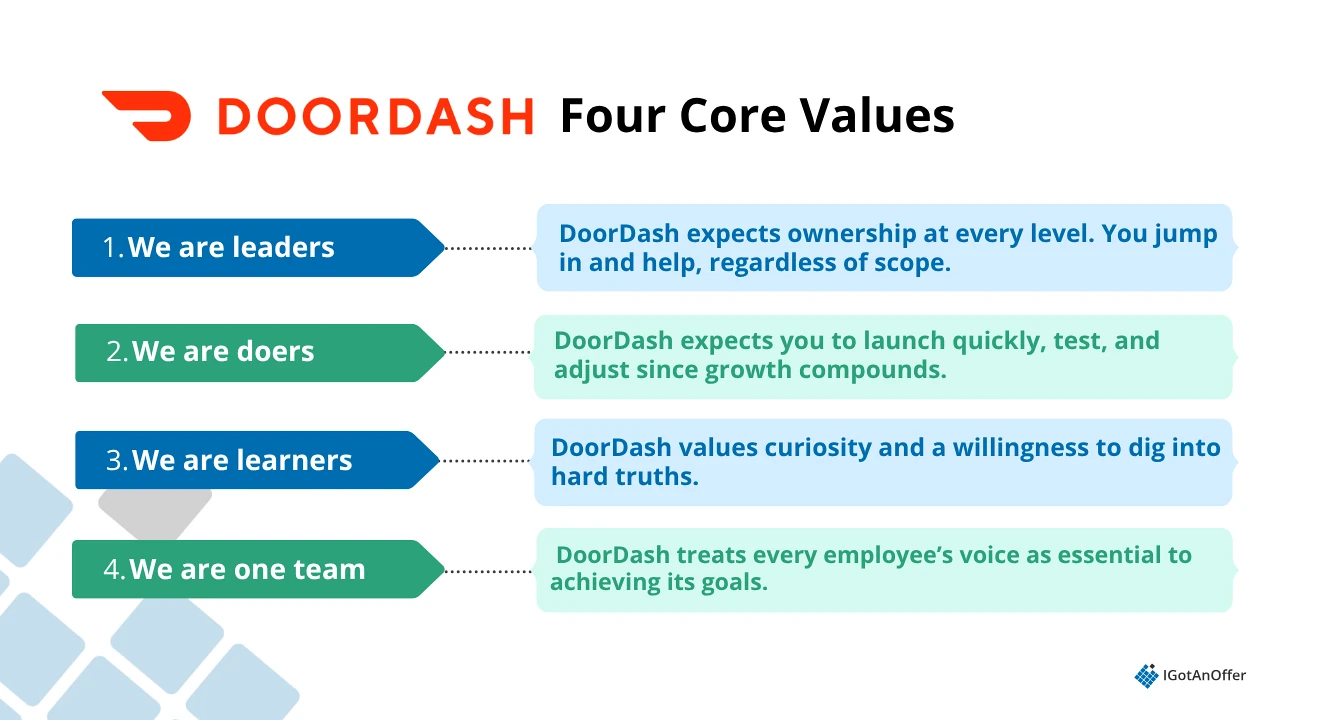
1. We are leaders. DoorDash expects ownership at every level. This shows up in three principles:
- Be an owner. No problem is too big or too small. You jump in and help, regardless of scope.
- Dream big, start small. Take a small idea, grow it using data and rigorous testing, then double down on what works.
- Choose optimism and have a plan. As DoorDash puts it, “positive thinking brings people along, especially when things are tough.” In interviews, this means walking through how you've kept teams motivated through setbacks, rather than just listing the wins.
2. We are doers. Speed is a core part of how DoorDash operates. The doer principles are:
- Bias for action. Launch quickly, test, and adjust. Growth compounds, so getting started matters more than getting it perfect.
- Operate at the lowest level of detail. Know the details that drive the business. Surface-level understanding doesn't cut it.
- And, not either/or. Don't pick between options when you can engineer a way to do both. Reject false dichotomies.
3. We are learners. DoorDash values curiosity and a willingness to dig into hard truths. They gauge that with the principles here:
- Truth seek. Dig into uncomfortable truths using data and common sense, even when the answer is inconvenient.
- 1% better every day. Aim for constant improvement rather than perfection. Share feedback and celebrate a growth mindset.
- Customer-obsessed. Stay connected to the people you serve. Learn from customers, not from competitors.
4. We are one team. DoorDash treats every employee’s voice as essential to achieving its goals. This value breaks down into three principles:
- Make room at the table. Grow a diverse and inclusive community. Innovation happens when everyone has the tools and opportunity to thrive.
- Think outside the room. Consider people who aren't in the meeting when making decisions.
- One team, one fight. Success and failure are shared. The culture is high-accountability and no-blame.
During interviews, you'll be evaluated on how well you align with these values. You don't need to use DoorDash's exact language, but you do need concrete examples that show these principles in action. Think of a time you took ownership of an ambiguous problem, made a fast call without complete data, or pushed back on a comfortable assumption with the truth.
Check out our behavioral interview guide for more tips on how to structure your answers and better showcase these traits.
4. DoorDash interview process and timeline ↑
The full process typically takes four to eight weeks from the recruiter call to the offer, though it can move faster for priority roles. The steps can vary by role, but most candidates go through these main stages:
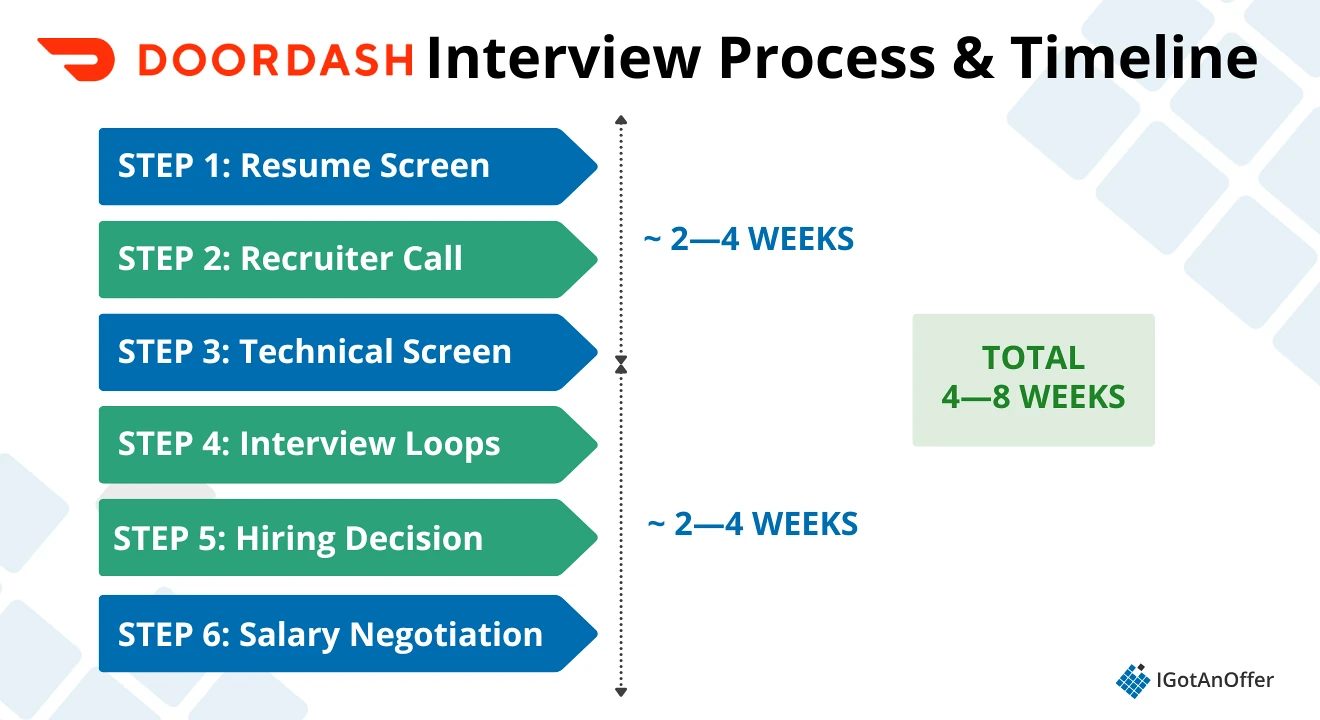
- Resume screen
- Recruiter call (30 minutes)
- Technical phone screen (45-60 minutes, 1 round)
- Virtual onsite interviews (4-5 rounds, 60-75 minutes each)
- Hiring decision (~1-2 weeks)
- Salary negotiation
Your recruiter may clarify your specific process during the initial call.
Step 1: Resume screen↑
The first step of DoorDash's interview process is the resume screen.
After you've submitted your application through the DoorDash careers portal, or if you’re contacted directly via email or LinkedIn, recruiters will evaluate your resume to see if your experience aligns with the open position.
This is an extremely competitive step, as we’ve found that ~90% of candidates don’t make it past the resume stage. To help you put together a targeted resume that stands out from the crowd, follow the tips below:
Tips on crafting a resume
- Study the job description: The work experience you showcase on your resume should directly relate to the role qualifications. For software engineers applying to platform teams, for example, emphasize systems-level work and scale.
- Be specific: Use data to back up your claims. How many users did your product serve? How much did you improve latency, conversion, or cost? Quantify as much as you can.
- Emphasize impact and scale: DoorDash values people who have worked on systems and problems at a significant scale. Highlight work affecting millions of users, real-time logistics, or complex distributed systems.
- Be concise: Recruiters often don't have much time to study a resume in depth, so keep it clear and concise, emphasizing roles and achievements that make you stand out.
For more detailed guidance on crafting a competitive resume, take a look at one of our free resume guides below:
- Tech resume guide
- Software engineer resume guide
- Engineering manager resume guide
- Product manager resume guide
- Machine learning engineer resume guide
- Data science resume guide
- Technical program manager resume guide
If you want more personalized feedback from people who understand what DoorDash looks for, you can also get input from our resume coaches.
This step typically takes about a week, though response times can vary, so be prepared to wait a little longer to hear back.
Step 2: Recruiter call↑
If your resume passes the initial screen, a DoorDash recruiter will reach out to schedule a call. This typically lasts 30 to 45 minutes.
The call is primarily a background and fit conversation. You can expect questions like:
- Tell me about yourself.
- Why DoorDash?
- Walk me through your resume.
The recruiter is assessing whether your experience broadly matches the position and whether you communicate clearly.
Your recruiter will also walk you through the overall interview process. If you have any specific questions about the timeline, the team, or clarification about the job description, now is the time to ask.
One thing you should clarify early is the level for which you’re being considered. Interview expectations can vary significantly by level and team, even for the same job title. In some cases, strong candidates fail simply because they were evaluated at the wrong level.
If all goes well, the recruiter will get back to you to schedule the technical phone screen.
Step 3: Technical phone screen↑
Once you pass the recruiter call, you'll progress to the technical phone screen, assuming there's a fit.
This is the first technical assessment. The goal here is to evaluate your problem-solving and coding skills, and to get a deeper read on whether your experience matches the role.
Here's what to expect during the technical phone screen:
3.1 Role-specific technical assessment
The format depends on your position:
- Software engineers get a 60-minute round on HackerRank or CoderPad in one of two formats: a Code Craft challenge, where you build a working service from scratch, or a debugging exercise, where you fix bugs in an unfamiliar codebase. Code Craft tests clean code under time pressure; debugging tests how well you read code you didn't write.
- Product managers get a 45-minute round with the hiring manager or a senior PM. The focus is on product sense or product prioritization, drawn from DoorDash's four PM question categories.
- Engineering managers get a conversation that combines system design and team building in a single call, according to candidate reports on Blind. The hiring manager wants to see how you approach both technical decisions and people leadership.
Technical assessments are typically conducted on coding platforms like HackerRank or CoderPad, where interviewers can run your code against test cases. Some teams use plain screen sharing instead.
Note: You won't be allowed to use outside tools, including AI assistants, and violating these rules will result in disqualification.
3.2 Behavioral and motivation questions
Even though this is a technical round, expect a few minutes on your background, recent work, and why you want to join DoorDash. The hiring manager (or whoever is running the screen) wants a quick read on cultural fit before passing you to the onsite panel.
If you advance, the recruiting team will schedule your virtual onsite.
Step 4: Virtual onsite interviews↑
The onsite interviews are the most challenging and intensive part of DoorDash's hiring process.
DoorDash onsite interviews are conducted virtually for most roles, with 4 to 5 interviews of 60 to 75 minutes each, often spread across one or two days. Some teams may invite final candidates to visit an office, but virtual interviews are the default.
The exact format varies by team and role, but most onsite rounds include:
-
Code craft challenge (software engineers)
This is a practical coding round where you build a small, functional service from scratch, then extend it as the interviewer adds requirements. It's closer to a day on the job than a LeetCode puzzle.
During this round, interviewers evaluate whether you can build well-structured, practical solutions with clean and readable code. They’ll also assess your API design and data modeling decisions, how you handle edge cases and testing, and how clearly you communicate trade-offs throughout the exercise.
Example code craft challenge questions to expect:
- Build a service that calculates dasher pay from a set of completed deliveries.
- Build a bootstrap API.
Learn more about how to get better at coding interviews here. Then, check out our coding interview prep guide for a complete list of practice questions.
-
Coding debugging round (software engineers)
In this round, you're given an existing codebase with one or more bugs and asked to find and fix them. The code is unfamiliar, so part of the test is how quickly you can get your bearings in someone else's work. In the onsite version, the bugs are subtler and the codebase is bigger than in the phone screen.
What separates strong candidates is how methodically they isolate the problem. Read the failing tests, trace the code path, and form a hypothesis before touching anything. The interviewer is watching that process as much as the fix itself.
Example code debugging questions to expect:
- Here's a Python service for dasher assignment. Find and fix the logic bugs in how orders are matched to drivers.
- Here's a partially built app with a feature that isn't working. Debug it.
-
System design/domain knowledge (software engineers)
This is a 60- to 75-minute round where you architect a large-scale, real-time system. DoorDash prompts almost always center on its own logistics and marketplace problems rather than generic examples.
Interviewers are evaluating how you scope an open-ended prompt into clear requirements, how you reason about trade-offs between consistency, availability, and cost, and also your failure and recovery plan.
The most common mistake is rushing to an architecture diagram before scoping the problem. The prompts are deliberately open-ended, and interviewers are watching how you handle that ambiguity too.
For senior roles, this round often folds in a domain knowledge component tied to your past projects and the team's stack.
Example system design/domain knowledge questions to expect:
- Design DoorDash's dasher dispatch and matching system.
- Design a real-time delivery tracking system
- Design an order status notification system
Learn about how to prepare for your system design interviews here. If you're applying for an AI or ML role, you might also find our ML system design and GenAI system design interview guides useful.
-
Product interviews (PMs)
Product questions carry a lot of weight at DoorDash. Every decision has to balance the company’s three-sided marketplace at once: customers, merchants, and dashers. The product rounds exist to test whether you can reason through that, which is exactly what the role demands day to day.
Interviewers are evaluating whether you think end-to-end (i.e., identifying issues, proposing solutions, weighing trade-offs), how you set and use success metrics, whether you reason about DoorDash’s three-sided marketplace, and your alignment with DoorDash's values.
Strong candidates state their assumptions up front, keep the user's problem as the north star, and tie every recommendation back to data and the broader business.
Aamna, who interviewed PMs at DoorDash, notes that the company gives candidates a lot of structure on what each round covers, so "there is slightly less room for error compared to product case rounds at other companies."
PM onsite loops cover the four DoorDash question categories, which we’ll get into briefly below.
Example product questions to expect:
- Product sense looks at how you understand a product, who uses it, and how you'd improve it. Example: "Walk me through the experience of using OpenTable to book a reservation. What works, what would you improve, and how would you drive engagement?"
- Product prioritization tests how you allocate resources and sequence solutions against a goal. Example: "Prioritize possible solutions of a problem based on impact and constraints."
- Product retrospective is a behavioral round about a project you've run, with a focus on ownership and outcomes. Example: "Tell me about a time you had to manage a major project."
- Product values is a behavioral round that checks your fit with DoorDash's culture and how you work with others. Example: "Tell me about a time you resolved a conflict between stakeholders."
See full sample questions and prep in our DoorDash PM interview guide.
-
Leadership and people management interviews (EMs)
The EM onsite loop covers system design and cultural fit questions. You'll mostly be interviewed by current engineering managers, with sessions often scheduled back-to-back, lasting up to an hour each.
Interviewers are evaluating your leadership style and how you grow people, how you handle conflict and underperformance, your ability to deliver through a team, and whether you operate at the lowest level of detail while still delegating.
Strong candidates bring specific stories with measurable team outcomes, not just descriptions of their philosophy. They show they can dig into technical detail without taking over the work.
Example leadership and people management questions to expect:
- How do you manage high performers versus low performers?
- How do you approach coaching, mentorship, and retention?
- Tell me about the biggest challenge you've faced as a manager.
See our DoorDash engineering manager guide for a full breakdown of each round.
-
Behavioral questions
Across roles, DoorDash places heavy weight on culture fit. The final round of the onsite is typically a conversation with the hiring manager covering ownership, collaboration, and how you handle ambiguity.
Example behavioral and hiring manager questions to expect:
- Tell me about a time you made a decision with incomplete data.
- Describe a project where priorities shifted mid-flight.
- Walk me through a time you disagreed with a teammate.
For more guidance on how to ace this round, read our behavioral interview questions guide.
Step 5: Hiring decision↑
After you finish your onsite interviews, you should hear back within about a week or two. But don't hesitate to reach out to your recruiter for updates if you haven't heard back within two weeks.
The hiring committee reviews all feedback along with your application materials. They're looking for consistency across interviews and evidence that you meet the technical bar and cultural fit requirements.
Decisions are usually reached by consensus, though the hiring manager has final say if the panel is split.
There are three possible outcomes:
- You receive an offer
- You receive a rejection (DoorDash's policy is typically not to disclose feedback, though some recruiters share informal notes by phone)
- You're asked back for an additional interview (less common, but possible if the panel wants clarification on a specific competency)
After your final interviews, you can expect your recruiter to give you a timeline for the decision.
Step 6: Salary negotiation↑
Once you've passed through all the steps above and received your offer package from DoorDash, you'll negotiate your offer.
At this point, your recruiter will get in touch about the details and likely schedule a call to discuss the terms. If they have not scheduled a call, you can ask for one.
Of course, salary discussions can be difficult and uncomfortable, especially if you’re not used to them. Here are some tips to help you navigate your salary negotiations.
Salary negotiation tips
- Do your research: Have a realistic number in mind based on your level and role. Check Levels.fyi and Blind for DoorDash-specific data, factor in the cost of living in your location, and ideally get input from a current DoorDash employee.
- Be prepared to justify: Why are you asking for higher compensation? Back it up with data, market benchmarks, and the value you bring. Know how your experience translates to impact, whether that's scaling infrastructure, improving marketplace metrics, or driving product adoption.
- Leverage competing offers: If you have competing offers from other companies, share the total comp figure rather than the breakdown. Competing offers from peer companies (Uber, Instacart, FAANG) carry the most weight.
- Negotiate each component separately. If base salary won't budge, you might get movement on equity or sign-on bonus. Consider the back-weighted vesting schedule when evaluating equity offers. Your first-year cash compensation will be lower than that of companies with even vesting.
For even more detailed guidance, check out our salary negotiation guides for peer FAANG companies like Amazon, Google, and Meta, where the process isn’t too different.
Even better, you can work with specialized salary negotiation coaches, including former FAANG and DoorDash recruiters, for personalized negotiation help.
5. Are you prepared for your DoorDash interviews? ↑
Learning on your own is an essential first step. We recommend you make full use of the free prep resources on this blog. That way, you can see what an excellent answer looks like.
You can start by reading these free interview guides, both for DoorDash and other similar tech companies:
Role-specific
- DoorDash product manager interview
- DoorDash engineering manager interview
- DoorDash strategy and operations interview
Technical (coding and system design)
- Coding interview prep
- Coding interview questions
- System design interview prep
- ML system design interview
- GenAI system design interview
Behavioral
Product
- Product sense interview questions
- Product strategy interview questions
- Product design interview questions
- Product metric interview questions
- Product improvement interview questions
- Product prioritization interview questions
- PM behavioral interview questions
Also, we've coached more than 20,000 people for interviews since 2018. In our experience, practicing real interviews with experts who can give you company-specific feedback makes a huge difference.
Find a DoorDash interview coach so you can:
- Test yourself under real interview conditions
- Get accurate feedback from a real expert
- Build your confidence
- Get company-specific insights
- Learn how to tell the right stories, better
- Save time by focusing your preparation
Landing a job at DoorDash often results in significant career growth and the opportunity to work on real-time marketplace problems at scale. Three or four coaching sessions worth ~$500 make a great difference in your ability to land the job.
Click here to book mock interviews with experienced DoorDash interviewers.





 Strategy and operations manager


 Product sense