

 Back to other articles
 Last updated: September 28, 2026
 Interviews
 Product manager
 Deeply researched
Product manager interviews at Netflix are extremely competitive. And with the rise of AI, the hiring bar has shifted. The company now prioritizes AI-savvy candidates, and with many current PMs becoming heavy vibe coders themselves, you may get a vibe coding round depending on the team.
Thankfully, the right preparation makes all the difference.
To put together this guide, we’ve gathered information from Netflix candidate reports on Glassdoor, other online sources, and official guides, as well as expert insights from ex-Netflix Lead PM and interview coach Michael.
Below, you’ll find a detailed overview of the Netflix PM role, its interview process, example interview questions, how to answer them, and a preparation plan.
Here’s an overview of everything we’ll cover:
Key takeaways from this Netflix PM interview guide:
- Netflix is pushing for ‘an aspiration for AI fluency’ in all its current and potential PMs.
- Netflix values culture alignment above all else, but don’t be afraid to challenge aspects of it in the interview.
- Asking smart clarifying questions signals PM maturity.
- When answering product questions, stand out by bringing your user segment to life with a brief narrative.
- Netflix values radical candor. Prepare examples of how you handled conflict with someone by going directly to them rather than escalating the issue for others to resolve.
Click here to book 1-on-1 coaching with product manager interviewers.
1. Netflix product manager role and salary ↑
Before we dive into the Netflix product manager interview process, it’s important to understand the role itself. Here’s what you need to know about what the Netflix PM role involves, what Netflix looks for, and what you can expect to earn.
1.1 What does a Netflix product manager do?
Product managers are part of Netflix’s dynamic product division, which encompasses three teams: product management, product design, and product discovery & promotion.
As a product manager at Netflix, you are primarily responsible for how people (including members, non-members, and content creators who work with Netflix) interact with its service across different devices.
To thrive in the PM role, you’ll need a deep understanding of the company’s primary product, content, and its fusion of technology and entertainment.
According to current PM job listings at Netflix, product managers are expected to:
- Build strategic roadmaps and take product concepts through the entire product lifecycle of ideation, validation, shipping, measurement, and iteration
- Lead and collaborate across various departments (including design, engineering, consumer insights, and data science) to deliver outstanding products to Netflix customers
- Build business cases and measure the impact of product innovations, alongside data science partners
- Understand and translate the evolving needs of Netflix customers, alongside consumer insights and design partners
- Represent your team’s work to senior executives, and author strategy memos and presentations
One thing to note about Netflix is that its engineers with a longer tenure have real influence over product strategy, according to Michael, an ex-Netflix Lead PM who also coaches candidates for the company.
So as a PM, you’ll need to show you have enough technical fluency to have credible conversations with engineers about APIs, system architecture, experimentation, data pipelines, reliability, or platform tradeoffs, depending on the team.
Your exact responsibilities will depend on the specific PM role you’re applying for. Example PM specializations at Netflix include: commerce growth, sales products (ads), consumer identity and authentication, and developer platforms.
Ultimately, your goal as a Netflix PM is to ensure that its content reaches its worldwide audience in a seamless and highly personalized way, allowing them to discover even more content that delights and engages them. This is the user-centric experience that Netflix is known for.
1.2 Is AI fluency a requirement for Netflix PM candidates?
AI fluency isn’t explicitly listed as a requirement on many of the currently posted PM roles. But, according to this interview with Elizabeth Stone (Netflix Chief Product and Technology Officer), the company is encouraging "an aspiration for AI fluency" among all its employees and candidates.
How does that shift in mindset show up in the hiring process? You could expect to get questions about how you use AI in your current workflow, or even how comfortable you are with change and exploration.
Does this mean you’ll likely get a vibe coding interview at Netflix? According to Michael, he hasn’t heard of any official vibe coding rounds yet.
"But I am almost certain this will change in the very near future, as many within the company are currently heavy vibe coding users in their day-to-day work," he says.
As of writing, we can confirm that we've found no actual candidate reports that mention vibe coding. But it’s an excellent technical skill to learn and may help you stand out in your interviews.
1.3 How much does a Netflix product manager make?
The compensation for a Netflix PM varies depending on your location and the exact PM role or specialty you occupy. Historically, most Netflix PM postings state a salary range of $120k - $515k, while certain PM roles go up to $440,000 – $725,000.
Netflix states that they rely “on market indicators and [consider] your specific job family, background, skills, and experience to determine your compensation in the market range.”
Below, you’ll find the average total yearly compensation for different product manager levels at Netflix US, as of 2026, based on Levels.fyi data:
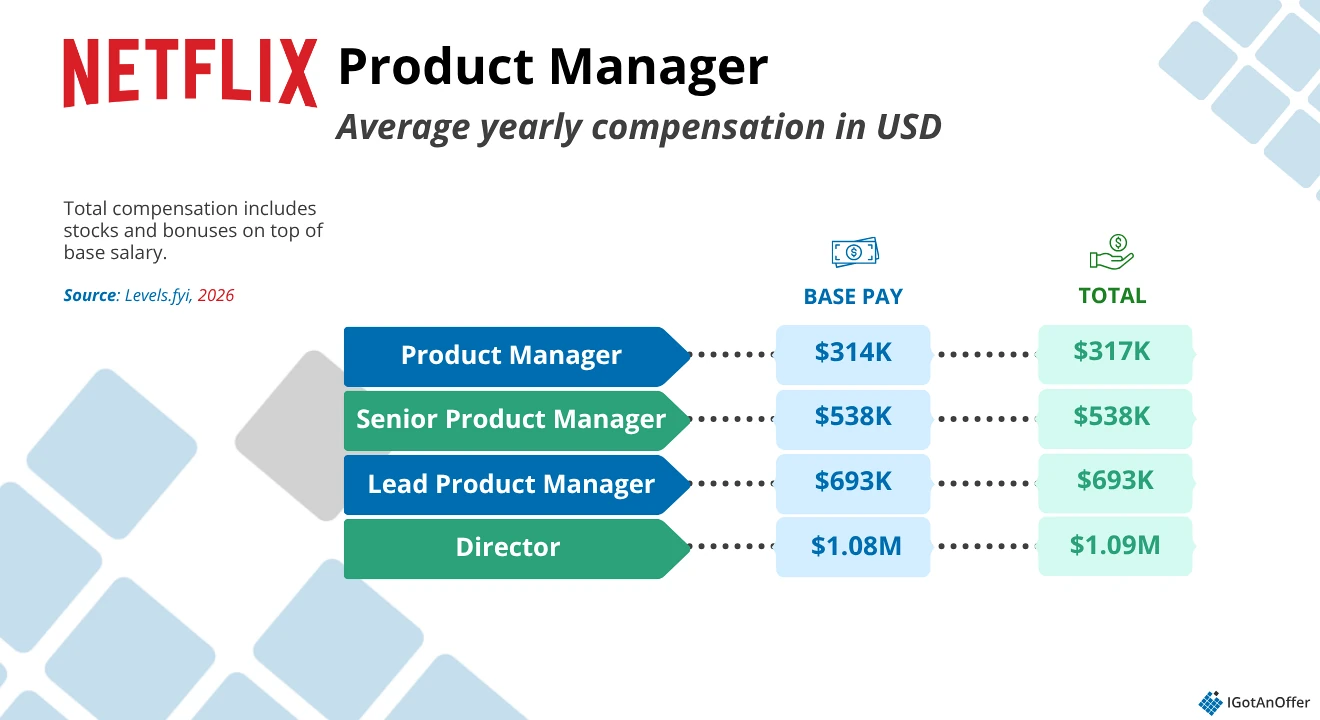
Netflix's compensation structure differs from most tech companies. Instead of granting stock that vests over several years, Netflix lets employees decide each year how much of their pay they want in cash versus stock options.
You can choose all cash, all options, or any mix that suits you. The options are fully vested from day one, valid for ten years, and remain yours even if you leave the company. This setup gives employees both flexibility and the opportunity to benefit from Netflix’s long-term growth.
Netflix generally does not give bonuses. However, it does offer a suite of benefits, including comprehensive health plans, a 401K retirement plan, among many others.
Ultimately, how you do in your interviews will help determine your offer. That’s why hiring one of our ex-FAANG PM interview coaches can provide such a significant return on investment.
And remember, compensation packages are always negotiable, even at Netflix. So, if you do get an offer, don’t be afraid to ask for more! Netflix recruiters are known to be transparent and responsive, as long as you come prepared with data and context.
If you need help negotiating, check out our product manager salary negotiation guide and consider booking one of our salary negotiation coaches to get expert advice.
Coaches who contributed to this guide



2. Netflix product manager interview process ↑

The Netflix interview process for PMs generally takes about three to six weeks to complete.
Here’s a quick overview of the steps you may face along the way:
- Resume screen (may include cover letter and referrals)
- Recruiter screen
- Hiring manager screen
- Onsite interview loops
- Final culture fit interview
- Hiring committee
- Salary negotiation
If you are interviewing for a product leadership position (VP, Director, Group PM) or senior PM role, check out our guides: product leader interview and senior product manager interview questions to learn more about what questions to expect and how to prepare.
Now, we’ll cover each of the steps we listed above in more detail, so you can get a better idea of what to expect and how to prepare.
2.1 Resume screen (may include cover letter and referrals) ↑
The first step of Netflix's PM interview process is the resume screen. For that, you’ll need a high-quality resume tailored to the Netflix PM position you’re targeting.
After you've submitted your application through the Netflix jobs portal or been contacted directly via email or LinkedIn, recruiters will evaluate your resume to see if your experience aligns with the open position.
This is a highly competitive step. To help you put together a targeted resume that stands out, follow the tips below:
Tips on crafting a resume
- Study the job description: Your work experience should relate directly to the role qualifications you're applying for. Netflix typically doesn't hire entry-level candidates, so emphasize your senior-level accomplishments.
- Be specific and quantify: Use data to back up your claims. How many users did your features impact? What measurable improvements did you drive? Netflix cares deeply about scale, availability, and impact.
- Emphasize ownership and leadership: Netflix values "context, not control." Highlight situations where you operated with significant autonomy, drove decisions, and owned outcomes. Show examples of emergent leadership, even if you weren't in a formal management role.
- Demonstrate culture alignment: While you shouldn't explicitly reference the culture memo in your resume, your experience should demonstrate the behaviors Netflix values: judgment, innovation, courage, communication, and impact.
- Be concise: Keep your resume to 1-2 pages maximum. Recruiters don't have time for lengthy documents, so make every word count.
If you have yet to apply, you can optimize your documents by using our product manager resume guide and PM cover letter guide. You can also get our FAANG recruiters or PMs to review your resume.
As with most companies, it can also be helpful to get an employee or contact at Netflix to refer you to the recruiting team. In our experience, the most straightforward way to do this is to contact Netflix employees you share connections with directly on LinkedIn.
2.2 Recruiter screen (30 min)↑
Next, you'll usually start your interview process by talking to an HR recruiter on the phone. This call typically lasts 30 minutes. During this stage, recruiters are seeking to know:
- Does this person have the baseline experience and skills for the role?
- Will this person thrive in Netflix's culture?
Netflix takes cultural fit more seriously than most other companies. The recruiter call is where that evaluation begins.
As a result, you’ll need to show your enthusiasm for their mission and answer questions like "Why Netflix?" or "Tell me about yourself." Review the Netflix culture memo before this call to increase your chances of advancing to the interview stage.
If you’re unsure about what steps are ahead in the interview process, take this opportunity to ask any clarifying questions about what you can expect. The recruiter will be your point of contact for the rest of the interviews.
2.3 Hiring manager screen (45-60 min)↑
After your recruiter screen, you’ll move on to the hiring manager screen, which typically lasts 45-60 minutes. It’s a bit similar to the recruiter screen, but goes more in-depth into your past professional experiences and role fit.
During this stage, the hiring manager is trying to gauge how you think and communicate, as well as how you connect product choices to important business outcomes.
Expect questions related to culture fit, behavioral, product design, and other role-related knowledge. We cover these question types in more detail in section 3.
If you manage to clear this screening, you’ll be given a case study prompt. You have 1 to 3 weeks to work on this and turn your answer into a 15-minute presentation.
2.4 Onsite interview loops↑
If you pass your hiring manager screen, you’ll move on to the onsite interview loops.
This is the most extensive stage of the Netflix interview process and typically consists of 4-5 interviews done in one day. They may take place in Netflix’s offices or virtually over video call.
These interviews will be done by different Netflix team members, including:
- Interviews with cross-functional teams: A couple of your onsite interviews will likely be with members and leaders of teams you’ll be working with. You’ll likely get a panel with cross-functional team members, and a 1-on-1 with a leader, like one of the Directors of Engineering if you’re applying to a technical PM post.
- Interviews with internal team members/leader: Your next on-site interviews will be with members and leaders of the product team you’ll be joining, if you succeed with your application. Apart from testing you on your product knowledge and culture fit, expect the PM team members to focus on how you work with others.
In one of these panels, you’ll be asked to present the case study presentation that you were given after your hiring manager interview. You’ll present for 15 minutes, and then spend the rest of the session fielding questions.
In the case study presentation, expect to dive deep into product sense, metrics, strategy, and judgment. To stand out, align your answers to Netflix’s culture memo.
And if you're applying for an AI-focused PM role, you might also get AI-related interview questions. Check out our guide to AI PM interviews to learn more.
Note: Netflix's process is highly decentralized. Questions, format, and emphasis vary significantly by team. This means your experience might differ from others interviewing at Netflix simultaneously.
2.5 Final culture fit interview↑
After the interview loop, expect one final round with the recruiter, where you’ll go more in-depth on questions about the culture memo.
Before this final culture fit interview, you may have already gotten several behavioral questions used to test culture alignment. In this round, prepare to answer even more questions.
Come prepared with concrete examples that highlight Netflix’s cultural pillars: judgment, candor, courage, curiosity, and selflessness.
Watch this video where ex-Netflix lead PM Michael breaks down the Netflix culture interview.
2.6 Hiring committee↑
A hiring committee reviews all interview feedback and makes the final decision on your candidacy. This is a collective judgment process based on your interview feedback, alignment with culture, and how you stack up against other finalists.
While Netflix doesn’t publicly share how its committees work, we’ve had reports from candidates that reveal a consistent pattern.
Netflix recruiters typically inform you that “the team is debriefing” or “finalizing feedback.” This phase can last a few days to several weeks, depending on how many candidates are still in process.
The recruiters generally maintain strong communication throughout, providing updates and, when possible, sharing snippets of feedback. However, some candidates report receiving concise rejections after weeks of waiting, with little explanation.
If you haven’t heard back after a couple of weeks, it’s perfectly fine to follow up with your recruiter for an update. Response times can vary depending on team schedules, so try to stay patient and use the waiting period to prepare for potential next steps.
2.7 Salary negotiation↑
Netflix is known for exceptional compensation, but that doesn't mean you shouldn't negotiate.
The company's philosophy is to pay "top of personal market". Meaning, Netflix looks at your individual market value (what you could get if you were to leave today for another top offer) and tries to match or exceed it.
Looking for a more general guide to Netflix's interview process? Check out this article.
3. Netflix product manager example interview questions ↑
Below, we've compiled lists of real questions from Netflix product manager interviews based on reviews on Glassdoor. We’ve also included a few common questions you can expect at most FAANG PM interviews.
To help you structure your preparation, we've organized them into four categories.
3.1 Culture & behavioral questions ↑
Netflix asks behavioral interview questions to get to know you better based on your past and most recent professional experiences. In particular, they’re interested in whether the way you work and respond to situations aligns with the company’s very specific work culture.
Netflix places a big emphasis on its unique culture. Candidates attest to this, and you’ll also find their culture guide highlighted on their job postings.
The most common advice for anyone applying to Netflix—whether it’s for a PM job or another position—is to read the culture guide and reflect on it.
Reflecting on Netflix’s culture and being honest about what you like about it and your misgivings is a good way for you to determine whether Netflix is the ideal work environment for you.
Bringing up your honest feedback on their culture could also score you points in your interview, as Netflix puts importance on radical candor and feedback.
Preparing radical candor stories is a top tip from ex-Netflix Lead PM Michael. "State specific examples of when you handled conflict with someone by going directly to them rather than escalating the issue for others to resolve," he says.
Here are some culture and behavioral interview questions you should be prepared for.
Example culture questions asked at Netflix product manager interviews
- Why Netflix? (Click here to learn how to answer the 'Why this company?" question.)
- What do you think about the Netflix culture memo?
- What do you like most about the Netflix culture memo?
- What do you like best about the Netflix culture memo, and what resonates less?
- Why did you move from this product area to another?
- Tell me something I can’t find on your resume, LinkedIn, online, etc.
- Tell me something I can’t find on your resume, LinkedIn, online, etc.
- Tell me about your main achievements in your current role.
- Tell me about the area where you have the most to learn.
- Name a time when you experienced a difficult coworker and how you handled it.
- What past global experience do you have managing projects?
- Name a time when you experienced a difficult coworker and how you handled it.
Check out our guide to product manager behavioral questions to get more practice questions and a framework to structure your answers.
For more expert insights into how Netflix culture works and how to crack Netflix PM culture interviews, check out this video we did with ex-Netflix Lead PM and coach, Michael P.:
3.2 Product sense questions ↑
Netflix asks product-related questions to assess your product sense and user-centricity. These questions will naturally come up in the case study, as well as in the hiring manager round and other onsite interviews.
Product sense is your ability to understand what users truly need, translate those needs into focused product decisions, and balance them against business goals and practical constraints. It’s a blend of user empathy, structured reasoning, and sound judgment.
Aside from knowing what to build, you should understand why it matters and how to move the product forward.
As a PM, you’ll also be evaluated on your ability to simplify, prioritize high-leverage opportunities, and make confident decisions in ambiguous situations. Interviewers aren’t just testing creativity. They’re assessing whether you can think like an owner who can define problems sharply, designing solutions that both delight users and drive measurable impact.
To help you organize your product prep, we’ve separated this question type into two specific sub-categories:
- Product design: How you approach creating a new product or feature from scratch. This tests your user-centric thinking, clarity of problem definition, and ability to design simple, high-impact solutions that are consistent with Netflix’s culture of autonomy and excellent judgment.
- Product improvement: How you analyze an existing product, identify meaningful gaps, and propose focused, high-leverage enhancements. This reveals whether you can prioritize what truly moves the needle for users and for Netflix as a business.
These attributes are important in a product manager, especially at Netflix, a company known for its great UX and its willingness to adapt, evolve, and innovate.
Below, you’ll find example interview questions for each product sub-category.
Example product questions asked at Netflix product manager interviews
Product design
- What's your favorite product and why?
- Design a neural network.
- Design a web-based application for collaborative work.
- Design a new feature for an existing Netflix product.
Product improvement
- How would you improve Netflix?
- How would you improve Netflix’s recommendations?
- What would you have done differently with X product?
- Pick your favorite app or website. How would you improve it?
- Describe a situation in which a product you were managing wasn't doing well. How did you overcome it?
If you'd like to learn more about answering this kind of question, then check out our separate guides on product sense, product design, and product improvement interview questions.
If you’re targeting an AI PM role, our AI PM questions guide should give you an idea of what questions to expect.
3.3 Metrics and strategy questions ↑
Netflix asks metrics and strategy questions in order to gauge how well you use data to strategize as a PM.
As a Netflix PM, you’re in charge of defining the product vision and articulating a roadmap to deliver it. A big part of that roadmap is identifying the right metrics to track, measure, and analyze to assess a product’s success.
These questions are usually built into product case interviews, but do be prepared for stand-alone rounds that dig deeper into these types of questions. You’ll usually get questions about Netflix’s business model, so you’ll want to be more than familiar with the company’s products.
Here are a few example questions to practice with.
Example metrics and strategy questions asked at Netflix product manager interviews
Metrics
- What are the things that Netflix should measure and analyze on a daily basis?
- Define metrics for Netflix Podcasts.
- How would you measure the success of the Netflix recommendation engine?
- What are the key metrics to be captured for a streaming service product?
- How would you measure engagement for Netflix?
Strategy
- How did you come up with the most innovative idea you've ever come up with? How did you implement it?
- What are your plans for Netflix’s expansion into new markets in the region?
- If you were the CEO of Netflix, what new product line would you come up with to increase revenue?
Learn more about both topics, including the best frameworks to structure your answers, by reading our separate interview guides: product metrics and product strategy.
3.4 Product judgment questions ↑
Netflix asks product judgment questions to assess the following key PM skills: how you prioritize, manage stakeholders, and make decisions. These questions may be baked into your product case interviews, or you may get specific behavioral questions regarding them.
In particular, Netflix wants to see how you operate in a fast-moving environment where you’ll constantly need to make decisions with limited data, high uncertainty, and real-world constraints.
Product managers often need to size opportunities, forecast impact, and assess trade-offs without waiting for perfect analytics. Your ability to reason clearly, stay grounded in first principles, and justify your assumptions shows interviewers how you’ll perform when making decisions that affect millions of users.
Instead of looking for perfect numbers, interviewers want to see how you frame a problem, identify the most meaningful inputs, and make reasonable assumptions. The emphasis is always on your thinking, not the final figure.
Example product judgment questions asked at Netflix product manager interviews
- If you were a VC, would you be more bullish on AR or VR? Why?
- If you were the CEO of Netflix, what are the top three things you would do?
- How do you prioritize what to build?
- If you have projects A, B, C, how do you prioritize them?
- How do you prioritize in your current role?
Read our guide to prioritization interviews for PMs to learn how to tackle product judgment questions.
4. Netflix product manager interview tips ↑
You might be a fantastic product manager, but unfortunately, that’s not necessarily enough to ace your interviews at Netflix. Interviewing is a skill in itself that you need to learn.
Here are some tips on how to approach your Netflix PM interviews effectively.
4.1 Ask smart, clarifying questions
Some of the questions you will be asked will be quite ambiguous. In those cases, you’ll need to ask clarifying questions to get more information about the problem and to reduce its scope.
Jumping straight in without asking questions first will be a red flag to the interviewer and hinder your answer.
According to Michael (ex-Netflix Lead PM), asking a couple of focused questions signals to interviewers a kind of PM maturity, and shows that you’re not going to rush into solutioning.
But don’t just ask any questions; be smart about them.
For instance, if you were asked, "What would be your 10-year strategy if you were CEO?" you can respond by asking some questions about the company’s current situation and any business objectives the interviewer may have in mind. This way, you’ll have a better understanding of what the company needs in the coming years and have more information from which to build a strategy.
4.2 Adapt to your interviewer’s follow-up questions
Don’t be alarmed if your interviewer asks follow-up questions; this is perfectly normal.
Listen carefully to how your interviewer asks these questions. There will often be a subtle clue about the specific skills they’re looking to assess from the next part of your answer.
For example:
- "How did your team react to that?" → They're testing collaboration and influence.
- "What other options did you consider?" → They're testing judgment and the decision-making process.
- "What would you do differently now?" → They're testing self-awareness and growth.
- "How did you measure success?" → They're testing impact orientation and data-driven thinking.
If an interviewer asks, 'Tell me more about X situation or project,' they're often testing whether you actually did the work or if you're speaking generally about team efforts.
4.3 Check in with your interviewer
Interviewers differ in their willingness to provide hints. Some may wait for you to ask about customer or product details, while others expect you to make assumptions on your own.
Gauge this by asking a direct question or specifying your assumptions. If the interviewer tends to offer specifics, they’ll engage. If not, limit additional questions to demonstrate your ability to make decisions independently.
4.4 Justify your choices
Netflix wants to see the reasoning behind your answers, so make sure to justify each decision you make. You'll need to make plenty of trade-offs as you arrive at a solution, so be sure to call them out.
One of Netflix’s valued behaviors is judgment, in particular, "making wise decisions despite ambiguity," "using data to inform your intuition and choices," and "making decisions mostly based on long-term, rather than near-term, impact." Keep these in mind when answering decision-related questions.
4.5 Be data-driven, but not too data-driven
Netflix is looking for product managers who can make decisions based on data and judge everything they do by relevant metrics.
In an interview situation, it's okay to make assumptions because you might not have access to the facts and data. But you need to make it clear that in real life, you would seek out that data and that your approach would be highly data-driven.
That said, Netflix is also looking for PMs who are comfortable with some level of ambiguity. In her blog, Netflix rejected me. I didn’t have this PM Skill, Academy of PM founder Sondra Orozco shares that being "too data-driven" caused her to be rejected from a Netflix PM job.
She writes, "I learned that day that product decisions often need to be made with imperfect data. So product managers must be able to deal with ambiguity and make good decisions in the midst of uncertainty."
4.6 Demonstrate user empathy
When answering a PM interview question, your first instinct should be to focus on the user. Identify who uses the product, why, and what the use cases are. Avoid designing a product based solely on personal preferences.
As part of your prep, think hard about the different kinds of users across Netflix’s device ecosystem and be prepared to divide them into segments.
One way to truly stand out in your product interviews is to bring your users to life with a short narrative. Talk about the pain points and proposed solutions from their point of view.
Michael says, "I think that's the empathy layer that really transforms a competent answer into something really memorable for the interviewers."
4.7 Highlight your contribution in a cross-functional collaboration
As a PM candidate, you’ll naturally get questions about your experience with cross-functional collaboration.
When talking about your experience, talk about what the team did, but don’t focus on that. Instead, highlight what you did. The ability to influence without authority is essential for the role.
Demonstrate your ability to:
- Influence without authority: Show how you've driven alignment when you don't control resources.
- Build consensus among diverse stakeholders: Product management work requires collaboration among various teams. Prove you can navigate competing priorities.
- Communicate technical concepts to non-technical audiences: Your sales team, for example, needs to understand what you're building and why it matters.
- Navigate organizational complexity: Netflix is a large and fast-paced company. Show you understand how to work in complex environments.
- Manage conflicting priorities across teams: Engineering wants to pay down tech debt, the sales team wants new features yesterday. Show how you balance these tensions.
Make sure to prepare stories to PM behavioral questions that showcase these leadership and collaboration skills.
4.8 Learn a technique for answering questions
"The combination of structure, rigor, and empathy separates a good PM from a great one," Michael says.
One way to demonstrate structure and rigor is to answer interview questions in a structured way. Having a structure helps you make sure you cover all your bases, while also keeping your answers easy to follow.
For product design questions, we recommend using the BUS framework (Business objective, User problems, Solutions).
For behavioral questions, the STAR method (Situation, Task, Action, Result) is a popular approach, but we recommend the IGotAnOffer method (SPSIL: Situation-Problem-Solution-Impact-Lessons) to make sure you cover what you’ve learned, which STAR users typically miss.
The 'Lessons' component is particularly important because Netflix values growth and self-awareness. Interviewers want to see that you extract learning from experiences and apply it forward. Many candidates skip this step, leaving interviewers to wonder if you actually learned anything from the situation.
4.9 Don’t get stuck in a framework
Frameworks are extremely helpful. However, some of our successful candidates have mentioned that excessive reliance on frameworks may hinder performance.
"Interviewers care more about your quality of reasoning and your ability to deliver clear and concise recommendations with supporting data-driven decision-making rationale," Michael says.
4.10 Exhibit a coachable mindset
According to Michael, one common mistake PM candidates make is not displaying a coachable mindset during the interview.
"Having the curiosity to engage with others in areas that you may be uncertain about and displaying a sense of intellectual honesty is the kind of growth mindset that interviewers want to see from candidates," he says.
Demonstrate this by owning up to gaps in your knowledge and asking clarifying questions about areas you’re not familiar with. Listening intently and picking up on helpful hints are also signs of a coachable mindset.
4.11 Center on the company’s core values
We cannot stress enough how important it is to deeply study Netflix’s culture page. When answering culture fit and behavioral questions, share stories from past experiences that align with Netflix’s core values. When designing a product or a strategy, consider how your answer aligns with these values.
4.12 Save questions and feedback for your interviewer
Prepare thoughtful questions that go beyond what you could have found out online. You can ask about career growth opportunities or specific ways of working in the company. It's your chance to showcase genuine curiosity and investment in the conversation.
Similarly, Netflix loves it when candidates challenge the company. Come prepared with feedback about Netflix in general—whether it’s an item on the culture guide, a feature of the streaming platform, their global strategy, or even their selection of programs.
As Valarie Toda, vice president of talent acquisition at Netflix, said in the Business Insider article on how to get a job at Netflix, "Come with questions, challenge our thinking."
This is in keeping with an item on Netflix’s culture guide: “We do not seek to preserve our culture—we seek to improve it. Every new employee helps to shape and evolve the culture so we find new ways to accomplish more together.”
5. Preparation plan ↑
Now that you know what questions to expect, let's focus on preparation.
Below, you’ll find links to free resources and four introductory steps to help you prepare for your Netflix PM interviews.
5.1 Deep dive into the product/organization
As you've probably figured out from the example questions listed above, you can't become a PM at Netflix without being familiar with the company's products and its organization. You'll therefore need to do some homework before your interviews.
Here are some resources to help you get started with this:
- Netflix Culture
- Netflix Product Strategy: A 2020 Case Study by Gibson Biddle (Previous VP of Product at Netflix)
- Netflix Techblog
- Netflix Annual Reports and Proxies
5.2 Learn a consistent method for answering PM interview questions
As we mentioned previously, Netflix will ask you questions that fall into certain categories, like culture, behavioral, design, strategy, and estimation questions. Approaching each question with a predefined method will enable you to build strong interview habits.
Then, when it comes time for your interviews, these habits will reduce your stress and help you to make a great impression.
If you’re just looking for a jumping-off point, you can start learning about the different question types you’ll need to master in the following interview guides:
Netflix guides
- Netflix interview process and timeline
- Netflix culture and behavioral interview guide
- Netflix interview questions by role (with answers)
Behavorial
Product
- Product sense questions
- Product design questions
- Product improvement questions
- Product execution questions
Others
- Prioritization questions
- Strategy questions
- Metric questions
- Technical questions
- Estimation questions
- AI PM interview questions
For an in-depth look at how an actual ex-Netflix product manager would answer a common PM interview question, watch our interview walk-through with Michael P. below.
Then, try answering the questions yourself and use our PM interview grading rubrics to assess your performance and identify areas for improvement.
Once you’re in command of the different subject matters relevant to your target role, you’ll want to practice answering questions.
But by yourself, you can’t simulate thinking on your feet or the pressure of performing in front of a stranger. Plus, there are no unexpected follow-up questions and no feedback.
That’s why many candidates try to practice with friends or peers.
5.3 Practice with peers
If you have friends or peers who can do mock interviews with you, that's an option worth trying. It’s free, but be warned, you may come up against the following problems:
- It’s hard to know if the feedback you get is accurate
- They’re unlikely to have insider knowledge of interviews at your target company
- On peer platforms, people often waste your time by not showing up
For those reasons, many candidates skip peer mock interviews and go straight to mock interviews with an expert.
5.4 Practice with experienced PM interviewers
In our experience, practicing real interviews with experts who can give you company-specific feedback makes a huge difference.
Find a Netflix product manager interview coach so you can:
- Test yourself under real interview conditions
- Get accurate feedback from a real expert
- Build your confidence
- Get company-specific insights
- Learn how to tell the right stories, better.
- Save time by focusing your preparation
Landing a job at a big tech company often results in a $50,000 per year or more increase in total compensation. In our experience, three or four coaching sessions worth ~$500 make a significant difference in your ability to land the job. That’s an ROI of 100x!






 Product sense