


 Back to other articles
  Last updated: June 15, 2026

 Salaries
 Deeply researched
First off, congratulations on clearing Google's onsite and hiring committee. Before you can relax, there's one last hurdle between you and a formal offer: the team matching phase.
If you're about to enter this stage, or you've been stuck in it for weeks, this guide is for you. To put it together, we drew on our experience coaching candidates through Google's hiring process, alongside real candidate reports from forums like Blind.
We'll walk you through how Google team matching works, how long it takes, what hiring managers ask, and what to do if you match or fail to match with a team.
- Google team matching process and timeline
- Google team matching validity and attempt limits
- How to navigate Google team matching
- What happens if you fail the Google team matching
- You got a successful team match, here's what to do next
Book 1-on-1 salary negotiation coaching with an ex-Google coach
Let’s get started!
1. Google team matching process and timeline ↑
Before we get into the details, it helps to understand where team matching sits in Google's hiring pipeline.
Google's interview process has seven steps:
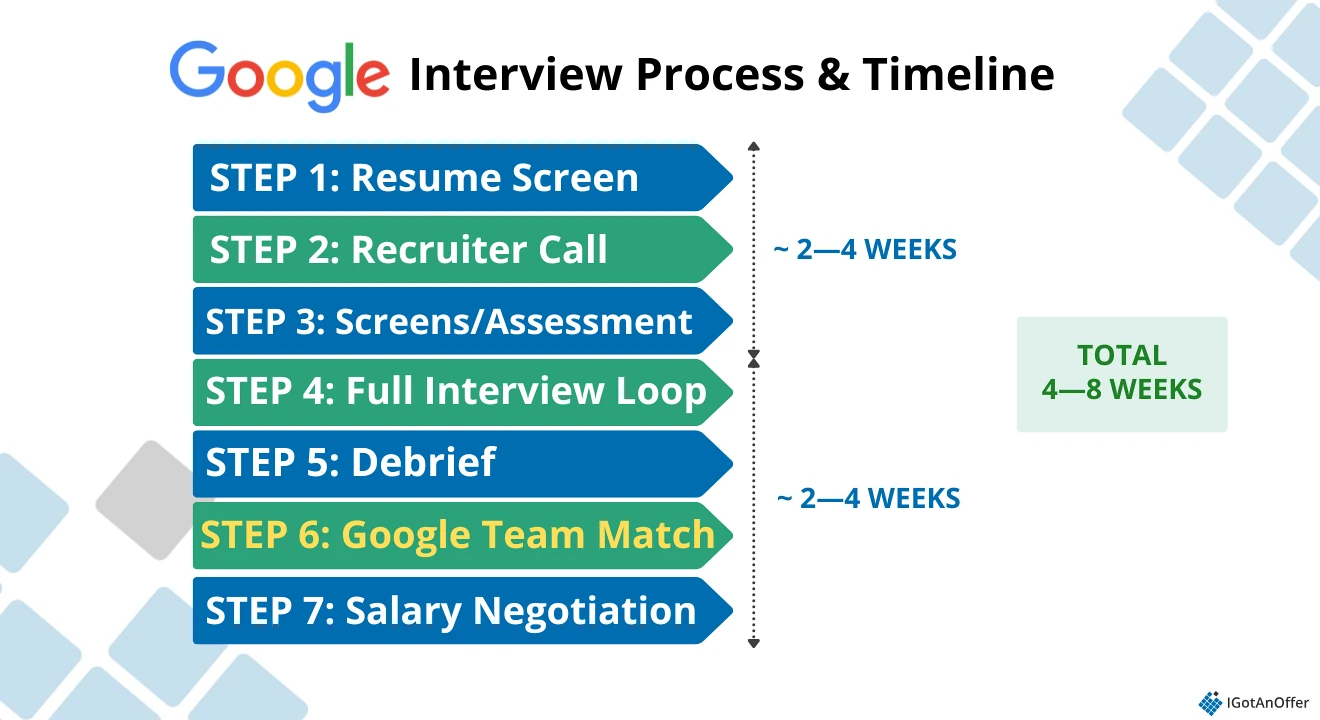
Team matching happens after the hiring committee approves your packet (step 5), but before you receive a formal offer.
At this stage, your recruiter shares your packet (which includes your interview feedback and resume) with teams that have open headcount at your level. If a team is interested, you'll have a call with the hiring manager to assess mutual fit.
The sections below break down how this unfolds.
1.1 What is the team matching process at Google?
Once the hiring committee approves you, your recruiter proposes teams that are actively looking for someone with your skills. You then meet with the hiring manager from each team to gauge fit. A match only happens if both sides want it: you have to want the team, and the hiring manager has to want you.
Some candidates describe these calls as “speed dating.” They typically run 30 to 60 minutes and feel more like a conversation than a formal interview. You'll talk through your background and recent projects, and the manager will explain what their team is working on.
For more senior roles, you may also meet directors or potential teammates. One candidate hired at a higher level described a series of "360" meetings the director set up with engineering leads and product managers across the team.
Note that not every Google candidate goes through this step. If you applied for a role tied to a specific team from the start, you may receive an offer directly for that team and skip team matching. Some teams also run matching before the onsite, when they have a specific opening.
For a fuller picture, see our Google interview process guide.
1.2 How long does Google team matching take?
There's no fixed timeline, and candidate reports vary widely. Some match within a couple of weeks, while others wait several months. An estimate for the current market would land around two to three weeks in the best case and two to three months in the worst case.
The pace depends on how many teams have open headcount at your level, your preferred location, and how specific your background is. Generalists can take longer to place than people with a clear specialty.
The process is also typically serialized, meaning you're introduced to teams one at a time rather than interviewing with several at once. That can stretch the timeline if early conversations don't lead to a match.
2. Google team match validity and attempt limits ↑
Clearing Google's interviews is a major milestone. But until your offer is finalized and in writing, there are a few things worth keeping in mind about the matching stage.
2.1 Does a team match guarantee an offer?
Not on its own. Passing the hiring committee means you've met Google's bar, but an offer only comes once a team selects you. If you can't find a team before your candidacy expires, you won't receive an offer.
Many candidates report passing every interview but never matching, with their results eventually expiring. In tighter markets, headcount is limited, so even strong candidates can sit in the matching pool for a while.
2.2 How long is a Google team match valid?
A hiring committee approval is typically valid for around 12 months. After that, your candidacy expires, and you'd need to re-interview to re-enter the process.
That said, the window isn't always clearly communicated. Some candidates report being told different things by their recruiters. A few sources cite shorter effective windows. It's best to confirm your specific timeline directly with your recruiter rather than assuming the 12-month figure applies to you.
2.3 How many matching attempts am I permitted at Google?
Google doesn't appear to enforce a fixed number of attempts the way some companies do.
Candidates report matching after as few as two calls, while others go through seven or more without a hard stop. One L3 candidate was told their recruiter would share their packet with eight to ten teams.
But the practical limit is momentum. Decline too many teams, respond slowly, or pick up with consistently lukewarm feedback, and Google can quietly deprioritize you. You can say no to a team that isn't right, but staying responsive and decisive is what keeps you in the process.
2.4 Can I delay team matching or take a break from the process?
It's possible, but not guaranteed. Teams with urgent openings tend to move on if you're slow to engage, so a long pause can cost you momentum.
If you need time, the best approach is an honest conversation with your recruiter about your availability.
It’s better to negotiate a later start date once you’re matched with a team. A delayed start is often easier to arrange than a paused search.
3. How to navigate Google team matching ↑
Team matching is a two-way evaluation. The team is assessing whether you fit, and you're deciding whether their work, growth path, and culture are right for you.
The tips below cover both sides.
3.1 What questions to expect from hiring managers
These calls aren't a repeat of your technical loop. You generally won't face coding or system design questions again. Instead, the manager wants to understand your background, how you work, and whether your interests line up with what the team needs.
Come ready to explain your story clearly and tie your experience to the team's problem space. Managers can tell when you're genuinely interested in their work versus reciting generic answers, so always answer honestly.
Below are some questions you can expect during these calls.
Example questions hiring managers ask during Google team matching
- Walk me through a project you've led recently and the challenges you faced.
- What are you looking for in your next role?
- What kind of work are you most interested in?
- What are your strengths, and where do you want to grow?
- How do you approach working with cross-functional partners?
- How does your background fit what our team is working on?
3.2 What questions to ask Google hiring managers
This is the team you'll likely spend the next few years with, so it's worth asking the hard questions. You want to leave the call understanding how the team works, what they're building, and whether you can see yourself growing there.
A useful approach is to let the manager describe the team and role first, then align your questions to what they've shared. Here are questions worth covering, grouped by theme.
Example questions to ask during Google team matching
Technical and product
- What’s the technical stack, and how does it align with your interests or growth goals?
- What are the biggest technical challenges the team is facing?
- How does the team approach technical debt and system reliability?
Growth and impact
- What opportunities exist for technical leadership and mentorship?
- What does the promotion path look like on this team?
- Is this an established team or an up-and-coming area for Google?
Team dynamics
- What’s the team composition (junior vs. senior, tenure, backgrounds)?
- How does the team handle on-call responsibilities and work-life balance?
- What’s the manager’s leadership style, and how do they run team meetings and planning?
Stability
- How long have you been with the team?
- When was the last reorg, and is anything similar on the horizon?
- How has the team been affected by recent headcount changes?
3.3 How to evaluate and choose between Google teams
Once you have the information you need, weigh it against your career goals for the next two to three years. Consider which team best positions you for that path.
Think about what stage the team is in. A fast-growing team can offer more room to step up and take on leadership, while a team focused on infrastructure or optimization may give you deeper technical problems to grow into. Match the environment to what you want next.
Should you take the first team even if it's not perfect?
Don’t stress too much about finding the “perfect” team, especially in a tight market. Google has strong internal mobility, so you can usually move teams after a year or so once you're already inside and vetted. Also, joining a team where you can grow and do good work is usually a better bet than waiting indefinitely.
4. What happens if you fail to match with a team at Google? ↑
If your candidacy expires without a match, you'll need to reapply and go through the interview process again. The good news is that your prior performance can sometimes shorten a future loop, so it's worth telling recruiters you've already passed the onsite when you re-engage.
If a lack of alignment with teams' needs held you back, it can help to build a clearer specialty before reapplying so your profile matches open roles more easily. A focused plan for the next round makes a real difference.
To make the most of your next attempt, consider working with one of our career coaches, who can help you build a focused plan. Click here to find out more about career coaching.
And if you think it’s the right move for you, book a 1-to-1 interview coaching session with one of our ex-Google coaches.
You might also want to check out our Google interview rejection guide for tips on how to bounce back and better prepare for the next time.
5. You got a successful team match—here's what to do next ↑
Once you've matched with a team, your recruiter will start putting together your offer. This is your chance to review the details, ask questions, and negotiate your compensation.
Many candidates aren't sure whether they can negotiate. Like most tech companies, Google expects it. You don't need a competing offer to make a case, and the initial offer usually isn't the most they can do.
Not every part of a Google offer is equally flexible. The bulk of any increase typically comes from GSUs (Google stock units), which tend to be the most negotiable component, followed by sign-on bonus, then base salary.
Here are a few quick tips for negotiating your offer:
- Never accept the first offer right away. Ask for a few days to review and run comparisons.
- Research your market value. Use Levels.fyi and other sources to benchmark comp for your level, role, and location.
- Prioritize GSUs and sign-on. These have the most wiggle room and often account for most of the increase.
- Set a walk-away number. Know what offer you’d accept and what would make you keep looking.
- Keep it collaborative. Frame your asks as part of a conversation, not a demand.
Check out our Google job offer negotiation guide for more tips on how to negotiate effectively, sample counteroffer emails, and advice from ex-Google recruiters and hiring managers.
We also recommend speaking with a coach who’s helped others negotiate with Google. They can walk you through what’s negotiable, how to craft a counteroffer, and how to avoid common mistakes that could leave money on the table.
Get support from a professional salary negotiator ↑
Our coaching team has run thousands of salary negotiations as recruiters and hiring managers. They negotiate daily and are therefore extremely comfortable with the process.
A negotiation done well should usually yield $10k+ to $100k+ in increase, depending on your role and level. So spending $150 to $500 on getting help from a coach has a huge ROI (at least 10x).
Here’s what our coaches can help you with:
- Help you understand how "hot" the overall hiring market is right now
- Finding the weaknesses in your initial offer
- Determining what a reasonable total compensation is for you
- Practicing mock negotiations over the phone
- Giving you advice in situations we haven’t covered above
Click here to book 1-on-1 session with an ex-Google salary negotiatior.








 Product manager









 Coding, System design