

 Back to other articles
  Last updated: August 24, 2026
 Interviews
 Deeply researched
The NVIDIA interview process is challenging. The company wants candidates who can thrive in one of AI's most demanding environments.
To give you a clear picture of NVIDIA's process, we researched dozens of candidate reports from platforms like Glassdoor and Blind, analyzed NVIDIA's official materials, and synthesized publicly available information.
In this guide, we'll break down exactly what happens during the NVIDIA interview hiring process stage-by-stage and how you can prepare for each. You'll learn about NVIDIA's unique culture, what to expect throughout the process, and proven strategies to stand out as a candidate.
Here's an overview of everything this guide covers:
- About NVIDIA
- Working at NVIDIA
- NVIDIA's core values
- NVIDIA interview process & timeline
- Are you prepared for your NVIDIA interviews?
Click here to book 1-on-1 coaching with an NVIDIA interview coach.
If you're interested in applying for roles at the top AI labs, check out our company interview guides for OpenAI and Anthropic.
1. About NVIDIA ↑
NVIDIA was founded in 1993 by Jensen Huang, Chris Malachowsky, and Curtis Priem. Since then, the company has grown from a graphics chip startup to the dominant force in AI computing.
The company's invention of the GPU in 1999 transformed computer graphics and enabled the modern AI revolution.
Today, NVIDIA controls 90% of the AI chip market share. The company's products power everything from gaming PCs to autonomous vehicles to data centers training advanced AI models.
With approximately 36,000 employees worldwide and a market valuation above $4.5 trillion, NVIDIA is one of the most valuable technology companies today.
NVIDIA operates across nine key areas:
- Artificial intelligence
- Automotive
- Data center
- Gaming
- Graphics
- Hardware
- Research
- Robotics
- Worldwide field operations
The company's dominance in AI computing infrastructure has made NVIDIA one of tech's most sought-after employers.
2. Working at NVIDIA ↑
2.1 What's working at NVIDIA like?
NVIDIA has a close-knit workplace culture. That’s a big thanks to CEO Jensen Huang's philosophy of keeping the organization "as small as possible” while being “as large as necessary."
At the heart of NVIDIA's culture is an unusually flat structure. This means you'll have direct access to senior leadership, but you'll also need to operate independently.
Key aspects of the NVIDIA work environment include:
- Radical transparency: NVIDIA doesn't conduct traditional one-on-one meetings. All discussions happen in group settings where everyone hears the same information simultaneously, preventing information silos.
- Everyone contributes: Employees at all levels participate in strategic discussions. New college graduates sit in meetings alongside vice presidents and senior executives.
- Intense pace: NVIDIA operates with an unofficial motto: "We're always 30 days away from going out of business." This mindset means employees are expected to push through difficult challenges.
- Results over boundaries: Work-life balance varies by team and role. The culture emphasizes delivering results over maintaining traditional boundaries.
- Speed over perfection: NVIDIA doesn't follow traditional planning cycles. Strategies are constantly re-evaluated based on evolving market conditions.
Despite the intensity, retention is strong. Approximately one in five employees has been with NVIDIA for over a decade.
2.2 How much do NVIDIA employees make?
Compensation is a major draw for working at NVIDIA. The company offers highly competitive packages across roles, from site reliability engineers to data scientists to product managers.
Since most candidates start their NVIDIA careers at an entry level, we've focused on those compensation figures to give you a realistic baseline.
Here are median yearly total compensation figures for common entry-level roles at NVIDIA in the United States, based on data from Levels.fyi:
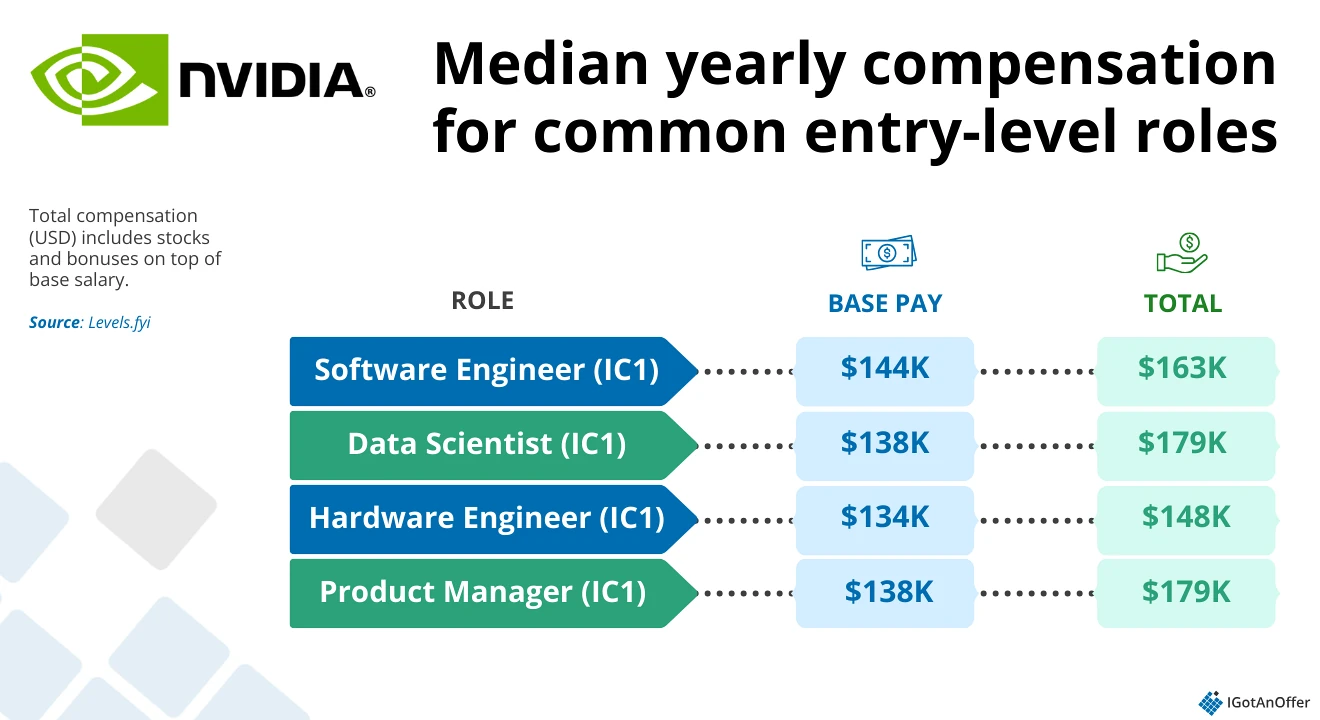
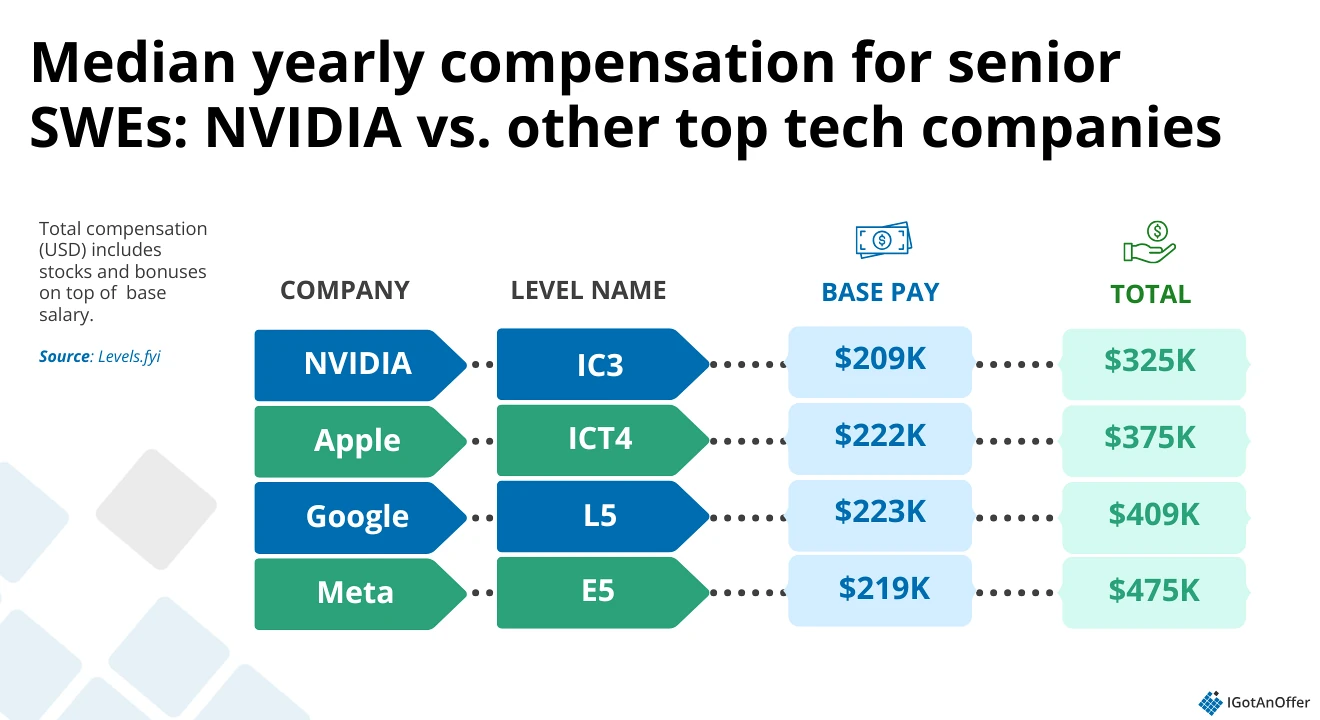
For software engineers specifically, NVIDIA's compensation is competitive with other top tech companies, though slightly below some peers at mid-level positions.
Since senior SWEs (IC3) are the most commonly reported position at NVIDIA, we compared it to similar roles at other top companies to give you a clear picture of long-term earning potential.
For more details on NVIDIA's software engineering role and interview process, check out our NVIDIA software engineer interview guide.
3. NVIDIA's core values ↑
Understanding NVIDIA's core values is important because they shape the company's interview questions and evaluation criteria. Interviewers often look for evidence that candidates align with these principles.
According to NVIDIA, the company operates according to 5 core values:
3.1 Innovation
NVIDIA encourages employees to "dream big, start small, take risks, learn fast," accepting that mistakes are inevitable on the path to discovery.
In line with this, interviewers look for candidates who:
- Challenge conventional approaches and iterating quickly
- Share examples of problems you identified that others missed
- Discuss experiments that failed and what you learned from them
- Demonstrate comfort with ambiguity and calculated risk-taking
Candidates who can articulate lessons from failed experiments tend to stand out, as this demonstrates genuine innovation rather than just executing established approaches.
3.2 Intellectual honesty
NVIDIA values "seeking truth, learning from mistakes, and sharing learnings," aiming to accurately understand both strengths and weaknesses without assigning blame.
In line with this, interviewers look for candidates who:
- Acknowledge when they've been wrong and explain what they learned
- Share clear lessons from setbacks and failures
- Create environments where people surface problems early
- Prioritize finding solutions over protecting ego
This matters because teams move faster when people aren't hiding problems. Interviewers want to see that you can be vulnerable about mistakes while focusing on improvement.
3.3 Speed and agility
In a market where being first often means capturing market share, your ability to move fast while maintaining quality determines competitive success. NVIDIA looks out for those.
In line with this, interviewers look for candidates who:
- Have examples of delivering results under tight deadlines
- Make sound decisions with incomplete information
- Pivot quickly when circumstances change
- Balance speed with maintaining quality standards
These signals help interviewers assess whether you can operate effectively in NVIDIA’s high-velocity environment.
The goal at NVIDIA isn’t speed for its own sake. It’s the ability to execute decisively while preserving technical rigor and long-term impact.
3.4 Excellence
NVIDIA expects the highest standards in everything, from product quality to customer support to internal processes.
In line with this, interviewers look for candidates who:
- Emphasize attention to detail in your past work
- Show determination and "grit" when facing obstacles
- Discuss your process for ensuring high-quality outcomes
- Demonstrate relentless pursuit of improvements, not just "good enough"
NVIDIA interviewers specifically probe for evidence of persistence and high standards. Be ready to discuss how you've maintained quality even under pressure.
3.5 One team
Despite its flat structure and high individual accountability, collaboration is fundamental across hardware, software, and research teams.
In line with this, interviewers look for candidates who:
- Work successfully across different functions and disciplines
- Put team success above individual recognition
- Build consensus across different stakeholders
- Communicate effectively with technical and non-technical colleagues
These values appear consistently in interview questions and in how NVIDIA evaluates cultural fit. When preparing your interview responses, consider how your experiences demonstrate these values.
4. NVIDIA interview process and timeline (6 steps to an offer) ↑
The NVIDIA interview process typically takes 6-8 weeks, from application to offer. It will largely depend on how quickly feedback is collected if you’re approved for the next stage.
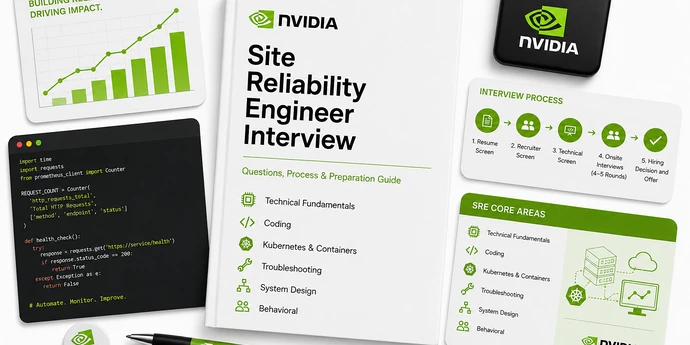
Here are the main steps in NVIDIA's interview process:
- Resume screen
- Recruiter screen
- Technical screen(s)
- Onsite interviews
- Hiring decision
- Offer negotiation
Now we'll cover each of the steps in more detail, so you can get a better idea of what to expect and how to prepare.
4.1 Resume screen ↑
Step one is getting the interviews. For this, you’ll need a quality resume that’s tailored to both NVIDIA and the position you’re applying for.
Use these tips and best practices to optimize your documents so you can stand out.
- Simplify. Avoid using overly creative resume layouts. A simple resume layout accomplishes two things: it helps your resume pass through the applicant tracking system (ATS) and makes it easy to read for recruiters and hiring managers.
- Verbalize. Start each bullet point under your previous roles with an action word.
- Quantify. Add numbers to illustrate your impact in each role. If you were in a leadership role, how many people were in your team? If you’ve successfully launched a product, what metrics did you use to measure its success?
- Emphasize cross-functional collaboration. NVIDIA's flat structure requires strong teamwork. Highlight experiences coordinating across different functions—engineering, product, design, research, or business teams.
- Summarize. Make your resume ATS-friendly by having a skills section. Insert keywords from the job requirements that are relevant to your professional experience.
For more guidance on writing up an effective resume, check out some of our resume guides:
- Tech resume examples
- Software engineering resume examples
- Product manager resume examples
- Technical program manager resume examples
- Engineering manager resume examples
- Machine learning engineer resume examples
- Data science resume examples
If you’re looking for expert feedback, you can also get help from one of our tech resume coaches, who will cover what achievements to focus on (or ignore), how to fine-tune your bullet points, and more.
4.2 Recruiter screen (30 min) ↑
If your resume passes screening, you'll hear from a NVIDIA recruiter within a few weeks. This initial call typically lasts 30 minutes.
The recruiter will verify information on your resume, understand your motivation for joining NVIDIA, and evaluate whether you're a good fit for the role. You can expect questions like:
- Walk me through your resume
- Why are you interested in NVIDIA?
- What attracts you to this specific role?
This is your opportunity to demonstrate a genuine interest in the company's mission and technology. Come prepared with thoughtful answers that show you've researched your target role, NVIDIA's products, recent developments, and the team you'd be joining.
The recruiter will also explain the interview process ahead. Ask about the number of rounds, focus areas for each interview, and the expected timeline. If you come from a non-technical background, this is a good time to mention it and understand whether it's a concern for the role.
Don't discuss salary expectations or reveal your current compensation at this stage. If pressed, politely indicate that you'd like to learn more about the role and interview first. Early salary discussions can limit your negotiating power later.
4.3 Technical screen(s) ↑
This stage is the first technical assessment. Their purpose here is to evaluate your basic competencies in problem-solving and coding, as well as to have further discussions on your past experiences.
Here's what to expect during the technical phone screen:
4.3.1 Role-specific technical assessment
The focus depends on your position:
- Software engineers face coding challenges on data structures and algorithms, typically at LeetCode medium difficulty level
- Product managers discuss technical trade-offs, system architecture understanding, and past product decisions
- Data scientists work through statistical concepts, model selection, and data analysis problems
- Hardware engineers answer questions on circuit design, verification, or system architecture
Technical assessments are typically conducted on platforms like HackerRank or through screen sharing. You will not be allowed to use outside tools, including ChatGPT, and violating these rules will result in disqualification.
4.3.2 Domain-specific depth
Depending on the team, you might encounter questions on GPU programming, parallel computing, AI/ML concepts, or NVIDIA-specific technologies relevant to your role.
4.3.3 Behavioral questions about past projects
Expect to discuss your technical work, decision-making process, and how you've handled challenges in previous roles.
The format varies by role and team. NVIDIA doesn't maintain an internal question bank, so you might encounter classic problems or more practical, job-specific challenges.
4.4 Onsite interviews (3-6 rounds, 45-60 minutes each) ↑
The onsite interviews are the most challenging, intensive part of NVIDIA's hiring process.
Depending on the role, you'll typically face 3-6 rounds of back-to-back interviews, each lasting 45-60 minutes. These can be conducted virtually or on-site at an NVIDIA office.
The exact format varies by team and role, but most interview rounds include:
Coding interviews (2-3 rounds)
Relevant for: Software engineers, data scientists, site reliability engineers
The coding interviews focus on data structures, algorithms, and problem-solving. Expect questions at LeetCode medium difficulty, though this may increase for senior positions.
Some NVIDIA teams emphasize practical, domain-aligned problems rather than generic LeetCode questions. Others may ask you to review and debug existing code instead of writing solutions from scratch.
For more guidance on coding interviews, read our coding interview prep guide.
System design interview (1-2 rounds)
Relevant for: Mid-level and senior software engineers, data engineers, site reliability engineers, ML engineers, and senior technical product managers
You'll design large-scale systems or architectures relevant to NVIDIA's products. Questions might involve designing distributed systems, data pipelines, real-time analytics platforms, or GPU-accelerated computing infrastructure. The interviewer will evaluate how you handle trade-offs, scalability concerns, and operational considerations.
For more guidance, read our system design interview prep guide.
Product and strategy round (1-2 rounds)
Relevant for: Product managers, technical program managers
Product managers face questions on product sense, execution, and technical understanding. You'll discuss how you'd approach building features, prioritizing roadmaps, or solving customer problems in NVIDIA's ecosystem. Expect questions about GPU/AI market dynamics and technical trade-offs.
For more guidance, check out our NVIDIA product manager interview guide.
Domain-specific technical round (1 round)
Relevant for: All technical roles
All technical roles have a domain-specific interview focused on knowledge relevant to your specific role and team. This round assesses whether you have the depth of expertise needed to contribute immediately to the team's specific challenges.
NVIDIA uses this to differentiate between general technical competence and the specialized knowledge required for the position.
- AI/ML roles: Model training, inference optimization, distributed computing
- Graphics/gaming roles: Rendering pipelines, shader programming, real-time performance optimization
- Hardware roles: Circuit design, verification methodologies, system architecture
- Data science roles: Statistical modeling, experimentation, data pipeline design
Behavioral interview (1 round)
Relevant for: All roles
NVIDIA assesses cultural fit and collaboration skills through behavioral questions. Expect questions about:
- Times you faced technical challenges and how you overcame them
- How you work with cross-functional teams
- Situations where you had to adapt to changing requirements
- Examples of taking ownership and driving results
- How you handle feedback and learn from mistakes
For more guidance, read our behavioral interview prep guide.
What does NVIDIA evaluate?
Throughout these interviews, interviewers evaluate whether you align with NVIDIA's core values: innovation, intellectual honesty, speed and agility, excellence and determination, and one team. Structure your responses to demonstrate these qualities naturally.
One unique aspect of NVIDIA's interview process is its decentralized nature. Hiring managers have significant autonomy in designing their team's interviews, so your experience may vary from other candidates interviewing for different teams.
All your interviewers will be from the specific team you're joining.
4.5 Hiring decision ↑
After your onsite interviews conclude, your interviewers submit their feedback and recommendations. Based on candidate reports, this process typically takes 1-3 weeks, though it can vary based on scheduling and how quickly feedback is collected.
NVIDIA doesn't always make decisions on a rolling basis. Some teams may prefer to interview multiple candidates before making a final decision, which can extend the timeline.
If you haven't heard back within two weeks, send a polite follow-up to your recruiter expressing continued interest.
The hiring committee reviews all feedback along with your application materials. They're looking for consistency across interviews and evidence that you meet the technical bar and cultural fit requirements.
4.6 Offer negotiation ↑
If NVIDIA extends an offer, your recruiter will schedule a call to discuss terms. Before finalizing your employment terms, you may have final discussions with managerial staff about team matching to ensure the right fit between your skills and team needs.
NVIDIA also offers an Insider Chat program, where you can speak with a Community Resource Group member. This optional 15-minute conversation doesn't influence hiring decisions. It's simply an opportunity to learn more about NVIDIA's company culture and ask questions before you accept your offer.
NVIDIA's compensation packages include base salary, initial NSU grant, sign-on bonus (if negotiated), and benefits. The company has established compensation bands for each level.
When negotiating:
- Do your research. Use Levels.fyi data to understand typical compensation for your target role’s level and location.
- Focus on total compensation. Base salary often has less flexibility than equity. If the recruiter can't move on base, ask about increasing the NSU grant or sign-on bonus.
- Provide specific numbers. Say something like, "Based on my research, I was targeting total compensation around $X," rather than something vague like "I was hoping for more."
- Be professional. Express enthusiasm about joining NVIDIA while advocating for fair compensation.
For detailed negotiation strategies, check out our video on the 10 rules of salary negotiation and our guides on negotiating offers at Amazon, Google, and Meta, whose processes are similar to NVIDIA’s.
For even more in-depth and personalized advice, work with a specialized negotiation coach.
Interviewing at other FAANG+, emerging tech, or AI labs? Check out our FAANG interview process and FAANG interview prep guides for company-specific insights into the companies and different roles you’re targeting.
Frequently asked questions about the NVIDIA interview process and timeline ↑
What programming languages does NVIDIA use in interviews?
The programming language depends on the role and team. Many positions allow you to choose your preferred language for coding interviews (Python, C++, Java, etc.).
However, roles focused on GPU programming or systems-level work often require C++ proficiency. CUDA programming knowledge is valuable for positions involving parallel computing or graphics.
Always clarify language requirements with your recruiter early in the process.
Does NVIDIA offer remote work?
NVIDIA offers remote and hybrid positions, though policies vary by team, role, and location.
Some positions are explicitly designated as remote, while others require in-office presence on certain days per week. Check the job posting and discuss options with your recruiter.
What should I emphasize in NVIDIA behavioral interviews?
Focus on demonstrating NVIDIA's core values through specific examples.
Share concrete stories showing you can collaborate across teams, adapt quickly, learn from mistakes openly, and deliver quality results under pressure.
Through our coaching work, we've found that intellectual honesty (your ability to acknowledge failures and articulate what you learned) is particularly important.
Can I interview for multiple teams at NVIDIA?
NVIDIA's approach varies. Some candidates explore different opportunities, though interview feedback is often shared across teams.
If you're interested in multiple positions, discuss your interests with your recruiter early. The company recommends applying to your top 3-5 most relevant roles.
What happens if I don't get an offer from NVIDIA?
If you're not selected after interviews, NVIDIA typically requires a 12-month cooldown period before you can reapply.
Use this time to strengthen your skills in areas where you received feedback. Many candidates successfully join NVIDIA on their second or third attempt after addressing gaps identified in earlier interviews.
Is CUDA programming required for all technical roles at NVIDIA?
No, CUDA programming is not required for all roles. While knowledge of parallel computing is valuable, only certain roles directly work with CUDA daily.
Many software engineering positions focus on application development, infrastructure, or other areas where CUDA isn't central. Check the job description for specific requirements.
Even without CUDA experience, demonstrating strong general programming proficiency and willingness to learn can be sufficient for many teams.
5. Are you prepared for your NVIDIA interviews? ↑
The most effective preparation is practicing with experts who've actually conducted interviews at NVIDIA. Our coaches include former NVIDIA interviewers who know exactly what the company looks for.
Find an NVIDIA interview coach so you can:
- Test yourself under real interview conditions
- Get accurate feedback from a real expert
- Build your confidence
- Get company-specific insights
- Learn how to tell the right stories, better
- Save time by keeping your preparation focused
Landing a job at a big tech company often results in a $50,000 per year or more increase in total compensation. In our experience, three or four coaching sessions worth ~$500 make a significant difference in your ability to land the job. That’s an ROI of 100x!
Click here to book a mock interview with an ex-NVIDIA interviewer






 Software engineer, Engineering manager
 AI system design