

 Back to other articles
 Last updated: June 09, 2026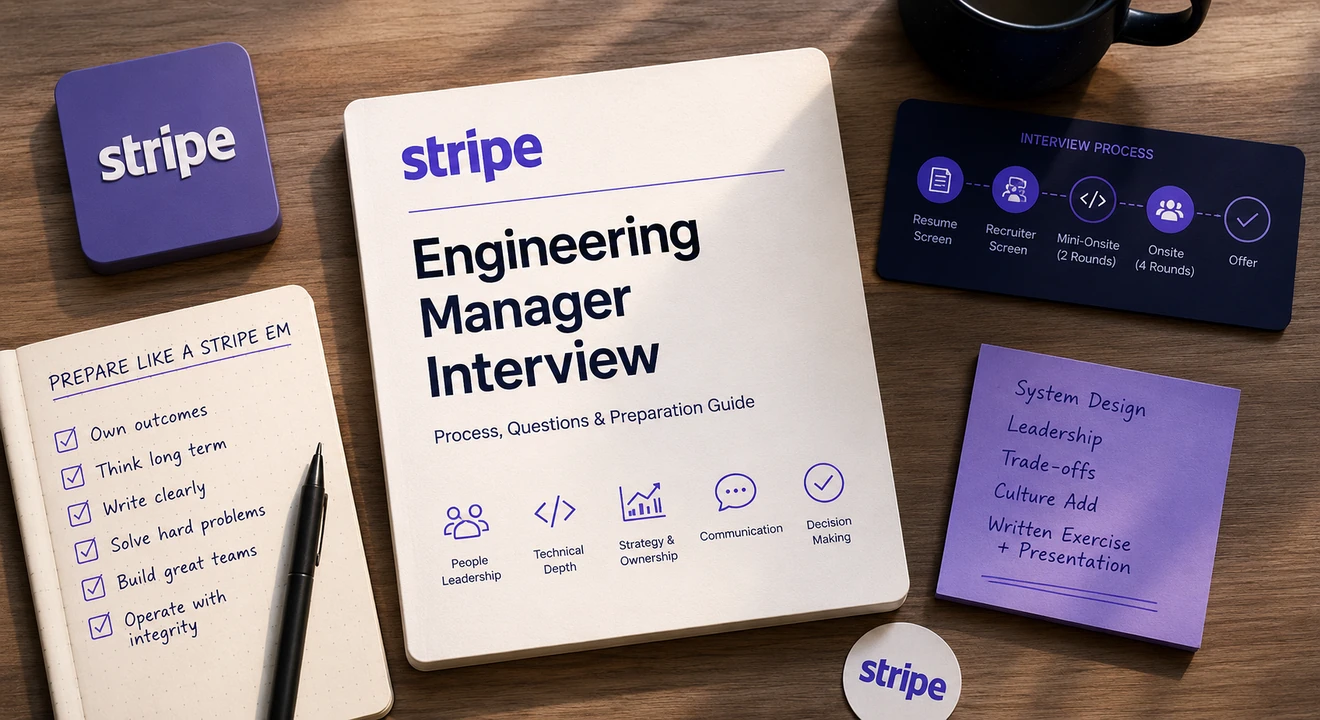

 Interviews
 Engineering manager
 Deeply researched
Stripe engineers process around $1.5 million in payments every minute, with an API reliability standard that leaves almost no room for error. That's the bar for engineering managers (EM) too.
At Stripe, EMs are expected to lead teams and stay genuinely close to the technical work: owning architectural decisions, driving strategy, and operating with a high degree of automomy. It's a demanding combination, and it's a big part of what makes the Stripe engineering manager interview process unique.
We've coached thousands of candidates through big tech interviews. To put this guide together, we reviewed 26 Glassdoor reports from Stripe EM candidates, gathered insights from Stripe insiders, and drew on the expertise of our coaching team.
Click here to practice 1-on-1 with expert ex-Stripe interviewers
1. Stripe Engineering Manager Role and Salary↑
Before we cover the interview process, let's take a quick look at what life as a Stripe engineering manager actually looks like, and what it pays.
1.1 What does a Stripe engineering manager do?
Stripe EMs lead one product or infrastructure team inside one of four business areas: Payments, Connect, the Financial Stack (Capital, Issuing, Treasury), or Revenue & Finance Automation. Based on Stripe job postings, core responsibilities include:
- Own technical direction, execution, and team health
- Author strategy for your product domain, not just execute on someone else's plan
- Stay technically engaged: review architecture decisions and ask engineers good questions
- Recruit, develop, and retain engineers; mentor other engineering leaders
- Work cross-functionally across teams and time zones with a high degree of autonomy
Work culture
Two things stand out about Stripe's engineering culture.
First, reliability is non-negotiable: the core payments API runs above 99.999% uptime, climbing even higher during peak periods like Black Friday. EMs are directly accountable for that standard on their teams.
Second, writing is central to how Stripe operates: strategy memos, design docs, friction logs. Engineers and managers alike produce written work regularly, which is why the Stripe engineering manager interview includes a written exercise and live presentation.
Work setup
About 70% of Stripe engineers work in a hybrid model across hubs in San Francisco, Dublin, Seattle, Bangalore, and Singapore. The other 30% are fully remote.
Glassdoor reviews from Stripe EMs rate the overall experience 3.8 out of 5: strong colleagues and interesting problems on the plus side, roadmap churn and a team-dependent experience on the other.
1.2 How much does a Stripe engineering manager make?
Stripe EM compensation is among the most competitive in tech. According to Levels.fyi (last updated May 2026), total compensation ranges from approximately $456K per year at M0 to over $1.5M at M3.
Here's the breakdown by level, based on Levels.fyi data:
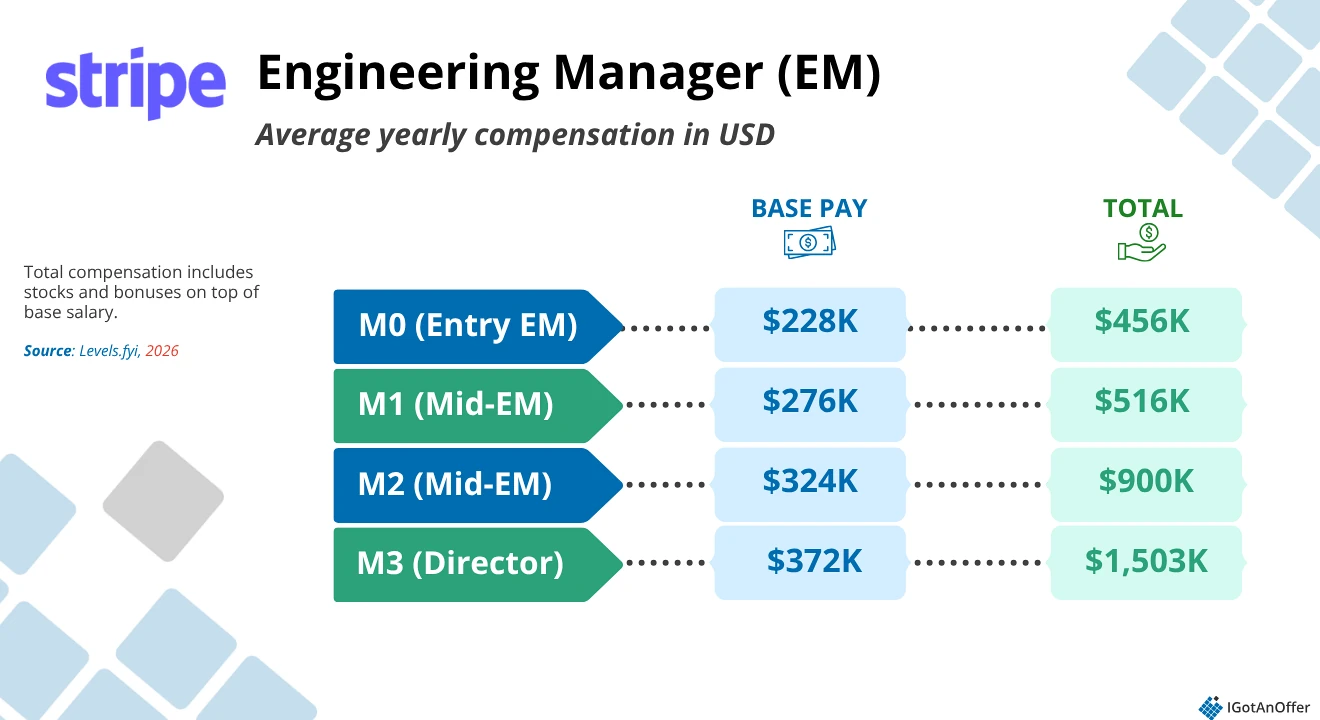
Compensation is structured as base salary + RSUs + performance bonus. Total compensation will vary depending on the specific role level and location.
Stripe also offers a solid benefits package. According to Levels.fyi, this includes three medical plan options (Cigna PPO, HDHP, and Kaiser HMO for California and Washington employees), dental through MetLife, vision through VSP, 21 days PTO, 16 weeks paternity leave, and a $3,000 annual gym and wellness reimbursement.
Compensation adjusts for geography. If you're interviewing for a role outside the US, expect the numbers to differ from the table above.
Ultimately, how you do in your interviews will help determine what you'll be offered. That’s why hiring one of our ex-Stripe interview coaches can provide such a significant return on investment.
And remember, compensation packages are always negotiable, even at Meta. So, if you do get an offer, don’t be afraid to ask for more. If you need help negotiating, consider booking one of our salary negotiation coaches to get expert advice.
Coaches who contributed to this guide





2. Stripe Engineering Manager Interview Process and Timeline↑
Now that you have a clear picture of what a Stripe engineering manager actually does and how much they're paid, let's talk about how you actually get in.
2.1 What interviews to expect
The Stripe engineering manager interview process typically takes 3-6 weeks from application to final decision and follows this structure:
Step 1: Resume screen↑
Your application is first reviewed by a recruiter. Stripe looks for a combination of strong technical background and leadership experience, with particular emphasis on experience owning outcomes, not just managing delivery.
To make sure your resume stands out, here's a free engineering manager resume guide. And if you'd like expert feedback, our resume review coaches can advise on what achievements to focus on, how to fine-tune your bullet points, and more.
Step 2: Recruiter screen↑
This is a competency-based call, not just a walkthrough of your CV. The recruiter will ask some STAR-format (Situation, Task, Action, Result) questions about your background and assess your fit for the role. They'll also walk you through what to expect at each subsequent stage. Stripe's recruitment team is generally good about providing written guidance in advance.
One thing worth knowing upfront: 33% of EM candidates get their interview through recruiter outreach, 33% through employee referrals, and 33% applied online directly, based on Glassdoor interview statistics.
Pro tip: Be upfront about your timeline. If you're interviewing elsewhere with faster processes, mention it. Stripe can move faster when they need to, but only if you give them a reason.
Step 3: Mini-onsite (2 rounds, ~1 hour each)↑
Before the full onsite, you'll go through two separate one-hour interviews:
- People management round: Focuses on tough team dynamics, your hiring approach, and how you lead through ambiguity. Expect STAR-format questions about specific situations you've managed.
- Technical round: Light live coding and a lightweight system design exercise. The focus is on your reasoning and tradeoffs, not algorithmic correctness.
Some candidates describe the mini-onsite as difficult. Don't treat it as a warmup.
Step 4: Written exercise↑
After passing the mini-onsite, you'll be asked to write a report on a major technical project you led. You submit this before the full onsite, and the panel reads it in advance of your presentation round.
Multiple Glassdoor reviews flag a recurring frustration with the written exercise: the brief is often vague.
You may not get clear guidance on audience, context, or what Stripe is looking for. Ask your recruiter to clarify before you start writing. If they can't tell you, write for a mixed audience of engineers and managers who are familiar with distributed systems but not your specific codebase.
Step 5: Full onsite (4-6 rounds, ~45 minutes each)↑
Plan to block out a full day. Candidates consistently report the same named rounds:
- Experience & Goals: STAR-style questions about your leadership history, career trajectory, and why Stripe.
- Strategy & Execution: How you set vision and drive outcomes.
- People & Organization: Team building, hiring philosophy, diversity, and culture.
- System Design: Live architecture exercise with a tech lead. Recurring topics include ledger services, analytics pipelines, and payments infrastructure.
- Role-Play: You play the manager; your interviewer plays a direct report. You're dropped into a realistic conflict scenario and expected to handle it live.
- Technical Presentation: You present the written document you submitted earlier. Twenty minutes of presentation, followed by intense Q&A from a panel who has already read your doc.
Not every candidate goes through all six rounds. But the technical presentation and role-play appear in nearly every detailed review from 2022 onward.
We’ll get into each interview round in more detail in section 3 below.
2.2 What is Stripe looking for?
Stripe publishes its hiring criteria openly. Their six operating principles are the explicit framework interviewers use to evaluate every candidate.
Based on our analysis of Stripe's operating principles and what companies typically look for in an EM candidate, here is how we believe those principles translate into what interviewers actually test in practice:
- Technical credibility: Rooted in 'Users first' and 'Create with craft and beauty.' Stripe EMs are expected to stay close to the engineering work, weighing in on architecture decisions, reviewing tradeoffs, and asking engineers good questions. The system design and technical presentation rounds are specifically designed to test this.
- Ownership mindset: Rooted in 'Move with urgency and focus.' Candidates who can point to outcomes they personally drove, and not just projects they managed, stand out. Interviewers probe for accountability and bias for action.
- People leadership depth: Rooted in 'Obsess over talent.' The behavioral rounds focus heavily on people management: how you've handled underperformers, built diverse teams, and developed other leaders. Expect detailed follow-up questions about specific decisions and their outcomes.
- Writing and communication: Rooted in 'Create with craft and beauty.' The written exercise and technical presentation exist because Stripe's engineering culture runs on clear written work. Candidates who produce vague or poorly structured documents consistently underperform in this round.
- Cultural alignment: Rooted in 'Collaborate egolessly' and 'Stay curious.' The role-play and people management rounds test whether you create psychological safety and lead with curiosity, not authority.
These themes are consistent with what Stripe publishes on their compatibility page. They want candidates who are 'comfortable causing short-term friction in pursuit of better outcomes' and 'eager to take on ambiguous, complex problems outside their domain.' The weight given to each area likely varies by team and seniority level.
2.3 Hiring timeline
Stripe is reasonably responsive at the start of the process. Recruiter contact usually comes within a week of applying. But everything after that moves at Stripe's pace. Based on Glassdoor EM interview reviews, here's what candidates have actually experienced:
- Fastest process: 2 weeks from first recruiter contact to decision
- Typical process: 3-4 weeks
- Slower processes: up to 6 weeks, sometimes with multi-week gaps between stages
Why it takes so long:
- Scheduling: Coordinating 4-6 interviewers across time zones takes time, and Stripe engineers are busy.
- Decision-making: There are multiple layers of review and discussion before an offer is extended.
- Recruiter communication gaps: This is the most consistent complaint in EM reviews; recruiter responsiveness after the onsite is poor.
Tip: Ask your recruiter for typical timelines and when you should follow up. One polite email per week after expected decision dates will go a long way.
2.4 What happens behind the scenes (after interviews)
Stripe's post-interview process is not publicly documented. Nevertheless, based on candidate reports from Glassdoor and Blind, here's what the final steps are believed to look like (though the exact sequence may vary by role and seniority):
- Interviewers submit feedback, typically within 2-3 days
- Hiring committee review: a panel reviews all feedback alongside your background and written exercise
- Senior leadership approval
- Reference checks run in parallel for senior roles; one candidate confirmed moving to this stage after completing all four onsite rounds
- Final executive sign-off for more senior positions
- Offer extended, or rejection communicated
3. Stripe Engineering Manager Example Questions↑
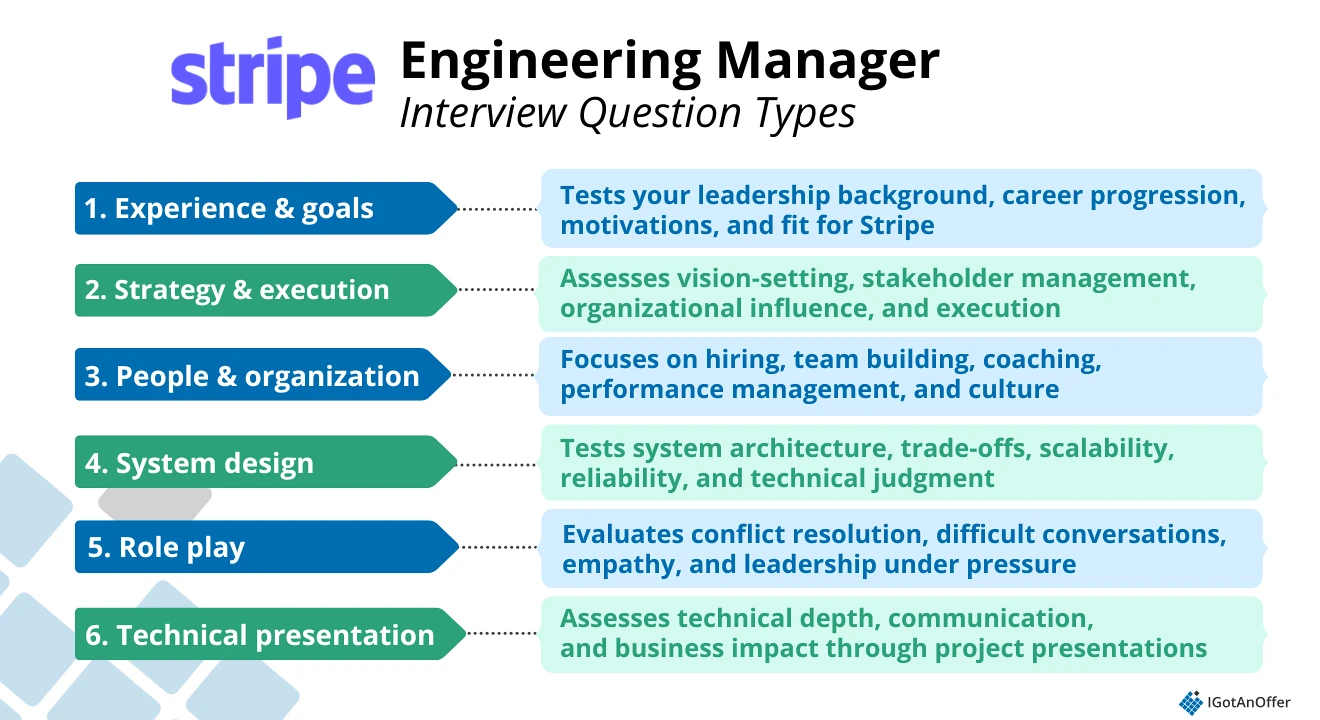
Like we mentioned earlier, the Stripe engineering manager interview is designed to test both your leadership ability and your technical depth. In practice, that means you'll see questions from these categories:
- Experience and goals
- Strategy and execution
- People and organization
- System design
- Role-play
- Technical presentation
We've pulled together real Stripe EM interview questions sourced from Glassdoor and organized them into the above categories. Some are lightly reworded for clarity, but the substance remains the same.
(Note: In section 5, you’ll find links to prep resources for each type of interview/question type)
3.1 Experience and goals↑
This round focuses on your leadership history, career trajectory, and why Stripe. Specific questions are rarely reported for this round. Candidates tend to describe it as conversational rather than formulaic.
Based on older Glassdoor reports and the round's stated focus, here are the kinds of questions you should prepare for:
Example Stripe engineering manager interview questions
- Describe a complex project you led.
- Why do you want to take this role at Stripe specifically?
- What does success mean to you as an engineering manager?
- Tell me about a time you had to lead through significant ambiguity.
- Why Stripe?
3.2 Strategy and execution↑
This round tests how you set direction and drive outcomes at the organizational level. Expect STAR-format questions with follow-ups probing the specific decisions you made and why.
Example questions from Stripe engineering manager interviews
- How do you set vision? How do you execute?
- Give an example of a time you had to get stakeholder buy-in across the company.
- Tell me about a difficult technical decision you had to make.
3.3 People and organization↑
This round focuses on how you build and lead teams (e.g., hiring, developing engineers, handling difficult situations, and fostering a strong culture). Expect detailed follow-up questions on specific decisions and their outcomes.
This round tests how you set direction and drive outcomes at the organizational level. Expect STAR-format questions with follow-ups probing the specific decisions you made and why.
Example questions from Stripe engineering manager interviews
- Walk me through your management philosophy.
- How do you approach building a team from scratch vs. inheriting one?
You can find more questions to practice with by reviewing our guide to people management questions in tech interviews.
3.4 System design questions↑
System design at Stripe isn't a textbook exercise. The scenarios tend to be grounded in Stripe's actual product domain: financial ledgers, analytics pipelines, payments infrastructure. You're being assessed on how you structure your thinking, identify tradeoffs, and handle constraints, not whether you arrive at the exact right answer.
A few things to keep in mind:
- No one expects a flawless design. What matters is how you structure your approach, the questions you ask, and the tradeoffs you highlight.
- The interviewer is typically a tech lead who will probe your reasoning actively. Don't just draw boxes. Explain why you're making each architectural choice.
- Strong design instincts can influence what level you're hired at. Hand-wavy thinking will hold you back.
Because there's so much ground to cover, the best way to prepare is systematically. You'll want to get comfortable across two main dimensions:
- High-level system architecture: how to break down large, complex systems into workable pieces, with attention to scalability and reliability.
- Low-level design and optimization: how to dive into data flows, storage choices, and performance considerations that make the system viable in practice.
With that framing, here are some real examples of system design questions reported by Stripe candidates.
Example system design questions from Stripe engineering manager interviews
High-level system design
- Design a system that aggregates and consumes analytics events. Answer basic product analytics questions using your architecture and data model.
- Design a key component of Stripe's payments system.
Low-level system design
- How would you create a reporting service that acts as a transaction balance/ledger, based on transactions in an existing transaction service?
- How would you build a system to collect metrics from a large number of processes?
For more questions with sample answer outlines, take a look at our guide to system design interview questions.
3.5 Role-play questions↑
This is one of the more unusual rounds you'll encounter in the Stripe engineering manager interview, and the one candidates are least prepared for. You play the manager; your interviewer plays a direct report. You're dropped into a realistic conflict scenario and expected to handle it as a live conversation, not describe what you would do in the abstract.
A few things to keep in mind:
- The scenarios are designed to create tension. Your IC has a strong emotional investment in something, and you need to redirect them without damaging the relationship.
- The panel may include other EMs observing. They're watching how you handle pressure, not just whether you reach the right outcome.
- There are no scripts. What Stripe is assessing is whether you can balance business needs against the person in front of you, in real time.
Example role-play scenarios from Stripe engineering manager interviews
- Your report is working on a project they care deeply about with high visibility and a clear path to promotion. You have a critical project that only they can deliver. Walk through the conversation to pull them off their current work.
- Convince your report to commit to switching to a new project that pulls them out of work they really care about.
- Your senior engineer is excited about an upcoming initiative. You need to assign them an urgent 12-week compliance audit instead.
3.6 Technical presentation↑
This round is specific to the Stripe engineering manager interview. Here, you don't get a question. Instead, you choose the subject yourself. The brief is to pick a major technical project you led, write approximately 1,000 words on it, and present it live for 20 minutes to a panel who has read your document in advance.
The panel focuses on:
- The technical challenges you faced and how you diagnosed them
- The decisions you made and why, including what you considered and rejected
- The business outcomes your work produced
Q&A is intense. Reviewers have read your doc and will probe specific claims. Don't write anything you can't defend in detail. Choose a project where you had genuine technical ownership, not one where you managed the engineers while the architects made the real calls.
Pro tip: Stripe's writing culture means the document itself matters, not just the presentation. A clearly structured, precise 1,000-word memo will carry you further than a polished slide deck built on vague prose.
Example technical presentation prompt
- Pick a project you played a major part in and understand intimately. Describe the technical challenges you faced, how you overcame them, and the business outcomes. Then prepare a 20-minute presentation on that project and be prepared for in-depth Q&A from a panel who has already read your document.
4. Stripe Engineering Manager Interview Tips↑
You might be a fantastic engineering manager, but unfortunately, that won't necessarily be enough to ace your interviews at Stripe. Interviewing is a skill in itself that you need to learn.
Let's look at some key tips to make sure you approach your interviews in the right way.
4.1 Create your story box
The biggest game-changer for behavioral interviews is having a story bank ready. Start by compiling every EM example question you can find, then map specific experiences from your career to each one. Aim to avoid reusing the same situation across multiple answers.
As one candidate put it after going through the Stripe process: "This prep work made the interviews a breeze."
We have a full compilation of the most-asked software engineer behavioral interview questions (with answers) here you can start with.
You'll find structured examples, proven frameworks, and sample answers that show you exactly how to frame your own experience in a way that resonates with interviewers.
4.2 Practice makes perfect (but practice smart)
Once you have your stories, the next step is structuring and rehearsing them. Write each one on a note card and rehearse until you can deliver it in under a minute. Best to even practice in front of someone who can give you honest feedback.
When structuring your stories, frameworks help you cover all the important points without rambling or missing key details. You'll hear a lot about the Situation, Task, Action, Result (STAR) framework out there. It's popular because it works. But honestly, it can be a bit lacking. It's hard to tell between steps two and three, or task and action.
That's why one of the frameworks we always recommend is IGotAnOffer's SPSIL method (Situation, Problem, Solution, Impact, Lessons). It corrects some of the pitfalls we've observed when using the STAR method. You can learn more about SPSIL here.
Just remember that early attempts will most likely come out robotic. That's why part of the prep is making the storytelling feel natural and conversational, without getting so locked into frameworks that you miss the actual question being asked.
4.3 Get used to setting up the situation in 30 seconds or less
Whether you're using SPSIL or STAR to answer behavioral questions, use a timer while you practice to ensure you provide only the necessary information.
Spending too much time on setting up the situation is one of the most common mistakes candidates make. Stripe interviewers hear a lot of stories each day. If you go into unnecessary detail, you risk losing their attention before you get to the interesting part.
4.4 Be proud and talk about YOU
This is not the time to be shy about your accomplishments. Concentrate on your impact, not what 'the team' did. Not talking about yourself enough is one of the most common mistakes we see. When telling stories in behavioral rounds, connect your decisions explicitly to outcomes you personally drove.
4.5 Show your growth mindset
Stripe values continuous learning and adaptation. Throughout your interviews, demonstrate how you've evolved as a leader, learned from failures, and adapted your management style based on team needs.
Do the stories and experiences that you're giving show that you're always looking to grow and learn, rather than having a fixed mindset? That's an important signal the interviewer is looking out for, says Mark (ex-Google EM).
4.6 Ask clarifying questions first
When a problem is presented to you, don't start drawing the solution immediately. As our coaches explain in our system design interview tips guide, the first step is always to ask clarifying questions about requirements, constraints, and goals.
The same applies at Stripe; their CTO has said interviews are designed to test whether you work in a way that is 'curious, digging into the details.'
4.7 Share your thought process clearly
Stripe interviewers want to understand how you think, not just what you know. Walk through your reasoning step by step, especially during technical portions.
Call out the tradeoffs you're making. Name what you're deprioritizing and why. Vague answers that skip to a conclusion without showing the path will land poorly.
4.8 Adapt to follow-up questions
Don't be alarmed if your interviewer asks follow-up questions. This is perfectly normal at Stripe.
Listen carefully to how they're asking, as there will often be a subtle clue about the specific skill they're looking to assess from your next answer. Stripe's interviewers are trained to dig deeper, so a follow-up question is usually a good sign, not a bad one.
4.9 Focus on your strengths
Here's an important reality check from a successful Stripe candidate: 'Don't stress the coding interview. I failed mine (partial solution) and still got hired as an M1. I did well on the behavioral and system design interviews, and that's what really mattered in the end.'
Stripe evaluates you holistically. If you're stronger in leadership and system thinking than algorithms, lean into those strengths while still showing some technical competency.
4.10 Treat it like a conversation
Remember that interviews are two-way discovery processes. While they're assessing fit, you're also evaluating whether Stripe aligns with your career goals.
Ask thoughtful questions about team dynamics, technical challenges, and growth opportunities. Stripe allocates time for questions at the end of every interview. Use it.
4.11 Center on Stripe's operating principles
When telling stories in behavioral rounds, connect your decisions explicitly to how Stripe operates. 'Move with urgency and focus' and 'Obsess over talent' come up most directly in EM contexts. You don't need to recite the principles; just let them shape which details you emphasize. Read them on Stripe's culture page before your first round.
4.12 Be honest and authentic
Be genuine in your responses. Stripe interviewers appreciate authenticity. If you faced challenges or setbacks, discuss how you improved and learned from them. When talking about failure, don't try to hide your mistakes or frame a weakness as a strength. Instead, show what you learned and how the experience helped you grow.
4.13 Follow up after the interview
When your interview finishes, you'll be given guidance about what happens next. If you aren't, follow up with your recruiter. Most communication during Stripe's interview process flows through your assigned recruiter.
If you haven't heard back by the timeline mentioned during your last interview, one polite follow-up email per week is appropriate. Don't put your job search on hold for Stripe. If you have competing offers, tell your recruiter. It's the one lever that reliably speeds up the process.
4.14 If you get rejected, reapply
Stripe's hiring bar is notoriously high, and rejection doesn't mean you're not qualified, just that this particular role wasn't the right fit.
Many successful Stripe employees were rejected on their first attempt and hired later when they had more experience or interviewed for a different team. Consider applying again after 6-12 months if you've gained additional experience or if different roles open up that better match your background.
5. How to prepare for the Stripe EM interview↑
Now that you know what questions to expect, let's focus on preparation. Below, you'll find links to free resources and four introductory steps to help you prepare for your Stripe EM interviews.
5.1 Deep dive into the product and organization
As you've probably figured out from some of the example questions listed above, you can't become an EM at Stripe without being familiar with the company's products and its organization. As a result, you'll need to do some homework before your interviews. Here are some resources to help you get started:
- Stripe's culture guide (by Stripe)
- Stripe business teardown (by CB Insights)
- Stories from Stripe's work and history (by Wired)
- How Stripe Built a Writing Culture (by Slab)
- Building Products at Stripe (by Bring the Donuts)
- Building a culture of excellence | David Singleton (CTO of Stripe) (Lenny's Podcast)
5.2 Learn a consistent method for answering interview questions
As mentioned previously, Stripe will ask you questions that fall into certain categories: leadership and behavioral, system design, role-play, and technical presentation. Approaching each question with a predefined method will enable you to build strong interview habits.
Then, when it comes time for your interviews, these habits will reduce your stress and help you to make a great impression.
If you're just looking for a jumping-off point, you can start learning about the different question types you'll need to master in the following articles:
Leadership questions
- Behavioral questions
- People management questions
- Program/project management questions
- Dealing with conflict
- Dealing with difficult stakeholders
- Grokking the engineering management leadership interview
Technical design
- System design fundamentals (series of 9 articles)
- Guide to technical retrospectives (by Tony Wu, ex-Meta)
You may also want to practice writing as part of your prep. Not only will it help you align better with Stripe's writing culture, but it can also help you improve your overall interviewing and communication skills. Candidates who struggle to articulate structured thoughts in concise, clear language tend to underperform, even in live interviews.
Interviewing for an EM role at another company? You may also want to check out our other company-specific EM interview guides:
- Microsoft engineering manager interview guide
- Google engineering manager interview guide
- Meta engineering manager interview guide
- Netflix engineering manager interview guide
- Apple engineering manager interview guide
- Uber engineering manager interview guide
- DoorDash engineering manager interview guide
Once you're in command of the various subject matters, you'll want to practice answering questions. But by yourself, you can't simulate thinking on your feet or the pressure of performing in front of a stranger. Plus, there are no unexpected follow-up questions and no feedback. That's why many candidates try to practice with friends or peers.
5.3 Practice with peers
If you have friends or peers who can do mock interviews with you, that's an option worth trying. It's free, but be warned, you may come up against the following problems:
- It's hard to know if the feedback you get is accurate
- They're unlikely to have insider knowledge of interviews at your target company
- On peer platforms, people often waste your time by not showing up
For those reasons, many candidates skip peer mock interviews and go straight to mock interviews with an expert.
5.4 Practice with experienced interviewers
In our experience, practicing real interviews with experts who can give you company-specific feedback makes a huge difference.
Find a Stripe engineering manager interview coach so you can:
- Test yourself under real interview conditions
- Get accurate feedback from a real expert
- Build your confidence
- Get company-specific insights
- Learn how to tell the right stories, better
- Save time by focusing your preparation
Landing a job at a big tech company often results in a $50,000 per year or more increase in total compensation. In our experience, three or four coaching sessions worth ~$500 make a significant difference in your ability to land the job. That's an ROI of 100x!
Click here to book engineering manager mock interviews with experienced interviewers.

 Coding, Technical