

 Back to other articles
  Last updated: June 09, 2026

 Interviews
 Behavioral
 Deeply researched
Today, we're going to give you four actionable steps to craft the perfect answer to the "Why Anthropic?" interview and application question. You can work through all of them in a matter of hours.
This is one of the first questions you'll face in the Anthropic process, both on the written application and in your recruiter screen. Anthropic weights motivational fit heavily, so coming prepared with a specific, well-reasoned answer matters more here than at most companies.
Our first tip: do your research.
- Learn why Anthropic asks this question
- Study up on Anthropic
- Write out your answer
- Practice your answer out loud
Click here to practice 1-on-1 with Anthropic interview coaches.
1. Learn why Anthropic asks this question
Anthropic isn't a typical tech company. It was founded by researchers who left OpenAI specifically because of how seriously they took the risks of advanced AI, and that founding conviction shapes everything from how it hires to how it runs its teams. The mission, not just the product, is what holds the organization together.
When an interviewer asks "Why Anthropic?", they're trying to find out whether you understand that mission, and whether you're drawn to the work for genuine reasons. Someone who's applying because it's a “hot” company, or because the compensation is competitive, is unlikely to last, or to make the kinds of judgment calls Anthropic needs from its people.
Anthropic also uses the question to see how well you've prepared. Researching a company before an interview is table stakes. But at Anthropic, that research needs to go beyond the homepage.
Interviewers can tell the difference between someone who's read the careers page and someone who's engaged seriously with the company's published research, values, and reasoning.
1.1 How to formulate a great answer
Here are the components of a great answer:
Tips for formulating your answer to “Why do you want to work at Anthropic?”
- Make it specific to Anthropic: "I care about AI safety" applies to half a dozen companies. The stronger answer explains what draws you to Anthropic's particular approach (its founding thesis, its interpretability research, how it thinks about responsible scaling) rather than just the field.
- Engage with the mission seriously: Anthropic looks for candidates who understand the nuance behind the mission, including the tension between building powerful AI and doing so safely. Show that you've thought about it.
- Reference specific work: If you're applying for a research or engineering role, mention something concrete from Anthropic's published research. Constitutional AI, interpretability work, and the Responsible Scaling Policy are all worth knowing about. For non-technical roles, referencing Claude's deployment philosophy or Anthropic's public policy work signals genuine engagement.
- Connect it to your background: If you have any examples from your personal experience that tie in with Anthropic, now is a good time to bring them up: an Anthropic product that shaped how you see the world, an Anthropic initiative that has made a difference in your life, etc. Talk about what you value most about Anthropic or one of its products.
- Network: Make an effort to meet with or call one or more current Anthropic employees, ideally from the team you’re applying to. Ask them what it’s like working there, why they chose Anthropic, and what is unique about it. This will give you good, specific talking points for your answer, and mentioning their names shows the interviewer that you’ve put in effort to get to know the company.
- Give two or three reasons, not one: Aim for two to three concise reasons as to why you want to work for Anthropic, as well as in your team and position specifically. Adding any more reasons risks making your answer too long, and only having one reason likely won’t be a strong enough answer.
- Keep it to around one minute: This question often comes at the start of a longer round. Being concise and structured shows the interviewer you can get to the point and leave room for the rest of the conversation.
1.2 Common pitfalls
Finally, before moving on to the next step, take some time to review common mistakes that candidates make when answering this question.
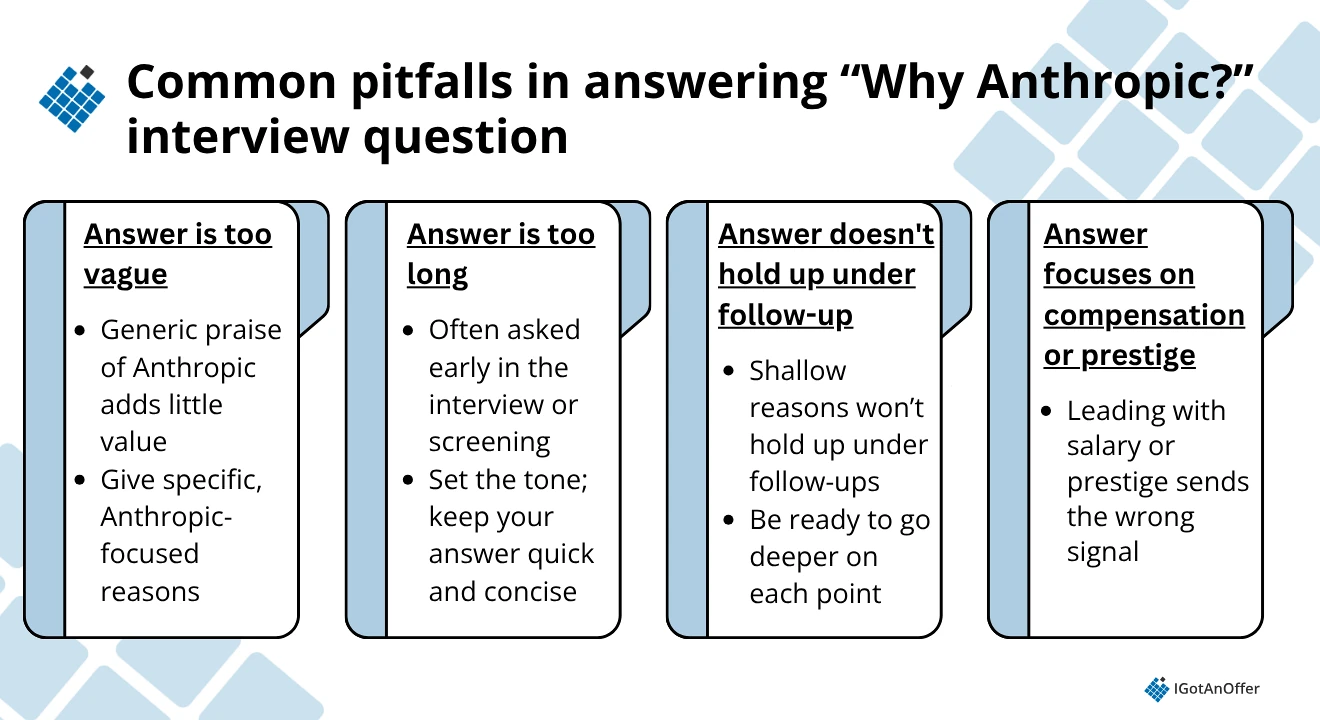
Common pitfalls in answering “Why Anthropic?” interview question
- Answer is too vague. Responses like "I love AI" or "Anthropic is doing such important work" don't tell the interviewer anything. They've heard those answers dozens of times. You need specific reasons that only apply to Anthropic.
- Answer is too long. This question is frequently asked at the beginning of a longer interview round or during the initial screening process. In both cases, it’s important to answer quickly and concisely, so that the interviewer can understand your answer and have time for other questions. Aim for a roughly 1-minute response.
- Answer doesn't hold up under follow-up. If your reasons are surface-level, an interviewer who asks one follow-up question will quickly see that. Make sure you can say more about each reason if pushed.
- Answer focuses on compensation or prestige. Nick Lewis, Anthropic's Head of Global GTM Recruiting, has said publicly that the company is "comfortable turning away even top-tier talent" if they don't connect genuinely with Anthropic’s mission. Leading with salary or prestige signals you're thinking about the wrong things.
2. Study up on Anthropic ↑
It’s time to start putting together the components of your answer. That means learning about Anthropic.
As we mentioned in our tips, a good way to get an inside scoop about the company is to reach out to current or past employees of Anthropic to get an idea of what the company is like. You can also learn a lot about a company by asking previous candidates about their interview experience at Anthropic.
In addition to networking, do some research about Anthropic’s culture and values. Here are a few general resources to get you started:
- Anthropic's company page (by Anthropic)
- Anthropic's core views on AI safety (by Anthropic)
- Constitutional AI: harmlessness from AI feedback (by Anthropic)
- Responsible Scaling Policy (by Anthropic)
For a broader overview of the interview process and other useful resources, take a look at our Anthropic guides:
- Anthropic interview process guide
- Anthropic culture interview guide
- Anthropic system design interview guide
- Common Anthropic interview questions and how to answer them
- How to answer the "Why Anthropic?" interview and application question
Applying for a specific role at Anthropic? Take a deep dive with these guides:
2.1 What sets Anthropic apart
There are things about Anthropic that you won't find anywhere else, and these are the details that make an answer specific and memorable. A few examples:
2.1.1 The "peculiar position" thesis
Anthropic occupies an unusual place in the AI landscape. The company openly acknowledges that it's building technology it considers potentially dangerous, not out of cognitive dissonance, but as a deliberate strategic bet.
If powerful AI systems are coming regardless, it's better to have safety-focused organizations at the frontier than to leave that ground to developers less focused on safety. This stance shapes how the company makes decisions, and it's worth engaging with honestly in your answer.
2.1.2 Interpretability research
A major part of Anthropic's research agenda involves trying to understand the internal workings of AI models. The goal is to make AI systems more transparent and controllable.
In 2024, Anthropic researchers published a landmark interpretability paper mapping millions of internal features inside Claude 3 Sonnet and showing they could directly manipulate the model's behaviour by adjusting them. It's a concrete step toward understanding what's happening inside AI systems.
If you're applying to a research or engineering role, showing that you've read and thought about this work carries weight.
2.1.3 Constitutional AI
Anthropic developed a training approach called Constitutional AI, where a model's behavior is guided by an explicit set of principles. Rather than relying solely on human feedback, the model evaluates and revises its own outputs against a defined framework. This is a distinctive technical contribution, and candidates who can speak to it intelligently stand out.
2.1.4 Public Benefit Corporation status
Anthropic is incorporated as a Public Benefit Corporation, a legal structure that formally balances shareholder returns with obligations to the public good. This reflects a genuine commitment to prioritizing long-term societal outcomes, and it affects how the company makes resource allocation decisions.
2.1.5 High-trust, low-ego culture
Across employee reviews on Glassdoor, one theme comes up consistently: Anthropic hires smart people who aren't arrogant. The company describes itself as a high-trust, low-ego organization where everyone is expected to contribute regardless of seniority, and where mission alignment is the final arbiter in decisions.
If you've worked in environments where politics or hierarchy got in the way of good work, that context might make this genuinely meaningful to mention.
Need help in your tech career?
Our career coaches can show you how to get to where you want to be, whether that's at Anthropic or elsewhere. Book a product management career coaching session or a software engineering career coaching session and get clarity on your next steps.
3. Write out your answer ↑
Using the information above, you should be able to put together a list of two or three distinct reasons as to why you would like to work for Anthropic. The list can include information from the resources we’ve given you, examples from your network, facts you’ve found in your own research, and/or reasons from your own personal experience.
Using this list, write out your complete answer to the question, “Why do you want to work at Anthropic?”
Once you’ve written your answer out, you’ll also need to edit it. Make sure that you are stating the most relevant information, without too many extra details. You should be able to speak through it in one minute or less.
To give you some inspiration, we’ve included an example below. Note that it is specific to Anthropic, takes no more than one minute to recite, and highlights the candidate’s skills without bragging.
Sample answer: "Why Anthropic?"
I want to work at Anthropic for three reasons.
The first is a specific paper. I read "Scaling Monosemanticity" last year (the work on extracting interpretable features from Claude 3 Sonnet), and it changed how I think about the problem. Most safety work I'd seen was trying to constrain model behaviour from the outside. This felt like the first serious attempt to understand what's happening on the inside. That's the direction I want to work in, and it's what drew me to this role specifically.
The second is a conversation I had with Jayne, a research engineer on your interpretability team, whom I reached out to a few weeks ago. She described an environment where people are genuinely willing to say "we don't know yet" and treat that as a starting point rather than a weakness. That matches the way I work best.
The third is the founding logic. I find the "peculiar position" argument (that it's better to have safety-focused labs at the frontier than to leave that ground to developers less focused on safety) more honest than most of what I hear from AI companies. It doesn't pretend that the tension doesn't exist.
Notice what this answer does: it's specific, it names real research and people, it connects to the candidate's professional interests, and it explains why these reasons matter to them personally. It doesn't apply to any other company.
For more guidance on structuring this kind of answer, watch the video below. It was made for Google PM candidates, but the framework applies equally to any role or company, including Anthropic.
4. Practice your answer out loud ↑
You’ve made it to the last step of preparing your answer to “Why Anthropic?”
By now, you should have an answer written out and edited down to the most pertinent information. It’s time to practice speaking through your answer so that you’re able to recite it naturally, without missing any key details.
Here are two steps to prepare for this:
4.1 Practice on your own
If you haven’t already, recite your answer and time yourself. If it is longer than one minute, edit your answer down even more.
Recite your answer a few more times until you are able to speak through it easily, without having to refer to your notes. Ideally, it should not sound too rehearsed, while managing to hit each of the main points.
Film yourself speaking through your answer to get a sense of how you deliver it. Make note of your body language, as well as places you may be stumbling over important details or speaking too mechanically.
Repeat this process until you’re able to answer the question enthusiastically, with engaging body language and a smooth response.
If you're preparing for a specific role or interview type at Anthropic, you may want to check out the following guides:
- Anthropic product manager interview guide
- Anthropic software engineer interview guide
- Anthropic engineering manager interview guide
- Anthropic system design interview guide
- 30+ common Anthropic interview questions + answers (by role)
- How to get a job at Anthropic
If you're looking into other AI/ML-forward tech companies, we also recommend reading the following company-specific guides:
Nvidia
OpenAI
- OpenAI interview process
- How to get a job at OpenAI
- OpenAI interview questions (by role, with answers)
- OpenAI software engineer interview
- OpenAI product manager interview
- OpenAI coding interview
- OpenAI system design interview
- OpenAI behavioral interview
- How to answer "Why OpenAI?" interview and application question
4.2 Practice with peers
Try out your answer in an interview setting by doing mock interviews. If you have friends or peers who can do mock interviews with you, that's an option worth trying. It’s free, but be warned, you may come up against the following problems:
- It’s hard to know if the feedback you get is accurate
- They’re unlikely to have insider knowledge of interviews at your target company
- On peer platforms, people often waste your time by not showing up
For those reasons, many candidates skip peer mock interviews and go straight to mock interviews with an expert.
4.3 Practice with experienced interviewers
In our experience, practicing with someone who's actually interviewed at Anthropic, or conducted interviews there, makes the biggest difference. The feedback is more precise, and the simulation is closer to the real thing.
Find an Anthropic interview coach so you can:
- Test yourself under real interview conditions
- Get accurate feedback from a real expert
- Build your confidence
- Get company-specific insights
- Learn how to tell the right stories, better.
- Save time by focusing your preparation
Landing a job at a big tech company often results in a $50,000 per year or more increase in total compensation. In our experience, three or four coaching sessions worth ~$500 make a significant difference in your ability to land the job. That’s an ROI of 100x!
Click here to book a mock interview with experienced Anthropic interview coaches.





 Software engineer, Engineering manager