

 Back to other articles
 Last updated: September 27, 2026

 Interviews
 Technical program manager
 Deeply researched
Technical program manager interviews at Apple are challenging. The questions are difficult, specific to Apple, and cover a wide range of topics.
The good news is that the right preparation can make a big difference in helping you land the job. We have put together the ultimate guide to help you maximize your chances of success.
- Role and salary
- Process and timeline
- Apple TPM example interview questions
- Interviewing tips
- Preparation plan
Click here to practice with expert TPM interviewers
If you're interviewing for TPM roles at other companies, see our guides to Google TPM interviews, Meta TPM interviews, and Amazon TPM interviews.
1. Apple technical program manager role and salary ↑
1.1 What does an Apple technical program manager (TPM) do?
Apple TPMs lead complex technical programs from start to finish. Their job is to ship Apple's hardware, software, and services on time and at a high quality. That work often includes:
- Shipping new hardware programs across engineering validation stages: engineering validation test (EVT), design validation test (DVT), and production validation test (PVT)
- Building and scaling internal systems
- Coordinating cross-platform software releases (iOS, macOS, watchOS, tvOS)
- Rolling out machine-learning and AI features across Apple products
- Driving services launches (iCloud, App Store, Apple Music)
To do that, they collaborate with many teams, including software engineering, hardware engineering, design, operations, supply chain, and product management.
Apple TPMs don't usually write code themselves, but they're expected to have a strong understanding of technical concepts. On any given program, their responsibilities typically include:
- Setting program scope, milestones, and resource needs
- Managing engineering timelines, often under tight, secrecy-driven deadlines
- Spotting technical risks and dependencies early, and escalating where needed
- Keeping stakeholders aligned on goals and deliverables
- Tracking delivery metrics and reporting on program health
Note: Some teams use the Engineering Program Manager (EPM) title instead of Technical Program Manager (TPM). The two roles overlap heavily at Apple, though EPMs are often in charge of hardware and cross-functional execution. The interview process is broadly the same for both roles.
1.2 Core competencies Apple looks for in TPM candidates
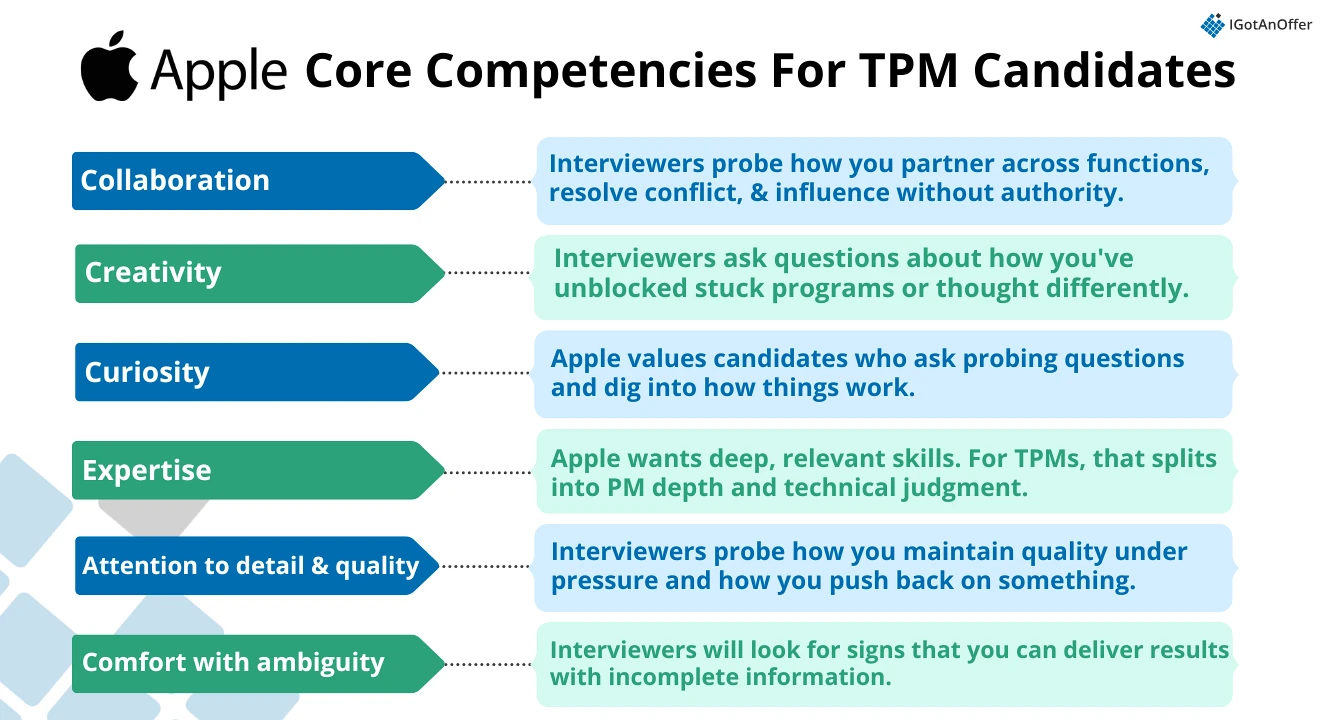
Apple hasn't publicly published a scoring rubric for TPM interviews. But based on our analysis of candidate reports on Glassdoor and Tim Cook's public commentary on hiring, here are the six attributes Apple TPM interviewers consistently screen for across the loop:
- Collaboration. TPMs at Apple coordinate work across engineering, design, operations, and product, often without direct authority over the people they're managing. Interviewers will probe how you partner across functions, resolve conflict, and influence without authority.
- Creativity. Apple looks for people who think differently. For a TPM, that shows up as questions about how you've unblocked stuck programs or found a path through ambiguity.
- Curiosity. Apple values candidates who ask probing questions and dig into how things work. For a TPM, that means showing you can investigate root causes, challenge engineering assumptions, and understand the technical context of any program you own.
- Expertise. Cook has been clear that Apple wants deep, relevant skills. For TPMs, that splits into program management depth (planning, risk, execution at scale) and technical judgment (enough credibility to lead engineering conversations and make trade-off calls).
- Attention to detail and product quality. Apple's culture obsesses over details, and that mindset extends to its TPMs. Expect interviewers to probe how you maintain quality under pressure and how you push back when something isn't ready to ship. "If you expect quick wins and fast returns, then you might not fit in Apple's culture," says John (ex-Apple Sr TPM).
- Comfort with ambiguity and secrecy. Apple TPMs often coordinate work without full visibility into other programs around them. Interviewers will look for signs that you can deliver results with incomplete information.
For more on how these come up in behavioral questions specifically, see our Apple behavioral interview guide.
1.3 Salary and compensation
Apple offers competitive total compensation packages for TPMs. They typically include a base salary, an annual bonus, and equity in the form of restricted stock units (RSUs). Compensation varies depending on level, team, and location.
Below is a breakdown of typical TPM compensation at Apple in the US, based on verified user-submitted data from Levels.fyi.
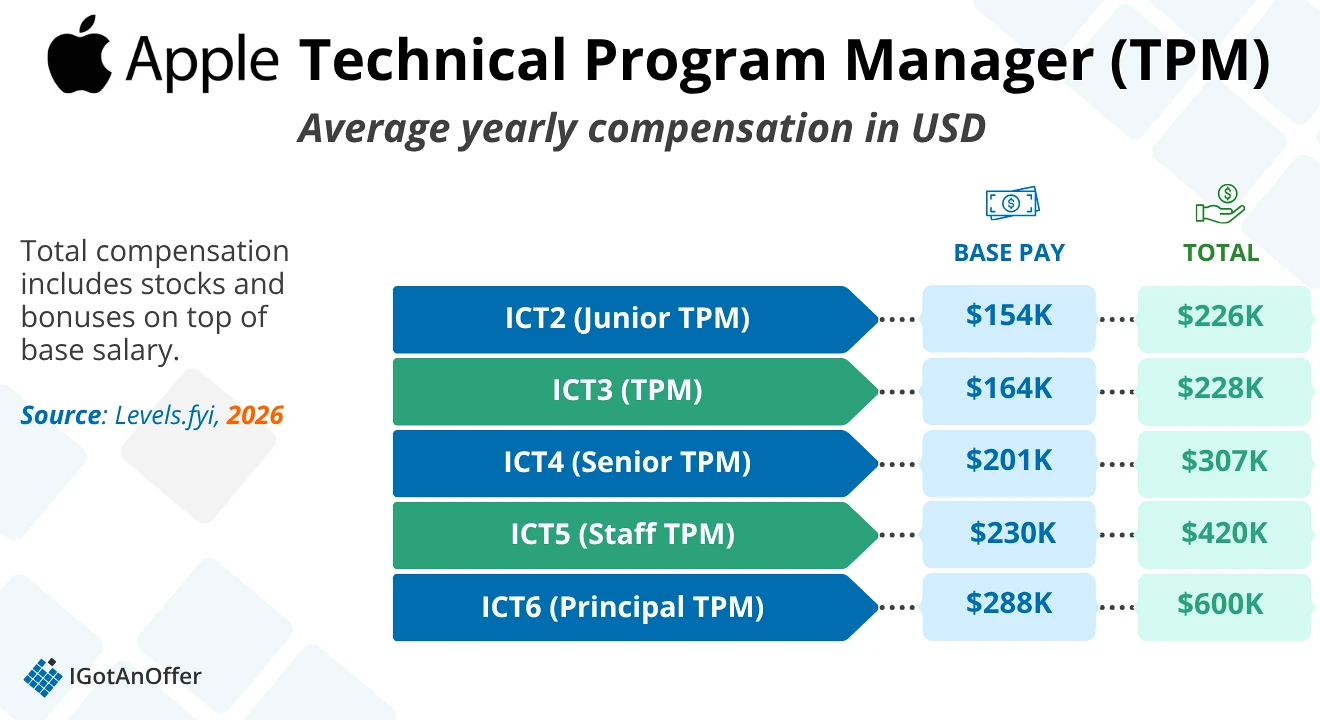
If you’re actively interviewing for an Apple TPM role, ask your recruiter which level you're being considered for. This will help you understand what you should expect in terms of compensation.
And remember, compensation packages are always negotiable, even at Apple. If you do get an offer, don't be afraid to ask for more. If you need practical negotiation tips, read our Apple job offer negotiation guide or consider booking one of our salary negotiation coaches to get expert advice.
Coaches who contributed to this guide




2. Apple technical program manager interview process and timeline ↑
Apple's interview process is more decentralized than at Google or Meta. Each team designs its own loop, so two TPM candidates who interview at Apple in the same month can have different experiences.
Below is a general guide to give you a sense of what to expect during your Apple TPM interviews.
2.1 What interviews to expect
The whole process typically takes between 4 and 8 weeks, but can stretch to 12 weeks. Here's an overview of the steps:
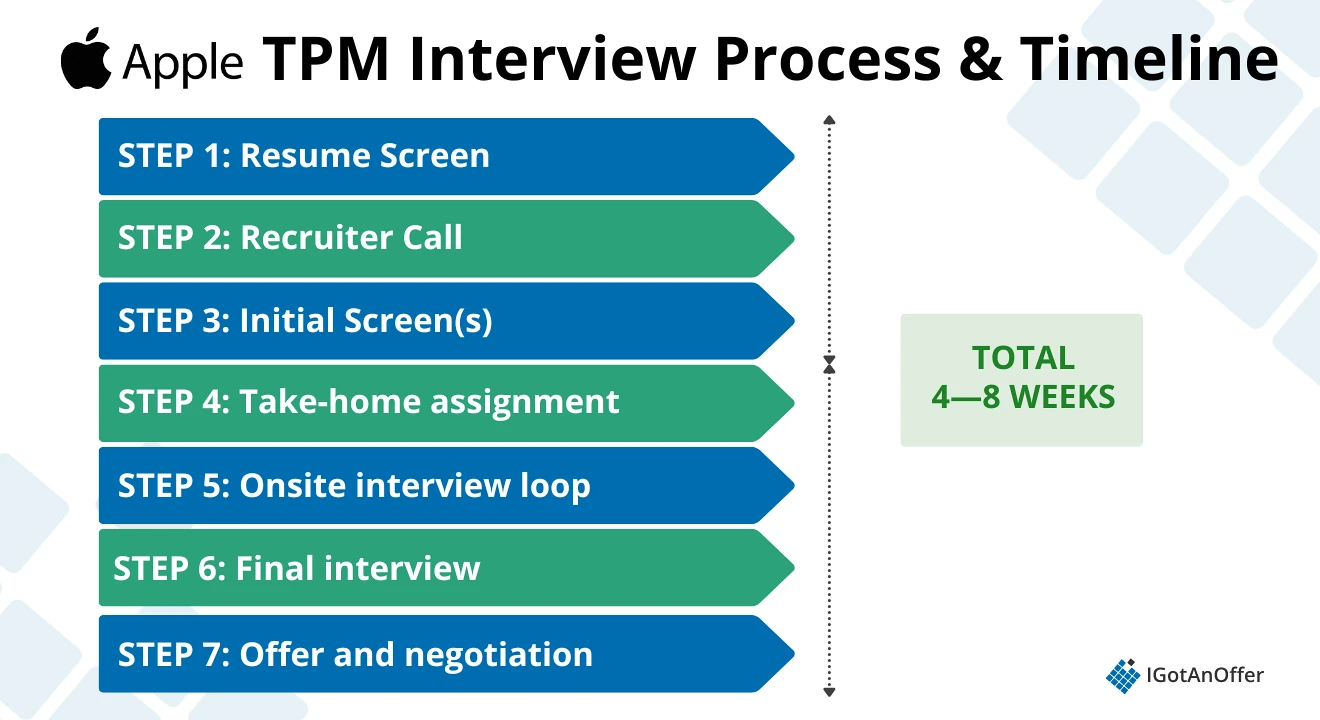
- Resume screen
- Recruiter screen
- Hiring manager and peer phone screens
- Take-home assignment or presentation (some teams)
- Onsite interview loop
- Final interview (some teams)
- Offer and negotiation
2.1.1 Resume screen ↑
First, recruiters will review your resume to assess whether your experience aligns with the open role. This is the most competitive step in the process. We’ve found that ~90% of candidates don’t make it past this stage.
Use this free TPM resume guide to help tailor your resume to the specific TPM role you're targeting at Apple. And if you’re looking for expert feedback, you can also get input from our team of ex-Apple recruiters, who can help you fine-tune your bullet points.
2.1.2 Recruiter screen ↑
If your resume passes the initial review, an Apple recruiter will reach out for a 30-minute phone or Webex call. The conversation is usually casual. It's designed to confirm you're a viable candidate for the role and to outline what comes next.
Expect questions like:
- Tell me about yourself
- Walk me through your resume
- What are your career goals?
- Why Apple, and why this team?
The recruiter will also give you a sense of what's coming, but it’s worth asking specific questions if they don't volunteer the information. You can ask clarifying questions around how many onsite rounds there will be, whether there's a take-home component, and which interview types each round will cover.
2.1.3 Hiring manager and peer phone screens ↑
After the recruiter screen, you'll have one or two phone screens, each 45 to 60 minutes long. One is with the hiring manager, and if there's a second, it's usually with a TPM or peer on the team.
The peer screen tends to skew more technical, while the hiring manager call goes deeper on management style and team fit. Both rounds are equally important, as the goal at this stage is to confirm whether you're worth bringing onsite.
One important thing to note is that Apple's culture of secrecy means hiring managers are often deliberately vague about the specific projects or tech stacks involved. They'll explain high-level responsibilities but avoid sharing confidential details about the team's work.
Expect a mix of questions about your background and resume, program management scenarios from your past work, light technical or system design questions, and behavioral questions about cross-functional collaboration.
2.1.4 Take-home assignment or presentation ↑
In some cases, you may be given a take-home assignment or be asked to prepare a presentation. This isn't standard for every TPM loop, but it does happen, especially for senior (and even hardware-focused) roles.
If a presentation is involved, it's typically a deep dive into a past program you've led. You'll be asked to walk a panel through the problem, your approach, the tradeoffs you made, and the outcome. The panel will likely interrupt with detailed follow-up questions, so be ready to defend your decisions.
Check with your recruiter whether this step will be part of your process so you can prepare accordingly.
2.1.5 Onsite interviews ↑
The onsite is the longest and most demanding part of Apple's TPM interview process. It runs for a full day, either virtually or onsite at an Apple campus.
Most Apple TPM loops run to about 6 rounds, though some go up to 8 or 13, depending on the team. Each interviewer covers a different area, with a heavy emphasis on culture fit alongside the technical and program management content.
Typical onsite rounds for a TPM include:
- Hiring manager round. Deep dive into your background, management style, and team fit. Some candidates have this at the start, others toward the end.
- Program management round. Expect questions on how you'd run a kickoff, manage risk, or recover a slipping program. For more on this round, see our program management primer for tech interviews.
- Technical round. A mix of system design, technical explanation, and occasionally coding. Apple wants to see that you can lead technical conversations with your team. See our system design and coding interview guides for more.
- Behavioral and cross-functional rounds. Multiple rounds focused on collaboration, conflict resolution, and influencing without authority. These often go deep into specific past situations. See our Apple behavioral interview guide for more details on this round.
- Skip-level or director round. Often, the final round of the loop. Here, a director tests your culture fit and overall judgment. This round tends to be more conversational.
If you interview onsite at Apple's campus, one of the rounds may take the form of a lunch interview. You're not formally being evaluated during lunch, but it’s still an opportunity to make a positive impression.
2.1.6 Final interview ↑
In some cases, candidates who pass the onsite rounds are invited to one final interview with a senior team member.
This usually takes the form of a short but in-depth interview that tests any areas the team felt were missing from the onsite rounds, as well as your overall culture fit at Apple.
If all goes well, this or the onsite round will be your last step as a candidate, and from there, you just have to wait to (hopefully) receive your offer.
Because hiring is team-dependent, Apple doesn’t have a standard hiring committee like Amazon or Google. The decision to hire rests upon the hiring manager. They take into consideration the interviewers’ feedback, interview notes, and recommendations, but will ultimately make the final choice.
2.2 What happens behind the scenes
Your recruiter is leading the process and taking you from one stage to the next. Here's what happens behind the scenes at each of the stages described above:
- After the phone screens, your recruiter decides to move you to the onsite, depending on how well you've done up to that point.
- After the onsite, each interviewer submits their notes and a recommendation to the hiring manager.
- The hiring manager pulls the feedback together and makes the call. Unlike Amazon (with a Bar Raiser) or Google (with a hiring committee), there's no separate body that ratifies the decision. The hiring manager weighs the interviewers' input, but the final call is theirs alone.
- You get an offer. If everything goes well, the recruiter will then give you an offer, usually within a week of the onsite, but it can sometimes take longer.
It's also important to note that recruiters and people who refer you have little influence on the overall process. They can help you get an interview at the beginning, but that's about it.
For more on how Apple's hiring structure works, see our Apple interview process guide. And once you have an offer in hand, our Apple offer negotiation guide walks through how to negotiate it.
3. Apple technical program manager example interview questions ↑
The main difficulty with TPM interviews at Apple is that you'll be asked a wide range of questions. We've grouped them into three buckets based on TPM interview reports available on Glassdoor and Blind.
Here are the results of our analysis:
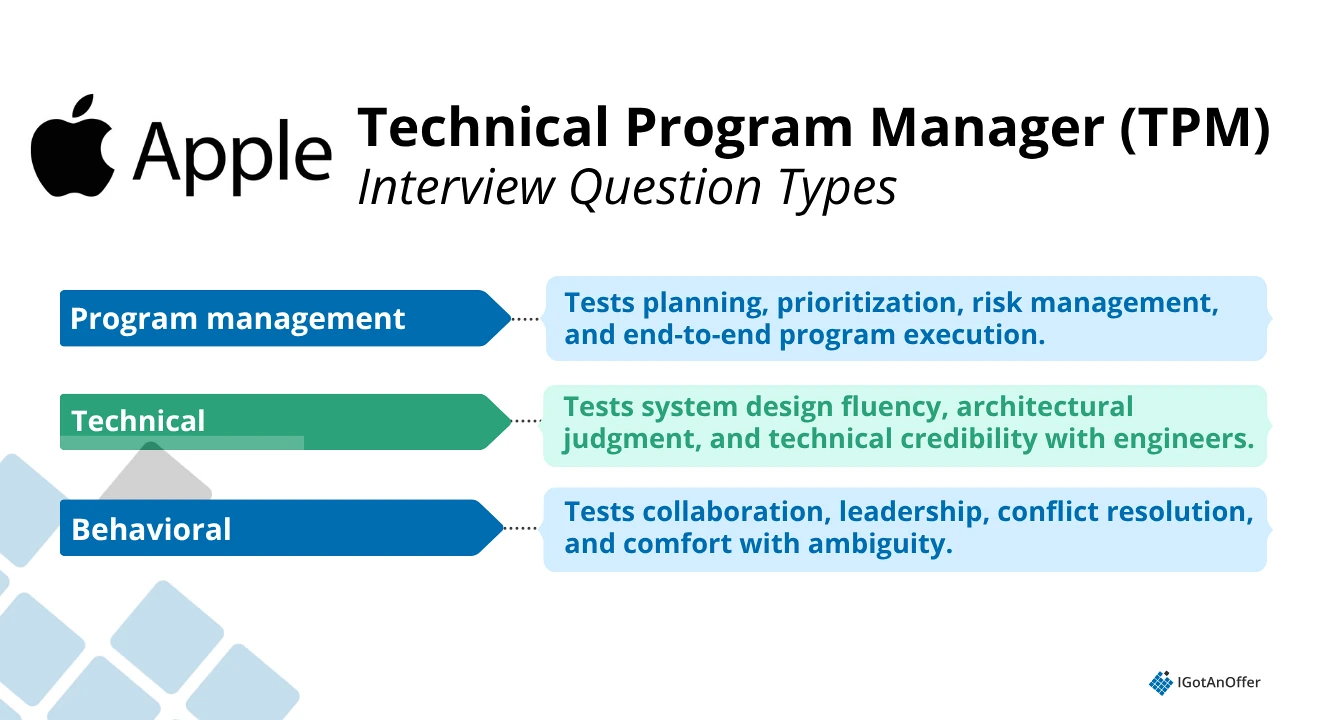
At the time of writing, candidate reports for the Apple TPM role on Glassdoor and other forums are relatively limited. So, we’ve supplemented the list with TPM questions from Google, Meta, and Amazon, where the question type is clearly relevant.
When a question comes from another company, we've added a note in parentheses.
3.1 Program management questions ↑
Apple TPMs design and execute programs from end-to-end. So it's important that you have strong planning, prioritization, and project delivery skills.
This is the part of the interview process where you need to show you think about programs in a comprehensive way (e.g., resources, risks, vendors, etc.) and have a track record of executing flawlessly.
Program management questions can take the form of either a hypothetical or a behavioral question.
Here are some example program management questions you may encounter at Apple:
Example program management questions asked in Apple TPM interviews
1. General/end-to-end questions
- Tell me about a recent TPM project you led. What was the scope and outcome?
- Describe a recent user-facing project you worked on and your role in it.
- Tell me about a time you had to manage a technical program from end to end. (Google)
- What method/process do you use to run a project from end-to-end? (Amazon)
- What makes a successful program manager? (Google)
- What does success look like for a technical program manager? (Amazon)
2. Prioritization
- How do you break up complex projects into milestones and prioritize them?
- How do you prioritize and allocate resources when your team is too small? (Google)
- If you were given several tasks with varying due dates and limited information, how would you schedule them? (Google)
- How do you deliver programs on a tight timeline and with limited resources? (Google)
3. Execution
- Your engineer comes to you and informs you that a particular feature can't be launched by the due date. How do you respond?
- Imagine you find a bug in the software the day before its release date. How would you handle the situation?
- You're working on a program where part of the features were completed with errors. The team that's responsible has moved on to another project and has no time to fix the errors. What do you do? (Amazon)
- What's your process for change and incident management? (Amazon)
4. Delivery
- How do you measure the success of a technical program? What KPIs do you use?
- Compare the agile and waterfall methodologies.
- What is a critical path in project management? (Google)
- How do you make sure you deliver quality outcomes in your projects? (Google)
- How do you manage delivery closure? (Amazon)
5. Kickoff
- What's your process to kick off programs? (Google)
- You're joining a project with no timeline and which didn't have a kickoff. What do you do? (Google)
- Walk me through the complete program lifecycle. (Google)
6. Planning
- How do you handle additional requirements in the middle of a project? (Google)
- How do you forecast a project with no history? (Google)
- How do you create a strategy and roadmap for your programs? (Amazon)
7. Risk
- How do you manage risk for your projects? Please provide an example where you successfully identified and managed risk.
- Tell me about a time you had to manage a significant risk on one of your programs. (Google)
- What are the trade-offs of agile development? (Google)
- How do you manage external team dependencies in your programs? (Amazon)
Learn more in our program management primer for tech interviews.
3.2 Technical questions ↑
Apple TPMs work on very technical programs and need to engage in system design discussions with engineers, debug architectural tradeoffs, and occasionally write code.
That said, Apple's culture of secrecy means there are far fewer public reports on the specific technical questions asked in TPM loops than there are for Google, Meta, or Amazon.
The system design and coding questions below are drawn from TPM interview reports at Google and Amazon. They reflect the question types you should be ready for, even if the exact wording will differ.
3.2.1 System design questions ↑
Apple TPMs work on systems that ship to over a billion active devices. Their products need to be highly scalable while also handling Apple-specific constraints, such as on-device privacy.
As a result, part of the design discussion will focus on scalability, performance, and reliability concerns.
This is the part of the interview process where you need to show you have thorough technical knowledge and can discuss architecture concepts clearly and in a structured way.
System design questions are usually either deep dives into the design of a system you've previously worked on (e.g., "Tell me about the design of the most complex project you've worked on") or about designing a new system from scratch (e.g., "How would you design iCloud?").
Example system design questions reported in FAANG TPM interviews
- Design a server infrastructure for Gmail. (Google)
- Design a global system to upgrade software on a fleet of machines. (Google)
- Design a web cache. (Google)
- Design a file transfer system that can move 100 Petabytes of data from the US East Coast to the US West Coast. (Google)
- Design a system that's capable of displaying an ebook 60s or less after purchase. (Amazon)
- Design a system that keeps track of the last 10 products a user has browsed. (Amazon)
- Design a database for a tiny URL implementation. (Amazon)
- Design a software for an elevator system. (Amazon)
- How would you develop the back end of a parking app? (Amazon)
For more sample questions and a proven answer framework, see our system design interview prep guide.
3.2.2 Technical explanation questions ↑
Technical explanation questions test the depth of your technical knowledge and your ability to communicate it simply.
Your interviewer will usually ask you technical questions based on the projects and technologies listed on your resume, so be sure to brush up on the technologies you've used in the past.
The exact questions will depend on your background. For example, a TPM with a software development background will likely face different technical questions than one with experience in machine learning, embedded systems, or hardware engineering.
Example technical explanation questions reported in FAANG TPM interviews
- What happens when you enter a URL in your browser? (Google)
- How does the cloud work? (Google)
- What is the difference between TCP and UDP? (Google)
- What are threads? What is multi-threading? (Google)
- Describe the memory structure of an operating system (heap, data, and stack). (Google)
- Explain the XYZ technology listed on your resume. (Google)
- What is the difference between a router and a switch? (Amazon)
- What is a linked list? Double linked list? (Amazon)
- How are mobile devices made secure? (Amazon)
- How are passwords passed securely from server to client? (Amazon)
3.2.3 Coding questions ↑
Coding questions are rare in Apple TPM loops. When technical content does come up, it's usually resume-driven, with interviewers probing concepts from projects on your resume rather than asking you to write code from scratch.
According to candidate reports on Blind, even Apple software engineer interviews don't always include LeetCode-style coding. The process varies a lot by team, with some teams skipping LeetCode entirely in favour of architecture discussions, take-home projects, or domain-specific coding. Apple TPM loops follow a similar team-dependent pattern, with even less emphasis on coding.
That said, it's still worth having a working knowledge of coding fundamentals so you can discuss technical concepts, evaluate tradeoffs, and communicate effectively with engineering teams.
The examples below come from Google and Amazon TPM reports.
Example coding questions reported in FAANG TPM interviews
- Write a program to find if an integer is a palindrome. (Solution) (Google)
- Write a program to select two numbers whose sum is lower than a target number. (Solution) (Google)
- Write a program to reverse a string (no built-in functions can be used). (Solution) (Google)
- Implement a queue in an array. (Google)
- Parse all lines in a CSV file with a given string. (Solution) (Google)
- Write a program to find common items between two linked lists. (Solution) (Amazon)
- Write a program that traverses a linked list. (Solution) (Amazon)
We recommend reading our coding interview prep guide and practicing with this list of coding interview examples with answers, in addition to reviewing those listed above.
3.3 Behavioral questions ↑
Behavioral questions appear at multiple stages of the process, from the recruiter screen through to onsite interviews. They can also show up as icebreakers during technical rounds.
These questions are designed to assess how you've handled real situations in the workplace, including leadership, stakeholder management, conflict resolution, decision-making, and cross-functional collaboration.
Apple TPMs work closely with software engineers, product managers, engineering managers, MLEs, and other stakeholders, so collaboration is particularly important. "The culture is all about collaboration," says Santosh (Apple Engineering Leader).
Expect to be tested on how you communicate clearly, build trust across teams, and drive alignment without direct authority.
We've listed common examples below.
Example behavioral questions asked in Apple TPM interviews
General
- Tell me about yourself.
- Walk me through your resume.
- Why do you want to work at Apple? (See sample answer from similar Amazon interviews here.)
- What do you like most about being a Technical Program Manager?
- Tell me about a time you failed. (Amazon)
Collaboration
- Tell me about a time when you handled a difficult stakeholder.
- Tell me about a time you disagreed with someone and how you resolved it.
- Tell me about a time when you faced a conflict while on a team.
- Tell me about a time you had to tailor your communication for different audiences, like an engineering team vs. leadership.
Leadership
- Tell me about a time you had to pivot mid-project when the original goals changed.
- Tell me about a time you had to overcome doubts from your boss or management on a program. (Google)
- Tell me about a time when you were called in to help with a situation.
- Tell me about a time when you took a risk. (Amazon)
- Tell me about a situation where you demonstrated your leadership skills. (Google)
Past project deep dives
- Tell me about your past projects.
- Describe a challenging project you worked on and what made it difficult.
- Tell me about a recent TPM project you led. What was the scope and outcome?
- Describe a recent user-facing project you worked on and your role in it.
For more sample questions, see our guide to Apple behavioral interviews. Then, check out our general behavioral interview guide for sample answers and a proven framework for structuring your responses.
4. Apple technical program manager interviewing tips ↑
Plenty of candidates are excellent at their jobs, but still end up failing their Apple TPM interview. Why? Their interview skills are simply not up to par, especially for a company as competitive and prestigious as Apple.
Here are some tips to keep in mind when preparing for your Apple interview:
4.1 Don't jump straight to answering
Answering a question right away may seem like a great way to show your confidence and knowledge, but it can be a huge red flag to interviewers. It shows them that you:
- haven't taken the time to pause and truly think about your answer,
- haven't bothered to ask clarifying questions or discuss possible approaches, and
- are not being collaborative with your interviewer.
All three are bad signs for how you may work within teams, especially for a cross-functional role. For Apple interviewers, your collaboration and communication skills are just as important as your technical capabilities.
Instead, take a moment to think before you respond. It's okay to pause or jot down notes, as long as you let the interviewer know that's what you're doing.
Example:
Question: "Can you tell me about a time you had to disappoint your supervisor?"
Response: "That's a great question — give me just a minute to collect my thoughts."
This helps by:
- Giving you time to consider and structure your response
- Signaling that you are thoughtful in your communications, even in an interview setting
For a technical interview, you'll want to start by discussing your approach before you begin coding or drawing up solutions. Writing pseudocode, for example, is an excellent way to outline your plan and show your thought process to the interviewer.
This tip is most relevant for technical interviews like coding and system design, but you can also apply it to behavioral interviews. For example, if you're asked about previous work experiences and have several scenarios to share, ask your interviewer which story they prefer to hear.
4.2 Answer with intention
Many of the questions you're asked in a TPM interview will be open-ended. That means there are no right or wrong answers. You have to choose what area to focus on within the large possible space of responses.
In addition to this, you'll also want to be intentional by tailoring your answers to the specific team you're applying for as a TPM. This matters more at Apple than at most FAANGs, since each team designs its own loop, and a TPM on Apple Silicon will face different questions from one in Services or AI/ML.
One way to make sure you're going in the right direction is to first refine the scope of the question.
Consider the larger topic, then either ask for clarification from the interviewer or propose some context/constraints within which you will respond. Here's an example of how to do this:
Example:
Question: "What's your approach to leading a team?" (The interviewer could ask about your principles and values, or they may want to know your best practices for implementing them.)
Response (clarification): "Leading a team is a pretty broad topic. Can you elaborate a bit on what you're after?"
Response (assumption): "This question makes me think about principles. Let me talk about three that are important to me and how I apply them."
This helps by:
- Forcing you to focus your response, both in terms of time and content
- Signaling that you recognize the complexity of the situation being asked about
4.3 Be honest with your knowledge gaps
Your interviewer does not expect you to know everything. If you're unsure about how to proceed with a question, be honest about that. Your interviewer will be able to tell anyway!
Transparency is important, and you can still offer up a possible solution at the same time. For example, you might say: "I don't know that much about X, but I think I would do Y here, correct me if I'm wrong."
The same goes for your behavioral questions. If you've faced challenges or setbacks, be honest and own up to your mistakes and failures. But most importantly, discuss how you improved and learned from them.
4.4 Break problems into smaller tasks
The types of coding questions asked in tech interviews can typically be broken down into 2-5 tasks, each taking a few minutes to complete. While you're making your plan, list out these small steps and explain them to your interviewer.
Then, as you work through those steps, cross out each one you complete and let your interviewer know, e.g., "I have completed task X, and now I will work on Y, then Z." Doing this will also boost your confidence each time you finish a smaller task.
By breaking problems down into smaller tasks, you're showing your ability to tackle difficult, long-term projects on the job.
4.5 Acknowledge tradeoffs
Any decision you make when problem-solving will have a tradeoff. So, call them out in real-time. Use it as an opportunity to discuss different approaches with your interviewer and explain why your choice is the best one.
If you don't bring up tradeoffs, your interviewer will almost certainly ask about them. It's better to beat them to it and show that you can think strategically.
4.6 Adapt to follow-up questions
Interviewers will often ask follow-up questions, whether it's a coding, system design, or behavioral interview. So, don't be alarmed when your interviewer probes your answers!
Instead, listen carefully to the way your interviewer asks these questions. There will often be subtle clues about what they're looking to assess in your next answer.
Sometimes, follow-up questions are also a way for your interviewer to steer you in a particular direction. So, don't hesitate to follow them! In fact, most interviewers have good intentions and are trying to help you, so listen actively for hints.
4.7 Answer in a clear and structured manner
Using an answer framework helps you give clearer, more structured answers across every type of interview. We have a few we recommend:
- For behavioral interviews: the SPSIL framework (Situation, Problem, Solution, Impact, Lessons). It keeps your stories focused and forces you to share what you learned, which is usually what interviewers want to hear.
- For system design interviews: our 4-step framework for breaking down architecture problems at FAANG scale.
- For coding interviews: our 5-step coding answer framework, which helps you communicate your thought process clearly before writing a line of code.
That said, a framework doesn't replace strong content. Spend more time developing the right stories than rehearsing the steps.
4.8 Quantify your achievements
Numbers and data help paint a clearer, more tangible picture of your skills and experience. Plus, they show your potential to make significant contributions to a team, especially for an important technical role like TPM.
When you describe a program you ran, attach a metric to it: reduced cycle time by 30%, saved $2M, improved on-time delivery from 60% to 85%. The further up the ladder you're interviewing, the more your stories need to show measurable business impact.
4.9 Demonstrate both confidence and a growth mindset
Apple seeks candidates who are confident in their skills but who still actively seek growth. Interviewers will usually assess this in the behavioral questions they ask.
When preparing your stories, ask yourself: "Do the stories and experiences that I'm giving show that I'm always looking to grow and learn, rather than having a fixed mindset?"
So, how exactly can you demonstrate this? By asking questions, applying feedback, and owning up to the gaps in your knowledge, while still pushing through. This shows a growth mindset by demonstrating your ability to adapt and learn quickly.
However, be careful not to ask too many questions or need confirmation for every decision you make! This can show a lack of confidence in your skills, not a growth mindset. Only ask for confirmation at specific points as you talk through your solution.
5. Preparation plan ↑
Now that you know what questions to expect, let's focus on how to prepare. After all, the right preparation will make the difference between failing your Apple TPM interviews and getting an offer.
Here are the four most important things you can do to prepare for Apple technical program manager interviews.
5.1 Learn about Apple's culture
Most candidates fail to do this. Before investing tens of hours preparing for an interview at Apple, you should make sure it's actually the right company for you.
Apple is prestigious. It's tempting to assume that you should apply without considering things more carefully. But it's important to remember that the prestige of a job (by itself) won't make you happy in your day-to-day work. It's the type of work and the people you work with that will.
If you know TPMs who currently work at Apple or have worked there, talk to them about the culture. This guide gives you a sense of what to expect, but there's no replacement for a conversation with an insider. Finally, we would also recommend reading the following resources:
- Apple Core Values
- Apple Investor Relations
- Apple Strategy Teardown (from CB Insights)
- Apple’s Company Culture: An Organizational Analysis (by Panmore Institute)
- Apple’s Marketing Mix: 4P Analysis (by Panmore Institute)
- Apple Mission and Vision Statement Analysis
- How Apple is Organized for Innovation (by Harvard Business Review)
- Apple's Culture Rejects the Conventional Wisdom of Product Design (by Inc)
Once you’re comfortable with the culture and team operations, the next step is practice.
5.2 Practice by yourself
As mentioned above, you'll have three types of interviews at Apple: program management, technical, and behavioral.
5.2.1 Program management interview preparation
For program management interviews, start with our TPM interview guide for an overall view of what to expect across the loop. Then dive into our program management primer for tech interviews for a closer look at this specific question type.
After that, brush up on the basics of project management. An efficient way to do this is to take a free course designed to prepare for the Project Management Professional (PMP) exam, such as this course on LinkedIn Learning. It'll refresh your memory on all the key aspects of project management.
If you're interviewing for a TPM role in software development, make sure you're also up to speed on Agile project management. Atlassian's Agile project management guide is a great resource. Focus on:
- The differences between Kanban and Scrum
- Common structures used in Agile projects (epics, stories, themes)
Once you've refreshed your memory on project management best practices, go through the list of program management questions in section 3.1 and draft answers for each.
5.2.2 Technical interview preparation
As a reminder, you can expect three types of questions in technical interviews: system design, technical explanation, and coding questions.
For system design questions, we recommend studying our system design interview prep guide. The guide covers a step-by-step method for answering system design questions and provides several example questions with solutions.
For technical explanation and coding questions, we recommend reading our coding interview prep guide for a step-by-step answer framework. To practice, you can use that method to craft answers to the technical questions listed in section 3.2.
5.2.3 Behavioral interview preparation
For behavioral interviews, start with our Apple behavioral interview guide, which covers how Apple specifically tests collaboration, creativity, curiosity, and expertise.
Then, learn our step-by-step method to answer behavioral questions. You can use that method to craft answers for the main behavioral questions we have listed in section 3.3.
A few other resources:
- People management: People management primer for tech interviews
- Project/program management: Program/project management primer for tech interviews
- Collaboration and partnerships: Dealing with conflict, dealing with stakeholders
- Leadership: Grokking the engineering management leadership interview
- General: General behavioral interview
If you’re preparing for TPM interviews at other FAANG companies, you may find these guides helpful as well:
Once you're in command of these question types, you'll want to practice answering questions. But by yourself, you can't simulate thinking on your feet or the pressure of performing in front of a stranger. Plus, there are no unexpected follow-up questions and no feedback.
That's why many candidates try to practice with friends or peers.
5.3 Practice with peers
If you have friends or peers who can do mock interviews with you, that's an option worth trying. It's free, but be warned, you may come up against the following problems:
- It's hard to know if the feedback you get is accurate
- They're unlikely to have insider knowledge of interviews at your target company
- On peer platforms, people often waste your time by not showing up
For those reasons, many candidates skip peer mock interviews and go straight to mock interviews with an expert.
5.4 Practice with experienced Apple interviewers
In our experience, practicing real interviews with experts who can give you company-specific feedback makes a huge difference.
Find an Apple TPM interview coach so you can:
- Test yourself under real interview conditions
- Get accurate feedback from a real expert
- Build your confidence
- Get company-specific insights
- Learn how to tell the right stories, better
- Save time by focusing your preparation
Landing a job at a big tech company often results in a $50,000 per year or more increase in total compensation. In our experience, three or four coaching sessions worth ~$500 make a significant difference in your ability to land the job. That's an ROI of 100x!
Click here to book TPM mock interviews with experienced interviewers.



 People management and Leadership