

 Back to other articles
  Last updated: June 09, 2026

 Interviews
 Engineering manager
 Deeply researched
Anthropic engineering manager interviews are among the most demanding in the AI industry. While the process is shorter (2-4 weeks) than most top tech companies, the technical bar remains extremely high.
You'll need to demonstrate a combination of technical depth, strong leadership judgment, and genuine alignment with Anthropic's safety-first, high-trust culture.
On top of this, Anthropic is also uniquely focused on how well candidates fit their mission and values. This can trip up even the most experienced EMs.
In this guide, we cover everything you need to know to prepare for your Anthropic EM interview: the role’s key responsibilities, reported salaries, a step-by-step breakdown of the interview process, example interview questions from real candidate reports, and preparation tips that actually make a difference.
Here’s an overview of everything we’ll cover:
Book 1-on-1 interview coaching with an expert EM coach
1. Anthropic engineering manager role and salary ↑
Before we dive into the Anthropic engineering manager interview process, let’s take a deeper look at the role itself and what it entails.
1.1 What does an Anthropic engineering manager do?
Anthropic engineering managers lead teams responsible for building and maintaining systems that power one of the most consequential AI products in the world. Depending on the team, that might mean working on model inference infrastructure, developer tooling, safety systems, or the platform behind Claude.
Anthropic EMs blend technical depth, strategic thinking, and people leadership, much like EM roles at other top AI companies. But the way these elements come together is shaped by Anthropic's founding mission: to build AI that is safe, interpretable, and steerable.
Anthropic’s bar for both technical excellence and ethical judgment is demanding. The real distinction lies in how engineering managers lead at Anthropic.
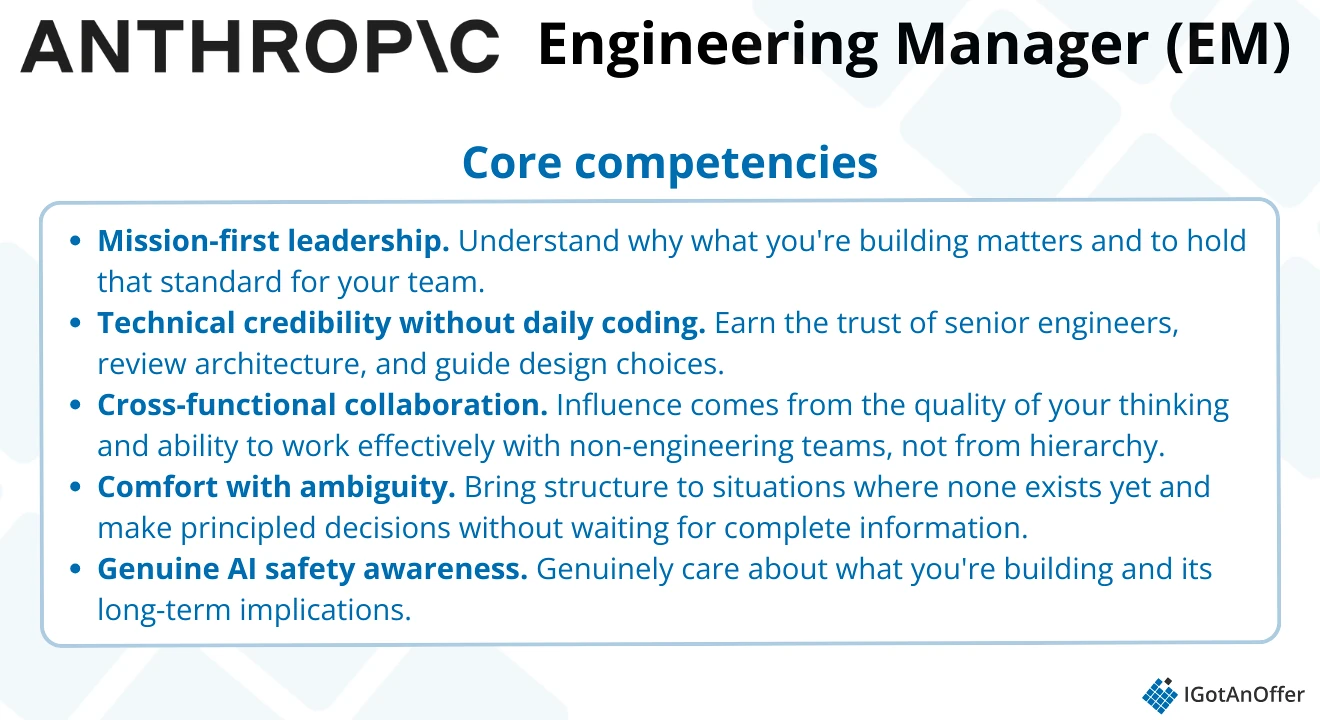
Here are the core competencies of an Anthropic EM:
- Mission-first leadership. Every decision, from hiring to architectural tradeoffs, is evaluated through the lens of Anthropic's mission. You're expected to understand why what you're building matters and to hold that standard for your team.
- Technical credibility without daily coding. You'll need to be close enough to the work to earn the trust of senior engineers, review architecture, and guide design choices. But your success is measured by how well your team performs, not how much you personally build.
- Cross-functional collaboration. You'll partner closely with researchers, product teams, and policy stakeholders. Anthropic's structure is relatively flat and low-ego. Influence comes from the quality of your thinking, not from hierarchy.
- Comfort with ambiguity. Anthropic is a fast-moving company working on genuinely novel problems. Teams are expected to bring structure to situations where none exists yet and to make principled decisions without waiting for complete information.
- Genuine safety awareness. This is what makes Anthropic different from any other tech company. You need to genuinely care about what you're building and its long-term implications. Interviewers can tell the difference between candidates who have thought seriously about this and those who haven't.
1.2 Anthropic engineering manager salary
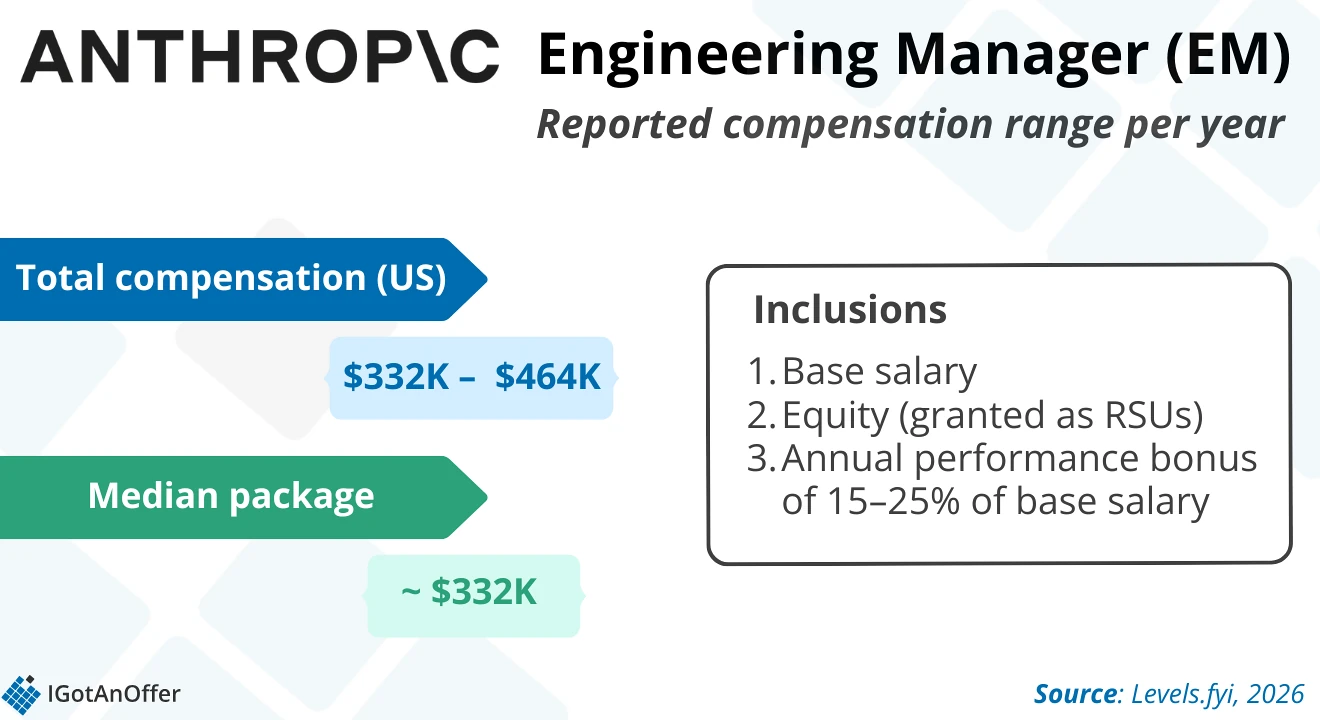
Anthropic offers highly competitive compensation, and the engineering manager role is no exception.
There is no data for level-specific compensation, but here’s what you can expect based on reported figures on Levels.fyi:
- Total compensation (US): typically ranges from $332K to $464K per year
- Median package: around $332K
- Inclusions: base salary, equity (granted as RSUs), and an annual performance bonus typically ranging from 15–25% of base salary
Overall, Anthropic's Glassdoor ‘Compensation and Benefits’ score sits at 4.9 out of 5. It’s one of the highest among AI companies, with OpenAI ranked slightly lower at 4.6. The company does not offer traditional annual cash bonuses separately from its RSU structure, so its compensation model is more equity-weighted.
The high compensation reflects Anthropic's expectations. The company is explicit about wanting to hire exceptional people and paying them accordingly.
While we presume that you already know which specific EM level you are applying for, it’s still good to double-check this with your recruiter. Your recruiter should be able to advise you on which level you’re being evaluated.
Ultimately, how you do in your interviews will help determine what you’ll be offered. That’s why hiring one of our ex-Anthropic interview coaches can provide such a significant return on investment.
It’s also worth noting that, according to reports online, Anthropic offers little negotiation room for salaries. It operates on a strict no-bidding-wars philosophy and a levels-based compensation system. In other words, you’ll want to make sure you perform your best during interviews, so that you at least have a shot at getting the highest possible offer within your role level.
2. Anthropic engineering manager interview process & timeline ↑
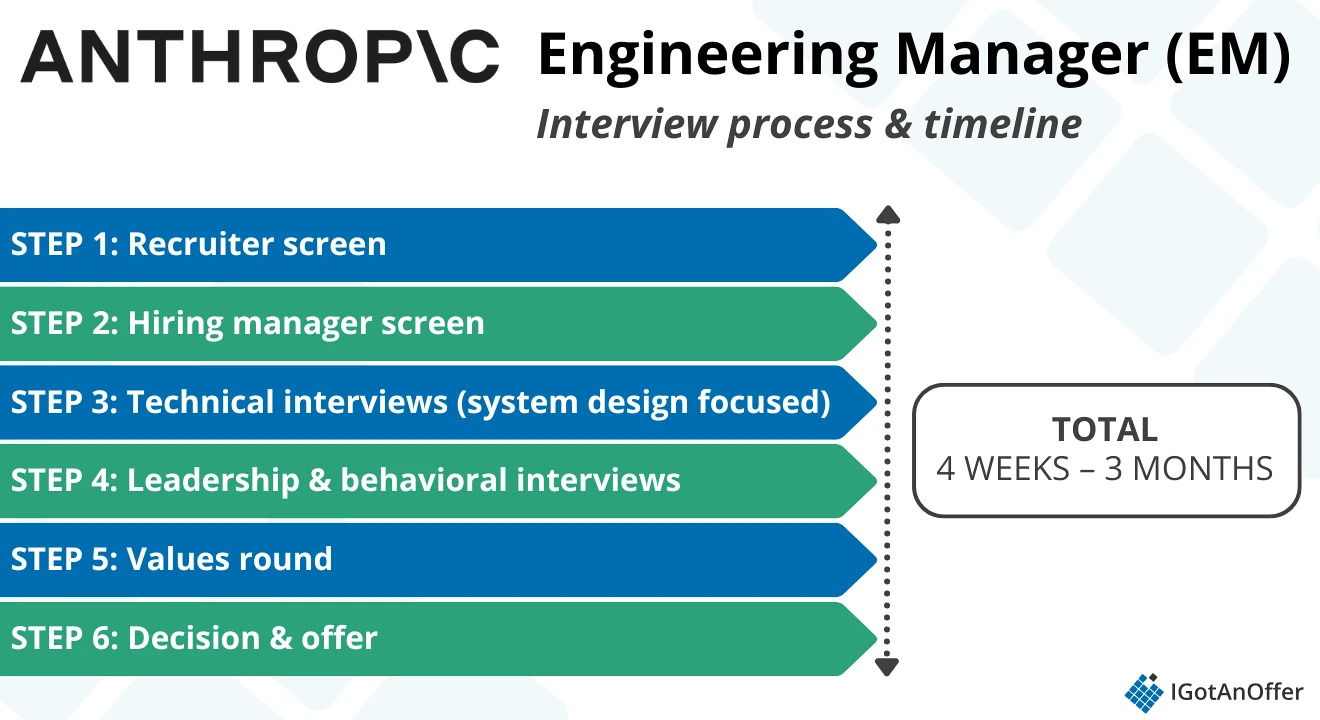
Anthropic’s interview process is well-organized. Candidates consistently describe it as thoughtful and efficient. The process typically spans 4 weeks to 3+ months, though it may actually be faster in some cases.
For the EM role, expect the following steps:
- Recruiter screen
- Hiring manager screen
- Technical interviews (system design focused)
- Leadership and behavioral interviews
- Values round
- Decision and offer
Step 1: Recruiter screen (30 minutes) ↑
Your first interaction with Anthropic will be with someone from the recruiting team. They'll explain the process, ask about your background, and assess high-level fit. They'll also talk about Anthropic as a public benefit corporation (PBC) and what that means in practice.
This isn't an intensive interview. But your answer to “Why Anthropic?" matters here more than it would at most companies.
Recruiters are listening for genuine mission alignment from the very first conversation. They’re not looking for enthusiasm for AI generally, but a specific, considered reason for wanting to work on safe AI at Anthropic in particular.
These conversations are generally open and candid. Anthropic wants candidates to self-select out early if the culture or mission isn't genuinely the right fit, so recruiters tend to be transparent about what the environment is really like, including the intensity.
Step 2: Hiring manager screen (45 to 60 minutes) ↑
This is your first conversation with someone who would potentially be your peer or manager at Anthropic. The purpose is to assess your technical background, your approach to people management, and how you lead.
Expect questions about:
- Your experience leading engineering teams
- Technical challenges you've tackled
- Your management philosophy
The hiring manager is assessing whether you have the technical depth and leadership judgment for the role, and whether your approach aligns with how Anthropic operates.
Some hiring managers also include a light code review component, showing you a piece of code and asking you to identify issues, explain what it does, or suggest improvements across different languages.
Check with your recruiter on what to expect for your specific team.
Step 3: Technical interviews (system design focused) ↑
Anthropic's EM technical rounds focus on system-level thinking and architectural judgment rather than live coding.
Based on candidate reports, EM candidates are typically not asked to write code. Instead, the focus is on how you evaluate designs, identify tradeoffs, and think through problems at scale.
Anthropic's philosophy is that interview problems should be related to the actual work of the team. This means you should expect system design questions that are directly tied to Anthropic's technical domain — LLM inference, distributed systems, request handling at scale — rather than generic design problems.
Step 4: Leadership & behavioral interviews ↑
Candidates typically go through multiple behavioral and leadership rounds covering people management, cross-functional collaboration, and delivery under pressure.
These follow a standard behavioral format, but Anthropic interviewers probe harder on specifics than you might expect. Come with concrete examples and be ready to go deep on what you specifically did, not just what the team achieved.
Interviewers will follow up to distinguish between candidates who led outcomes and those who were adjacent to them.
Step 5: Values round ↑
This is the round that defines Anthropic's EM interview process and the one that catches the most candidates off guard. It’s where most EM candidates fail because the format is unlike anything most candidates have encountered.
The values round is conducted by non-technical interviewers and has been described by multiple candidates as closer to a therapy session than a job interview: deeply personal, emotionally probing, and conversational.
Interviewers are not looking for enthusiasm or polished talking points about AI safety. They want to understand whether you'll hold your values under real pressure, and they actively look for skepticism and pushback.
You'll face a mix of reflective questions (drawing on real experiences where your values were tested) and hypothetical questions (novel ethical situations with no clean answer).
For more guidance on these non-technical, values-driven interview questions at Anthropic, check out our Anthropic culture interview guide.
Step 6: Decision and offer ↑
After the final round, the interview team reviews all feedback and makes a hiring decision by consensus. If Anthropic extends an offer, you'll work with the recruiter to discuss the compensation structure.
One dynamic unique to Anthropic's process: candidates who perform well but don't match an immediate opening may be placed in a candidate pool and contacted by hiring managers over the following months.
This has been reported by multiple candidates on Glassdoor and is worth keeping in mind if you go through the process and don't receive an immediate offer.
What exactly does Anthropic look for in a potential hire?
Throughout these interview rounds, Anthropic is evaluating specific qualities. Here's what they're looking for regardless of role:
- Mission alignment over enthusiasm. Anthropic isn't looking for people who are excited about AI. They're looking for people who have genuinely wrestled with the implications of what they're building and have a considered, honest point of view. Performed enthusiasm is easy to spot and actively works against you.
- Judgment under uncertainty. Anthropic would rather hire people with strong judgment than build policies to cover every situation. They look for managers who make principled decisions without complete information and who can articulate their reasoning clearly.
- Candor and intellectual honesty. Anthropic's culture values direct, honest communication. Interviewers expect you to share real failures, genuine disagreements, and authentic concerns — not polished stories where everything worked out.
- Technical credibility. EMs at Anthropic stay close to the work. You're expected to engage meaningfully with architectural decisions and earn the respect of senior engineers through genuine technical depth.
- Safety awareness. You don't need to be an AI safety researcher. But you do need to demonstrate that you've thought seriously about the implications of the work and that safety is something you'd hold to under pressure, not just talk about in interviews.
3. Anthropic engineering manager example interview questions ↑
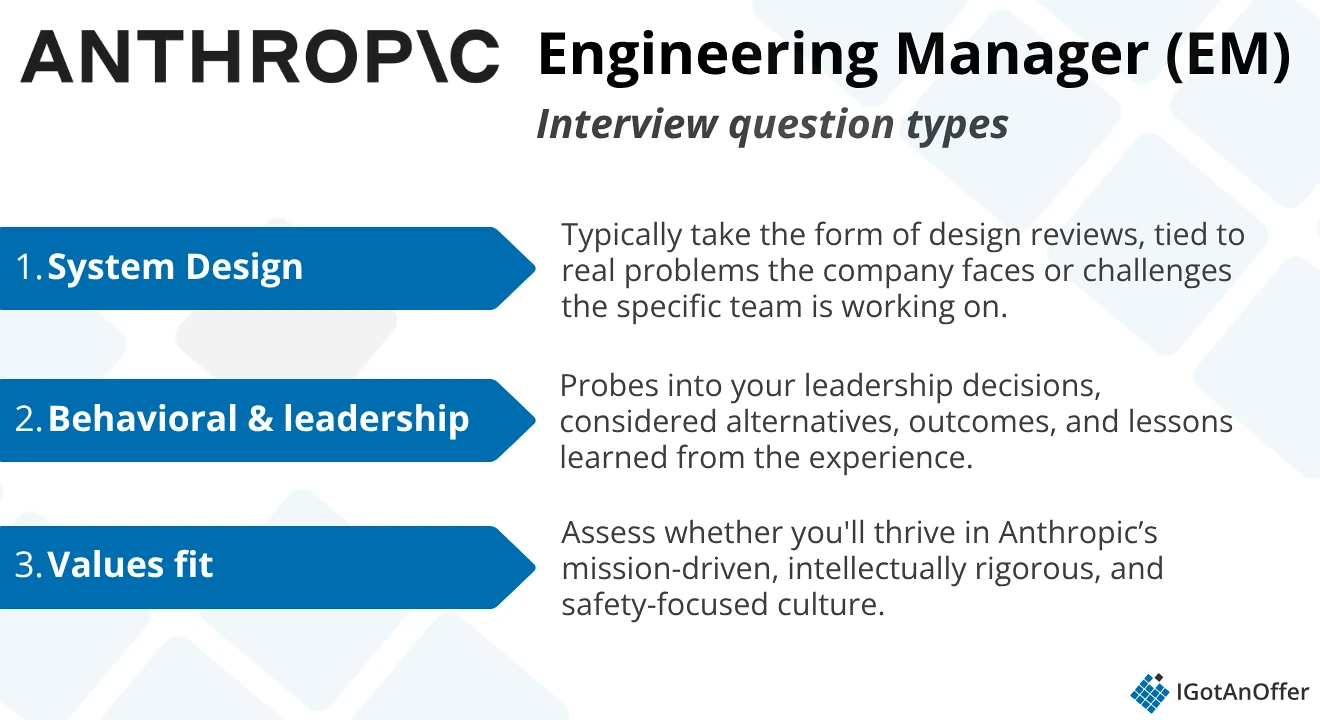
There’s very limited data about the exact interview questions asked at Anthropic’s engineering manager interviews.
To compile these questions, we gathered reported questions from Exponent, Glassdoor, and other online sources, plus questions from similar AI companies.
To make your preparation more focused, we've grouped them into three question categories:
3.1 System design questions ↑
System design questions at Anthropic are tied to real problems the company faces or challenges the specific team is working on.
Based on candidate reports, system design questions for EM candidates typically take the form of design reviews, rather than designing from scratch. You may be shown an existing design and asked to evaluate it, find problems, and suggest improvements.
You may also be asked to walk through the architecture of a system you've built and explain the tradeoffs you made.
When answering system design questions at Anthropic, focus on your reasoning as well as your solution. Interviewers want to see how you think: how you identify failure modes, evaluate tradeoffs, and balance competing priorities like speed, reliability, and simplicity.
Demonstrating sound judgment matters as much as the technical answer itself.
Example system design questions asked in Anthropic engineering manager interviews:
- You're shown a design for an inference batching system from a junior developer — provide feedback, identify issues, and suggest improvements. (Glassdoor, Aug 2025)
- Design an API for serving large language models efficiently, covering request batching, queuing, and GPU utilization under variable load. (LinkedIn)
- Walk through a high-level design of a complex system you've built. Explain the tradeoffs you made and why you made them. (Exponent)
- Design a distributed search system capable of handling 1 billion documents and 1 million QPS. (Medium)
- Design a key-value store. (Sample answer)
- Design a web crawler. (Sample answer)
For a deeper breakdown of how to approach these kinds of problems, including frameworks, examples, and best practices, check out our system design interview guide, machine learning system design guide, and generative AI system design guide.
3.2 Behavioral and leadership questions ↑
These questions come up repeatedly across multiple rounds. Anthropic interviewers will dig deeper to uncover why you made certain choices, what alternatives you considered, what the outcomes were, and what you learned from the experience.
Expect follow-up questions that push you to reflect more deeply on your leadership decisions.
One important pattern to notice is that Anthropic asks both retrospective questions ("Tell me about a time when...") and hypothetical questions ("What would you do if...").
Together, they help interviewers understand both who you are (your leadership patterns) and how you think (your judgment and adaptability).
Example behavioral and leadership questions asked in Anthropic engineering manager interviews:
- Tell me about a technical misjudgment that delayed a project.
- Walk me through a project you owned end-to-end. What were the key technical decisions?
- Why are you an effective R&D leader? (Google)
- Tell me about a project that had multiple solutions. How did you decide and arrive at the most optimal solution? (Google)
- How is managing other managers different from managing individual contributors? (Microsoft)
- Tell me about a time you had a conflict with someone. How did you resolve it, and what did you learn? (Exponent)
- How do you motivate your team to perform better? (Exponent)
- How do you mentor top talent? (Exponent)
- Tell me about a time when you received negative feedback and how you handled it. (Exponent)
- Tell me about a time when you had to deliver negative feedback. (Exponent)
- Tell me about a time you made a bold and difficult decision. (Exponent)
- Tell me about a time you led a cross-functional team. (Exponent)
- Describe the most technically complex project you have worked on and explain why it was complex. (Exponent)
To see how to approach behavioral questions with structure and confidence, explore our behavioral interview guide for software engineers.
3.3 Values fit questions ↑
Anthropic's values questions assess whether you'll thrive in its mission-driven, intellectually rigorous, and safety-focused culture.
Interviewers are not looking for rehearsed AI safety talking points. Instead, they'll probe your reasoning, challenge your assumptions, and often prefer thoughtful uncertainty over unquestioning agreement.
Expect questions tied to Anthropic's seven core values, with follow-ups that test how you navigate tensions between competing priorities such as speed versus safety, candor versus diplomacy, and autonomy versus collaboration.
As we’ve already mentioned, Anthropic's culture is unusually mission-driven, intellectually demanding, and safety-focused. It goes deeper than typical culture fit assessments at other companies.
If you can speak honestly and specifically about how you've navigated these tensions, you'll significantly strengthen your candidacy.
Example values questions asked in Anthropic engineering manager interviews:
- Why Anthropic?
- Tell me about a time you made a safety-first decision in a project. (Medium)
- Describe a situation where you had to prioritize safety or reliability over speed or performance.
- Tell me about a moment where your values were genuinely tested. How did you feel at the time?
- Describe a situation where you changed your mind about something you had previously believed strongly.
- What are the risks of assuming LLMs think or feel like humans?
- What do you find most challenging about Anthropic's mission?
- Which of Anthropic's core values do you find hardest to live up to?
Check out our Anthropic culture interview guide for more guidance on these types of questions.
4. Interview tips ↑
You might be a skilled engineering manager, but that alone won't get you through these rounds. Interviewing itself is a skill. At Anthropic, expectations are so high that your interview impression matters as much as your subject knowledge.
Here's how to approach your Anthropic EM interviews:
4.1 Avoid sounding too scripted
Using memorized behavioral STAR stories can backfire in Anthropic culture interviews as the company values intellectual honesty more than a polished performance.
However, without a structure, you might start to ramble, or your answer may become hard to follow. As a compromise, we suggest preparing with a framework, such as IGotAnOffer’s SPSIL framework (Situation, Problem, Solution, Impact, Learning) to cover the essential details.
It’s similar to STAR but fixes two common pitfalls candidates often face: (1) candidates often struggle to clearly distinguish between “task” and “action,” and (2) it includes a “learning” step, which STAR often overlooks, even though it’s one of the most important parts of your answer.
That said, don’t be overly reliant on your script or the framework. Treat it as a guide, and be ready to adapt to open-ended questions, think out loud, and engage with the interviewer. Focus on your most relevant achievements and experiences.
4.2 Keep your stories concise
When answering behavioral questions, clarity matters more than detail. Whether you're using the SPSIL or STAR method, aim to set up the situation in 30 seconds or less.
Use a timer to stay concise and avoid overexplaining — one of the most common mistakes candidates make. In Anthropic's multi-round process, interviewers hear dozens of stories, so keep yours focused and easy to follow.
4.3 Practice system design with Anthropic's context
System design questions at Anthropic are tied to real problems the company works on. Generic design prep isn't enough. You should start by familiarizing yourself with Anthropic's technical domain — LLM inference, request batching, distributed systems at scale — and practice evaluating existing designs, not just building from scratch.
To help you prepare, take a look through our machine learning (ML) system design interview guide and generative AI system design interview guide.
4.4 Adapt to follow-up questions
Don't be alarmed if your interviewer asks follow-up questions — this is normal, and at Anthropic, it's especially common. Listen carefully to how your interviewer is asking these questions, as there will often be a clue about the specific thing they're trying to assess.
For example:
- "How did your team react to that?" → They're testing collaboration and influence.
- "What other options did you consider?" → They're testing judgment and decision-making.
- "What would you do differently now?" → They're testing self-awareness and growth.
- "How did that make you feel?" → In the values round specifically, they're testing emotional honesty and self-reflection.
If an interviewer says, "Tell me more about [specific detail]," they're often testing whether you actually did the work or whether you're speaking generally about team efforts.
4.5 Prepare questions for your interviewers
Anthropic expects candidates to be curious and engaged.
Thoughtful questions show you're seriously evaluating whether Anthropic is right for you. This aligns with how the company thinks about mutual selection.
Avoid generic questions. Interviewers can tell when you're asking boilerplate questions versus when you're genuinely curious about the specific team, the research, or how decisions get made.
5. Preparation plan ↑
Like management, interviewing is a skill. The more deliberately you practice it, the better you'll perform when it matters.
5.1 Study Anthropic's culture and mission deeply
If you haven't already, spend real time reading Anthropic's core values, their Responsible Scaling Policy, and their published research — particularly on Constitutional AI and mechanistic interpretability.
Don't skim them for talking points. Try to form genuine opinions and reflect on the harder parts. Maybe you find one of the values genuinely difficult to live up to, or have real questions about how Anthropic balances safety with the commercial pressure of shipping products.
Anthropic interviewers can tell when candidates have done real introspection. Authenticity matters more than rehearsed perfection.
5.2 Practice by yourself
You'll have to answer three types of questions at Anthropic: behavioral and leadership, system design, and values fit. The first step of your preparation should be to brush up on these different question types and practice answering them by yourself.
To get you started, you might want to check out the following guides:
- For company-specific interview guidance, check out our Anthropic interview process and timeline guide and How to get a job at Anthropic guide.
- For people management guidance, read our guide to people management questions in tech interviews, program management primer, and leadership primer.
- For insights on EM leadership interviews, read our guide to Grokking the engineering management leadership interview.
- For system design questions, we recommend studying our system design interview prep guide, GenAI system design guide, and ML system design guide.
- For other types of interview questions, check out our guide to FAANG interview questions for engineering managers.
- For Anthropic culture insights, read our guide to the Anthropic culture interview and how to answer “Why Anthropic?” guide.
Interviewing for an EM role at another company? You may also want to check out our other company-specific EM interview guides:
- Google engineering manager interview guide
- Meta engineering manager interview guide
- Apple engineering manager interview guide
- Netflix engineering manager interview guide
- Amazon software development manager interview guide
- Microsoft engineering manager interview guide
- Uber engineering manager interview guide
- DoorDash engineering manager interview guide
- Stripe engineering manager interview guide
- Engineering manager interview prep guide
Finally, a great way to improve your communication for behavioral, system design, and values questions is to interview yourself out loud.
This may sound strange, but it can significantly improve the way you communicate your answers under pressure. Play the role of both the candidate and the interviewer, asking questions and answering them out loud.
However, by yourself, you can't simulate thinking on your feet or the pressure of performing in front of a stranger. Plus, there are no unexpected follow-up questions and no feedback.
That's why many candidates try to practice with friends or peers.
5.3 Practice with peers
If you have friends or peers who can do mock interviews with you, that's an option worth trying. It's free, but be warned, you may come up against the following problems:
- It's hard to know if the feedback you get is accurate
- They're unlikely to have insider knowledge of interviews at your target company
- On peer platforms, people often waste your time by not showing up
For those reasons, many candidates skip peer mock interviews and go straight to mock interviews with an expert.
5.4 Practice with experienced ex-Anthropic engineering manager interviewers
In our experience, practicing real interviews with experts who can give you company-specific feedback makes a huge difference.
Find an Anthropic engineering manager interview coach so you can:
- Test yourself under real interview conditions
- Get accurate feedback from a real expert
- Build your confidence
- Get company-specific insights
- Learn how to tell the right stories, better
- Save time by focusing your preparation
Landing a job at a big tech company often results in a $50,000 per year or more increase in total compensation. In our experience, three or four coaching sessions worth ~$500 will make a significant difference in your ability to land the job. That’s an ROI of 100x!
Click here to book mock interview sessions with top tech EM interviewers.

 System design