

 Back to other articles
  Last updated: June 01, 2026

 Interviews
 Deeply researched
The TikTok interview process is difficult. It has multiple technical interviews that challenge even candidates who've succeeded at Meta, Google, and Stripe.
But the technical bar isn't the only challenge. TikTok's process varies significantly by team, and takes longer than big tech companies like Uber. Not knowing these details makes preparation harder.
We're here to help. We work with former TikTok engineers and interviewers on our platform, and we've mapped out exactly how the process works and what you need to prepare for.
This guide breaks down TikTok's full interview process, including timeline expectations, what’s tested at each interview stage, and how to prepare for the technical and behavioral components that trip up most candidates.
Here’s an overview of what we’ll cover:
- About TikTok
- Working at TikTok
- TikTok’s core values
- TikTok interview process and timeline
- Are you prepared for your TikTok interviews?
Click here to book 1-on-1 interview coaching with an ex-TikTok interviewer.
1. About TikTok ↑
TikTok is the world's leading short-form video platform with over 1 billion users, and it got there by fundamentally reimagining content discovery. TikTok's "For You" algorithm processes billions of signals in real-time to predict what each user wants to watch next, often surfacing content from creators they've never heard of. This approach has made TikTok one of the most culturally influential platforms of the past decade.
Launched globally in 2017 by Chinese technology company ByteDance, TikTok operates with a distinctly global structure. The company maintains headquarters in Los Angeles and Singapore with major offices across North America, Europe, and Asia, while keeping close technical collaboration with ByteDance engineering teams in Beijing.
The company also offers technical challenges at a global scale, meaningful cultural impact, and compensation packages that compete with or exceed those of other top tech companies.
2. Working at TikTok ↑
To understand what TikTok looks for in candidates, you need to understand how the company operates.
2.1 Fast-paced environment
TikTok ships features to billions of users in weeks, not months. Engineers and product teams adapt quickly to changing priorities and work across multiple time zones, particularly alongside teams based in China and Singapore.
The company maintains an "always day 1" mentality. Teams are encouraged to take initiative and move quickly, even in ambiguous situations. Being comfortable with autonomy is essential.
2.2 Global collaboration
As we already mentioned, TikTok requires significant collaboration with international teams, though it depends on the role you play. Many engineers have meetings during Chinese business hours, including evening or early morning slots.
Some candidates are asked about Mandarin language skills during interviews, particularly for roles requiring close collaboration with Beijing-based teams. The company's core values emphasize thinking globally and celebrating different cultures.
2.3 Strong technical culture
TikTok focuses heavily on machine learning, recommendation systems, and large-scale distributed systems.
However, its main product is the recommendation engine, which means TikTok engineers work on complex technical problems, such as:
- Training models on petabyte-scale datasets
- Optimizing for millisecond-level latency on video delivery
- And building distributed systems that serve content to over a billion daily active users across hundreds of countries
Engineers see their code impact hundreds of millions of users almost immediately. This velocity comes with some tradeoffs, of course. You’ll face tight deadlines, evolving requirements, and making technical decisions with incomplete information.
This velocity comes with tradeoffs. You'll face tight deadlines, evolving requirements, and need to make technical decisions with incomplete information.
So the technical bar is extremely high. You can pass interviews at Meta, Google, and Stripe and still not pass TikTok’s technical standards. One candidate who successfully interviewed at all 4 companies mentioned that TikTok's technical interviews are more challenging.
2.4 Competitive salaries
Of course, the competitive salaries on offer are likely part of your reason for applying to TikTok.
One distinctive aspect of TikTok's compensation is the back-weighted equity vesting schedule. You receive 15% of your shares in year 1, 25% in years 2 and 3, and 35% in year 4. Meaning your highest total compensation comes in year 4. Amazon is the only other major tech company with a similar structure.
Software engineers at TikTok receive compensation packages that compete with or exceed other major tech companies, with a median total compensation of $244,000 in the United States.
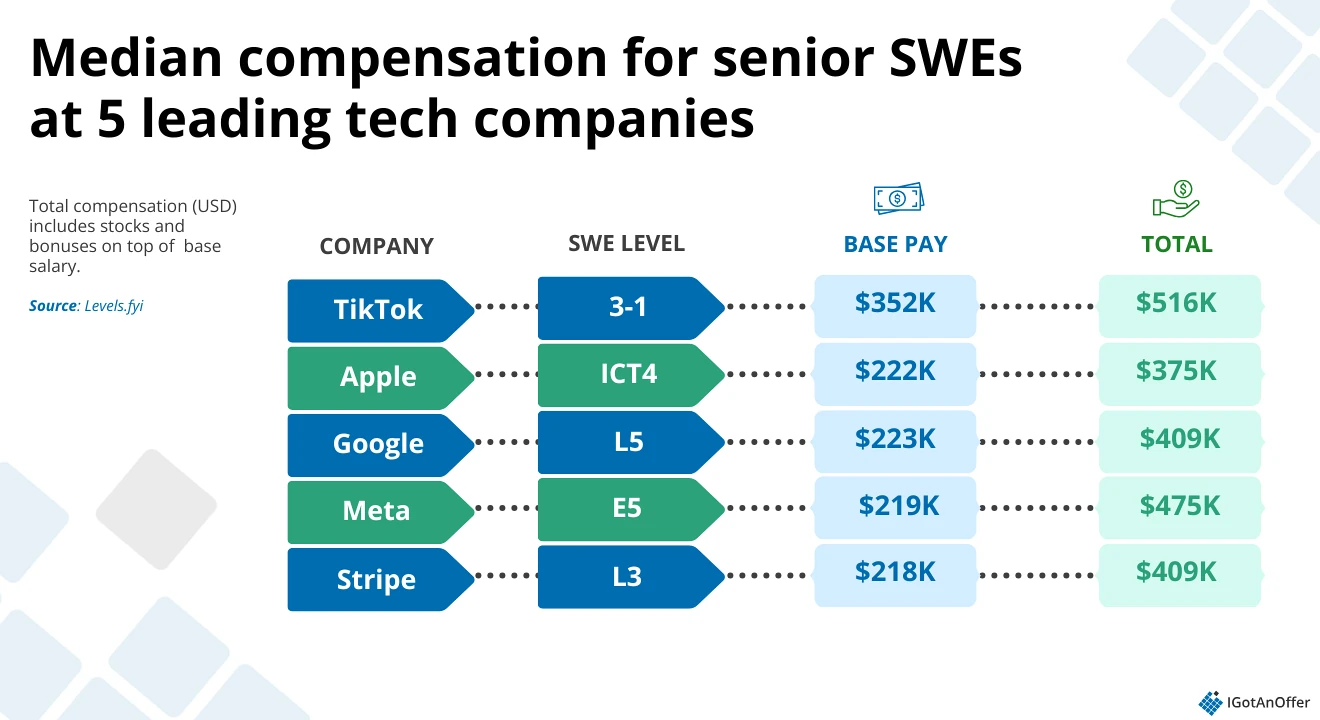
While TikTok offers competitive packages, it's helpful to see how compensation stacks up against other major tech companies at similar experience levels.
The table below compares median compensation for mid-level software engineer roles at TikTok vs. 4 other leading tech companies, sourced from Levels.fyi.
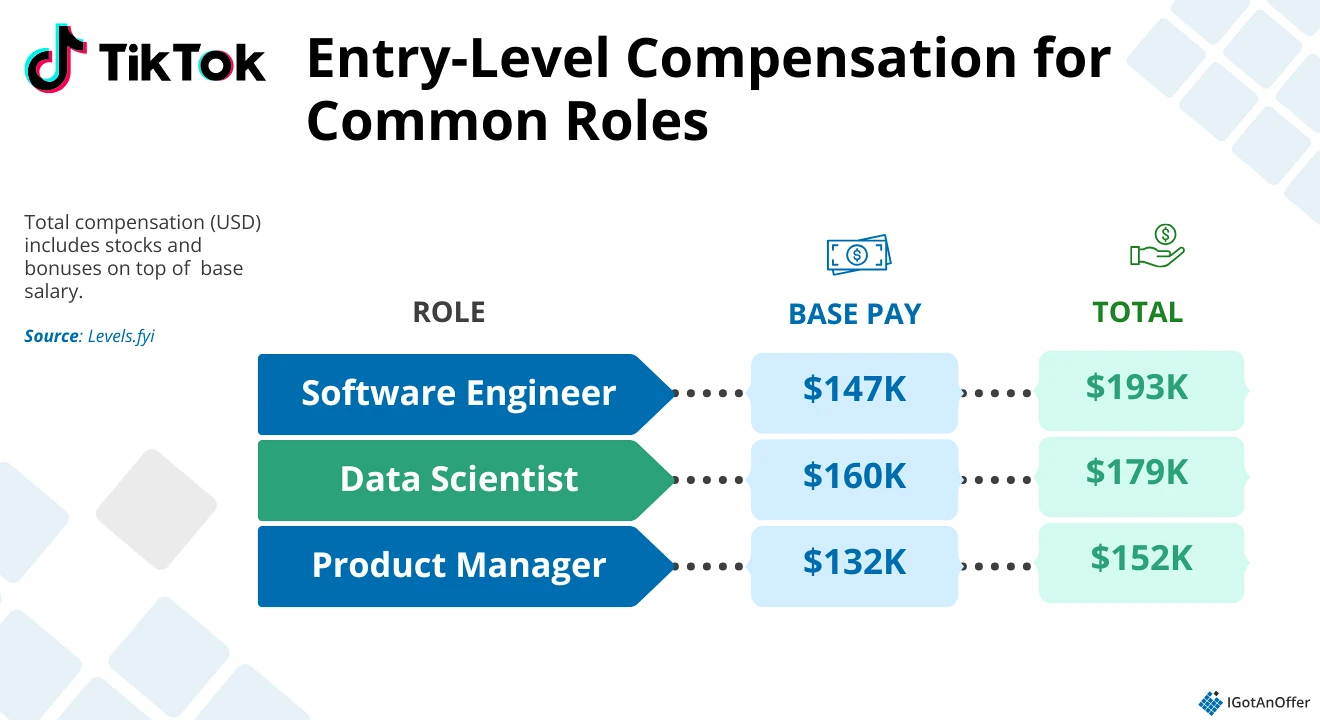
For entry-level candidates at TikTok, here's a breakdown of what to expect for 3 common roles: software engineer, data scientist, and product manager:
High compensation comes with high expectations. TikTok evaluates candidates against specific values that shape how the company operates and what they look for in interviews.
3. TikTok's core values ↑
TikTok's core values, known as ByteStyle, guide how employees work together and pursue the company's mission to "Inspire Creativity & Bring Joy." Understanding these values is critical for interview success, as behavioral questions often assess alignment with ByteStyle.
3.1 Always day 1
TikTok looks for people who approach their work with an “entrepreneurial” mindset and stay humble, even as the company grows. This means questioning established processes, taking initiative without waiting for permission, and avoiding the assumption that past success guarantees future results.
In interviews, they want to hear about times you challenged the status quo or pushed for innovation despite organizational inertia.
3.2 Champion diversity and inclusion
Working at TikTok means collaborating across cultures, time zones, and perspectives daily. The company values people who actively seek out different viewpoints and adapt their communication style based on who they're working with.
They expect you to default to trust rather than skepticism when working with international teammates and to assume good intent when conflicts arise.
3.3 Be candid and clear
TikTok operates with minimal hierarchy and expects employees to surface problems directly, regardless of who's in the room. This means presenting bad news early, backing up arguments with data rather than opinions, and avoiding the impulse to soften messages for senior leaders.
Clear, factual communication is valued over diplomatic hedging.
3.4 Seek truth and be pragmatic
The company wants independent thinkers who dig into problems themselves rather than accepting surface-level explanations. This means challenging assumptions, testing hypotheses with real data, and basing decisions on first-hand experience rather than secondhand reports.
TikTok looks for people who question conventional wisdom and verify claims before acting on them.
3.5 Be courageous and aim for the highest
TikTok evaluates risk based on potential return. They want people who pursue ambitious goals and consider unconventional approaches, but who can also articulate the tradeoffs and explain why the risk is justified.
Meaning, you need to be making calculated bets that others might avoid because the payoff is uncertain.
3.6 Grow together
The company operates on longer time horizons than typical tech startups. They want people who stay patient during setbacks, invest in building relationships with teammates, and prioritize collective success over individual wins.
This means helping others succeed even when it doesn't directly benefit your own projects.
Now let's get into the TikTok recruitment process so you know exactly what to expect and how to prepare.
4. TikTok interview process & timeline (6 steps to getting an offer) ↑
Companies like Google, Meta, and Apple typically complete their onsite interviews in a single day with four to six back-to-back sessions, each lasting 45-60 minutes.
TikTok, by contrast, spreads interviews across multiple separate rounds over 4-6 weeks. Each of those rounds serves as a checkpoint before proceeding to the next.
While this sequential approach extends the overall timeline compared to competitors, it allows for more thorough evaluation at each stage and gives candidates time to prepare between rounds.
Here's how the process works:
- Step 1: Resume Screen
- Step 2: Recruiter phone screen
- Step 3: Technical screen
- Step 4: Virtual interview rounds
- Step 5: Final HR interview
- Step 6: Offer negotiation
Here’s a deep dive into each step, so you know exactly what to expect and how to prepare.
Step 1: Resume screen ↑
This is the most competitive part of your TikTok application process. You'll need to make sure your resume is tailored to the role and level you're applying for.
This is an extremely competitive step, as we’ve found that ~90% of candidates don’t make it past the resume stage. To help you put together a targeted resume that stands out from the crowd, follow the tips below:
Tips for crafting a resume
- Study the role requirements. TikTok looks for specific technical skills and experience levels. Your resume should directly address the qualifications listed in the job description, using similar terminology where appropriate.
- Quantify your achievements. Rather than listing responsibilities, demonstrate impact with specific metrics. How many users did your feature reach? What performance improvements did you achieve? For example, instead of writing "Led team to improve system performance," write "Led 5-engineer team to reduce latency by 40%, improving experience for 2M daily users."
- Emphasize relevant technical experience. For engineering roles, highlight experience with large-scale systems, machine learning, recommendation algorithms, or video technologies if applicable. For product roles, emphasize experience shipping consumer products or working with algorithmic platforms.
- Keep it concise. Use clear formatting, strong action verbs, and keep your resume to 1-2 pages maximum. Make your most impressive achievements immediately visible.
For more detailed guidance, check out our tech resume guides:
- Tech resume guide
- Software engineer resume guide
- Product manager resume guide
- Technical program manage resume guide
- Engineering manager resume guide
- Data science resume guide
- Machine learning engineer resume guide
However, if you want personalized feedback and tips from those who know TikTok’s hiring process firsthand, you can get input from ex-TikTok hiring managers and recruiters themselves.
Step 2: Recruiter phone screen ↑
Once you're invited to interview with TikTok, you'll first speak with a recruiter on a phone screen. This typically lasts 20-30 minutes.
The call is usually non-technical, though some technical roles include light screening questions.
Otherwise, you should expect questions like, “Tell me about yourself,” “Why TikTok?”, and “Walk me through your resume.” Be prepared to go over your previous experience and explain your motivation for applying to the company.
The recruiter will also discuss how the overall interview process will work. If you have any specific questions (regarding timeline, location, or clarifications about the job description), now is the time to ask.
Your recruiter should also provide you with helpful interview prep materials from TikTok.
Don't reveal your salary expectations at this stage. If pressed, say you're looking for a competitive offer and would like to learn more about the full compensation package later. See some of our salary negotiation guides for specific phrasing.
If all goes well, the recruiter will get back in touch with you to schedule your first interviews: the initial screens.
Step 3: Technical screen ↑
Depending on the role, you will have one or two screening interviews with a hiring manager and/or future peers.
In most cases, these will be video calls, although some interviewers may opt for audio-only mode. There are also cases where you might be invited for in-person interviews.
The format varies significantly by role. Software engineers face coding challenges, data scientists get SQL and statistics questions, while product managers have behavioral discussions.
We've broken down what to expect for each role below.
Software engineers
Software engineers complete a 45-60 minute coding screen. It will be conducted over video call using HackerRank or CoderPad without syntax highlighting or auto-completion, so practice in similar environments beforehand.
You'll solve 1-2 coding problems focused on data structures and algorithms (DSA), while explaining your thought process.
The difficulty level is typically LeetCode medium, though some candidates report medium-hard problems. Most need to complete two medium-hard problems within the 60-minute time limit.
Common topics include arrays, strings, trees, graphs, dynamic programming, and system design fundamentals.
Note that some assessments are proctored with video and microphone enabled.
Data roles
Data scientists and data engineers face SQL, Python coding, and statistics questions in a 45-60 minute session.
According to one candidate on Glassdoor, the first round included "2 medium real-world SQL questions, and 3 case studies and some important metrics questions regarding the team's business interest." So, you can expect a mix of these topics within a single round.
You can also expect questions testing your ability to manipulate data, draw insights, and solve real-world problems. Machine learning roles may include ML fundamentals questions alongside coding.
Product and other non-technical roles
Product managers, program managers, and other non-technical roles typically have 1-2 behavioral interviews with hiring managers or team members instead of coding screens.
These 45-minute conversations assess your domain knowledge, problem-solving approach, and cultural fit.
For product roles specifically, expect questions about product sense, analytical thinking, and execution. You may receive a take-home case study to present during later interview rounds. Account managers often complete case studies demonstrating client management skills.
Step 4: Virtual interview rounds ↑
The longest and most daunting step of the TikTok interview process is the virtual interview rounds. As the name suggests, this stage is completely virtual.
Here, you will have 3-5 interview rounds that last 45-60 minutes each. Your recruiter should let you know what to expect for each round, but essentially, you can expect a more in-depth version of your initial screen, and more behavioral and role-related knowledge questions.
These interviews don't all happen in one day. TikTok conducts these sequentially over 4-6 weeks. You complete one interview, wait for feedback (typically 2-3 business days), and only advance to the next interview if you pass.
One important thing to remember: Each round is eliminatory. If you don't pass, the process stops. There's no opportunity to compensate for a weaker performance in one round with a strong showing in another.
The specific interviews you'll face depend on your role. Here are some you may encounter:
- Coding interviews
- System design interviews
- Product sense and execution interviews
- Data and analytical interviews
- Behavioral interviews (by hiring manager)
Let's walk through each interview type and what happens in each of them.
Coding interviews
If you're a software engineer or a similar technical role, you'll complete around 2-3 coding interviews beyond your initial technical screen. Each session presents algorithmic problems that you'll need to solve while explaining your thought process.
For tactical tips on solving these problems effectively, check out our coding interview tips and coding interview prep guide.
System design interviews
Mid-level and senior technical candidates are usually given one system design interview, testing your ability to architect systems at scale.
You'll discuss how to build systems that handle billions of users, massive data processing, real-time recommendations, and distributed architectures. The interviewer evaluates your understanding of scalability, reliability, data storage tradeoffs, and technical decision-making.
Note: You may get combined rounds with both system design and coding questions in a single session.
For tactical tips on how to approach these system design questions, check out our system design interview tips.
Product sense and execution interviews
Product managers face 2-3 rounds that test different PM skills. If you’re going for a PM role at TikTok, you can expect
- Product sense interview: assesses your ability to identify user needs, define success metrics, and design product solutions. For detailed preparation strategies, see our product sense interview guide.
- Execution interview: evaluates how you drive projects forward, handle tradeoffs, and work cross-functionally. Check out our Meta execution interview guide for frameworks that apply to TikTok as well.
See our TikTok product manager interview guide for detailed preparation.
Data and analytical interviews
Data scientists complete multiple technical rounds. You’ll face:
- SQL interviews: Write queries for data extraction and analysis from complex datasets.
- Python coding: Solve data manipulation and algorithm problems.
- Statistics and probability: Answer theoretical questions and apply statistical concepts to real-world scenarios.
- Machine learning fundamentals: Demonstrate understanding of ML concepts, model selection, and evaluation metrics.
- Case studies: Analyze business problems and present data-driven recommendations (common for many roles).
Check our TikTok data scientist interview guide for specific question types.
Hiring manager interview
You'll also have a separate interview with the hiring manager who would be your direct supervisor. This interview assesses both technical judgment and team fit, focusing on how you'd work within their specific team and contribute to ongoing projects.
Sometimes, you’d get some behavioral questions here as well. This interview is distinctly practical. Expect task-oriented, project-related questions rather than generic "Tell me about a time…" prompts. You'll discuss specific projects, decisions you made, challenges you overcame, and results you achieved.
After you complete an interview, your interviewer submits feedback to the hiring team. The hiring manager reviews this and decides whether you advance to the next round.
There's no standardized review process here: decisions are team-dependent, and the hiring manager has final authority.
Important process notes
The stated timeline is 2-3 business days for feedback, but the reality often differs. Candidates on Glassdoor mention being "ghosted after multiple follow-ups" following final rounds, so expect longer timelines.
All interviews happen via video call. Since TikTok's teams are global, particularly with a significant presence in China, you may have interviews scheduled for early morning or evening to accommodate Beijing time zones.
In some cases, the interview may be conducted entirely in Chinese, typically for native speakers. While this is more common for Asia-based roles, some candidates on Reddit have reported similar experiences even when applying for US-based positions.
We’d advise confirming the interview language in advance and, if needed, clarifying whether language proficiency is a formal requirement for the role.
Step 5: Final HR Interview ↑
Finally, if you pass each of the previous interviews, you’ll be scheduled for one last interview with TikTok’s HR team.
If you make it to this round, you will likely receive an offer, although there are rare cases of candidates getting rejected after completing this interview.
The decision process at TikTok is less transparent than at some other tech companies. Most candidates receive a simple "yes" or "no" without detailed feedback.
If you're rejected after passing multiple rounds, the feedback is typically minimal. Recruiters may cite "changing hiring priorities" or a "better fit with other candidates."
If you haven’t heard back after a couple of weeks, it’s perfectly fine to follow up with your recruiter for an update. Response times can vary depending on team schedules, so try to stay patient and use the waiting period to prepare for potential next steps.
They may also ask for feedback on the previous interview rounds, as well as your salary expectations. More on how to negotiate your offer in the next section.
Step 6: Offer negotiation ↑
Finally, once you’ve passed all interview stages, you’ll receive your offer package from TikTok.
At this point, all that is left for you to do is negotiate your offer.
Your recruiter will get in touch with you about the details, likely scheduling one final call to clarify and discuss the terms. If they have not scheduled a call, you can ask for one.
Of course, salary discussions can be difficult and uncomfortable, especially if you’re not used to them. Here are some tips to help you navigate your salary negotiations.
Salary negotiation tips:
- Do extensive research before negotiating. Check Levels.fyi for compensation data specific to your level. Compare with offers from Meta, Google, and other tech companies for similar roles.
- Have competing offers. TikTok is more likely to negotiate significantly if you have strong competing offers. Be prepared to share details about competing compensation packages.
- Negotiate each component separately. If base salary won't budge, you might get movement on equity or sign-on bonus. Consider the back-weighted vesting schedule when evaluating equity offers. Your first-year cash compensation will be lower than that of companies with even vesting.
- Consider the full package. Beyond compensation, evaluate factors like team fit, growth opportunities, visa sponsorship (if applicable), and work-life balance expectations.
For even more detailed guidance, check out our salary negotiation guides for peer FAANG companies like Amazon, Google, and Meta, where the process isn’t too different.
Even better, you can work with specialized negotiation coaches (including former TikTok recruiters and hiring managers) for personalized negotiation help.
Interviewing at other FAANG+, emerging tech, or AI labs? Check out our FAANG interview process guide for company-specific insights into the companies and different roles you’re targeting.
Frequently asked questions about the TikTok interview process and timeline ↑
How long does the TikTok interview process take?
The TikTok interview process typically takes 4-6 weeks from initial application to offer. However, timelines vary significantly. Some candidates report completing the process in 3-4 weeks when they actively push for faster scheduling, while others’ experiences can stretch up to 3 months due to gaps between rounds or team matching delays.
How many total interview rounds does TikTok have?
Most candidates complete 5-7 total interview stages: 1 recruiter screen, 1 technical screen or online assessment, and 3-5 virtual interview rounds. The exact number depends on your role and level.
How difficult are TikTok interviews?
TikTok interviews are considered highly difficult, particularly for technical roles. Many candidates who successfully passed interviews at Meta, Google, Stripe, and other top companies report that TikTok's technical interviews were more challenging.
Can I interview for multiple teams at TikTok?
Yes, TikTok's interview process is decentralized by team. You can interview for multiple positions simultaneously, though you'll need to complete the full process for each team.
However, you typically won't be able to skip steps you've completed for one team when interviewing with another. Each team manages its own headcount and hiring decisions.
What if I get asked questions in Mandarin?
Some candidates are asked about Mandarin language skills during interviews, particularly for roles requiring close collaboration with Beijing-based teams. If you've listed Mandarin on your resume, be prepared to demonstrate proficiency.
However, all interviews are conducted primarily in English. The Mandarin questions assess your ability to collaborate with your Chinese colleagues. If you don't speak Mandarin and aren't asked about it, it's not required for most US-based roles.
What happens if I fail a TikTok interview?
If you don't pass the interview process, TikTok typically doesn't provide detailed feedback on why. You'll receive a standard rejection noting that other candidates were a better fit or that hiring priorities changed.
TikTok doesn't have a formal reapplication waiting period like some companies. Some candidates report successfully reapplying 6-12 months after a rejection. The decentralized team structure means you might interview with a different team sooner if they're interested in your profile.
5. Are you prepared for your TikTok interviews? ↑
The TikTok interview process isn’t easy, and that’s by design.
The company looks for people who can operate like it’s “always day 1,” aim for the peak, are pragmatic, and make great decisions without layers of process. Every stage, from the recruiter screen to the hiring committee, is built to test those exact traits.
If you're prepping to apply for a specific role, you may want to check out our other TikTok interview guides:
- TikTok data scientist interview guide
- TikTok product manager interview guide
- TikTok machine learning engineer interview guide
But if you're seeking some expert help, we've also coached more than 21,000 people for interviews since 2018. In our experience, practicing mock interviews with real experts who can give you company-specific and personalized feedback makes a huge difference.
Find a TikTok interview coach so you can:
- Test yourself under real interview conditions
- Get accurate feedback from a real expert
- Build your confidence
- Get company-specific insights
- Learn how to tell the right stories, better
- Save time by focusing your preparation
Landing a job at a big tech company often results in a $50,000 per year or more increase in total compensation. In our experience, three or four coaching sessions worth ~$500 make a significant difference in your ability to land the job. That's an ROI of 100x!
Click here to book a mock interview session with an ex-TikTok interviewer.





 Machine learning engineer



 Case
Case