

 Back to other articles


 Last updated: April 27, 2026
 Interviews
 Behavioral
 Deeply researched
Behavioral interview questions may seem simple, but answering them well is one of the best ways to stand out in a competitive tech job market.
Unfortunately, many candidates still miss the mark. That’s where we come in.
In this guide, we’ll cover the most common behavioral questions you’ll likely face at FAANG and other top tech companies. You’ll learn how to prepare effectively and craft strong answers using a proven method that works better than STAR.
- Behavioral interview overview
- Most common behavioral interview questions
- More behavioral interview questions
- Interviewing tips
- Preparation plan
Let’s go!
Note: Behavioral interviews are just one part of the FAANG interview process. Check out our FAANG interview prep guide for a complete preparation plan.
Click here to practice with ex-interviewers from top companies
1. Behavioral Interview Overview↑
Before we go into the questions, let’s first define what a behavioral interview is, why interviewers ask them, and the best way to answer.
1.1 What are behavioral interview questions?
Behavioral interview questions are questions interviewers give to prompt you to tell a story about your past experiences. They are typically used to assess culture fit and evaluate your soft skills, such as problem-solving, leadership, communication, conflict resolution, and others.
The behavioral interview is one of the key components of any FAANG+ interview process. "If you think of the interview as an exam, this is nearly half of it. Failing the behavioral round can mean falling short overall—it’s that critical," Vicky (IGotAnOffer FAANG SuperCoach) says.
These questions are also guaranteed to appear in the interview process for other industries, including consulting interviews and investment banking interviews, especially for Full-Time Analyst and Summer Analyst roles.
1.2 Why do interviewers ask behavioral interview questions?
According to Vicky, "Major tech companies use behavioral interviews to assess how your past experiences align with the role and reveal your character in business situations."
The belief behind behavioral interviews is that past behavior is the best predictor of future performance. They reveal how you think, not just the skills you’ve mastered.
Furthermore, while technical skills are important, technology changes quickly. Melissa (ex-Amazon Bar Raiser) says, “Learning a new technical skill is easier than changing how you think, how you respond to pressure, and how you overcome roadblocks.”
Aside from wanting concrete examples of your competence and thought process in a real-world setting, interviewers also want to see whether you will thrive within the company culture. FAANG companies, in particular, heavily emphasize culture fit as each company has a different way of working that might not be for everybody.
Asking behavioral questions about how you act or react to certain sources of tension, like change or conflict, allows interviewers to get to know you and your values, and from there, they can assess if you’ll fit within the set culture in the company.
1.3 What do most major companies assess during a behavioral interview?
There are slight differences in the sets of traits and behaviors most companies look for, but you’ll notice that there are universal themes.
“At their core, almost all behavioral interview questions boil down to a small set of competencies that are essential for a successful career in tech regardless of your role,” Melissa says.
Her advice is to focus on the following core competencies as your baseline for selecting the stories you want to share:
- Ownership
- Problem-solving
- Collaboration
- Resilience
- Growth
1.4 Are ‘tell me about a time’ questions behavioral questions?
Yes, ‘Tell me about a time’ statements are a common prompt style for behavioral interviews. Popular examples include: ‘Tell me about a time you handled a difficult stakeholder’, ‘Tell me about a time you showed leadership’, and ‘Tell me about a time you had a conflict’.
1.4 How to answer behavioral interview questions
When answering behavioral questions, you should focus on your most relevant work stories and communicate them in a clear way. An easy way to achieve this is to use a step-by-step method to tell your stories.
Below, we’ll show you two storytelling frameworks to use to structure your answers: the often-recommended STAR framework, and IGotAnOffer’s alternative, the SPSIL framework (which is a more efficient structure).
1.4.1 STAR method
The STAR method (Situation, Task, Action, Result) is a popular approach for answering behavioral questions because it’s easy to remember. You’ll see it’s recommended by many articles you can find on Google, similar to this one (they tend to copy each other!).
However, the STAR method has two problems:
- We’ve found that candidates often find it difficult to distinguish the difference between steps two and three, or task and action.
- It ignores the importance of talking about WHAT YOU LEARNED, which is often the most important part of your answer.
To correct those two faults, we actually developed our own (very slightly different) framework that many of our candidates have used successfully over the years: the SPSIL method.
1.4.2 IGotAnOffer’s SPSIL method
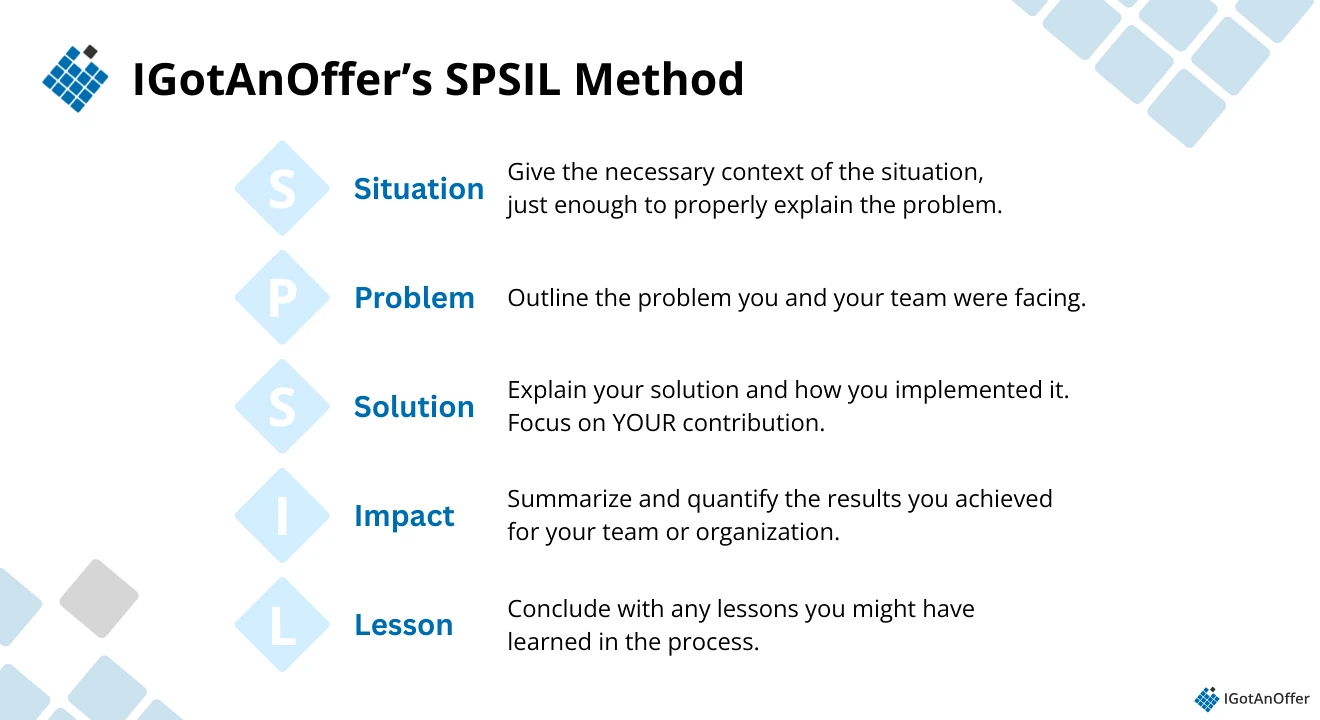
The SPSIL (Situation, Problem, Solution, Impact, Lesson) method has a less catchy name, but it corrects both of the STAR method’s faults. You’ll see it in action in the example answers in the next section, but let’s go through the five-step approach:
- Situation: Start by giving the necessary context of the situation you were in. Describe your role, the team, the organization, the market, etc. You should only give the minimum context needed to understand the problem and the solution in your story. Nothing more.
- Problem: Outline the problem you and your team were facing.
- Solution: Explain the solution you came up with to solve the problem. Step through how you went about implementing your solution, and focus on your contribution over what the team / larger organization did.
- Impact: Summarize the positive results you achieved for your team, department, and organization. As much as possible, quantify the impact.
- Lessons: Conclude with any lessons you might have learned in the process.
Of course, you should practice using whatever method you’re the most comfortable with. By all means, use the STAR method if you prefer, just don’t forget to mention what you learned.
For a deeper dive into this topic, check out our article on why the STAR method isn’t always the best for behavioral interviews and how IGotAnOffer's SPSIL method can be a better option. It was written with product managers in mind, but it applies just as well to any role.
Now, let’s take a look at some of the most common behavioral interview questions you might encounter at a FAANG+ interview. We’ve also included sample answers, structured using IGotAnOffer’s SPSIL framework.
Coaches who contributed to this guide













2. 16 Most Common Behavioral Interview Questions (with Answers)↑
We’ve worked with thousands of job interview candidates on our platform, and we’ve seen the questions below come up very frequently across different roles and industries.
Click on a question if you want to skip straight to it.
- Give me an example of when you worked well within a team
- Tell me about a time you dealt with conflict on a team. How did you solve it?
- Tell me about a time you failed at work / made a mistake at work
- Tell me about a time you faced a really hard problem / a challenge at work
- How do you deal with difficult customers/clients?
- Tell me about a time you adapted well to change
- Tell me about a time you led a team / showed leadership
- Tell me about a time you had to meet a tight deadline
- Tell me about a time you saw a problem and took the initiative to solve it
- Tell me about a time you disagreed with your superior
- Tell me about your biggest weakness
- Tell me about a time you received a really useful piece of feedback
- Describe a time you had to prioritize projects under pressure
- Tell me about a time you had to make an unpopular decision
- Describe a time you had to set goals for others
- Tell me about a time when you had to do something at work that you didn’t know how to do / had never done before.
2.1 Give me an example of when you worked well within a team.↑
This is a very common question across industries. You might want to look back through your resume and use one of your most impressive achievements as the basis of your answer to this. After all, it's very likely you worked in a team to achieve it.
Your answer should showcase your collaboration and communication skills. Show that you're a team player, but don’t forget to include specific actions that you took.
Example answer:
(Situation)
"In my previous software engineering role, our team was tasked with developing a real-time data analytics platform for a major client.
(Problem)
The project had a tight timeline and required integrating multiple complex systems, including data ingestion, processing, and visualization components.
(Solution)
To be as efficient as possible, we adopted an Agile development approach. We held daily stand-up meetings to discuss progress, address challenges, and prioritize tasks. I took on the role of the Scrum Master, facilitating the meetings and making sure that everyone had a clear understanding of their responsibilities.
One particular challenge we faced was the need to integrate a third-party data visualization library with our custom backend solution. I took the initiative to organize a brainstorming session with the frontend and backend developers, UX designers, and data scientists.
Together we explored different integration approaches and identified potential roadblocks.
(Impact)
We were successful in delivering the real-time data analytics platform within the given timeline. What’s more, the client was delighted with the platform’s user-friendly interface, real-time insights, and advanced visualizations.
(Lessons)
This experience taught me how important communication skills are in my role. As a software engineer, I had previously thought that the most important skill I had was my ability as a programmer. But this project taught me that by communicating well with other people and other teams, I could have a far greater impact than I could just through writing code.”
2.2 Tell me about a time you dealt with conflict on a team. How did you solve it?↑
This is a real favorite among interviewers because across all industries, strong differences of opinion are an everyday occurrence. Conflicts can cause real problems, especially if they’re not dealt with properly. However, they can also be constructive if centered on work.
The interviewer will want to see that you have the empathy to understand both sides of a conflict and the communication skills to solve it. If you’re a manager, you’ll want to show that you put processes in place to deal with conflicts and can quickly and effectively bring about the best possible resolution.
Example answer:
(Situation)
“Unfortunately, I’ve found that conflicts can often arise from clashing personalities. When I was a lead software engineer at a fintech startup, one of my new engineers, Rob, told me that he had a hard time working with another engineer, Benji.
(Problem)
He explained that Benji was consistently rude and demeaning to him, to the extent that Rob was ready to change teams or even leave the company.
(Solution)
With Rob’s permission, I brought this up with Benji in our next one-on-one. Benji admitted that he likes to joke around and tease his coworkers, but that none of it was ill-intended and he didn’t feel that he had done anything wrong.
However, I insisted to Benji that while I personally enjoyed his sense of humor, we all had a responsibility to make sure we created a friendly, safe and professional environment for every team member. I encouraged him to speak to Rob directly and apologize for the misunderstanding, and to keep his interactions with Rob more matter-of-fact in the future.
(Impact)
I offered to be present as a mediator, but Ben elected to initiate the conversation himself. I checked in with Rob regularly in the weeks and months following, and he reported that his working relationship with Ben had greatly improved.
(Lessons)
The experience showed me that people can perceive the same situation very differently, and often the key to solving conflicts is simply talking it through and listening actively.”
For more help on answering this question, read our specific guide: 5 ways to answer "Tell me about a time you had a conflict"
2.3 Tell me about a time you failed at work / made a mistake at work↑
Everybody makes mistakes. The key to acing this question is to demonstrate that you’re someone who owns your mistakes and views failure as a learning opportunity.
Don’t shy away from talking about a real failure or an important mistake you made. That will be far more powerful than choosing something inconsequential.
Explain what went wrong, why it went wrong, and how the experience has helped you become better at your job.
Example answer:
(Situation)
“Last year, I was working on a project where I had to implement a new online booking feature for a client. I had a tight deadline and was working under pressure to get it done. I was in such a hurry that I didn’t take as much time as I normally do to check my code for bugs.
(Problem)
Unfortunately, it did have a bug, and it caused a lot of follow-on problems on the client’s website.
(Solution)
I tried to solve it, but I quickly started to feel a bit out of my depth, so I decided to ask for help from my manager as well as a more experienced colleague. We worked together to identify the root cause of the issue, and we came up with a plan of action.
We had a very frank meeting with the client where we laid out the extent of the problem and the steps we were going to take to fix it.
(Impact)
We had to work some long hours to get everything fixed, but in the end, we were successful. We only narrowly missed the deadline, and our relationship with the client actually improved in the long term as they appreciated how committed we were to fixing the problem and how transparent we’d been with them.
(Lessons)
I learned three things through this experience. One, don’t skip on testing code properly or you’ll pay for it later on. Two, it’s important to always be transparent and honest, in this case, both with my manager and then with the client. And three, I learned that when you have to own up to a mistake, it’s a lot easier if you can also explain what you’re going to do to solve the problem.”
To dive deeper into this question, read our guide on how to answer "Tell me about a time you failed".
2.4 Tell me about a time you faced a really hard problem / a challenge at work↑
Employers at competitive companies want to know how you’ll react under difficult circumstances. Your resume may be full of impressive achievements with quantifiable impacts, but that doesn’t necessarily show that you can thrive when the going gets tough.
Don’t make the mistake of spending too long explaining the problem. Succinctly outline the situation and the problem/challenge, then spend the bulk of your answer talking about what you did, the impact your actions had, and what you learned.
Example answer:
(Situation)
"In my previous role as a project manager, we faced a major challenge when a critical vendor abruptly ceased operations just weeks before a high-stakes project deadline.
(Problem)
This vendor was responsible for a significant portion of our project's deliverables, and their sudden closure jeopardized the entire timeline. Our client was going to be very unhappy.
(Solution)
I immediately gathered my team and assessed the potential risks and alternatives. I initiated a series of emergency meetings with our procurement team to explore viable options. We researched alternative vendors, engaged in intense negotiations, and evaluated the feasibility of ramping up our internal capabilities to fill the gaps left by the defunct vendor.
We also reached out to our existing network, leveraging relationships with industry peers and partners to identify potential resources that could support us in the short term. Simultaneously, I kept in regular contact with the client to update and reassure them.
(Impact)
Through our relentless efforts, we secured a new vendor partnership and swiftly onboarded them, aligning their capabilities with our project requirements. Despite the initial setback, our team's dedication and adaptability allowed us to deliver 70% of the project's deliverables before the deadline, with the remaining 30% shortly afterwards, and this satisfied the client.
(Lessons)
This experience taught me the importance of proactive risk management and effective contingency planning. It reinforced the significance of building strong relationships within the industry, as they proved invaluable for us when we were scrambling for options. I also learned that honest communication builds trust - the client really appreciated being in the loop from the beginning and thus was happy to allow some flexibility."
2.5 How do you deal with difficult customers/clients?↑
If you’re interviewing for a client or customer-facing role, you should definitely expect this question. The interviewer will want to see that you're empathetic enough to understand your customers’ needs and problems and willing to go the extra mile to make them happy.
However, contrary to the saying, the customer isn’t “always right”. The interviewer may want to see that you can put systems in place to deal with difficult customers and avoid them negatively impacting your or your team’s performance.
In your answer, you’ll want to portray yourself as sympathetic but firm, calm but determined. You may also want to highlight your powers of persuasion, as this is an extremely attractive quality for a customer/client-facing role.
Example answer:
(Situation)
"In a previous role, I had to deal with a client who was extremely demanding and very difficult to satisfy. His company had been a very important account for u,s and so he was used to getting everything he asked for. However, it was no longer profitable to employ so many resources on this account.
(Problem)
When I took over the team, I found that some of them were suffering from stress and anxiety because of this client. He would even call them outside office hours to chase up work. Furthermore, he constantly gave negative feedback.
(Solution)
I realized that this client needed his expectations managed and clear boundaries set. First of all, I spoke to our director and convinced her that we had to be prepared to lose this client if we were unable to improve the situation. With the director on board, I then spoke to the team and explained that I wanted to change the way we worked with the client, but I needed their help.
Together, we worked extra hours to create a 20-page presentation that clearly outlined our way of working and what the client could expect from us. I then presented it to him in person. I explained the specific steps I was taking to improve the quality of our work for him, but that some things were simply out of scope. I also insisted that I was his only contact point with the team.
(Impact)
Gradually, the relationship with the client improved. He became more reasonable in his demands, and the quality of the team’s work improved, as they were no longer being motivated by stress and fear. Three months later, this account was taking up 30% fewer hours of work than it was previously.
(Lessons)
I learned the importance of setting very clear deliverables and boundaries with clients. I like to say that we try to over-deliver, not over-promise. I also learned that my team is my most important resource, and anything that worsens their motivation and well-being must be solved immediately."
For further prep, check out our article on a very similar question, How to answer "Tell me a time you handled a difficult stakeholder".
2.6 Tell me about a time you adapted well to change↑
It’s not just start-ups and disruptive tech firms that tell their employees to “move fast and break things”. These days, many different industries are in a constant state of flux, having to quickly adapt to emerging technologies (such as AI) and shifting opportunities and challenges.
Suffice to say, if you get the job, it’s unlikely you’ll be doing the same thing for the next ten years. The interviewer wants to know that you’re ready to embrace change when it’s thrown at you and rise to meet new challenges.
Present yourself as someone who loves to learn and is not afraid of new challenges. If you’re struggling for a story from your work, it’s probably okay to use an example from outside work, as long as it demonstrates a pro-change attitude and outlook.
Example answer:
"I’ve learned to see change as an extremely positive thing, and I’m used to working in frequently changing environments.
(Situation)
In my first proper job out of universit,y I worked at a startup that made mobile apps. The company was still in its first year and was growing fast, but it was complete chaos. I was constantly being moved around as teams were restructured or disappeared and new ones created.
(Problem)
At first, I found it quite disconcerting and stressful, as I never really knew what was expected of me.
(Solution)
However, after talking to a colleague who’d been there from the start, I realized I need to “embrace the chaos”. I changed my outlook and focused on the positives: constantly moving teams meant I got to learn from people with different skills and profiles. Meanwhile, the chaos meant that there was a big opportunity for people who took the initiative - everything was up for grabs.
(Impact)
Instead of waiting for processes and systems to be put into place for me, I started to create them myself. For example, I created a Trello board for my team to organize our work and shared the link with other departments, a simple change that probably increased our productivity by 20%.
I also started coming to our weekly meetings with proposals for new projects, many of which were accepted and I led.
(Lessons)
I was soon moved to another side of the business with a whole new way of working, but I took my positive attitude with me. In the end, I stayed for another two years and was promoted twice, when initially I’d thought I’d be lucky to last two months! I learned so much more than I would have done in a more traditionally run company."
2.7 Tell me about a time you led a team / showed leadership↑
Across any industry, leadership is one of the qualities that interviewers are likely to assess you on, even if you’re not applying for a leadership role. Why? Because a good leader not only does their job well, but also helps others do their job better. Their positive impact on the company is therefore multiplied.
A junior software engineer, for example, won’t know how to lead a team of engineers. But there may be an occasion where they can lead a process, or lead a meeting, and doing this well has an impact on the wider team.
If you’re applying for a senior or management role, you may be asked a more specific version of the question, such as “Tell me about a time you led a team through a difficult period.” Prepare an example that shows you as someone with some key leadership traits: determined, empathetic, decisive, good motivator, etc.
Don’t worry if you’re more junior and you’ve never held a leadership position before. Your answer can come from a situation in which you weren’t in a leadership position but demonstrated leadership nevertheless.
Example answer:
(Situation)
"I spent three years working at a small start-up, and after an initial period of rapid growth, revenue dropped off and we started losing money.
(Problem)
I was leading a team of five, and understandably, people were extremely worried about their jobs. I also had pressure from the CEO to implement cost-cutting and revenue-generating measures that would help us get back to break-even as soon as possible.
(Solution)
My primary focus was on keeping the team motivated and productive, even in the face of uncertainty. My first action was to schedule a meeting to specifically discuss the situation and provide an honest and transparent overview of what was happening.
I acknowledged the challenges that the company was facing, but that our team was essential to the company's success. I said that if they had any questions, they could always ask me. We also came up with a list of team actions we could take that would reduce costs, and over the next 6 months, I arranged bi-weekly updates with the CEO to show how we were progressing.
(Impact)
Through these actions, my team played a major part in getting the company back on track, and I made sure this was visible to the CEO. There were no lay-offs in our area, and morale and productivity stayed strong.
(Lessons)
It was a difficult experience to go through, but I learned that when you’re managing a team, constant communication is vital in a crisis. People always have doubts and hypothetical scenarios you hadn't even thought of, and it’s really useful to provide a space where you can listen to them and give them a more accurate picture of what’s going on, even if that picture is incomplete.”
See more example answers to this question in 5 ways to answer "Tell me about a time you showed leadership".
2.8 Tell me about a time you had to meet a tight deadline↑
This question helps employers assess your ability to handle time-sensitive projects and manage competing priorities.
Demonstrate your proficiency in project management, problem-solving, and your commitment to achieving successful outcomes under pressure.
Use an example of a time when the odds were stacked against you. It will make for a more interesting and compelling answer, as it will also show how you perform under pressure.
Example answer:
(Situation)
"In my previous role as a management consultant, meeting tight deadlines was a common occurrence due to the fast-paced nature of client engagements.
(Problem)
One particular time, we had one week to complete a comprehensive set of analysis and recommendations for an upcoming executive board meeting.
(Solution)
To address the tight deadline, I quickly organized a project team, including subject matter experts and analysts, to tackle the assignment effectively.
We developed a detailed project plan, breaking down tasks and assigning responsibilities.
We stayed in sync with regular meetings, and I made sure that everyone was extremely transparent with their progress. When we were falling behind in one area, I shifted resources to help in that area and avoid it becoming a bottleneck.
We also stayed in communication with the client and briefed them on our progress - this was key as they steered us away from lower priority areas of analysis that would have taken up further time.
(Impact)
Through our focused efforts (and a few late nights!), we successfully delivered the analysis, recommendations, and implementation plan within the tight deadline. The deliverables were well-received by the executive board.
(Lessons)
My number 1 learning was that if you’re going to complete a project at high speed, you have to get the foundations right. That meant spending a significant amount of time early on making sure that everybody knew what they had to do, and creating a central project spreadsheet that acted as our guide. This extra time spent early on enabled us to work much more quickly throughout the rest of the week."
2.9 Tell me about a time you saw a problem and took the initiative to solve it↑
Employers want to hire people who are problem-solvers. And so this question, or a version of it, tends to come up a lot.
If you’ve got a reasonable depth of professional experience, you should be able to think of a strong example to use for this. It could be almost anything: a bug that was affecting bookings, a colleague suffering from low motivation, a bottleneck in the operations process, etc.
The important thing is to show that you took action when it wasn’t really your responsibility. This shows that you’re not someone who looks the other way, you take pride in the company you work for, and are ready to step in and fix things.
If you’re still fairly junior, you could even use an example from one of the part-time jobs you may have had in the last few years. The qualities the interviewer is looking for (initiative, problem-solving abilities, creativity) can still be demonstrated in, say, a job waiting tables.
Let’s see how in the example answer below.
Example answer:
(Situation)
“When I was in college, I was a barista at a long-standing local coffee shop called Sunny’s. It was a small, family business with a few employees, resistant to change, and located in a neighborhood with new shops and restaurants opening constantly.
(Problem)
It was also starting to lose regular customers and revenue, but we didn’t know why. The owner was trying all kinds of different promotions that weren’t working.
(Solution)
I was only a barista and had no stake in the business, but I wanted the shop to succeed. So I decided to find an easy way to understand the market and find some of the root causes of the problem we were experiencing. My first step was to informally survey customers about their coffee habits as they paid for their order. This gave me insight into what other shops were popular and what people liked about them.
Next, I stopped by some of the other shops on my way to work. I noticed a few common themes at these other popular shops: 1) They offered soy and almond as alternatives to dairy milk, 2) they emphasized fair trade coffee, and 3) they printed the WiFi password on receipts.
I mentioned these themes to the owner and helped to prioritize easy, low-cost solutions. First, buying a few cartons of soy and almond milk allowed us to test if this made a difference to Sunny’s customers without requiring a big investment. Second, most of the coffee that Sunny’s sold was already fair trade, but this wasn’t advertised; so I helped make a few signs to explain and placed them around the store. Third, we realized that printing the password on receipts was too cumbersome a change, so instead I trained all baristas to ask customers if they wanted the WiFi password after they paid for their order.”
(Impact)
After these changes, sales returned to normal within a couple of months. Seeing this, the owner started more regularly surveying customers and executing competitive analysis, which has helped to make Sunny’s one of the top coffee shops in the neighborhood to this day.
(Lessons)
This all happened before my professional career really started, but it taught me that the most innovative solutions are not always radical or expensive. It’s also a great reminder that understanding customer needs is crucial when trying to innovate in any business."
2.10 Tell me about a time you disagreed with your boss↑
This question allows employers to assess your communication skills, your ability to challenge ideas constructively, and whether you can maintain a professional approach even in conflicting situations.
You’ll want to show that you have the courage to express a difference of opinion with a superior and can do so respectfully and in a way that achieves the best outcome for the company.
Example answer:
(Situation)
"During my time as a financial trader, I encountered a situation where I disagreed with my manager regarding a trading strategy for a specific market opportunity.
(Problem)
My manager had a more conservative approach, emphasizing risk mitigation, while I believed that a more aggressive trading approach could yield significant profits in the current market conditions.
(Solution)
I carefully listened to my manager’s concerns and then went away to construct arguments to counter them.
I requested a meeting with him in which I presented a detailed analysis supporting my view, showcasing the potential profitability of the more aggressive approach within a calculated risk framework. I made sure to back up my arguments with relevant market data and insights to show that it was a very feasible strategy.
(Impact)
Recognizing my preparedness and commitment, my boss appreciated the depth of my analysis and willingness to challenge conventional thinking.
As a result, we reached a compromise where we agreed to allocate a portion of our portfolio to the more aggressive strategy, while ensuring we maintained risk controls and monitored the positions closely.
(Lessons)
I learned that challenging people’s opinions or arguments that you don’t agree with is not just acceptable, it’s actually extremely important, as long as you go about it the right way: with respectful communication, active listening, and presenting well-reasoned arguments backed by data."
2.11 Tell me about your biggest weakness↑
A classic interview question at all levels, and one that causes much anxiety for many candidates. It shouldn’t, it’s not a trick question. We all have weaknesses, and as long as your biggest weakness isn’t one that is vital for the job, you should try and answer honestly.
The interviewer is testing to see if you have the self-awareness to know what you’re less good at, and enough drive to actually do something about it.
So pick a weakness that is real and is relevant to your role, though not something critical. You can also use this answer to show that you’re good at taking on feedback, an important skill and one that your interviewer will be looking for.
Example answer:
“My biggest weakness is probably attention to detail. I’m what you would call a “big picture” person - I find that I’m quite good at taking on large amounts of information and just focusing on what’s important. And that can be really helpful when I’m working on things like strategy, for example.
However, focusing on the details comes less naturally to me. In the past, this has meant that I’ve presented documents with small errors in, and I haven’t always paid attention to correctly labeling files and saving them in the right place, that kind of thing.
To be completely honest, I used to think that these things didn’t really matter. After all, what do a few typos matter in an internal document as long as the strategy I’ve outlined is top quality? But after some feedback from a colleague, I realized that small details help set the standard, and people are more likely to perceive your work as high quality and buy into what you’re telling them if there are no typos and the formatting is all correct.
Now I always force myself to take an extra 5 minutes to check any document before I share it. And when I’m working on a client-facing presentation, I have a long error checklist I go through before sending.
It’s still something I have to be conscious o,f but with a little bit of extra effort, I’m able to keep on top of the details and prevent small errors from occurring.”
2.12 Tell me about a time you received a really useful piece of feedback↑
The ability to take on feedback and not only make the appropriate changes but also adapt and improve your work next time around is a hugely important skill in almost any role.
If you don’t receive much unsolicited feedback in your role, you should seek it out. The interviewer wants to know that you understand how valuable feedback is and that you’re capable of using it to learn and improve.
Example answer:
(Situation)
“A month into my first management position, my team was only just hitting its targets. My manager asked me to assess my performance so far, and I first outlined my own individual performance, which had been strong, then explained how I had been trying to help my team.
(Problem)
My manager told me that I was displaying the wrong mindset. She said I was acting as though his first responsibility was to meet my own targets, when in fact it was the other way around. She told me she’d rather see my own individual results go down if that meant the team’s results improved overall, and that I needed to change my mindset from an “execution mindset” to a “leverage mindset”.
I was used to leading the way in terms of performance charts, etc, and initially I found it difficult to accept that I was going to have to stop doing measurable work for things that were less directly visible.
(Solution)
However, the more I thought about what my manager had said, the more it made sense.
The time I spent empowering my team would be multiplied by five (for each team member) in terms of value. This kind of leverage was worth much more to the firm than the time I spent chasing my individual targets.
I reorganized my workload to focus more on leverage and started to judge myself first and foremost on the results of my team. I also realized that the skills I’d relied on as an individual contributor were no longer enough to excel in my position, and I started reading up on management theories and best practices.
(Impact)
A month later, there was already a clear improvement in my team’s performance as a whole. Over the next year, my team consistently exceeded the targets se,t and what’s more, we had a much lower churn rate than the company average.
(Lessons)
I hadn’t really understood the importance of good management until this experience. It opened my eyes to a new way of thinking, and I ended up enjoying management so much that I went off to study for an MBA.
This experience also taught me how impactful great feedback can be. I made sure to give my team regular feedback, and also instigated a process where they gave me anonymous feedback at least every 6 months.”
2.13 Describe a time you had to prioritize projects under pressure↑
Prioritization is key for a project manager or anyone who has to coordinate teams and projects. It’s not easy to do, and it’s even harder under pressure, so the interviewer will want to know that it’s something you’re used to doing.
For certain roles, such as product manager, you may want to demonstrate that you’re comfortable using prioritization frameworks, such as RICE.
Example answer:
(Situation)
"In my last role as a product manager, I frequently encountered situations where multiple projects demanded attention and had tight deadlines.
(Problem)
One particular instance stands out when we had an important funding round coming up and we were under pressure to finish important projects ahead of time.
(Solution)
I used a prioritization framework called RICE, which helped me assess the potential impact, reach, confidence, and effort required for each project. By considering these factors, I was able to give myself a solid overview of the projects and their alignment with strategic objectives.
(Impact)
Through careful evaluation and applying the RICE framework, I successfully prioritized the projects based on their potential reach, impact, confidence, and effort.
I was able to take this to senior management and show them that, while we weren’t in a position to finish all the projects ahead of time, we could finish the two that were most important in terms of the upcoming funding round.
Senior management accepted my analysis, and we were able to allocate resources effectively and meet their expectations. They were satisfied, and my team escaped having to work a month of late nights which would have severely impacted morale.
(Lessons)
This experience reinforced the value of utilizing frameworks like RICE to prioritize projects under pressure. By incorporating a systematic approach, I was able to make informed decisions, and it was much easier to convince other stakeholders of my arguments than it would have been if I had simply used my instincts to prioritize."
2.14 Tell me about a time you had to make an unpopular decision↑
You may face this question or a similar one if you’re going for a management role. Trade-offs and hard calls will be an everyday part of your job, so you’ll need to show that you have empathy and will defend your team’s interests, but that you're ready to make unpopular decisions when the business interests demand it.
Example answer:
(Situation and Problem)
“As a middle manager in my previous role, the company urgently needed to reduce costs due to budget constraints.
(Solution)
I realized that a particular department had overlapping responsibilities with another team, leading to inefficiencies and duplication of efforts. To address this issue, I proposed a restructuring plan that involved merging the two departments and redistributing tasks among the team members.
This decision, unfortunately, meant we would have to let three people go. However, it was essential for the sustainability of the company.
To mitigate the impact, I spent the next few days in individual meetings with the relevant team managers and many of their team members, including the three who were being let go.
I was as transparent as I possibly could about the situation and the reasons for the redundancies. I took full responsibility for the decision, emphasizing that it had been an extremely difficult decision but that it should help put the company on a more solid footing and that no further redundancies were planned.
(Impact)
The decision gradually yielded very positive outcomes. The merged department experienced improved collaboration and synergy, and after 6 months, productivity was up 20% with a reduced wage bill.
(Lessons)
I learned that it’s better to make tough decisions when necessary rather than delaying them. If I hadn’t made the call to merge the departments, we would have carried on losing money, and even more redundancies would have been necessary, or our department might have been axed completely.”
2.15 Describe a time you had to set goals for others↑
You may face this question if you’re applying for a management or team leader position. You’ll want to show the interviewer that you have experience in setting clear goals and expectations as well as tracking progress on those goals.
Example answer:
(Situation)
"In my previous role as a team leader, I was responsible for managing a cross-functional team to develop and launch a new product.
(Problem)
To ensure everyone was aligned and working towards a common objective, I had to set clear and achievable goals for the team.
(Solution)
Taking into account their input, I sat down with each team member to establish SMART goals (Specific, Measurable, Achievable, Relevant, Time-bound) that aligned with the project's objectives.
For example, one team member had a strong background in user experience design, so I set a goal for them to lead the development of an intuitive and user-friendly interface. Another team member had exceptional coding skills, so their goal was to optimize the software's performance by reducing the response time.
To ensure continuous progress, I established regular check-ins and provided constructive feedback.
(Impact)
We managed to launch the new product on time and received a 4.2* average rating on the App Store.
(Lessons)
This experience showed me the importance of getting team members to take the lead in setting their goals, as this way they felt much more ownership over them and worked harder towards them. It also made sure the goals were challenging but realistic.”
2.16 Tell me about a time when you had to do something at work that you didn’t know how to do / had never done before.↑
This question is especially important if you are someone with a broad but shallow range of expertise, like many managers. Most of your skills are very transferable, and your value isn’t so much in being an expert at anything in particular. Instead, you bring value with your ability to understand multiple concepts and tasks just as well as is necessary for the job.
For this type of candidate, doing something new shouldn’t pose any problems. The interviewer wants to see that you can proactively learn how to do new things quickly and independently.
Example answer:
(Situation)
“I was working at Start Up X on the marketing team, and our SEO expert left unexpectedly.
(Problem)
This was a big problem because we relied on her analysis to inform us as to what content we should be creating to drive demand for our services. I was tasked with providing the SEO analysis, but I had only a rudimentary understanding of SEO and had never considered myself a “technical” person.
(Solution)
I re-organized my workload and spent the next couple of days watching YouTube tutorials on Google Analytics and reading articles about SEO. Obviously, I couldn’t get near the expertise that my former colleague had, but I was confident that I could quickly grasp the basics and that would be enough to inform our strategy.
(Impact)
I quickly realized that SEO was not as impenetrable as I’d always assumed, and within a week, I had provided the team with the necessary analysis and worked with them to finalize our content strategy for the next quarter ahead of the deadline. SEO and analysis continued to be a part of my rol,e and I ended up developing a whole new area of expertise.
(Lessons)
I learned not to be put off by things that seem “technical”; often, seemingly complex topics are actually quite simple once you learn the jargon. And if in doubt, YouTube has the answer to pretty much anything!”
3. More Behavioral Interview Questions↑
The questions above are the most commonly asked behavioral interview questions, but of course, there are plenty of other ones you could face.
Let’s take a look at a few more example questions, divided by topic and by company. Click below to skip to the list most relevant to your needs.
3.1 By topic
3.1.1 Teamwork questions
Tell me about a time you worked on a cross-functional team
If you’re applying for a product manager role or any role that requires working with people from different teams, you’ll most likely get this question.
You need to show you can communicate and organize with people from across the organization, with different expertise and backgrounds. Talk about setting clear goals and expectations,and show that you’re comfortable communicating with various types of professional profiles.
Tell me about a time you struggled to work with one of your colleagues
Think carefully about the example you use here. Avoid using an example that’s too personal,, as it could end up sounding unprofessional. Be sure to present yourself as empathetic, an active listener, and with a positive attitude.
Tell me about a time when you had to deal with a difficult or demanding supervisor
As we all know, bosses can be a nightmare. However, avoid using this question to launch into a tirade against a previous supervisor, no matter how terrible they were. Even in this kind of question, try to always talk positively and focus on the lessons you learned from the experience.
Tell me about a time you did something at work that wasn't your responsibility / in your job description
Companies want to hire people with ambition and initiative. This question is especially common in start-ups where responsibilities are often less clearly defined and there is more of an “all-hands to the pumps” attitude, but you could face it in any company.
Demonstrate a proactive approach and show that you’re the kind of team player who is ready to have a positive impact outside the confines of your role.
3.1.2 Project / program management questions
Can you share an example of a situation where you had to adjust your schedule or priorities due to unexpected circumstances? How did you handle it?
Here you’ll want to demonstrate that you’re calm under pressure and that you use a structured approach to prioritizing your work and schedule.
Tell me about a time you had to work to a tight budget
Amazon is one company that loves asking this question, as it tests for one of its Leadership Principles, “Frugality”.
Demonstrate that you’re used to controlling budgets and maximizing their effectiveness. Try to include actual figures in your answer, as this will help give the impression that you’re comfortable dealing with numbers.
Can you share an example of a time when you had to delegate tasks effectively to achieve a goal?
Delegation is a key skill for any manager. Demonstrate that you can leverage the maximum output from your team through effective delegation and you’re not the kind of micro-manager who becomes a bottleneck.
Click here for more help on answering program management interview questions.
3.1.3 Communication questions
Describe a situation where you had to communicate complex information to a non-technical audience.
This question is common for candidates who have a technical background and are applying for a management role. The interviewer wants to see if you’ll be able to communicate effectively with non-technical stakeholders.
Tell me about a time when you had to deal with a miscommunication or misunderstanding at work. How did you handle it, and what steps did you take to resolve it?
This question can be particularly important in companies with a large mix of nationalities, where things can sometimes get lost in translation.
Demonstrate that you now take specific steps to avoid misunderstandings, such as writing down and sharing key takeaways or next steps after meetings.
Tell me about a time when you had to persuade others to adopt your ideas or proposals
Persuasion is an extremely important quality in many jobs. You’ll want to show that you are capable of getting people to buy into your ideas, and that you’re a good enough listener to understand their concerns and react to them.
Describe a time when you had to provide constructive feedback to a coworker.
Giving good feedback is an extremely valuable skill. Talk about the method and principles you employ when giving feedback (e.g. specific, positive, etc.) and show that you also value receiving feedback yourself.
3.1.4 People management questions
Tell me about a time when you had to manage a team remotely or across different locations
This has become an increasingly common question for management candidate interviews. You can talk about timezone challenges and the importance of making good use of chat tools, shared calendars, virtual social events, and other topics around remote working.
Tell me about a time you saw an issue that would negatively impact your team. How did you deal with it?
Team members want a manager who looks after them and, when necessary, stands up for their interests. The interviewer will be assessing whether you can do this while still acting in the best interests of the company.
Tell me about a time you managed a low performer
A core part of being a manager is getting the best out of your team. If possible, choose an example where you successfully managed to turn a low performer into a good performer.
Tell me about a time you identified a high performer and helped their career growth
A core part of being a manager is getting the best out of the people working under you. In fact, it’s one of the ways you can have the most impact as a manager. Show that you value the career growth of all your team members. You can talk about processes such as action plans, regular feedback sessions, etc.
Click here for more help on answering common people management questions.
3.1.5 Other questions
Tell me about a time you had to handle a customer complaint
An almost inevitable question if you’re applying for a role that deals with customers. You’ll want to show that you strive to delight customers but that you also value efficiency.
If you want to learn more about customer service interview questions, we recommend reading this article.
Tell me about a time when you had to deliver a presentation or pitch to a large audience.
If giving presentations is a key part of the role you’re applying for, be sure to prepare an answer to this question. Focus your answer on the strategy you used when preparing the presentation and the successful impact it had.
Can you share an example of a time when you had to handle confidential or sensitive information?
Here, you’ll want to show that you’re risk-averse in this context and that you’re aware of best practices around dealing with confidential information at a corporate level.
Give an example of a situation where you had to think creatively to come up with an innovative solution. How did you approach the problem-solving process?
A very tricky question to answer if you’re not prepared for it, so think hard about a good example to have ready for this one. Show that you don’t take no for an answer and that you can think outside the box when necessary to provide solutions to problems that aren’t easily solved.
3.2 By company
3.2.1 Amazon behavioral interview questions
If you're applying for any role at Amazon, you've most likely come across the Amazon Leadership Principles. They encapsulate the core values and behaviors that guide decision-making and actions across the company.
Expect your behavioral interviews to revolve around most of these principles. Your recruiter should inform you which ones to focus on, but it’s still good to familiarize yourself with all of them.
Let’s take a look at some example questions.
Example Amazon behavioral questions
- Why Amazon? (watch an example answer from an ex-Amazon interviewer)
- Tell me about a time you failed at work. What did you learn from it?
- Tell me about a challenge you faced. What was your role and the outcome?
- Tell me about a time you disagreed with a coworker/manager/decision.
- Tell me about a time you had to work under a tight deadline or make a decision quickly.
Check out our guide to the Amazon behavioral interview to learn more company-specific insights and questions.
3.2.2 Google behavioral interview questions
When preparing for a Google behavioral interview, you’ll come across “Googleyness”, Google’s shorthand term for the attitudes and character traits that it wants its employees to have. These traits are:
- Being comfortable with ambiguity
- Being humble and valuing feedback
- Having a bias for action
- Doing the right thing
- Taking ownership
- Having high standards and dreaming big
- Thinking freely
- Enjoying fun
You’ll want to prepare stories that demonstrate these characteristics and reflect or align with Google’s values.
Let’s take a look at some example questions.
Example Google behavioral questions
Check out our guide to the Google behavioral interview to learn more company-specific insights and questions.
3.2.3 Meta behavioral interview questions
When preparing for a Meta behavioral interview, keep in mind the following traits the company wants in its candidates (according to Pranav, ex-Meta engineering manager):
- How good are you at resolving conflicts with your peers, managers, or external teams?
- Do you have a growth mindset? Do you accept feedback openly and work to resolve it?
- How well do you deal with ambiguity? How do you bring structure in place when there is none?
- How do you sustain progress despite multiple hurdles?
- How well are you at communicating with peers, cross-functional partners, and the team?
It will also help to review the company’s six core values and find ways to align them with your answers:
- Move fast
- Focus on long-term impact
- Build awesome things
- Live in the future
- Be direct and respect your colleagues
- Meta, metamates, me
Let’s take a look at some example questions.
Example Meta behavioral questions
- Why Meta?
- Tell me about a time you had to resolve a conflict in a team.
- Tell me about a time you struggled on one of your software projects
- Tell me about the area where you have the most to learn
- Tell me about a time you led a team
Check out our guide to the Meta behavioral interview to learn more company-specific insights and questions.
3.2.4 Netflix behavioral interview questions
When preparing for a behavioral interview at Netflix, the most important thing to know is that the company places a big emphasis on its unique culture. Candidates attest to this, and you’ll also find their culture guide highlighted on their job postings.
The company’s most valued behaviors are:
- Judgment
- Selflessness
- Courage
- Communication
- Inclusion
- Integrity
- Passion
- Innovation
- Curiosity
The culture guide goes in-depth into these qualities and the rest of the company’s philosophy of creating a “dream team”. Make sure to review their culture guide and prepare stories that align with their values.
Let’s look at some common behavioral questions you might get at Netflix.
Example Netflix behavioral questions
- Why Netflix?
- Tell me about your main achievements in your current role.
- How did you come up with the most innovative idea you've ever come up with? How did you implement it?
Click here to dive deep into the Netflix interview process. For role-specific questions with sample answers, check out our comprehensive guide to Netflix interview questions.
3.2.5 Apple behavioral interview questions
Behavioral questions at Apple center around its culture of critical thinking, innovation, and collaboration. When preparing for behavioral and culture fit interviews, Santosh (Apple Engineering Leader) says, “You’ll want to prepare ahead by recalling the times you solved difficult or ambiguous problems.”
Example Apple behavioral questions
- Tell me about a time when you had to convince someone of something without authority over them.
- Tell me about a challenging moment in your career.
- How do you handle changes or unexpected obstacles during a project? Can you provide an example of a challenging project you completed? How did you overcome obstacles?
Click here to dive deep into the Apple interview process.
3.2.6 Capital One behavioral interview questions
Behavioral interview questions at Capital One appear at every stage of the hiring process. Aside from evaluating your alignment with the company culture and core values, they're looking to see if you can thrive in an innovation-heavy and data-driven company.
Example Capital One behavioral interview questions
- Tell me about a challenge or conflict you faced at your past/current job. How did you handle it?
- Tell me about your biggest achievements in your past work.
- Tell me about the last time you failed, and what happened.
- What type of work environment do you prefer?
- How do you work with difficult people/stakeholders?
- Tell me about a time you demonstrated leadership even though you weren't the formal manager.
- If you and a colleague disagree on how to proceed with a project, what are the reconciliation/compromising steps you would take?
Click here for a deep dive into Capital One's behavioral interviews.
3.2.7 OpenAI behavioral interview questions
Behavioral interviews at OpenAI appear in almost every stage of the process, including the recruiter call, hiring manager screen, and final onsite loop. They assess whether you can operate in a fast-moving, mission-driven environment. Interviewers look for strong judgment, comfort with ambiguity, and clear alignment with the company’s goals.
Example OpenAI behavioral interview questions
- What parts of OpenAI's mission statement resonate most with you?
- Tell me about a time you had to come up with a creative solution to a problem with severely incomplete data
- Tell me about a time you had competing ideas within your own team on how to move a project forward
- Tell me about a time you had to bring structure to an unclear or ambiguous situation.
- Tell me about the area where you have the most to learn
- Describe a situation where a product you were managing wasn't performing well. What did you do?
- What are your thoughts on AI safety and the risks of advanced AI systems?
Click here for a deep dive into OpenAI's behavioral interviews.
4. Tips for Answering Behavioral Questions↑
Here are a few helpful tips and interview best practices to keep in mind during your behavioral interview.
4.1 Get used to setting up the situation in 30 seconds or less
Spending too much time on the Situation step is one of the most common mistakes candidates make. To ensure you’re spending just enough time to provide only necessary information, use a timer while you practice.
4.2 Stay focused on essential details
Interviewers hear a lot of behavioral stories a day. If you go into unnecessary details, you are likely to lose their attention.
Share your stories with a few different people before your interview and ask them what details they would suggest cutting.
One way to make sure you’re focused on the right details, according to Melissa (ex-Amazon Bar Raiser), is to include at least one core competency in a story that also demonstrates your functional expertise.
That said, the balance between core competencies and functional depth will depend on the role and who is interviewing you.
4.3 Be proud and talk about YOU
Not talking about YOU enough is another common mistake we see with a lot of candidates. This is not the time to be shy about your accomplishments. Concentrate on your impact, not just what “the team” did.
4.4 Adapt to follow-up questions
Don’t be alarmed if your interviewer asks follow-up questions; this is perfectly normal. Listen carefully to the way your interviewer is asking these questions, as there will often be a subtle clue about the specific skills they’re looking to assess from the next part of your answer.
4.5 Be ready to go off script
You should know your stories extremely well by interview time. But don't feel that you have to stick rigidly to a script. The interview should feel like a conversation, so if the interviewer takes you down an unexpected direction, go with it.
4.6 Mix and match
You'll probably have a lot of overlap with your stories. That's to say, a story you use to answer a leadership question could equally be used for a question on conflict or people management, etc.
If you practice adapting stories so they can answer various questions, 10-15 strong stories should be enough to get you through even the toughest interview.
4.7 Quantify your impact
“One mistake that stands out as the most common reason candidates get rejected for highly competitive jobs in tech: they can’t quantify their impact,” Melissa says.
You might find it hard to quantify your impact because you’re focusing on directly tying your story to simple outcomes like revenue or customer conversion. But there are other ways to do so.
Some of Melissa’s suggestions are:
- Estimated efficiency gains (perfect for many technical roles, as long as you can defend your logic)
- Speed to delivery
- Cost savings
- Increasing scale
4.8 Never under-prepare
According to Vicky (Google Cloud Enterprise Account Executive), the biggest mistake a candidate can make is under-preparation. "Under-prepared responses tend to be disjointed, too long, hard to follow, and lack measurable outcomes," she says
While there's no way you can predict every question, you can prepare reusable stories that apply to multiple prompts. To avoid this, practice concise answers with quantifiable results that demonstrate clear business value.
5. How to Prepare for Behavioral Interview Questions↑
Right, now that we’ve been through all the questions and the techniques you can use to answer them, we’d like to offer some resources to help you prepare.
5.1 Practice by yourself
Acing a behavioral question is much harder than it looks. You’ll stand out if you put in the required work to craft concise and direct answers.
5.1.1 Do your research
Melissa (ex-Amazon Bar Raiser) highly recommends researching the company to understand their culture, current goals, and biggest challenges.
“Use this information to curate your stories to match their needs and ask insightful questions at the end of the interview.”
Aside from getting to know the company, if you can get a list of your interviewers ahead of time, Melissa’s advice is to get to know them as well.
“Understanding the people behind the questions helps you anticipate what matters most to them and tailor your stories accordingly. It’s also one of the most effective ways to build rapport.”
5.1.2 Write down your stories
After doing your research, it’s time to work out which stories you’d like to tell.
First, make a list of key moments in your career (e.g., accomplishments, failures, team situations, leadership situations, etc.) that you can use to answer one or multiple questions. Take a look at your target company’s main attributes and their core values, then find at least one story from your past that exemplifies each one.
After you’ve finished your list, write out a story for each key moment in your career using the structure we've laid out in section 1.4. Be sure to emphasize your impact in each of these examples and quantify the results of your actions. Don’t forget to explain the lessons you learned from the experience.
Once you have a bank of stories, go through the questions in sections 2 and 3 and make sure you’d be able to answer all of them either by using one of the stories you’ve written directly or by adapting it on the fly.
If you identify any gaps, add stories to your bank until you’re comfortable that you can cover all the questions listed in this article.
5.1.3 Prepare a solid ‘about me’ intro
After preparing your competency-based stories, Melissa’s advice is to craft your ‘about me’ introduction, or how you will answer, “Tell me about yourself.”
Your self-introduction should succinctly summarize your experience in a way that highlights what makes you unique.
Take a look at the video below for examples of how to craft your ‘about me’ introduction:
5.1.4 Practice your stories out loud
After you've written everything down, a great way to practice your answers is to interview yourself out loud. This may sound strange, but it will significantly improve the way you communicate during an interview.
You should be able to tell each story naturally, neither missing key details nor memorizing them word-for-word.
Play the role of both the candidate and the interviewer, asking questions and answering them, just like two people would in an interview. Trust us, it works.
5.2 Do mock interviews
Practicing by yourself will only take you so far. One of the main challenges of behavioral interviews is communicating your different answers in a succinct and clear way.
5.2.1 Mock interviews with peers
A great place to start is to practice with family, friends, or peers. This can be especially helpful if you can find someone who has experience with behavioral interviews or is at least familiar with the process.
It’s free, but be warned, you may come up against the following problems:
- It’s hard to know if the feedback you get is accurate
- They’re unlikely to have insider knowledge of interviews at your target company
- On peer platforms, people often waste your time by not showing up
For those reasons, many candidates skip peer mock interviews and go straight to mock interviews with an expert.
5.2.2 Mock interviews with top ex-interviewers
In our experience, practicing interviews with experts who can give you company-specific feedback makes a huge difference.
Find a behavioral interview coach so you can:
- Test yourself under real interview conditions
- Get accurate feedback from a real expert
- Build your confidence
- Get company-specific insights
- Save time by focusing your preparation
Landing a job at a big tech company often results in a $50,000 per year or more increase in total compensation. In our experience, three or four coaching sessions worth ~$500 make a significant difference in your ability to land the job. That’s an ROI of 100x!

 Product manager