


 Back to other articles

 Last updated: August 05, 2026

 Interviews
 Software engineer
 Deeply researched
Software engineer interviews at Capital One are not what most candidates expect. Alongside the usual coding and system design rounds, the Power Day loop includes a business case interview, which few other engineering employers ask of candidates.
That one round changes how you prepare. Most candidates train for coding and treat everything else as secondary, then lose the offer on a case they didn't see coming. Preparing for Capital One means splitting your time across different formats.
Below, you'll find a detailed breakdown of the interview process, example questions reported by real candidates, preparation tips, and links to the best resources, so that you can prepare more strategically and maximize your chances of landing a software engineer job at Capital One.
Here's an overview of what we'll cover:
- Role and salary
- Interview process and timeline
- Example interview questions
- Interviewing tips
- Preparation plan
Note that we have separate guides for the Capital One interview process, Capital One behavioral interviews, and the Capital One Virtual Job Tryout, so take a look at those if they are more relevant to you.
Click here to practice 1-on-1 with expert SWE interviewers
1. Capital One software engineer role and salary ↑
Before we get into the interview process and questions, let's cover some basics about the role you're applying for.
1.1 What does a Capital One software engineer do?
A Capital One software engineer builds the software behind the company's banking products. That includes account systems, payments, fraud detection, and the apps customers use every day.
The work is hands-on. You write and review code, design services, and work across teams to ship features that handle money reliably and securely.
Capital One exited its last physical data center in 2020 and moved fully onto Amazon Web Services (AWS). Most of its applications now run as microservices: small, independent services that communicate over the web.
This shapes the interview process in two important ways:
- Cloud-first mindset: AWS will likely come up, especially in system design and case interviews. Be prepared to discuss cloud architecture decisions and explain why you would choose specific services or approaches.
- Financial systems mindset: You're designing systems where security, compliance, auditability, and fault tolerance are essential requirements. Interviewers expect you to consider these constraints from the beginning rather than adding them later.
Is the Capital One SWE role right for you?
The role tends to suit engineers who:
- Want tech company engineering practices with the stability of a large bank
- Are comfortable working within regulatory constraints
- Enjoy cloud and distributed systems work at scale
- Can explain technical decisions to business stakeholders
Capital One moves more slowly than a startup and more quickly than a legacy bank. If you want either extreme, it may not be the right fit.
1.2 Capital One software engineer salary and compensation
Here are the average total compensation figures for the different software engineer levels at Capital One, based on reported data from Levels.fyi.
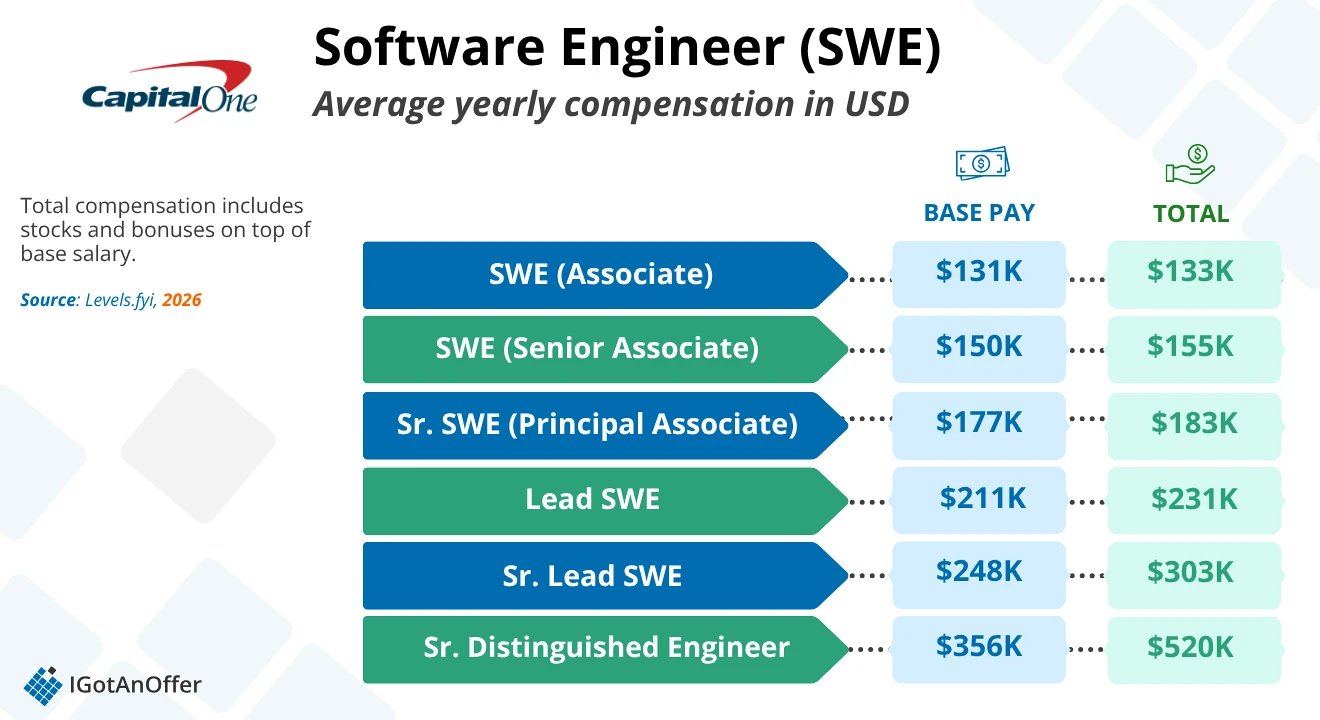
Capital One uses banking titles alongside engineering ones. For example, a senior software engineer is a principal associate internally, which can be confusing when comparing offers with other tech companies.
Also, stock makes up a smaller share of the compensation package than at most FAANG companies. Most of your compensation is base salary, so that's where negotiating is likely to have the biggest impact.
And remember, Capital One compensation is negotiable. If you get an offer, don't hesitate to ask for more. If you need expert guidance, consider booking a session with our salary negotiation coaches.
Coaches who contributed to this guide










2. Capital One software engineer interview process and timeline ↑
2.1 What steps to expect
The Capital One software engineer interview process typically takes four weeks to eight weeks from application to offer, depending largely on team matching and reference check timing. Most candidates go through these steps:
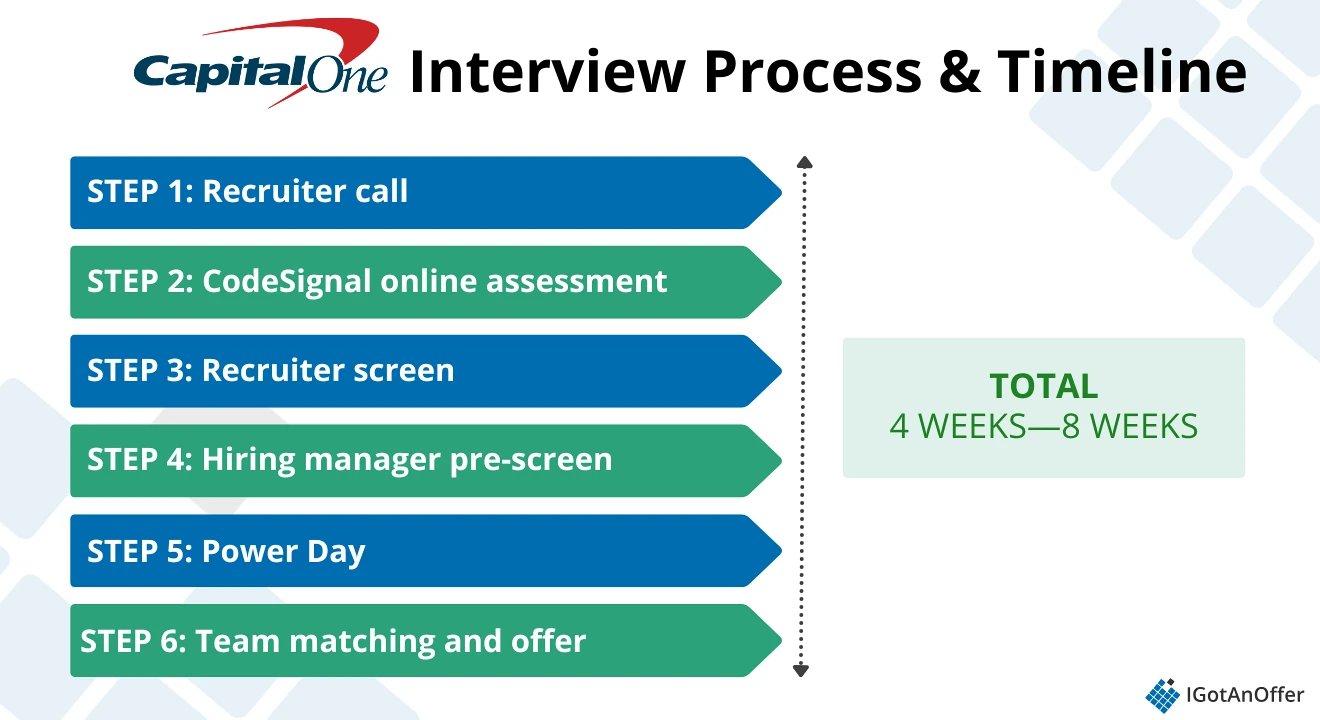
- Resume screen
- CodeSignal online assessment
- Recruiter screen
- Hiring manager pre-screen (for senior levels)
- Power Day: four interviews
- Team matching and offer
Software engineers do not typically take Capital One's standard Virtual Job Tryout. That assessment is used mainly for business and consulting-side roles. Engineering, cyber, and machine learning candidates are routed through CodeSignal instead.
Let's take a look at each step.
2.1.1 Resume screen ↑
First, recruiters will look at your resume and assess if your experience matches the open position. This is the most competitive step in the process. We’ve found that ~90% of candidates don’t make it past this stage.
So take extra care to tailor your resume to the specific position you're applying to. Take a look at our SWE resume and senior SWE resume guides for expert tips and real examples.
If you’re looking for expert feedback, get input from our team of ex-FAANG recruiters, who will cover what achievements to focus on (or ignore), how to fine-tune your bullet points, and more.
2.1.2 CodeSignal online assessment ↑
Capital One uses the CodeSignal general coding assessment as its technical filter. It's a proctored 70-minute test, so you'll need a webcam.
The assessment is a single coding problem that gets progressively harder over four levels. You start with a basic version to solve against a set of unit tests, and passing one level unlocks the next. Because each level builds on the last, you spend most of your time extending and adapting code you've already written.
Capital One software engineer candidates on Glassdoor and Blind report a consistent set of problem types. These problems tend to test:
- Your ability to write clean, modular code that scales
- How you approach incrementally increasing complexity
- Whether you can think about performance and edge cases
- Your overall problem-solving process
For example, you might be asked to build an in-memory key-value database (starting with basic SET, GET, and DELETE operations before adding filtered scans, TTL timestamps, and file compression), implement a scalable banking system, build a constrained file cache, or simulate a cloud database.
While we've seen reports of candidates with high CodeSignal scores not advancing, the specific reasons aren't clear. In any case, this suggests that the CodeSignal score is evaluated holistically alongside your resume, experience, and references.
During the test, we recommend that you:
- Budget 20–25 minutes per level.
- Test and debug as you go. It's much faster to catch small issues early than to untangle them all at the end.
- If you get stuck, move on and circle back if time allows.
- Keep your initial solution simple. The early levels are intentionally straightforward, and complexity is introduced gradually.
If you pass, you’ll typically receive an email within one to two weeks inviting you to the next stage. If not, you’ll get an automated rejection and can reapply after 12 months, or sooner if your skills or experience have significantly evolved.
For more tips on how to prepare, see our coding interview prep guide.
2.1.3 Recruiter screen ↑
The next step is the recruiter screen. This will typically be a brief phone call with your recruiter to discuss further details about the company and role. The purpose of this interview is to assess your fit. Your recruiter will also brief you on Power Day and usually send prep materials.
Expect questions such as:
- Why Capital One? (Sample answer)
- Walk me through your resume.
- Tell me something about yourself that’s not on your resume.
- What’s your biggest accomplishment?
- How did you hear about this position?
- What are your strengths and weaknesses?
This list of 23 common interview questions by Capital One is a good resource for practicing more example questions.
2.1.4 Hiring manager pre-screen ↑
For senior and lead roles, you may have a 30-minute call with a hiring manager before Power Day. This covers your background and technical experience at a high level.
Some candidates skip this step entirely. Your recruiter will confirm whether it applies to you.
2.1.5 Power Day ↑
Finally, once you’ve passed all of the initial tests mentioned above, you’ll move on to what Capital One calls the “Power Day.” This stage is an entire day of back-to-back virtual interviews.
Each interview typically lasts up to one hour, with a one-hour break scheduled during the day.
Capital One Power Day has a consistent four-round structure:
- Coding. Often object-oriented design rather than pure algorithms. The most common task is modeling a banking domain in code (for example, a credit card with balances and limits). To prepare for this round, take a look at our coding interview prep guide and our guide on how to answer coding interview questions.
- System design. Most system design interviews revolve around financial systems, with "Design a banking system" being the most commonly reported prompt. To learn more, check out our system design interview guide and our guide to databases and system design, which covers the consistency tradeoffs that come up in banking systems.
- Case interview. A business problem with light math, ending in a recommendation. The scenario is tailored to your track, so backend, DevOps, data, and full-stack candidates get different versions. To learn more about case interviews at Capital One, check out our guide on Capital One case interviews and our case interview math guide.
- Behavioral. The behavioral interview typically lasts an hour and includes around four STAR-format questions. To learn more about behavioral interviews, check out our guide on Capital One's behavioral interviews and the 40+ most-asked behavioral interview questions.
The interview loop varies by seniority. Internship and entry-level candidates often have a shorter process without a dedicated system design interview, while senior and lead candidates may have a second system design interview instead of a case interview.
Your recruiter should be able to confirm which rounds apply to you, so don’t hesitate to ask.
As mentioned earlier, the case round is what sets Capital One apart from a typical SWE loop. It's also the round candidates are least prepared for. We cover it in detail in Section 3.3.
2.1.6 Team matching and offer ↑
After Power Day, successful candidates typically move to team matching, where they meet with hiring managers from teams that have open positions. It's common to speak with two or three managers before deciding which team is the best fit.
One thing to be aware of is down-leveling. Even if you pass the interview loop for a senior position, you may receive an offer for a mid-level role if your matched team doesn't have a senior opening.
2.2 Differences between SWE levels
Capital One's engineering ladder uses banking-specific titles, which can make comparisons with other companies confusing. Here's how the levels typically map and how the interview expectations change at each level.
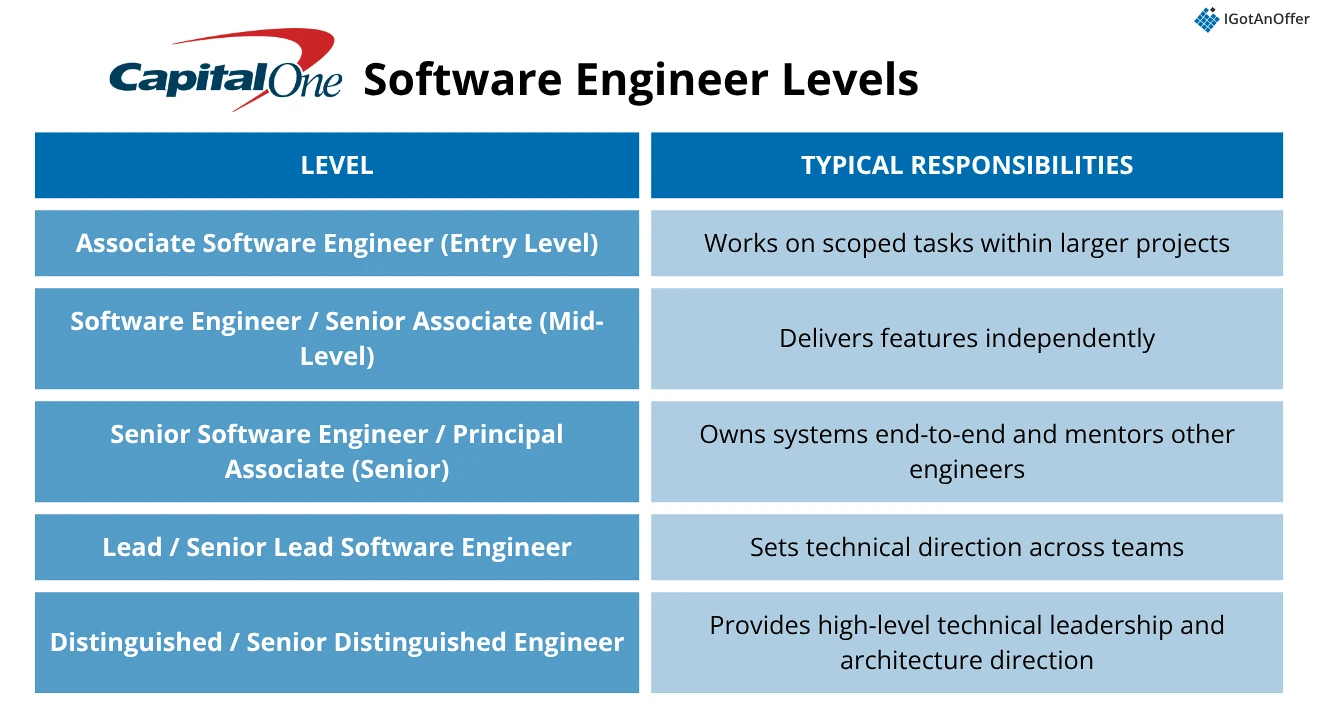
If you're targeting a staff-equivalent role, our staff software engineer interview guide covers what interviewers expect at that level.
3. Capital One software engineer interview questions ↑
We believe in data-driven interview preparation, so we've analyzed Glassdoor and Blind reports to identify the questions you’re likely to be asked in your Capital One SWE interviews.
Capital One tends to reuse a relatively small pool of interview questions, with some candidates on Blind reporting that questions from Glassdoor often appear word-for-word in actual interviews. They fall into four categories:
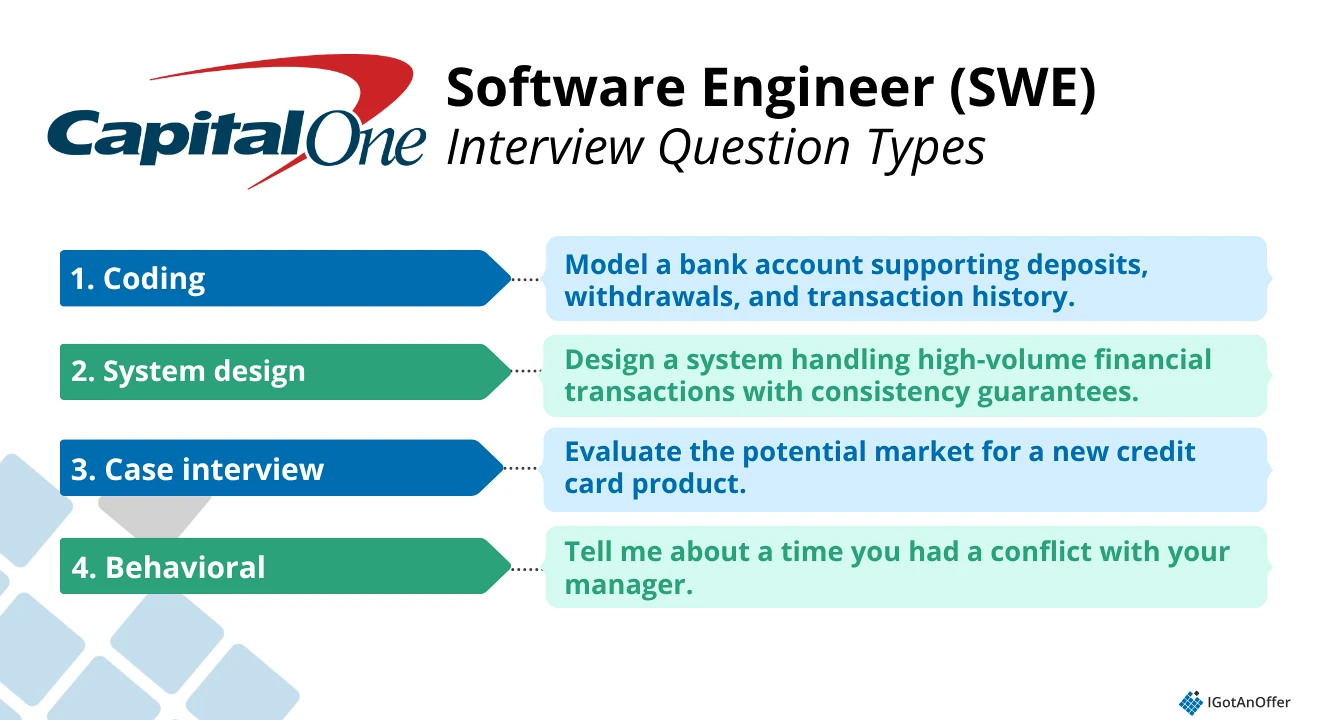
- Coding interview questions
- System design interview questions
- Case study interview questions
- Behavioral interview questions
Reviewing these questions can be especially valuable when preparing for your interview.
3.1 Coding interview questions ↑
Capital One's live coding round is different from its online assessment. The CodeSignal test is algorithmic, but the Power Day coding interview leans toward object-oriented design, usually modeling part of a banking domain in code.
Each round runs about an hour on the CodeSignal whiteboard rather than a full IDE, so practice writing code without autocomplete before the day.
A working solution matters more here than an optimal one. Interviewers are looking for:
- Working code that passes the given tests: aim for a solution that runs correctly on every test case before worrying about optimization. Then, use any time left to discuss possible improvements.
- Continuous narration: talk through what you're doing while you do it. If you're adding a helper function or picking one data structure over another, explain the reason out loud. The interviewer is judging how you reason, so don't make them guess.
- Sensible class structure: when you're asked to design something, split it into classes that each handle one job. For instance, if you’re modeling a bank account, you might separate the account, the transactions, and the ledger rather than putting everything in one class.
- Explicit edge-case handling: flag the inputs that could break your code before the interviewer asks. In a banking problem, that means overdrafts, negative amounts, and insufficient funds. Raising these yourself shows you know where a financial system tends to fail.
Based on our analysis of the most recent SWE coding questions reported on Glassdoor and Blind, here are sample coding questions asked at Capital One software engineer interviews.
Example Capital One software engineer interview questions: Coding
- Model a bank account supporting deposits, withdrawals, and transaction history
- Model a credit card with balances, credit limits, and payments
- Build a nested hashmap to resolve a multi-part lookup
- Apply a financial calculation, such as compound interest, to a coding problem
- Identify and fix a bug in an existing function, then explain your reasoning
- Implement an LRU cache (solution)
- Count the number of islands in a binary matrix (solution)
For more practice, see our coding interview prep guide and our guide to how to answer coding interview questions.
3.2 System design interview questions ↑
Capital One's system design round is heavily focused on financial systems. "Design a banking system" is the most reported question, appearing across every level from associate to principal.
Interviewers want to see that you build financial requirements into your design from the start. Your design should account for:
- Transaction consistency: keeping financial data accurate and reconciled while operations are in flight, so no transaction is lost, duplicated, or half-applied.
- Audit trails: recording every change to accounts and transactions, so activity can be traced and reviewed after the fact.
- Regulatory compliance: designing systems that support financial rules and reporting requirements.
- Fault tolerance: handling failures without losing or corrupting critical data, so a crash mid-transaction leaves the system in a recoverable state.
Raise these yourself instead of waiting for the interviewer to prompt you. Doing so shows you understand what makes financial systems harder to build than a typical consumer app.
The upside of Capital One's narrow focus is that you can prepare for it more strategically. Unlike companies that draw from a wide question bank, Capital One's domain is predictable enough that you can practice the types of problems you're most likely to see. Here are examples reported by Capital One software engineer candidates:
Example Capital One software engineer interview questions: System design
- Design a banking system.
- Design a banking application supporting accounts, transfers, and transaction history.
- Design a payment processing system.
- Design a credit card transaction authorization system.
- Design a system handling high-volume financial transactions with consistency guarantees.
- Design a fraud detection pipeline.
For a detailed breakdown of how to approach this round, including example answer outlines, see our system design interview guide and our guide to how to answer system design questions.
3.3 Case interview questions ↑
At a Capital One case interview, you’ll be given a business problem and asked to work through it and give your recommendation.
Capital One uses the interviewer-led case interview approach, similar to McKinsey's case interview method. The interviewer guides you through the case one question at a time, whereas in a candidate-led case, you're expected to set the direction and decide which areas to analyze yourself.
To ace a case interview at Capital One, you’ll need to:
- Walk your interviewer through your thought process
- Show off your analytical reasoning and quantitative skills
- Arrive at a clear final recommendation based on your findings
Another important aspect of the Capital One case interview you should be aware of is that you will be asked to commit to a clear decision, then challenge your reasoning to see how well it holds up. "Interviewers will push you to commit (launch or do not launch, price A or price B) and then stress-test your logic," says James (expert case interview coach).
Example Capital One software engineer interview questions: Case study
- Optimize a cloud compute setup for both resiliency and cost
- How to improve insurance sales within a specific region.
- Evaluate a tradeoff between infrastructure spend and system reliability
- Work through a business case where the technical decision has a measurable cost impact
- Evaluate the potential market for a new credit card product. What factors would you consider, and how would you assess the competitive landscape?
For more tips on how to approach and structure your answer, check out our Capital One case interview guide.
3.4 Behavioral interview questions ↑
These questions focus on your past work experience, your qualifications, and your motivation for applying to Capital One. In other words, it's a way for your interviewer to understand how you approach problems and whether you're a good fit for the role.
Interviewers typically work from a script and stay on it, so expect a more structured interview than a free-flowing conversation.
Your interviewer will usually be a tech lead or hiring manager, and they’ll assess you in three main areas: problem-solving, influencing skills, and results focus.
Capital One's culture is built on data-driven decision-making, and it shows in how answers are scored. Be ready to explain what changed as a result of your work and quantify it wherever possible.
You can expect behavioral questions to come up in the recruiter screen, and interviewers in the technical rounds often open with one.
Below are questions reported by Capital One software engineer candidates. We've also included links to sample answers to help you prepare.
Example Capital One software engineer interview questions: Behavioral
General
- Tell me about yourself.
- Why Capital One? (Sample Answer)
- Walk me through your resume.
- What are your strengths and weaknesses?
Conflict resolution
- Tell me about a time you handled conflict in the workplace.
- If you and a colleague disagree on how to proceed with a project, what reconciliation steps would you take?
- Tell me about a time you had a conflict with your manager.
- Tell me about a time you handled a difficult stakeholder.
Ownership
- Tell me about a time you failed.
- Describe a time you made a mistake and how you handled it.
- Tell me about a project you're most proud of.
Learning
- Tell me about a time you learned something new quickly
- How do you keep yourself updated with new technologies?
- Tell me about a time you had to shift priorities.
For a deeper dive, see our Capital One behavioral interview guide, which includes 40+ questions and full worked answers using IGotAnOffer’s SPSIL framework.
Then, see our software engineer behavioral questions guide, which also includes sample answers to the most common SWE questions.
4. Capital One SWE interviewing tips ↑
You might be a great engineer, but that won't be enough on its own to get you through a Capital One interview. Interviewing is a skill in itself, one that needs to be learned and developed.
Let’s look at some key tips to make sure you approach your interviews in the right way.
4.1 Ask clarifying questions before you write any code
Capital One’s coding problems are intentionally more ambiguous than standard algorithm questions. Spend the first few minutes of each coding round clarifying scope, asking about edge cases, and restating the problem in your own words.
This keeps you from writing code toward the wrong solution. It also shows the interviewer you approach ambiguous problems in a structured way, which is a large part of what they're assessing.
4.2 Communicate efficiently
During your technical interviews, you’ll also be assessed on your communication skills and how you talk through your problem-solving process. Use this as your opportunity to show how well you communicate and collaborate with colleagues by treating your technical interviews like a conversation.
In system design interviews, start by stating your assumptions to make sure you’re aligned with your interviewer. And in behavioral interviews, set up your situation quickly before diving into your actions and results.
A great way to improve this skill is to familiarize yourself with answer frameworks, such as IGotAnOffer’s SPSIL framework (Situation, Problem, Solution, Impact, Learning) for behavioral interviews, or the 4-step system design framework we recommend to candidates for tackling system design questions.
4.3 Go brute force first, then iterate
Do not chase the perfect solution before you have a working one. Get to a correct answer first, then discuss how you would improve it. Most interviewers appreciate a candidate who can clearly explain trade-offs over those who freeze trying to find the optimal solution.
4.4 Be honest
Capital One does not expect its candidates to know everything. So if you get a question that's outside your expertise, don't hesitate to let your interviewer know. Ask the right questions and show motivation to learn.
Similarly, when asked if you faced challenges or setbacks, don’t deny or frame your weakness as a strength. Instead, discuss how you’ve improved and learned from these challenges.
4.5 Build financial constraints into your designs
In the system design round, raise the financial constraints from section 3.2 before the interviewer does. Doing so shows you understand the unique challenges of designing banking systems.
4.6 Expect to be given a case from outside the finance industry
Capital One likes to use cases from different industries. It’s because they want to evaluate how you think and solve problems rather than your knowledge of the finance industry or Capital One itself.
This is also a preview of the job itself. As a Capital One software engineer, you'll often turn a business problem into a technical solution, sometimes in a domain you've never worked in.
4.7 Train on ugly numbers
Expect case numbers that don't round off neatly (i.e. 17.5% of 2,340, not 20% of 2,000). Capital One uses such numbers to test your composure and estimation discipline.
James (expert case interview coach) says, "Build your mental math on ugly numbers and messy inputs. Also practice the two-pass technique, i.e., a fast estimate to sanity-check direction, then the precise calculation."
4.8 Contextualize the data
Capital One case interviews are maths-heavy, so you might assume that getting the correct calculations is the end-all be-all of the interview.
But if you want to stand out, you need to interpret the data in the context of the main question being asked.
Say your math shows a new product would bring in $2M a year. Don't stop at the number. Point out that it's below the $5M threshold the company set for a launch, so the recommendation is to hold. That connection between the figure and the decision is what interviewers are looking for.
Brittany (expert case prep coach) calls this ‘the push.’ It's what shows you can connect a technical decision to its business impact, which is exactly what Capital One wants from its engineers.
4.9 Don’t freeze when stuck
Brittany’s advice when you get stuck is to take a deep breath and do two things: summarize where you’re at in the case, and then pivot to another angle.
Doing both keeps you from going silent or falling back on filler. It also buys you a little time to find your way back to your original point.
5. How to prepare for Capital One SWE interviews ↑
Now that you know what to expect, let's focus on how to prepare.
5.1 Learn more about Capital One
Most candidates fail to do this. But before investing tens of hours preparing for an interview at Capital One, you should take some time to make sure it's the right company for you.
Capital One is undoubtedly prestigious, so it’s tempting to ignore this step. But in our experience, the prestige in itself won't make you happy day-to-day. It's the type of work and the people you work with that will.
If you know engineers who work or used to work at Capital One, it's a good idea to talk to them to understand what the culture is like. In addition, we would recommend reading the following:
- About Capital One (by Capital One)
- Work and culture at Capital One (by Capital One)
- Careers Blog (by Capital One)
- Capital One's AWS migration case study (by AWS)
5.2 Practice by yourself
As we've outlined above, you'll have to prepare for several different categories of questions ahead of your Capital One SWE interviews.
In this article, we've recommended various deep-dive articles that will help you prepare for each question category. Here's the complete list, plus a couple of extras we think could be useful.
For the coding round:
- Coding interview prep guide: a step-by-step framework with practice questions
- How to answer coding interview questions: a structured method for live coding rounds
- Coding interview examples: practice problems across question types
- Data structure interview questions: the underlying fundamentals, with dedicated sections on arrays, strings, graphs, trees, linked lists, stacks and queues, sorting, dynamic programming, and Big-O analysis
For the system design round:
- System design interview guide: our 4-step framework, plus practice questions
- How to answer system design questions: a minute-by-minute breakdown of a strong answer
- 19 system design interview tips: advice from ex-interviewers at Amazon and Google
- Staff system design interview: for lead and above candidates
For the case round:
- Capital One case interview guide: the structured approach Capital One expects
- Case interview prep guide: case fundamentals from the ground up
- Case interview math: formulas and drills to sharpen your mental math skills
- Case interviews: what finance concepts do I need to know?: a consulting-focused guide, but the concepts it covers, such as profit, margins, and break-even, are the ones Capital One's case math tends to lean on
For the behavioral round:
- Capital One behavioral interview guide: 40+ real questions with worked answers
- Software engineer behavioral questions: the most common SWE questions with sample answers
- Behavioral interview questions: our SPSIL framework and 40+ most common questions asked in tech interviews
Other Capital One guides:
- Capital One interview process: a general overview of the interview process at Capital One
- Capital One Virtual Job Tryout: worth a look if you're also applying to non-engineering roles
Once you've brushed up on the topics, practice answering out loud. Play both interviewer and candidate. It sounds strange, but it significantly improves how you communicate under pressure.
5.3 Practice with peers
If you have friends or colleagues who can run mock interviews with you, that's worth trying. It's free, but comes with limitations:
- It's hard to know if the feedback you get is accurate
- They're unlikely to have insider knowledge of Capital One's format
- On peer platforms, people often don't show up
For those reasons, many candidates skip peer mocks and go straight to practicing with an expert.
5.4 Practice with experienced SWE interviewers
In our experience, practicing real interviews with experts who can give you company-specific feedback makes a significant difference.
Find a Capital One software engineer interview coach so you can:
- Test yourself under real interview conditions
- Get accurate feedback from a real expert
- Build your confidence
- Get company-specific insights
- Learn how to tell the right stories, better
- Save time by focusing your preparation
Landing a job at a big tech company often results in a $50,000 per year or more increase in total compensation. In our experience, three or four coaching sessions worth ~$500 make a significant difference in your ability to land the job. That's an ROI of 100x!
Click here to book software engineer mock interviews with experienced SWE interviewers.

 System design