


 Back to other articles
 Last updated: June 09, 2026

 Interviews
 Deeply researched
The Stripe interview process is time-consuming and difficult, and not knowing what’s ahead makes it even harder to prepare for.
We're here to help. We work with ex-Stripe interviewers on our platform, who have helped dozens of candidates navigate the Stripe interview process.
In this guide, we’ll walk you through exactly what to expect at each stage of Stripe's interview process and how to prepare for it. We've drawn on real candidate reports from Glassdoor and Blind, so you know what's tested at each round and how Stripe's process differs from other big tech companies.
Here is an overview of Stripe's full interview process:
- Step 1: Resume screen
- Step 2: Recruiter call
- Step 3: Online assessment
- Step 4: Screening interview
- Step 5: Take-home assignment
- Step 6: Onsite interviews
- Step 7: Team matching
- Step 8: Offer and negotiation
Click here to practice 1-on-1 with an ex-Stripe interviewer
Before we dive into each step, let's get to know Stripe.
1. About Stripe ↑
Stripe builds tools that allow businesses to accept payments, run subscriptions, issue cards, manage tax, and move money across borders, and a meaningful share of online commerce now runs through Stripe's systems. In 2025 alone, Stripe processed $1.9 trillion in payments, roughly 1.6% of global GDP.
The company, valued at $159 billion, was founded in 2010 by Irish brothers Patrick and John Collison. They built the company out of frustration with how difficult it was for developers to accept online payments. Their fix was a few lines of code that any engineer could drop into a website. That developer-first philosophy still shapes everything Stripe builds today.
2. Working at Stripe ↑
Stripe is famously high output, ships fast, and expects employees to own problems end-to-end.
The job is demanding, and Stripe is upfront about that. Their own culture guide explicitly asks candidates to consider whether they want a job that "could never be described as a cushy job."
2.1 Stripe's operating principles
Stripe's culture is built around six operating principles. Together, they describe a company that puts users first, ships quickly with high craft, and expects everyone to push for excellence regardless of role.
You'll be evaluated on how these principles show up in your own reasoning throughout the interview process, including in initial screens and onsite interviews. So, it's worth knowing them before you walk in.
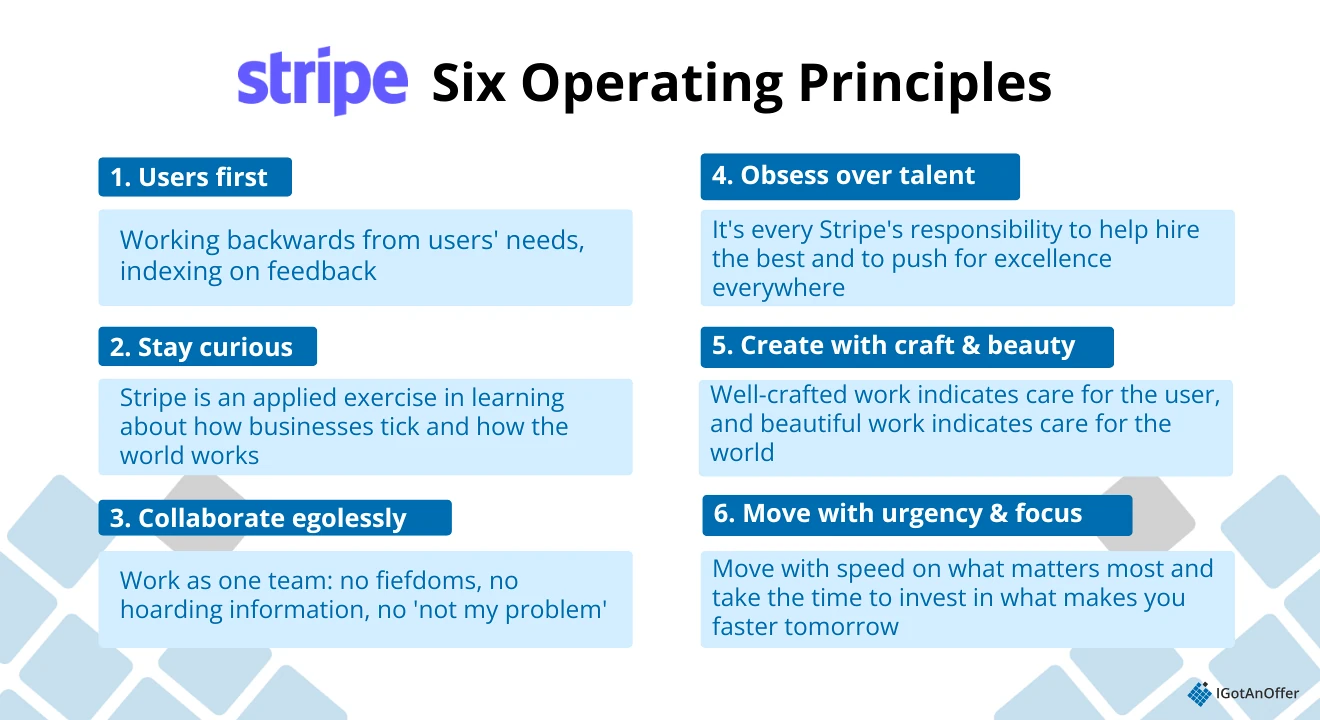
The six core principles are:
- Users first.
"We serve millions of businesses and a meaningful fraction of global GDP. We have a weighty responsibility to those businesses and to society. We work backwards from our users' needs, indexing especially on feedback from the most innovative. Everyone at Stripe talks to users."
- Create with craft and beauty.
"With careful thought, anything can be made surprisingly great. Across every part of Stripe, we are committed to doing so. Well-crafted work indicates care for the user, and beautiful work indicates care for the world."
- Move with urgency and focus.
"We move with speed on what matters most and take the time to invest in what will make us faster tomorrow. Whereas many companies get slower until they're eventually mired in mediocrity, we aspire to become the world's fastest company."
- Collaborate egolessly.
"We work as one team: no fiefdoms, no hoarding information, no 'not my problem.' We question assumptions, debate energetically, and abandon ideas when better ones emerge. We're generous with credit and stingy with blame. We learn from mistakes together."
- Obsess over talent.
"It's every Stripe's responsibility to help hire the best and to push for excellence everywhere. Managers must relentlessly uphold our high talent bar, lead their teams with clarity and context, foster development, and ultimately support Stripes in accomplishing the best work of their careers."
- Stay curious.
"Stripe is an applied exercise in learning about how businesses tick and how the world works. Since the details and possibilities are infinite, we are always seeking to learn. We're energized by the unfamiliar, preferring the joy of discovery to the comfort of certainty."
2.2 Great compensation
The pay is likely one of the reasons you're applying to Stripe, alongside a strong benefits package that covers medical, mental health, parental leave, fertility support, and learning and development programs.
So how do Stripe's salaries compare to those of other top tech companies?
Here’s a comparison table featuring the average salaries and compensation for L5 level software engineer, product manager, and engineering manager roles, based on Levels.fyi data as of April 2026:
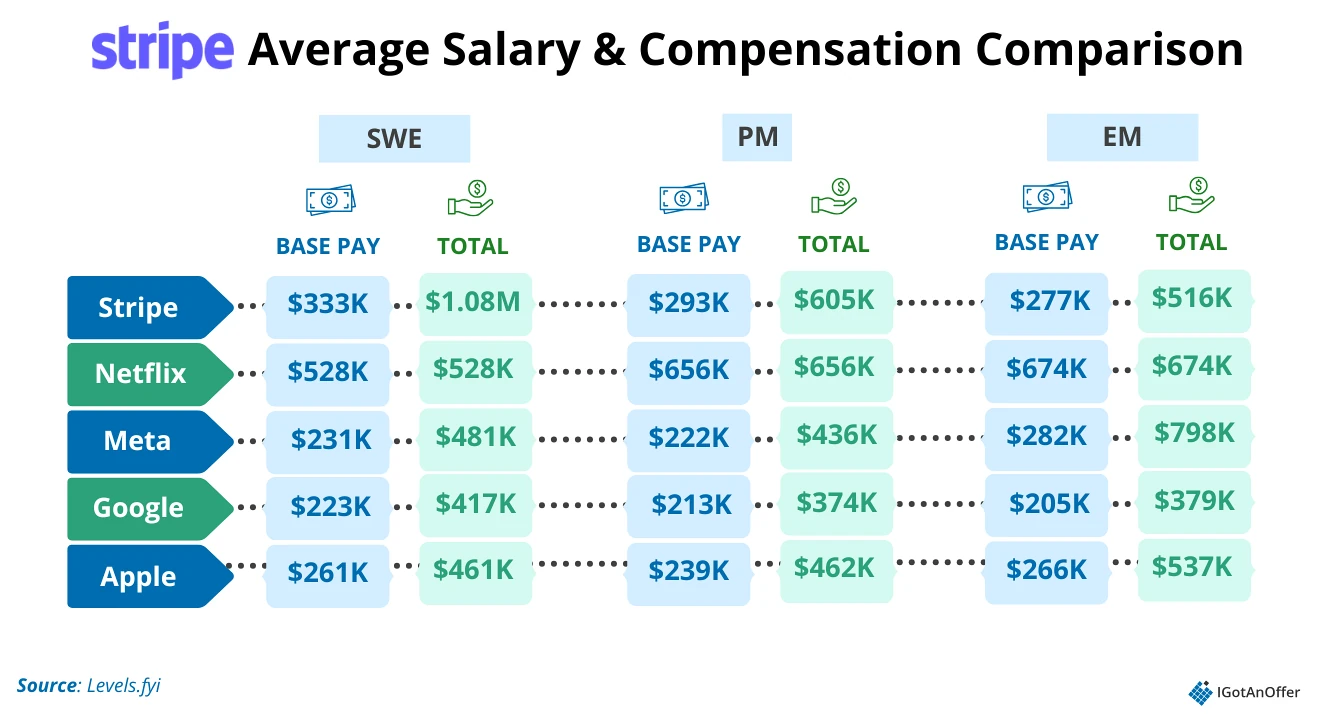
From the table, you’ll notice Stripe's SWE and EM pay sit at the top end of this list. L5 engineers earn close to what they would at Google, and engineering managers earn more than at Netflix, Google, and Apple. Stripe’s PM compensation is more modest but still ahead of Meta's and Apple's.
Coaches who contributed to this guide




Now, let’s get into the Stripe recruitment process.
3. Stripe interview process and timeline (8 steps to an offer) ↑
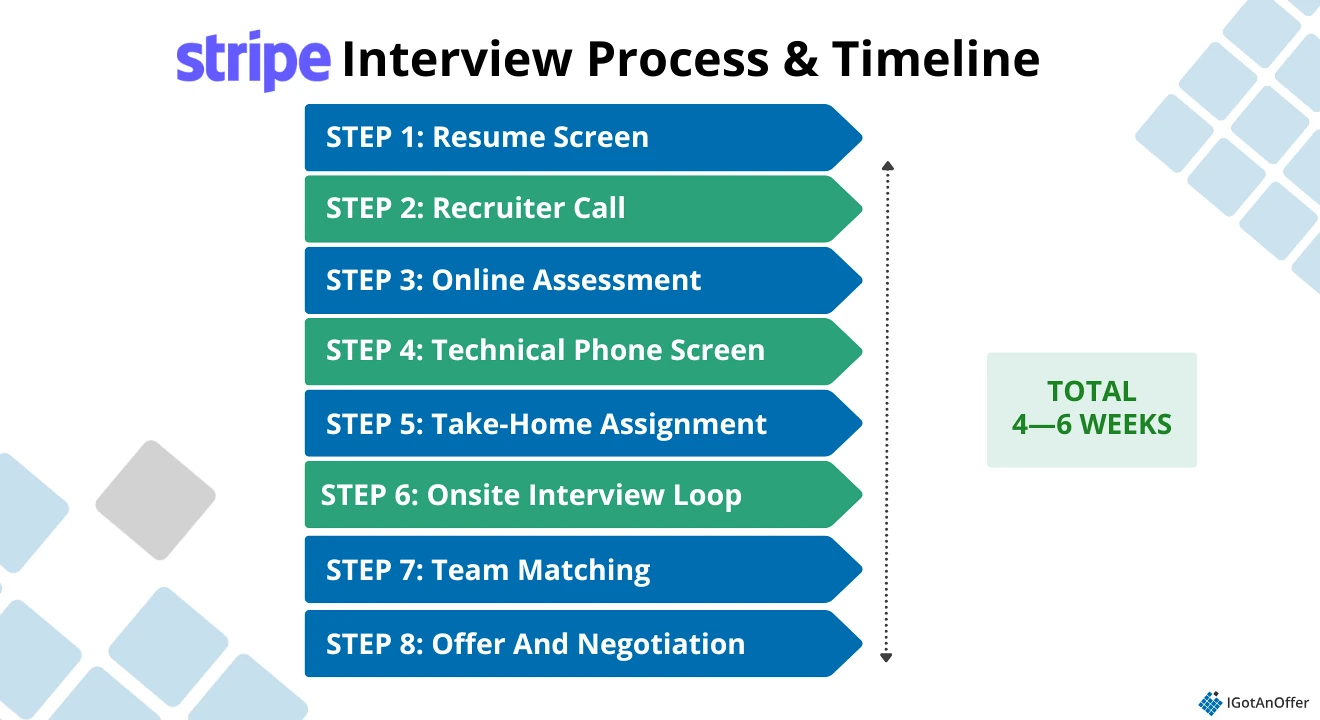
The exact process varies by role, but most candidates go through some variation of these stages:
- Resume screen
- Recruiter call
- Online assessment (for some roles)
- Technical phone screen
- Take-home assignment (PM roles)
- Onsite interview loop
- Team matching
- Offer and negotiation
Your recruiter will clarify the exact process for your role during the initial call. If you're specifically applying for a PM role, you can also check our Stripe product manager interview guide.
3.1 Resume screen ↑
The first step of Stripe's interview process is the resume screen. After you've submitted your application through the Stripe jobs portal or been contacted directly via email or LinkedIn, recruiters will evaluate your resume to see if your experience aligns with the open position.
This is an extremely competitive step, as we’ve found that ~90% of candidates don’t make it past the resume stage. To help you put together a targeted resume that stands out from the crowd, follow the tips below:
Tips for crafting a resume
- Study the job description: Your work experience should relate directly to the role qualifications you're applying for. Stripe typically doesn't hire entry-level candidates, so emphasize your senior-level accomplishments.
- Be specific and quantify: Use data to back up your claims. What scale systems did you work on? How many users did your features impact? What measurable improvements did you drive? Stripe cares deeply about scale, availability, and impact.
- Emphasize ownership and leadership: Highlight situations where you operated with significant autonomy, drove decisions, and owned outcomes. Show examples of emergent leadership, even if you weren't in a formal management role.
- Demonstrate culture alignment: While you shouldn't explicitly reference the culture memo in your resume, your experience should demonstrate the behaviors Stripe values.
- Be concise: Keep your resume to 1-2 pages maximum. Recruiters don't have time for lengthy documents, so make every word count.
For more insights as well as example resumes from real candidates, take a look at our resume guides below:
- Tech resume examples
- Software engineering resume examples
- Product manager resume examples
- Technical program manager resume examples
- Engineering manager resume examples
These guides are great starting points for creating a competitive resume for free. However, if you’re looking for expert feedback, you can also get help on your resume from one of our tech resume experts, who will cover what achievements to focus on (or ignore), how to fine-tune your bullet points, and more.
3.2 Recruiter call ↑
If you pass the resume screen, a Stripe recruiter will reach out to schedule a call. The call typically lasts 30 to 45 minutes and is a non-technical conversation.
The recruiter's job is to confirm that your background fits the role. Be prepared to go over your previous experience and explain your motivation for applying to the company. During the interview, expect questions like:
- Walk me through your resume. (Be ready to discuss key projects and decisions.)
- Tell me about yourself. (Give a concise overview of your background, key experiences, and how they led you to this opportunity.)
- Why Stripe specifically? (Reference Stripe's API, developer experience, or its role as financial infrastructure for the internet.)
The recruiter will also discuss how the overall interview process will work. If you have any specific questions (regarding timeline, location, or clarifications about the job description), now is the time to ask.
Your recruiter should also provide you with helpful interview materials from Stripe.
One thing to avoid: don't reveal your salary expectations at this stage. If pressed, say you're looking for a competitive offer and would like to learn more about the full compensation package later.
3.3 Online assessment (SWE roles) ↑
Not all roles at Stripe will require an online assessment. But a few software engineer candidates have reported on Glassdoor that they were given an online assessment on CodeSignal or HackerRank after submitting their applications on online job platforms.
The online assessments (OA) are 60-minute HackerRank tests, usually a single problem (Leetcode-style DSA) broken into three or four progressively more difficult parts. You solve part one to unlock part two, and so on.
3.4 Screening interview(s) ↑
Once you've cleared the recruiter call and any role-specific assessment, you'll move into the initial screen. The format varies depending on the role you're interviewing for, with most rounds running 45 to 60 minutes.
We've researched the interview process for the most common Stripe roles, so here's a rough idea of what to expect.
What to expect in Stripe initial screens (by role):
- Software engineers: a 60-minute live "team screen" with a Stripe engineer, where you'll work through a practical coding problem on a shared editor (CoderPad) or your own IDE. Unlike the OA, this one is live, so expect to think out loud and field follow-up questions as you go.
- Product managers: a 1-hour hiring manager screen covering your background, your motivation for Stripe, and one or two PM-style questions about a product you know well or how you'd approach a typical product problem.
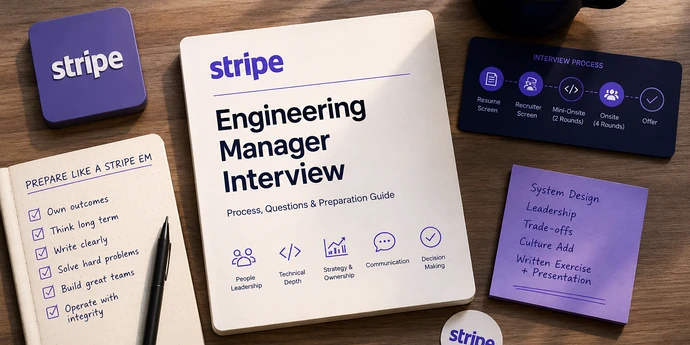
- Engineering managers: the EM screen is bigger than for other roles. Stripe calls it a "mini-onsite," and it consists of two 1-hour rounds: one on people management and one technical, usually live coding plus a lightweight system design discussion.
- Data engineers: a 60-minute technical screen covering SQL (window functions, CTEs, joins) and Python, often with a small ETL or data cleaning problem.
- Technical program managers: a 1-hour conversation with a hiring manager focused on your project history, how you approach program execution, and how you work across cross-functional teams.
Once you clear the initial screens, it’s time to get ready for the interview loop.
3.5 Take-home assignment (PM roles) ↑
In some cases, PMs are asked to complete a written take-home assignment, usually after or between the screening interviews. The intent of this assignment is to see how you approach the types of problems you might encounter on the job.
Here are some examples of what you could get as a PM take-home assignment:
- A product metric question on diagnosing a drop, evaluating a launch, or setting goals for a product area.
- A strategy memo on a Stripe-relevant problem, where you frame the problem, lay out trade-offs, and make a recommendation.
- Presentation materials you'll have around a week to prepare and present to a panel during one of your onsite rounds.
Take-homes also show up for some data scientist and data analyst candidates, usually as a dataset challenge with a short write-up. SWE candidates don't typically get a take-home, since the OA and team screen already cover the coding component.
It’s best to check with your recruiter whether the take-home assignment will be part of your interview process so you can prepare for it.
3.6 Onsite interview ↑
If you pass the phone screen, you'll be invited to the onsite. Despite the name, most onsite loops are now conducted virtually over one or two days. The onsite typically consists of 4 to 5 rounds, each lasting about an hour.
The rounds you face depend on your role:
- Coding interview (SWE)
- Bug bash (SWE)
- Integrations round (SWE)
- System design interview (SWE, mid-level and senior)
- Product sense interview (PM)
- Product execution interview (PM)
- Cross-functional interview (PM)
- Behavioral and values round (all roles)
Note: Interviewers score cultural fit in every round, not just the behavioral one.
What to expect in Stripe onsite interviews
The rounds are distinct, but together they assess the same core qualities: your ability to reason clearly, design robust systems, and make thoughtful tradeoffs.
1. Coding interview (SWE)
A 1-hour live-coding round on CoderPad or your own IDE, similar in style to the team screen but often deeper. You'll work through a practical problem in multiple parts, with new requirements added as you go. Most questions sit around LeetCode medium level on arrays, strings, and hashmaps.
See our coding interview prep guide for more.
2. Bug bash (SWE)
You’ll be given a small codebase or service and asked to identify and fix bugs within a time limit. The problems are often based on issues Stripe engineers have encountered. This round tests your debugging process, how you approach problems, and how clearly you explain your thinking.
3. Integrations round (SWE)
You're given access to a private GitHub repo and the Stripe API documentation, with internet access enabled, and asked to build a small feature against the Stripe API. That could be wiring up a payment flow, connecting two endpoints, or adding a new use case to an existing service.
The setup mirrors how Stripe's own customers use the product. Most companies that build on Stripe are reading the company’s API docs for the first time and writing code based on them. This round tests whether you can do the same: read the docs quickly, get familiar with new tools, and ship working code.
4. System design interview (SWE, mid-level and senior)
For mid-level and senior candidates, you'll have a system design round. You'll be asked to design a service end-to-end, often related to Stripe's core products (e.g., an idempotency layer for an API). The focus is on practical trade-offs: reliability, monitoring, failure modes, and operational concerns.
See our system design interview guide for prep.
5. Product sense interview (PM)
You'll be asked to design or improve a product, often related to Stripe's core offerings (developer tools, payments, billing, fraud). Stripe's customers are mostly developers, so interviewers want to see you think about their needs (clear docs, predictable APIs, easy debugging) rather than the end user clicking "buy" at checkout.
See our Stripe product manager interview guide for more.
6. Product execution interview (PM)
This is a more analytical round focused on how you'd diagnose a metric problem, evaluate a launch, or set goals for a product area. Expect to work with hypothetical numbers and walk through your reasoning out loud. Our product execution interview guide should help you adequately prep for this round.
7. Cross-functional interview (PM)
This round pairs you with someone from engineering, design, data science, or senior leadership. They'll probe how you collaborate with technical partners, communicate trade-offs to non-PM audiences, and influence decisions without authority.
Senior software engineers (Staff level and above) may also see a cross-functional round in their loop, though it isn't standard for SWEs.
Notes on PM onsite rounds
Most PM rounds at Stripe are case-style interviews built around role-playing real work scenarios. CTO David Singleton has said the goal is to see whether candidates approach the work "in a way that is curious, digging into the details, and collaborative." So, come ready to act through scenarios with your interviewer, not just answer Q&As.
8. Behavioral and values round (all roles)
Every Stripe loop includes a behavioral round, usually led by a hiring manager or a senior interviewer trained to maintain a consistent hiring bar across levels (similar to Amazon's Bar Raiser). It's structured around Stripe's operating principles, and interviewers use them as a lens to understand your past experiences, motivations, and how you handle specific situations.
According to Halim (Stripe product lead), “Stripe looks for candidates who proactively raise the quality bar, whether it’s UX polish, API ergonomics, or writing quality.”
For frameworks to structure your Stripe behavioral answers, see our behavioral interview questions guide.
3.7 Team matching ↑
Once you clear the loop, you enter team matching.
You'll have 30-minute conversations with 2 to 4 hiring managers from different teams. These calls are partly about mutual fit: the team learns about your background, and you learn about the work, the people, and the technical scope. After these calls, you and the hiring managers rank preferences, and a match is made.
For some candidates, this stage can stall, particularly if no team is actively hiring at your level. Communication can slow down here, even after you've passed every other round.
3.8 Offer and negotiation ↑
Finally, once you’ve passed all the steps above, you’ll receive your offer package from Stripe.
At this point, all that is left for you to do is negotiate your offer. Your recruiter will get in touch with you about the details, likely scheduling one final call to clarify and discuss the terms. If they have not scheduled a call, you can ask for one.
Of course, salary discussions can be difficult and a bit uncomfortable, especially if you are not used to them. Below are some tips to help you navigate your salary negotiations:
Salary negotiation tips
- Be polite: Remember that the person you’re negotiating with is just doing their job, and that the two of you are not enemies. You’ll get much further in your negotiations if you approach the conversation with grace.
- Don’t give a number right away: Whenever possible, it’s better to wait until you receive an offer to start negotiating. This reduces the risk of giving a number that is lower than the company would otherwise pay, or so high that they'll be reluctant to interview you.
- Do your research: Have a number in mind before the conversation begins, and back it up with data. Research your position and level on Levels.fyi, ask around on professional social networking sites like Blind, factor in the cost of living where you are, and, ideally, get some input from a current Stripe employee.
- Start high: To start the conversation, name a compensation number that is higher than your goal, and the Stripe negotiator will likely end up negotiating it down to a number that is closer to your original goal.
- Negotiate everything: Your offer will include more than a base salary and stock options. You also have bonuses, vacation days, location, work-from-home options, and other factors to consider. If the salary won’t budge, there may be some wiggle room around the other perks.
For even more salary negotiation tips, check out our product manager job offer negotiation guide. It’s written for PMs, but the principles apply across roles.
If you'd like expert help, we offer salary negotiation coaching with former tech recruiters and hiring managers, including some who have negotiated offers at Stripe.
Once the offer is accepted, congratulations. It's time to start your career at Stripe.
4. Are you prepared for your Stripe interviews? ↑
Learning by yourself is an essential first step. We recommend you make full use of the free prep resources on this blog. That way, you can see what an excellent answer looks like.
You can start by reading these free role-specific Stripe interview guides:
Once you’re in command of the subject matter, you’ll want to practice answering questions. But by yourself, you can’t simulate thinking on your feet or the pressure of performing in front of a stranger. Plus, there are no unexpected follow-up questions and no feedback.
That's where we come in. We've coached more than 20,000 people for interviews since 2018. In our experience, practicing real interviews with experts who can give you company-specific feedback makes a huge difference.
Find a Stripe interview coach so you can:
- Test yourself under real interview conditions
- Get accurate feedback from a real expert
- Build your confidence
- Get company-specific insights
- Learn how to tell the right stories, better
- Save time by focusing your preparation
Landing a job at a big tech company often results in a $50,000 per year or more increase in total compensation. In our experience, three or four coaching sessions worth ~$500 make a significant difference in your ability to land the job. That’s an ROI of 100x!
Click here to book mock interviews with experienced Stripe interviewers.

 Product manager








 Coding