


 Back to other articles

 Last updated: October 19, 2026

 Interviews
 Behavioral
 Deeply researched
Anthropic’s culture interview is one of the hardest stages in its hiring process, arguably even more challenging than the technical rounds. It appears in every interview loop, regardless of role or seniority.
This isn’t a standard behavioral interview in the FAANG sense. You’ll be asked to reason through difficult (and sometimes nuanced) topics, such as AI safety, ethical dilemmas, and your perspective on the company’s mission.
It can be daunting, which is why we’ve put together this guide. In here, we define Anthropic’s culture interviews, show you example questions, plus tips and a prep plan to help you approach these rounds with confidence.
- What is Anthropic’s culture interview?
- Anthropic’s core values and mission
- 5 different types of Anthropic culture interview questions (+ examples)
- Examples of Anthropic culture interview questions (by role)
- Tips for answering Anthropic culture interview questions
- How to prepare for Anthropic’s culture interview
Click here to practice one-on-one with an expert interview coach
Let’s get into it.
1. What is Anthropic’s culture interview?
Anthropic's culture interview is a 45-minute interview that assesses a candidate's alignment with Anthropic’s mission-first culture, core values, and 'high-trust/low-ego' environment.
While you’ll still get the typical “Why Anthropic?” and "Tell me about a time..." style questions, it is not a behavioral interview in the traditional FAANG sense. In fact, some reports say that using heavily scripted behavioral 'STAR' stories can do more harm than good.
Instead, you have to be prepared to discuss your personal ethical framework and real-life examples of when your values were tested. Interviewers want to know how you think about AI safety, handle moral dilemmas, demonstrate humility, etc.
You must also show a healthy degree of skepticism. If you’re asked, “What do you think about Anthropic’s mission?”, don’t simply echo Anthropic’s corporate manifestos. Anthropic expects you to think critically, engage in honest discourse, and feel comfortable challenging their methodologies.
2. Anthropic’s core values and mission ↑
To prepare for Anthropic’s culture interview, you should have a deep understanding of their mission and values, as they directly inform the interview process and culture fit assessment.
2.1 Mission-first culture
Anthropic’s north star is AI safety. The company’s entire structure (how it sets goals, how it prioritizes work, and even how it hires) flows from that.
In culture interviews, this shows up as questions about how you make decisions under uncertainty, how you weigh risk, and whether you think about long-term consequences. You don’t need to be an AI safety expert, but you do need to care about what you’re building.
2.2 High-trust, low-ego organization
Anthropic describes itself as "high-trust" and "low-ego." This translates to direct, honest communication and an expectation that everyone (regardless of role) will contribute beyond their title.
As Anthropic’s values state, "If something urgently needs to be done, the right person to do it is probably you!"
This creates a culture where there's less rigid hierarchy than at traditional tech companies. Your seniority matters less than your ability to solve problems and your willingness to take ownership.
2.3 Anthropic's seven core values
Anthropic’s values guide how the team builds and deploys AI systems, with a strong emphasis on safety and minimizing harm. The company is highly aware of both the risks and potential benefits of advanced AI, and expects employees to think carefully about that balance.
Each value highlights a different part of this approach, from prioritizing long-term impact and responsible development to making thoughtful trade-offs in high-stakes situations.
During the culture interview, you’ll be evaluated on how these principles show up in your own reasoning. As mentioned, you don’t have to agree with every methodology, but you must show that you take these core values seriously.
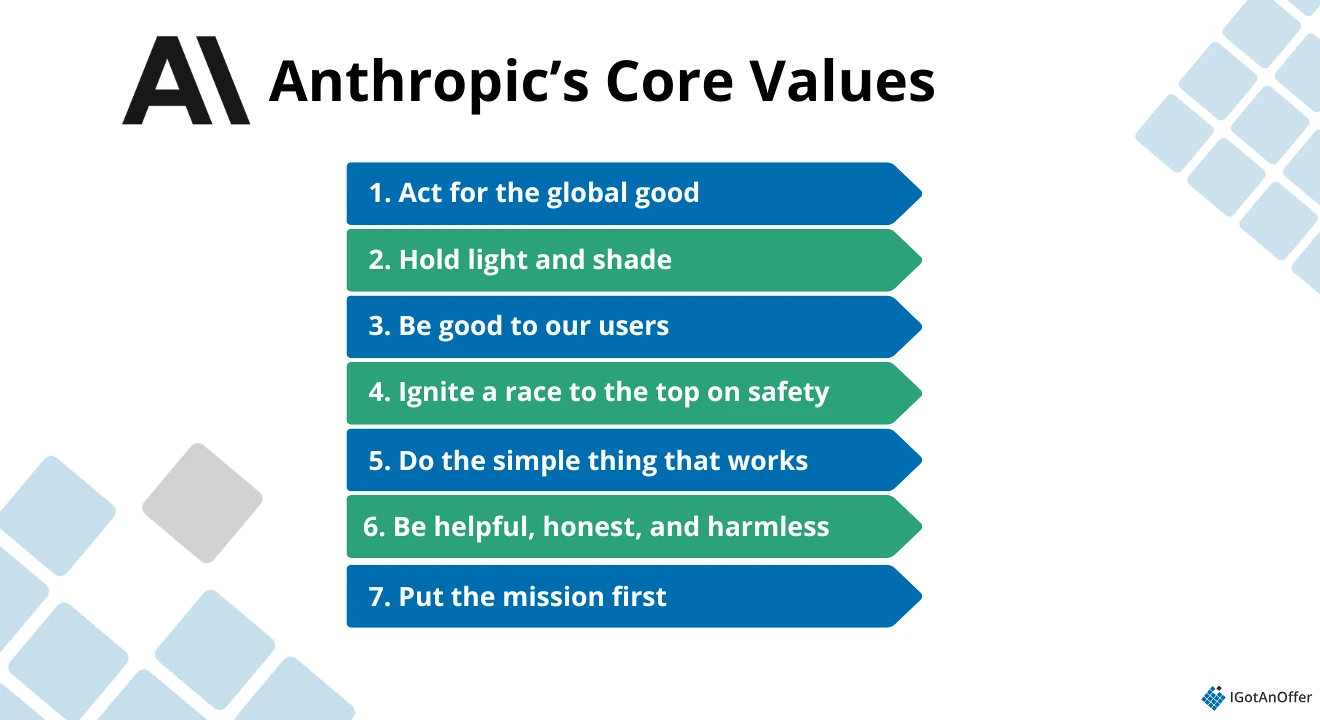
Below is how Anthropic outlines its core values:
Anthropic's 7 Core Values
1. Act for the global good
“We strive to make decisions that maximize positive outcomes for humanity in the long run. This means we’re willing to be very bold in the actions we take to ensure our technology is a robustly positive force for good. We take seriously the task of safely guiding the world through a technological revolution that has the potential to change the course of human history, and are committed to helping make this transition go well.”
2. Hold light and shade
“AI has the potential to pose unprecedented risks to humanity if things go badly. It also has the potential to create unprecedented benefits for humanity if things go well. We need shade to understand and protect against the potential for bad outcomes. We need light to realize the good outcomes.”
3. Be good to our users
“At Anthropic, we define ‘users' broadly. Users are our customers, policy-makers, Ants, and anyone impacted by the technology we build or the actions we take. We cultivate generosity and kindness in all our interactions—with each other, with our users, and with the world at large. Going above and beyond for each other, our customers, and all of the people affected by our technology is meeting expectations.”
4. Ignite a race to the top on safety
“As a safety-first company, we believe that building reliable, trustworthy, and secure systems is our collective responsibility - and the market agrees. We work to inspire a ‘race to the top’ dynamic where AI developers must compete to develop the most safe and secure AI systems. We want to constantly set the industry bar for AI safety and security and drive others to do the same.”
5. Do the simple thing that works
“We take an empirical approach to problems and care about the size of our impact and not the sophistication of our methods. This doesn’t mean we throw together haphazard solutions. It means we try to identify the simplest solution and iterate from there. We don’t invent a spaceship if all we need is a bicycle.”
6. Be helpful, honest, and harmless
“Anthropic is a high-trust, low-ego organization. We communicate kindly and directly, assuming good intentions even in disagreement. We are thoughtful about our actions, avoiding harm and repairing relationships when needed. Everyone contributes, regardless of role. If something urgently needs to be done, the right person to do it is probably you!”
7. Put the mission first
“At the end of the day, the mission is what we’re all here for. It gives us a shared purpose and allows us to act swiftly together, rather than being pulled in multiple directions by competing goals. It engenders trust and collaboration and is the final arbiter in our decisions. When it comes to our mission, none of us are bystanders. We each take personal ownership over making our mission successful.”
Coaches who contributed to this guide








Right, now let’s dive into the types of questions you’ll encounter in your culture interview.
3. Different types of questions to expect in Anthropic culture interviews (with examples) ↑
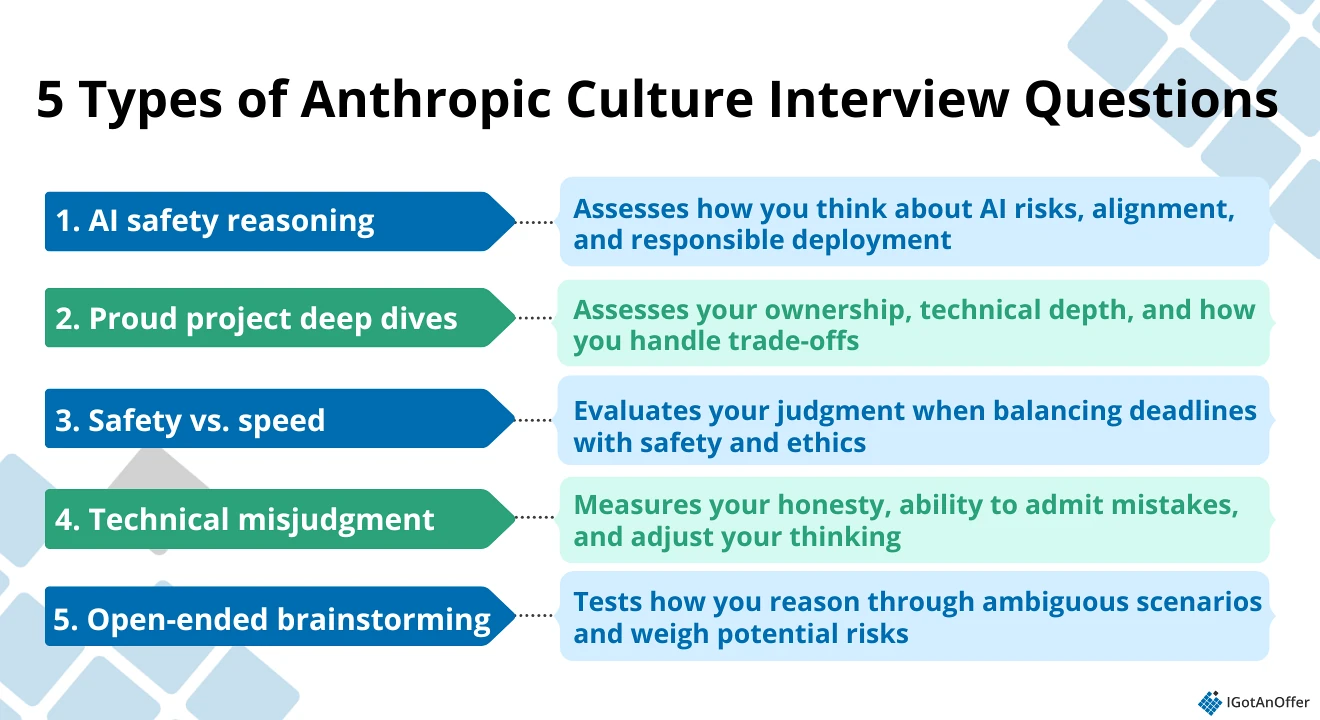
According to Ridhima Khurana (AI interview expert), you can expect the questions to be categorized into five areas. We analyzed real interview questions reported on Glassdoor across roles at Anthropic and categorized them under each:
- AI safety reasoning
- Proud project deep dives
- Safety vs. speed
- Technical misjudgment
- Open-ended brainstorming
Right, let's dive into each one.
3.1 AI safety reasoning ↑
These questions test how you think about the risks and societal impacts of AI. As a Public Benefit Corporation, Anthropic is structured to prioritize the safe and responsible development of AI for the collective good.
Vasu (ex-Amazon Global Head of Product Development), who has coached Anthropic candidates, says the company looks for a “safety-conscious systems architect.” In PM interviews, for example, interviewers want to see if you have the judgment to decide when a model is too risky to ship, even if it’s profitable.
In addition, Amit (ex-Meta Director of Enterprise Product Management), who also works with Anthropic candidates, adds that ideal candidates combine deep user empathy with the judgment to navigate ambiguous situations and evaluate the risks and benefits of new technologies.
Overall, interviewers want to see that you can think critically about how AI systems should be monitored, managed, or restricted to ensure they remain beneficial to humanity.
Example Anthropic culture interview questions: AI safety reasoning
- What are your thoughts on AI safety and the risks of advanced AI systems?
- What do you think could happen if AI weren't monitored or safe?
- What do you see as the most pressing unsolved problem in AI alignment?
- How would you design an experiment to test for a specific emergent capability or bias in a large language model?
- How would you balance performance optimization with model interpretability?
- Explain your interest in AI safety research.
- How would you design an experiment to test for a specific emergent capability or bias in a large language model?
- How would you approach designing a system to ensure the safe deployment of AI models in production?
- How would you collaborate with engineering, policy, and ethics teams to align technical solutions with safety requirements?
3.2 Proud project deep dives ↑
Instead of a high-level summary, expect a granular look at a past project to see how you handle complexity. They are looking for technical depth, a clear understanding of the trade-offs you made, and the values behind your choices.
Example Anthropic culture interview questions: Proud project deep dives
- Walk me through a project you owned end-to-end. What were the key technical decisions?
- Walk me through a project you’re most proud of. What decisions did you make, and what tradeoffs did you navigate?
- Present your past research: hypotheses, methods, results, and limitations.
- What would you explore next if you had more time on your presented research?
- Tell me about recent products you've helped lead. What was the impact?
- What KPIs and data insights did you use for those products?
- What is the most complex AI project you've worked on?
- What is a professional achievement you’re proud of?
- What's something you've done that left you feeling like "holy crap, I did that"?
- Tell me about a time when you raised the bar/set a new standard?
- Discuss complex deals you’ve been a part of.
3.3 Safety vs. speed ↑
This area explores how you handle pressure to hit deadlines without compromising your principles. Interviewers want to see that when you're faced with a choice between “shipping faster” and “ensuring a model is safe,” you have the moral clarity to choose the latter.
Example Anthropic culture interview questions: Safety vs. speed
- Tell me about a time you had to make a difficult decision.
- Tell me about a time when something went against your values, and what did you do?
- How do you operate in a fast-paced, high-intensity work environment?
- What's a non-negotiable for you?
3.4 Technical misjudgment ↑
This is a "low-ego" test in which you discuss a time when your reasoning was flawed. They are looking for intellectual honesty, the ability to take feedback, and how you adjust your thinking after a failure.
Example Anthropic culture interview questions: Technical misjudgment
- Tell me about a technical misjudgment that delayed a project.
- Tell me about a time you failed, and what you learned from it.
- Explain a time when you used data to make a decision or improvement.
- Who do you respect/admire but disagree with their values?
Learn how to answer these types of questions in our guide to answering the “Tell me about a time you failed” interview question.
3.5 Open-ended brainstorming ↑
There is no right or wrong answer for these questions. Interviewers simply want to see how you reason in real time, often through hypothetical scenarios or difficult conversations that require you to weigh benefits against potential harms.
Example Anthropic culture interview questions: Open-ended brainstorming
- What would you do if AI were starting to feel sad?
- How would you make complex AI research findings accessible to audiences without a technical background, such as policymakers or ethicists?
- How would you balance performance optimization with model interpretability?
- If I asked your current team to describe you as a product manager in one word, what would they say?
- What inspires you and what drives you?
4. Example Anthropic culture interview questions (by role) ↑
While culture interviews are standard for all roles, the specific questions are tailored to each position at Anthropic. To help you focus your preparation, we’ve categorized some of the questions from Section 3 according to the roles they’re typically asked for.
Example Anthropic culture interview questions: software engineer
- Talk about a past project you've worked on.
- Walk me through a project you owned end-to-end. What were the key technical decisions?
- Tell me about a technical misjudgment that delayed a project.
Example Anthropic culture interview questions: research engineer
- What do you see as the most pressing unsolved problem in AI alignment?
- How would you design an experiment to test for a specific emergent capability or bias in a large language model?
- How would you balance performance optimisation with model interpretability?
Example Anthropic culture interview questions: research scientist
- Present your past research: hypotheses, methods, results, and limitations
- What would you explore next if you had more time on your presented research?
- How would you make complex AI research findings accessible to audiences without a technical background, such as policymakers or ethicists?
- How would you design an experiment to test for a specific emergent capability or bias in a large language model?
- How would you approach designing a system to ensure the safe deployment of AI models in production?
- How would you collaborate with engineering, policy, and ethics teams to align technical solutions with safety requirements?
Example Anthropic culture interview questions: product manager
- Tell me about recent products you've helped lead.
- What KPIs and data insights did you use for those products?
- If I asked your current team to describe you as a product manager in one word, what would they say?
- Tell me about a time you had to make a difficult decision.
To learn more about the other types of questions you’ll face in each role, check out our Anthropic interview questions guide. It includes tips and sample answers to the six most frequently asked questions in Anthropic interviews.
5. 6 Tips for answering Anthropic culture interview questions ↑
Finally, before we move on to some interview prep resources, we'd like to give you six helpful tips to keep in mind.
5.1 Get used to setting up the situation in 30 seconds or less
Use a timer while you practice to ensure you provide only the necessary information. Spending too much time laying out the situation is one of the most common mistakes candidates make in culture interviews.
5.2 Avoid sounding too scripted
As mentioned in Section 1, using memorized behavioral STAR stories can backfire in culture interviews. Anthropic values intellectual honesty more than a polished performance.
However, without a structure, you might start to ramble, or your answer may become hard to follow. As a compromise, we suggest preparing with a framework, such as IGotAnOffer’s SPSIL framework (Situation, Problem, Solution, Impact, Learning) to cover the essential details.
It’s similar to STAR but fixes two common pitfalls candidates often face: (1) candidates often struggle to clearly distinguish between “task” and “action,” and (2) it includes a “learning” step, which STAR often overlooks, even though it’s one of the most important parts of your answer.
That said, don’t be overly reliant on your script or the framework. Treat it as a guide, and be ready to adapt to open-ended questions, think out loud, and engage with the interviewer.
5.3 Be honest and authentic
One of Anthropic’s core values is honesty. This means communicating transparently about your capabilities and limitations, and being genuine in your responses. If you faced challenges or setbacks in a past work situation, discuss how you learned from them and what you would do differently.
5.4 Challenge the status quo
Avoid the "dream company" trap and the urge to agree with every aspect of the company’s mission. Anthropic looks for critical thinkers who can provide genuine feedback or identify risks in their process and technology (e.g., trade-offs between speed and safety).
Showing a healthy level of skepticism demonstrates that you have the backbone to speak up when ethical concerns arise.
5.5 Discuss your ethical "grey areas"
Appearing “too perfect” can be a red flag in an Anthropic culture interview. They want to hear about an ethical dilemma or even a legal challenge you’ve faced in your previous work.
Interviewers want to hear about a situation that made you genuinely uncomfortable. Be ready to explain the trade-offs involved and who you consulted to work through the decision.
5.6 Adapt to follow-up questions
Don’t be alarmed if your interviewer asks follow-up questions; this is perfectly normal. They’ll probe your stories to confirm that your values are genuine rather than rehearsed.
Listen closely to how they frame each question, as there’s often a subtle clue about the specific skills they’re trying to assess in the next part of your answer.
6. How to prepare for Anthropic’s culture interview ↑
We've coached more than 21,000 candidates for interviews at top tech companies since 2018. Below are four of the most effective things you can do to prepare.
6.1 Learn about Anthropic
Most candidates fail to do this. But, even before investing hours preparing for an interview at Anthropic, you should take some time to make sure it's actually the right company for you.
Anthropic is prestigious, so it's tempting to assume that you should apply without careful consideration. But it's important to remember that the prestige of a job alone won't make you happy in your day-to-day work. It's the type of work and the people you work with that will.
If you know people who work at Anthropic or used to work there, talk to them to understand what the culture is like. The question types we discussed above can give you a sense of what to expect, but there's no replacement for a conversation with an insider.
We would also recommend checking out the following resources:
- Anthropic’s mission and core values (by Anthropic)
- Anthropic’s research
- Anthropic news
- How to collaborate with Claude during the hiring process (by Anthropic)
- How Anthropic maintained an 80% talent retention rate by Nick Lewis, Anthropic’s Head of Global GTM Recruiting
- Inside Anthropic’s Culture Interview by Ridhima Khurana
And given Anthropic’s strong focus on AI safety, it's also important to have a good understanding of the ethics of AI. Here are a few good resources to start with:
- Claude’s Constitution (by Anthropic)
- Building trusted AI in the Enterprise (by Anthropic)
- Anthropic’s responsible scaling policy (by Anthropic)
- UNESCO’s recommendation on the ethics of AI
6.2 Practice by yourself
Anthropic’s culture interview is only one part of the overall hiring process. To prepare effectively, we recommend familiarizing yourself with the full interview process and other question types using the following guides:
- Anthropic interview process
- Anthropic system design interviews
- 30+ common Anthropic interview questions and how to answer them
- How to answer the "Why Anthropic" interview and application question
Applying for a specific role at Anthropic? Take a deep dive with these guides:
- How to get a job at Anthropic
- Anthropic AI safety fellow interview guide
- Anthropic product manager interview guide
- Anthropic engineering manager interview guide
- Anthropic software engineer interview guide
If you're looking into other AI/ML-forward tech companies, we also recommend reading the following company guides:
- OpenAI interview process
- How to get a job at OpenAI
- OpenAI system design interviews
- OpenAI coding interviews
- OpenAI behavioral interviews
- OpenAI product manager interview
- OpenAI SWE interview
- 30+ common OpenAI interview questions + answers (by role)
- How to answer the “Why OpenAI?” interview and application question
- NVIDIA software engineer interview
- NVIDIA PM interview process
Once you have a strong foundation in the material, the next step is practicing under real conditions. But by yourself, you can’t simulate thinking on your feet or the pressure of performing in front of a stranger. Plus, there are no unexpected follow-up questions and no feedback.
That’s why many candidates try to practice with friends or peers.
6.3 Practice with peers
If you have friends or peers who can do mock interviews with you, that's an option worth trying. It’s free, but be warned, you may come up against the following problems:
- It’s hard to know if the feedback you get is accurate
- They’re unlikely to have insider knowledge of interviews at your target company
- On peer platforms, people often waste your time by not showing up
For those reasons, many candidates skip peer mock interviews and go straight to mock interviews with an expert.
6.4 Practice with experienced interviewers
In our experience, practicing real interviews with experts who can give you company-specific feedback makes a huge difference.
Find an Anthropic behavioral interview coach so you can:
- Test yourself under real interview conditions
- Get accurate feedback from a real expert
- Build your confidence
- Get company-specific insights
- Learn how to tell the right stories, better.
- Save time by focusing your preparation
Landing a job at a big tech company often results in a $50,000 per year or more increase in total compensation. In our experience, three or four coaching sessions worth ~$500 make a significant difference in your ability to land the job. That’s an ROI of 100x!
Click here to book mock interviews with experienced tech interviewers.





 Software engineer, Engineering manager