

 Back to other articles
  Last updated: September 08, 2026

 Interviews
 Business analyst
 Deeply researched
In this guide, we're going to cover everything you need to know to prepare for business analyst (BA) interviews at Capital One.
Capital One BA interviews are competitive. Beyond behavioral rounds, you'll face quantitative problems, structured business cases, and a product round across five to seven stages.
To put this guide together, we analyzed 55 Glassdoor interview reports from real Capital One BA candidates and researched the full hiring process.
Below, you'll find a detailed breakdown of the hiring process, real sample questions from all four interview categories, tips on how to perform on the day, and a prep plan built around how the process works.
Here's an overview of everything we'll cover:
Click here to practice 1-on-1 with business analyst interview coaches
1. Capital One business analyst role and salary ↑
Before we get into the interview process, it helps to understand what the Capital One business analyst role actually involves and what the company looks for in candidates.
1.1 What does a Capital One business analyst do?
As a Capital One BA, you'll work closely with product, engineering, and finance teams. You'll translate raw data into actionable recommendations across cards, consumer banking, and commercial banking.
In practice, a Capital One business analyst:
- Pulls and interprets data to support product and strategy decisions
- Builds quantitative models for profitability, break-even, and forecasting to evaluate business cases
- Partners with cross-functional teams to define requirements and measure outcomes
- Communicates findings to non-technical stakeholders in a clear, structured way
- Works on both customer-facing business problems and internal operational challenges
The role places heavy weight on quantitative reasoning. Capital One expects BAs to move fluently between structured business cases and hard numbers. If you're more comfortable with qualitative analysis, expect the interview to test your math.
1.2 How people work at Capital One
In Capital One's culture page, the company describes itself as a tech company that happens to be a bank. Product thinking and decisions grounded in data run through every division rather than just engineering. Additionally, BAs are expected to operate with a high degree of autonomy and to push back when the data doesn't support a decision.
Most roles are based out of McLean, Virginia, with additional positions in Plano, Texas and Richmond, Virginia. Teams operate on a hybrid schedule.
1.3 What Capital One looks for in a business analyst
Based on our analysis of Capital One BA job listings and Glassdoor interview reports, the company consistently screens for four qualities in BA candidates: quantitative fluency, structured thinking, product intuition, and communication clarity.
- Quantitative fluency: running a break-even calculation or building a profit and loss (P&L) model quickly and accurately. This gets tested in the Online Assessment (OA) and again in the Power Day.
- Structured thinking: taking an ambiguous business problem, framing it clearly, and working through it in a logical sequence. The case interview tests this directly.
- Product intuition: evaluating a product, identifying its weaknesses, and proposing improvements. BAs work alongside product teams, so don't underestimate this one. It shows up consistently in Power Day reports.
- Communication clarity: explaining your reasoning clearly, not just arriving at the right answer. Capital One interviewers consistently flag people who get the right answer but can't explain their thinking in plain language.
You’ll need to communicate all four qualities clearly during the interview. Capital One interviewers consistently flag people who get the right answer but can't explain their reasoning in plain language.
Set up the problem, walk through your thinking, and land on a clear recommendation.
1.4 How much does a Capital One business analyst make?
Levels.fyi data reports that Capital One BA total compensation in the United States ranges from roughly $115,000/year at the Associate level to over $204,000/year at the Lead level. Here's a breakdown by level:
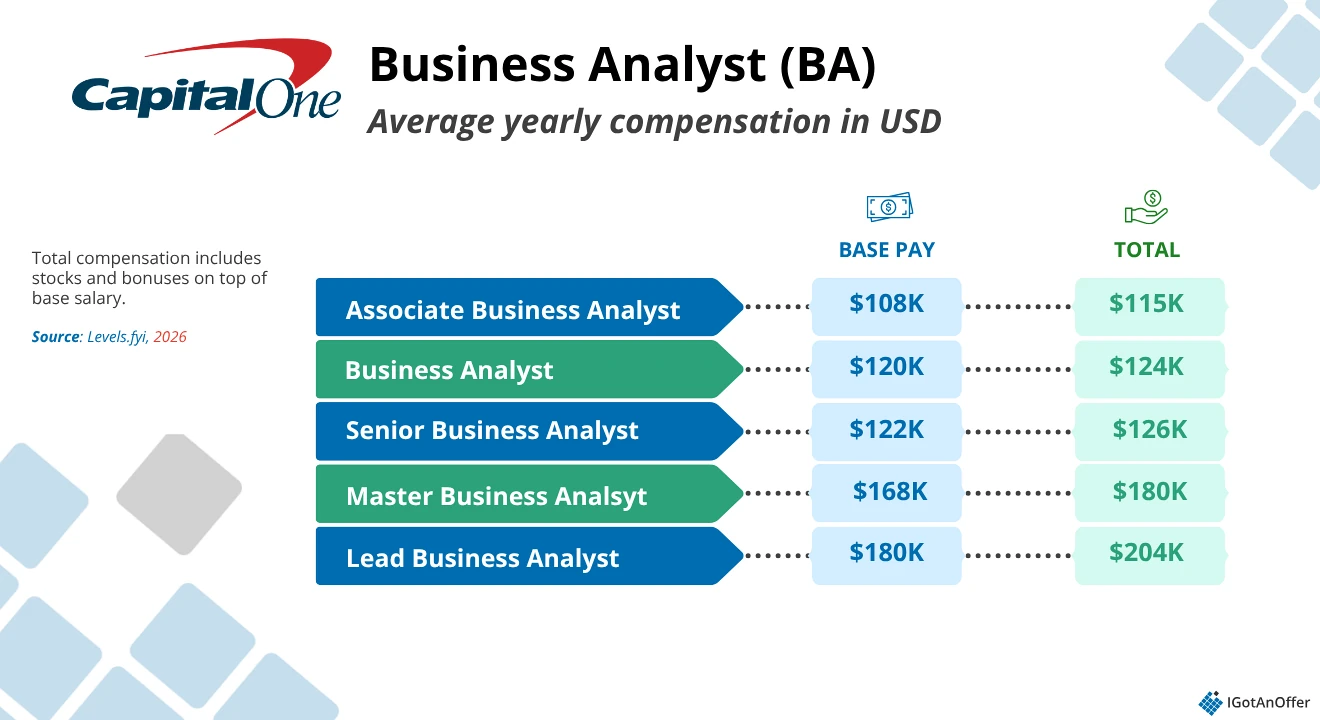
Location also plays a role in where your offer lands. Roles based in the Northern Virginia and Washington, D.C. area tend to sit at the lower end of the total comp range, while positions in major financial hubs typically come in higher.
On top of the pay, Capital One also offers equity as part of its compensation package. Stock vests on a 3-year schedule at 33.3% annually.
Remember, compensation packages are always negotiable at Capital One, so if you receive an offer, don't hesitate to ask for more.
If you need expert guidance with negotiating, consider booking a session with one of our salary negotiation coaches.
2. Capital One business analyst interview process and timeline ↑
This section mainly discusses the interview process for the Capital One Business Analyst role, but it also applies if you're going for a Capital One business analyst internship or an associate business analyst position.
The interview process for Capital One BAs generally takes four to eight weeks to complete. Here's a quick overview of the steps you may face along the way:
- Resume, cover letter, and referrals
- Automated assessment
- Recruiter screen
- Virtual Job Tryout (VJT)
- Hiring manager pre-screen
- Power Day interviews
- Offer and salary negotiation
Step 1: Resume, cover letter, and referrals ↑
Step one is getting the interviews. For that, you'll need a quality resume tailored to both BA positions and Capital One, specifically.
Once you find a role you're interested in and have determined that you meet all Basic Qualifications (BQs), you'll start your application by submitting some basic information. You'll then be prompted to complete your full application in Workday, according to Capital One's career FAQs.
As with most companies, getting an employee or contact at Capital One to refer you to the recruiting team can also be helpful. In our experience, the most straightforward way to do this is to directly contact Capital One employees you share connections with on LinkedIn.
Do note that cover letters are not required for any roles and will not be reviewed as part of your application, according to Capital One's UK-based early career website.
If you're looking for expert feedback, you can also get input from our team of resume coaches, who will cover what achievements to focus on (or ignore), how to get more impact from your bullet points, and more.
Step 2: Automated assessment ↑
The first step of Capital One's interview process is the automated assessment. The purpose of this step is to filter out the initial pool of applicants and evaluate basic competencies relevant to the role, which include communication, leadership, problem-solving, and customer focus.
On average, the online assessment tests take 20 to 45 minutes to complete.
However, it's unclear whether or not this assessment is given to every single applicant. It may depend on the exact role you're applying for, but it wouldn't hurt to be prepared in case it does come up.
If you pass this round, you'll be contacted by a recruiter to review your assessment experience and discuss the next steps.
Step 3: Recruiter screen ↑
The next step is the recruiter screen. This will typically be a brief 30-to-45-minute call during which your recruiter will discuss further details about the company and role. The purpose of this interview is to assess your fit. Expect to be asked behavioral questions during this stage.
This list of common interview questions by Capital One is a good resource to review more example questions for practice.
If you pass this step, you will then move on to the more in-depth portion of the process, which includes longer interviews and, for some roles, a take-home challenge.
If you're unsure about what steps are ahead in the interview process, take this opportunity to ask any clarifying questions about what you can expect. The recruiter will be your point of contact for the rest of the interviews.
Step 4: Virtual test (Virtual Job Tryout) ↑
Depending on your specific BA role, you may be asked to complete an hour-long virtual job tryout. This is not a video interview. It's a written, scenario-based assessment covering the following sections:
- Manage relationships: Make decisions and respond to scenarios you'll commonly encounter in the role.
- Work your business case: Review and integrate information from multiple sources about a fictitious business and offer solutions to help it succeed.
- Tell us your story: Talk about your work experiences and background that have helped shape who you are.
- Describe your approach: Talk about your preferred style and approach to work.
- Quantitative module (BA candidates only): Solve math and analytical problems drawn from business scenarios.
The virtual test may look like a personality quiz, but it carries real weight and can determine whether you advance to the next interview rounds. For a detailed breakdown and prep tips, see our Capital One virtual job tryout guide.
Step 5: Hiring manager pre-screen (behavioral / 1-hour mini case study) ↑
Once you've passed the Virtual Job Tryout, your next step is usually a 30-minute call with the hiring manager or a senior BA. Expect behavioral questions and more probing into your analytical background than during the recruiter call.
Some people also report a light case question here. It won't be a full Power Day case, but a quick gut-check on your business reasoning before you're invited to the final round.
If you want, you can jump straight to the Capital One case interview.
Step 6: Power Day interviews (3-5 interviews) ↑
Power Day is typically the final step in the BA hiring process. In this stage, expect three to five back-to-back virtual interviews. Each round can run up to an hour, with a one-hour break built into the day.
For BA candidates, rounds cover all four question categories: behavioral, case, quantitative, and product questions.
The order varies by interviewer, but every person in our Glassdoor analysis faced at least one quant-heavy round. You’ll also find that the real cases are harder than the practice questions Capital One provides.
However, that's not a reason to skip the prep material. We still highly recommend using it as a baseline for your prep, along with the resources we’ll be sharing throughout this guide.
Step 7: Offer and salary negotiation ↑
If you pass the Power Day, you'll receive your job offer from Capital One. Your recruiter will get in touch with the details, likely scheduling one final call to clarify and discuss the terms. If they haven't scheduled a call, you can ask for one.
We understand that salary discussions can be a bit uncomfortable, especially if you're not used to having them. So here are some tips to help you through salary negotiations.
Salary negotiation tips
- Be polite. Remember that the person you're negotiating with is just doing their job. You'll get much farther in your negotiations if you approach the conversation with grace.
- Don't give a number right away. Whenever possible, it's better to wait until you receive an offer to start negotiating. This reduces the risk of giving a number that is lower than what Capital One otherwise would have paid.
- Do your research. Have a number in mind before the conversation begins, and back it up with data. Research your position and level on Levels.fyi, ask around on professional networking sites like Blind, and factor in the cost of living where you are.
- Start high. Name a compensation number that is higher than your goal. Your Capital One recruiter will likely negotiate it down to something closer to what you actually want.
- Negotiate everything. Your offer includes more than a base salary. You also have bonuses, vacation days, location, and remote work arrangements to consider. If the salary won't budge, there may be wiggle room elsewhere.
Book a session with our salary negotiation coaches to practice what you've learned and maximize your compensation.
Want more detail on each step? Read our Capital One interview process guide.
3. Capital One business analyst example interview questions ↑
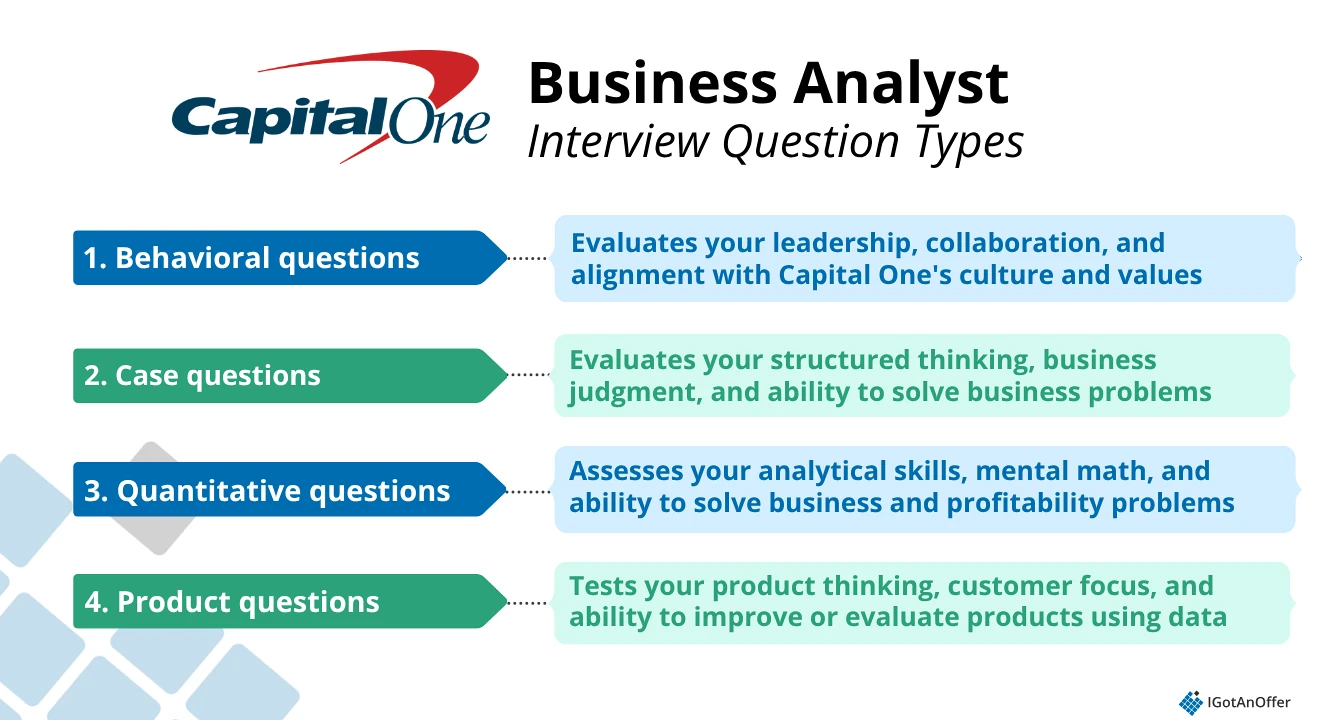
Below, we've compiled real questions from Capital One BA interviews drawn from our analysis of 55 Glassdoor reports (2022–2026). We've organized them into four categories.
3.1 Behavioral questions ↑
You can expect behavioral questions throughout the Capital One BA process, particularly during the recruiter screen, hiring manager pre-screen, and Power Day interviews.
Behavioral questions help interviewers understand how you think and whether your approach aligns with Capital One's culture and values. They focus on past experiences, how you respond to challenges, and how you collaborate with others.
To keep your answers clear and concise, use a repeatable framework for structuring your answers.
The STAR method (Situation, Task, Action, Result) is the most common, but we recommend the IGotAnOffer's SPSIL method (Situation, Problem, Solution, Impact, Lessons). It’s easier to use because there's no overlap between steps, and it prompts you to include lessons learned.
Let's look at some example questions.
Example Capital One business analyst interview questions: Behavioral
- Why do you want to work at Capital One?
- Why this role / why Business Analyst at Capital One?
- Walk me through your resume.
- Tell me about a time you failed. What did you learn?
- Describe a time you overcame a difficult project.
- Tell me about your proudest professional accomplishment.
- Tell me about a time you worked with a difficult teammate.
- Describe a time you managed multiple stakeholders.
- Tell me about a time your work made a measurable impact.
- Tell me something about yourself that isn't on your resume.
- Where would you begin when kicking off a new long-term project?
- How do you set priorities when critical tasks have similar urgency?
- How do you approach high-stress situations?
- What are your strengths and weaknesses?
- What are you looking for in this role?
- What motivates you in the workplace?
- What's something you can translate from school to Capital One?
- Name a time when you went out of your way to help someone with no direct benefit to yourself.
- Describe a time you had to make a difficult choice in a leadership role.
- Tell me about a time you made a mistake.
For a full breakdown of how to answer each of these, including example answers, see our Capital One Behavioral Interview guide.
3.2 Case questions ↑
Case questions give you a business problem and ask you to work through it. The goal is to show your thinking and decision-making process, not just arrive at an answer.
These questions require structured frameworks, analytical reasoning, and a clear final recommendation. Getting to a number is not enough. You have to explain what it means and what the business should do about it.
There are also questions where the answer is an exact number. Examples of those are in Section 3.3.
Example Capital One business analyst interview questions: Case
- What factors are driving (or hurting) this company's profitability, and what would you recommend?
- What are the risks if the company implements this strategy?
- Given Plans A, B, and C, which would you recommend and why?
- How would you evaluate whether Capital One should partner with a new type of business?
- A sports arena wants to increase revenue and reduce costs. Lay out a framework and walk through your analysis.
- A grocery app offers multiple loyalty programs. Analyze each and make a recommendation.
- You're a PM at Capital One launching a new credit card. Walk me through how you'd evaluate its profitability.
- Compare two membership plans (seasonal discount vs. new-member bonus). Which should the company implement?
- How would you grow this company's revenue beyond its current streams?
For sample case structures and worked examples, see our Capital One Case Interview guide.
3.3 Quantitative questions ↑
Quantitative questions appear both in the VJT and again during the Power Day. They may be presented as standalone word problems or embedded within a case interview as a follow-up question.
You'll be given a business scenario and asked to calculate metrics such as profit, break-even points, growth rates, or contribution margins. The goal is to identify the right calculation and arrive at the correct answer.
Capital One does allow basic calculators when appropriate. But you still want to be comfortable with quick mental math and estimation.
Example Capital One business analyst interview questions: Quantitative
- Analyze the profitability of a company given the revenue, cost, and volume parameters provided.
- Calculate the break-even point for a given business scenario.
- Calculate profit, revenue, or loss based on the data provided.
- Calculate the contribution margin or profit margin for the scenario.
- A company wants to add a new product line. How long will it take to break even?
- Georgia drinks 3 coffees/day at $1.25 each. A home setup costs $230 upfront, plus $70 per 100 cups. After how many bags does she save money?
- Ali and Sophie played 4 shows with 900 total tickets. Given fan repeat-visit percentages, how many unique fans attended?
- An entertainment company targets $19,000/month net income. Given the cost structure, what sales volume is required?
- Calculate the percent growth required in a product to reach break-even.
- Based on the data, calculate the maximum profit for Company A and Company B.
- You're running a software service and want to add a SaaS product. How long to break even given the hypothetical inputs?
To improve your mental math, check out our case interview math guide. Then, refresh your knowledge of common finance concepts with our case interview finance concepts guide.
3.4 Product questions ↑
Capital One BAs work alongside product teams, so a baseline of product thinking is expected even though this isn't a PM role. These questions aim to assess your product sense. Interviewers want to see how you evaluate a product, identify what's not working, and propose data-driven improvements.
Remember, while you don't need a product manager's depth, vague answers like "improve the user experience" won't land.
To help you prepare, we've grouped the questions below into the three most common types you'll encounter: product improvement, product design, and product strategy questions.
3.4.1 Product improvement questions
Interviewers may ask you to improve an existing product. The most common format in Capital One BA interviews is picking a digital product you use daily and naming specific improvements.
The key thing interviewers are testing is whether you can identify real user pain points and prioritize solutions. So you are not just going to generate a list of features.
Example Capital One business analyst interview questions: Product improvement
- Pick a digital product you use every day and name 6 ways you would improve it.
- Describe a digital product's business model and explain how you would improve it.
- What's your favorite product and why?
- If you could add 5 features to your product, what would they be?
- What are the direct and indirect competitors of this product?
3.4.2 Product design questions
Here, interviewers ask you to design something from scratch, often an everyday object rather than a digital product. They use this format to test creative ideation under constraints. Note that the object changes by interviewer, so practice across a few different types.
Example Capital One business analyst interview questions: Product design
- Name 10 ways to improve or redesign an everyday object (e.g., umbrella, lunchbox, trash can, alarm clock).
- Design a product for a specific use case (e.g., design an alarm clock for a new market).
3.4.3 Product strategy questions
These questions sit at the business model level. You'll be asked to evaluate a strategic decision, propose a revenue model, or assess market opportunities. Your answers here need a clear commercial rationale and not just feature ideas.
Example Capital One business analyst interview questions: Product strategy
- How would you propose new revenue streams for a digital platform?
- A video game company is considering an online streaming option vs. its traditional model. Evaluate the decision.
For answer frameworks across all three product question types, see our product sense guide, product improvement guide, product design guide, and product strategy guide.
4. Capital One business analyst interviewing tips ↑
You might be a strong BA candidate, but that's not always enough to ace the interviews at Capital One. After all, interviewing is its own skill. Here are some tips to help you approach each round.
4.1 Ask clarifying questions
Some questions will be deliberately ambiguous. In those cases, ask for more information before you start working through the problem. Jumping straight in without clarifying the scope is a red flag to the interviewer.
Be smart about which questions you ask. The questions you choose to ask signal how you think about a problem before you've started solving it.
If you were asked, "What would be your strategy to double revenue?", ask about the time horizon and which business lines are in scope before you respond.
4.2 Check in with your interviewer
Interviewers differ in how much they'll guide you. Some will offer hints or additional data if you ask, while others expect you to make reasonable assumptions and push forward independently.
Gauge this early by asking a direct question. If your interviewer engages with specifics, keep asking when it helps. If not, then state your assumptions clearly and move on. That ability to make decisions under uncertainty is part of what the interview is testing.
4.3 Justify your choices
Capital One wants to see the reasoning behind your answer. In quantitative and case rounds, you'll make trade-offs as you work toward a recommendation, so call them out as you go.
Interviewers are not grading you solely on your perfect math (though it does matter at Capital One). They want to hear how you think. Clear, logical thinking at every step matters more than precision.
4.4 Keep your answers concise
Your interviews run within a time limit. To ensure you're spending just enough time to provide only the necessary information, use a timer while you practice.
For behavioral rounds, prepare a small bank of stories that cover the most question types and correspond to Capital One's values. That way, you're drawing from a ready set of examples rather than constructing answers on the spot.
4.5 Demonstrate a data-driven approach
Capital One built its competitive advantage on data. That means interviewers are specifically looking for people who default to quantifying their claims and grounding recommendations in numbers.
In an interview, you won't always have access to real data. That's fine. What matters is making it clear that you'd seek out that data before making a decision, and that your working assumptions are reasonable and explicit.
4.6 Center on Capital One's core values
Before your interviews, go through Capital One's culture page. Then, when answering behavioral questions, connect your stories to what Capital One actually values.
The same applies in case and product rounds. Factor in how your recommendation aligns with how the company thinks about customer impact and data.
4.7 Treat the interview like a conversation
The interview runs in both directions. While the interviewer assesses your fit for Capital One, you're also evaluating whether the role and team match what you're looking for.
Come prepared with thoughtful questions that go beyond what you could find on the careers page. Ask about the team's current priorities, how success is measured in the BA role, or specific ways of working in the organization.
4.8 Be comfortable performing quick mental math
As mentioned in Section 3.3, only basic calculators are allowed in Capital One BA interviews. You won't be expected to perform complex modeling, but many quantitative questions involve quick estimation, percentages, ratios, or rough calculations.
If you're out of practice, regularly exercise your mental math muscle to become as fast and accurate as possible. Khan Academy has several helpful resources for refreshing your arithmetic skills. Here are a few we recommend:
Here are a few more resources you can use for math drills. We haven't tested all of them, but some of the candidates we work with have used them in the past and found them helpful.
- Preplounge's math tool. This web tool is very helpful to practice additions, subtractions, multiplications, divisions, and percentages. You can both sharpen your precise and estimation math with it.
- Mental math cards challenge app (iOS). This mobile app lets you work on your mental math easily on your phone. Don't let the old-school graphics deter you from using it. The app itself is actually very good.
- Mental math games (Android). If you're an Android user, this one is a good substitute for the mental math cards challenge one on iOS.
5. How to prepare for your Capital One business analyst interview ↑
Now that you know what questions to expect, let's focus on preparation.
Below, you'll find links to free resources and four introductory steps to help you prepare for your Capital One business analyst interviews.
5.1 Research Capital One's business, products, and culture
As you've probably figured out from the example questions listed above, you can't perform well in the case and product rounds without being familiar with Capital One's products and organization. You'll therefore need to do some homework before your interviews.
Here are some resources to help you get started:
- Capital One Careers: Culture page
- Capital One Careers: How we work
- Capital One Careers Blog
- Capital One About page
- Capital One culture video (YouTube)
- Capital One Careers FAQ
5.2 Learn a consistent method for each question type
As we mentioned in section 3, Capital One will ask you questions that fall into certain categories: behavioral, case, quantitative, and product questions. Approaching each question with a predefined method will enable you to build strong interview habits.
Then, when it comes time for your interviews, these habits will reduce your stress and help you to make a great impression.
If you're just looking for a jumping-off point, you can start learning about the different question types you'll need to master in the following guides:
General/Behavioral
- Capital One interview process
- Capital One Virtual Job Tryout guide
- Capital One Behavioral Interview guide
- 40+ Most Common Behavioral Interview Questions
Skills-based
Quantitative round
Case round
- Capital One Case Interview guide
- Finance concepts for case interviews
- Capital One case interview PDF (TBS Education)
- Capital One: How we interview for strategy roles
- Capital One practice case study guide (PDF)
- Capital One Case Playbook (PDF)
- Capital One case interview walkthrough (YouTube)
Product round
- Product sense interviews
- Product design questions
- Product improvement questions
- Product strategy questions
If you're interviewing at other companies, our other business analyst guides may help too:
Once you're in command of the different subject matters, you'll want to practice answering questions.
You can start practicing alone, asking and answering questions out loud, to help you get a feel for the different types of interview questions. It will help you perfect your step-by-step approach for each question type and give you time to correct your early mistakes.
But by yourself, you can't simulate thinking on your feet or the pressure of performing in front of a stranger. Plus, there are no unexpected follow-up questions and no feedback.
That's why many candidates try to practice with friends or peers.
5.3 Practice by yourself or with peers
If you have friends or peers who can do mock interviews with you, that's an option worth trying. It's free, but be warned, you may come up against the following problems:
- It's hard to know if the feedback you get is accurate
- They're unlikely to have insider knowledge of interviews at your target company
- On peer platforms, people often waste your time by not showing up
For those reasons, many candidates skip peer mock interviews and go straight to mock interviews with an expert.
5.4 Practice with experienced interviewers
In our experience, practicing real interviews with experts who can give you company-specific feedback makes a huge difference.
Find a Capital One business analyst interview coach, so you can:
- Test yourself under real interview conditions
- Get accurate feedback from a real expert
- Build your confidence
- Get company-specific insights
- Learn how to tell the right stories better
- Save time by focusing your preparation
Landing a job at a top company often results in a $50,000 per year or more increase in total compensation. In our experience, three or four coaching sessions worth ~$500 make a significant difference in your ability to land the job. That's an ROI of 100x!
Click here to book mock interviews with experienced business analyst interviewers.

 Case
Case