

 Back to other articles

 Last updated: July 14, 2026

 Interviews
 Product manager
 Deeply researched
In this guide, we're going to cover everything you need to prepare for product manager interviews at Databricks.
Databricks product manager interviews lean heavily on behavioral deep dives, with interviewers digging into why you made each decision and what trade-offs you weighed.
And because Databricks PMs build for technical users like data engineers, data scientists, and developers, you need enough technical fluency to reason about the platform, its users, and its market to stand out.
Thankfully, the right preparation makes all the difference. To put together this guide, we've analyzed interview reports from real Databricks PM candidates on Glassdoor and Blind, and researched the interview process using the company's official hiring resources.
Below, you'll find a detailed breakdown of the company's hiring process, some real sample interview questions, and essential prep resources that maximize your chances of success.
Click here to practice 1-to-1 with PM ex-interviewers
Let's get started.
1. Databricks product manager role and salary ↑
Before getting into the interview itself, let's take a quick look at the role and what you can expect to earn. Feel free to skip ahead to the interview process if you'd prefer.
1.1 What does a Databricks product manager do?
Databricks builds the Data Intelligence Platform, a unified environment that companies use to manage data and build analytics, machine learning, and AI applications. The company was founded in 2013 by the original creators of Apache Spark, and it maintains widely used open-source projects including Delta Lake and MLflow.
More than 20,000 organizations, including over 60% of the Fortune 500, rely on Databricks, according to the company's own figures.
As a Databricks PM, your users are mostly technical: data engineers building pipelines, data scientists training models, analysts querying data, and developers building AI apps and agents. Depending on your team, you might work on products like:
- Databricks SQL, the platform's data warehousing product
- Unity Catalog, its data governance layer
- Lakeflow, for data engineering pipelines
- Lakebase, its database for AI applications
- Genie and Agent Bricks, its conversational AI and agent products
This means working closely with engineering on architecture trade-offs and spending time with enterprise customers to understand their data workloads. You'll also make prioritization calls in a market that is shifting fast toward AI agents and applications.
You'll also work in a fast-moving company. Databricks reported a $5.4 billion revenue run rate in early 2026, growing more than 65% year over year, and it competes with companies like Snowflake and the major cloud providers.
1.2 What does Databricks look for in a product manager?
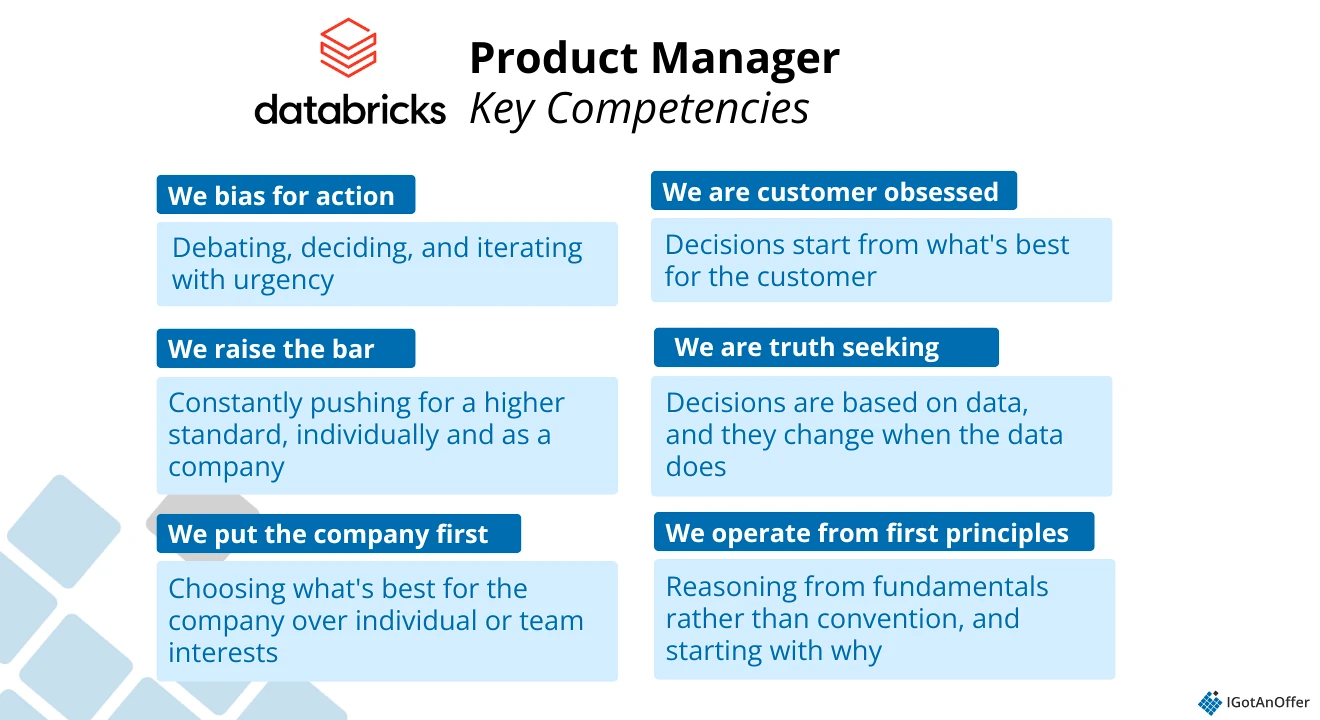
Databricks doesn't publish PM competencies, but it does publish the six culture principles it hires and operates by:
- We are customer obsessed: decisions start from what's best for the customer
- We raise the bar: constantly pushing for a higher standard, individually and as a company
- We are truth seeking: decisions are based on data, and they change when the data does
- We operate from first principles: reasoning from fundamentals rather than convention, and starting with why
- We bias for action: debating, deciding, and iterating with urgency
- We put the company first: choosing what's best for the company over individual or team interests
These principles show up directly in the interviews. When interviewers dig into your past projects, they're checking whether your decisions were grounded in data and clear reasoning (first principles), and whether you actually did what you say you did (truth seeking).
As you'll see in section 3, that's what the deep dive questions are for.
1.3 Databricks product manager salary
Databricks pays its PMs on par with the big tech companies. The figures below show the approximate total compensation by level, based on data reported on Levels.fyi.
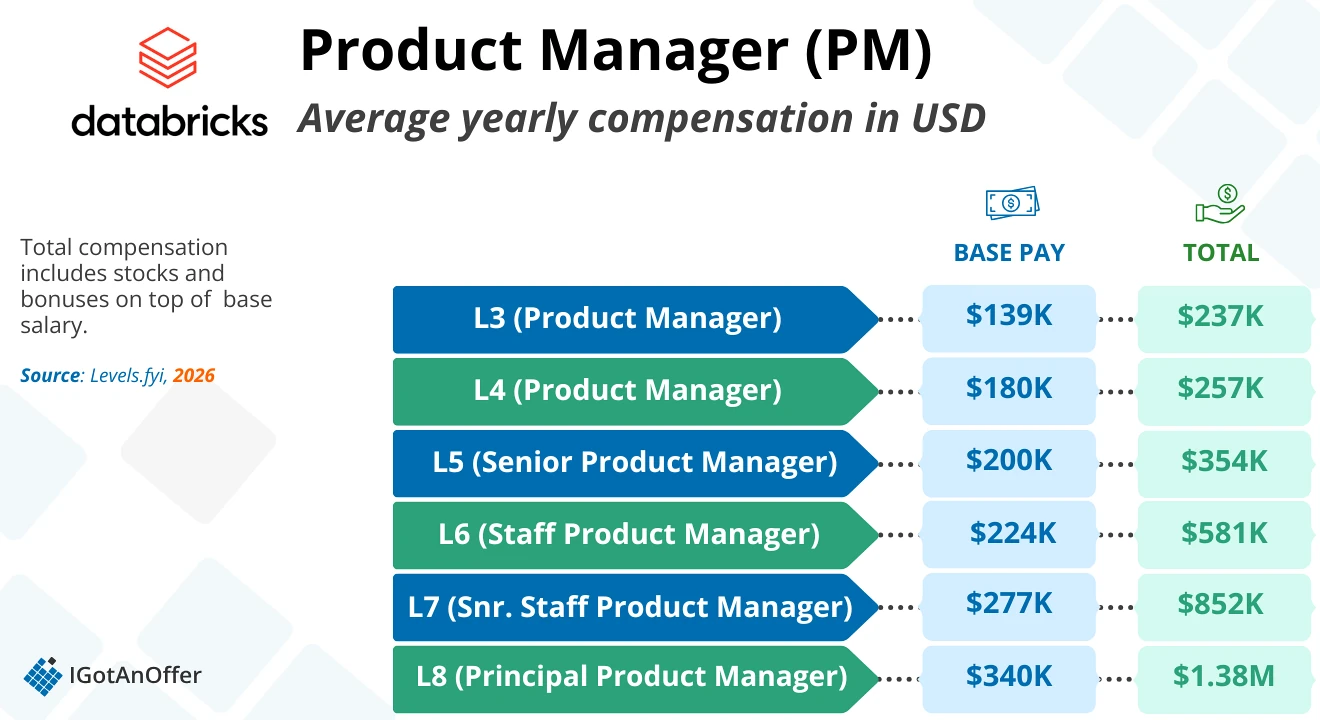
One thing to keep in mind: Databricks is still a private company, so equity comes as private company stock rather than publicly traded shares.
The company raised funding at a $134 billion valuation in its most recent round and has provided liquidity to employees through past rounds. Ask your recruiter how equity and liquidity work for your offer.
Ultimately, how you do in your interviews will determine what level you're offered. And remember, compensation packages are always negotiable. So, if you do get an offer, don't be afraid to ask for more.
Get tips from our PM salary negotiation guide, and practice what you've learned with one of our salary negotiation experts.
Coaches who contributed to this guide







2. Databricks product manager interview process and timeline ↑
2.1 What interviews to expect
The interview process for Databricks product managers typically takes five to six weeks from application to offer, depending on scheduling, the number of interview rounds, and your level.
While timelines can vary, most candidates go through a structured set of steps designed to assess both product sense and cross-functional collaboration skills.
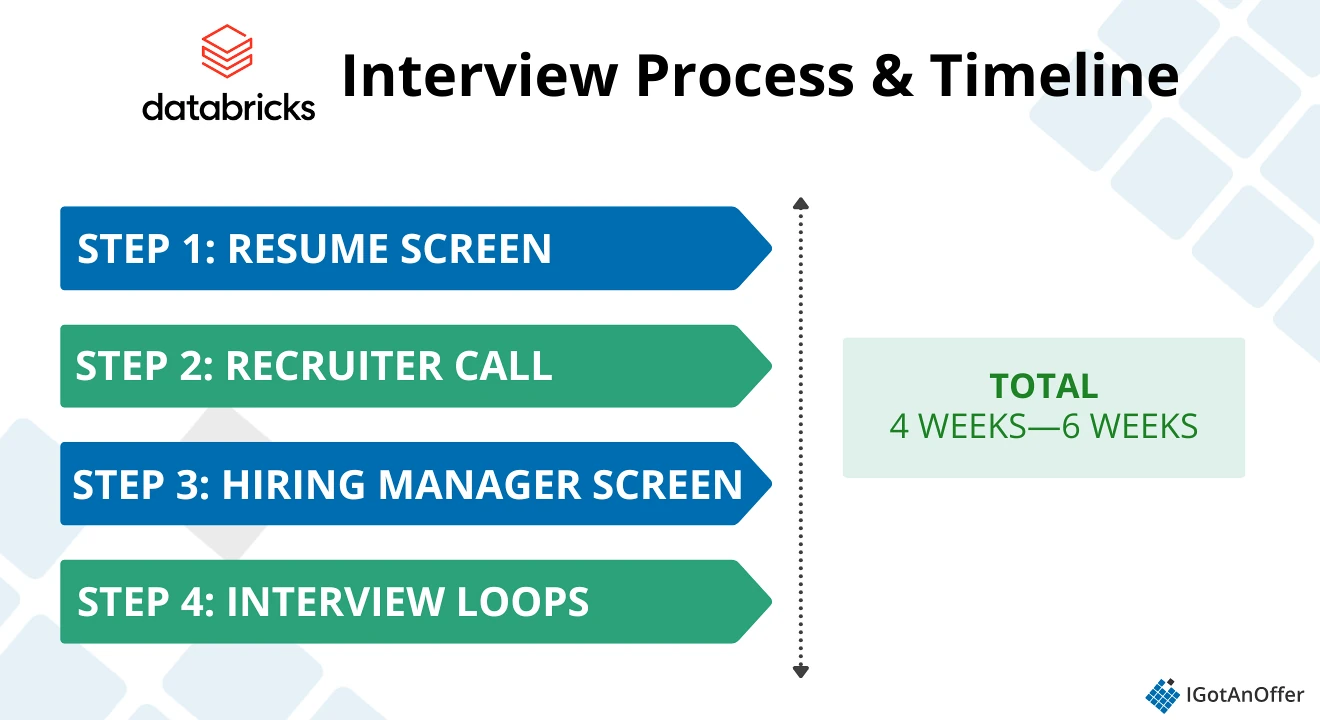
Here's what the process looks like at each stage:
Let's look more closely at each step of the PM process.
If you're interviewing for a group PM, director, or VP position, check out our product leader interview guide. For senior PM roles, see our senior product manager interview questions guide.
2.1.1 Resume screen ↑
After you apply through Databricks' careers page or are contacted directly, recruiters review your resume to decide whether to move you forward.
This stage filters out most applicants. Roughly 90% don't make it through, which means the resume screen is often more consequential than candidates expect.
Databricks PM postings tend to emphasize experience with technical or platform products. To give yourself a shot, make sure your resume demonstrates:
- Clear product impact backed by numbers
- Experience with data, infrastructure, developer tools, or AI products
- Enough technical depth to work credibly with engineering teams
- Experience with enterprise customers, where possible
If you can get a referral from a current employee, use it. Referrals typically improve your chances of getting past the resume screen.
If you're currently polishing your resume or writing one, read our product manager resume guide. It includes examples from real PMs plus a template to help you get started.
You can also work with one of our resume review coaches if you want some feedback from former FAANG and AI lab recruiters.
2.1.2 Recruiter call ↑
If your resume makes the cut, you'll be invited to a 30-minute call with a recruiter. This is a screening conversation covering your background, motivations, and fit for the role.
Expect questions like:
- Tell me about yourself
- Walk me through your resume
- Why Databricks? (Sample answer)
The recruiter will also explain how the rest of the process works, confirm logistics, and share prep materials. According to the company's interview prep page, Databricks conducts interviews virtually over Google Meet unless your recruiter says otherwise. This is also good time to ask a few clarifying questions. In particular, you can clarify the level you're being considered for and what to expect from each upcoming interview round.
2.1.3 Hiring manager screen ↑
Next, you'll typically speak with the hiring manager for the role. This round usually focuses on your product background and how you think.
Expect the interviewer to pick one or two projects from your resume and probe you on why you made specific decisions, what trade-offs you weighed, and what the outcomes were.
The hiring manager conversation is usually friendly and collaborative. They’re genuinely interested in your work, even if they sometimes seem rushed or distracted.
If you pass this stage, you'll move on to the main interview loop, which is typically scheduled within one to two weeks.
2.1.4 Interview loop ↑
The interview loop for Databricks PMs typically consists of 3 to 4 virtual interviews, each lasting about 45 minutes. Your interviewers may include PM peers, engineering counterparts, and cross-functional partners.
The loop generally covers:
- Behavioral and project deep dives (the core of the loop)
- Product sense and strategy (particularly around products for technical users)
- Case study or product requirements document (PRD) review (if you were assigned one, you may present or discuss it)
- Light technical discussion (how data platforms and AI products work, not engineering-level depth)
Depending on the team and role, you may also receive a take-home assignment before or during the interview loop. Check with your recruiter whether you'll be expected to complete one.
At more senior levels, candidates may also go through a panel interview or a final presentation, sometimes based on the take-home assignment.
If you get this step, be ready to structure your narrative, defend your recommendations with data, and respond to questions that challenge your assumptions.
If all goes well, the onsite interviews are your last step as a candidate, and from there, you just have to wait to (hopefully) receive your offer.
3. Databricks product manager example interview questions ↑
There are relatively few Databricks PM questions, so we've listed the verified ones below and supplemented each category with practice questions from other top companies, including, Google, Amazon, Netflix, DoorDash, OpenAI, and AirBnb.
To help you structure your preparation, we've organized them into four categories:
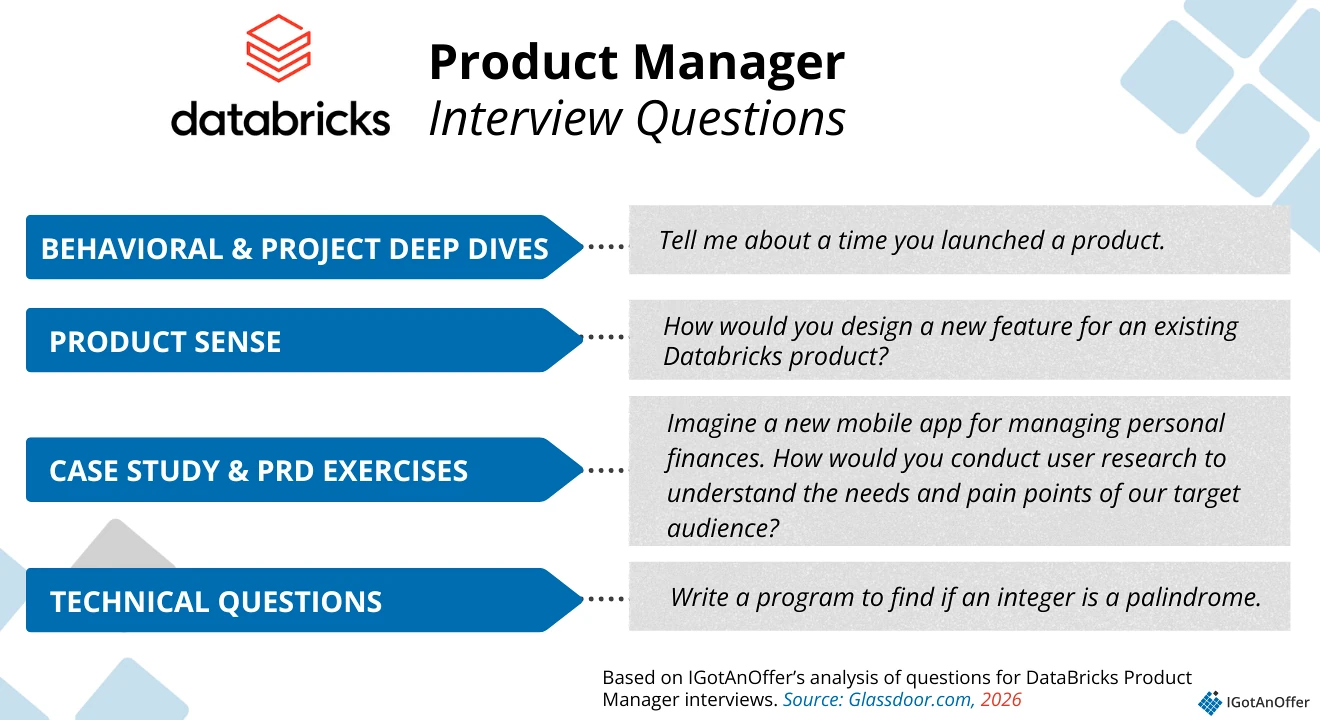
- Behavioral and project deep dives: questions about your past experience, with heavy follow-up on the decisions you made
- Product sense: open-ended questions about what to build and why, with a lens on products for technical users
- Case study and product requirements document (PRD) exercises: a take-home assignment that simulates real Databricks PM work
- Technical questions: light questions on how data platforms and AI products work
Let's look at each category.
3.1 Behavioral and project deep dive questions ↑
Tech companies use behavioral interviews to assess candidates based on their past experiences. Questions typically start with "Tell me about a time you..." and focus on soft skills like leadership, communication, influence, and decision-making.
What makes Databricks' behavioral rounds unusual is the depth of the follow-up questions. Interviewers typically start with your background, pick a project, and then dig into details around why you chose one direction over another, how you weighed trade-offs, and what impact your decisions had.
This interview style requires you to demonstrate genuine ownership of your work. You need to know your projects at the level of detail of someone who made the decisions, because follow-up questions will quickly expose any gaps.
Databricks PM interview example questions: behavioral and project deep dive
- Tell me about a time you launched a product.
- Tell me about yourself.
- Why did you make [a specific decision in your project], and what trade-offs did you consider?
- Have you ever made a mistake while leading a big project before? How did you rectify it, and what did you learn from the experience?
- Tell me why you are leaving your current company. (Stripe)
- What is your biggest strength as a Product Manager? (Stripe)
- Describe a project you managed from start to finish. (Google)
- How do you resolve conflicting product requirements? (Google)
- Tell me about a time when you tried to convince your manager of a product direction and were unsuccessful. (Amazon)
- Tell me about a time when you took a calculated risk and what the outcome was. (Amazon)
The best way to approach behavioral interviews is to keep your stories structured and concise. We recommend using the STAR method or IGotAnOffer’s SPSIL method (Situation, Problem, Solution, Impact, Lessons) to structure your answers.
Learn why we think SPSIL is better than STAR in our article on the STAR method for PM Interviews (why it’s NOT the best).
If you need more practice, check out our guide on PM behavioral interview questions, which includes sample answers to the top 8 most commonly asked.
3.2 Product questions ↑
Databricks asks product questions to assess your product sense and user-centricity. Product sense is your ability to understand what users truly need, translate those needs into focused product decisions, and weigh them against what the business wants and what's possible to build.
Aside from knowing what to build, you should understand why it matters and how it moves the product forward. At Databricks, this also reflects your ability to reason from first principles (one of Databricks' six culture principles), prioritize high-leverage opportunities, and make confident decisions in ambiguous situations.
Picking from Halim’s (Stripe product lead, ex-Meta) brain, one common mistake PM candidates make is proposing surface-level features without understanding the underlying systems, incentives, and technical architecture. His advice is to "Always start by mapping the ecosystem before proposing solutions."
That advice is especially important at Databricks, where every product sits inside a platform your users build on top of.
To ease your practice for product questions, we've separated them into three sub-categories:
- Product design: how you approach creating a new product or feature from scratch. This tests your user-centric thinking, clarity of problem definition, and ability to design simple, high-impact solutions for technical users.
- Product improvement: how you analyze an existing product, identify meaningful gaps, and propose focused, high-leverage enhancements. This reveals whether you can prioritize what truly moves the needle for users and for Databricks as a business.
- Product strategy: how you think about long-term direction, competitive positioning, trade-offs, and metrics. This assesses whether you can set a vision, make sound strategic decisions, and tie product choices to Databricks' broader goals, including how it competes with Snowflake and the cloud providers.
These three skills matter in any product manager, but especially at Databricks, a company that reasons from first principles and moves fast in a market shifting toward AI agents and applications.
Below, you'll find example interview questions for each product sub-category.
Databricks PM interview example questions: product sense
Product design
- How would you design a new feature for an existing Databricks product?
- Design an alarm clock.
- How would you design a notification system for a mobile app? (Google)
- How would you design Uber's ride-matching system? (Uber)
- How would you design the API for a payments product? (Stripe)
Product improvement
- Describe a product you like. How would you improve it? (Sample answer)
- How would you improve Databricks' own product?
- Choose a phone app that you use daily and identify 3 features you would improve or build from scratch (Google)
- How would you improve Facebook? (Meta)
- How would you improve AirBnb? (AirBnB)
- How would you improve Netflix? (Netflix)
- How would you improve Reddit? (Reddit)
Product strategy
- Imagine you're a PM at a startup that works with big data from the NFL. What's the first product you would ship?
- Imagine you’re the CEO of Apple, what product would you eliminate from the lineup? (Apple) [TIP: don't say iCloud]
- What new products do you think Databricks should launch? (DoorDash)
- How would you monetize a product more effectively? (Google)
- Pretend Google wants to acquire iRobot. What do you look for, and how would you position yourself? (Google)
- How would you pitch to Microsoft's CEO that they should purchase LinkedIn? (LinkedIn)
- How would you run a promotion to increase top-line, in-store revenues at Databricks? (DoorDash)
- How would you increase Databricks’ revenue by decreasing prices? (DoorDash)
If you'd like to learn more about answering this kind of question, then check out our separate guides on product sense, product design, product improvement, and product strategy interview questions.
3.3 Case study and PRD exercises ↑
The take-home assignment simulates real PM work. Depending on the role, candidates are asked to complete a product case study or draft a PRD, and in some cases present their work to a panel.
Whatever the format, interviewers are looking at how you frame the problem, who you identify as the user, how you prioritize, and how you define success. Keep your document or presentation structured and concise.
If you're asked to present your work, expect the interviewer to challenge your assumptions. When they push back on an assumption, don't defend reflexively. Acknowledging a good counterpoint and adjusting your recommendation shows the kind of first principles thinking Databricks looks for.
Databricks PM interview example questions: case study
- Imagine a new mobile app for managing personal finances. How would you conduct user research to understand the needs and pain points of our target audience? (Capital One)
- A major US non-profit health insurer is known for its service quality, but it has begun to fall behind in operational performance. The leadership team wants to identify gaps in customer and member engagement, especially in digital self-service. How would you assess the current customer operations and recommend changes to improve service delivery and operational efficiency? (PwC)
- A leading oil field services and equipment company’s financial performance was lagging behind its peers, and the company had committed to a 3% improvement in North American net margin. Management believed there was an opportunity to improve the effectiveness of their >$1B equipment maintenance spend, but was unclear on where and how to achieve savings. How can the company improve the efficiency of its maintenance operations to meet its margin target? (PwC)
- You’re given a file with 25,000 rows of raw data. Using our Open API error codes, evaluate the trends causing order errors and suggest possible solutions for the vendor. (BizOps)
To answer product design case questions, we recommend the BUS framework, a simple three-step approach for structuring your answers:
- Business objective
- User problems
- Solutions
The BUS framework keeps your answer anchored to the business goal and the user's real problems before you jump to solutions, which is exactly the trap Databricks interviewers watch for. It also gives you a clear structure to lean on without making you sound robotic.
You can learn more about the BUS framework and how to apply it in our guide on how to answer product design questions.
3.4 Technical questions ↑
Databricks PM interviews don't appear to be heavily technical, based on the limited reports available. You won't be asked to code. However, given that Databricks products serve technical users, you should be able to hold a credible conversation about how the platform works.
At a minimum, be ready to explain:
- What a data lakehouse is and how it differs from a data warehouse
- What Apache Spark and Delta Lake do at a high level
- How customers use Databricks to build AI applications
If you are asked technical questions, the most important thing to remember is to answer them like a PM. This means, aside from scoping the problem intelligently and reasoning through trade-offs and risks, you should always connect your technical decisions to product goals.
You’ll also need to show how well you can communicate technical concepts to non-technical stakeholders.
Your recruiter should advise you on what type of technical questions to expect. Usually, they’ll be team-dependent. If they don’t, be sure to ask.
As of writing, real examples of technical questions asked in Databricks PM interviews are not as widely reported as those from Meta or Google. So to help you prepare, we’ve gathered real sample questions asked at Google, Meta, Apple, and Amazon.
Databricks PM interview example questions: technical questions
- What’s your understanding of the RAG (Retrieval-Augmented Generation) framework? (Google)
- Write a program to find if an integer is a palindrome. (Solution) (Google)
- Write a program to select two numbers whose sum is lower than a target number. (Solution) (Google)
- Use a whiteboard to teach me something, work-related or otherwise. (Apple)
- Walk me through the components needed to build a data processing and reporting system. (Apple)
- What is the difference between a router and a switch? (Amazon)
- What is the computational complexity of hash tables? (Amazon)
- Tell me about the architecture design and technical details for that project. (Meta)
- Tell me about how you managed technical dependencies and tradeoffs for that project. (Meta)
If you're interviewing for a more technical PM role, expect deeper questions on data workflows and architecture trade-offs. You’ll find more practice questions in our guide to technical product manager interview questions.
4. Databricks product manager interview tips ↑
We've pulled together insights from candidate reports and Databricks' own published materials for some specific tips to help you pass your product manager interviews.
Here's how to approach your Databricks PM interviews:
4.1 Ask clarifying questions
Some of the questions you will be asked will be quite ambiguous. In those cases, you’ll need to ask clarifying questions to get more information about the problem and to reduce its scope.
Jumping straight in without asking questions first will be a red flag to the interviewer and will hinder your answer.
For instance, if you were asked, “What would be your 10-year strategy if you were CEO?” you can respond by asking some questions about the company’s current situation and any business objectives the interviewer may have in mind.
This way, you’ll have a better understanding of what the company needs in the coming years and have more information from which to build a strategy.
4.2 Justify your choices
Databricks wants to see the reasoning behind your answer, so make sure to justify each decision you make. You'll need to make plenty of trade-offs as you arrive at a solution, so be sure to call them out.
"The interviewer isn't that interested in the final number you get to. You're being judged on the process you use and the ability to explain your thinking," says Akshat (ex-FAANG PM).
4.3 Sharpen your product fundamentals
Databricks will still test you on core PM skills. Make sure you can:
- Lead a product discussion with a clear framework, without being robotic about it
- Define success metrics for technical products and defend your choices
- Write a structured, concise PRD under time pressure
- Tell 4 to 6 behavioral stories that cover launches, trade-offs, cross-functional work, and ownership
Our PM interview questions guide covers frameworks for each of these.
4.4 Communicate like a collaborator
Top companies like Databricks want product managers who are excellent collaborators and can influence without authority. Show you can keep stakeholders aligned, explain trade-offs simply, and build trust across engineering and product teams.
"You need to understand how the big blocks work together. You don't need to know how to code, but you do need to know how things kind of work and be able to communicate about them," says Mark (Senior FAANG PM).
4.5 Be data-driven and precise
Databricks is looking for product managers who can make decisions based on data and can judge everything they do by relevant metrics.
In an interview situation, it's okay to make assumptions because you might not have access to the facts and data. But you need to make it clear that in real life, you would seek out that data and that your approach would be highly data-driven.
Databricks also wants its PMs to be precise. So when proposing solutions or improvements, resist giving vague answers.
"Strategy questions can seem very conceptual, but you need to try and make your answer data-driven. Talk about the reach and impact of your solutions," says Jason (ex-FAANG PM).
4.6 Design for failure
Always remember to include safety guardrails and failure mitigation in your product design answers. Failure to acknowledge the probabilistic nature of output (and what you propose to do about it) is the biggest red flag in a Databricks PM interview.
4.7 Don’t get stuck in a framework
Frameworks can be helpful, but based on the experiences of our successful candidates, excessive reliance on them can hinder your performance.
So trust your instinct, and don’t be afraid to deviate from the framework if needed. A framework is only there to help you craft a better answer.
5. How to prepare for Databricks product manager interviews ↑
Now that you know what's required of you, let's focus on how you can get there.
Below, you'll find links to free resources and three steps to help you prepare for your Databricks product manager interviews.
5.1 Deep dive into Databricks’ product
To get an offer from Databricks, you must come to the interviews with a clear understanding of the company and its products. Many of the questions you'll be asked stem from real problems Databricks is working on, and interviewers expect you to reason about the platform, not just describe it.
So before your interviews, study up on the company. Here are some resources to get you started:
- Databricks interview preparation (by Databricks)
- Databricks culture principles (by Databricks)
- Databricks newsroom and press releases (by Databricks)
- The Databricks blog (by Databricks)
- Data lakehouse vs data warehouse explained (by DataCamp): a plain-English breakdown of the architecture Databricks is built on, useful if the technical concepts are new to you
- Databricks vs Snowflake: 5 key features compared (by Flexera): helpful for understanding how Databricks positions itself against its biggest competitor, which candidates report being asked about
Since Databricks products serve technical users, using the product yourself teaches you more than just reading about it. Databricks offers a free trial and a free edition, and even a few hours running queries and exploring notebooks will make your product discussion much more concrete.
It's also worth understanding how Databricks positions itself against Snowflake and the cloud providers' native data services, since candidates report being asked to frame the lakehouse versus warehouse thesis.
5.2 Learn a consistent method for answering PM interview questions
As mentioned previously, Databricks will ask you questions that fall into categories like behavioral and project deep dives, product sense, and light technical discussion. Approaching each question with a predefined method will enable you to build strong interview habits.
Then, when it comes time for your interviews, these habits will reduce your stress and help you make a great impression.
If you're just looking for a jumping-off point, you can start learning about the different question types in the guides below. We've grouped them by category:
General
- Product manager interview prep: a five-step overview of how to prepare for any PM loop
- The 8 types of PM interview questions: a map of every question type with example answers
- AI PM interview questions: relevant given Databricks' shift toward AI products
Behavioral
- PM behavioral interview questions: the 8 most common PM behavioral questions, with sample answers
- Behavioral interview questions for tech companies: a broader guide covering FAANG behavioral rounds and the SPSIL method
Product
- Product sense interviews: the umbrella guide covering design, improvement, and strategy
- Product design questions: how to build a product or feature from scratch
- Product improvement questions: how to improve an existing product
- Product strategy questions: vision, competition, and roadmap questions
Technical
- Technical PM questions: the technical concepts PMs are expected to hold a conversation about
- Prioritization questions: how to make trade-off calls under constraints
You can also use our PM interview grading rubrics to assess your practice answers and identify where you need to improve.
Once you're in command of the subject matter, you'll want to practice answering questions. But by yourself, you can't simulate thinking on your feet or the pressure of performing in front of a stranger. Plus, there are no unexpected follow-up questions and no feedback.
That's why many candidates try to practice with friends or peers.
5.3 Practice with peers
If you have friends or peers who can do mock interviews with you, that's an option worth trying. It's free, but be warned, you may come up against the following problems:
- It's hard to know if the feedback you get is accurate
- They're unlikely to have insider knowledge of interviews at your target company
- On peer platforms, people often waste your time by not showing up
For those reasons, many candidates skip peer mock interviews and go straight to mock interviews with an expert.
5.4 Practice with experienced PM interviewers
In our experience, practicing real interviews with experts who can give you company-specific feedback makes a huge difference.
Find a Databricks product manager interview coach so you can:
- Test yourself under real interview conditions
- Get accurate feedback from a real expert
- Build your confidence
- Get company-specific insights
- Learn how to tell the right stories, better
- Save time by focusing your preparation
Landing a job at a big tech company often results in a $50,000 per year or more increase in total compensation. In our experience, three or four coaching sessions worth ~$500 make a significant difference in your ability to land the job. That's an ROI of 100x!
Click here to book product manager mock interviews with experienced PM interviewers.











 Estimation