

 Back to other articles
  Last updated: October 19, 2026
 Interviews
 Deeply researched
No matter what role you're applying for, you can expect Netflix interview questions to be tough. To land an offer, your answers will need to be outstanding.
If that sounds daunting, don't worry, we're here to help. We've helped thousands of candidates get jobs at top tech companies, including Netflix, and we know what sort of questions you can expect in your interview.
Below, we'll go through the most common Netflix interview questions and show how you can best answer each one.
- Netflix interview process
- Top 6 Netflix interview questions + answers
- More Netflix interview questions (by role)
- How to prepare for a Netflix interview
Click here to practice one-on-one with an ex-Netflix interview coach
1. Netflix interview process ↑
Before diving into interview questions, it helps to understand the interview stages you'll face.
The Netflix interview process typically includes:
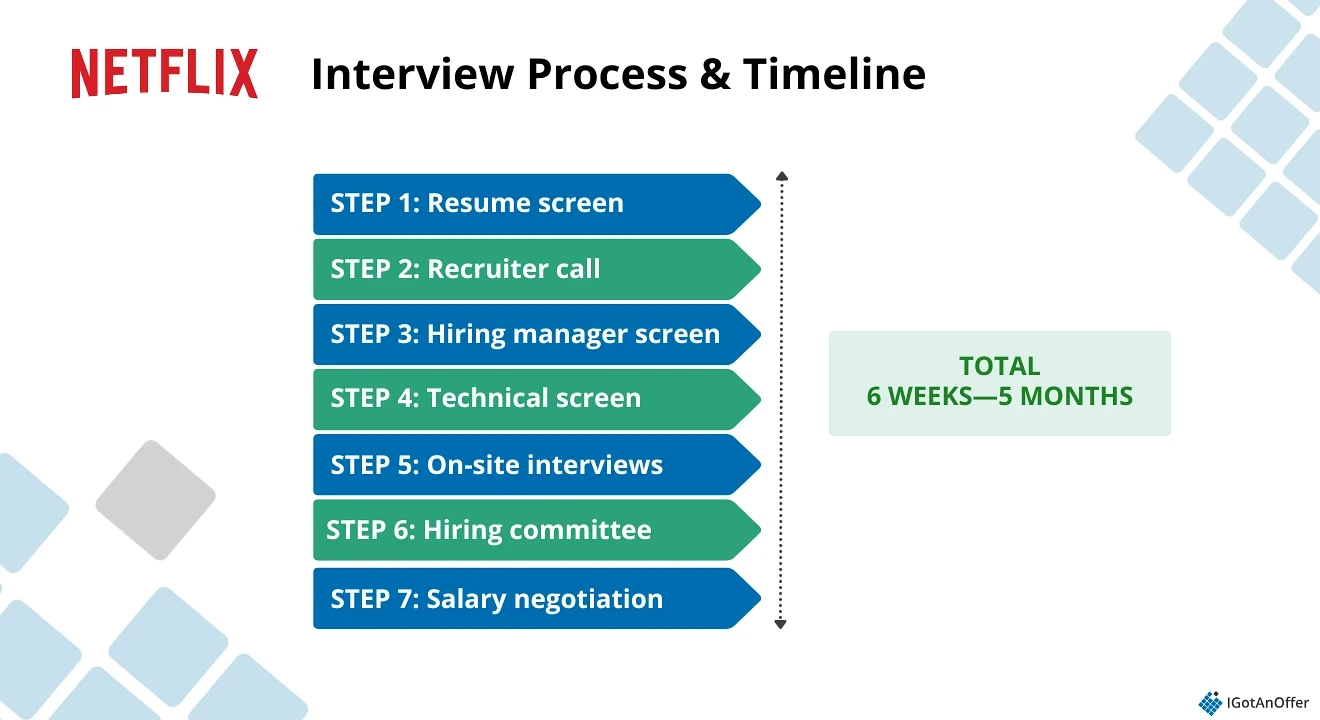
- Resume screen
- Recruiter call (30 minutes)
- Hiring manager phone screen (45-60 minutes)
- Technical screen (45-60 minutes)
- Onsite rounds 1 and 2
- Hiring committee
- Offer and negotiation
The Netflix interview process typically takes between 4 weeks and 2+ months, depending on factors such as the number of onsite interviews. Your recruiter may clarify your specific process during the initial call.
Step 1: Resume screen ↑
The first step of Netflix's interview process is the resume screen. After you've submitted your application through the Netflix jobs portal or been contacted directly via email or LinkedIn, recruiters will evaluate your resume to see if your experience aligns with the open position.
This is a highly competitive step. To help you put together a targeted resume that stands out, check out our resume guides:
- Tech resume examples
- Software engineer resume examples
- Senior software engineer resume examples
- Machine learning engineer resume examples
- Engineering manager resume examples
- Product manager resume examples
- Technical program manager resume examples
- Data science resume examples
Use the guides above as your starting point to make a competitive resume for free.
Or, book a resume review session to get personalized advice on which achievements to highlight, how to fine-tune your bullet points, and how to position your experience for the specific role you're targeting.
Step 2: Recruiter call ↑
If your resume passes the screen, a Netflix recruiter will reach out to schedule an initial call. This typically lasts 30 minutes.
The recruiter will send you Netflix's culture memo before your conversation. Read it carefully, as this call focuses heavily on assessing cultural fit. For example,
- Does this person have the baseline experience and skills for the role?
- Will this person thrive in Netflix's culture?
That second question is often more important than the first. Netflix is big on culture, and the recruiter call is where that evaluation begins.
The recruiter will also ask if you have follow-up questions. Avoid generic questions that can be easily researched online, like "What's the interview process like?" or "Is this position remote?" Instead, ask questions that demonstrate strategic thinking and genuine interest in the role you’re applying for, such as:
- “What does success look like in the first 6-12 months for this role?"
- "What's the biggest challenge the team is facing right now?"
If you do well here, the recruiter will move you to the next stage: the hiring manager screen.
Step 3: Hiring manager screen ↑
After the recruiter call, you'll have one or more screening interviews with a hiring manager or future peers. This typically consists of one 45-60 minute interview, though some roles may have two separate screens.
The goal here is twofold: to assess how you think and how you work, in the context of the role you’re applying for.
Rather than drilling into coding trivia for software engineering roles, for example, the manager will explore your technical background, decision-making process, and how you approach complex or ambiguous challenges.
What to expect in Netflix hiring manager screens (by role)
- Software engineers: Deep dive into 1-2 projects from your resume, focusing on architecture decisions and trade-offs, followed by behavioral questions about autonomy and decision-making.
- Data engineers/scientists: Often covers technical discussion of data pipelines you've built, SQL/data modeling questions, and how you communicate insights to non-technical stakeholders.
- Product managers/TPMs: Product thinking scenarios (prioritization, metrics, user needs), cross-functional collaboration examples, and Netflix-specific cases like improving recommendations or reducing churn.
- Backend/Infrastructure/SRE: System reliability and scale discussions, deep dive into infrastructure decisions you've made, and how you balance reliability with velocity.
Step 4: Technical screen ↑
This stage will be a critical assessment of your technical skills and fit for the role.
To pass this stage, you’ll need to practice with real-world problems related to Netflix's domain. Understand Netflix's architecture, content delivery challenges, and how recommendation systems work.
Also, be prepared to communicate your thinking clearly and discuss trade-offs in your approach.
This stage varies based on the role you’re interviewing for. Here's what you can expect, depending on the role:
What to expect in Netflix technical screens (by role)
- Software engineers: 45-60 minute coding session using CoderPad or CodeSignal, solving 1-2 practical problems (like building a rate limiter), writing production-quality code in your preferred language.
- Data engineers: Usually SQL queries and data modeling challenges, designing pipelines for high-volume streaming data, discussing ETL processes, and scalability at Netflix's scale.
- Machine learning engineers/data scientists: You’ll get practical ML problems (fraud detection, recommendation improvements), implementing solutions in Python, discussing A/B testing and experimentation methodology.
- Backend/Infrastructure/SRE: You’ll face system design discussions for Netflix-scale challenges (microservices health checks, distributed caching), which may include coding problems related to distributed systems.
- Product managers/TPMs: Product cases specific to streaming (reducing churn, discovery features), technical trade-off discussions, and how you'd measure success with data.
Step 5: Onsite interviews ↑
The onsite interview loop is the most extensive stage of the Netflix process. This typically consists of approximately 8 interviews conducted either in Netflix's physical offices or via video call over two rounds:
- Round 1 (4-5 interviews): Deep-dive into skills and collaboration
- Round 2 (2-3 interviews): Leadership, influence & organizational fit
Given how taxing these interviews are, Netflix recruiting may offer to split your onsite over two days. We recommend taking this option if offered, or requesting it if not.
Step 6: Hiring committee ↑
A hiring committee reviews all interview feedback and makes the final decision on your candidacy. This is a collective judgment process based on your interview feedback, alignment with culture, and how you stack up against other finalists.
Netflix recruiters typically inform you that “the team is debriefing” or “finalizing feedback.” This phase can last a few days to several weeks, depending on how many candidates are still in process.
If you haven’t heard back after a couple of weeks, it’s perfectly fine to follow up with your recruiter for an update. Response times can vary depending on team schedules, so try to stay patient and use the waiting period to prepare for potential next steps.
Step 7: Offer and negotiation ↑
Netflix is known for exceptional compensation, but that doesn't mean you shouldn't negotiate.
The company's philosophy is to pay "top of personal market". Meaning, Netflix looks at your individual market value (what you could get if you were to leave today for another top offer) and tries to match or exceed it.
For a full breakdown of each step with role-specific details and preparation tips, see our Netflix interview process guide.
2. Top 6 Netflix interview questions and answers ↑
We analyzed candidate reports on Glassdoor and Blind to identify the questions that come up most consistently across roles. Below are six you should have a strong answer for, along with guidance on what Netflix interviewers are looking for and how to respond.
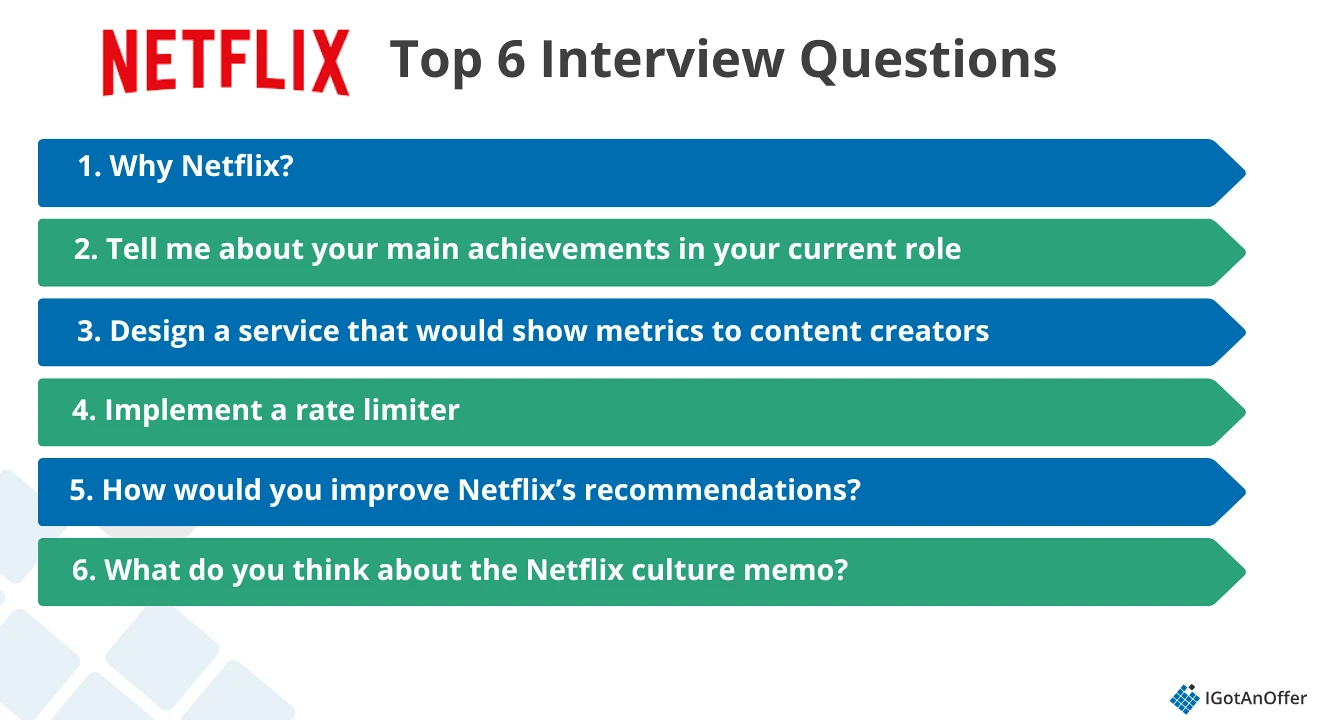
- Why Netflix?
- Tell me about your main achievements in your current role
- Design a service that would show metrics to content creators
- Implement a rate limiter
- How would you improve Netflix’s recommendations?
- What do you think about the Netflix culture memo?
These six questions cover different areas: motivation, behavioral, system design, coding, product design, and culture fit. For each, we explain why interviewers ask it and what a strong answer looks like, using the appropriate framework for that question type.
2.1 Why Netflix? ↑
This question appears in virtually every Netflix interview, regardless of role. It comes up in recruiter calls, hiring manager screens, and culture fit rounds, often more than once.
Why interviewers ask this question
Netflix's culture is deliberately distinct from other FAANG companies, and the company is transparent about that. Interviewers use this question to filter out candidates who are broadly applying to top tech companies from those who have genuinely engaged with what Netflix is and how it operates.
A vague or generic answer is treated as a red flag, because someone who doesn't understand why they want to work at Netflix specifically is unlikely to thrive in its high-trust, high-accountability environment.
How to answer
A strong answer is specific, personal, and grounded in real knowledge of the company. Here are a few tips to help you get there:
- Network: Before your interview, try speaking to people who currently or recently worked at Netflix. Ask them what drew them to the company, what surprised them about the culture, and what makes Netflix different from other FAANG companies. Their answers will give you material for your own, and mentioning that you spoke with a current employee signals initiative.
- Personalize: If you've had personal experience with Netflix's products or technology, bring that in. This could be as a user who studied the recommendation engine, a developer who's worked with their open-source tools, or someone who follows the Netflix tech blog, anything. Concrete examples are far more convincing than general admiration.
- Make it specific: Your answer should only make sense for Netflix. If it could be copy-pasted into a Meta, Google, or Amazon interview without changing a word, it's not specific enough. Reference something concrete (e.g., the culture memo or Netflix’s view on autonomy) and tie it directly to your experience or values.
- Keep it sincere: Interviewers can tell the difference between researched enthusiasm and genuine interest. Avoid superlatives like "Netflix is the most innovative company" or "I've always dreamed of working here." Give real reasons.
Example answer: Why Netflix?
"I want to work at Netflix for three reasons.
First, I've spent the past five years building backend infrastructure for streaming and media platforms, and the engineering problems Netflix is solving are genuinely the most interesting in the space.
I've followed the Netflix tech blog closely for a couple of years now, and the work on adaptive bitrate streaming and edge cache optimization is exactly the kind of infrastructure challenge I want to be working on. The scale is unlike anything I've encountered before, and that's a deliberate choice, not just a nice-to-have.
Second, I spoke recently with two engineers who worked at Netflix, and both described the same thing independently: the degree of ownership individual contributors have. Decisions get made by the people closest to the work, without layers of approval slowing things down. That's the environment where I do my best work, and it's genuinely rare.
Third, I've read the culture memo carefully, more than once at this point. The principle that resonates most is 'context over control.' I've worked in environments where alignment happened through process and oversight, and I've worked in environments where it happened through shared context and trust. The output and the quality of engineering decisions are noticeably different. Netflix builds that way deliberately, and that matters to me."
Read our complete guide to answering "Why X company?” While this particular guide is about Meta, it can still apply to other tech companies such as Netflix.
2.2 Tell me about your main achievements in your current role ↑
This is a standard opening question across all Netflix roles. It appears in recruiter calls, hiring manager screens, and onsite behavioral rounds.
Why interviewers ask this question
Netflix operates in small, focused teams (roughly 14,000 employees compared to 100,000+ at other FAANG companies). This means every hire is expected to contribute at an unusually high level.
Interviewers use this question to find out two things. First, whether you can point to concrete outcomes you personally drove, rather than simply describing your responsibilities.
Second, whether your values align with Netflix's, as the company expects every employee to take initiative, own their work end-to-end, and be accountable for results. You can read more about what that looks like in Netflix’s culture memo.
How to answer
A strong answer covers:
- One or two achievements that are concrete and quantifiable
- A clear description of your personal contribution, not just the team's
- Evidence of scale and independent judgment
To cover all bases properly, we recommend using IGotAnOffer’s SPSIL method (Situation, Problem, Solution, Impact, Lessons).
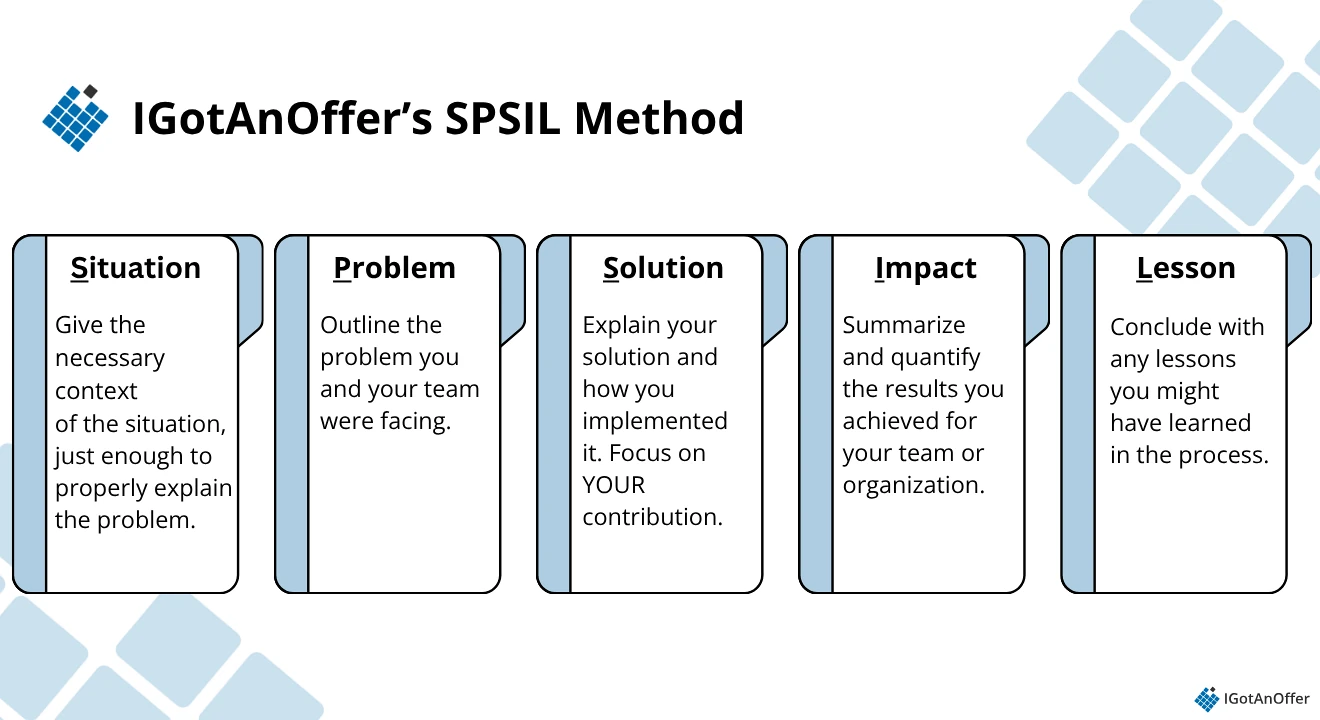
Here's how each element works:
- Situation: Give the minimum context needed to understand the problem: your role, the team, and the broader goal.
- Problem: Describe the specific challenge you faced.
- Solution: Walk through your actual contribution, including your decisions and the trade-offs you navigated.
- Impact: Summarize what the work achieved. Quantify where you can.
- Lessons: Close with what you learned or what you'd do differently.
Keep your answer recent. If you have several years of professional experience, don't choose an achievement from your undergraduate years.
Example answer: Tell me about your main achievements in your current role
(Situation)
"In my current role as a senior software engineer, I joined a team whose data pipeline was degrading under growing load. Ingestion latency had climbed to the point where downstream services were timing out during peak hours several times a week.
(Problem)
The pipeline had been designed when the team was processing about 10 million events per day. By the time I joined, it was handling closer to 80 million, and the architecture hadn't been updated to match. The team had patched it repeatedly but hadn't addressed the underlying design.
(Solution)
I proposed a rearchitecture that moved us from a synchronous ingestion model to an event-driven approach using Kafka. I built the business case, got buy-in from the team lead and the PM, and then led the implementation with two other engineers over about three months. I did most of the core design work and wrote the migration logic myself, since I was the one who'd diagnosed the problem in detail.
(Impact)
After the migration, peak ingestion latency dropped by about 80%, and we eliminated the timeout incidents entirely. The pipeline also became much easier to scale horizontally, so we haven't needed to revisit the architecture since, even as volumes have grown further.
(Lessons)
The main thing I took from it was the value of diagnosing before patching. The team had spent a lot of time on workarounds because a rearchitecture felt expensive. Once I laid out what the patching was costing us in downtime and engineering time, it was obvious the proper fix was cheaper."
If you want to go deeper into answering behavioral questions like this, read our full guide here.
2.3 Design a service that would show metrics to content creators ↑
This system design question is based on a real business problem Netflix faces: giving content partners (studios, production companies, independent creators) visibility into how their content performs on the platform. It's typically asked in software engineer and engineering manager interviews.
Why interviewers ask this question
Netflix uses domain-relevant system design questions. These questions test whether you can reason through a distributed system at scale in a context you'll encounter on the job.
Interviewers want to see how you scope an ambiguous problem, make trade-offs between freshness, cost, and complexity, and communicate your reasoning clearly at each step. It's as much a test of structured thinking as it is of technical knowledge.
How to answer
You must first be able to approach this question systematically. There are a variety of ways to solve system design questions, but at the end of the day, you need a method that will consistently:
- Show your interviewer that you have the knowledge they need
- Break the problem down into manageable steps
With that in mind, one of our favorite approaches is the 4-step system design framework:
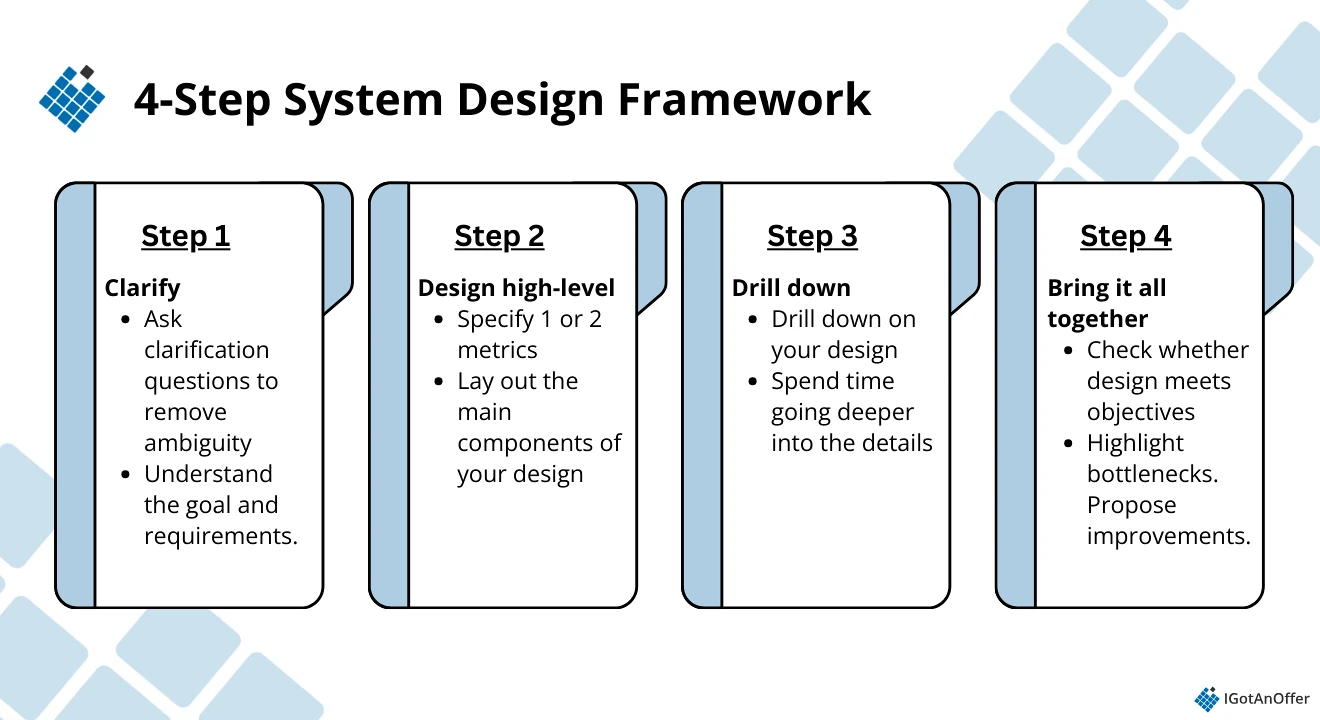
- Ask clarifying questions: Spend the first few minutes checking in with your interviewer about the functional and non-functional requirements of the system. Make sure you understand the goals, the scale, and which aspect of the system to focus on before you start designing.
- Design high-level: Map out only the most foundational components of the system, like the front end, web server, and database. Aim to have your high-level design ready within the first 20 minutes of the round.
- Drill down on your design: Once you've covered the high level, go deeper into the components that matter most, starting with the areas where you have the most knowledge. This is where you discuss trade-offs, bottlenecks, and specific technical decisions.
- Bring it all together: Revisit the goals you established at the start and confirm your design meets them. Highlight any improvement opportunities and leave time for the interviewer to ask follow-up questions.
Keep in mind that interviewers generally want to see your high-level design within the first 20 minutes of the round. Most system design interviews last for 45-60 minutes, which means that you’ve got to figure out how to allocate your time wisely.
Example answer: Design a service that would show metrics to content creators
Step 1: Ask clarifying questions
Start by narrowing the scope before designing anything.
- Scope: Who are the content creators in this context? Major studios, independent production companies, or both? Are we building a dashboard UI, an API for programmatic access, or both?
- Functional requirements: What metrics do partners need? Views, watch time, completion rates, regional breakdowns, revenue data?
- Non-functional requirements: How fresh does the data need to be? Real-time, near-real-time (within an hour), or is daily sufficient? How many content partners and titles are in scope? What are the read latency expectations for dashboard queries?
For this answer, I'll assume: studio-level partners, metrics covering views, watch time, and completion rates by title and region, hourly data refresh, and support for both a dashboard UI and an API.
Step 2: Design high-level
Map out the core components:
- Ingestion layer: Consumes viewing events from Netflix's existing streaming infrastructure via a message queue (Kafka), decoupling data production from processing
- Processing layer: Aggregates raw events into per-title, per-region metrics on an hourly schedule
- Metrics store: A read-optimized OLAP database (Apache Druid or BigQuery) built for fast time-series aggregation queries
- API layer: Serves partner requests with row-level access control so each partner only sees their own content
- Frontend dashboard: Partner-facing UI that queries the API layer
Step 3: Drill down on your design
The most critical design decisions sit in the processing and storage layers.
- Processing: Start with batch aggregation using Spark or Flink on an hourly schedule. Real-time streaming would reduce latency but significantly increase operational complexity. A Lambda architecture (batch for historical data and a lightweight streaming layer for recent events) is worth considering if partners need near-real-time views.
- Storage: Apache Druid handles high-cardinality, time-series aggregation queries at scale and supports pre-aggregation, which reduces query latency for common breakdowns (title by region, title by day). BigQuery is simpler to operate, but adds cost at high query volume.
- Access control: Implement row-level security at the API layer rather than separate databases per tenant. A shared schema with a partner_id partition key keeps the model manageable as the partner count grows.
Step 4: Bring it all together
- The main trade-off is data freshness vs. cost and complexity. Hourly batch processing satisfies most partners and is straightforward to operate. If near-real-time becomes a hard requirement, introduce a streaming layer for high-priority titles while keeping batch for the rest.
- Potential bottlenecks: query fan-out at the API layer if multiple partners hit the dashboard simultaneously during peak hours, mitigate with query result caching (Redis) for common time ranges.
- Edge cases to address: catalogue changes (a title moving between territories), partner access changes (a new studio onboarding or a contract ending), and late-arriving events from regions with unreliable network delivery.
For a complete walkthrough of the system design framework, see our system design interview guide.
2.4 Implement a rate limiter ↑
This is one of the most frequently reported coding questions in Netflix software engineer interviews. Netflix uses rate limiting extensively across its API infrastructure, so this question tests whether you can solve a real engineering problem rather than an abstract puzzle.
Why interviewers ask this question
Netflix interviewers are looking for production-quality thinking. They want to see whether you clarify requirements before coding, choose an algorithm you can justify, and write clean, extensible code.
They'll often add constraints mid-way (like supporting multiple users) to see how well your initial design absorbs change. How you respond to those extensions often matters as much as the original implementation.
How to answer
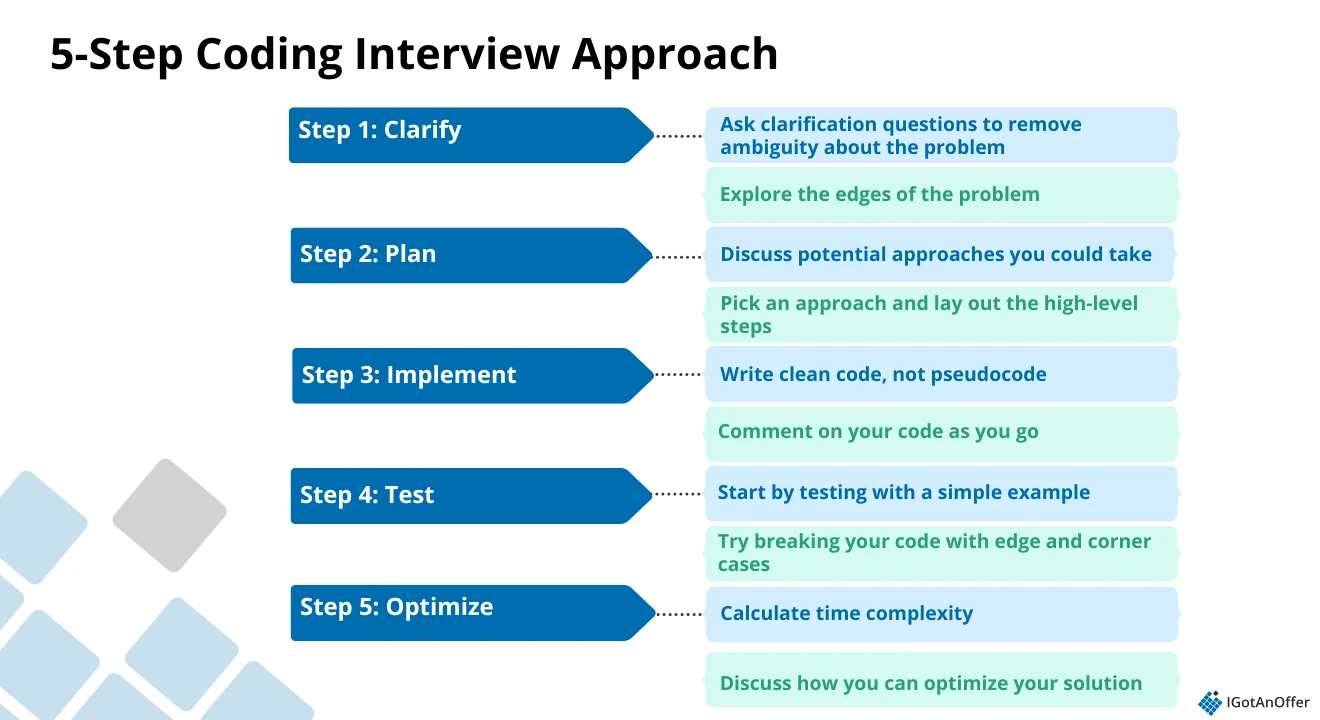
Use the five-step coding framework:
- Clarify: Don't jump straight into the problem. Ask questions to remove ambiguity, explore edge cases, confirm constraints, and specify what language you'll be coding in. State any assumptions you're making before you start.
- Plan: Think through your approach before writing a line of code. Identify at least a brute-force solution, then discuss potential improvements. Walk your interviewer through your thinking and get alignment on your chosen approach.
- Implement: Write clean, legible code. Use descriptive variable names, think about boundary conditions, and comment out loud on what you're doing as you go.
- Test: Run through your code with a simple example first, then try to break it with edge and corner cases. Check for anything that might cause it to fail in unexpected scenarios.
- Optimize: Calculate the time and space complexity of your solution. Discuss how you could improve it, and if time permits, implement the optimized version.
To illustrate the framework at work, we’ve laid out an example answer to a real coding question that was asked in a Netflix interview.
Example answer: Implement a rate limiter
Step 1: Clarify
"A few questions before I start.
- Is this a per-user rate limit or a global one?
- What's the limit we're enforcing?
- Do we need to handle bursty traffic, or enforce a strict cap?
- And is this running in a single process or distributed across multiple servers?
I'll assume per-user, 100 requests per minute, with some allowance for bursting, in a single-process context to start."
Step 2: Plan
"There are a few common algorithms. A fixed window counter is simple but can allow twice the limit at window boundaries. A sliding window log is precise but memory-intensive. A token bucket allows controlled bursting and is what I'd use here. The idea is that each user has a bucket that refills at a steady rate up to a maximum capacity. Each request consumes one token. If the bucket is empty, the request is denied."
Step 3: Implement
import time
class RateLimiter:
def __init__(self, max_requests: int, window_seconds: int):
self.max_requests = max_requests
self.window_seconds = window_seconds
self.buckets = {}
def allow_request(self, user_id: str) -> bool:
now = time.time()
if user_id not in self.buckets:
self.buckets[user_id] = {"tokens": self.max_requests, "last_refill": now}
bucket = self.buckets[user_id]
elapsed = now - bucket["last_refill"]
refill = (elapsed / self.window_seconds) * self.max_requests
bucket["tokens"] = min(self.max_requests, bucket["tokens"] + refill)
bucket["last_refill"] = now
if bucket["tokens"] >= 1:
bucket["tokens"] -= 1
return True
return False
Step 4: Test
"I'd check the happy path (requests within limit pass), the boundary (exactly at the limit), and the failure case (requests beyond the limit are denied)."
Step 5: Optimize
"Time complexity is O(1) per request; space is O(n) for n users. If we move to a distributed environment, in-memory state no longer works. You'd replace the dictionary with Redis and use atomic INCR operations with expiry to prevent race conditions across servers."
For more tips on how to answer coding questions, read our coding interview prep guide.
2.5 How would you improve Netflix's recommendations? ↑
This product design question comes up in PM interviews and occasionally in EM and general senior-level interviews. It's open-ended by design. Netflix's recommendation engine is one of the most sophisticated in the industry, and interviewers want to see how you think about a complex, well-established product.
Why interviewers ask this question
This question tests product sense. Meaning, it tests whether you can:
- Identify a real problem within a mature product
- Define it precisely
- Propose a focused solution
- Articulate how you'd measure success
Interviewers also use it to assess whether you understand Netflix's specific users and context, or whether you give generic suggestions like "add more filters" that could apply to any streaming service. Strong candidates pick one specific problem and go deep on it rather than listing five shallow ideas.
How to answer
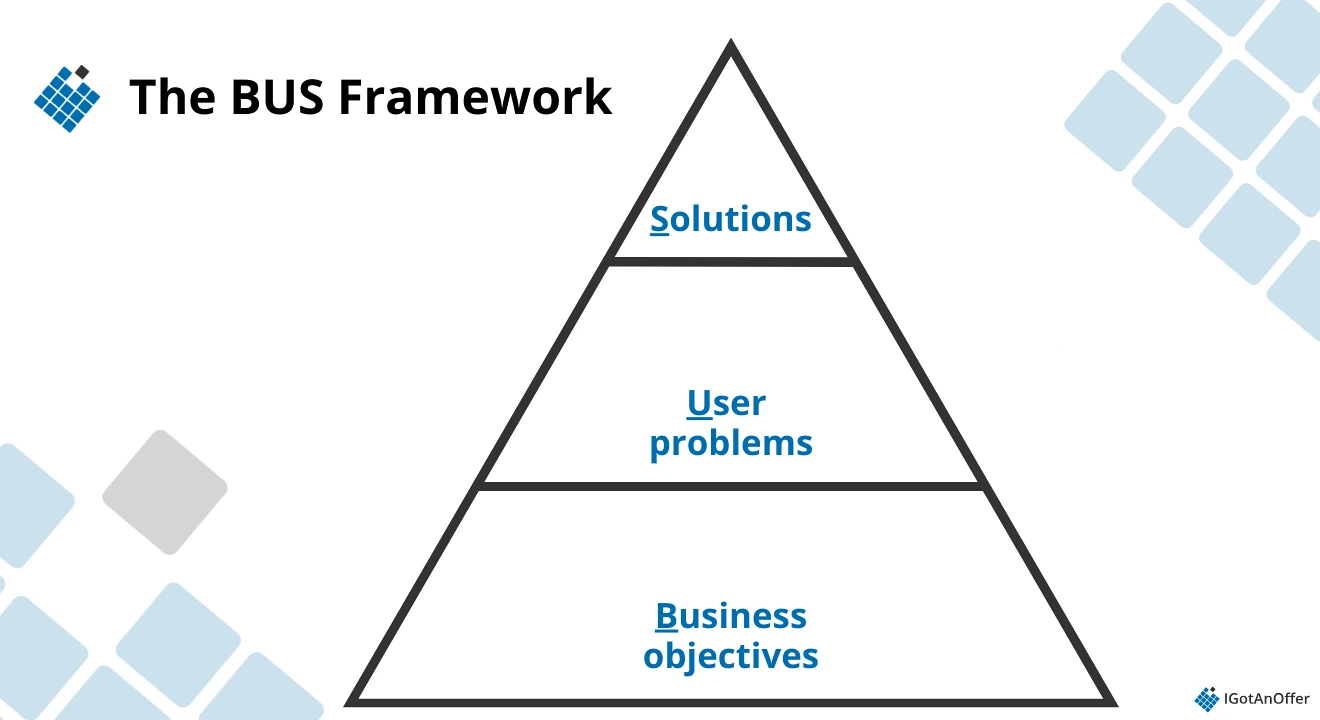
We recommend using a three-step approach called the BUS framework:
- Business objective: Ask questions to understand the goal, and outline how you'll approach your answer. Skipping this step and jumping straight to ideas is one of the most common red flags interviewers see.
- User problems: Identify the different types of users, select one to focus on, and list the problems they face. Prioritize those problems before moving on. The more work you do here, the easier the next step becomes.
- Solutions: Generate solutions for the problems you identified, prioritize them, and make a clear recommendation. Discuss trade-offs, and explain how you'd measure success.
The main benefit of using the BUS framework is that it forces you to approach problems in a logical order: you only start considering solutions when you’ve first established the business objectives and have found a relevant problem that is impacting them.
The strongest answers pick one specific problem within the recommendation experience and go deep on it, rather than listing five shallow ideas.
Example answer: How would you improve Netflix’s recommendations?
Step 1: Business objective
Netflix's recommendation engine serves multiple user types: subscribers browsing for something to watch, new members being onboarded, and lapsed users being re-engaged. For this answer, I'll focus on active subscribers.
In terms of business objective, I'd want to clarify with the interviewer whether we're optimizing for engagement (watch time, sessions started) or retention (reducing monthly churn). I'll assume we're focused on engagement, since that's what the recommendation engine most directly influences.
Step 2: User problems
Active subscribers on Netflix broadly fall into a few types: casual viewers who watch a couple of hours a week, binge watchers who go deep on a series, and co-viewers who watch together with a partner or family. I'd focus on casual viewers, since they represent the largest segment and the most untapped engagement potential.
The main problems this user faces when using the recommendation engine are:
- They spend more time browsing than watching, which leads to frustration and session drop-off
- The recommendations don't reflect their context (whether they have 20 minutes or two hours, or whether they're watching alone or with someone else)
- After finishing a series, the engine often struggles to surface a natural follow-on, leaving users back at square one
I'd prioritize problem two (the lack of contextual awareness) as it's the root cause of much of the browse fatigue described in the first problem.
Step 3: Solutions
For the problem of context-blind recommendations, a few possible solutions are:
- A lightweight session prompt at the start of browsing: a simple mode selector such as "quick watch," "movie night," or "something new," which surfaces content matched to the user's intent
- Passive context inference: use existing signals (time of day, device type, session length history) to auto-adjust recommendations without requiring user input
- A "watch together" mode that adjusts recommendations to content with broader appeal when co-viewing is detected via account sharing patterns
Prioritizing by user value and implementation complexity: the session prompt is the highest-value, lowest-complexity option.
The recommendation engine already has the underlying signals; this feature makes context explicit rather than requiring new modeling. Passive inference is higher complexity but could be phased in behind the prompt. The co-viewing mode is a longer-term investment.
Recommendation: Build a session intent prompt as an opt-in feature, A/B tested against the current experience with time-to-play and 30-day retention as the primary metrics. A meaningful reduction in browse time without a drop in completion rates would validate the improvement.
To go deeper on answering product improvement questions like this one, read our product improvement interview guide.
2.6 What do you think about the Netflix culture memo? ↑
This question appears in culture fit rounds across all roles and seniority levels, and it's one of the highest-signal questions in Netflix's process.
Why interviewers ask this question
Netflix puts a strong emphasis on culture fit, and your response shows how well you align with the values in its culture memo. Interviewers will ask for specific stories showing how you exercised judgment, gave difficult feedback, or operated under uncertainty. They'll also test how you handle tension between values, such as creativity vs reliability, or candor vs diplomacy.
Make sure to tie your answers back to the principles in Netflix’s culture memo. If you can internalize these values and talk convincingly about how you've embodied them, you'll significantly strengthen your candidacy.
Candor, for example, is one of Netflix’s core values, and this question tests for it directly. Interviewers expect you to explain what resonates with you, but also acknowledge where you might need to adapt. Saying everything 'aligns perfectly' can come across as insincere.
How to answer
Read the Netflix culture memo carefully before your interview, ideally more than once.
In your answer, pick one or two principles you strongly align with. For each, give a specific example that shows how you’ve applied it in practice (e.g. a time you gave direct feedback or made a high-stakes judgment call).
Then, choose another principle that doesn’t come as naturally to you. Explain what would need to change in how you work, and give a concrete example of where this might be difficult.
Don't manufacture a concern: interviewers have heard enough answers to tell the difference.
Example answer: What do you think about Netflix’s culture memo?
"I've read the memo a few times now, and what strikes me most is how direct it is. Most companies publish values that are vague enough to mean anything. The Netflix memo tells you what working there looks like day to day, and that made me take it seriously.
The principle I connect with most strongly is 'context over control.' In my last role, I led a team of five engineers building out a payments integration. We had a clear goal and the technical skills to hit it, but every significant decision had to go through two layers of approval before we could move. It slowed everything down and, over time, I watched people on the team stop bringing ideas to the table because they'd learned it wasn't worth the friction.
I spent a lot of energy trying to shield them from that process, but I was working against the culture rather than with it. The idea of an organisation where that context is set upfront, and people are trusted to run with it, is something I find genuinely compelling.
The principle I'd have to be most deliberate about is the expectation of real-time candor. In a previous role, I had a direct report who was missing deadlines regularly. I raised it with him eventually, but I waited longer than I should have because I wanted to find the right moment. By the time we had the conversation, the pattern had already affected the rest of the team. I learned from that, but my instinct is still to be thoughtful about timing rather than immediate.
Netflix seems to operate at a higher baseline of directness than anywhere I've worked, and that's something I'd need to consciously recalibrate. I think it's the right way to work. But I'd rather be honest about it being a real adjustment than pretend otherwise."
For example questions tied to each culture memo value and tips on answering them, read our Netflix culture interview guide.
3. More Netflix interview questions (by role) ↑
The questions below are organized by role and drawn from Netflix candidate reports on Glassdoor and Blind, as well as our role-specific Netflix guides.
For each role, you'll find links to the relevant in-depth guide where we've included answer frameworks, sample answers, and preparation plans.
3.1 Netflix software engineer interview questions
Software engineering candidates typically move through three main rounds:
- Coding interviews: These are progressive. You’ll start with a base problem, then new requirements get layered on to see whether your original approach can evolve cleanly without falling apart.
- System design interviews: You’re expected to think beyond standard backend patterns and reason about model constraints, tradeoffs, and real-world implementation details.
- Behavioral interviews: These go deeper than surface-level storytelling. They probe the thinking behind your past technical decisions. For example, why you chose a particular approach, what you optimized for, and what you’d change in hindsight.
Across all rounds, time pressure is real. Many candidates say they run out of time at some point in the loop.
Here’s a breakdown of what each round covers and the types of questions you should be ready to answer.
Example coding questions asked in Netflix software engineer interviews
- Implement a rate limiter
- Write a function to parse a log file and identify error patterns
- Build a basic streaming pipeline that processes events in order
- Implement an LRU cache
Example system design questions asked in Netflix software engineer interviews
- Design Netflix's content delivery network
- Design a recommendation engine for a streaming service
- How would you design a system to handle video uploads at scale?
- Design a notification system for a global streaming platform
Example behavioral questions asked in Netflix software engineer interviews
- Tell me about a time you had to make a decision with incomplete information
- Describe a technically complex project you worked on. What trade-offs did you make?
- Tell me about a time you had to push back on a product requirement
- How do you decide when code is "good enough" to ship?
If you’re preparing for this track, it’s worth spending time practicing. These resources should give you a great head start:
- Coding interview prep guide
- System design interview guide
- ML system design interview guide
- Software engineer behavioral interview guide
3.2 Netflix engineering manager interview questions
Netflix EM interviews assess technical depth, leadership judgment, and culture fit across multiple rounds. The qualities interviewers are specifically looking for are self-motivation and autonomy, judgment over process, candor and directness, cross-team collaboration, and enough technical credibility to earn the trust of senior engineers.
Netflix's environment is high-trust and high-accountability, and interviewers are trying to determine whether you'll thrive in it or find it uncomfortable.
To make your preparation more focused, we’ve grouped the questions into three key categories:
- System design questions
- Behavioral and leadership questions
- Culture fit questions
Let's look at some sample questions.
Example system design questions asked in Netflix engineering manager interviews
- Design a service that would show metrics to content creators
- Design and model core datasets for a specific Netflix use case
- Walk through the high-level design of a complex system you've built. What trade-offs did you make and why?
Example behavioral and leadership questions asked in Netflix engineering manager interviews
- How do you resolve conflict within your team?
- Tell me about a time you had to make a difficult prioritization call
- What's the hardest conversation you've had with one of your direct reports?
- How do you manage engineers who are more technically skilled than you in certain areas?
- Describe a time when you had to influence a decision without formal authority
- How do you set a technical vision for your team?
Example culture fit questions asked in Netflix engineering manager interviews
- What do you think about the Netflix culture memo?
- What resonates most with you in the culture memo, and what resonates least?
- Tell me something I can't find on your resume, LinkedIn, or anywhere online
- Which part of our culture would be the hardest adjustment for you?
We recommend reading our guide to Netflix’s engineer manager interviews and our article on grokking the engineering management interview. They’re not specific to Netflix, but reading them will be useful to get an overview of how FAANG and other top tech companies conduct interviews for this position.
We also recommend that you review the following articles on different aspects of tech leadership:
- Leadership primer for tech interviews
- People management primer for tech interviews
- Program management primer for tech interviews
3.3 Netflix product manager interview questions
As a Netflix PM, you can expect standard culture fit, behavioral, product sense, and estimation questions.
Because product managers at Netflix sit at the intersection of technology and entertainment, interviewers are looking for more than just strong product instincts. They want to see user-centric thinking paired with sound judgment under ambiguity, and the ability to drive alignment across engineering, design, and content teams, often without formal authority.
Example culture questions asked at Netflix product manager interviews
- Why Netflix? (Click here to learn how to answer the 'Why this company?" question)
- What do you think about the Netflix culture memo?
- What do you like most about the Netflix culture memo?
- What do you like best about the Netflix culture memo, and what resonates less?
- Why did you move from this product area to another?
- Tell me something I can’t find on your resume, LinkedIn, online, etc.
Example behavioral questions asked at Netflix product manager interviews
- Tell me about your main achievements in your current role.
- Tell me about the area where you have the most to learn.
- Name a time when you experienced a difficult coworker and how you handled it.
- What past global experience do you have managing projects?
Example product questions asked at Netflix product manager interviews
Product design
- What's your favorite product and why?
- Design a neural network.
- Design a web-based application for collaborative work.
- Design a new feature for an existing Netflix product.
Product improvement
- How would you improve Netflix?
- How would you improve Netflix’s recommendations?
- What would you have done differently with X product?
- Pick your favorite app or website. How would you improve it?
- Describe a situation in which a product you were managing wasn't doing well. How did you overcome it?
Product strategy
- How did you come up with the most innovative idea you've ever come up with? How did you implement it?
- What are your plans for Netflix’s expansion into new markets in the region?
- If you were a VC, would you be more bullish on AR or VR? Why?
- If you were the CEO of Netflix, what are the top three things you would do?
- If you were the CEO of Netflix, what new product line would you come up with to increase revenue?
Example estimation questions asked at Netflix product manager interviews
- How many tennis balls fit in an aeroplane?
- How much revenue does YouTube make per day?
- What is the market size for toilet paper in the US?
- How many kindergarten teachers are there in the US?
For a complete guide to the Netflix PM interview, see our Netflix product manager interview guide. If you want to go deeper into each topic, here are a few more guides with questions you can practice with:
- How to crack product sense interview questions
- How to answer estimation questions for product managers
- Product design interview guide
- Most-asked PM behavioral interview questions
4. How to prepare for a Netflix interview ↑
Right, now that we've been through the questions and what strong answers look like, here are the resources and steps we recommend to prepare.
4.1 Practice by yourself
Practicing by yourself is the foundation of good interview prep. We recommend you make full use of the free prep resources on the IGotAnOffer blog, like the ones we referenced above.
Here are a few more interview guides you might find helpful during your prep:
For Netflix:
- Netflix's culture page
- Netflix Interview Process & Timeline: 7 Steps to an Offer
- Netflix Engineering Manager Interview (questions, process, prep)
- Netflix Product Manager Interview (questions, process, prep)
- Netflix Data Scientist Interview (questions, process, prep)
By skill area:
- Behavioral interview questions
- Coding interview prep guide
- System design interview guide
- Product sense interview guide
- Product improvement interview guide
- How to crack product design interview questions
- Most-asked PM behavioral interview questions
- How to answer estimation questions for product managers
Once you have a strong foundation of the subject matter, the next step is practicing under real conditions.
But by yourself, you can’t simulate thinking on your feet or the pressure of performing in front of a stranger. Plus, there are no unexpected follow-up questions and no feedback.
That’s why many candidates try to practice with friends or peers.
4.2 Practice with peers
If you have friends or peers who can do mock interviews with you, that's an option worth trying. It's free, but be warned, you may come up against the following problems:
- It's hard to know if the feedback you get is accurate
- They're unlikely to have insider knowledge of Netflix's interview process
- On peer platforms, people often waste your time by not showing up
For those reasons, many candidates skip peer mock interviews and go straight to mock interviews with an expert.
4.3 Practice with experienced Netflix interviewers
In our experience, practicing with an expert who can give you feedback specific to Netflix's process in real time makes the biggest difference.
Find an expert Netflix interview coach so you can:
- Practice under real interview conditions
- Get accurate feedback from someone with direct experience of the process
- Build confidence under pressure
- Learn which stories to tell and how to tell them well
- Focus your preparation on what actually moves the needle
Landing a job at a big tech company like Netflix often results in a $50,000 per year or more increase in total compensation. In our experience, three or four coaching sessions worth ~$500 make a significant difference in your ability to land the job. That’s an ROI of 100x!
Click here to book mock interviews with experienced Netflix interviewers.

 Data scientist




 Product sense