


 Back to other articles
  Last updated: October 01, 2026

 Careers
 Deeply researched
Getting a job at OpenAI isn't easy: acceptance rates are low, and the hiring process is challenging. But if you make it in, it can be a game-changer; a great salary, huge growth opportunities, and the chance to work on huge global products like ChatGPT, Sora, and Codex.
Plus, the prestige of having even just one year at OpenAI will open doors for you moving forward.
Below, we’ve laid out the main steps you’ll need to take to get into OpenAI. Whether you’re a recent graduate or an experienced professional, we’ve helped thousands of people like you get job offers at OpenAI and other top tech companies.
- Step 1: Learn about OpenAI
- Step 2: Understand the company’s requirements
- Step 3: Choose the right role
- Step 4: Optimize your resume for OpenAI
- Step 5: Network, network, network
- Step 6: Send out applications
- Step 7: Prepare for the interviews
Ready? Let’s go.
Click here to talk to a FAANG+ interview coach
Step 1: Learn about OpenAI ↑
OpenAI is an AI research organization dedicated to ensuring that artificial general intelligence benefits all of humanity. The company was founded in 2015 as a non-profit research lab.
It has since evolved into one of the world's most influential AI organizations, developing groundbreaking models including ChatGPT, GPT-4o, and GPT-4. These systems have fundamentally shaped how businesses and individuals interact with AI.
As expected from one of the world's leading AI companies, OpenAI is incredibly hard to get into, but don't let that intimidate you. OpenAI is not credential-driven, and it seeks to hire talented people with diverse backgrounds who are passionate about collaboratively building safe Artificial General Intelligence (AGI).
OpenAI is headquartered in San Francisco, where many of its research, engineering, and product roles are based. It also has offices around the world, including in New York City, London, Dublin, Singapore, Tokyo, and Seoul.
1.1 What it’s like working at OpenAI
Not all tech companies are the same. There are subtle differences that make each one unique, such as how decisions are made, how teams collaborate, what truly drives the work, etc. OpenAI is no exception.
If you’re thinking about joining, here’s what makes OpenAI distinct from other tech companies:
1.1.1 Mission-driven culture
OpenAI is highly focused on its goal of building AGI that benefits all of humanity. Teams across research, engineering, and product are expected to understand this mission and how their work contributes to it.
This means developing AI at scale, turning research into products people use, and moving quickly toward the company's broader AGI goals.
1.1.2 High autonomy and bottom-up culture
OpenAI has a highly autonomous, bottom-up culture. Good ideas can come from anywhere, and teams are willing to change direction when new research or information points to a better approach. The goal is to follow the most promising ideas rather than stick to a plan simply because it's already in place.
Teams are also more fluid than at many other companies. Small groups can start working on promising ideas without waiting for a formal planning cycle, with teams forming around those efforts as they gain traction.
That level of autonomy comes with responsibility. You're expected to take ownership, identify problems and opportunities, and drive your work forward without needing constant direction.
1.1.3 Intense and fast-moving environment
OpenAI moves quickly, and priorities can shift as new research emerges or product needs change. Given the pace of AI development, teams may need to rethink their approach or change direction with little notice.
You'll need to be comfortable with that level of change. This means learning quickly, adapting as new information becomes available, and staying focused even when priorities shift.
1.1.4 Collaboration across research, engineering, and product
Despite the high level of individual autonomy, much of the work at OpenAI is cross-functional. Engineers may work closely with researchers developing new models, product teams bringing those models to users, and safety teams focused on responsible deployment.
Strong communication skills are important as a result. You'll need to explain your work clearly, understand different perspectives, and work with people whose expertise may be very different from your own.
1.1.5 Employee benefits and perks
OpenAI offers a generous benefits package covering health, financial wellbeing, time off, and professional development.
Some of the main benefits include:
- Health and wellness: Medical, dental, and vision insurance for employees and their families, along with mental health and wellness support.
- Financial wellbeing: A 401(k) retirement plan with employer matching, employer-paid life and disability coverage, and benefits such as charitable donation matching.
- Time off and family support: Flexible PTO for exempt employees, 13+ paid company holidays, paid company-wide office closures, and up to 24 weeks of paid parental leave for birth parents and 20 weeks for non-birthing parents.
- Learning and development: An annual learning and development stipend, a domestic conference budget, and six coaching sessions for employees and their dependents.
- Office perks: Daily breakfast, lunch, and dinner at OpenAI offices, along with meal delivery credits for eligible employees.
- Additional support: Relocation support for eligible employees, employee resource groups, team events, and global business travel insurance for employees and dependents traveling with them.
Further reading
Be sure that you’re up to date on the latest OpenAI products and releases, as well as their legacy products. Here are some resources that you can read up on:
- OpenAI Charter
- OpenAI research and product blog
- OpenAI's interview guide
- OpenAI careers and culture page
And given OpenAI’s strong focus on AI safety, it's also important to have a good understanding of the ethics of AI. Here are a few good resources to start with:
1.2 How much does OpenAI pay?
OpenAI is one of the highest-paying employers in tech. Below, we use data from Levels.fyi to compare the salaries of entry-level and senior software engineers at OpenAI with those in the same roles at other leading tech companies.
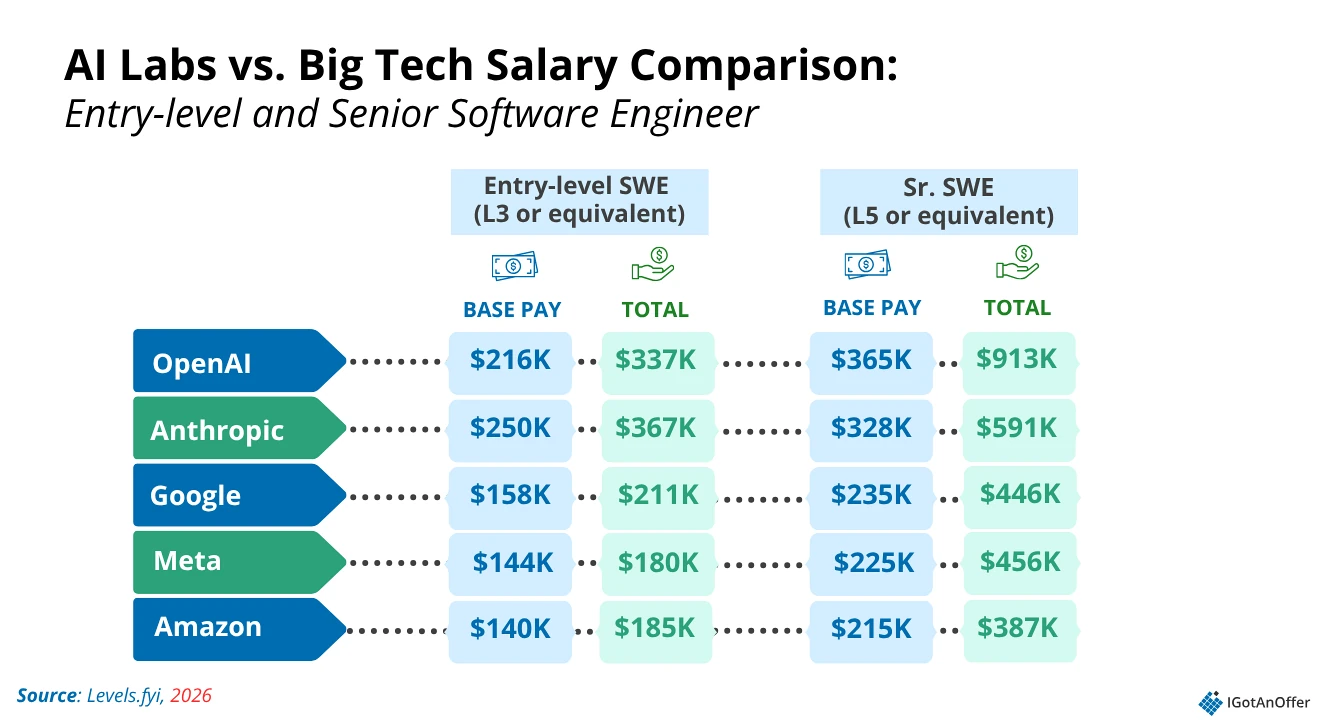
OpenAI offers the second-highest entry-level software engineering compensation at $337K, behind Anthropic at $367K. That's still around 60% more than Google and over 80% more than Amazon and Meta.
At the senior level, OpenAI takes the lead at $913K, paying 54% more than Anthropic and more than double the compensation at Google, Meta, and Amazon.
1.3 Is OpenAI hiring?
OpenAI has been in a period of rapid growth following the widespread adoption of ChatGPT and the expansion of its enterprise business. The company has scaled its operations considerably, growing from around 770 employees in 2023 to more than 4,000 in 2026.
OpenAI reportedly plans to nearly double its workforce to 8,000 employees by the end of 2026, with much of that growth focused on product development, engineering, research, and sales. At the time of writing, the company has more than 800 open technical and non-technical roles across its global offices.
Step 2: Understand the company’s requirements↑
OpenAI has a very selective hiring process. You'll find that the exact requirements vary considerably depending on the team and role you're applying for, but there are a few things the company looks for across most positions:
2.1 Academic qualifications
OpenAI does not evaluate candidates based solely on their credentials or academic background. Its engineering teams, for example, hire developers from non-traditional backgrounds who can demonstrate strong technical skills and relevant experience.
Research roles are an exception, as some positions may require an advanced degree or a strong record of published research.
For most other roles, personal projects, open-source contributions, technical writing, and relevant work experience can all help demonstrate your abilities, even without a traditional academic background.
2.2 Experience
OpenAI generally looks for experience relevant to the role, whether you've gained it through professional work, coursework, training, or independent projects.
If you're still early in your career or looking to transition into AI, OpenAI also offers several programs that can help you get started:
- Early-career opportunities: Full-time roles in research, applied engineering, and product for candidates with 0–3 years of experience, including recent graduates and self-taught applicants.
- OpenAI internships: Opportunities for undergraduate and master's students across engineering, business, and other fields to work on projects alongside OpenAI teams.
- OpenAI Residency: A six-month program for researchers and engineers looking to transition into AI, with the possibility of moving into a full-time role afterward.
Learn more about their Emerging Talents programs here.
2.3 Soft vs. technical skills
OpenAI places a surprisingly high value on soft skills. During the interview process, you'll be evaluated on qualities reflected in the company's core values.
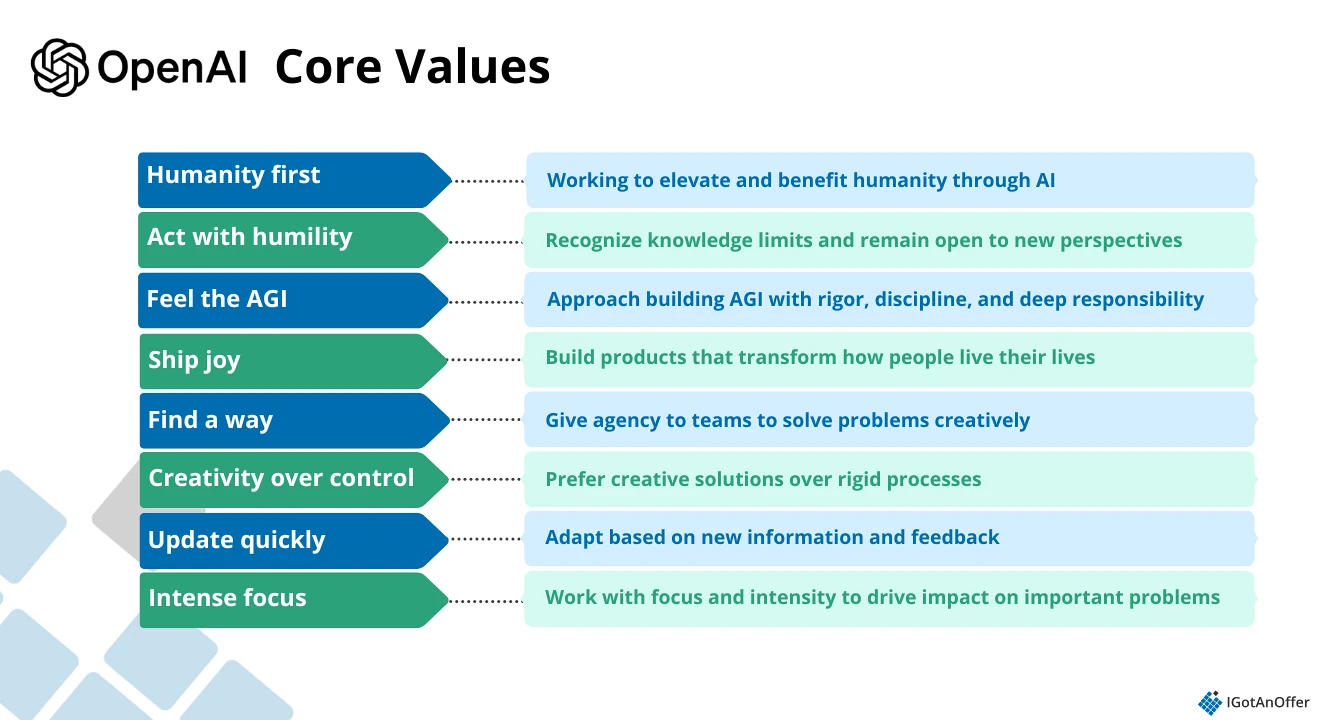
- "Find a way" (ownership and ambiguity): Taking ownership of difficult or ambiguous problems and finding a way forward without waiting for step-by-step direction.
- "Update quickly" and "Act with humility" (adaptability): Being open to feedback, admitting when you're wrong, and changing your approach when new information comes up.
- Clear communication: Explaining complex ideas clearly and working well across research, engineering, product, and other teams.
- Mission alignment: Showing a genuine commitment to OpenAI's mission of building AGI that benefits humanity
Expect these qualities to come up throughout the interview process, particularly in behavioral questions. See our OpenAI behavioral interview guide for example questions and preparation tips.
Technical skills
Technical skills vary by role, but engineering positions typically require a strong foundation in coding, system design, and machine learning.
OpenAI also places a strong emphasis on AI safety. For technical roles, you should understand the risks involved in developing and deploying AI systems, as well as how safeguards, evaluations, and monitoring can help address them.
2.4 MBA as a path to OpenAI
An MBA isn't usually a deciding factor for technical roles at OpenAI, such as software engineering, machine learning, or infrastructure. As mentioned in the previous sections, the company places much more weight on your technical abilities, open-source contributions, and real-world experience.
You'll get more value from an MBA if you're targeting business-facing roles such as AI product management, go-to-market and partnerships, strategy and business operations, or product operations. OpenAI also hires subject matter experts with backgrounds in areas such as finance to help train its models on specialized workflows.
Even for these roles, however, an MBA alone won't get you hired. Relevant industry experience and expertise are still important.
Step 3: Choose the right role↑
It isn't always obvious which role you should apply for at OpenAI.
One of the most common questions people ask our coaches is, "Which OpenAI role best matches my background?" or "Am I applying at the right level with my current experience?"
For example, if you're a software engineer with some machine learning experience, should you apply for software engineering, research engineering, or machine learning engineering?
The same goes for leveling. You have to consider that hiring at AI labs and top tech companies is often more conservative than at smaller companies. We've worked with candidates who were CEOs or even VPs at smaller organizations but were ultimately hired into senior engineering roles because the technical bar and scope of the role were much higher.
You’ll need to build up an accurate understanding of which roles interest you most, where you can bring the most value, and where your knowledge and experience gaps lie.
To some extent, you can do this by carefully reading relevant job descriptions, but talking to a career coach who has worked in tech is the most effective way to gain clarity.
3.1 Temporary vs. full-time roles at OpenAI
Most opportunities at OpenAI are full-time positions, but the company also hires temporary workers and third-party contractors for specific projects and operational needs.
OpenAI also offers internships and the six-month Residency program, as mentioned in Section 2.2. These provide alternative routes into the company for students, recent graduates, and people transitioning into AI.
Step 4: Optimize your resume for OpenAI↑
OpenAI is incredibly competitive, and the vast majority of candidates don’t make it past the initial resume screen. Because the bar is so high, you should invest a few hours into making sure your resume is as strong as possible.
OpenAI looks for clear, data-driven evidence of your impact. The best way to structure your achievements is to use a simple framework: "Accomplished X, as measured by Y, by doing Z." Quantifying your success shows that you focus on measurable outcomes and rigor, which aligns directly with how the company operates.
Here are the key tips to keep in mind when crafting your resume for OpenAI:
Tips for crafting your resume
- Study the job description. The work experience you showcase on your resume should directly align with the qualifications for the role you’re applying to.
- Be specific. Use data to back up your claims. How many people were on the team that you managed? How were your successes measured? Give numbers, percentages, and whatever you can to quantify your impact.
- Emphasize scale and infrastructure experience. OpenAI builds and trains massive foundational models. If you are applying for engineering or product roles, highlight any experience you have with cluster efficiency, high-performance computing, scaling laws, or managing heavy infrastructure constraints.
- Highlight AI safety and alignment interest. OpenAI is a public benefit corporation founded explicitly to focus on safe AI development. Whether you are technical or non-technical, your resume should show that you understand socio-technical impacts, ethics, or building robust, reliable systems.
- Facilitation skills. If you're applying for a management role, you need to show that you'll be able to help your team progress, remove obstacles, and solve blockages. Try to include an example that shows how you unblocked a project, took preemptive action to avoid a bottleneck, or improved a process.
- Be concise. OpenAI recruiters often don’t have the time to study a resume in-depth, so make sure to keep your resume clear and concise. Cherry-pick your highlights rather than giving a comprehensive summary of everything you’ve done.
Alternatively, you can get tips and see real resumes in our role-specific resume guides:
- Tech resume guide
- Software engineer resume guide
- Product manager resume guide
- Technical program manager resume guide
- Engineering manager resume guide
- Data science resume guide
- Machine learning engineer resume guide
Don’t forget to have a friend or family member proofread your resume before finalizing it. They’ll be able to spot grammar and formatting errors. For expert help on whether or not your resume is best suited for the position, you’ll need to get input from ex-tech interviewers.
Step 5: Network, network, network↑
If you have a connection to someone at OpenAI, use it! Ask them to refer you to your target role.
This may increase your chances of getting an interview. At the very least, a referral may help your application get a fair viewing, lessening the possibility of it getting lost amidst the vast number of general online applications.
If you end up landing the job, your contact should get paid a referral bonus, so it’s a win-win.
If you don’t have a contact in OpenAI, consider investing some time in improving your network.
Here are four actions you could take:
5.1 Build a networking funnel
In essence, networking is a sales process, and getting organized in advance will set you up for success.
Begin by creating a spreadsheet of potential contacts. Okay, so maybe you don’t know anyone at OpenAI. But do you know someone who knows someone?
Make a list of acquaintances or ex-colleagues who could connect you with someone inside OpenAI. Your last priority should be cold contacts.
5.2 Feed the funnel: go to OpenAI events
Once you have your spreadsheet (i.e., your funnel) set up, you need to create as many new connections as possible to feed it.
You should specifically target events organized by OpenAI or conferences where someone from OpenAI is speaking. Some of its major events include OpenAI DevDay, which brings together developers and OpenAI teams for technical sessions, workshops, product demos, and discussions about new tools.
If going to live events isn't an option, OpenAI also hosts virtual events through OpenAI Academy and OpenAI Forum, including workshops, training sessions, and discussions on topics such as responsible AI and applied engineering.
5.3 Send good emails and keep following up
Whether you are following up from an in-person conversation or cold-contacting someone, it's important to send good emails and follow-ups. Aim to build rapport and to make it easy for the person to say yes to you.
It's also important for you to follow up until you get a clear answer. Many people will be open to a short phone call or coffee meet-up.
We like this advice on how to write effective cold emails.
5.4 Be ready to sell yourself
This is a critical step. You want to make sure that you are prepared for impromptu “interviews” as you begin to have conversations with your contacts.
They’re not going to grill you as if you were in an OpenAI interview, but it’s worth practicing talking about your motivation for joining the company and what you think you could bring.
You need to be ready to sell yourself (without coming across as overbearing), and this takes practice.
5.5 Don’t just ask for a referral straight away
If you manage to get in touch with someone at OpenAI, don’t just straight up ask them to refer you before you’ve even met them. If they don’t know anything about you, it’s unlikely that they’d feel comfortable referring you even if your resume is outstanding.
Instead, explain that you’d like to pick their brains about the company. Once you’ve established some connection with them and they understand a bit more about what you can bring to the role, they might be happy to refer you.
Step 6: Apply↑
Right, so you’ve got a stand-out resume, and you’re confident you’re targeting the right role at OpenAI. It’s time for action!
Hopefully, you’ve managed to get a referral, but if not, you can do it the traditional way and apply through OpenAI’s job portal.
Step 7: Prepare for the interviews↑
Once you’ve applied, hopefully you’ll get put through to the start of the interview process.
The interview process at OpenAI usually takes 2 weeks to 2+ months. The steps vary by role, but most candidates go through these stages:
- Resume screen
- Recruiter call (30-45 mins)
- Hiring manager screen (20-30 mins)
- Skills-based assessment
- Final interviews (3-5 rounds)
- Decision
The steps that will require the most preparation are the phone screens and final interviews. Here are the most common question types you can expect for some of the top roles at OpenAI:
OpenAI question types (by role)
- For software engineers, you'll need to prepare for coding, behavioral interviews that assess your leadership and other soft skills, and both traditional and LLM-focused system design interviews.
- For product managers, expect behavioral interviews, product sense, analytical and metrics questions, system design, and questions that test your AI/ML fundamentals.
- For data scientists, you'll need to prepare for behavioral questions, SQL and Python, statistics and experimentation, product and metrics questions, machine learning, and AI/LLM-specific topics.
- For research scientists, expect coding, system design and ML systems, behavioral questions, and role-related knowledge, including research presentations and in-domain technical questions.
- For forward-deployed engineers, you'll need to prepare for coding, system design and architecture, AI/LLM technical deep dives, and behavioral questions. Senior candidates may also face a project deep dive and presentation.
7.1 Practice for the different question types
Whether you're targeting an engineering, PM, or a completely different role, we recommend you use one of our OpenAI interview guides, plus a few other resources that might be useful:
General
Role-specific
- OpenAI product manager interview
- OpenAI software engineer interview
- OpenAI data scientist interview
- OpenAI research scientist interview
- OpenAI forward deployed engineer interview
- AI engineer interviews
- AI product manager interviews
Skills-specific
Coding interviews
- OpenAI coding interview questions
- 47 coding interview examples
- Coding interview tips
- AI-assisted coding interview guide
System design
- OpenAI system design interview guide
- Machine learning system design interview
- Generative AI system design interview
- Staff system design interview
Behavioral and leadership
- How to answer "Why OpenAI?"
- OpenAI behavioral interview questions
- 40+ common behavioral interview questions
- 11 most-asked software engineer behavioral interview questions
- People management primer, Leadership primer (if you’re applying for senior leadership roles)
Product
Given how competitive getting into top AI labs is, you should also try to practice mock interviews with tech interviewers. They’ll be able to give you accurate, actionable feedback that will take your interview performance up a level and increase your chances of landing an offer.
And don’t be disheartened if you get rejected by OpenAI on your first attempt. Most people do! One of the keys to getting in is to get feedback from an expert and then keep trying. We’ve worked with plenty of candidates who landed an offer after multiple attempts.
Interviewing at other AI lab companies? Check out our free guides:
- Anthropic interview process
- Anthropic culture interviews
- Anthropic system design interviews
- 30+ common Anthropic interview questions and how to answer them
- How to answer "Why Anthropic?" interview and application question
- Anthropic product manager interviews
- Anthropic software engineer manager interviews
- Anthropic engineering manager interviews
- How to get a job at Anthropic
- NVIDIA interview process
- NVIDIA software engineer interview
- NVIDIA product manager interview
Take a big step towards a job at OpenAI↑
Navigating your path toward that job at OpenAI becomes a lot easier when you’ve picked the brains of someone in tech.
If you want to check out our career coaching services, browse our platform’s over 190 coaches with experience at many top companies. Search by industry, role, or company to get the right match for you. You can see the coaches' hourly availability and book your online session in a couple of clicks.
Click here to learn more about our career coaching services.













 Product manager