

 Back to other articles
 Last updated: May 04, 2026
 Interviews
 AI engineer
 Deeply researched
AI engineering is a fast-growing field, with top companies aggressively interviewing and hiring engineers who can ship AI into products and not just build model prototypes.
For instance, top AI labs like OpenAI and Anthropic are prioritizing hiring engineers capable of scaling AI systems and deploying in highly regulated industries like finance and healthcare. Meanwhile, legacy companies like Google and Meta are trying to catch up in the AI talent war and quietly ramping up hiring for their own product and enterprise AI initiatives.
If you’re applying for an AI-focused engineer role, you'll notice a lack of standard interview process information. That’s because the screening process for the role is still evolving. But no need to go into your interview a blank slate. With this guide, we’ll walk you through everything you need to know about the AI engineer interview so you can strategically prepare.
To create this guide, we researched and categorized real interview questions AI engineer candidates have reported online. We also talked to Meta AI/ML engineer expert Viral, who gave us his insights on the role. His biggest tips to differentiate yourself: think like a product + system owner, be explicit about failure modes, and show evaluation rigor.
Finally, we include a step-by-step prep plan with resources to help you approach your AI engineer interviews with confidence.
Here’s an overview of what we’ll cover:
- Most common AI engineer interview questions
- What you need to know about AI engineering
- AI engineer interview tips
- How to prepare for AI engineering interviews
Book a 1-on-1 interview coaching session with an AI engineering expert.
Let’s get started!
1. Most common AI engineer interview questions↑
Before we get into the questions, here are a few things you need to know about AI engineering, both the role and the interview process for it:
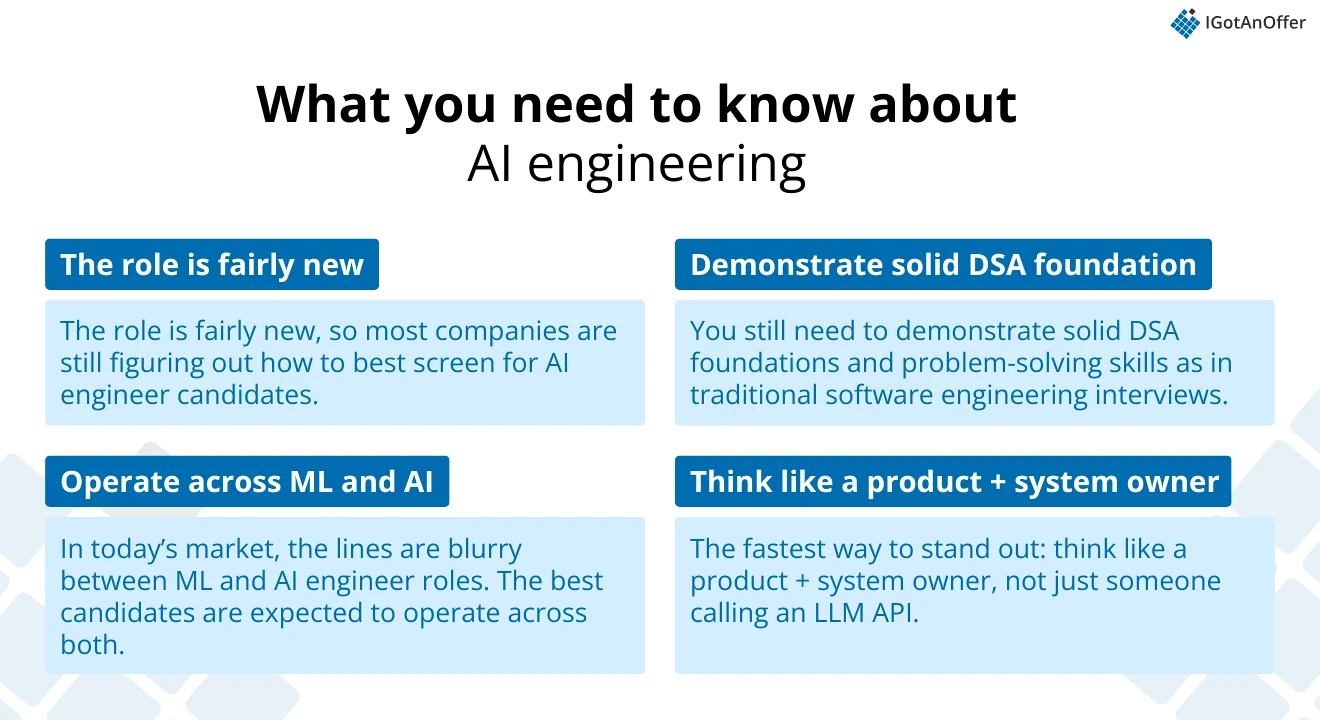
- The role is fairly new, so most companies are still figuring out how to best screen for AI engineer candidates.
- In today’s market, the lines are blurry between ML and AI engineer roles. The best candidates are expected to operate across both.
- You’ll still need to demonstrate solid DSA foundations and problem-solving skills as in traditional software engineering interviews.
- The fastest way to stand out: think like a product + system owner, not just someone calling an LLM API.
Given these, the best way to prepare is to know the different kinds of questions you can expect. Below, we give you the 6 most common question types, based on reports from Glassdoor across different companies, including Google, LinkedIn, Deloitte, and more.
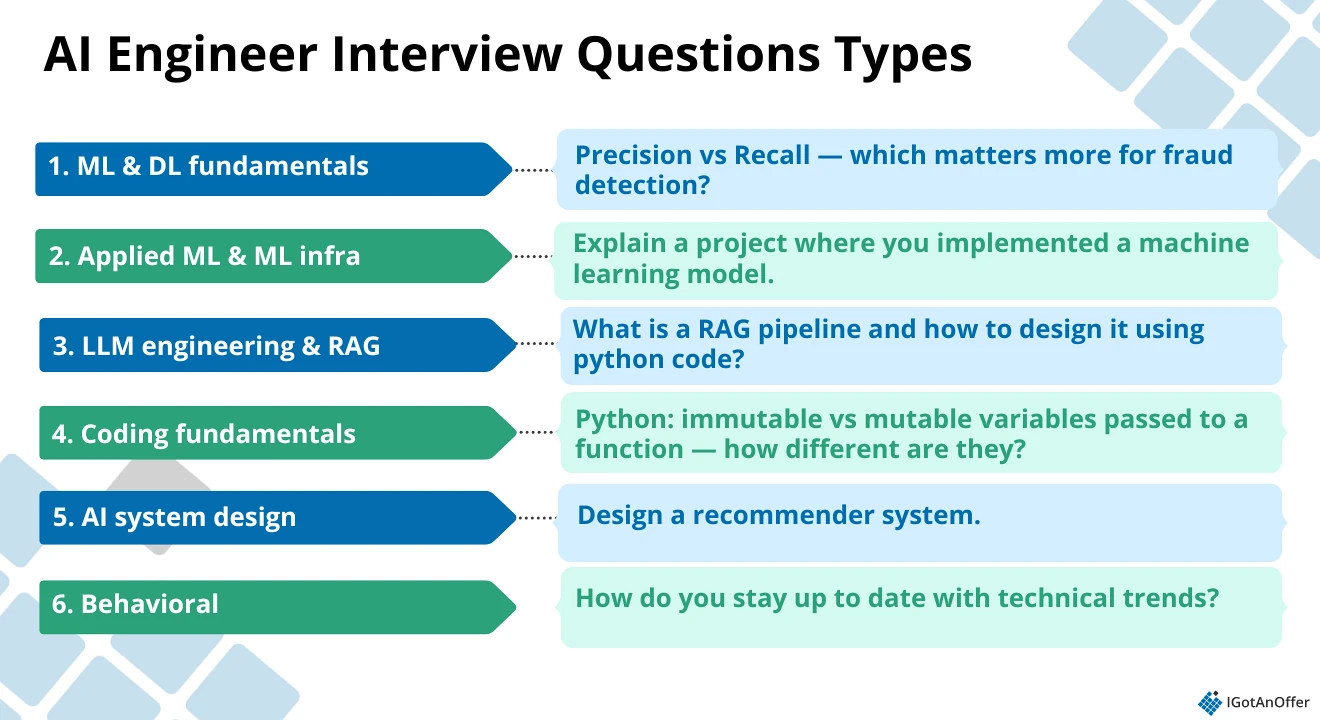
- Machine learning and deep learning fundamentals
- Applied machine learning and machine learning infrastructure
- LLM engineering and retrieval-augmented generation
- Coding/Python fundamentals
- AI system design
- Behavioral
Before we proceed with the questions, a note on our interview coach Viral who provided his expert insights for this guide.
Viral is currently an engineering leader at Meta. He previously worked at LinkedIn, where he built and led large-scale AI and recommendation systems. He has interviewed 200+ candidates across levels in ML, backend, platform, and product-focused engineering roles.
Now let’s look at the questions.
1.1 Machine learning and deep learning fundamentals↑
To ace your AI engineer interviews, you need to demonstrate foundational knowledge in machine learning, deep learning, and other related concepts.
For starters, make sure you can explain how to distinguish between the two concepts.
- Machine learning (ML). A subset of AI that involves designing, training, and deploying a computer system to perform and learn to improve tasks on its own.
- Deep learning (DL). A subfield of ML that involves the use of multiple layers of neurons within a neural network, allowing a machine to perform complex tasks like generating an image.
You could be tested on your knowledge of the different machine learning models and neural networks, generative AI, bias-variance trade-offs, and handling overfitting.
Let’s take a look at some example questions from AI engineer Glassdoor interview reports.
Example AI engineer interview questions: ML/DL fundamentals
- Precision vs Recall — which matters more for fraud detection?
- Explain precision/recall tradeoff.
- What is F1 score?
- What are underfitting and overfitting, and the tradeoff of each?
- Explain the significance of the ROC (Receiver Operating Characteristic) curve in machine learning.
- How to deal with overfitting?
- Give your detailed view about linear regression.
- Choose Linear Regression or Logistic Regression. Explain your pick and how you implement it.
- Explain Gradient Descent in machine learning.
- What algorithms would you use for a classification problem?
- What is your favourite ML model?
- Can you explain the basic principles behind Generative Adversarial Networks (GANs)?
- Explain the architecture and components of a Convolutional Neural Network (CNN)
- Tell me about BERT (Bidirectional Encoder Representations from Transformers) architecture.
1.2 Applied machine learning & machine learning infrastructure↑
As an AI engineer, you’ll be working with foundational models and finding ways to apply them to existing systems and APIs for problem-solving and optimization. You’ll also need to handle the ML infrastructure necessary for the deployment and scaling of these models. So be prepared to field questions on your hands-on ML application and infrastructure experience.
Let’s take a look at some real example interview questions.
Example AI engineer interview questions: Applied ML & ML infrastructure
- Explain a project where you implemented a machine learning model.
- How do you deal with certain situations of model training?
- Discuss a machine learning model you have experience with and its underlying principles.
- Explain RNN (Recurrent Neural Network) Transfer Learning.
- What is finetuning? How would you fine-tune X company’s model which uses hosted LLM models?
- Describe any AI pipelines that you implemented in any cloud.
- What does it mean for an algorithm to be numerically unstable?
- What are the trade-offs between using FP32, FP16, and BF16 precision when training large-scale models on NVIDIA GPUs?
- When dealing with massive datasets, how do you decide between using sparse matrix representations versus dense ones, and how does this affect memory bandwidth?
1.3 Large language model (LLM) engineering and retrieval-augmented generation (RAG)↑
Most, if not all, AI engineer roles will involve large language model (LLM) engineering, with a heavy focus on Retrieval-Augmented Generation (RAG). So demonstrating experience in both will give you a leg-up.
Expect questions on context limits, tokenization, cost/latency, and failure modes. Be explicit about failure modes, and don’t forget to discuss failure mitigation.
RAG experience is table stakes for any AI engineer roles, so be prepared to talk about embeddings, vector search tradeoffs, chunking, and grounding.
Let’s look at some example questions.
Example AI engineer interview questions: LLM engineering and RAG
- What is a RAG pipeline and how to design it using Python code?
- How do you deal with hallucination in LLMs?
- How are OpenAI embeddings different from normal deep learning embeddings?
- What is semantic searching?
- What are your metrics for evaluating RAG performance?
- Talk about prompt engineering principles.
- Explain LangGraph / LangChain.
- How would you optimize a RAG system that is currently returning noise, which increases context entropy and causes attention decay in the token sequence?
1.4 Coding fundamentals↑
To be a stand-out AI engineer candidate, focusing on your fundamentals is necessary, according to Viral. Not just in AI/ML, but also in your software engineering and coding basics.
If you look at many open AI engineer roles, you’ll find that most AI engineer roles will be software engineer roles with a focus on AI/ML. These roles typically require Python proficiency, DSA knowledge, and SQL experience for handling datasets. So it’s best to prepare for rounds testing for these skills.
Let’s take a look at some real example questions.
Example AI engineer interview questions: Coding fundamentals
- Python: immutable vs mutable variables passed to a function — how different are they?
- Python: what is the difference between is and ==?
- How would you build reproducible code?
- Write a code in Python to return a sorted order of a list of odd numbers extracted from a list of numbers. Do not use inbuilt sorted function. (Solution)
- In 2D array, find the shortest path to escape from a maze from top left to bottom right. (Solution)
- Given a string of parentheses, find the number of parentheses needed to make all parentheses closed. (Solution)
Check out our comprehensive list of coding interview example questions where you can find more example questions for Python, SQL, and other coding languages.
1.5 AI system design↑
According to Viral, AI engineer interviews evaluate you on your end-to-end system thinking, and not just on your knowledge or experience of tools.
He explains further that, whether you’re applying for an AI or ML engineer role, companies are looking to hire AI system builders. In particular, they want to know, “Can you build reliable AI systems?”
Aside from knowing how to build reliable systems, you need to demonstrate a deep understanding of how a system might fail. “If you can’t explain how your system breaks and how you’d fix it, you’re not ready,” Viral says.
Let’s see some real examples of AI system design questions.
Example AI engineer interview questions: AI system design
- How would you integrate an AI-based system to help a zoo owner improve their business?
- Design a recommender system.
- Design and implement a full system solution.
Take a look at our guides to the generative AI system design interview and ML system design interview for deep dives into the topics and more questions to practice with.
1.6 Behavioral questions↑
Based on our analysis of reported questions, AI engineers get a lot of AI-related behavioral questions, on top of the standard ones. Interviewers use behavioral questions to predict how you’ll perform and whether you'll fit well within a team.
Expect behavioral questions that test for skills necessary to thrive in an AI-focused role: problem-solving, comfort with ambiguity, communication skills, influence without authority, user empathy, ability to simplify complexity, cross-functional collaboration, and resilience.
You may also get hypothetical questions surrounding the ethics of AI, so be sure to read up on the topic beforehand.
Below, you’ll see examples from real AI engineer interview reports as well as typical behavioral questions in tech interviews.
Example AI engineer interview questions: Behavioral
- What is one unexpected challenge you ran into while working, and how did you tackle it?
- How do you stay up to date with technical trends?
- Tell me about a time you used data or experimentation to drive a decision in a high-ambiguity environment.
- How would you explain a complex AI system to a non-technical stakeholder and get buy-in?
- Give me an example of when you worked well within a team.
- Tell me about a time you dealt with conflict on a team. How did you solve it?
- Tell me about a time you failed at work / made a mistake at work.
- Tell me about a time you faced a really hard problem / a challenge at work.
- How do you deal with difficult customers/clients?
Take a look at our guide to behavioral interviews for more example questions and a deep dive into an effective answer framework.
Coaches who contributed to this guide



2. What you need to know about AI engineering↑
AI engineering is a relatively new field, but it’s fast becoming in demand as AI integration becomes a must in many industries.
In this section, we’ll look more closely at the role, how it differs from machine learning (ML) engineering, and its core competencies.
2.1 AI engineering vs. ML engineering
According to Viral (Meta engineering leader), AI engineering is an area where definitions are still evolving. “In practice, the lines between AI engineer and ML engineer roles are quite blurry,” he says.
One way to look at both roles is that they’re a spectrum. The best candidates are expected to operate across both.
Here are ways AI engineer and ML engineer roles differ and converge:
Day-to-day
- AI engineer: Orchestrates systems using models (LLMs, RAG, agents). Day to day leans toward working with LLM systems + pipelines (RAG, prompting, tools).
- ML engineer: Optimizes models (training, features, metrics). Day to day leans toward model training + evaluation.
Interviews
In interviews, expect a great overlap in knowledge and themes for evaluation:
- AI roles require experience with LLM-specific patterns (RAG, agents, grounding)
- MLE roles expect end-to-end thinking, not just modeling
- Both AI and ML engineers require ML fundamentals + system design
“Companies are not hiring for titles,” Viral says. Instead, they want to know if you can build reliable AI systems.
Minimum qualifications
In theory, there’s a clear demarcation between the two in terms of qualification.
- ML engineer: deeper ML theory
- AI engineer: stronger system-building + LLM experience
However, in practice, for you to qualify for either role, you’d need to demonstrate ML intuition + system design + product sense.
Ultimately, what you need to know is that the industry is moving from model specialists to AI system builders. “If you can only do one, you’re already behind,” Viral says.
2.2 AI engineering core knowledge and competencies
Generally, AI engineers work with foundational models and are therefore required to be well-versed with existing AI tools. However, you can’t just be proficient with tools and techniques. You need to demonstrate that you know the fundamentals behind them.
According to Viral, experience and knowledge in the following are fundamental if you want to qualify as an AI engineer:
- LLM basics. Context limits, tokenization, cost/latency, and failure modes (hallucination, prompt sensitivity)
- RAG experience. Embeddings, vector search tradeoffs, chunking, grounding
- System design thinking. Pipelines: Input → Retrieval → Generation → Verification, plus caching, cost, and reliability
- Evaluation. Not just accuracy, but also for faithfulness, usefulness, and safety
Evaluation, in particular, represents the biggest skill gap among AI engineer candidates. So if you want to stand out, this is an area you need to emphasize.
Ultimately, Viral says, “The fastest way to stand out is to think like a product PLUS system owner, not just someone calling an LLM API.”
3. AI engineer interview tips ↑
You might be a fantastic AI engineer, but unfortunately, that’s not enough to ace your AI engineer interviews. Interviewing is a skill in itself that you need to learn.
To position yourself as a strong AI engineer candidate, here are some interview tips and best practices from our coach, Viral (Meta engineering leader).
3.1 Lead with product and business metrics
Whether you’re answering an AI system design challenge or tackling an applied ML question, don’t jump straight to proposing an LLM model or a technique.
Instead, lead with product impact. Ask yourself, what are you optimizing here? "Anchor your answers on user value and business metrics like task success, retention, latency, or cost," Viral says.
3.2 Think in end-to-end systems
Frame solutions as a pipeline: Input → Retrieval → Generation → Verification → Feedback. But don’t just end there. Explain how each stage can fail and how you propose to fix it.
Also, don’t present static designs. Instead, close with an iteration mindset. Start simple and evolve your system by measuring, identifying bottlenecks, and ending with ideas for iteration and improvement. "Only add complexity where it moves metrics," Viral says.
3.3 Be ready to talk about trade-offs
If you’re specifically targeting a senior role, proactively talking about trade-offs will help you stand out.
When discussing trade-offs, don’t just name techniques. Instead, explain your decisions. Below are a few common trade-offs you might have to make, according to Viral:
- Quality vs latency vs cost
- Internal model vs external API
- Retrieval depth vs hallucination risk
3.4 Call out failure modes proactively
Don’t avoid digging deep into failure modes during your interviews. To set yourself apart as an AI engineer, you should be able to point out how any given system might fail.
Could a system fail because of hallucination, bad retrieval, or prompt brittleness? Also, talk about what you plan to do should a given failure mode occur. This shows real-world readiness.
3.5 Show evaluation rigor
Be prepared to talk about how you evaluate a system. Not just for accuracy but for faithfulness (is it grounded?), usefulness (does it solve the user problem?), and safety (does it avoid harmful inputs?)
Viral adds the following as 'bonus points' for evaluation rigor: offline evaluation, online A/B tests, and human-in-the-loop.
3.6 Demonstrate pragmatic judgment
"To be a standout candidate, you need to show your pragmatic judgment," Viral says.
Don’t hesitate to say things like:
- “I wouldn’t use an LLM here—it’s overkill”
- “We can get 80% with a cheaper model + rules”
- “We should gate expensive calls behind confidence thresholds”
Proactively calling out these ideas shows ownership of cost and reliability.
4. How to prepare for AI engineering interviews↑
As you can see from the complex questions above, there is a lot of ground to cover when it comes to AI engineer interview prep. So it’s best to take a systematic approach to make the most of your practice time.
Below are links to free resources and a plan to help you prepare for your AI engineer interviews.
4.1 Familiarize yourself with the interview process
Most open AI engineer roles are either labeled ML engineer or software engineer with a focus on AI systems. And because the role is quite new, most companies are still figuring out how to best screen for it.
However, you don’t want to enter the process without knowing a thing about it. We recommend looking into SWE and MLE interview processes to get an idea of how they generally work.
Below is a list of our company-specific interview guides to get you started:
- Google software engineer interview
- Meta software engineer interview
- Amazon software development engineer interview
- NVIDIA software engineer interview
- OpenAI interview process
- OpenAI behavioral interview
- OpenAI coding interview
- OpenAI software engineer interview
- Microsoft software engineer interview
- Airbnb software engineer interview
- LinkedIn software engineer interview
- Google machine learning engineer interview
- Meta machine learning engineer interview
- Amazon machine learning engineer interview
- Apple machine learning engineer interview
- Anthropic interview process
- Anthropic culture interview
- Anthropic system design interview
- Apple interview process
- TikTok interview process
- Netflix interview process
- Uber interview process
4.2 Brush up on relevant knowledge
Because the AI engineer role requires working with foundational models and tools, it can be tempting to focus on those aspects of the role. But as Viral says, “Strong candidates focus on fundamentals.” So be sure to brush up on those.
Here are a few resources to help you start your review.
AI/ML/DL fundamentals
- AI Frameworks and Libraries Every Software Engineer Should Know
- Fundamentals of Machine Learning
- Deep Learning Fundamentals Handbook
- Case Studies: AI-Driven Innovation
LLM/RAG
Coding fundamentals
- Ultimate DSA questions guide
- Coding interview prep guide
- Python for AI engineers
- SQL for AI and Machine Learning
AI system design
Behavioral interviews
4.3 Learn about your target company’s products and AI initiatives
If you’ve already got a target company, make sure you read up on their products and AI initiatives. Most companies will have a specific landing page for their AI initiatives, so that’s a great place to start.
Meta
Amazon/AWS
OpenAI
Anthropic
4.4 Focus on developing end-to-end AI system thinking
To stand out as an AI engineer, you need to think beyond tools and instead build on your end-to-end AI system thinking.
Viral (Meta engineering leader) recommends doing the following to develop this essential skill to prepare for your AI engineering interview.
- Build real systems (not demos): RAG, agents, tool use. This will help you understand failure modes.
- Practice AI system design: focus on discussing pipelines and their tradeoffs (quality, latency, cost)
- Learn to debug: retrieval vs prompt vs model issues
Most importantly, prepare an evaluation story, showcasing how you measure quality and detect regressions.
4.5 Do mock interviews
Once you’re in command of the subject matter, you’ll want to practice answering questions.
You can start practicing by yourself. Act the part of the interviewer and interviewee. You can also record yourself to assess your performance.
This should just be the first part of your practice. Because by yourself, you can’t simulate thinking on your feet or the pressure of performing in front of a stranger. Plus, there are no unexpected follow-up questions and no feedback.
That’s why many candidates try to practice with friends or peers.
4.5.1 Practice with peers
If you have friends or peers who can do mock interviews with you, that's an option worth trying. It’s free, but be warned, you may come up against the following problems:
- It’s hard to know if the feedback you get is accurate
- They’re unlikely to have insider knowledge of interviews at your target company
- On peer platforms, people often waste your time by not showing up
For those reasons, many candidates skip peer mock interviews and go straight to mock interviews with an expert.
4.5.2 Practice with experienced AI engineer interviewers
In our experience, practicing real interviews with experts who can give you company-specific feedback makes a huge difference.
Find an AI engineer interview coach so you can:
- Test yourself under real interview conditions
- Get accurate feedback from a real expert
- Build your confidence
- Get company-specific insights
- Learn how to tell the right stories, better.
- Save time by focusing your preparation
Landing a job at a big tech company often results in a $50,000 per year or more increase in total compensation. In our experience, three or four coaching sessions worth ~$500 make a significant difference in your ability to land the job. That’s an ROI of 100x!







 People management and Leadership