

 Back to other articles


 Last updated: June 09, 2026

 Interviews
 Software engineer, Engineering manager
 System design
 Deeply researched
Preparing for an Anthropic system design interview can feel intimidating, but with the right approach, it’s manageable.
To succeed, you’ll need a strong understanding of system design fundamentals, enough machine learning knowledge to reason about model-driven systems, and the ability to balance trade-offs across reliability, latency, cost, and safety while clearly explaining your thinking.
At Anthropic, safety and reliability are especially important, even in system design, so you should be ready to reflect that in your design decisions.
We’ll start by walking through what to expect in an Anthropic system design interview. From there, you’ll see common questions with sample answer outlines, along with expert tips and a step-by-step prep plan to help you improve your interviewing skills.
- What to expect from your Anthropic system design interviews
- System design topics to brush up on
- Common Anthropic system design interview questions (and answers)
- More Anthropic system design questions
- Tips to improve your system design interviewing technique
- How to prepare
Click here to practice 1-on-1 with system design ex-interviewers
Let’s get started.
1. What to expect at an Anthropic system design interview
You can expect Anthropic system design interviews for senior and staff-level software engineer, engineering manager, and infrastructure roles. In this guide, we’ll focus on system design interviews for SWE roles.
Before we get into the common questions asked, let’s look at how system design interviews work at Anthropic and what’s expected per level.
1.1 How do Anthropic system design interviews work?
System design interviews at Anthropic are 50–55-minute sessions focused on building AI infrastructure rather than standard web applications. These rounds evaluate how you design systems that operate at scale while meeting strict safety and reliability requirements.
The interview typically begins with an open-ended prompt, such as “Design the Claude chat service.” You’re expected to lead the discussion by defining the scope and designing systems around large language models (LLMs), including retrieval systems, evaluation pipelines, safety monitoring, and model serving infrastructure.
According to Tarek (ex-FAANG interviewer), who has coached Anthropic candidates, Anthropic’s system design interviews differ from traditional FAANG interviews because the focus is less on scaling standard web applications and more on designing systems around AI and ML workloads.
Instead of prompts like “Design Twitter,” you may encounter problems related to inference batching systems, evaluation pipelines, or AI safety and red-teaming workflows.
This also introduces a different set of constraints. In addition to standard system design topics like scalability and reliability, candidates may need to discuss GPU memory usage, latency trade-offs, KV cache optimization, and the challenges of serving LLMs efficiently in production.
Tarek adds that Anthropic interviews are more collaborative and discussion-driven than presentation-heavy. Interviewers will actively discuss trade-offs and constraints with you throughout the session. They care less about drawing the “perfect” diagram and more about how you reason through system interactions, data flow, safety, and deployment decisions.
1.2 What skills do Anthropic system design interviews test?
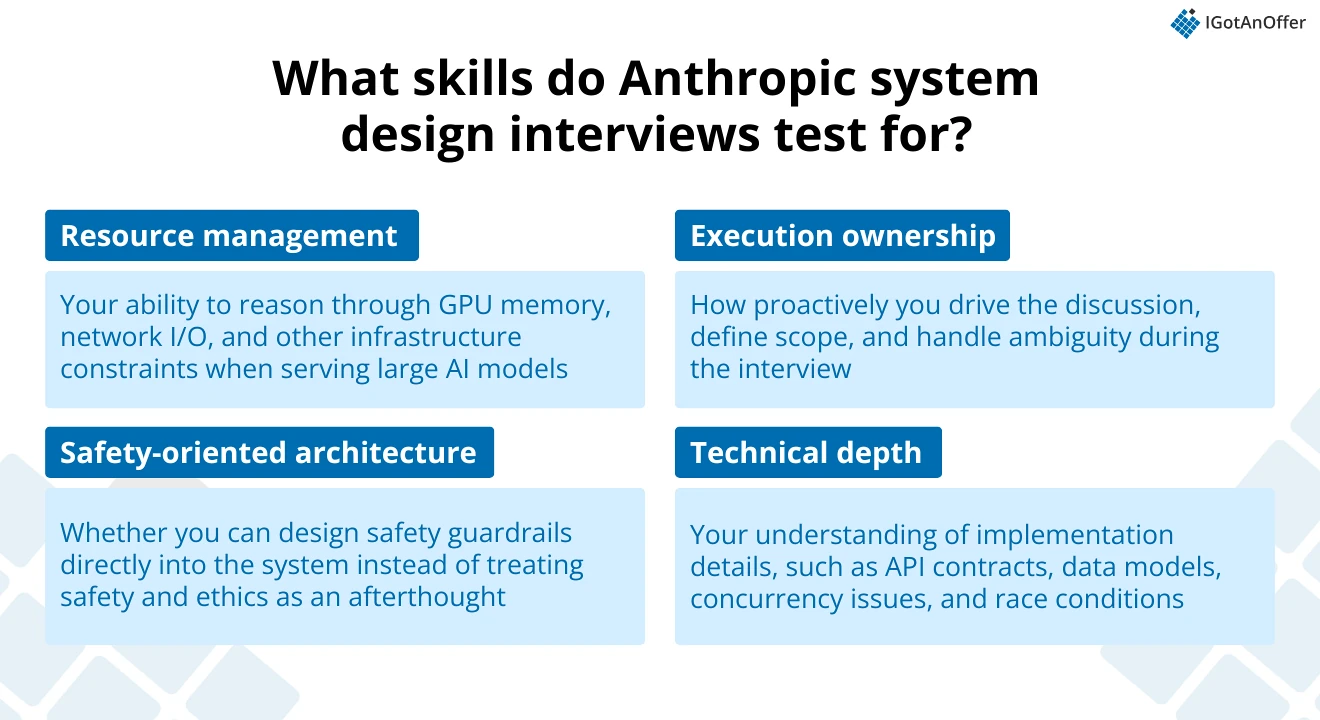
Interviewers want to know that you can design scalable and reliable AI systems while reasoning through ambiguity and trade-offs. According to Tarek (ex-FAANG interviewer), who has coached Anthropic candidates, you’ll be tested on the following skills:
- Resource mastery: reasoning through GPU memory, KV cache optimization, network I/O, and other infrastructure constraints involved in serving large AI models efficiently
- Architectural safety: designing safety guardrails directly into the request flow rather than treating safety and ethics as an afterthought
- Execution ownership: proactively driving the discussion, defining scope, and handling ambiguity instead of waiting for the interviewer to lead the design process
- Technical depth: understanding lower-level details such as API contracts, data models, concurrency issues, and race conditions, rather than only discussing high-level design
1.3 System design interview performance expectations per level
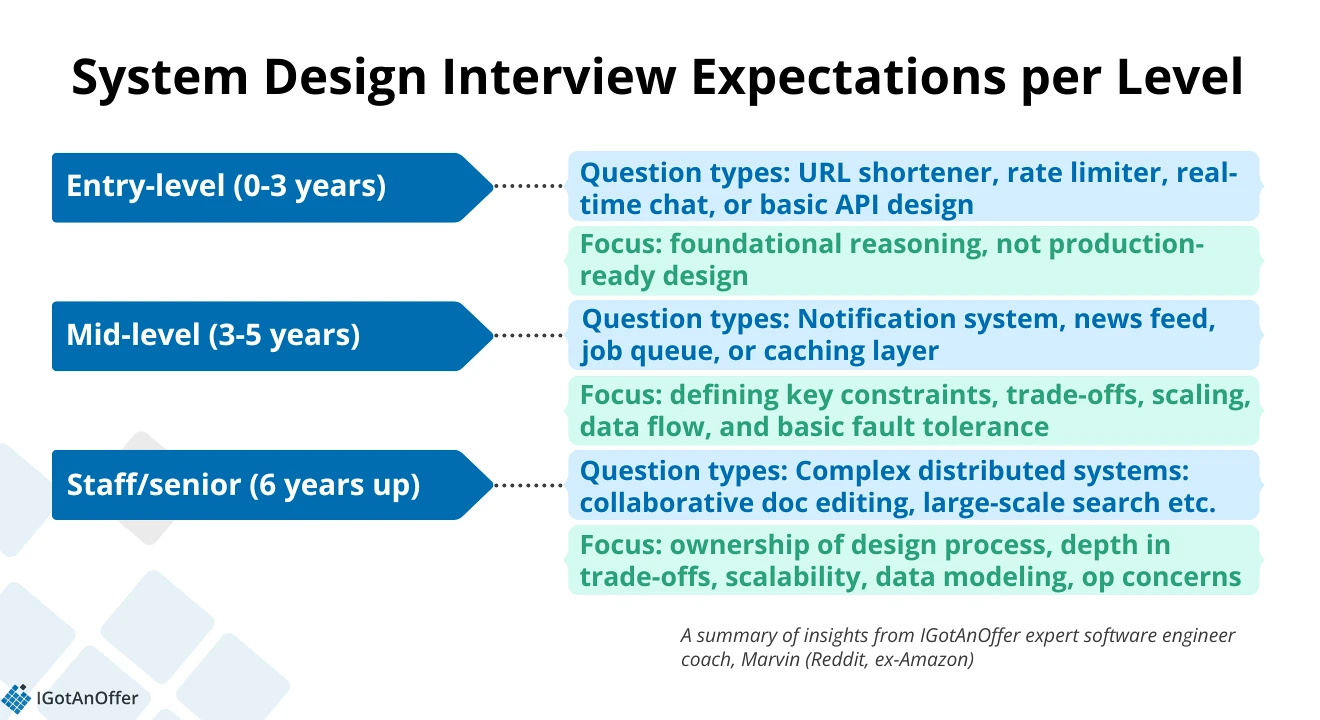
The requirements for system design interview performance vary by career level. Although Anthropic doesn’t publicly define level-specific expectations, below are the general types of questions you can reference and what interviewers typically expect you to cover at each level.
Entry-level engineer
As mentioned earlier, system design interviews are more common for mid- to senior-level positions. However, entry-level candidates may still encounter basic system design questions to assess their knowledge of core concepts.
As a junior engineer with less than 3 years of experience, you could expect basic system design questions. The most common ones you’ll get are for a URL shortener (Design TinyURL), rate limiter, real-time chat, or any basic API design.
“At this level, interviewers typically don’t expect full architectural depth,” Marvin (SWE expert coach) says. So you don’t need to provide a production-ready design. Instead, the focus will be on foundational reasoning.
You’ll need to demonstrate clarity in communication, structured thinking, and basic understanding of key components (e.g., databases, caches, queues). These matter more than getting the 'right' answer.
How to ace your system design interview as an entry-level engineer? Marvin’s advice: “Asking clarifying questions and articulating trade-offs go a long way.”
Mid-level engineer
Applying for a mid-level position requires a step up in systems thinking and component-level discussion. To assess you on these, interviewers will likely ask you to design a notification system, a news feed, a job queue, or a caching layer.
During your system design interview, you should drive the conversation, define key constraints, and discuss trade-offs. Marvin says, “You’ll be expected to go deeper into scaling, data flow, and basic fault tolerance.”
Finally, according to Marvin, good signals for mid-level engineers include thoughtful simplification and an awareness of real-world constraints.
Senior/staff engineer
The rule of thumb for SD interviews is that the more senior you are, the more system design interview sessions you’ll need to go through.
The level of complexity expected from your system design interviews also changes. At your level, you should have ownership of the entire design process, according to Marvin.
The questions you’ll get will likely be about complex distributed systems like collaborative document editing, large-scale search, or real-time analytics pipelines. Expect discussions around sharding, consistency, rate limiting, and trade-offs at scale.
At the staff level, you are expected to think about longer-term considerations such as system maintenance and future development.
You should also be able to show the importance of “proactively addressing cross-cutting concerns like operational and deployment toil, security, privacy, and team hiring”.
Furthermore, candidates should be able to make reasonable build-versus-buy decisions given budget and control constraints, and identify bottlenecks at multiple levels, from high-level architecture down to OS-level performance issues.
If you're specifically targeting a Staff-level role, we also recommend checking out our Staff system design interview guide for a deeper dive into what interviewers expect at this level
1.4 High-level design (HLD) vs. low-level design (LLD)
Now, let’s get into the difference between high-level design (HLD) and low-level design (LLD).
1.4.1 High-level design or HLD
You could describe HLD as the bird’s-eye view or the big picture of an entire system architecture. With HLD, you would be expected to cover the following:
- Functional requirements: Core features (send message, post tweet, search user, generate responses, retrieve documents, validate outputs, etc.)
- Non-functional requirements: Scale, latency, throughput, availability, consistency, cost, and response quality
- Traffic estimates and capacity planning: Requests/sec, storage size, growth projections.
- Architecture components:
- Load balancers
- Application/API servers
- Databases (SQL vs NoSQL, sharding, replication)
- Caches, queues, CDNs, pub/sub
- LLM inference services
- Vector databases or embedding services
- Model serving layers, evaluation systems, and safety/moderation components
- Data flows: Read path vs write path, how requests move through the system, including prompt construction, retrieval, model inference, and post-processing
- Trade-offs: CAP theorem, eventual vs strong consistency, cost vs scalability, quality vs latency
The goal of your interviewer is to assess whether you can design a reliable and scalable system that can work in real-world conditions and constraints.
1.4.2 Low-level design or LLD
LLD goes deeper into the details of how a system works, i.e., how the internal components are structured and work together. With LLD, you will be expected to cover:
- Object-oriented modeling: Classes, objects, interfaces, relationships
- Design patterns: Factory, Strategy, Observer, Singleton, etc.
- APIs and methods: Clear function signatures, parameters, return types
- Data models: Table schemas, indexes, relationships, how queries are optimized
- Component interactions: Sequence diagrams showing how services interact, including retrieval, inference, and validation steps
- Edge cases and validations: Error handling, retries, fallbacks, and handling incorrect or unsafe outputs
- Maintainability: Clean abstractions, modularity, extensibility
Asking you to drill down into LLD, interviewers want to see how you would translate and implement a high-level design for real-world use.
You should be able to communicate clearly and in depth, anticipate real-world constraints (and suggest ways to address them), and reason about trade-offs.
1.4.3 HLD vs. LLD - what will you cover at your level?
So, which one would you be expected to cover at your Anthropic system design interview?
For freshers and entry-level engineers, a basic understanding of system design concepts is expected, but nothing too complex.
When you do look it up online, you’ll see that freshers and entry-level do get LLD questions. But these will mostly focus on testing your knowledge of Object-Oriented Programming (OOP) fundamentals, design patterns, and coding hygiene.
Typically, covering both HLD and LLD is expected in mid-level engineers. At this level, you’re expected to own features end-to-end, so you must be able to design APIs, schemas, AND consider scale and integration.
At a senior or staff level, you’ll mostly focus on HLD, designing systems at a scale that can serve millions of users. However, you could also be asked to drill down into LLD. You need to prove that you can bridge high-level architecture with low-level implementation.
To learn more about these two topics, we recommend reading the following deep dives:
Coaches who contributed to this guide

















2. Core topics to brush up on for your Anthropic system design interviews↑
To prepare for Anthropic system design interviews, you should first brush up on the standard GenAI and ML system design topics that commonly appear in AI-focused interviews. For that, we recommend checking out our GenAI system design and ML system design guides.
After that, Tarek (ex-FAANG interviewer), who has coached Anthropic candidates, recommends focusing on the following high-signal areas:
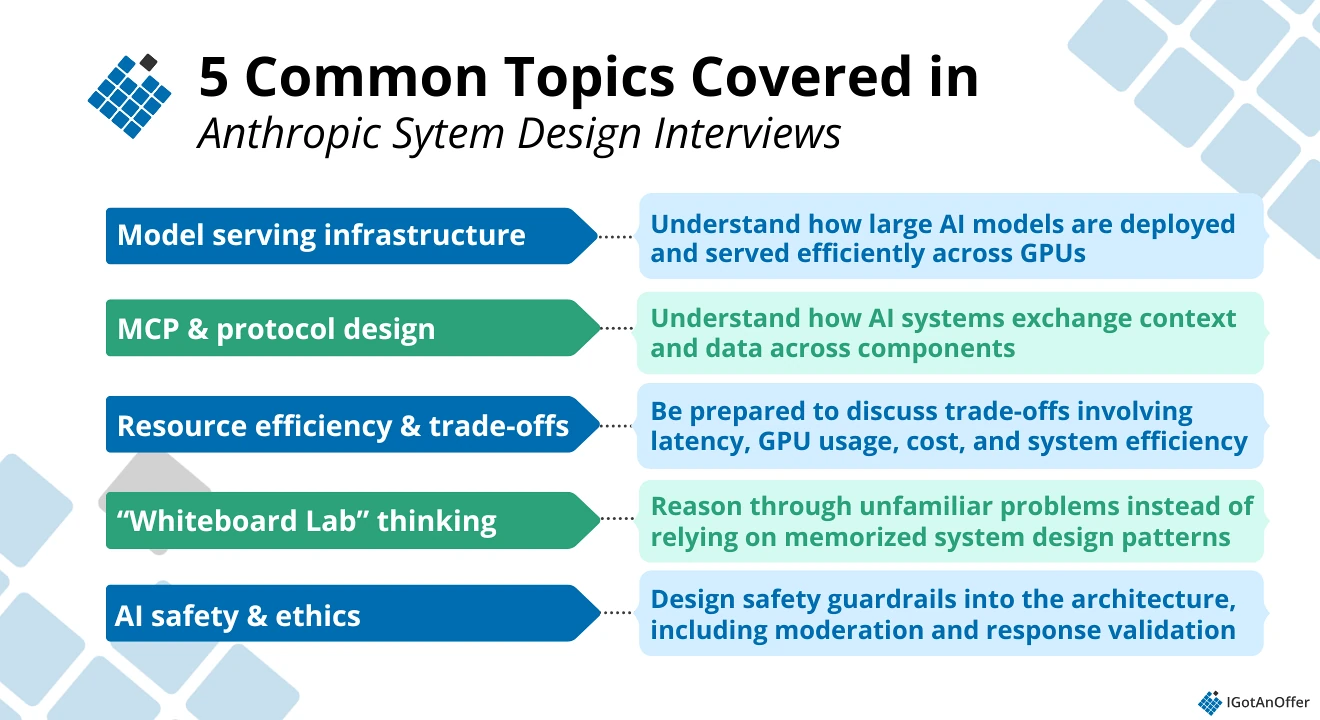
Here's a detailed overview:
- Model serving infrastructure (GPU scheduling and orchestration): Understand how large models are deployed and served efficiently across GPUs, including batching, scaling, and resource allocation trade-offs.
- Model Context Protocol (MCP) and protocol design: Be familiar with how AI systems exchange context and data across components, including APIs, data flow, and communication reliability.
- Resource efficiency and infrastructure trade-offs: Anthropic places strong emphasis on efficient compute usage. Be prepared to discuss trade-offs involving latency, GPU usage, cost, and system efficiency.
- “Whiteboard Lab” vs “Pattern Matching”: Tarek describes Anthropic interviews as more of a “Whiteboard Lab” because candidates are expected to reason through unfamiliar AI infrastructure problems, rather than rely on memorized or familiar system design patterns commonly used in traditional FAANG interviews.
- AI safety and ethics: Anthropic places heavy emphasis on building safe and reliable AI systems, so safety should be treated as a core part of the architecture rather than an afterthought. Be prepared to discuss safeguards such as input/output filtering, moderation layers, response validation, and mechanisms that prevent harmful model behavior.
3. Common Anthropic system design interview questions (and answers) ↑
Now that you know the different expectations for system design interviews at various levels, let’s get into some common Anthropic system design questions.
We picked out three of the most commonly asked questions, explained why interviewers at Anthropic ask them, and provided sample outlines using the 4-step answer framework below that we often recommend to candidates (see Section 5.2 for a detailed explanation).
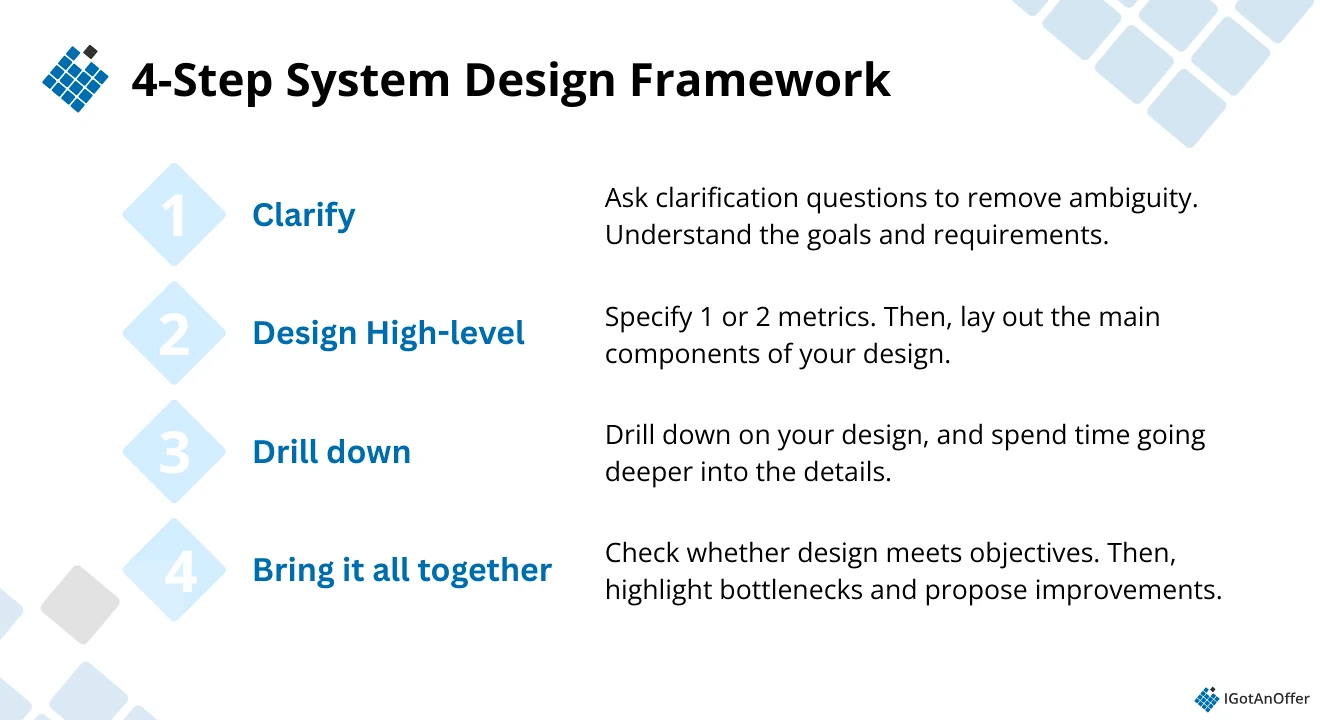
Try working on the system design interview question first, and then check your answer against the expert’s to find out where you can still improve.
- Design the Claude chat service
- Design APIs for developers to access Anthropic’s AI models securely and efficiently
- Design a high-concurrency inference API / parallel processing pipeline
Let’s dive into each.
3.1 Design the Claude chat service ↑
Claude is Anthropic’s flagship product, so it’s no surprise that this question comes up frequently in system design interviews during the onsite interviews.
As a candidate for Anthropic, you should be able to design end-to-end systems that power products like Claude, from request handling and model inference to safety and monitoring.
Interviewers use this question to assess whether you can design a large language model (LLM)-powered chat system that is scalable, reliable, and safe. You’ll need to think beyond the chat interface and cover areas like model serving, conversation state, latency, and safety controls.
Let’s look at a sample outline you can use.
Example answer outline: “Design the Claude chat service.”
1. Ask clarifying questions
- Functional: Real-time chat, multi-turn conversations, conversation history, streaming responses, multi-device support
- Non-functional: Low latency, high scalability, high availability, strong safety guarantees, and cost efficiency
2. Design high-level
- Client/API: Clients connect via API gateway (authentication, rate limiting)
- Orchestration: Handles request routing, prompt construction, and session context
- LLM serving: Claude model generates responses with streaming support
- Storage: Store conversation history and metadata (NoSQL / time-series DB)
- Safety: Input/output moderation and policy enforcement
- Retrieval (optional): Use RAG to fetch external data when needed
3. Drill down on the components of your design
- Conversation state: Store and retrieve context; use truncation or summarization for long threads
- Model serving: GPU-backed inference, autoscaling, request batching
- Latency: Streaming responses, caching repeated prompts, minimizing hops
- Safety: Pre/post-generation filtering, monitor unsafe or low-quality outputs
- Session handling: Maintain consistent user sessions across devices
4. Bring it all together by addressing potential problems and optimizations
Scalability and performance
- Horizontal scaling: Stateless services behind load balancers
- Batching: Group requests to improve throughput and reduce cost
- Caching: Cache frequent queries or partial outputs
Safety
- Guardrails: Enforce policies at input and output stages
- Monitoring: Track unsafe outputs and user feedback
Monitoring and logging
- Metrics: Track latency, errors, and system health
- Logging: Store prompts/outputs (with privacy controls) for debugging
Identified challenges and trade-offs
- Latency vs. quality: Faster responses vs. better outputs
- Cost vs. scale: LLM inference is expensive
- Context limits: Managing long conversations within token limits
- Reliability: Handling model failures and degraded performance
Proposed enhancements
- Personalization: Improve responses using user context
- Fine-tuning: Adapt model for specific domains
- Caching layers: Reduce repeated inference costs
3.2 Design APIs for developers to access Anthropic’s AI models securely and efficiently ↑
This question tests your ability to design the infrastructure behind Anthropic’s developer platform.
Interviewers want to see how you would expose AI models through APIs while managing scale, security, rate limits, authentication, usage tracking, and reliability. Since developers may build production systems on top of these APIs, your design needs to support high availability, predictable latency, and safe access controls.
Here’s one way you can approach this question.
Example answer outline: “Design APIs for developers to access Anthropic’s AI models securely and efficiently.”
1. Ask clarifying questions
- Scope: Are we exposing only inference APIs, or also fine-tuning, embeddings, and evaluation endpoints? Do we need streaming responses?
- Functional requirements: Submit prompts, receive responses (streaming or batch), manage API keys, track usage, support model/version selection
- Non-functional requirements:
- Scale: Millions of requests/day with bursty traffic
- Latency: Sub-second for most responses, streaming for longer outputs
- Availability: Highly available, possibly multi-region
- Consistency: Eventual consistency acceptable for usage/logging
- Constraints: GPU cost, safety requirements, abuse prevention, and quota enforcement
2. Design high-level
- Clients: Developer apps call APIs over HTTP/WebSockets
- APIs: Core endpoints – CreateCompletion, StreamCompletion, GetUsage, ManageKeysTraffic management: API gateway + load balancer
- Application/API servers: Stateless, handle auth, validation, routing
- Model routing: Route requests to correct model/version (Claude variants)
- Inference service: GPU-backed LLM serving layer with batching support
- Data storage:
- Metadata (users, API keys, quotas) in DB
- Logs/usage in data pipeline or warehouse
Safety layer: Input/output filtering, policy enforcement - Core entities:
Requests (requestId, userId, model, prompt, tokens, status)
Users (userId, API keys, quotas, usage)
3. Drill down on your design
- Authentication: API keys with scoped permissions and org-level controls
- Rate limiting: Token-based and request-based quotas
- Model versioning: Support multiple model versions and safe rollouts
- Streaming: Token-by-token output for better UX and latency.
- Batching: Group requests to improve GPU efficiency
- Usage tracking: Token counts, latency, errors for billing and monitoring.
- Safety: Pre/post-generation checks to prevent unsafe outputs.
- Performance considerations:
- High cost per request due to GPU inference
- Variable latency depending on prompt length
- Bottleneck handling: Inference service saturation
- Solution: queueing, batching, autoscaling
- Reliability/availability:
- Stateless API layer
- Redundant inference clusters
- Retry + fallback logic
- Monitoring for latency, errors, and abuse
4. Bring it all together
- Start from scope: expose LLM inference APIs with streaming support
- Expose APIs behind a gateway with authentication, rate limiting, and validation
- Route requests through a model routing layer to GPU-backed inference services
- Batch and queue requests to optimize GPU utilization and reduce cost
- Apply safety checks before and after inference to enforce policies
- Scale using stateless API servers, autoscaling inference workers, and multi-region deployment
- Monitor latency, token usage, error rates, and safety signals
- Acknowledge trade-offs and extensions: latency vs safety checks, cost vs availability, fine-tuning APIs, and improved developer tooling
3.3 Design a high-concurrency inference API / parallel processing pipeline ↑
This question focuses on how you would serve model requests at scale.
Anthropic’s systems need to handle many simultaneous requests while keeping latency and cost under control. Interviewers use this question to test your understanding of inference serving, batching, queuing, load balancing, backpressure, and failure recovery.
A strong answer should explain how requests move through the system, how you handle traffic spikes, and how you balance throughput, latency, and reliability.
Let’s get into a sample outline you can use to structure your answer.
Example answer outline: “Design a high-concurrency inference API / parallel processing pipeline”
1. Ask clarifying questions
- Scope: Are we optimizing for low-latency interactive use or high-throughput batch processing?
- Functional requirements: Accept prompts, run inference, return responses, support retries, and streaming
- Non-functional requirements:
- Scale: Millions of concurrent inference requests
- Latency: Low latency for interactive use cases
- Throughput: Maximize GPU utilization
- Availability: Highly reliable system
- Constraints: Expensive GPU resources, safety checks, variable request sizes
2. Design high-level
- Clients: Applications send inference requests via APIs
- APIs: SubmitRequest, StreamResponse, CheckStatus
- Traffic management: Load balancer distributes traffic
- Queue: Buffers requests to handle spikes
- Scheduler: Groups requests into batches based on size and latency targets
- Inference workers: GPU-backed services process batches in parallel
- Response service: Streams or returns results
- Safety layer: Applies input/output checks
- Monitoring: Tracks latency, throughput, GPU utilization
- Core entities:
- Requests (requestId, model, input, tokens, priority, status)
- Workers (workerId, GPU capacity, load, health)
3. Drill down on your design
- Batching: Combine requests to improve GPU efficiency
- Scheduling: Balance latency vs throughput when forming batches
- Backpressure: Queue, throttle, or reject requests under heavy load
- Autoscaling: Scale workers based on queue depth and GPU utilization
- Failure handling: Retry failed requests and isolate unhealthy workers
- Performance considerations:
- High variability in request size and compute cost
- Need to balance cost and responsiveness
- Bottleneck handling: Queue buildup or GPU saturation
- Solution: dynamic scaling + prioritization
- Reliability/availability:
- Redundant worker pools
- Health checks and failover
- Graceful degradation
4. Bring it all together
- Start from goal: serve high volumes of LLM inference requests efficiently
- Accept requests through an API layer and buffer them with a queue
- Batch requests and process them in parallel on GPU-backed workers
- Distribute load with load balancing and autoscaling
- Stream responses back while managing backpressure
- Ensure reliability with retries, failure isolation, and graceful degradation
- Monitor latency, throughput, queue depth, GPU utilization, and error rates
- Acknowledge trade-offs and extensions: batching vs latency, cost vs performance, prioritization, and improved scheduling strategies
3.1 More Anthropic system design questions ↑
Now, let’s get into the complete list of system design interview questions reported on Glassdoor for Anthropic SWE roles.
Keep in mind that, in most cases, your interviewer will adapt the question to your background. For example, if you’ve worked extensively on backend services or APIs, you may be asked to design a system in a similar domain.
However, that won't always be the case. So, it’s best to practice with the questions below to be ready to design any type of product or system at a high level.
Examples of Anthropic system design interview questions: software engineers
- Design the Claude chat service
- Design a distributed search system for 1 billion documents at 1 million QPS. Cover sharding, caching, and LLM inference scaling.
- Design a batched inference system where 100 requests take the same time as 1. Use a queue to batch requests.
- Design a system that enables a large language model to handle multiple questions in a single thread
- Design APIs for developers to access Anthropic's AI models securely and efficiently
- Design a file-sharing / distribution system
- Design a high-concurrency inference API / parallel processing pipeline
Check out our comprehensive guide to system design interviews, where you’ll find more insights and example questions, and answer outlines from FAANG experts.
If you're applying for an AI/ML engineering role, you can also check out our ML system design interview or generative AI system design interview guides.
4. Tips for answering Anthropic system design questions ↑
For this section, we’ve gathered tips from four of our system design interview coaches: Tarek, Mark, Marvin, and Oussama. Collectively, they’ve conducted hundreds of interviews, both actual and mock, at Anthropic and other top tech companies such as Google, Meta, and Amazon.
Here are their tips, based on what they’ve seen on the ground:
Tip #1: Communicate efficiently
Thirty-five to sixty minutes is an artificially compressed time. You won't be used to working and talking about things at this speed, and so you need to practice communicating with the interviewer efficiently.
During the interview, you want to make sure the interviewer can follow your thought process. It’s completely fine if they don’t agree with every single decision you make.
“What you need to do is keep your mental model of what you’re thinking and their mental model as closely aligned as possible,” says Mark (ex-Google engineering manager).
Tip #2: Reduce the scope of the problem
In Anthropic system design interviews, you're often asked to design entire large-scale systems like Claude. In ~45mins, this is impossible, so first you need to reduce the scope.
For example, you might suggest to your interviewer that you focus on a specific, crucial part of the system, such as the backend architecture or a particular feature (e.g., if you were designing Spotify, this might be the music recommendation engine).
"Scope the problem to a size that you think you can complete during the interview,” says Mark.
Tip #3: State your assumptions clearly
Most Anthropic system design questions are intentionally vague because interviewers want to see how you handle ambiguity and make reasonable decisions with incomplete information.
By stating your assumptions early on, you give the interviewer a chance to confirm or correct your direction before you go too far down the wrong path.
“Feel free to make assumptions as long as you communicate them clearly. Share your thought process, including both the choices you make and the ones you discard.” Oussama (ex-Amazon ML solutions architect)
Tip #4: Start drawing ~15 minutes in
Drawing is an important visual aid to help the interviewer understand your answer. A good rule of thumb is to start drawing around a third of the way into the interview. Ideally, once you’ve clarified the requirements and aligned on scope.
This ensures that your diagram supports the discussion and doesn’t lock you into a premature design.
“If you start drawing too soon, you might start going down a road that doesn’t address the problem,” says Mark.
Tip #5: Start with a simple design and iterate
When working through a system design problem, aim to get to a working solution first, then iterate. Don’t get sidetracked by adding requirements that didn’t exist in the question, as these will complicate your design.
You can always acknowledge a specific item and come back to it later. For example, “We’ll need to use caching here, but I’ll come back to that later.”
“Candidates often make the mistake of designing for an unrealistic scale without grounding in problem constraints, and not prioritizing or evolving the design incrementally,” says Marvin (Reddit senior software engineer, ex-Amazon).
Tip #6: Properly understand the problem
It’s very tempting to jump straight into solution mode as soon as you hear the problem. However, doing so can prevent you from fully understanding what’s being asked and lead to incorrect assumptions that affect the rest of your design.
To avoid this, imagine you're calling your own interfaces and think about specific use cases. This will help ensure you really understand what the problem is and what the objective is. It can help you catch assumptions you’ll likely make in your instant solution mode.
Doing this early also reduces the risk of glossing over important trade-offs, failure scenarios, or state consistency, which is another common mistake observed by our experts.
Tip #7: Drive the interview
At senior or staff levels, interviewers expect you to take ownership of the discussion instead of waiting to be led step by step, says Tarek, an ex-FAANG interviewer who has coached Anthropic candidates. This means proactively defining the scope, clarifying assumptions, and guiding the conversation through key trade-offs and design decisions.
Tip #8: Practice, practice, practice!
There is a knowing and doing gap with Anthropic system design interviews. Learning the theory and reading prep guides is great, but you need to practice out loud with friends or experts, or at least record yourself and watch yourself back.
Doing so can help build your confidence and reduce stress as you get more comfortable explaining your ideas in an interview setting.
If you do some mock interviews, which are hugely helpful, ideally allow time for long feedback and conversation afterward.
Tip #9: Explain your thinking
Give your reasons as to why you're making each choice you do. Why did you choose one particular technology over another one? Interviewers want to understand what's behind a candidate’s thinking to assess their level of technical judgment.
“Not only do you understand why you're making a choice and the different aspects of different technology choices, but you're also communicating it to me in a way that I can understand,” says Mark.
Tip #10: Get comfortable with the math
For FAANG companies, scale is important in system design interviews. That means you're going to have to do some back-of-the-envelope calculations early on in your design.
Get comfortable estimating requests per second, latency, and resource usage, and how these scale as usage grows.
Tip #11: Use the drawing tool efficiently
Your drawing is a visual aid; it doesn't need to look pretty, but you do need to be able to create boxes, shapes, and arrows quickly without having to think much about it.
Try to find out which tool the company you're interviewing with will want you to use and make sure you're comfortable using it.
Tip #12 Avoid these common Anthropic system design mistakes
During Anthropic system design interviews, interviewers are on the lookout for possible red flags. These are some examples from Tarek (ex-FAANG interviewer), who has coached Anthropic candidates:
- Prioritizing scale over safety: Designing systems that optimize aggressively for speed or availability while overlooking safety checks, monitoring, or model reliability
- Relying on buzzwords without depth: Using terms like “agentic” or “distributed” without being able to explain the underlying APIs, data flow, infrastructure decisions, or basic scaling calculations
- Following rigid frameworks: Becoming overly dependent on a memorized system design structure and struggling when interviewers interrupt to explore a low-level detail, edge case, or failure scenario
- Ignoring operational realities: Proposing architectures that sound good in theory but would be difficult to monitor, debug, maintain, or operate in production
- Falling into the “dream company” trap: Agreeing with everything Anthropic does instead of showing independent thinking, intellectual honesty, and healthy skepticism around AI systems and safety
- Giving rehearsed answers about ethics: Speaking about AI safety in a generic or overly polished way, without explaining how safeguards would actually be implemented in the system design
- Over-engineering the solution: Adding unnecessary complexity or services that weren’t required by the prompt instead of focusing on the core problem first.
- Becoming defensive during feedback: Struggling to adapt when interviewers challenge your assumptions, architecture decisions, or safety trade-offs
5. How to prepare for Anthropic system design interviews ↑
As you can see from the complex questions above, there is a lot of ground to cover when it comes to Anthropic system design interview preparation. So it’s best to take a systematic approach to make the most of your practice time.
Below are links to free resources and a plan to help you prepare for your system design interviews at Anthropic.
5.1 Learn the concepts
There is a base level of knowledge required to be able to speak intelligently about system design. You don't need to know EVERYTHING about sharding, load balancing, queues, etc.
However, you will need to understand the high-level function of typical system components.
You'll also want to know how these components relate to each other, and any relevant industry standards or major tradeoffs.
To help you get the foundational knowledge you need, we've put together a series of 9 system design concept guides.
Here's the full list:
- Network protocols and proxies, which make it possible for any networked computers to talk to each other, no matter where they are or what hardware or software they’re running.
- Databases, integral components of the world’s biggest technology systems.
- Latency, throughput, and availability, three common metrics for measuring system performance.
- Load balancing, the process of distributing tasks over a set of computing nodes to improve the performance and reliability of the system.
- Leader election algorithms, which describe how a cluster of nodes without a leader can communicate with each other to choose exactly one of themselves to become the leader.
- Caching, a technique that stores copies of frequently used application data in a layer of smaller, faster memory in order to compute costs and to improve data retrieval times and throughput.
- Sharding, the horizontal scaling of a database system that is accomplished by breaking the database up into smaller “shards,” which are separate database servers that all contain a subset of the overall dataset.
- Polling, SSE, and WebSockets, techniques for streaming high volumes of data to or from a server.
- Queues and pub-sub, mechanisms that allow a system to process messages asynchronously, avoiding bottlenecks and helping the system to operate more efficiently.
Anthropic system design interviews require a fundamental understanding of system design. If you need a quick refresher, check out the following guides for additional tips and resources:
- System design interview prep guide
- GenAI system design interviews
- ML system design interviews
- 19 system design interview tips from ex-interviewers
5.2 Learn an answer framework
As you likely noticed in the common questions section, we recommend using a repeatable answer framework when answering system design interview questions.
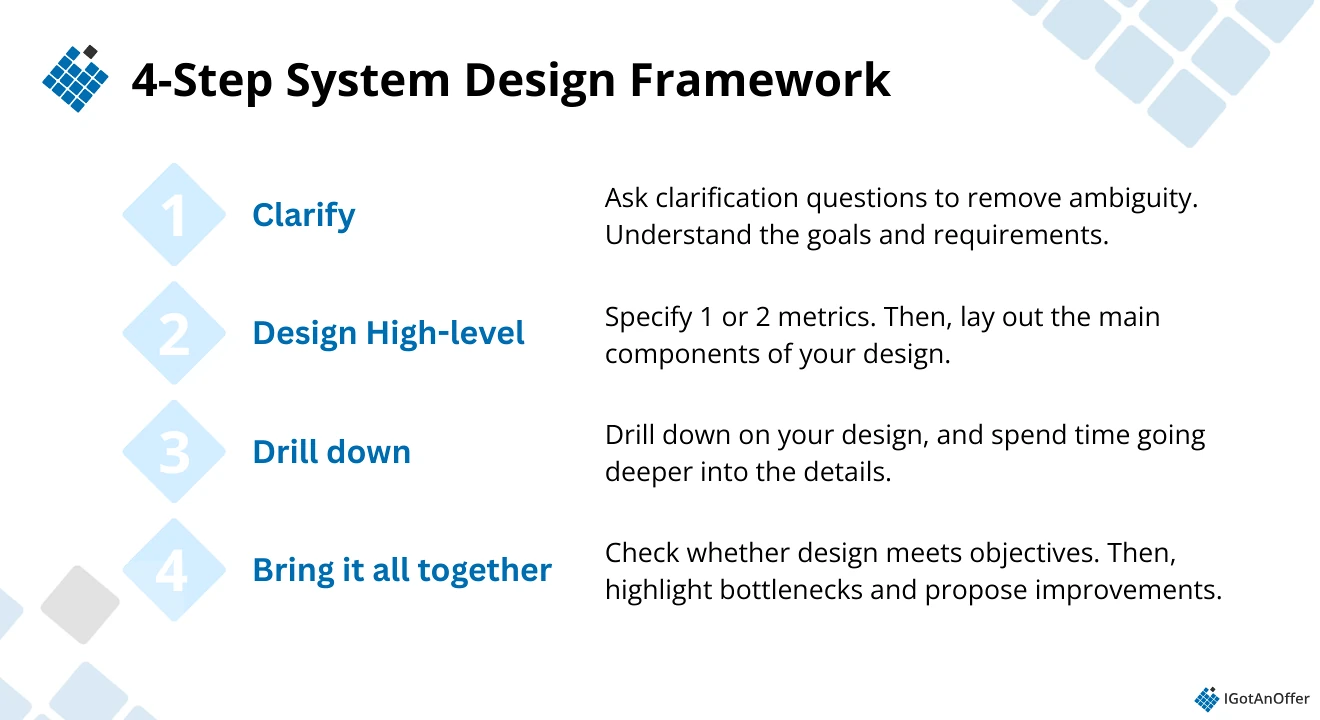
1. Ask clarifying questions
First, spend about five minutes checking in with your interviewer about the functional and non-functional requirements of what you’re going to design. Ask about the system’s goals and how they will be measured. Be sure that you fully understand the question before moving forward.
Call out any assumptions you’re making that will influence your design approach. If applicable, ask about non-functional requirements such as availability, consistency, scalability, etc.
2. Design high-level
Start the high-level design by specifying one to two metrics (e.g., number of users added, products sold before vs after a feature launch, etc.). Then use these metrics to do some simple calculations in order to find the optimal usage pool of the system.
Once you’ve defined your metrics, map out only the most functional components of the system (e.g., front end, web server, database, etc.).
Finally, before getting into the more detailed aspects of your system, make some decisions on how you will design its database. Choose whether it will be a relational or a NoSQL database, as well as its metadata and table structure.
3. Drill down on your design
If you haven’t already, start mapping out the system on your whiteboard. Talk through your diagram so that your interviewer is able to follow along and ask questions when necessary.
Consider any bottlenecks that may arise when it comes to the system’s scalability, performance, or flexibility.
To finalize your design, play to your strengths by choosing a component you’re more familiar with and drilling down on it. If you’re not sure which component would be best to explore, ask your interviewer.
4. Bring it all together
Before wrapping up the round, take about five minutes to re-examine what you’ve designed. Does it meet the objectives you laid out with the interviewer at the beginning of the session?
It is okay to change some components at this stage if you think it will improve the system, but you must explain to the interviewer what you are doing and why.
Learn more about that framework in our guide on how to answer system design questions.
Apply this framework to practice questions like those we’ve included in this article. Use it on different types of questions in a variety of subjects, so that you learn how to adapt it to different situations and respond to unpredictable questions on the fly.
5.3 Dive deep into Anthropic’s culture and products
Be sure that you’re up to date on the latest Anthropic products and releases, as well as their legacy products, as you’ll most likely be asked system design questions that relate to them. Here are some resources that can help:
- Anthropic’s mission and core values (by Anthropic)
- Anthropic’s research
- Anthropic news
- How to collaborate with Claude during the hiring process (by Anthropic)
- How Anthropic maintained an 80% talent retention rate by Nick Lewis, Anthropic’s Head of Global GTM Recruiting
- Inside Anthropic’s Culture Interview by Ridhima Khurana
And given Anthropic’s strong focus on AI safety, it's also important to have a good understanding of the ethics of AI. Here are a few good resources to start with:
- Claude’s Constitution (by Anthropic)
- Building trusted AI in the Enterprise (by Anthropic)
- Anthropic’s responsible scaling policy (by Anthropic)
- UNESCO’s recommendation on the ethics of AI
Your system design interviews at Anthropic will be part of a larger interview process. For help understanding the overall interview process and practice questions for every type of question you’ll be asked, use one of IGotAnOffer’s guides below.
- Anthropic interview process
- Anthropic culture interviews
- Anthropic software engineer interviews
- Anthropic engineering manager interviews
- 30+ common Anthropic interview questions and how to answer them
- How to answer "Why Anthropic" interview and application question
- How to get a job at Anthropic
If you're looking into other AI/ML-forward tech companies, we also recommend reading the following company guides:
- OpenAI interview process
- How to get a job at OpenAI
- OpenAI system design interviews
- OpenAI coding interviews
- OpenAI behavioral interviews
- OpenAI software engineer interview
- OpenAI product manager interview
- 30+ common OpenAI interview questions + answers (by role)
- How to answer “Why OpenAI?” interview and application question
- NVIDIA interview process
- NVIDIA software engineer interview
- NVIDIA product manager interview
5.4 Watch mock interviews
You'll need to spend a good amount of time practicing answering questions on your own or watching mock interviews on YouTube.
We’ve linked to a few good mock interview videos and sample solutions below if you want more examples to learn from.
Example system design questions - with solutions
The easiest way to start practicing under simulated interview conditions is to practice interview questions out loud or with peers. But if you want to get more actionable feedback and Anthropic-specific tips, we highly recommend practicing with an expert.
5.5 Practice by yourself
A great way to start practicing is to interview yourself out loud. This may sound strange, but it will significantly improve the way you communicate your answers during an interview.
Use a piece of paper and a pen to simulate a whiteboard session, or use a whiteboard if you have one. Anthropic uses Excalidraw for its system design interviews, so it would be helpful to practice using it.
Play the role of both the candidate and the interviewer, asking questions and answering them, just like two people would in an interview. Trust us, it works.
5.6 Practice with peers
Once you've done some individual practice, we strongly recommend that you practice with someone else interviewing you.
If you have friends or peers who can do mock interviews with you, that's an option worth trying. It’s free, but be warned, you may come up against the following problems:
- It’s hard to know if the feedback you get is accurate
- They’re unlikely to have insider knowledge of interviews at your target company
- On peer platforms, people often waste your time by not showing up
For those reasons, many candidates skip peer mock interviews and go straight to mock interviews with an expert.
Get feedback from experienced system design interviewers
In our experience, practicing real interviews with experts who can give you company-specific feedback makes a huge difference.
Find an AI/ML system design interview coach so you can:
- Test yourself under real interview conditions
- Get accurate feedback from a real expert
- Build your confidence
- Get company-specific insights
- Save time by focusing your preparation
Landing a job at a big tech company often results in a $50,000 per year or more increase in total compensation. In our experience, three or four coaching sessions worth ~$500 make a significant difference in your ability to land the job. That’s an ROI of 100x
Click here to book system design mock interviews with experienced AI/ML system design interviewers.