

 Back to other articles
  Last updated: October 19, 2026

 Careers
 Deeply researched
Getting a job at Anthropic isn't easy: acceptance rates are exceptionally low at under 1%, and the hiring process can be long and rigorous, sometimes lasting over three months.
But if you make it in, it can be a game-changer. You'll get a world-class salary, huge growth opportunities, great benefits packages, and the chance to work on frontier-level systems like Claude Assistant, Claude Code, and Claude API.
Plus, the prestige of having even just one year at Anthropic will open doors for you moving forward.
Below, we’ve broken down the exact roadmap you need to follow to get your foot in the door. We have packed this guide with tips and resources to help you successfully land a job at Anthropic.
Here are the seven main steps:
- Step 1: Learn about Anthropic
- Step 2: Understand the company’s requirements
- Step 3: Choose the right role
- Step 4: Optimize your resume for Anthropic
- Step 5: Network, network, network
- Step 6: Send out applications
- Step 7: Prepare for the interviews
Let’s get into it!
Click here to talk 1-on-1 with a tech career coach
Step 1: Learn about Anthropic
Anthropic is an AI safety and research company best known for creating Claude, its flagship AI assistant.
The company was founded in San Francisco in 2021 by siblings Dario Amodei and Daniela Amodei, who previously held senior leadership roles at OpenAI. They left OpenAI over differing views on how AI safety should be prioritized as models became more powerful.
Unlike most tech companies, Anthropic operates as a public benefit corporation (PBC). This means it's legally required to balance shareholder interests with its public mission of developing safe and beneficial AI.
Today, Anthropic employs around 2,500 people and has raised billions of dollars from investors including tech giants like Amazon and Google.
You’ll also be pleased to know that because it competes directly with Big Tech for elite talent, its compensation packages are remarkably high (more on that below).
Anthropic is headquartered in San Francisco and has offices across North America, Europe, and Asia-Pacific:
- United States: San Francisco, CA; Seattle, WA; New York City, NY
- Europe: London, UK; Dublin, Ireland; Paris, France; Munich, Germany; Zurich, Switzerland; Milan, Italy
- Asia-Pacific: Tokyo, Japan; Bengaluru, India; Seoul, South Korea; Sydney, Australia
1.1 What it’s like working at Anthropic?
To understand what Anthropic looks for in candidates, you need to know the company’s culture and how it operates.
1.1.1 Mission-first culture
AI safety sits at the center of everything Anthropic does. It shapes the company's research priorities, product decisions, and hiring process.
In interviews, you can expect questions about decision-making under uncertainty, balancing trade-offs, and considering the long-term impact of your work.
1.1.2 High-trust, low-ego organization
Anthropic describes itself as a "high-trust, low-ego company." Employees are expected to share ideas openly, challenge decisions respectfully, and speak up when they see a better approach, regardless of seniority.
Ownership is also a big part of the culture. Rather than waiting for direction, you're encouraged to take initiative and solve problems.
The same philosophy carries over into how the company is organized. All technical employees share the same title: Member of Technical Staff. The idea is that good ideas should carry more weight at Anthropic than hierarchy or job titles.
1.1.3 Open to generalists
Anthropic welcomes applicants from a wide range of technical backgrounds. Even if you don’t have direct machine learning experience, you are still encouraged to apply. In fact, the company says that roughly half of its technical staff come from non-ML backgrounds.
1.1.4 Employee benefits and perks
Another reason that a lot of people want to work at Anthropic is its generous package of employee benefits and programs.
Employee perks include on-site amenities like daily catered meals and snacks, along with comprehensive health insurance and flexible leave policies.
More specifically, some of the benefits that Anthropic provides in different areas are:
- Health and wellness: Medical, dental, and vision insurance for employees and dependents; mental health support resources; fertility and family planning benefits.
- Financial wellbeing: Top-of-market base salaries paired with regular equity packages; retirement plans with company matching; philanthropic equity donation matching.
- Flexibility and time-off: Generous paid time off; hybrid work models built around central office hubs; up to 22 weeks of paid parental leave.
- Support and development: Home office stipends; annual learning and development allowances; full relocation support.
Further reading
Be sure that you’re up to date on the latest Anthropic products and releases, as well as their legacy products. Here are some resources that you can read up on:
- Anthropic’s mission and core values (by Anthropic)
- Anthropic’s research
- Anthropic news
- How to collaborate with Claude during the hiring process (by Anthropic)
- How Anthropic maintained an 80% talent retention rate by Nick Lewis, Anthropic’s Head of Global GTM Recruiting
- Inside Anthropic’s Culture Interview by Ridhima Khurana
And given Anthropic’s strong focus on AI safety, it's also important to have a good understanding of the ethics of AI. Here are a few good resources to start with:
- Claude’s Constitution (by Anthropic)
- Building trusted AI in the Enterprise (by Anthropic)
- Anthropic’s responsible scaling policy (by Anthropic)
- UNESCO’s recommendation on the ethics of AI
1.2 How much does Anthropic pay?
Anthropic is one of the highest-paying employers in tech. Below, we use data from Levels.fyi to compare the salaries of entry-level and senior software engineers at Anthropic with those in the same roles at other leading tech companies.
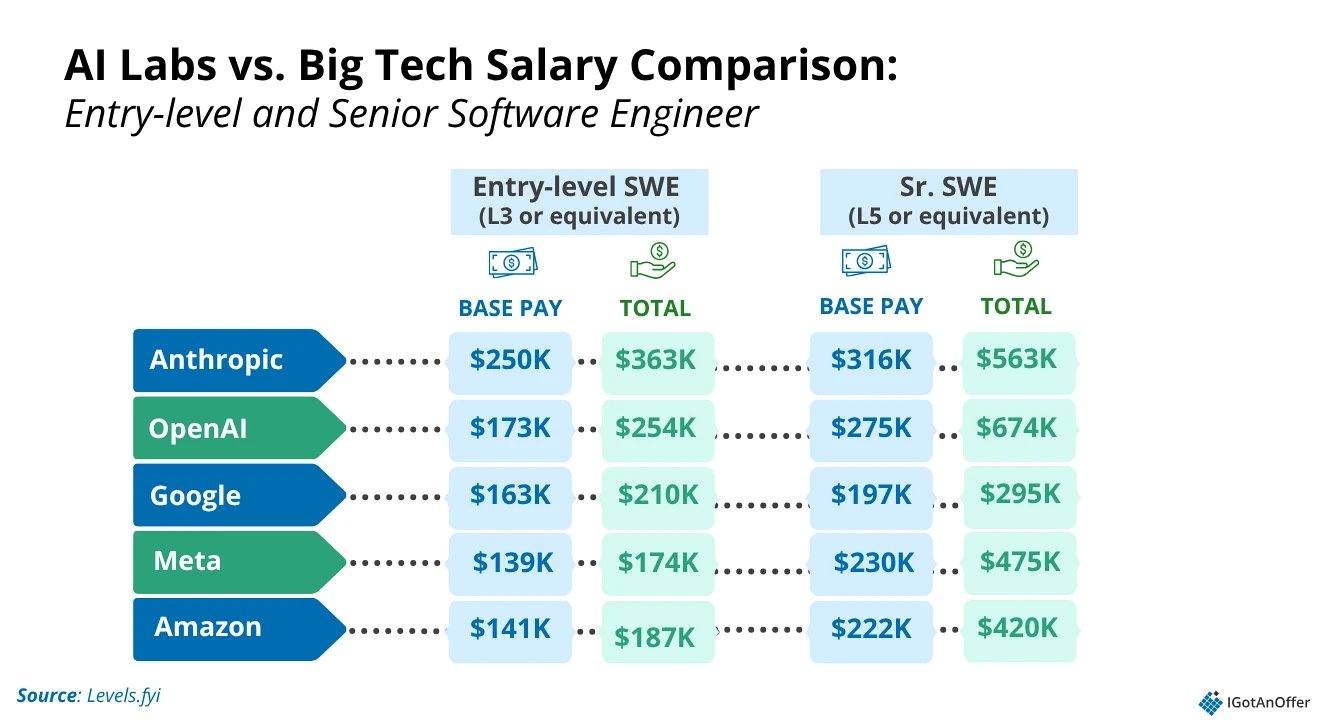
Anthropic offers the highest entry-level software engineering compensation, paying 43% more than OpenAI and 73–109% more than Google, Amazon, and Meta. Even at the senior level, it ranks second only to OpenAI.
1.3 Is Anthropic hiring?
Anthropic has been hiring aggressively as demand for AI continues to grow, with engineering leading much of that expansion. According to research, Anthropic hires engineers 2.68x faster than it loses them, compared with 2.18 for OpenAI, 2.07 for Meta, and 1.17 for Google.
Beyond engineering, Anthropic is also hiring across AI safety, research, product management, sales, and enterprise operations. Many of these roles are available remotely.
You can browse current openings on Anthropic’s Careers page.
Step 2: Understand the company’s requirements↑
Anthropic has a very selective hiring process. You'll find that the exact requirements vary considerably depending on the team and role you're applying for, but there are a few things the company looks for across most positions.
2.1 Academic qualifications
Anthropic does not evaluate candidates based solely on their academic background. The company says that about half of its technical staff had no prior machine learning experience, and many don’t have a college degree.
If you can demonstrate your ability through strong personal projects, open-source contributions, research, or technical writing, you're more than qualified to apply.
2.2 Experience
Generally, Anthropic looks for experience in a field relevant to the role, whether through coursework, training, or professional experience.
From our analysis of current job postings, Anthropic doesn't publicly state a minimum number of years of experience for most roles. When it does, it's usually for more senior positions requiring at least five years of experience.
If you're hoping to join Anthropic through an internship, the bad news is that the company doesn't offer one at the time of writing. Mike Krieger, Anthropic's Chief Product Officer, has also said the company has been hiring fewer fresh graduates because AI now handles much of the entry-level work that junior employees would traditionally do.
If you're early in your career, your best route in is through the Claude Corps Fellowship. The program accepts applicants with less than two years of full-time experience and doesn't require a technical background or college degree.
2.3 Soft vs technical skills
Soft skills
Anthropic places a surprisingly high value on soft skills. Daniela Amodei, Anthropic's co-founder and president, says the company looks for people who can "communicate well, have strong emotional intelligence, are curious, and genuinely want to help others."
As AI takes on more technical work, Anthropic believes people will create the most value by applying judgment in situations where AI falls short. That's why these qualities are assessed throughout the interview process, especially during Anthropic’s Culture interview.
Technical skills
Technical skills vary by role, but most engineering positions require a solid foundation in coding, system design, and machine learning fundamentals.
Anthropic also places a strong emphasis on AI risks and safety. You should know how to design systems with the right guardrails in place, including content moderation, abuse prevention, and safe model deployment.
2.4 MBA as a path to Anthropic
An MBA isn't usually a deciding factor for technical roles at Anthropic, such as software engineering, machine learning, or infrastructure. As mentioned in the previous sections, the company places much more weight on your technical abilities, open-source contributions, and real-world experience.
You'll get more value from an MBA if you're targeting business-facing roles such as AI product management, go-to-market, operations, and strategy. Even then, Anthropic places greater emphasis on your experience and ability to do the job.
Step 3: Choose the right role↑
It isn't always obvious which role you should apply for at Anthropic.
One of the most common questions people ask our coaches is, "Which Anthropic role best matches my background?" or "Am I applying at the right level with my current experience?"
For example, if you're a software engineer with some machine learning experience, should you apply for software engineering, research engineering, or machine learning engineering?
The same goes for leveling. You have to consider that hiring at AI labs and top tech companies is often more conservative than at smaller companies. We've worked with candidates who were CEOs or even VPs at smaller organizations but were ultimately hired into senior engineering roles because the technical bar and scope of the role were much higher.
You’ll need to build up an accurate understanding of which roles interest you most, where you can bring the most value, and where your knowledge and experience gaps lie.
To some extent, you can do this by carefully reading relevant job descriptions, but talking to a career coach who has worked in tech is the most effective way to gain clarity.
3.1 Temporary vs. Full-time roles at Anthropic
At the time of writing, most opportunities at Anthropic are limited to full-time positions. They don't typically hire contractors the way a company like Google does.
They do, however, offer the Claude Corps Fellowship program, as mentioned in Section 2.2. The fellowship allows early-career professionals to work alongside Anthropic teams on real projects while receiving mentorship and training.
Step 4: Optimize your resume for Anthropic↑
Anthropic is incredibly competitive, and the vast majority of candidates don’t make it past the initial resume screen. Because the bar is so high, you should invest a few hours into making sure your resume is as strong as possible.
Anthropic looks for clear, data-driven evidence of your impact. The best way to structure your achievements is to use a simple framework: "Accomplished X, as measured by Y, by doing Z." Quantifying your success shows that you focus on measurable outcomes and rigor, which aligns directly with how the company operates.
Here are the key tips to keep in mind when crafting your resume for Anthropic:
Tips for crafting your resume
- Study the job description. The work experience you showcase on your resume should directly align with the qualifications for the role you’re applying to.
- Be specific. Use data to back up your claims. How many people were on the team that you managed? How were your successes measured? Give numbers, percentages, and whatever you can to quantify your impact.
- Emphasize scale and infrastructure experience. Anthropic builds and trains massive foundational models. If you are applying for engineering or product roles, highlight any experience you have with cluster efficiency, high-performance computing, scaling laws, or managing heavy infrastructure constraints.
- Highlight AI safety and alignment interest. Anthropic is a public benefit corporation founded explicitly to focus on safe AI development. Whether you are technical or non-technical, your resume should show that you understand socio-technical impacts, ethics, or building robust, reliable systems.
- Facilitation skills. If you're applying for a management role, you need to show that you'll be able to help your team progress, remove obstacles, and solve blockages. Try to include an example that shows how you unblocked a project, took preemptive action to avoid a bottleneck, or improved a process.
- Be concise. Anthropic recruiters often don’t have the time to study a resume in-depth, so make sure to keep your resume clear and concise. Cherry-pick your highlights rather than giving a comprehensive summary of everything you’ve done.
Alternatively, you can use one of our role-specific guides:
- Tech resume guide
- Software engineer resume guide
- Product manager resume guide
- Technical program manager resume guide
- Engineering manager resume guide
- Data science resume guide
- Machine learning engineer resume guide
Don’t forget to have a friend or family member proofread your resume before finalizing it. They’ll be able to spot grammar and formatting errors. For expert help on whether or not your resume is best suited for the position, you’ll need to get input from ex-tech interviewers.
Step 5: Network, network, network↑
If you have a connection to someone at Anthropic, use it! Ask them to refer you for a role for which you’re applying.
This may increase your chances of getting into the interview process. At the very least, it makes it likely that your application will get a fair viewing, lessening the possibility of it getting lost amidst the vast number of general online applications.
If you end up landing the job, your contact should get paid a bonus for referring you, so it’s a win-win.
If you don’t have a contact in Anthropic, consider investing some time in improving your network.
Here are four actions you could take:
5.1 Build a networking funnel
In essence, networking is a sales process, and getting organized in advance will set you up for success.
Begin by creating a spreadsheet of potential contacts. Okay, so maybe you don’t know anyone at Anthropic. But do you know someone who knows someone?
Make a list of acquaintances or ex-colleagues who could connect you with someone inside Anthropic. Your last priority should be cold contacts.
5.2 Feed the funnel: go to Anthropic events
Once you have your spreadsheet set up (i.e. your funnel), then you need to create as many new connections as possible to feed your funnel.
You should specifically target events organized by Anthropic or an event where someone from Anthropic is speaking. If you go, introduce yourself to people and start a conversation.
If going to events is not an option, Anthropic also holds online webinars.
5.3 Send good emails and keep following up
Whether you are following up from an in-person conversation or cold-contacting someone, it's important to send good emails and follow-ups. Aim to build rapport, and to make it easy for the person to say yes to you.
It's also important for you to follow up until you get a clear answer. Many people will be open to a short phone call or coffee meet-up.
We like this advice on how to write effective cold emails.
5.4 Be ready to sell yourself
This is a critical step. You want to make sure that you are prepared for impromptu “interviews” as you begin to have conversations with your contacts.
They’re not going to grill you as if you were in an Anthropic interview, but it’s worth practicing talking about your motivation for joining the company and what you think you could bring.
You need to be ready to sell yourself (without coming across as overbearing), and this takes practice.
5.5 Don’t just ask for a referral straight away
If you manage to get in touch with someone at Anthropic, don’t just straight up ask them to refer you before you’ve even met them. If they don’t know anything about you, it’s unlikely that they’d feel comfortable referring you even if your resume is outstanding.
Instead, explain that you’d like to pick their brains about the company. Once you’ve established some connection with them and they understand a bit more about what you can bring to the role, they might be happy to refer you.
Step 6: Apply↑
Right, so you’ve got a stand-out resume, and you’re confident you’re targeting the right role at Anthropic. It’s time for action!
Hopefully, you’ve managed to get a referral, but if not, you can do it the traditional way and apply through Anthropic’s job portal.
Step 7: Prepare for the interviews↑
Once you’ve applied, hopefully you’ll get put through to the start of the interview process.
The interview process at Anthropic usually takes 4 weeks to 3+ months. The steps vary by role, but most candidates go through these stages:
- Recruiter call (30 minutes)
- CodeSignal online assessment (90 minutes)
- Hiring manager screen (1 hour)
- Technical interview loops (4-5 rounds, 55 minutes each)
- Reference checks & team matching (variable, 2-4+ weeks)
- Offer & negotiation
The steps that will require the most preparation are the phone screens and technical interview loops. Here are the most common question types you can expect for some of the top roles at Anthropic:
Anthropic question types (by role)
- For software engineers, you'll need to prepare for coding, behavioral interviews that assess your leadership and other soft skills, and both traditional and LLM-focused system design interviews.
- For engineering managers, expect system design interviews (often in the form of design reviews), behavioral and leadership interviews, and values interviews that assess whether you'll thrive in Anthropic's mission-driven, intellectually rigorous, and safety-focused culture.
- For product managers, expect behavioral interviews, product sense, analytical, and execution questions, along with discussions around AI safety, judgment, and your alignment with Anthropic's mission and values.
7.1 Practice for the different question types
Whether you're targeting an engineering, PM, or a completely different role, we recommend you use one of our Anthropic interview guides, plus a few other resources that might be useful:
General
- Anthropic interview process and timeline
- 30+ common Anthropic interview questions and how to answer them
Role-specific
- Anthropic software engineering interview guide
- Anthropic engineering manager interview guide
- Anthropic product manager interview guide
- Anthropic AI safety fellow interview guide
- AI engineer interviews
- AI product manager interviews
Skills-specific
Coding interviews
- Coding interview examples: 47 examples with answers in Python and other languages
- Coding interview tips: practical tips for performing well under interview conditions
- AI-assisted coding interview guide: relevant given Anthropic's use of AI to evaluate CodeSignal submissions
- LeetCode: practice concurrency and OOP problems at medium and hard difficulty
- NeetCode: structured roadmap for systems and OOP coding patterns
System design
- Anthropic system design interview guide: question breakdowns and tips specific to what Anthropic asks
- Machine learning system design interview: how to approach ML-specific design questions, which come up regularly at Anthropic
- Generative AI system design interview: directly relevant for Anthropic's AI and LLM system design round
- Staff system design interview: types of questions and performance expectations at the staff level
Behavioral and leadership
- How to answer "Why Anthropic?"
- Anthropic culture interview guide: detailed breakdown of the culture round with example questions
- 11 most-asked software engineer behavioral interview questions: the questions that come up most often in SWE interviews, with sample answers and a proven answer framework
- People management primer, Leadership primer for tech interviews: if you’re applying for senior leadership roles
Product
Given how competitive getting into top AI labs is, you should also try to practice mock interviews with tech interviewers. They’ll be able to give you accurate, actionable feedback that will take your interview performance up a level and increase your chances of landing an offer.
And don’t be disheartened if you get rejected by Anthropic on your first attempt. Most people do! One of the keys to getting in is to get feedback from an expert and then keep trying. We’ve worked with plenty of candidates who landed an offer after multiple attempts.
Interviewing at other AI lab companies? Check out our free guides:
- OpenAI interview process
- OpenAI system design interviews
- OpenAI coding interviews
- OpenAI behavioral interviews
- OpenAI software engineer interview
- OpenAI product manager interview
- 30+ common OpenAI interview questions + answers (by role)
- How to answer “Why OpenAI?” interview and application question
- NVIDIA interview process
- NVIDIA software engineer interview
- NVIDIA product manager interview
Take a big step towards a job at Anthropic↑
Navigating your path toward that job at Anthropic becomes a lot easier when you’ve picked the brains of someone in tech.
If you want to check out our career coaching services, browse our platform’s over 190 coaches with experience at many top companies. Search by industry, role, or company to get the right match for you. You can see the coaches' hourly availability and book your online session in a couple of clicks.
Click here to learn more about our career coaching services.


 Management consultant