

 Back to other articles




 Last updated: September 30, 2026
 Interviews
 Product manager
 Product sense
 Deeply researched
If you’re applying for an AI-focused PM role, the AI product sense interview is the biggest hurdle you’ll need to clear.
Top tech companies like Anthropic, OpenAI, Google, and Meta give AI product sense interviews in slightly different ways, but the goal is the same: to evaluate how you integrate AI into product thinking, exercise judgment while working with AI tools, and maintain strategic control while building in a probabilistic environment.
To help you prepare, we put together this guide. It includes insights from FAANG+ AI PM interview experts, interview questions reported by real candidates, and frameworks you can use to structure your answers.
We also provide the best resources and a step-by-step prep plan to help you walk into your AI product sense interviews with confidence.
Here's a quick overview of what we'll cover:
- What is an AI product sense interview?
- What interviewers evaluate in an AI product sense interview
- How to answer an AI product sense question (2 frameworks)
- AI product metrics
- Example AI product sense interview questions (per company)
- AI product sense interview tips
- How to prepare for AI product sense interviews
Let’s get started!
Click here to practice 1-on-1 with an AI PM interview coach.
1. What is an AI product sense interview?↑
An AI product sense interview is typically a ~45- to 60-minute product interview with an AI component. This AI focus makes the biggest difference.
In classic product sense, candidates build predictive software with linear user journeys. In AI product sense, the expectation is that you're building in a probabilistic world with unpredictable output.
"It’s less about designing features and more about designing guardrails inside which models work," Gal (ex-Google senior PM) says.
The AI product sense interview comes in two general formats:
Classic product case with an AI component
Many companies embed AI product sense in their usual product sense interview and don't label it differently. This tends to catch a lot of candidates off-guard. In this format, you’re generally expected to talk through your solution like you would at any product sense interview. The main difference is that your product case will involve designing an AI product or feature from scratch, or improving an existing product with AI.
In addition to product and technical metrics, you’ll also need to proactively identify countermetrics or guardrails for responsible AI usage.
Product case + vibe coding
In this format, you’ll start as you would at a classic product sense interview: define user motivations, target audiences, and product problems. In the next part of the interview, you’ll be required to translate your thinking into prompts to build a working prototype using AI tools. This is the format Meta, OpenAI, Figma, Microsoft, and Google India reportedly give.
Similar to the first format, you’ll need to talk about countermetrics or guardrails if you’re building an AI product or feature.
According to Piyush (ex-Microsoft Principal Group PM), "The belief [behind giving vibe coding interviews] is that PMs should be able to vibe code any UX they are writing a PRD for."
2. What interviewers evaluate in an AI product sense interview↑
According to Anik (Amazon GenAI product lead), AI PMs are required to have the same baseline skills that every standard PM needs: product knowledge, strategic thinking, customer discovery, cross-functional leadership, and communication.
On the AI front, every AI PM role will have different requirements, but the core foundational skills necessary for success across various AI product domains are as follows:
- Solid foundational understanding of the ML lifecycle (such as data requirements, model training, evaluation metrics) and how to translate these technical concepts into tangible user experiences and business outcomes
- Understanding the non-deterministic nature of AI outputs, a demonstrated ability to set realistic user expectations, design robust failure/fallback states in the user experience, and proactively address critical concerns around Responsible AI
If your AI product sense interview involves vibe coding, you’ll be evaluated on the same skills as above, in addition to a few more unique skills required when working with AI tools. Below is a list of skills that Audrey (ex-Meta senior product leader) says Meta evaluates in AI product sense interviews:
- The “Human Delta”, or the insight you add to what the AI produces on its own. You need to show you can identify hallucinations, generic outputs, or misalignment with the product vision, and clearly explain how and why the solution should be improved
- More than AI fluency, you need to show you can use AI to handle "commodity thinking" (e.g., baseline segmentation, feature drafting, outlining success metrics, etc.) so you can spend 90% of the interview on high-stakes trade-offs
- Ability to translate ambiguous product goals into structured instructions, set clear constraints, and iterate when the AI’s outputs lack depth, clarity, or alignment
- Ability to course-correct AI, spot feasibility issues, policy or privacy risks, and cross-functional friction that AI tools typically overlook, and redirect the solution accordingly
Coaches who contributed to this guide













3. How to answer an AI product sense question (2 frameworks)↑
In this section, we’ll show you two answer frameworks that you can use in your AI product sense interview based on the format you get.
3.1 Framework for a classic product case with an AI component
If you’ve been asked to design an AI product or improve a product with AI, we recommend the classic BUS (Business objective, User problems, Solutions) framework.
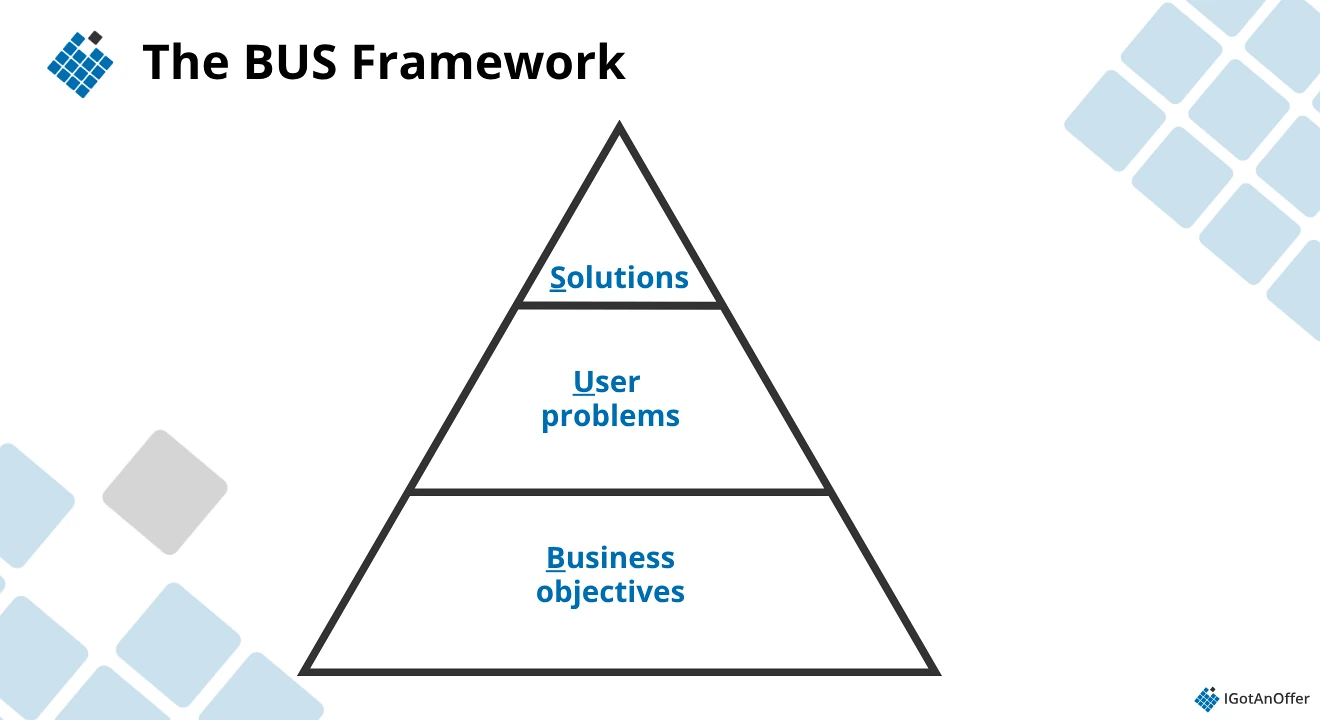
Depending on the focus of the interview, you may not be required to go as deep into the metrics and guardrails. Still, we recommend proactively discussing them as you go through your proposed solutions and near the end.
Step 1: Ask clarifying questions
- Make sure you clearly understand the goals and requirements of the problem
- Set expectations and agree on simplifications
- Make sure you’re on the same page with the interviewer to ensure a meaningful discussion
Step 2: Outline goals
- Pause and think about your goals
- Differentiate between the user goal and the business goal
- Define how the two interact, and link it back to the company's mission
Step 3: Prioritize actions
- Be comprehensive, list multiple actions
- Don’t be too detailed, stick to high-level
- Prioritize based on your main goal
Step 4: Define metrics & guardrails
- Give 2-3 metrics for each prioritized action
- Find the specific metrics that tell the story of what we want to happen with this action
- Include countermetrics or guardrails to address Responsible AI use
Step 5: Evaluate
- Take a minute to summarize your answer
- Show how metrics are tied to the original goal
- Discuss the downside of the metrics chosen
- Explain how the metrics balance each other
Watch how Gal (ex-Google senior PM) uses this framework to work through an AI product sense question: “Set goals for an AI-only social network”
3.2 Framework for product case + vibe coding interview
If your AI product sense interview involves vibe coding a prototype, here's a step-by-step approach adapted from PMCurve’s Deepak Singh’s vibe coding framework.
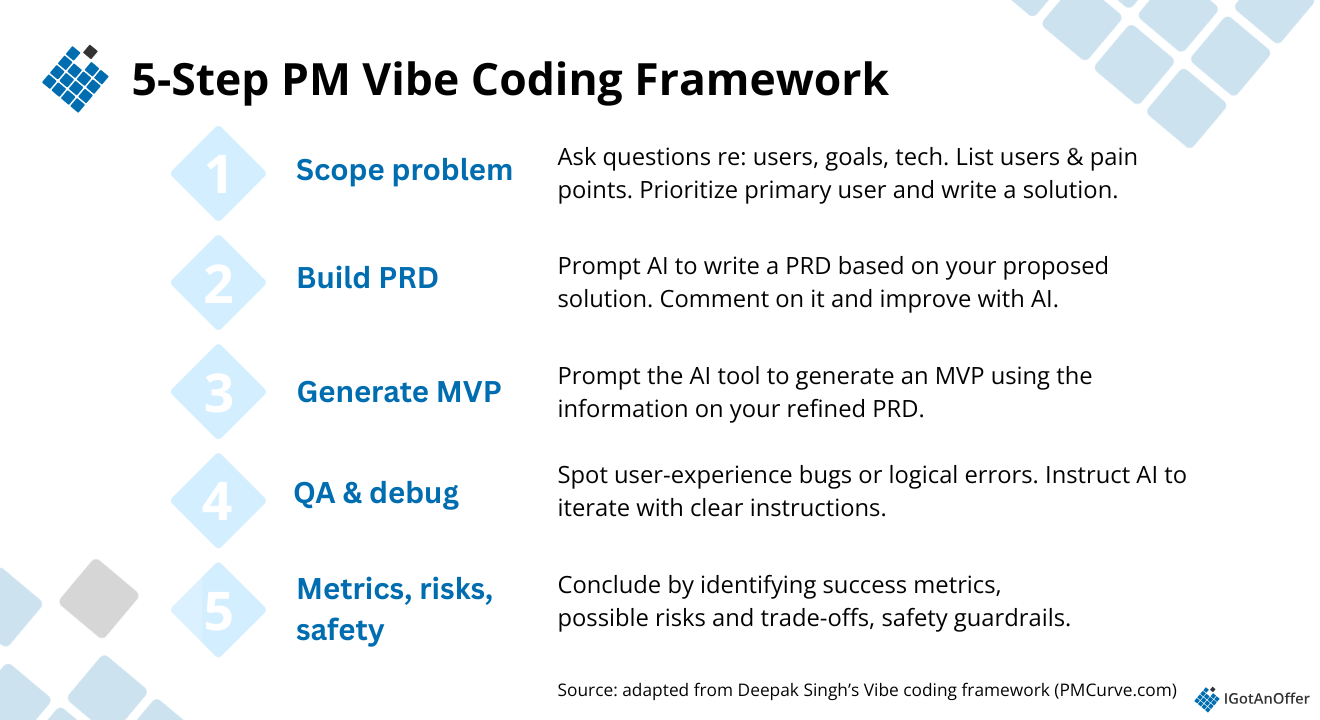
Step 1: Narrow down the problem scope
Start by asking clarifying questions about the users, goals, and tech constraints. Just like at a standard product design interview.
Then, list your user segments and pain points, and from there prioritize a user segment and their needs.
With the primary user segment in mind, come up with your proposed solution.
Narrate as you go, include features, and some nice-to-haves. As you narrate your proposed solutions, talk about your design choices. Why did you choose one feature over another?
NOTE: Don’t let LLM write your solution for you. Coming up with the solution on your own shows your interviewers that you can think on your feet.
You don’t need to write a perfect prompt, especially when practicing mock interviews. You want to go through the process of perfecting your prompt, which you’ll be doing during your interview.
Step 2: Build a PRD
To build a PRD, you need to turn your solution into a prompt to feed your AI tool.
Start with a persona prompt, i.e., “You’re an experienced technical product manager with a founder’s mindset.” Then copy-paste your solution and instruct the AI to use the information to build a product requirement doc (PRD).
Now go through the generated PRD and comment on it aloud. Point out what’s good (great labeling etc.) and what could be improved (too many options) and how you plan to improve it (cut down and prioritize).
This step of going through your PRD shows your judgment and that you’re not just letting the AI tool write for you. Spend 2 to 3 minutes reviewing the PRD.
Step 3: Generate the MVP
Before you can instruct your AI tool to build an MVP, you need to make sure your PRD is as honed in as possible. So you want to revise it using your LLM as well.
Do this by prompting the AI to self-critique. Here are some details you need in your prompt:
- Only make suggestions the AI is 90% sure about; otherwise, it will go haywire
- Instruct the AI to only include suggestions backed by data
Go through the points for improvement. Choose only the points you care about. Tell the AI to improve your PRD based on these points, and remove the ones that are not on your list.
Ask the AI again to fact-check the revised PRD. Repeat the instruction about removing anything that isn’t backed by data. This signals that you’re very careful and thoughtful about using LLMs and you’re not just using AI to create some random document.
Once you’ve got a refined PRD, use that to generate an MVP.
Step 4: QA and debug
Now, it’s time to check your AI-generated MVP. Do a comprehensive check. Use the AI prototype and comment as you go.
This is where you can demonstrate your product sense by spotting user-experience bugs or logical errors.
It’s also a good chance for you to show your comfort with AI tools. Guide the AI with clear instructions to fix them. Listen to your interviewer’s feedback and incorporate it into your QA prompt.
Step 5: Define success metrics, risks, and safety guardrails
Close your vibe coding answer by coming up with success metrics, based on the goals and user pain points you’ve figured out at the start.
Also, mention the risks you’ve identified and the tradeoffs you’ve made. If you’ve been tasked to design an AI feature or product, be sure to list plans for safety guardrails.
Click here to learn more about PM vibe coding interviews.
4. AI product metrics↑
In an AI product sense interview, you’re designing in a probabilistic world, where the system's outputs are unpredictable. Therefore, your answer should take into account metrics that say something about the quality and safety of the model's output, and not only usage.
According to Gal (ex-Google Sr. PM), below are the most important AI product metrics you’ll need to mention in your AI product sense interview:
4.1 Output quality metrics
In short, you want to measure whether the AI is doing its job well. You should define "accuracy" concretely: accuracy of what, measured against which ground truth, and defined by whom. Some of the behavioral signals from users that you could track:
- How often do they accept a suggestion?
- How heavily do they edit a suggestion, and how often do they discard it entirely? A discarded output is a strong sign the model missed.
4.2 Hallucination rate
This should be tracked as its own metric rather than folded into general accuracy, ideally with a rate the team agrees it will not launch above.
4.3 Trust and safety guardrails
What guardrails are put in place to prevent harmful or policy-violating outputs and behavior across different user groups, and what happens when the model is not confident (for example, routing to a human or a safe fallback)?
4.4 System guardrails (latency and cost per query)
You need to account for latency, accuracy and cost in your AI design. Every interaction has a real cost per query, so usage is not free the way it is in a classic consumer product.
4.5 Adoption and business outcomes
Metrics like activation, repeat use, and retention, and the business impact a product was built for still matter. But you’ll need to read them next to the quality metrics above.
“A useful way to structure the whole answer is to put them in tiers,” Gal says. Go with safety, then quality, product, and then business, plus a north star and guardrails.
As for measuring these metrics, Gal says that it is important that you differentiate between offline and online evaluation in your answer.
- Offline evaluation means a golden dataset (labeled examples of real tasks, with named labelers) that the model is tested against before launch and after every model update, with go/no-go thresholds.
- Online evaluation means what you watch after launch: A/B tests, behavioral signals, and sampled human review of outputs. Success criteria should be defined before launch, not after the results come in.
5. AI product sense interview questions (Anthropic, Google, Meta, OpenAI)↑
Now that you have an idea of how to structure your answers, let’s look at real example questions from Glassdoor shared by PM candidates from Anthropic, Meta, Google, and OpenAI.
Try using the frameworks we shared above and apply the appropriate one to each question for more practice.
Examples of AI product sense questions at Meta
- You are a Meta PM for AI chat. How would you define success and goals for it?
- You're the sole PM for Zoom. Imagine that AI is sending transcripts of meeting notes to all invitees, and suddenly, meeting attendance is down. What do you do?
Examples of AI product sense questions at Google
- Design a smart fridge for Google
- Given an AI-powered product facing usability challenges, how would you improve it?
Examples of AI product sense questions at OpenAI
- What’s your favorite AI product, and why?
- What goal would you set for an AI-only social network that OpenAI is building?
- What industry could benefit most from enterprise ChatGPT?
Examples of AI product sense questions at Anthropic
- How would you improve Claude.ai for new users?
- What is your long-term product vision for Anthropic, and how would you translate it into a roadmap?
- If you were PM for Claude Code, what would you prioritize in the next six months?
- Design a product to help enterprises build safely on top of Claude
Applying for an AI PM role? Learn more about the different AI PM interview questions you’ll get and how to best approach them.
6. AI product sense interview tips↑
Interviewing itself is a skill that you need to learn. If you've interviewed for a PM role before, you'll be familiar with the best practices for classic product sense interviews. Apply those and the rest of the tips below to demonstrate strong AI product sense.
6.1 Center on the user
An AI product sense interview is still, first and foremost, about building solutions to solve a user’s problem while also meeting a company’s business objective. Focus your answer by always referring to the user pain points you’ve identified.
As part of your product evaluation, you’ll also need to address how you plan to set realistic user expectations, design robust failure/fallback states in the user experience, and integrate human-in-the-loop review to maintain trust.
6.2 Discuss AI-specific failure modes
When evaluating your proposed solutions, discuss how you plan to manage and mitigate AI-specific failure modes, such as latency (slow response times from complex models) and hallucinations (models generating factually incorrect but confident-sounding outputs).
6.3 Show awareness of token usage optimization
AI product sense interviewers focus more on evaluating your judgment of AI outputs rather than how impressive your prompts are.
Still, as a PM, you’ll want to demonstrate high-level awareness of how your actions impact the business. Prompts use tokens, and token usage can drive up resources. Be prepared to get pushback on the efficiency of your prompts and practice prompt compression techniques if necessary.
6.4 Proactively address complex Responsible AI concerns
As an AI PM, you’ll want to be familiar with Responsible AI concerns and build with these in mind. You’ll want to incorporate them when coming up with product metrics and countermetrics (or safety guardrails).
These concerns include algorithmic bias, fairness, and the explainability of the AI's decisions, which are critical for user trust and regulatory compliance.
6.5 Practice simplifying complex technical terms
Part of your responsibilities as an AI PM is to be able to get buy-in from stakeholders who may not be as technically well-versed. Demonstrate this skill in your interview by breaking down complex technical terms into simple analogies.
6.6 Demonstrate structured thinking
As in a classic product sense interview, you’ll need to demonstrate structured thinking when working with AI. Using classic product and prioritization frameworks is a good start, but don’t forget to customize your approach to take into account the unpredictability of AI output.
6.7 Stress-test AI output
AI output almost always looks perfect. Great candidates will know that this is a trap.
In an AI product sense interview with vibe coding, Audrey (ex-Meta senior PM) says you need to stress-test the output, ask what breaks at scale, where privacy risk emerges, and which trade-offs engineering would push back on.
7. How to prepare for AI product sense interviews↑
Here's our recommended step-by-step prep plan for cracking the highly complex AI product sense interviews.
7.1 Know the PM interview process
Your AI product sense interview is just one of the many interviews you’ll get as an AI PM candidate. To prepare more strategically, you need to know how the entire process works at your target company.
Below, we have a list of our company-specific interview guides, where we walk you through everything you need to know to prepare:
- Google product manager interview guide
- Meta product manager interview guide
- Amazon product manager interview guide
- OpenAI product manager interview guide
- Microsoft product manager interview guide
- LinkedIn product manager interview guide
- Uber product manager interview guide
- Stripe product manager interview guide
- Lyft product manager interview guide
- Apple product manager interview guide
- TikTok product manager interview guide
- Coinbase product manager interview guide
- Airbnb product manager interview guide
- DoorDash product manager interview guide
- Nvidia product manager interview guide
- Spotify product manager interview guide
- Netflix product manager interview guide
- Capital One product manager interview guide
- Oracle product manager interview guide
- Databricks product manager interview guide
7.2 Brush up on your product fundamentals
To ace your AI product sense interviews, you’ll still need to demonstrate a strong user focus and product knowledge. Build your interview muscles by practicing with the resources below:
- Product sense
- Product design
- Product improvement
- Product strategy
- Product execution
- Strategy questions
- Product metric questions
- Technical questions
- Estimation questions
- Prioritization questions
- PM vibe coding interview
- AI PM interview guide
We also recommend watching mock interview videos at our IGotAnOffer Product Management YouTube channel so you can see what an excellent answer looks like.
7.3 Deep dive into AI/ML
You don’t need a highly technical background to ace your AI product sense interviews. But you will need foundational AI/ML knowledge to show that you'll be able to effectively collaborate with engineers and other technical cross-functional teams.
To get started with your AI/ML deep dive, check out these free resources we’ve gathered:
- AI for Everyone (DeepLearning.ai)
- Machine Learning and Artificial Intelligence Training (Google)
- How AI changes product management (Reforge)
- GenAI Prompt Engineering: A Product Manager’s Guide
- Data Analysis for Product Managers (UserPilot)
- Ethics in AI: The New Frontier for Product Managers (ProdPad)
- Your Guide to Product Strategy (OpenAI’s Product Lead)
- How to Create an AI Product Roadmap (Aakash Gupta)
- How to Ace the Vibe Coding Interview (Aakash Gupta)
- The Four Types of Metrics for AI Product Managers (Valerio Zanini)
Here are a few ideas on how to get hands-on AI/ML experience as a PM, from our AI PM coaches, Anik, (Amazon GenAI Product Lead), Piyush (ex-Microsoft Group PM), and Casey (eBay GenAI staff PM-T):
Learn ML/AI concepts and AI-adjacent skills
You don’t need to learn how to code; you simply need to learn the basic science behind AI.
"This means understanding core ML concepts: what a model is, how it 'learns' from data (training), and the difference between giving it labeled examples versus letting it find patterns on its own," Anik says.
Casey adds that you should also beef up on AI-adjacent skills, including data analysis, experimentation, and product metrics.
Build a portfolio of AI-adjacent projects
Casey suggests building a portfolio of AI-adjacent projects to demonstrate applied experience. Some projects you can tackle are recommendation systems, personalization, and automation.
Through hands-on AI projects, Anik says you’ll learn how to drive business value with AI. You can initiate these projects at your current job, as a side project, or as a capstone.
Learn how to design for uncertainty
When beefing up your AI knowledge, it’s important that you learn to design for failure. In a traditional PM role, software either works or crashes, but AI is always 'sort of right.'
To address this built-in uncertainty, Anik says, "Design the product experience to manage user expectations, clearly communicate when the AI might be wrong, and build reliable backup plans (like a human review) to maintain user trust."
Learn prompt engineering
Piyush thinks that GenAI experience is overrated for AI PMs, as anyone with a strong customer mindset and product thinking can become an effective GenAI PM. What he does recommend strongly is learning how to do prompt engineering well.
7.4 Practice by yourself and with peers
Once you’re in command of the different subject matters, you’ll want to practice answering questions. If your AI product sense interview involves vibe coding, practice with the tools you’ll use during the interview.
Do know that practicing by yourself has its limitations. You can’t simulate thinking on your feet or the pressure of performing in front of a stranger. Plus, there are no unexpected follow-up questions and no feedback.
That’s why many candidates try to practice with friends or peers. If that’s an option available to you, it’s worth trying. It’s free, but be warned, you may come up against the following problems:
- It’s hard to know if the feedback you get is accurate
- They’re unlikely to have insider knowledge of interviews at your target company
- On peer platforms, people often waste your time by not showing up
For those reasons, many candidates skip peer mock interviews and go straight to mock interviews with an expert.
7.5 Practice with experienced AI PM interviewers
In our experience, practicing real interviews with experts who can give you company-specific feedback makes a huge difference.
Find an AI PM coach so you can:
-
Test yourself under real interview conditions
-
Get accurate feedback from a real expert
-
Build your confidence
-
Get company-specific insights
-
Learn how to tell the right stories, better.
-
Save time by focusing your preparation
Landing a job at a big tech company often results in a $50,000 per year or more increase in total compensation. In our experience, three or four coaching sessions worth ~$500 make a significant difference in your ability to land the job. That’s an ROI of 100x!
Click here to book AI product manager mock interviews with experienced PM interviewers.