


 Back to other articles




 Last updated: April 30, 2026






 Interviews
 Software engineer, Engineering manager
 AI system design
 Deeply researched
Generative AI system design interviews are becoming more common as demand for generative AI-focused roles grows. If you’re targeting a mid- to senior-level software engineering or AI/ML engineering role, you’ll be expected to build production-ready applications using large language models (LLMs).
To succeed, you need strong system design fundamentals and a practical understanding of Generative AI, including how to balance quality, latency, cost, and safety while clearly explaining trade-offs.
Below, you’ll find real generative AI system design interview questions from top companies like Google, Apple, and OpenAI. We’ll also share the best resources, expert tips, and a step-by-step prep plan to help you walk into your GenAI system design interview with confidence.
- What to expect from your generative AI system design interview
- Different topics to cover in generative AI system design interviews
- Generative AI system design interview questions (by company)
- Tips for answering GenAI system design questions
- Common GenAI system design mistakes to avoid
- How to prepare
Click here to practice 1-on-1 with system design ex-interviewers
Let’s get started.
1. What to expect from your generative AI system design interview
Generative AI (GenAI) system design interviews are typically given to candidates applying for GenAI-focused software engineer, AI/ML engineer, engineering or technical program manager, and solutions architect roles.
In this guide, however, we’ll focus mostly on system design interviews for GenAI-focused SWE roles and AI/ML engineering roles.
1.1 What is a generative AI system design interview?
A generative AI (GenAI) system design interview assesses your ability to design a production-ready application built around large language models (LLMs). These interviews are typically 35–60 minutes long and often appear in the onsite stage, after passing the initial phone screens.
GenAI system design interviews usually begin with an open-ended prompt, such as “Design an AI chatbot” or “Design an LLM-powered document search system.” From there, you’ll be expected to propose a high-level system design clearly showing how an LLM fits into a real application.
You may also be asked to discuss the different components required to safely, efficiently, and reliably use LLMs at scale, such as retrieval-augmented generation (RAG) pipelines, prompt design, latency optimization, methods for reducing hallucinations, and relevant topics.
1.2 Skills assessed in generative AI system design interviews
Interviewers want to see that you can apply GenAI concepts to real-world applications and reason about the trade-offs involved during deployment. According to Aniket (Amazon senior PM, AI-focused), you’ll typically be evaluated on the following skills:
- Problem decomposition: Turning a vague prompt (e.g., “build a copilot”) into crisp, measurable goals
- LLM-aware architecture: Knowing where the model fits, and where deterministic systems should take over
- Data and context strategy: Choosing between retrieval-augmented generation (RAG), fine-tuning, tools, or memory, and explaining why
- Reliability: Designing for rate limits, retries, idempotency, fallbacks, queues, timeouts, circuit breakers, and risks like hallucinations, unsafe outputs, and dependency on third-party model providers
- Evaluation and monitoring: Measuring quality and regressions over time, including safety and reliability in production
- Security, privacy, and ethical concerns: Handling sensitive data, defending against prompt injection, and addressing bias, responsible use, and privacy concerns.
- Cost / latency optimization: Model routing, caching, prompt compression, and token budgeting to keep systems fast and cost-effective
- Communication and trade-offs: Explaining your design clearly, stating assumptions, and making explicit trade-offs under time constraints
1.3 ML system design vs. AI system design vs. Generative AI system design
System design interviews test your ability to design distributed systems. When applied to machine learning, AI, or Generative AI use cases, the scope expands beyond the concerns of traditional infrastructure.
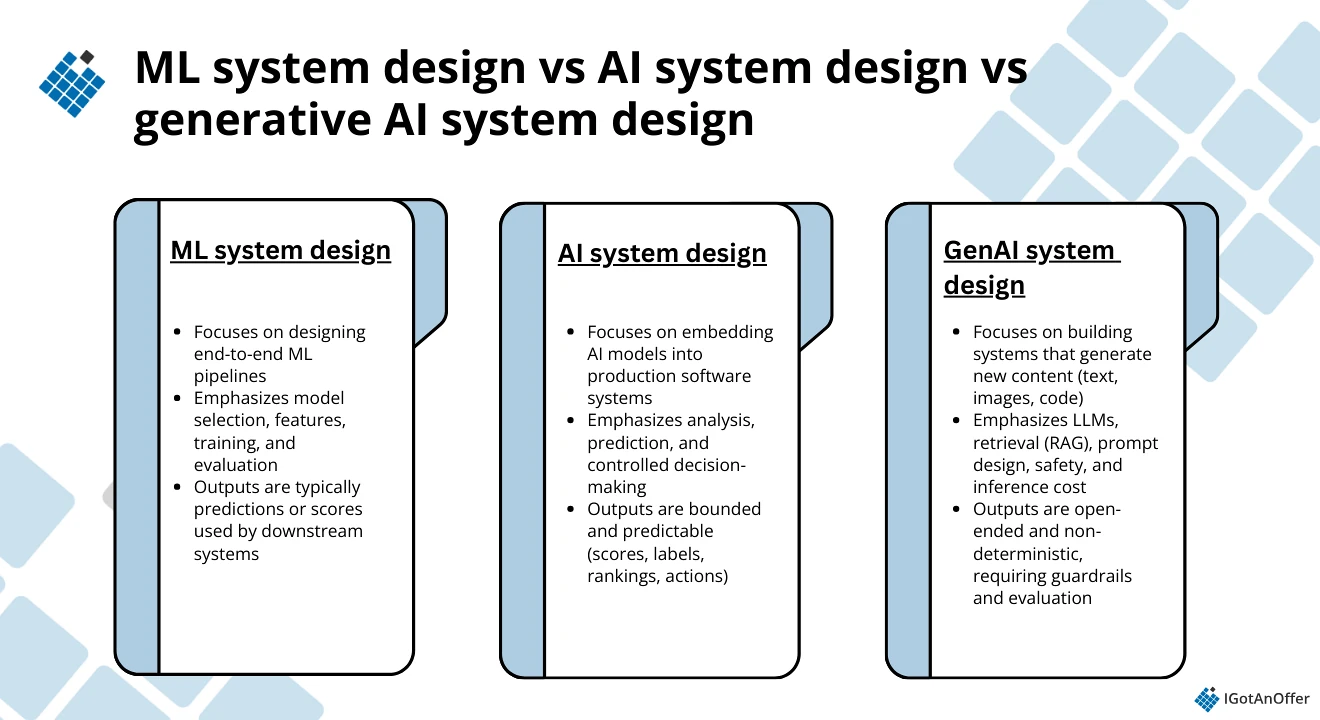
Below, we break down how system design expectations differ across ML system design, AI system design, and Generative AI system design interviews.
ML system design interviews
ML system design interviews are similar to standard system design questions in that you’ll need to outline a high-level approach for a system or problem. You’ll still be expected to cover concepts such as databases, microservices, APIs, queues, and functional or non-functional requirements.
The main difference is that you’ll need to design a machine learning solution in ML system design interviews and explain the full pipeline (training pipelines, feature stores, model lifecycle management, offline evaluation metrics, and model serving).
According to Aniket (Amazon senior PM, AI-focused), these systems typically produce structured outputs such as scores or classifications. So, you can expect interviewers to probe how you would address and mitigate risks around data quality, model drift, and reliability in production.
Learn more about ML system design interviews here.
AI system design interviews
Meanwhile, AI system design focuses on building efficient systems for analysis and prediction. Like ML systems, these models typically produce fixed or bounded outputs, such as a score, label, ranking, or decision, which downstream systems can reliably act on.
So, you can expect questions around:
- Predictive systems, which use historical and real-time data to generate scores or predictions that downstream systems act on. Examples: “Design a system to predict customer churn for a subscription product” or “Design a real-time fraud detection system for online transactions.”
- Agentic systems, where a model can reason, make decisions, and take actions such as calling APIs or orchestrating workflows. Example: “Design an AI agent that can schedule meetings by interacting with calendar and email APIs.”
- Wrapper applications, where an AI model (often an LLM) is embedded into an existing product with a custom interface or workflow. Examples: “Design an AI writing assistant inside a document editor” or “Integrate an AI assistant into a customer support platform.”
AI system design differs from ML system design in that the focus is less on building the ML pipeline and more on designing AI-first software. Hence, Oussama (ex-Amazon ML Solutions Architect) says you might not be expected to go as deep into ML architecture or breadth.
Generative AI system design interviews
Finally, generative AI system design interviews are a specialized subset of AI system design interviews, with a specific focus on systems that generate new content, such as text, images, or code.
As mentioned earlier, traditional AI system design produces fixed, predictable outputs. In contrast, GenAI systems produce open-ended outputs, meaning the same input prompt can result in different responses each time. Some examples of GenAI systems include:
- A chatbot may generate different answers to the same question
- A document assistant may rewrite the same paragraph in multiple valid ways
- A coding assistant may produce different implementations for the same problem
Because these systems rely on probabilistic models and operate heavily at inference time, interviewers focus on how you design around prompting, retrieval, tools, agents, evaluation, and user experience.
You’re also expected to reason about GenAI-specific risks such as hallucinations, prompt injection, sensitive data leakage, inconsistent behavior, and cost blowups.
As a result, GenAI system design interviews emphasize designing systems that can reliably orchestrate inference while delivering a safe, high-quality user experience at scale.
“GenAI interviews still care about the standard distributed-systems basics, but they’ll push harder on evaluation, guardrails, and context/tooling design,” says Aniket.
1.4 High-level design (HLD) vs. low-level design (LLD)
GenAI system design questions are intentionally scoped to high-level design. However, depending on the role and company, interviewers may ask you to selectively dive deeper into certain components of the system.
As a result, it’s important to understand the difference between high-level design (HLD) and low-level design (LLD).
1.3.1 High-level design or HLD
You could describe HLD as the bird’s-eye view or the big picture of an entire system architecture. With HLD, you would be expected to cover the following:
- Functional requirements: Core features (send message, post tweet, search user, generate responses, retrieve documents, validate outputs, etc.)
- Non-functional requirements: Scale, latency, throughput, availability, consistency, cost, and response quality
- Traffic estimates and capacity planning: Requests/sec, storage size, growth projections
- Architecture components:
- Load balancers
- Application/API servers
- Databases (SQL vs NoSQL, sharding, replication)
- Caches, queues, CDNs, pub/sub
- LLM inference services
- Vector databases or embedding services
- Safety, validation, or moderation layers
- Data flows: Read path vs write path, how requests move through the system, including prompt construction, retrieval, model inference, and post-processing
- Trade-offs: CAP theorem, eventual vs strong consistency, cost vs scalability, quality vs latency
The goal of your interviewer is to assess whether you can design a reliable and scalable system that can work in real-world conditions and constraints.
1.3.2 Low-level design or LLD
LLD goes deeper into the details of how a system works, i.e., how the internal components are structured and work together. With LLD, you will be expected to cover:
- Object-oriented modeling: Classes, objects, interfaces, relationships
- Design patterns: Factory, Strategy, Observer, Singleton, etc.
- APIs and methods: Clear function signatures, parameters, return types
- Data models: Table schemas, indexes, relationships, how queries are optimized
- Component interactions: Sequence diagrams showing how services interact, including retrieval, inference, and validation steps
- Edge cases and validations: Error handling, retries, fallbacks, and handling incorrect or unsafe outputs
- Maintainability: Clean abstractions, modularity, extensibility
Asking you to drill down into LLD, interviewers want to see how you would translate and implement a high-level design for real-world use.
You should be able to communicate clearly and with depth, anticipate real-world constraints (and suggest ways to handle them), and reason about tradeoffs.
1.2.3 HLD vs. LLD: What will you cover at your level?
So, which one would you be expected to cover at your GenAI system design interview?
For freshers and entry-level engineers, a basic understanding of system design concepts is expected, but nothing too complex.
When you do look it up online, you’ll see that freshers and entry-level do get LLD questions. But these will mostly focus on testing your knowledge of Object-Oriented Programming (OOP) fundamentals, design patterns, and coding hygiene.
Typically, covering both HLD and LLD is expected in mid-level engineers. At this level, you’re expected to own features end-to-end, so you must be able to design APIs, schemas, AND consider scale and integration.
At a senior or staff level, you’ll mostly focus on HLD, designing systems at a scale that can serve millions of users. However, you could also be asked to drill down into LLD. You need to prove that you can bridge high-level architecture with low-level implementation.
To learn more about these two topics, we recommend reading the following deep dives:
Coaches who contributed to this guide




















2. Different topics to cover in Generative AI system design interviews ↑
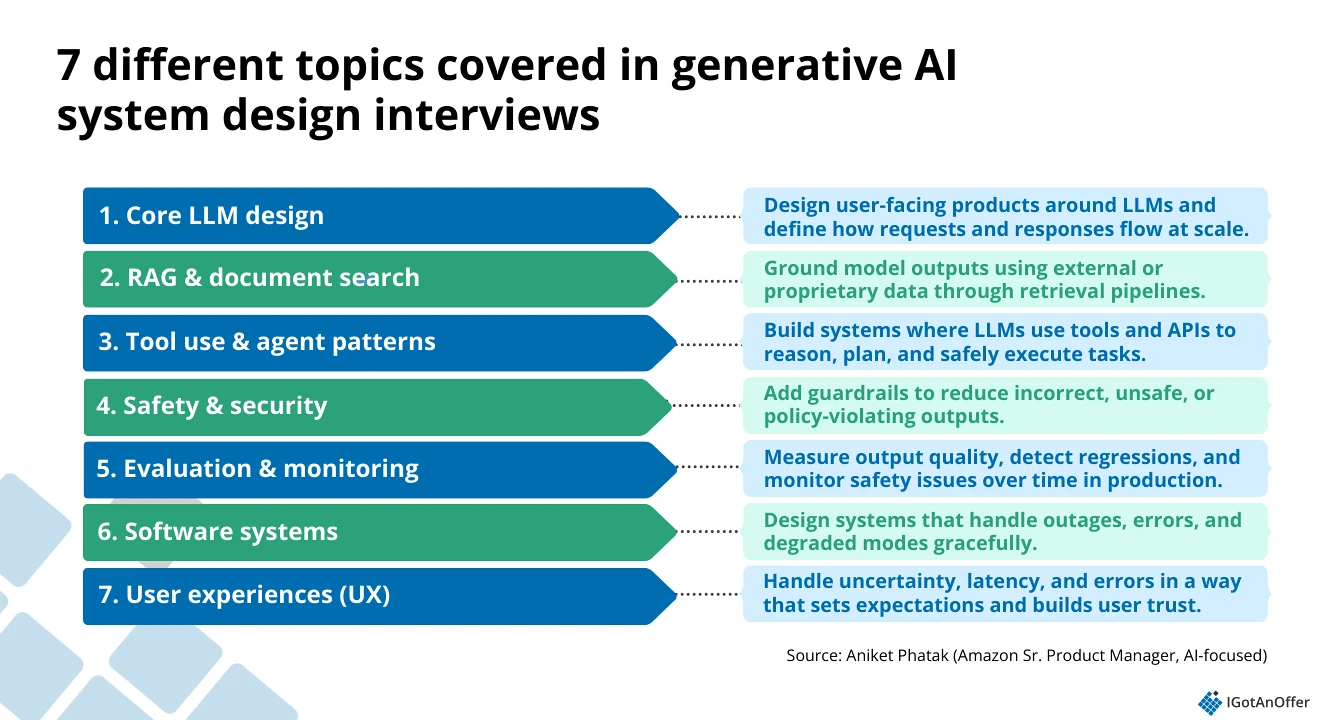
Based on insights from our expert coach Aniket (Amazon senior PM, AI-focused) and our analysis of hundreds of Glassdoor reports for software and AI engineering candidates at Google, Apple, OpenAI, and Anthropic, we’ve narrowed down the most important areas you should prioritize during your preparation.
About our coach: Aniket is a product leader with 10+ years of experience driving growth at Amazon across Voice AI, Generative AI, and other automotive platforms. During his time at Amazon, he has conducted 200+ interviews across product and engineering roles.
2.1 Core LLM design
A large portion of GenAI system design interviews focuses on designing user-facing applications built around LLMs, such as chatbots, assistants, or internal tools.
You’re expected to explain how the LLM fits into the system, how requests flow through different components, and how responses are generated and delivered to users. Other relevant topics include:
- Tokens and context window limits
- Temperature and top-p trade-offs
- Structured output and function calling
- Streaming responses, truncation, and prompt budgeting
2.2 Retrieval-Augmented Generation (RAG) and document search
Many GenAI systems need to generate answers based on external or proprietary data, rather than relying solely on a model’s training data. This is where retrieval-augmented generation (RAG) comes in.
These questions test whether you understand when and why to use retrieval, including:
- When RAG is the right tool vs not
- Chunking strategies, embedding choice, hybrid search, re-ranking
- Query rewriting, multi-hop retrieval
- Citation and provenance, freshness, deletion/compliance
Example questions:
2.3 Tool use and agent patterns
More advanced GenAI system design interviews may ask you to design systems where an LLM uses tools and follows agentic patterns to reason, plan, and take actions by interacting with external APIs. You should be able to discuss:
- When to use tools vs. pure text generation
- Planning-based agents vs. direct tool calls
- Guardrails for tool execution and permissions
- Retries, reconciliation, and failure recovery
- Human-in-the-loop controls for sensitive actions
Example questions:
2.4 Safety and security
Because LLMs can generate incorrect, unsafe, or sensitive outputs, interviewers often test how you reason about safety and security at the system level.
These questions focus on mitigation strategies such as:
- Prompt injection patterns and defenses
- Data exfiltration prevention, policy enforcement, and personally identifiable information (PII) handling
- Least-privilege access for tools and scoped credentials
Example questions:
2.5 Evaluation and monitoring
Some GenAI system design interview questions focus on how models are evaluated and monitored once deployed. Interviewers want to see whether you can measure output quality over time and detect regressions or unsafe behavior in production.
You should be able to discuss:
- Offline evaluation methods: golden datasets, adversarial testing, and red-teaming
- Online evaluation: A/B testing, user feedback loops, and quality dashboards
- Common failure taxonomies: hallucinations, refusal errors, tool misuse, toxicity, and data leakage
- How evaluation results feed back into iteration, prompt updates, or model changes
Example questions:
2.6 Software systems
GenAI system design interviews still heavily test core distributed systems fundamentals, especially because LLM systems are expensive, latency-sensitive, and dependent on external providers.
Interviewers want to see whether you can design infrastructure that scales safely, controls costs, and remains stable under load.
Be prepared to design for:
- Caching, queues, rate limiting, and backpressure to protect model providers and downstream services
- Multi-region deployment, observability, and fault isolation in production systems
- Cost modeling and capacity planning, including how inference usage impacts infrastructure spend
Example questions:
“How would you design a GenAI system to handle traffic spikes without overwhelming the model provider?” “How would you think about cost and capacity planning for an LLM-powered application at scale?”2.7 User experience
Users should be at the center of your GenAI system design. Poor handling of uncertainty, latency, or errors is one of the fastest ways GenAI products lose user trust.
Interviewers want to see whether you can design user experiences that account for the non-deterministic nature of LLMs and set the right expectations when the model is slow, uncertain, or constrained.
Be prepared to make design decisions around:
- When and how the system should ask clarifying questions or provide partial answers
- How uncertainty or limitations in model outputs are communicated to users
- Latency masking techniques, such as streaming responses
- Guardrail messaging and the use of citations or sources to build user trust
Example questions:
3. Generative AI system design interview questions (by company) ↑
Now that you know what to expect in GenAI system design interviews, let’s look at a complete list of company-specific examples from AI-focused companies. These are based on real candidate reports from Glassdoor and Reddit for SWE and AI/ML engineering interviews (we’ve lightly edited some for clarity and phrasing).
The questions below are organized by company to help you find the most relevant ones for your interviews.
Example of Google GenAI system design interview questions
- Design a small language learning model (LLM) that could run on a phone while making sure it’s polite
Example of Apple GenAI system design interview questions
- What is KV cache? How does it help in LLM inference?
- What retrieval-augmented generation (RAG) projects have you worked on?
- What is your most challenging work in GenAI?
Example of OpenAI GenAI system design interview questions
- Design ChatGPT
- How would you design an AI chatbot?
- How would you design / build an LLM-powered enterprise search system?
- How would you design a scalable and efficient system for training a large language model (LLM), considering both computational and data constraints?
Example of Anthropic GenAI system design interview questions
- Design our Claude chat service
- How would you design a language model that minimizes harmful outputs while still being useful and expressive?
- Here’s a junior developer’s design for an inference batching system. Can you review it and explain what you’d change or improve?
Example of Cohere GenAI system design interview questions
- How would you design a model that can solve math problems? Walk through data collection, supervised fine-tuning (SFT), post-training, evaluation, etc.
Example of Salesforce GenAI system design interview questions
- Describe how you would architect an AI agent system, including the agent loop, tool interfaces, memory design, orchestration technologies, and safety considerations
In addition to the company-specific list above, below are a few recruiter-shared examples shared by AI engineering candidates on Reddit:
More examples of GenAI system design interview questions
- Design a system to process 10k user uploads per month (bank payslips, IDs, references). How would you extract data, detect inconsistencies, reject invalid files, and handle LLM provider downtime?
- Design a system that lets doctors automatically send billing info to insurers based on patient notes
- Design a generative AI document-processing pipeline for unstructured data (emails, PDFs, images) to automate workflows like claims processing
- Design a conversational recommender system that suggests products based on user preferences, combining chat, retrieval, and database layers
4. Tips for answering generative AI system design questions ↑
For this section, we’ve gathered tips from four of our system design interview coaches, Mark, Marvin , Oussama, Ashish, and Aniket. Collectively, they’ve conducted hundreds of interviews, both actual and mock, at top tech companies such as Google, Meta, and Amazon.
Here are their tips, based on what they’ve seen on the ground:
Tip #1: Communicate efficiently
Thirty-five to sixty minutes is an artificially compressed time. You won't be used to working and talking about things at this speed, and so you need to practice communicating with the interviewer efficiently.
During the interview, you want to make sure the interviewer can follow your thought process. It’s completely fine if they don’t agree with every single decision you make.
“What you need to do is keep your mental model of what you’re thinking and their mental model as closely aligned as possible.” Mark (ex-Google engineering manager)
Tip #2: Reduce the scope of the problem.
In GenAI system design interviews, you're often asked to design entire large-scale systems like ChatGPT. In ~45mins, this is impossible, so first you need to reduce the scope.
For example, you might suggest to your interviewer that you focus on a specific, crucial part of the system, such as the backend architecture or a particular feature (e.g., if you were designing Spotify, this might be the music recommendation engine).
"Scope the problem to a size that you think you can complete during the interview.” Mark.
Tip #3: State your assumptions clearly
Most GenAI system design questions are intentionally vague because interviewers want to see how you handle ambiguity and make reasonable decisions with incomplete information.
By stating your assumptions early on, you give the interviewer a chance to confirm or correct your direction before you go too far down the wrong path.
“Feel free to make assumptions as long as you communicate them clearly. Share your thought process, including both the choices you make and the ones you discard.” Oussama (ex-Amazon ML solutions architect)
Tip #4: Start drawing ~15 minutes in
Drawing is an important visual aid to help the interviewer understand your answer. A good rule of thumb is to start drawing around a third of the way into the interview. Ideally, once you’ve clarified the requirements and aligned on scope.
This ensures that your diagram supports the discussion and doesn’t lock you into a premature design.
“If you start drawing too soon, you might start going down a road that doesn’t address the problem.” Mark
Tip #5: Start with a simple design and iterate
When working through a system design problem, aim to get to a working solution first, then iterate. Don’t get sidetracked by adding requirements that didn’t exist in the question, as these will complicate your design.
You can always acknowledge a specific item and come back to it later. For example, “We’ll need to use caching here, but I’ll come back to that later.”
“Candidates often make the mistake of designing for an unrealistic scale without grounding in problem constraints, and not prioritizing or evolving the design incrementally,” Marvin (Reddit senior software engineer, ex-Amazon) says.
Tip #6: Properly understand the problem
It’s very tempting to jump straight into solution mode as soon as you hear the problem. However, doing so can prevent you from fully understanding what’s being asked and lead to incorrect assumptions that affect the rest of your design.
To avoid this, imagine you're calling your own interfaces and think about specific use cases. This will help ensure you really understand what the problem is and what the objective is. It can help you catch assumptions you’ll likely make in your instant solution mode.
Doing this early also reduces the risk of glossing over important trade-offs, failure scenarios, or state consistency, which is another common mistake observed by our experts.
Tip #7: Practice, practice, practice!
There is a knowing and doing gap with GenAI system design interviews. Learning the theory and reading prep guides is great, but you need to practice out loud with friends or experts, or at least record yourself and watch yourself back.
Doing so can help build your confidence and reduce stress as you get more comfortable explaining your ideas in an interview setting.
If you do some mock interviews, which are hugely helpful, ideally allow time for long feedback and conversation afterward.
Tip #8: Explain your thinking
Give your reasons as to why you're making each choice you do. Why did you choose one particular technology over another one? Interviewers want to understand what's behind a candidate’s thinking to assess their level of technical judgment.
“Not only do you understand why you're making a choice and the different aspects of different technology choices, but you're also communicating it to me in a way that I can understand.” Mark
Tip #9: Get comfortable with the math
For FAANG companies, scale is important in system design interviews. That means you're going to have to do some back-of-the-envelope calculations early on in your design.
Get comfortable estimating requests per second, latency, and resource usage, and how these scale as usage grows.
Tip #10: Use the drawing tool efficiently
Your drawing is a visual aid; it doesn't need to look pretty, but you do need to be able to create boxes, shapes, and arrows quickly without having to think much about it.
Try to find out which tool the company you're interviewing with will want you to use and make sure you're comfortable using it.
Tip #11: Avoid getting lost in technical details
A common mistake in system design interviews is spending too much time on low-level details before establishing the overall architecture. Interviewers care first about how you structure the system, identify essential components, and reason trade-offs.
If you notice that your explanation is getting overly technical, pause and reframe your answer at a higher level before diving back into the problem.
Remember, software engineers also work with cross-functional teams. So, it’s important to communicate your thought process in a way that non-technical stakeholders can easily understand.
“Try to avoid overloading your answers with jargon and AI buzzwords." — Ashish (ex-software engineer, AI/ML-focused)
Tip #12 Avoid these common GenAI system design mistakes
During GenAI system design interviews, interviewers are also on the lookout for possible red flags. These are some examples Aniket (Amazon senior PM, AI-focused) cites:
- Treating the LLM like a source of truth: Candidates sometimes rely on raw generation for factual answers instead of grounding outputs with retrieval, tools, or citations, which raises concerns about correctness and reliability.
- Skipping an evaluation or monitoring plan: Designing a system without explaining how output quality, regressions, or safety issues will be measured over time signals a lack of production readiness.
- Defaulting to fine-tuning too early: Jumping straight to fine-tuning without first considering prompting, retrieval, or tools suggests poor judgment around cost, iteration speed, and maintainability.
- Ignoring safety and abuse vectors: Failing to address prompt injection, data leakage, or unsafe tool execution indicates weak awareness of GenAI-specific risks.
- Overlooking latency and cost constraints: Designing as if model calls are unlimited, without discussing token budgets, caching, or model routing, signals a lack of systems thinking.
- Not addressing failure modes: Avoiding discussion of what breaks, how failures are detected, and how the system degrades gracefully raises concerns about reliability in production.
5. How to prepare for Generative AI system design interviews ↑
As you can see from the complex questions above, there is a lot of ground to cover when it comes to system design interview preparation. So it’s best to take a systematic approach to make the most of your practice time.
Below are links to free resources and a plan to help you prepare for your GenAI system design interviews.
5.1 Learn the concepts
There is a base level of knowledge required to be able to speak intelligently about system design. You don't need to know EVERYTHING about sharding, load balancing, queues, etc.
However, you will need to understand the high-level function of typical system components. You'll also want to know how these components relate to each other, and any relevant industry standards or major tradeoffs.
To help you get the foundational knowledge you need, we've put together a series of 9 system design concept guides.
Here's the full list:
- Network protocols and proxies, which make it possible for any networked computers to talk to each other, no matter where they are or what hardware or software they’re running.
- Databases, integral components of the world’s biggest technology systems.
- Latency, throughput, and availability, three common metrics for measuring system performance.
- Load balancing, the process of distributing tasks over a set of computing nodes to improve the performance and reliability of the system.
- Leader election algorithms, which describe how a cluster of nodes without a leader can communicate with each other to choose exactly one of themselves to become the leader.
- Caching, a technique that stores copies of frequently used application data in a layer of smaller, faster memory in order to compute costs and to improve data retrieval times and throughput.
- Sharding, the horizontal scaling of a database system that is accomplished by breaking the database up into smaller “shards,” which are separate database servers that all contain a subset of the overall dataset.
- Polling, SSE, and WebSockets, techniques for streaming high volumes of data to or from a server.
- Queues and pub-sub, mechanisms that allow a system to process messages asynchronously, avoiding bottlenecks and help the system to operate more efficiently.
Generative AI system design interviews require a fundamental understanding of system design. If you need a quick refresher, check out our system design interview prep guide and our list of 19 system design interview tips from ex-interviewers for additional tips and resources.
If you're specifically targeting a Staff-level role, we also recommend checking out our Staff system design interview guide for a deeper dive into what interviewers expect at this level.
5.2 Learn an answer framework

We always recommend using a repeatable answer framework when answering system design interview questions. To help with this, we asked Coach Aniket (Amazon senior PM, AI-focused) to share a 5-step step-by-step framework for answering GenAI system design questions.
5-Step Generative AI System Design Answer Framework
- Clarify user, use cases, success criteria, constraints (latency, cost, privacy, regions)
- Define quality expectations, guardrails, and reliability requirements
Step 2: Design a high-level architecture (10–15 min)
- Identify core components: client, API gateway, auth, orchestration service, retrieval, tools, model(s), storage, analytics.
- Walk through data paths: prompt in, context build, model call, post-processing, logs/telemetry.
Step 3: Dive deep into the problem (20–30 min)
- RAG design (indexing, chunking, query routing, citations)
- Tool use / agents (function calling, planning, retries)
- Memory (session vs long-term, privacy, relevance)
- Latency / cost (caching, batching, model routing, streaming)
- Evaluation (offline + online, golden sets, LLM-as-judge pitfalls)
- Safety (prompt injection, data exfiltration, policy enforcement)
Step 4: Discuss tradeoffs (10–15 min)
- What breaks? How do you detect it? How do you degrade gracefully?
Step 5: Conclusion
- Summarize the design, list risks, and outline the next iteration
Apply this framework to practice questions like those we’ve included in Section 3. Use it on different types of questions in a variety of subjects, so that you learn how to adapt it to different situations and respond to unpredictable questions on the fly
5.3 Dive deep into the company’s culture and products
Be sure that you’re up to date on the latest products and releases of your target company, as well as their legacy products, as you’ll most likely be asked system design questions that relate to them.
Here are some resources that can help with the top GenAI-focused companies:
Meta
OpenAI
Anthropic
Microsoft
If you’re applying for a specific Gen AI-focused tech company, you might want to check out our company-specific interview guides as well:
OpenAI
- OpenAI interview process
- OpenAI interview questions
- OpenAI system design interviews
- OpenAI software engineer interview
Anthropic
- Anthropic interview process
- Anthropic common interview questions
- Anthropic system design interviews
- Anthropic culture interview questions
NVIDIA
If you’re targeting a specific company, you can also refer to our company-specific SWE and MLE interview guides:
- Google software engineer interview guide
- Google engineering manager interview guide
- Google technical program manager interview guide
- Google machine learning engineer interview guide
- Meta software engineer interview guide
- Meta engineering manager interview guide
- Meta technical program manager interview guide
- Meta machine learning engineer interview guide
- Amazon software development engineer interview guide
- Amazon software development manager interview guide
- Amazon technical program manager interview guide
- Amazon machine learning engineer interview guide
- Microsoft software engineer interview guide
- Microsoft engineering manager interview guide
- LinkedIn software engineer interview guide
- Airbnb software engineer interview guide
- Uber engineering manager interview guide
- Netflix engineering manager interview guide
- NVIDIA software engineer interview guide
- Apple machine learning engineer interview guide
- Apple engineering manager interview guide
- TikTok machine learning engineer interview guide
5.4 Practice by yourself
A great way to start practicing is to interview yourself out loud. This may sound strange, but it will significantly improve the way you communicate your answers during an interview.
Use a piece of paper and a pen to simulate a whiteboard session, or use a whiteboard if you have one. For example, OpenAI uses Excalidraw for its system design interviews, while Google typically uses Google Docs. Get used to drawing your basic charts and arrows on these tools.
Play the role of both the candidate and the interviewer, asking questions and answering them, just like two people would in an interview. Trust us, it works.
5.5 Practice with peers
Once you've done some individual practice, we strongly recommend that you practice with someone else interviewing you.
If you have friends or peers who can do mock interviews with you, that's an option worth trying. It’s free, but be warned, you may come up against the following problems:
- It’s hard to know if the feedback you get is accurate
- They’re unlikely to have insider knowledge of interviews at your target company
- On peer platforms, people often waste your time by not showing up
For those reasons, many candidates skip peer mock interviews and go straight to mock interviews with an expert.
Get feedback from experienced system design interviewers ↑
In our experience, practicing real interviews with experts who can give you company-specific feedback makes a huge difference.
Find a generative AI system design interview coach so you can:
- Test yourself under real interview conditions
- Get accurate feedback from a real expert
- Build your confidence
- Get company-specific insights
- Save time by focusing your preparation
Landing a job at a big tech company often results in a $50,000 per year or more increase in total compensation. In our experience, three or four coaching sessions worth ~$500 make a significant difference in your ability to land the job. That’s an ROI of 100x
Click here to book system design mock interviews with experienced system design interviewers.