

 Back to other articles
  Last updated: September 08, 2026

 Interviews
 Data scientist
 Deeply researched
Data scientist interviews at OpenAI are among the most competitive in tech. The process spans up to six rounds and tests everything from SQL to AI tool judgment to product thinking.
There's another wrinkle: with only a handful of publicly reported interview experiences for this specific role, most candidates go in with limited visibility into what to expect. This guide changes that.
We've pulled together everything available: OpenAI's own interview guide, Glassdoor and Blind candidate reports, and question patterns from our DS guides for Meta, Google, Amazon, and TikTok. The goal is to give you a complete picture of the process and what it takes to prepare.
Click here to practice 1-on-1 with expert data science interviewers
Let's get started.
1. OpenAI data scientist role and salary ↑
Before covering the OpenAI data scientist interviews, here's a quick look at the role itself.
1.1 What does an OpenAI data scientist do?
OpenAI data scientists work across a wide range of teams: product, infrastructure, finance, safety, and agentic AI. The common thread across all of these, as reflected in OpenAI's active job postings, is that you're expected to own work end-to-end by defining metrics, building analysis, and communicating findings directly to engineers, product managers, and executives.
A few things make the role distinct from a typical big tech DS position. Many of the products you'll be measuring are AI systems, which means you'll be evaluating things like model output quality and user trust in AI-generated responses.
OpenAI also moves fast and ships frequently, so your work needs to hold up under time pressure and with imperfect data.
Based on OpenAI's data scientist job postings, core responsibilities typically include:
- Designing and running rigorous experiments with clear product recommendations
- Defining, implementing, and operationalizing metrics for new features and products from scratch
- Building dashboards and self-serve tools that let teams draw data-backed insights without depending on you for every query
- Working with engineers, product managers, researchers, and executives to align on what to measure and why
- Applying strategic thinking beyond standard A/B testing to surface long-term tradeoffs
1.2 OpenAI’s work culture
OpenAI describes itself as mission-driven in a way that's more than a tagline. The company's stated goal is to“ensure artificial general intelligence benefits all of humanity.” That goal is woven into how teams operate and how candidates are assessed during interviews.
You don't need to be an AI safety researcher to work here, but you should be able to speak thoughtfully about the responsibility involved in building these systems.
Beyond that, the pace is intense. OpenAI is one of the fastest-moving companies in tech, and data scientists are expected to keep up with product cycles that move at a speed most candidates won't have encountered elsewhere.
1.3 How much does an OpenAI data scientist make?
OpenAI pays data scientists well above the tech industry average. Below is the salary and compensation breakdown by level, based on Levels.fyi data.
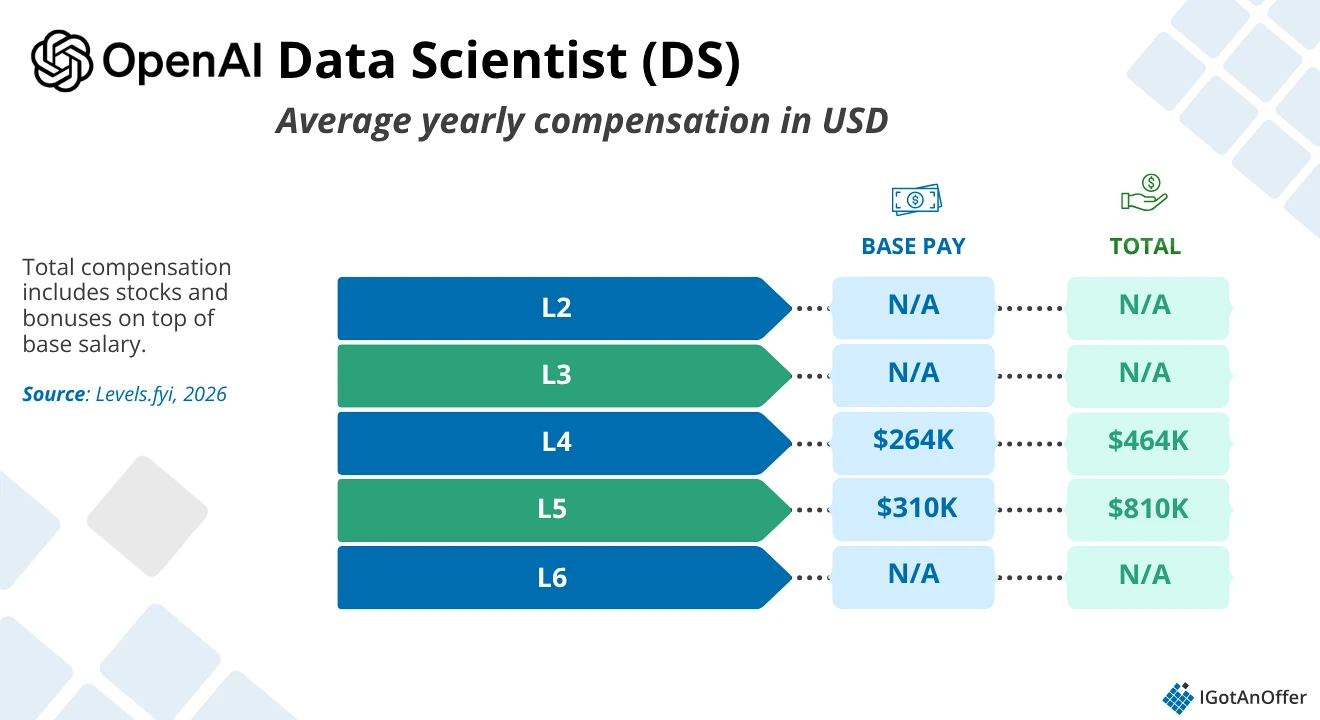
Check with your recruiter to confirm which level you're being evaluated at. Keep in mind that OpenAI operates with limited salary negotiation room compared to most big tech companies. The company takes a largely 'this is the number' approach, especially below senior levels.
Ultimately, how you do in your interviews will help determine what you'll be offered. That's why hiring one of our salary negotiation experts can provide such a significant return on investment.
1.4 What OpenAI looks for
Based on our analysis of OpenAI's hiring philosophy and what the company consistently looks for in data scientists, there are a few attributes that show up across every stage:
- Mission alignment: you don't need to be an AI researcher, but you should be able to discuss your perspective on responsible AI development with some depth
- Judgment over process: OpenAI values candidates who can make good decisions under constraints, especially when data is imperfect or infrastructure is limited
- AI fluency: the ability to work with, critique, and debug AI-generated outputs is tested directly, not assumed
- Clear communication: every stage assesses whether you can explain findings to engineers, PMs, and executives without losing precision
- Ownership: you're expected to drive projects from scoping to delivery, not hand off analyses once the hard part is done
2. OpenAI data scientist interview process and timeline ↑
Now that you have a clear picture of what a data scientist at OpenAI does and how much they make, here is what the interview process looks like and what you need to do to get through it.
2.1 What steps to expect
The OpenAI interview process and timeline for data scientist roles typically takes 2 to 3 weeks from application to decision, though some candidates report timelines of up to 6 weeks. It follows these steps:
- Step 1: Resume screen
- Step 2: Recruiter call
- Step 3: Hiring manager screen
- Step 4: Skills-based assessment
- Step 5: Final interviews
- Step 6: Decision
Let's look at each step in more detail.
Step 1: Resume screen ↑
After you apply through the OpenAI careers portal or get contacted directly by a recruiter, the recruiting team reviews your resume to assess fit. According to OpenAI's interview guide, this typically takes about a week.
OpenAI says it's not credential-driven, but it does look for candidates who have worked on problems at a meaningful scale and who can demonstrate a track record of impact. Quantify wherever you can how many users your analysis affected, what decisions it drove, and what changed as a result.
For help building a strong resume, see our data science resume guide. If you’re looking for expert feedback, you can get input from our team of expert resume reviewers, who will cover what achievements to focus on (or ignore), how to fine-tune your bullet points, and more.
Step 2: Recruiter call ↑
If your resume passes, a recruiter will reach out to schedule a 30- to 45-minute call. This is non-technical. Expect questions like 'Tell me about yourself,' 'Why OpenAI?', and 'Walk me through your background.' Be ready to discuss your motivations and goals.
The recruiter should also walk you through the rest of the process and answer questions about timeline and role details. This is a good time to ask which teams are hiring and to clarify which level you'll be evaluated at.
Pro tip: Before the call, spend time reading OpenAI's blog and familiarizing yourself with the team you're targeting. Recruiters notice when candidates know the product.
Step 3: Hiring manager screen ↑
This is typically a 20 to 30-minute virtual conversation with the hiring manager, where you may be asked about your background and long-term goals. Depending on the team, you may also get basic ML theory questions or be asked to talk through a past project.
If you're applying to a research-adjacent team, be prepared to discuss any relevant publications or research work.
Step 4: Skills-based assessment ↑
This is where the technical evaluation begins, and it's one of the most distinctive parts of the OpenAI DS process. The assessment has two parts.
First, you'll receive a take-home data challenge with 48 hours to complete it. The problem is based on a real business scenario, such as a feature launch or a shift in user behavior.
You're encouraged to use AI tools like ChatGPT during the assessment. OpenAI isn't testing whether you can grind through exploratory data analysis manually. They're assessing your judgment in directing AI effectively, catching its mistakes, and synthesizing findings into a clear narrative.
Once you submit, the second part is a one-hour review call. For the first 30 minutes, you'll cover your approach and answer the reviewer's questions. The second 30 minutes, you'll be working on a standalone SQL data manipulation task.
One candidate reported on Blind that the Python portion involved debugging AI-generated code rather than writing from scratch, consistent with what candidates from Glassdoor also describe for this stage.
Step 5: Final interviews ↑
According to OpenAI's official interview guide, candidates typically go through 4 to 6 hours of final interviews with 4 to 6 people over 1 to 2 days. Most roles are based in San Francisco, though you can choose to interview virtually or on-site at OpenAI's SF headquarters.
Based on candidate reports, the DS final round typically includes five interviews:
- Hiring manager interview: a deep-dive into a past project, covering both technical decisions and team collaboration
- Data science case study (x2): given metrics on a feature, you'll analyze them, make strategic recommendations, and decide whether to launch. Expect questions on statistics, P-values, and multifactorial experiment design.
- Data science Q&A: academic-style statistical questions on concepts that may require an advanced statistics background. Candidates report that this round can be more demanding than standard DS interview prep covers.
- Project management case study: a product manager-led interview focused on collaborative skills, constraint handling, and communicating findings to non-technical stakeholders.
OpenAI says its interviews are designed to stretch you beyond your comfort zone. The bar is high, and the final round in particular rewards independent thinking under pressure over coached answers.
Step 6: Decision ↑
You should expect to hear back within a week of your final interviews, though timelines vary. Your recruiter will be your point of contact throughout.
If you get an offer, don't hesitate to ask detailed questions about vesting schedules, refresh grants, and equity valuation. These matter significantly at a company where equity makes up the majority of total compensation.
3. OpenAI data scientist example questions ↑
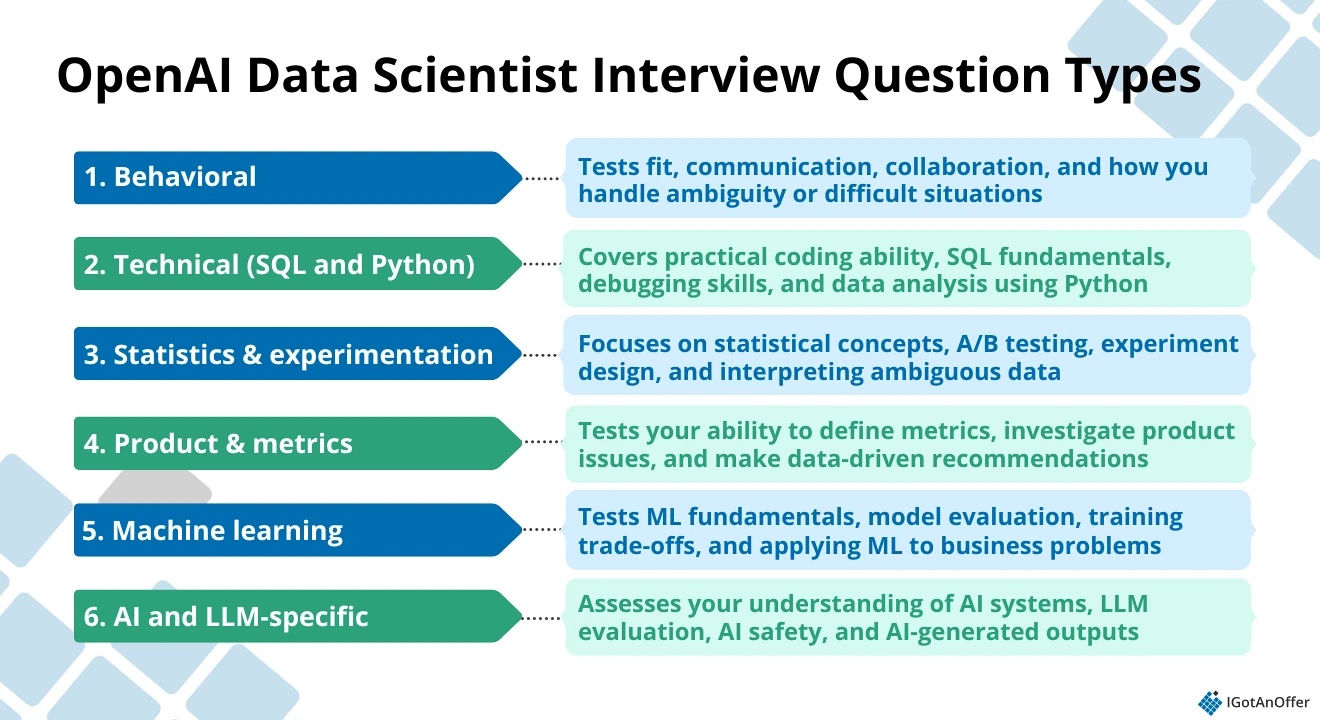
OpenAI data scientist interviews cover six main areas:
- Behavioral
- Technical (SQL and Python)
- Statistics and experimentation
- Product and metrics
- Machine learning
- AI and LLM-specific
Glassdoor has only two reported questions for this role. Rather than leave it at that, we’ve supplemented them with confirmed questions from our OpenAI interview guides and candidate reports on other online forums like Blind.
Plus, we used question patterns from our DS guides for Meta, Google, Amazon, and TikTok. Where questions come from other companies, we’ve indicated the source in brackets.
3.1 Behavioral questions ↑
Behavioral questions appear from the recruiter call all the way through the final round. OpenAI uses them to assess mission alignment, how you handle ambiguity, and your collaborative instincts.
Prepare concrete examples from past projects that show impact and independent thinking. Make sure you can explain how you've communicated technical findings to non-technical audiences.
Questions below are drawn from the IGotAnOffer OpenAI behavioral interview guide and confirmed candidate reports on Glassdoor.
Example OpenAI data scientist interview questions: Behavioral
- Why do you want to work at OpenAI?
- Tell me about yourself.
- Walk me through a project or accomplishment you're most proud of.
- Provide your resume and experience.
- Describe a data and analytics project you've worked on.
- Tell me about a time you solved a complex problem. How did you approach it?
- Tell me about a time you had to come up with a creative solution to a problem with severely incomplete data.
- Tell me about a time you took initiative on a project that wasn't explicitly your responsibility.
- Tell me about a time you had to make a decision with incomplete information.
- Tell me about a time you had to bring structure to an unclear or ambiguous situation.
- Describe a time you failed. What did you take from it?
- Tell me about the most useful piece of feedback you've ever received.
- What are your thoughts on AI safety and the risks of advanced AI systems?
- What does responsible AI development mean to you in practice?
Learn more in our OpenAI behavioral interview guide. Then, get in more practice with our general behavioral interview questions guide, which includes sample answers to the most common behavioral questions and an answer framework.
3.2 Technical questions (SQL and Python) ↑
The technical assessment is a two-part process: a 48-hour take-home assignment followed by a one-hour review that includes a live SQL task. Based on candidate reports, SQL is the primary focus, with Python appearing in both the take-home (data analysis) and in a code-debugging segment.
Below are sample questions we gathered from actual Glassdoor reviews, along with similar questions from interviews at Google, Amazon, and Meta that are relevant to this role.
Example OpenAI data scientist interview questions: Technical questions
SQL
- Identify bugs in code without writing any new code yourself.
- Given three columns of data, how would you compare the first three to the last three?
- Write a SQL query to explain the month-to-month retention rate. (Amazon) (Solution)
- Given a table with three columns (id, category, value), find IDs for which the value of two or more categories matches. (Amazon) (Solution)
- Provided a table with user_id and dates they visited the platform, find the top 100 users with the longest continuous streak as of yesterday. (Meta) (Solution)
- Using SQL, calculate the daily revenue generated in the US for this product over the past 30 days. (Meta) (Solution)
- What's the difference between a left join, a union, and a right join? (Meta)
- How would you find the top 5 highest-selling items from a list of order histories? (Google)
Python
- Write a Python class that supports basic get, add, and delete operations. (TikTok)
- Write a Python function that displays the first n Fibonacci numbers. (Amazon)
- We have two models, one with 85% accuracy and one with 82%. Which one do you pick?
For more practice, see our OpenAI coding interview guide and our general coding interview prep guide.
3.3 Statistics and experimentation questions ↑
OpenAI has a dedicated data science Q&A round that focuses on statistical principles. Based on candidate reports, the concepts tested are fairly academic and may be challenging for someone without an advanced statistics background or extensive relevant experience.
Statistics also show up in the DS case study rounds, where you'll be asked to design experiments, interpret results, and justify your methodology.
Beyond the standard concepts, be prepared for questions about working around constraints, such as small sample sizes, imperfect historical data, and experiments that can't be run cleanly. Here are examples reported by candidates:
Example OpenAI data scientist interview questions: Statistics and experimentation
- Walk through A/B test concepts such as alpha, beta, and how they relate to sample size. (TikTok)
- How would you design a test and determine the minimum required sample size? (TikTok)
- Explain the concept of variance and standard deviation. Why are they important? (TikTok)
- An A/B test shows a 0.2% drop in CTR but an increase in session length. How would you interpret these results? (Meta)
- What are you going to do with network effects when designing an A/B test? (Meta)
- When would you use a t-test versus a z-test? (Meta)
- Define precision and recall in a tweet-length explanation. (Meta)
- Given data from two product campaigns, how could you do an A/B test if we see a 3% increase for one product? (Google)
- In what situation would you consider mean over median? (Google)
- For sample size n, the margin of error is 3. How many more samples do we need to make the margin of error 0.3? (Google)
Click here to learn more about data science case interviews, including an effective framework to approach them.
3.4 Product and metrics questions ↑
Two of the five final-round case interviews are product-focused: the DS case study rounds and the project management case study. You'll be given a scenario, such as a feature launch or a shift in user behavior, and asked to define success metrics, diagnose what's going wrong, or decide whether to ship.
Because OpenAI's products are AI systems, many of these questions involve measuring things harder to define than engagement or revenue, such as trust in AI outputs, quality of model responses, and the reach of AI-assisted workflows.
Be ready to explain which metrics you would use, why they matter, and how you would validate them.
Example OpenAI data scientist interview questions: Product and metrics
- Lifecycle and cost of customer acquisition.
- How would you measure the success of a product? (Meta)
- Activity in a product feature is down by 20%. What do you do? (Meta)
- A feature change is launched and a key rate drops by 15%. How would you investigate? (Meta)
- If a product had a feature and the team wanted to change it, how would you use data science to give recommendations? (Google)
- Given there are no metrics being tracked for a product, what are the top five metrics you would implement? (Google)
- How would you investigate a drop in a KPI? (TikTok)
- What would you do if the Day 2 retention rate dropped by 50%? (TikTok)
- Design an experiment to evaluate the success of a recommendation system, ensuring both user satisfaction and business KPIs. (Amazon)
See our guide to product metrics to learn more about the topic and the best way to approach them.
3.5 Machine learning questions ↑
ML questions show up across the final round, particularly in the hiring manager interview. Expect questions on specific techniques, model evaluation, and how you'd handle common data problems at scale.
The inclusion of 'Build a RAG system' in DS guides reflects how much the field has shifted. At OpenAI, this carries more weight than at most companies: data scientists work directly with the systems being built, so interviewers expect you to understand how models work, not just how to apply them.
Example OpenAI data scientist interview questions: Machine learning
- How do you handle overfitting and underfitting in machine learning models? (Amazon)
- What is the difference between bagging and boosting? (Amazon, Google)
- What is L1 vs. L2 regularization? (Amazon)
- Describe a case where you solved an ambiguous business problem using machine learning. (Amazon)
- How do you manage an unbalanced dataset? (Amazon)
- How do you perform anomaly detection? (Amazon)
- Explain transformer architecture. (Amazon, Google)
- Describe an end-to-end machine learning project you worked on. (Google)
- How would you evaluate the performance of a machine learning algorithm? (Google)
- If two predictors are highly correlated, what is the effect on the coefficients in logistic regression? (Google)
- Can you describe how you would approach building a predictive model for user engagement on a new feature? Walk through steps from data collection to model evaluation. (Google)
- How does a neural network without an activation function compare to logistic regression? (Amazon)
- What is precision and what does it measure? What is recall? (TikTok)
- Build a RAG system. (Amazon)
3.6 AI and LLM-specific questions ↑
As a data scientist at OpenAI, you are expected to work with, evaluate, and critique AI systems directly. Because of this, having a solid understanding of core AI concepts is increasingly important.
OpenAI also places a strong emphasis on AI risk and safety. AI lab companies like OpenAI and Anthropic consistently evaluate candidates on these topics throughout the interview process.
Interviewers will likely assess your knowledge of topics like model evaluation, AI-generated outputs, AI safety, and data quality throughout the interview process. According to Glassdoor reports, one area where this shows up directly is the take-home assessment, where candidates are asked to debug AI-generated code.
Example OpenAI data scientist interview questions: AI and LLM-specific
- How does understanding and debugging AI-generated code differ from debugging human-written code?
- How would you measure and improve the factual accuracy of AI-generated content?
- How would you analyze bias in a large language model's outputs?
- What are your thoughts on AI safety and the risks of advanced AI systems?
- How would you evaluate and compare different OpenAI models (e.g., GPT-4o vs GPT-4o-mini) for a specific use case?
- How do you evaluate Gen AI models? (Amazon)
If you need even more questions to practice with, take a look at our data science interview prep guide.
4. OpenAI data scientist interviewing tips ↑
You might be a strong data scientist, but that alone won't get you through these rounds. Interviewing is a skill, and OpenAI's process is demanding enough that preparation style matters as much as subject knowledge.
4.1 Ask clarifying questions
Most of the questions you'll get, particularly in the case study rounds, are deliberately open-ended. Before diving in, ask enough questions to understand the scope and what success looks like.
Be upfront if you're unfamiliar with a specific topic, but don't stop there. OpenAI is assessing how you handle problems you haven't seen before, not just ones you've rehearsed.
4.2 Treat the interview like a conversation
Walk your interviewer through your reasoning as you go, especially in technical and case rounds. This applies to coding too: talk through your approach before you write a single line.
Your interviewer will often give hints if they see you going in the wrong direction. Be alert for those cues.
4.3 State your assumptions explicitly
When information is missing, and it often will be, state your assumption and check in with your interviewer whether it's reasonable.
The difference between a real work context and an interview is this: at work, you'd go find the missing data. In an interview, you make your assumption explicit and move forward. Candidates who skip this step often produce technically correct answers that miss the point of the question.
4.4 Back everything with data
Always reach for specific numbers and concrete examples when answering product or behavioral questions. Even in a behavioral round, the strongest answers describe outcomes in measurable terms. Vague answers about 'improving performance' without any indication of scale read as thin.
4.5 Present multiple solutions
Lay out more than one approach when possible. OpenAI interviewers want to understand your reasoning for choosing a particular path. Show you've considered the tradeoffs, not just the answer. This matters especially in the case study and PM rounds, where the problem often has no single correct solution.
4.6 Show AI fluency
This is not optional at OpenAI. During the take-home assessment, you're expected to use AI tools and demonstrate judgment in doing so. That means knowing which outputs to trust, which to question, and how to synthesize AI-assisted work into something clear.
In the final round, questions about LLMs and model evaluation are live. Being generally familiar with AI is not enough. Show that you've worked with these tools in practice.
4.7 Demonstrate mission alignment
OpenAI asks about its mission and values throughout the process. You don't need rehearsed talking points about AGI safety, but you should be able to speak with some depth about why the work matters and what responsible AI development means to you. Candidates who treat this as a formality tend to fall short in the behavioral round.
4.8 Communicate efficiently
During your interviews, you'll be assessed on how clearly you communicate and walk through your thinking. Treat every round like a collaboration, not a performance.
In case study and product rounds, state your assumptions upfront before diving into your analysis. In behavioral rounds, set up the situation quickly before moving into your actions and results.
A great way to sharpen this skill is to use a structured answer framework. IGotAnOffer's SPSIL framework (Situation, Problem, Solution, Impact, Learning) is a strong option for behavioral questions and helps you stay focused and concise under pressure.
5. How to prepare for OpenAI data scientist interviews ↑
Now that you know what questions to expect, let's focus on how to prepare. Below is our four-step prep plan for OpenAI data scientist interviews.
If you're preparing for other companies as well, check out our general data science interview preparation guide.
5.1 Learn about OpenAI's culture and products
As you've probably figured out from the example questions above, OpenAI's interviews are built around its products and mission. Before spending tens of hours on technical prep, make sure this is the right company for you, and that you can speak credibly about what it does.
Talk to anyone you know who works or has worked at OpenAI. That's the fastest way to understand the culture firsthand.
We also recommend reading the following:
- OpenAI's mission and hiring philosophy
- OpenAI Charter
- OpenAI Blog for recent products and research updates relevant to the team you're targeting
- OpenAI's research publications
- OpenAI Careers page for the full job description for your target role carefully
5.2 Practice by yourself
As outlined in Section 3, you'll encounter six types of questions: behavioral, technical (SQL and Python), statistics and experimentation, product and metrics, machine learning, and AI/LLM-specific. Here are resources for each, plus a few more resources you might find useful during your prep:
OpenAI guides:
- OpenAI interview process and timeline
- OpenAI interview questions
- OpenAI behavioral interview questions
- How to answer "Why OpenAI" interview and application question
- OpenAI system design interview
- OpenAI coding interview
- How to get a job at OpenAI
Behavioral:
Technical (SQL and Python):
- Coding interview prep
- Practice for 3 types of SQL interviews
- Mode Analytics SQL Tutorials
- DataLemur SQL practice problems
Statistics and experimentation:
- Ultimate A/B Testing Guide
- Khan Academy Statistics and Probability Course
- Brilliant.org statistics courses
Product and metrics:
Machine learning:
- Deep Learning Book (recommended by OpenAI's own interview guide)
- Spinning Up in Deep RL (also recommended by OpenAI)
- StackExchange statistics and ML threads
AI and LLM-specific:
Practicing other DS roles? See our other general and company-specific guides:
- Data science interview prep guide
- Meta data scientist interview guide
- Google data scientist interview guide
- Amazon data scientist interview guide
- TikTok data scientist interview guide
- Uber data scientist interview guide
- Microsoft data scientist interview guide
5.3 Practice with peers
Solo practice will only take you so far. One of the main challenges of data scientist interviews at OpenAI is communicating your answers clearly under pressure, particularly in the case study and Q&A rounds where you're expected to walk through your reasoning in real time.
A peer or friend can help. Even better if you can find someone with a data science background or who has gone through a similar process.
Be warned, though. You may run into the following problems:
- It's hard to know if the feedback you're getting is accurate.
- They're unlikely to have insider knowledge of interviews at OpenAI specifically.
- On peer platforms, people often waste your time by not showing up.
For those reasons, many candidates skip peer practice and go straight to mock interviews with an expert.
5.4 Practice with experienced data science interviewers
In our experience, practicing real interviews with experts who can give you company-specific feedback makes a significant difference.
Find an OpenAI data scientist interview coach so you can:
- Test yourself under real interview conditions
- Get accurate feedback from a real expert
- Build your confidence
- Get company-specific insights
- Learn how to tell the right stories, better
- Save time by focusing your preparation
Landing a job at a big tech company often results in a $50,000 per year or more increase in total compensation. In our experience, three or four coaching sessions worth ~$500 make a significant difference in your ability to land the job. That's an ROI of 100x!
Click here to book data scientist mock interviews with experienced DS interviewers.

 Coding