

 Back to other articles


 Last updated: September 21, 2026

 Interviews
 Forward deployed engineer
 Deeply researched
The OpenAI forward deployed engineer interview is demanding. You'll need to show strong production coding and system design skills, as well as the ability to work within a customer's organization and take ownership of a deployment.
Because the role is new, preparing for it is harder than usual. There are fewer candidate reports to learn from than for more established roles like software engineering. Plus, there's no well-established playbook for acing the interview because the process varies by team.
To help, we've put together a detailed breakdown of the interview process, example questions reported by real candidates, preparation tips, and links to quality resources. Use it to prepare more strategically and maximize your chances of landing a forward deployed engineering role at OpenAI.
Here's an overview of what we'll cover:
- Role and salary
- Interview process and timeline
- Example OpenAI forward deployed engineer interview questions
- Interviewing tips
- Preparation plan
Click here to practice 1-on-1 with experienced tech interview coaches
1. OpenAI forward deployed engineer role and salary ↑
Before we dive into the interview process and questions, let's quickly cover some basics about the role you're applying for.
1.1 What does an OpenAI forward deployed engineer do?
A forward deployed engineer (FDE) at OpenAI embeds with enterprise and government customers to take frontier models from prototype to production inside the customer's own systems.
You own the work end-to-end: discovery, technical scoping, system design, the build, and the rollout. You also write and review production code across the stack, work directly with the customer's engineers, and report back to Research and Product on how the models perform in real environments.
If you want to work directly with customers, solve problems across different organizations, and take AI systems from prototype to production, the FDE role may be a good fit for you. If you prefer deep focus on a single codebase with a stable roadmap, the OpenAI software engineer track is the better match.
1.2 Forward deployed engineer vs. AI deployment engineer vs. Forward deployed software engineer
Candidates often confuse OpenAI's three deployment titles, since all three take customers from prototype to a live system. The main difference is how much time you spend writing code versus advising customers:
- Forward deployed engineer: the hands-on build role. You write and review production code and work in the customer's codebase directly.
- AI deployment engineer: the consultative role. You advise senior stakeholders on what to deploy first. OpenAI asks for seven or more years of technical consulting experience.
- Forward deployed software engineer: works alongside FDEs, building the custom software and reusable tools behind deployments.
The interview questions overlap heavily across all three titles, so the guidance here applies to whichever one you're targeting.
1.3 OpenAI forward deployed engineer salary and compensation
OpenAI publishes base salary ranges on many of its US job postings. Since pay varies by role and location, check the specific job posting you’re applying to for the most accurate range. .
OpenAI lists base salary bands on its careers page. Two current postings give you a usable range for this role:
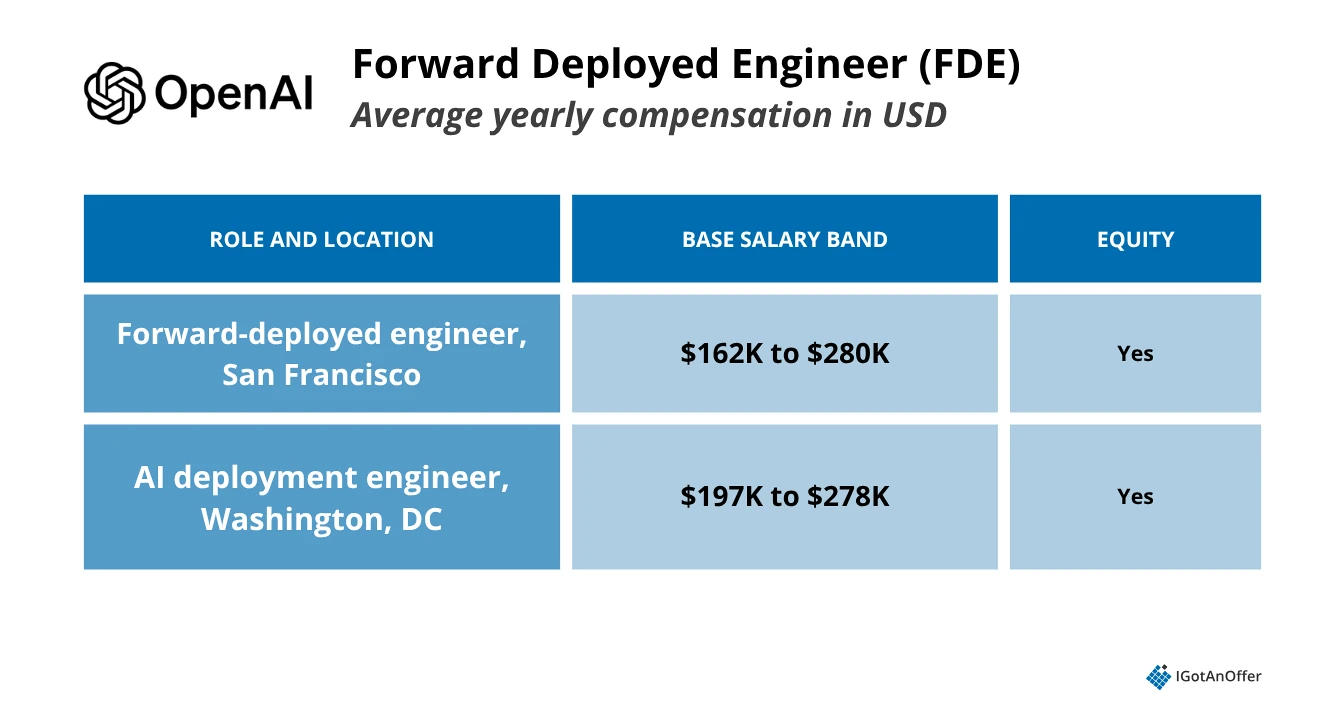
The salary band above covers several seniority levels under one title, so where you land depends on your level.
Base salary is also just one part of the offer. OpenAI packages lean heavily toward equity, with no target performance bonus and rare signing bonuses.
Ultimately, your interview performance will largely determine your offer, which is why working with our ex-OpenAI interview coaches can be a smart investment.
And remember, compensation at OpenAI is still negotiable, as it is at other top tech companies. If you receive an offer, don’t hesitate to ask for more. If it's your first time negotiating, consider booking a session with one of our salary negotiation coaches to get personalized advice.
Coaches who contributed to this guide















2. OpenAI forward deployed engineer interview process and timeline ↑
OpenAI's forward deployed engineer interview process typically takes four weeks to two months and follows these steps:
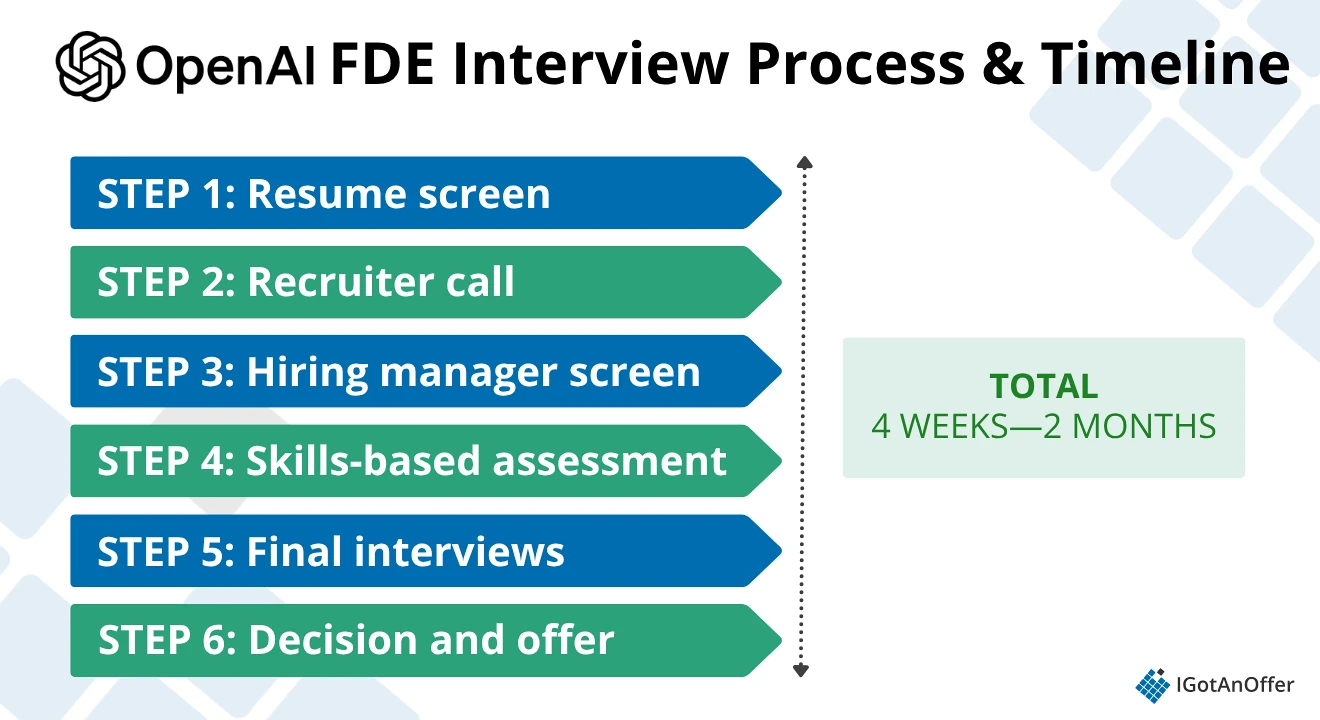
- Resume screen
- Recruiter call
- Hiring manager screen
- Skills-based assessment
- Final interviews
- Decision and offer
Because the role is new, OpenAI is still shaping this loop, so yours may not match the steps above exactly. Your recruiter will have the most accurate and up-to-date information about what to expect in your specific interview process.
For a full breakdown of every stage across roles, see our OpenAI interview process guide.
2.1 Resume screen
The first step of OpenAI's FDE interview process is the resume screen. This is an extremely competitive step. Like at other FAANG companies, the vast majority of candidates don't make it past this stage.
After you've submitted your application through the OpenAI careers portal, or been contacted directly via email or LinkedIn, recruiters will evaluate your resume to see if your experience aligns with the open position.
To help you put together a targeted resume that stands out, follow the tips below:
Tips on crafting a resume
- Make your work with customers explicit: if your experience was informal, describe it anyway. Owning a migration for a partner team, running technical onboarding for a client, or scoping requirements with a department outside engineering all count.
- Emphasize systems you owned end-to-end: the role is about delivery, so highlight work where you carried something from scoping through to production.
- Show applied AI experience: name the LLM systems you've shipped and what they did, including evaluation and reliability work.
- Be specific and concise: quantify impact wherever you can, and keep the document scannable for a recruiter reading quickly.
For more tips on writing your resume, see our tech resume examples. You can get expert feedback from our team of former FAANG recruiters, who will cover what achievements to focus on (or ignore) on your resume, how to fine-tune your bullet points, and more.
2.2 Recruiter call
If your resume passes the screen, an OpenAI recruiter will reach out to schedule a call. This generally lasts 30 to 45 minutes and isn't technical in most cases.
The recruiter is testing role fit here. You should expect questions like "Tell me about yourself," "Why OpenAI?" and "Walk me through your resume." Be prepared to discuss your previous experience and explain your motivation for applying to OpenAI.
You'll also get questions about your production AI experience. You should be able to talk in depth about a system you deployed, including who used it and any issues you encountered.
During this call, the recruiter should give you information on how the overall interview process will work and may answer your questions about the timeline, location, or job description. This is a great time to ask about which teams are hiring and express any role preferences.
Your recruiter should also provide you with helpful interview prep materials. If all goes well, the recruiter will get back in touch with you to schedule the hiring manager screen and skills-based assessment.
2.3 Hiring manager screen
This is usually a 20-30 minute call with the hiring manager. The conversation is a mix of your background, your long-term goals, and light technical discussion.
Have examples ready that show you can scope work in fast-moving situations and stay composed under pressure. If you're applying to a specialized team, such as OpenAI for Government, be ready to discuss the constraints that come with that customer base.
2.4 Skills-based assessment
If you passed the hiring manager screen, you'll move on to the skills-based assessment within about a week. This is where technical evaluation begins.
The format varies by team, but it commonly involves one or more of the following:
- Coding challenge: A practical problem on CoderPad or HackerRank, usually 45 to 60 minutes. OpenAI's problems are grounded in real work, such as building a small working system or debugging an existing function. Learn more in our OpenAI coding interviews guide.
- System design interview: For more senior roles, you may face a system design problem where you create a solution to a technical challenge, like API design, database schema, and overall architecture. These questions can be highly detailed with specifications and mockups provided. Learn more in our OpenAI system design interviews guide.
- Take-home project: You may be asked to build on OpenAI's APIs and submit working code plus a running application, then defend it in a live walkthrough. These projects can run to roughly five hours.
You can expect to hear back within about a week after completing your assessment. If you receive a take-home project, see Section 4.6 for tips on how to approach it. You'll also find detailed example questions for the different interview rounds in Section 3.
2.5 Final interviews
Candidates who pass the skills-based assessment advance to the final round. The final loop assesses your technical skills in greater depth, including how independently you can work through problems. You're expected to identify logical flaws and reach a solution without relying heavily on hints from the interviewer.
According to OpenAI's interview guide, this stage typically involves four to six hours of interviews with four to six people, conducted virtually over one to two days.
You can expect some combination of the following interview types:
1. Coding interview
You'll solve one or more coding problems, often in different formats than the skills assessment. Rather than simple implementation problems, final round coding may include refactoring a messy codebase, debugging a function that returns the wrong output, or extending a working system with new requirements.
You should also be prepared for follow-up questions. Even after you reach a correct answer, the interviewer may ask you to optimize your solution, handle a new edge case, extend it to a larger input, or explain the tradeoffs behind your approach.
Learn more about OpenAI coding interviews here.
2. System design or architecture interview
For most mid-level and senior roles, you'll face at least one system design interview during the final round. If you're interviewing for a staff SWE role, you might get two rounds. You're expected to discuss trade-offs thoughtfully, design APIs and database schemas, consider scalability and reliability, and even suggest improvements and features sometimes.
To learn more, see our OpenAI system design, generative AI system design, and ML system design interview guides.
3. AI and LLM technical deep-dive
A conceptual round on retrieval-augmented generation (RAG) architecture, evaluation, fine-tuning tradeoffs, and production guardrails. Expect follow-ups on every answer you give. Interviewers want to see that you understand how LLMs work, where they fail, and how to design around those limitations.
4. Project deep-dive and presentation (senior roles)
You may be asked to prepare a four- to five-slide presentation on a significant system you built. You'll walk through your decisions, trade-offs, and the impact of your work. This helps OpenAI assess whether you can communicate complex engineering work and explain the reasoning behind your decisions.
5. Behavioral and culture fit interview
Mission alignment matters a lot at OpenAI. Be prepared to discuss your perspective on AGI safety, alignment, and beneficial AI development. You don't need to be an alignment researcher, but you should show that you understand the risks and responsibilities of building powerful AI systems.
Learn more in our OpenAI behavioral interview guide.
2.6 Decision and offer
OpenAI typically moves quickly after the final round, with most candidates hearing back within a week or longer.
If you're approaching a decision deadline for another offer, let your recruiter know and give them the specific date. This may help speed up the decision process. If you advance, you will move into the offer and negotiation stage. Team matching can occasionally add some time to this stage before a formal offer is extended.
3. OpenAI forward deployed engineer interview questions ↑
There are four types of interviews you'll encounter as an OpenAI forward deployed engineer candidate:
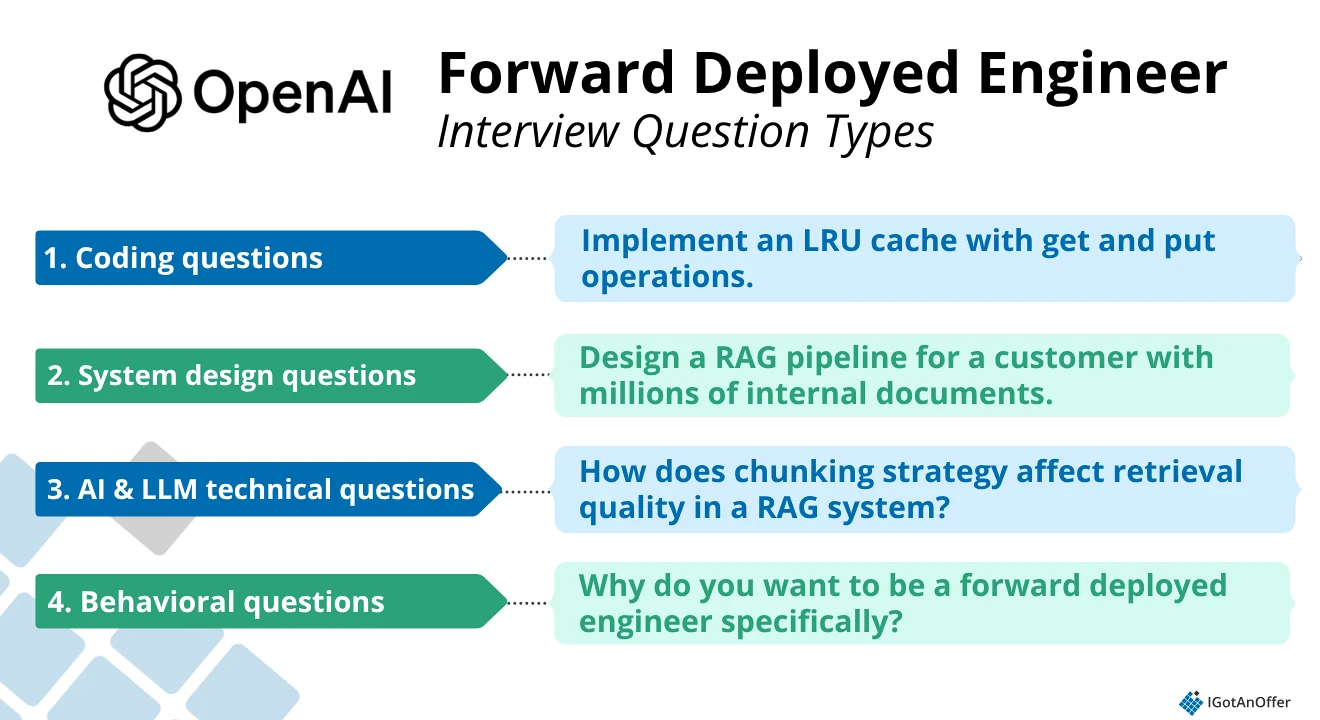
We analyzed candidate reports for the OpenAI forward deployed engineer role on Glassdoor, Blind, and other forums. Since there are few reports specific to this role, we supplemented them with questions from similar engineering roles at OpenAI, mapped against what the job postings say the FDE role requires.
Below, you will find curated lists of sample questions for each interview type.
3.1 Coding questions ↑
OpenAI's coding rounds are practical problems that simulate real engineering tasks. Each round typically runs 45 to 60 minutes on CoderPad and involves significant follow-up questions from the interviewer as you work through your solution.
This format mirrors the role, since the job involves writing production code directly in a customer's codebase. A working solution isn't enough on its own. You should be able to write clean, production-quality code that other engineers can read and maintain. This means:
- Clean structure: code organized into functions or classes instead of one long block
- Clear variable naming: avoid x, temp, or res. The names should communicate intent so the interviewer can read your code without needing clarification
- Explicit edge case handling: proactively account for empty inputs, nulls, boundary values, and unexpected data types without waiting for the interviewer to prompt you
- Test coverage, even when not asked: write a few test cases after solving the problems to show that your solution works across different inputs and edge cases
Here are some sample coding questions organized by type:
Example OpenAI forward deployed engineer interview questions: Coding
1. Data structures and systems implementation
- Implement an LRU cache with get and put operations. (solution)
- Implement a key-value store with serialization and deserialization, where keys and values can contain any characters.
- Implement a time-based key-value store. (solution)
- Implement a simplified spreadsheet API with formula evaluation and dependency tracking.
2. Code quality and debugging
- Refactor a bad codebase to improve structure, readability, and maintainability.
- Debug an existing function that produces incorrect output.
3. Graphs and trees
- Given a list of words sorted according to the rules of an alien language, determine the order of characters in that language.
- Given an n×n grid of 1s and 0s, return the number of islands.
- Given the root of a tree, count the number of nodes that satisfy a given condition.
- Topologically sort a directed acyclic graph and detect cycles.
For more coding practice, see our guides on coding interview prep, OpenAI coding interviews, and how to answer coding interview questions.
3.2 System design questions ↑
System design rounds typically last 45-60 minutes and assess how you reason about complex systems. You'll get a broad prompt and use Excalidraw to outline a high-level design, including key components and how they work together.
Be prepared to explain your decisions and the tradeoffs you make along the way. Your interviewer may also ask follow-up questions that push you to go deeper into specific parts of your design.
For FDE candidates, the prompts carry an LLM deployment angle. That means designing systems where model behavior, retrieval quality, latency, and cost all interact, and where a customer's constraints shape the architecture.
The RAG pipeline question is especially relevant to the FDE role, since it maps directly onto the deployments you'd run. Expect follow-up questions on chunking, embedding choice, hybrid retrieval, reranking, and how you'd keep the index in sync with a customer's live data.
Example OpenAI forward deployed engineer interview questions: System design
- How would you design an enterprise search system powered by an LLM?
- Design a RAG pipeline for a customer with millions of internal documents.
- How would you design an AI chatbot?
- Design a webhook system.
- You are given a simple UI for user preferences. Design the server-side system behind it, including API endpoints and data models.
For a detailed breakdown of how to approach this round, including example answer outlines specific to OpenAI, see our OpenAI system design interview guide and our machine learning system design guide.
If you're specifically targeting a Staff-level role, we also recommend checking out our Staff system design interview guide for a deeper dive into what interviewers expect at this level.
3.3 AI and LLM technical questions ↑
This is a conversational technical round that tests your understanding of how LLM applications work in production, including retrieval, evaluation, latency, reliability, and safety. There's no coding or diagramming. For many candidates, it's the most demanding round in the loop.
The questions map onto real deployment problems. For example, you may need to explain why a customer's assistant returns the wrong document, how you'd bring an eight-second response time down, or how anyone can tell whether the system is working at all.
Example OpenAI forward deployed engineer interview questions: AI and LLM
- When would you fine-tune a model, use RAG, or rely on prompt engineering?
- How does chunking strategy affect retrieval quality in a RAG system?
- How do you know your AI system is actually working well?
- Walk me through how you would diagnose high latency in an LLM inference pipeline.
- How would you handle API rate limiting and retries in a production LLM application?
- What guardrails would you put around an LLM application before it goes live?
Several of these questions touch on how LLM systems are architected. For a deeper look at designing that architecture, including RAG pipelines, retrieval, and serving tradeoffs, see our generative AI system design guide.
3.4 Behavioral questions ↑
Behavioral questions appear at every stage of the OpenAI process, including the recruiter call and the start of technical rounds. During the final loop, you can expect at least one dedicated behavioral session with a senior manager.
You’ll typically be assessed on the following traits:
- Mission alignment: your view on safe and beneficial AI, grounded in decisions you've made before
- Comfort with ambiguity: the ability to bring structure to unclear situations and make progress without complete information
- Communication: clear, efficient communication with peers, cross-functional partners, and the wider team across different levels of technical depth
- Conflict resolution: navigating disagreement with peers, partners, and customers without escalation
- Growth mindset: openness to feedback and a track record of acting on it
"Why OpenAI?" is one of the most common questions you’ll face. Be prepared to explain why you want to work at OpenAI and what interests you about its mission to build safe and beneficial AI.
You should also be ready to discuss the projects in your resume in technical detail, as well as the types of projects you'd like to work on at OpenAI.
Example OpenAI forward deployed engineer interview questions: Behavioral
1. General
- Why do you want to be a forward deployed engineer specifically, and not a product software engineer?
- Why OpenAI?
- Walk me through your resume.
- Tell me about your experience deploying AI or ML systems in production.
- Where do you see yourself in five years, and how does OpenAI fit into that?
2. Teamwork
- Tell me about a time you and a partner in another function disagreed. How did you resolve it?
- Tell me about a time you had competing ideas within your own team on how to move a project forward.
- Describe a time you had to work with someone difficult. What was the outcome?
3. Leadership
- Tell me about a time you showed leadership.
- Tell me about a time you solved a complex problem. How did you approach it?
- Tell me about a time you took initiative on a project that wasn't explicitly your responsibility.
- Tell me about a time you had to come up with a creative solution to a problem with severely incomplete data.
- Tell me about a time you made a mistake. How did you handle it?
4. Ambiguity and prioritization
- How have you managed multiple conflicting priorities?
- Tell me about a time you had to make a decision with incomplete information.
- Tell me about a time you had to bring structure to an unclear or ambiguous situation.
- Describe a time when you had to change direction mid-project. How did you handle it?
5. Mission and AI ethics
- What are your thoughts on AI safety and the risks of advanced AI systems?
- How do you think about the ethical implications of the work you do?
- What does responsible AI development mean to you in practice?
- Tell me about a time you had to weigh technical capability against potential harm or risk.
Learn more in our OpenAI behavioral interview guide. For more practice, see our general behavioral interview questions guide, which includes sample answers to common behavioral questions and an answer framework.
4. OpenAI forward deployed engineer interviewing tips ↑
You might be an excellent engineer, but that alone won't be enough to ace your interviews at OpenAI. Interviewing is a skill in itself, and there are a few things you can do to prepare specifically for the forward deployed engineer interview process.
Let’s look at 9 tips to make sure you approach your interviews the right way.
4.1 Answer the "why FDE" question before you're asked
Have a clear, specific reason for wanting to work in engineering with customers. One way to make your answer more convincing is to connect it to something you've already done. If you've worked closely with a customer or user and changed your approach based on what you learned, talk about that.
4.2 Prepare one production AI system you can defend in depth
Almost every stage of this interview loop gives you a chance to discuss a system you’ve built and put into production. Pick one system you know well and prepare to explain it in depth.
Be ready to discuss your chunking strategy, the embedding model you chose and what you compared it against, how you evaluated the system, and its latency. You should also be able to explain the key trade-offs and why you made each major technical decision.
4.3 Scope the problem before you design
System design prompts are broad by design, and 45 minutes isn't enough to cover an entire system. Narrowing the problem early is a skill interviewers actively assess.
Mark (ex-Google EM) says, "Scope the problem to a size that you think you can complete during the interview." The same instinct is what the job asks for when a customer arrives with an unbounded request.
4.4 State your assumptions out loud
Interviewers may intentionally give you an ambiguous prompt to see how you make decisions with incomplete information. State your assumptions clearly so your interviewer can correct you before you've spent 20 minutes going the wrong way.
Oussama (ex-AWS ML solutions architect) advises candidates to share both sides of their thinking, including "the choices you make and the ones you discard."
4.5 Cut the jargon
"Avoid overloading your answers with jargon and AI buzzwords," Ashish (TikTok lead engineer) says.
As an FDE, you'll constantly explain technical decisions to customers and colleagues who don't share your vocabulary. Interviewers want to see that you can explain a technical decision, including the trade-offs involved, in plain language.
4.6 Be honest
OpenAI does not expect candidates to know everything. If you get a question that’s outside your area of expertise, don’t hesitate to let your interviewer know. Ask the right questions and show motivation to learn.
Similarly, when asked if you faced challenges or setbacks, don’t deny or frame your weakness as a strength. Instead, discuss how you’ve improved and learned from these challenges.
4.7 Be concise but detailed
When answering behavioral questions, start with a short description of a situation you want to cite and be prepared to go into further detail once asked.
The best way to do this is to prepare a single specific example of a past experience to illustrate your answer to a question. When discussing your past accomplishments, Bilwasiva (Amazon applied scientist) advises quantifying your achievements wherever possible: “Use metrics and data to demonstrate the impact of your contributions.”
4.8 Present multiple possible solutions
When answering coding or system design interview questions, present multiple possible solutions if you can.
For complex or ambiguous problems, break them down into smaller, logical groups and explain how you’d approach each one. Compare the possible solutions, discuss their trade-offs, and explain why you chose your final approach. This demonstrates both your structured thinking and your ability to reason through trade-offs.
4.9 Prepare for system design at scale with a safety lens
OpenAI expects you to reason about reliability, fault tolerance, and safety at the architecture level, not just performance and throughput. In system design, for example, you should be able to explain what happens when components fail, how you would monitor for unexpected behavior, and what tradeoffs you are accepting.
5. How to prepare for OpenAI forward deployed engineer interviews ↑
Now that you know what questions to expect, let's focus on preparing as efficiently as possible. Below are the four steps we recommend for the FDE role.
5.1 Deep dive into OpenAI's mission and customer work
Before investing dozens of hours in technical prep, take the time to understand what OpenAI is building, why it matters, and whether it genuinely aligns with what you want to work on.
This matters at OpenAI because the mission shapes how the company hires, how teams operate, and how decisions get made at every level. Interviewers will probe your alignment with it directly.
If you know anyone who works at OpenAI (or used to), it's a good idea to talk to them to understand what the culture is like.
We also recommend checking out the following resources to get you started:
- OpenAI Charter
- OpenAI research and product blog
- OpenAI's interview guide
- OpenAI customer stories
- Spinning Up in Deep RL (OpenAI’s own resource on reinforcement learning)
- Deep Learning Book by Ian Goodfellow (for foundational AI understanding)
- Tech Philosophy and AI Opportunity by Stratechery (Ben Thompson)
Customer stories are particularly useful for understanding the FDE role. Learning how OpenAI works with enterprise customers can give you concrete examples to draw on when answering the "Why FDE?" question and for the scenarios that come up in system design.
5.2 Practice by yourself
As we've outlined above, you'll face four types of interviews at OpenAI: coding, system design, AI and LLM technical, and behavioral. The first step in your preparation should be to build a solid foundation in each area and practice answering questions independently.
For coding interviews:
Practice in CoderPad or a plain text editor without autocomplete because that's the environment you'll be working in.
- Coding interview prep guide
- OpenAI coding interview guide
- 47 Coding interview examples
- Coding interview tips
- AI-assisted coding interview guide
For system design and AI technical interviews:
OpenAI's rounds often require familiarity with ML infrastructure at scale, so generic prep isn't enough. These guides contain question breakdowns specific to what OpenAI asks:
- System design interview guide
- How to answer system design questions
- OpenAI system design guide
- Generative AI system design interview
- Machine learning system design interview
- Staff system design interview
For behavioral interviews:
Prepare specific, detailed stories for the questions in Section 3. Treat "Why OpenAI?" as one of the most important to get right, as a vague answer is a red flag:
For preparation specific to OpenAI:
To go deeper on the company and its process, we've put together a set of OpenAI guides:
- OpenAI interview process
- OpenAI interview questions
- OpenAI software engineer interview
- How to get a job at OpenAI
A great complement to written practice is answering questions out loud. It sounds unusual, but it will significantly improve how you communicate under pressure during the real interview.
5.3 Practice with peers
If you have friends or colleagues who can run mock interviews with you, that's worth exploring. Performing in front of another person is genuinely useful, and it's free.
Peer practice does come with real limitations:
- It's hard to know whether the feedback you receive is accurate.
- Your peers are unlikely to have inside knowledge of OpenAI's interview style.
- On peer platforms, people often don't show up or don't take the sessions seriously.
For those reasons, many candidates move straight to practicing with an expert.
5.4 Practice with experienced interviewers
In our experience, practicing real interviews with experts who can give you specific feedback makes a significant difference in your outcomes.
Working with an OpenAI interview coach means you can:
- Test yourself under real interview conditions
- Get accurate feedback from a real expert
- Build your confidence
- Learn how to tell the right stories, better
- Save time by keeping your preparation focused
Landing an engineering role at OpenAI often results in a $50,000 per year or more increase in total compensation. In our experience, three or four coaching sessions at around $500 in total make a meaningful difference in your ability to get the offer. That is an ROI of 100x.
Click here to book mock interviews with experienced OpenAI interview coaches.




 Coding