

 Back to other articles


 Last updated: June 04, 2026

 Interviews
 Product manager
 Deeply researched
Anthropic product manager interviews are different from most PM loops. As one of the leading tech companies in AI innovation, Anthropic and its PM interviews focus heavily on safety judgment and mission alignment, alongside the usual product sense and analytical rounds. Even experienced candidates struggle more often than you'd expect.
But with the right preparation, you can increase your chances of success. In this guide, we'll cover everything you need to know to prepare for product manager (PM) interviews at Anthropic.
To put it together, we gathered insights from our coaches, real reports from Anthropic applicants on Glassdoor and Blind, and official Anthropic job postings. You'll learn about Anthropic's PM interview process, provide real interview sample questions, tips on how to answer them, and a preparation plan.
Here's an overview of everything we'll cover:
Click here to practice 1-on-1 with Anthropic ex-interviewers
Let's get started.
1. Anthropic product manager role and salary ↑
Before getting into the interview itself, let's take a quick look at the role and what you can expect to earn. Feel free to skip ahead to the interview process if you'd prefer.
1.1 What does an Anthropic product manager do?
Product managers at Anthropic typically take ownership of specific products in the Claude lineup, the company's flagship family of large language models. These include:
- Claude consumer apps (web, desktop, mobile)
- Developer API
- Claude Code
- The enterprise tier, sold to companies like Zoom and Snowflake
Day to day, that means deciding which model capabilities to expose in your product and when, writing the evaluations that determine whether a feature is safe to ship, setting usage policies and rate limits, and working with researchers to shape what the next model release should prioritize.
What makes the role different from a typical AI PM job is that the model itself is the product, and it changes every few months. A capability that wasn't possible at the last release might anchor your roadmap at the next one. The standard PM playbook of building incrementally on stable underlying tech doesn't apply.
You're also shipping into a market where the conventions aren't set. Pricing, packaging, safety thresholds, and enterprise controls are still being worked out across the industry, and Anthropic PMs are often the ones working them out.
1.2 What does Anthropic look for in a product manager?
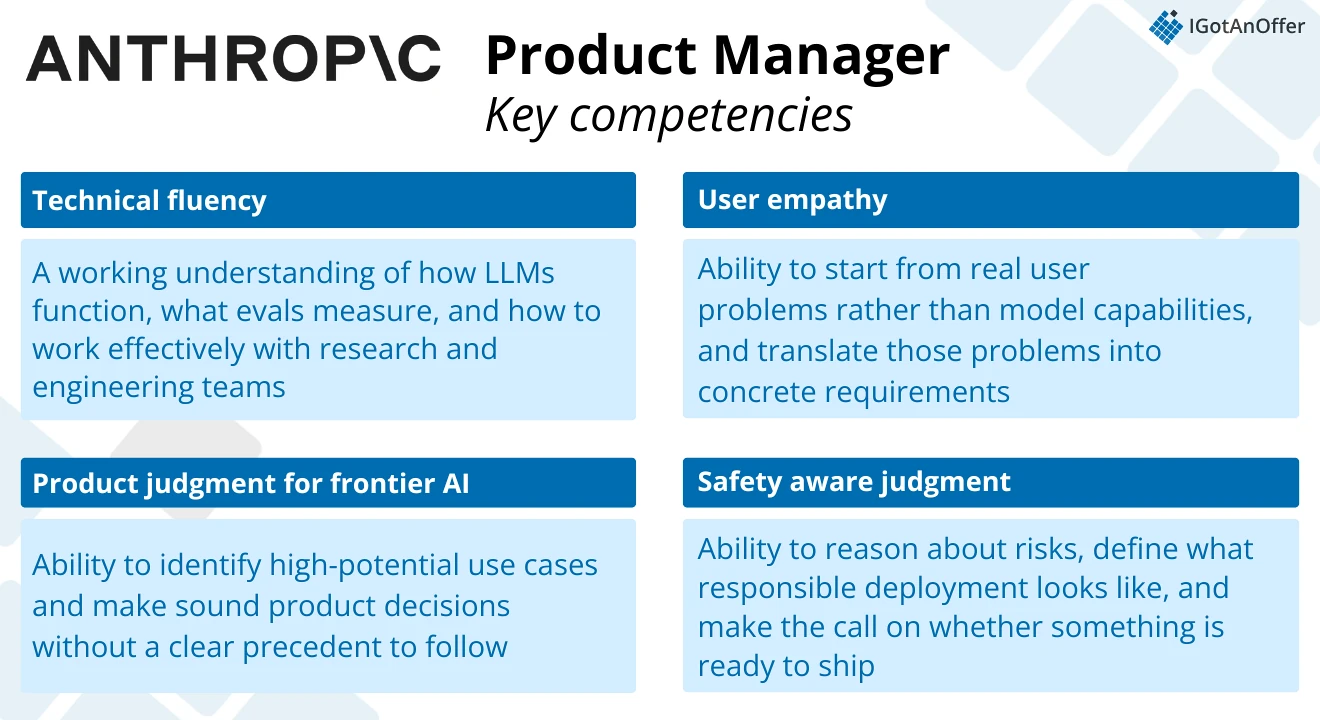 Amit, a former Director of Enterprise PM at Meta who coaches AI PM candidates on our platform, has interviewed hundreds of PM candidates at the senior level. In his view, Anthropic looks for these four core competencies above all else:
- Product judgment for frontier AI: the ability to identify high-potential use cases, translate model capabilities into user value, and make sound product decisions without a clear precedent to follow
- Safety aware judgment: the ability to reason about risks, define what responsible deployment looks like in practice, and make the call on whether something is ready to ship
- Technical fluency: a working understanding of how LLMs function, what evals measure, and how to work effectively with research and engineering teams
- User empathy: the ability to start from real user problems rather than model capabilities, and translate those problems into concrete requirements
As you'll see in section 3, Anthropic's interview loop is essentially a test of all four of these competencies, often simultaneously.
1.3 Anthropic product manager salary
Anthropic pays among the highest PM salaries in the industry. The table below shows the approximate total compensation breakdown based on data reported on Levels.fyi.
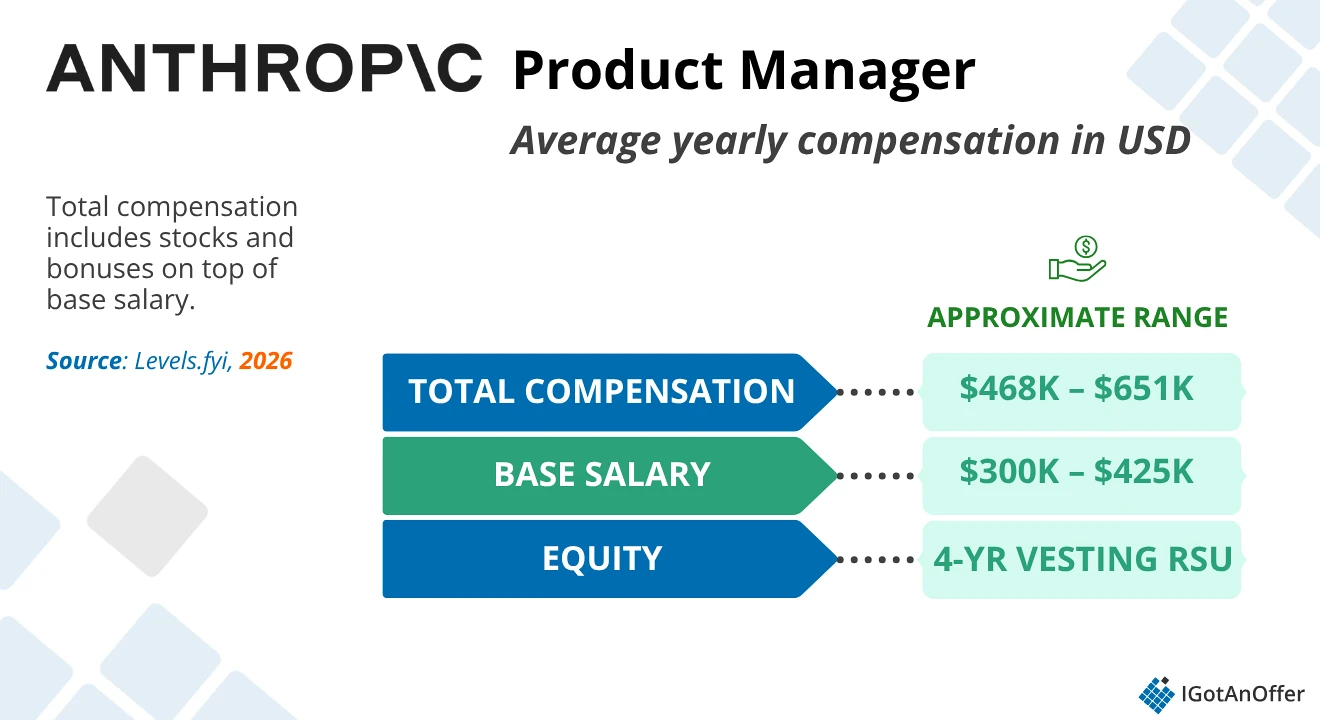
Anthropic doesn't publish a public leveling system for PMs the way Meta or Amazon do, so per-level breakdowns aren't available. If you're unsure what level you're being considered for, it's worth asking your recruiter early in the process.
Given Anthropic's rapid growth and rising valuation, the equity component can shift significantly over time. Check the most current data before you negotiate.
Ultimately, how you do in your interviews will determine what level you’re offered. That’s why hiring one of our Anthropic PM interview coaches can provide such a significant return on investment.
And remember, compensation packages are always negotiable. So, if you do get an offer, don’t be afraid to ask for more. Get tips from our PM salary negotiation guide, and practice what you’ve learned with one of our salary negotiation experts.
Coaches who contributed to this guide







2. Anthropic product manager interview process and timeline ↑
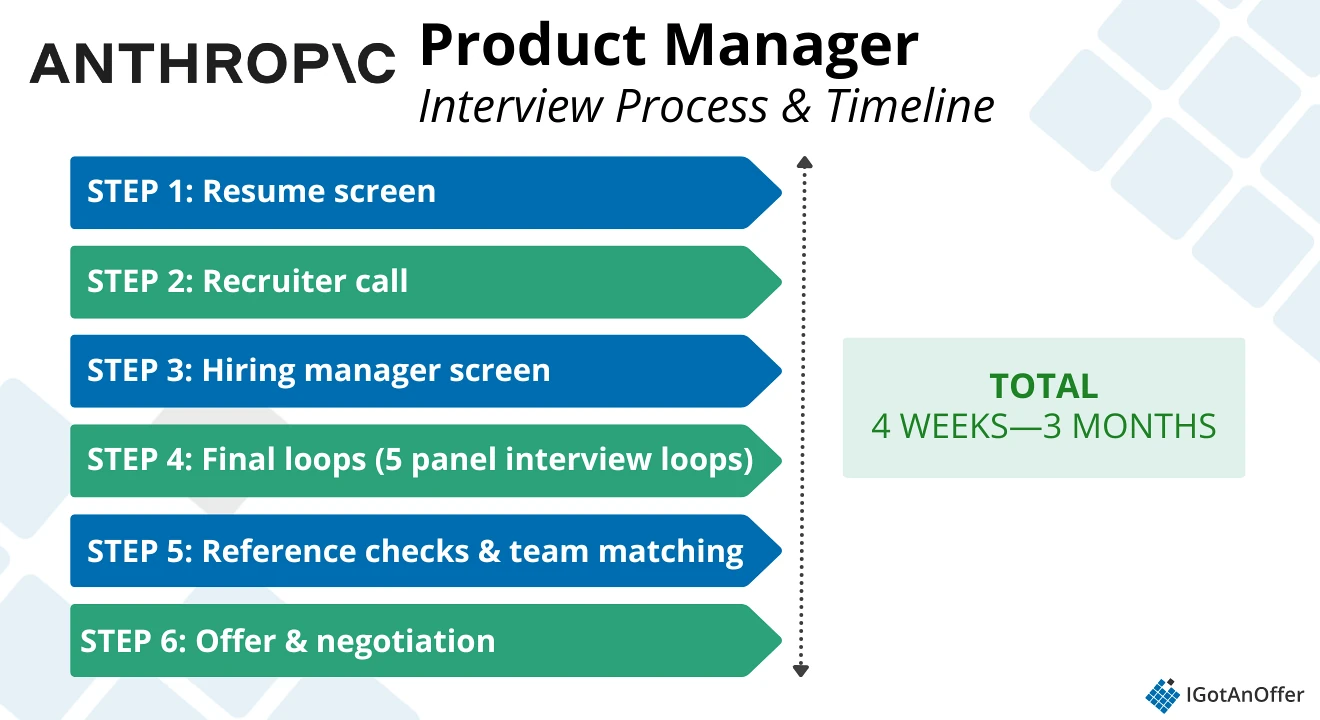
The Anthropic interview process for the PM role doesn't have a set timeline. Some candidates report it takes 4 to 8 weeks, though timelines can be closer to 2-3 months depending on scheduling.
Here's what the process looks like at each stage:
- Resume screen
- Recruiter call
- Hiring manager screen
- Final loops (5 panel interviews)
- Reference checks & team matching
- Offer & negotiation
Note: If you are interviewing for a product leadership position (VP, Director, Group PM) or senior PM role, check out our guides: product leader interview and senior product manager interview questions to learn more about what questions to expect and how to prepare.
Now, let's look more closely at each step of the PM process.
2.1 Resume screen ↑
After you apply through Anthropic's careers page or are contacted directly, recruiters review your resume to decide whether to move you forward.
This is the most competitive stage of the process. Application volume is enormous, and Anthropic is hiring for a very small number of PM seats at any given time.
To give yourself a shot, make sure your resume demonstrates:
- Clear product impact backed by numbers
- Experience shipping in ambiguous, zero-to-one environments
- Technical depth, especially anything relevant to AI, ML, or developer tooling
- A genuine connection to Anthropic's mission, where possible
If you’re currently polishing your resume or writing one, read our product manager resume guide. It includes examples from real PMs plus a template to help you get started.
You can also work with one of our coaches on a resume review if you want some feedback from former FAANG and AI lab recruiters.
2.2 Recruiter call ↑
If your resume makes the cut, you'll be invited to a 30-minute call with a recruiter. This is a screening conversation covering your background, motivations, and fit for the role.
Expect questions like:
- Why Anthropic?
- Walk me through your resume
- What are you looking for in your next role?
- What are your thoughts on AI safety?
The recruiter will also explain how the rest of the process works, confirm logistics, and share prep materials. Anthropic recruiters often ask about salary expectations on this call, so it's worth having a researched range ready.
They tend to be transparent about timelines and patient with candidates, which makes this a good time to ask clarifying questions of your own.
2.3 Hiring manager screen ↑
Next is a 45-minute to 1-hour conversation with the hiring manager for the team you'd join. This round is usually a mix of behavioral and role-specific questions.
You can expect to:
- Talk through one or two past projects in depth
- Discuss your approach to product strategy and prioritization
- Answer questions about how you handle ambiguity, tradeoffs, and cross-functional tension
- Get asked again about your views on AI safety and Anthropic's mission
Also, if you don’t come from a machine learning background, don’t try to hide it. Own your story. Be ready to explain how you got here: what sparked your interest in AI, how you’ve been learning, and what unique perspective your background brings. Anthropic values diverse experiences, and many of its engineers transitioned from other fields.
The hiring manager conversation is usually friendly and collaborative. They’re genuinely interested in your work, even if they sometimes seem rushed or distracted.
If you pass this stage, you’ll move on to the technical interview loop, typically scheduled within one to two weeks.
2.4 Final loop (5 panel interviews) ↑
The final loop for Anthropic PMs typically consists of five panel interviews on the same day. Each round is roughly 45 to 60 minutes.
Before the loop, some candidates are given a case prompt or business problem to prepare in advance. This isn't always a separate formal stage.
Based on candidate reports on Glassdoor, it varies by team and role. In some cases, it's a written memo or PRD; in others, it's a presentation you deliver to the panel as the first round.
If you're given one, treat it seriously. Candidates have flagged that these assignments are demanding and can take many hours to do well. Remember that Anthropic values depth and judgment over polish.
Based on candidate reports and our own coaching data, the final loop generally covers:
- Case presentation or deep dive (if a case was assigned, you'll present it here. Otherwise, this may be a product deep dive)
- Behavioral interviews (3 named rounds, each with a different focus. More in section 3)
- Product sense (a case discussion, with a focus on AI products)
- Analytical and execution (metrics, experimentation, tradeoffs)
- Culture and values (AI safety judgment, mission alignment, and how you think)
Anthropic's PM loops put unusual weight on the culture round. As Ridhima Khurana notes in her breakdown of the round, this interview often trips up confident, senior candidates because the questions feel deceptively simple.
Pre-prepared STAR stories rarely land here. What matters is how you reason about your own work, safety tradeoffs, and the implications of what you're building.
We'll cover the types of questions you can expect in each of these rounds in section 3.
2.5 Reference checks & team matching ↑
After you pass your technical interviews, Anthropic moves into two parallel processes: reference checks and team matching.
You'll be asked to provide names and contact information, and you should notify your references to expect contact. Anthropic will reach out to them directly and ask about your technical abilities, reliability and follow-through, how you collaborate with others, and specific examples of your work. Choose references who know your work well and can speak specifically about projects and impact, not just general praise.
At Anthropic, the team matching process is to find an open role that fits your skills and experience. If there’s a clear fit, you’ll move toward an offer. If not, the process can stall, even if you passed every technical round.
This is the point where many candidates describe the process as the “most opaque”. Communication can slow down considerably. It’s common for this stage to take anywhere from two to four weeks, sometimes longer.
Note: Some candidates report hearing nothing for 10–14 days at a time; others receive occasional check-ins but no clear timeline.
That said, you can (and should) stay proactive. If you haven’t heard back within 7–10 days of submitting your references, it’s reasonable to send a polite follow-up.
2.6 Offer & negotiation ↑
If you pass team matching and a team wants you, your recruiter will contact you to discuss the offer. They'll walk through compensation (salary, equity, bonus if applicable), discuss your start date and logistics, and discuss visa sponsorship if needed.
Anthropic's packages are comparable to Meta roles at similar levels. You can expect a mix of base salary and equity, plus benefits like comprehensive health coverage (for you and dependents), 22 weeks of paid parental leave, flexible PTO, and a $500/month wellness and time-saver stipend.
While your offer may look top band, you don't have to accept the first one. Anthropic expects candidates to negotiate. Come prepared with market data, know your value, and back your ask with specifics.
Salary negotiation is where many strong candidates leave money on the table. Here's how to approach it:
Salary negotiation tips
- Be polite: Remember that the person you’re negotiating with is just doing their job, and that the two of you are not enemies. You’ll get much further in your negotiations if you approach the conversation with grace.
- Don’t give a number right away: Whenever possible, it’s better to wait until you receive an offer to start negotiating. This reduces the risk of giving a number that is lower than what the company otherwise would have paid, or giving a number that is so high that they'll be reluctant to interview you.
- Do your research: Have a number in mind before the conversation begins, and back it up with data. Research your position and level on Levels.fyi, ask around on professional social networking sites like Blind, factor in the cost of living where you are, and, ideally, get some input from a current Anthropic employee.
- Start high: To start the conversation, name a compensation number that is higher than your goal, and the Anthropic negotiator will likely end up negotiating it down to a number that is closer to your original goal.
- Negotiate everything: Your offer will include more than a base salary and stock options. You also have bonuses, vacation days, location, work from home, and other aspects to consider. If the salary won’t budge, there may be some wiggle room around the other perks.
For even more salary negotiation tips, check out our product manager job offer negotiation guide. It’s written for PMs, but the principles apply across roles.
Once you’re ready to put your negotiation skills to the test, get salary negotiation coaching from ex-FAANG recruiters so you can practice with and get instant feedback from a real expert.
3. Anthropic product manager example interview questions ↑
Now let's look at the types of questions you can expect in each of Anthropic's PM interview rounds. To put these together, we've analyzed reports on Glassdoor and Blind, alongside insights from our coaches.
Anthropic PM interviews cover five main question types:
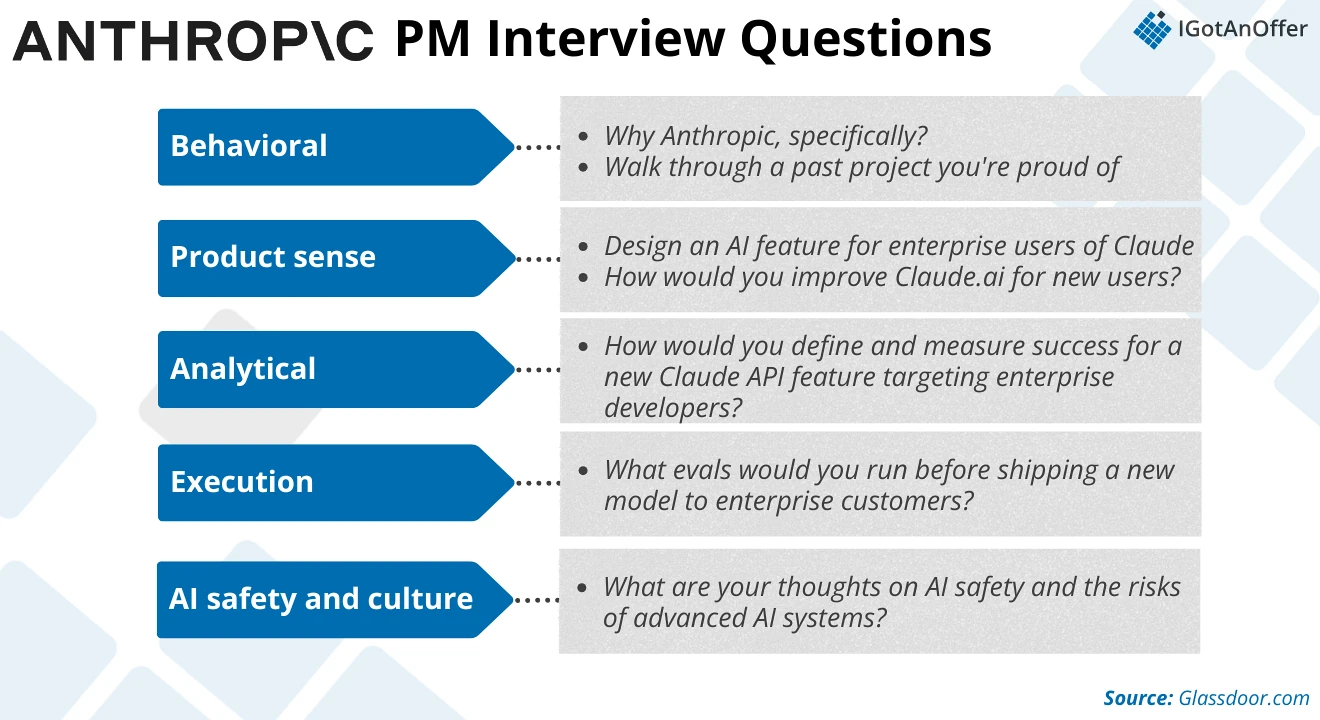
- Behavioral: questions about your past experience, tested across three named rounds: User Centricity, Engineering Partnership, and XFN Leadership
- Product sense: open-ended design and strategy questions focused on AI products and how you think about user needs, model capabilities, and safety tradeoffs
- Analytical: questions about metrics, defining success, interpreting data, and making evidence-based decisions for AI products
- Execution: questions about prioritization, roadmap tradeoffs, and operational decision-making
- AI safety and culture fit: questions about your values, judgment under ambiguity, and genuine alignment with Anthropic's mission
The weight Anthropic puts on that fourth category is what makes the loop unusual. Vasu, a former Amazon Global Head of Product Development, frames it well:
"While other companies focus on product sense (can you build an app?) and execution (can you move a metric?), Anthropic is essentially looking for a safety-conscious systems architect. Instead of testing how you'd grow a user base, Anthropic tests how you'd govern a model. They care less about growth loops and much more about redlines: when does a model become too dangerous to ship, even if it's profitable?"
That framing comes through in almost every round of the loop, as you can see in the following sections.
3.1 Behavioral questions
Tech companies use behavioral interviews to assess candidates based on their past experiences. Questions typically start with "Tell me about a time you..." and focus on soft skills like leadership, communication, influence, and decision-making.
What makes Anthropic's behavioral round unusual is that it's structured around three named competency areas. Amit, who reviewed these against Anthropic's PM job postings, confirmed that all three map directly to what the role requires.
The three competency areas are:
- User centricity: strong user empathy, translating user needs into requirements and behavior improvements
- XFN leadership: coordinating across product, research, safeguards, and engineering
- Engineering partnership: important, though at Anthropic it often broadens into research plus engineering partnership
All three are behavioral in format. They look for stories that stem from your past experience, not hypotheticals.
Below are sample questions for each competency.
3.1.1 General behavioral
These questions come up in the hiring manager screen and across all 3 named rounds. They test ownership, judgment under pressure, and how you reason about tradeoffs.
Example behavioral questions asked in Anthropic PM interviews: General
- Why Anthropic, specifically?
- Tell me about a recent product you helped lead. What KPIs and data insights did you use?
- Tell me about a time you had to make a difficult product decision with incomplete information.
- Describe a time you disagreed with a senior stakeholder. How did you handle it?
- Tell me about a time you had to work through ambiguity to define a problem.
- Describe a time you shipped something you weren't fully comfortable with. What happened?
- Tell me about a time you failed to deliver on a product commitment. What did you learn?
3.1.2 User centricity
This round tests your user empathy and your ability to translate user needs into concrete product requirements. Anthropic wants to see that you start from the user rather than the technology.
This means you should be able to articulate a real user problem before you talk about what the model can do, not the other way around.
Example behavioral questions asked in Anthropic PM interviews: User centricity
- Walk through a past project you're proud of and discuss your decisions.
- Tell me about a time when something went against your values and what you did.
- Describe a time when you had to make a difficult ethical decision at work.
- How do you translate alignment or interpretability research findings into product requirements?
3.1.3 XFN leadership
This round tests how you coordinate across the full range of stakeholders Anthropic PMs work with: research, engineering, policy, safeguards, and go-to-market.
Expect questions around a recent product launch, stakeholder alignment and communication, creating content for both technical and non-technical audiences, and staying current with AI trends.
Example behavioral questions asked in Anthropic PM interviews: XFN leadership
- Tell me about a recent product launch you led. How did you manage alignment across teams?
- Tell me about a time you convinced a skeptical stakeholder to support your proposal.
- Describe a time you had to make a decision without consensus across stakeholders.
3.1.4 Engineering partnership
Anthropic PMs work multiple teams from different departments. They work with engineers, researchers, policy teams, safeguards, go-to-market teams, and enterprise customers. Amit describes this as a distinctive feature of the role:
"XFN leadership at Anthropic often broadens into research plus engineering partnership. You're coordinating across product, research, safeguards, and engineering, not just product and eng."
This round is typically behavioral in format but focused on how you work across functions, especially when priorities conflict or when there's no clear owner.
We don't have verified question-level data specifically for this Anthropic round. The questions below come from our PM interview guides for Google, where similar engineering partnership competencies are tested. They reflect the same skills this round is designed to test.
Example behavioral questions asked in Anthropic PM interviews: Engineering partnership
- What would you do when you've already committed to a release but your engineering team says it can't be shipped in time? (Google)
- Describe a time when you had a cross-functional challenge on a project. How did you manage it? (Google)
- Describe how you would convince engineering to work on a business-requested feature that would interfere with their existing work. (Google)
- Tell me about a time you had to push back against the engineering team. (Technical PM interview)
- Tell me about a time you created a roadmap with an engineer. (Technical PM interview)
For Anthropic specifically, apply a research and safety lens to these. The technical partner you're working with may be an ML researcher rather than a software engineer. Stories that involve navigating that kind of collaboration will land better than standard PM/engineering conflict stories.
You'll have the chance to ask one question at the end of this round. Have something prepared that's curious rather than performative.
Note: For structuring your answers, we recommend IGotAnOffer's SPSIL method (Situation, Problem, Solution, Impact, Lessons) over traditional STAR. It tends to produce more focused, reflective answers, which is what Anthropic interviewers are listening for.
For a deeper dive, check out our PM behavioral interview guide.
3.2 Product sense questions
Product sense is tested in its own round and often also comes up during the case presentation.
Anthropic's version has an AI-first lens. You're expected to reason about model capabilities, user needs, and safety tradeoffs as a unified set of concerns.
Amit expands on what this looks like in practice:
"The substance of an AI product sense round is embedded in Anthropic's PM interviews. They look for user empathy, comfort with ambiguity, ability to find non-obvious use cases, willingness to go deep on ML concepts, and what they literally describe as intellectual curiosity without ego."
Product sense questions are often ambiguous and open-ended. This is intentional, as these questions are designed to force MECE (mutually exclusive, collectively exhaustive) thinking.
For example, if you’re asked to design a product around sports, the first step is to clarify what “product around sports” actually means.
Good answers here go beyond generic "design a product" frameworks. You need to think about what the underlying model can and can't do, how you'd measure success, including safety, and where the real user problems are.
Example product sense questions asked in Anthropic PM interviews
- Design an AI feature for enterprise users of Claude
- How would you improve Claude.ai for new users?
- What is your long-term product vision for Anthropic, and how would you translate it into a roadmap?
- If you were PM for Claude Code, what would you prioritize in the next six months?
- How would you identify high-potential use cases for a new model capability before there's much user data?
- Design a product to help enterprises build safely on top of Claude
Each of these needs to tie back to concrete user problems, model behavior, and safety considerations. A strong answer considers what could go wrong as carefully as what could go right.
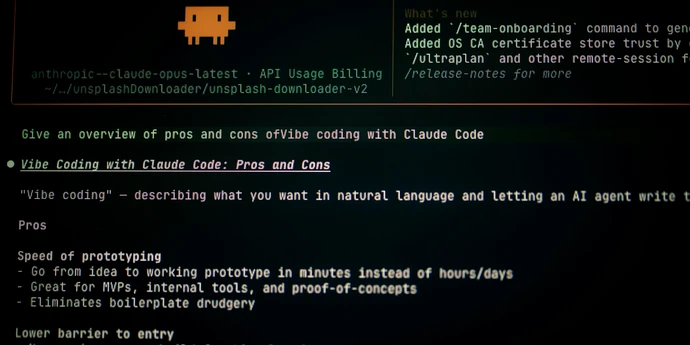
For practice and frameworks, see our guides to product design questions, product strategy questions, and our AI product manager interview guide. If your round includes AI prototyping, check out our PM vibe coding interview guide to learn how it works.
3.3 Analytical questions
Analytical interviews at Anthropic test your ability to define what success looks like for AI products and measure it in a meaningful way. That's harder than it sounds. There are rarely obvious right metrics for frontier AI products, and Anthropic wants to see how you reason about the options, what you'd prioritize, and how you'd validate your choices.
A strong answer explains why each metric matters, what it would tell you, and what you'd do with the information.
Example analytical questions asked in Anthropic PM interviews
- How would you measure success for Claude on a coding task?
- What KPIs would you track for Claude.ai's monthly active users?
- How would you define and measure success for a new Claude API feature targeting enterprise developers?
- How would you know if a Claude feature is actually improving user productivity?
For metric definition questions, we recommend our GAME framework, a four-step method for defining Goals, Actions, Metrics, and Evaluations that gives your answer structure and stops you from just listing numbers.
3.4 Execution questions
Execution interviews test how you make decisions when priorities compete, and information is incomplete. At Anthropic, this means being able to reason through trade-offs that aren't purely commercial, like safety, capability, speed, and user trust. Interviewers want to see how you navigate that.
Example execution questions asked in Anthropic PM interviews
- Daily active users of a Claude feature dropped 15% last week. How do you diagnose the issue?
- What evals would you run before shipping a new model to enterprise customers?
- Imagine adoption of Anthropic's AI platform slows down despite increasing visibility. How would you diagnose and respond?
For root cause questions, follow a structured approach that isolates user segments, features, and timing before proposing hypotheses. For prioritization questions, our guide to prioritization and tradeoff interview questions walks through the frameworks that work best.
3.5 Culture fit questions
This round is the most distinctive part of Anthropic's PM loop. Every candidate at every level goes through a 45-minute culture interview, and Anthropic has flagged it as the round where experienced candidates fail most often.
At most companies, a culture interview tests whether you'd be a good colleague. At Anthropic, it goes further than that. Because the company's mission is so central to how it operates, fitting the culture means genuinely caring about AI safety. The two things are inseparable here, which is what makes this round unlike any culture interview.
The goal isn't to quiz you on AI safety research. Interviewers want to see whether you engage with specific, concrete risks, whether your judgment holds up under ambiguity, and whether your values are a fit for a mission-driven org.
Vasu puts it this way:
"They test your ability to translate human values into model constraints. It's less about user experience and more about system alignment. With their focus on computer use and agents, they want to know if you can design the human-in-the-loop guardrails that prevent an autonomous agent from going rogue on a user's desktop."
Example AI safety and culture fit questions asked in Anthropic PM interviews
- What are your thoughts on AI safety and the risks of advanced AI systems?
- What's the most important tension in AI product development right now?
- How would you define a "redline" for a model capability? When would you refuse to ship?
- How would you prioritize between a capability improvement and a safety improvement on the same roadmap?
- How would you balance helpfulness and harmlessness when defining launch criteria for a new model?
- What's a risk of current AI systems that you think is underrated?
For more on this round, see our guide to Anthropic's culture interview and our broader behavioral interview guide.
4. Anthropic product manager interview tips ↑
To help you perform your best at your Anthropic PM interviews, we've pulled some insights from Anthropic's own published materials and advice from experienced coaches.
Here's how to approach your Anthropic PM interviews:
4.1 Build real AI fluency
You don't need to be an ML researcher, but you do need to speak the language and understand the trade-offs.
- Read Anthropic's research, starting with Core Views on AI Safety, the Responsible Scaling Policy, and recent posts on interpretability and Constitutional AI
- Use Claude regularly, including via the API and Claude Code, so you can reason from experience rather than abstraction
- Understand the basics: how LLMs work, what evals are, why prompting matters, and what agentic systems introduce in terms of risk
- Build a small personal project, even if it's just comparing how different models handle the same prompt. Interviewers notice when candidates have hands-on experience
For a broader list of AI PM concepts worth knowing, see our AI product manager interview guide.
4.2 Sharpen your product fundamentals
Anthropic will still test you on core PM skills. Make sure you can:
- Lead a product sense discussion with a clear framework, without being robotic about it
- Define success metrics for ambiguous AI products and defend your choices
- Run a structured root cause analysis on a metric drop
- Tell 4 to 6 behavioral stories that cover ambiguity, tradeoffs, cross-functional work, and ownership
Our PM interview questions guide covers frameworks for each of these. For company-specific practice, our guides to Google, Meta, and OpenAI PM interviews will help you benchmark.
4.3 Consider how you align with Anthropic’s mission and values
Anthropic is a mission-driven company in a way that affects how it hires.
"Why Anthropic?" comes up at every stage. Interviewers can tell the difference between someone who has thought seriously about AI safety and someone who has memorised the company's about page.
Mark R., ex-Meta and Google PM,’s advice here is direct:
"In product design questions, you’re going to literally want to cite the company’s mission back at them. If you’re interviewing remotely, write it on a post-it note and stick it on your laptop!"
4.4 Communicate like a collaborator
Top companies like Anthropic want product managers who are excellent collaborators and can influence without authority. Show you can keep stakeholders aligned, explain trade-offs simply, and build trust across research and product teams.
Mark (ex-Meta and Google PM) says, "Don’t ask the interviewer, ‘Here’s my segmentation, what do you think?’ You need to be more confident. Say, ‘Here’s my segmentation, and I’m going to choose this segment because of X. Okay?’ Check in with the interviewer instead of trying to get them to show you the way."
4.5 Stress-test AI output
During your product sense with AI interview, your interviewers want to see that you can look critically at anything the AI produces, especially if it looks clean and complete.
"Candidates that get hired stress-test this, they ask what breaks at scale, where privacy risk emerges, and which trade-offs engineering would push back on," Audrey (ex-Meta Sr. Product Lead) says.
4.6 Stay informed about tech trends
Being knowledgeable about recent technological advancements and trends can help you bring fresh perspectives. It demonstrates your enthusiasm and commitment to staying relevant in a fast-paced field.
Mark recommends TechCrunch for fairly light reading and Ben Thompson's Stratchery blog for deep dives.
5. How to prepare for Anthropic product manager interviews ↑
We've coached more than 15,000 people for interviews since 2018. There are essentially three activities you can do to practice for interviews. Here’s what we've learned about each of them.
5.1 Practice by yourself
Learning by yourself is an essential first step. We recommend you make full use of the free prep resources on this blog and also watch some mock interviews on our product management YouTube channel.
As mentioned previously, Anthropic will ask you questions that fall into certain categories.
Approaching each question type with a predefined method will enable you to build strong interview habits. These habits will reduce your stress and help you make a great impression during your actual interviews.
If you’re just looking for a jump-off point, you can start with our PM interview guides:
- Product design questions
- Product improvement questions
- Favorite product question
- Strategy questions
- Estimation questions
- Metric questions
- Prioritization questions
- System design interviews for PMs
- AI product manager interview questions
You can also use our PM interview grading rubrics to assess your performance and identify areas for improvement.
For general tips on getting into Anthropic, we also recommend reading our How to get a job at Anthropic guide.
Once you’re in command of the subject matter, you’ll want to practice answering questions. But by yourself, you can’t simulate thinking on your feet or the pressure of performing in front of a stranger. Plus, there are no unexpected follow-up questions and no feedback.
That’s why many candidates try to practice with friends or peers.
5.2 Practice with peers
If you have friends or peers who can do mock interviews with you, that's an option worth trying. It’s free, but be warned, you may come up against the following problems:
- It’s hard to know if the feedback you get is accurate
- They’re unlikely to have insider knowledge of interviews at your target company
- On peer platforms, people often waste your time by not showing up
For those reasons, many candidates skip peer mock interviews and go straight to mock interviews with an expert.
5.3 Practice with experienced PM interviewers
In our experience, practicing real interviews with experts who can give you company-specific feedback makes a huge difference.
Find an Anthropic product manager interview coach so you can:
- Test yourself under real interview conditions
- Get accurate feedback from a real expert
- Build your confidence
- Get company-specific insights
- Learn how to tell the right stories, better
- Save time by focusing your preparation
Landing a job at a big tech company often results in a $50,000 per year or more increase in total compensation. In our experience, three or four coaching sessions worth ~$500 make a significant difference in your ability to land the job. That’s an ROI of 100x!
Click here to book product manager mock interviews with experienced PM interviewers.








 Product sense