

 Back to other articles
  Last updated: September 21, 2026

 Interviews
 Behavioral
 Deeply researched
If you're applying for a role at OpenAI, behavioral interview questions will appear at every stage: the recruiter call, the hiring manager screen, and the final onsite loop.
OpenAI uses them to assess whether you can operate in a fast-moving, mission-driven environment where autonomous judgment, comfort with ambiguity, and genuine alignment with the company's goals are non-negotiable.
To help you prepare, we've compiled the most commonly reported OpenAI behavioral questions from our role-specific guides and candidate reports on Glassdoor and Blind. We've also included a step-by-step method for answering them and a preparation plan.
- What is an OpenAI behavioral interview?
- OpenAI behavioral interview questions
- How to answer OpenAI behavioral interview questions
- Tips to impress your interviewers
- How to prepare for OpenAI behavioral interview questions
Let's get into it.
Click here to practice 1-on-1 with an expert OpenAI interview coach
1. What is an OpenAI behavioral interview? ↑
OpenAI behavioral interviews are structured conversations in which the interviewer asks you to describe past experiences to predict how you'll behave in the future. The underlying logic is that past behavior is a more reliable signal than hypothetical responses.
At OpenAI, behavioral questions appear throughout the process. You can expect them during the hiring manager screen, at the start of technical rounds, and in dedicated behavioral sessions during the final loop. At the onsite stage, candidates typically face at least one full behavioral interview with a senior manager.
1.1 What OpenAI looks for in behavioral interviews
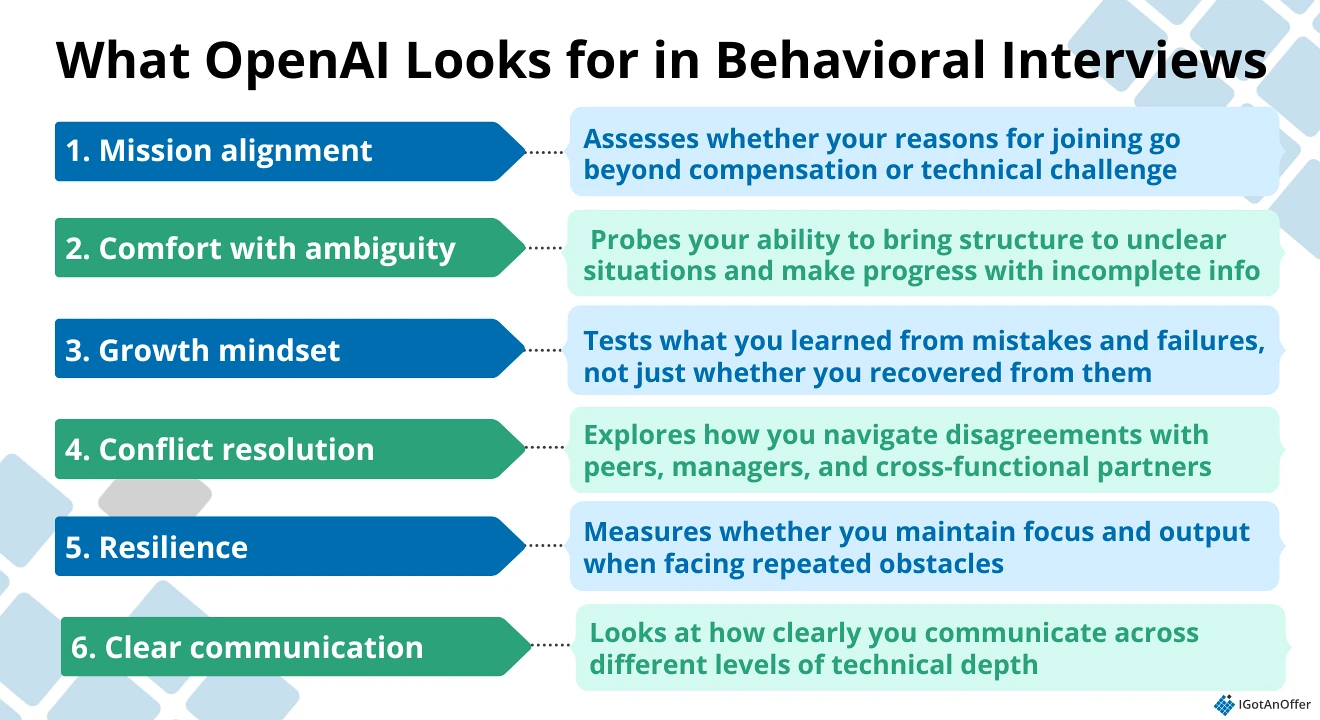
OpenAI interviewers assess behavioral questions through a specific lens. Based on candidate reports and our own coaching experience, the qualities they probe most consistently are:
- Mission alignment. OpenAI's goal is to ensure that artificial general intelligence benefits all of humanity. Interviewers want to know that you've thought seriously about what that means and that your reasons for joining go beyond compensation or technical challenge. Vague or generic answers are a red flag.
- Comfort with ambiguity. OpenAI operates at the frontier of a rapidly evolving field. The ability to bring structure to unclear situations and make progress without waiting for complete information is one of the most frequently cited traits interviewers look for in engineers and product managers.
- Growth mindset. Openness to feedback and a demonstrated track record of acting on it matter a great deal at OpenAI. Interviewers are particularly interested in what you learned from mistakes or failures, not just whether you recovered from them.
- Conflict resolution. The ability to navigate disagreements with peers, managers, and cross-functional partners constructively, without escalation, is a consistent theme across software engineer and engineering manager reports.
- Resilience. Sustained focus and output when facing repeated obstacles or shifting priorities. OpenAI's pace is fast, and its problems are hard. Interviewers want evidence that you don't lose effectiveness under pressure.
- Clear communication. Clear, efficient communication with peers, cross-functional partners, and the wider team at different levels of technical depth. This matters across every role.
Since behavioral questions at OpenAI are tightly linked to these traits, every interview guide we have for the company references them. You can find more in these resources:
- OpenAI software engineer interview guide
- OpenAI product manager interview guide
- OpenAI data scientist interview guide
- OpenAI interview questions guide
2. OpenAI behavioral interview questions↑
As we mentioned earlier, we analyzed Glassdoor candidate reports and cross-referenced them with the behavioral questions in our OpenAI role guides to compile the list below. Questions are organized by category to help you structure your preparation.
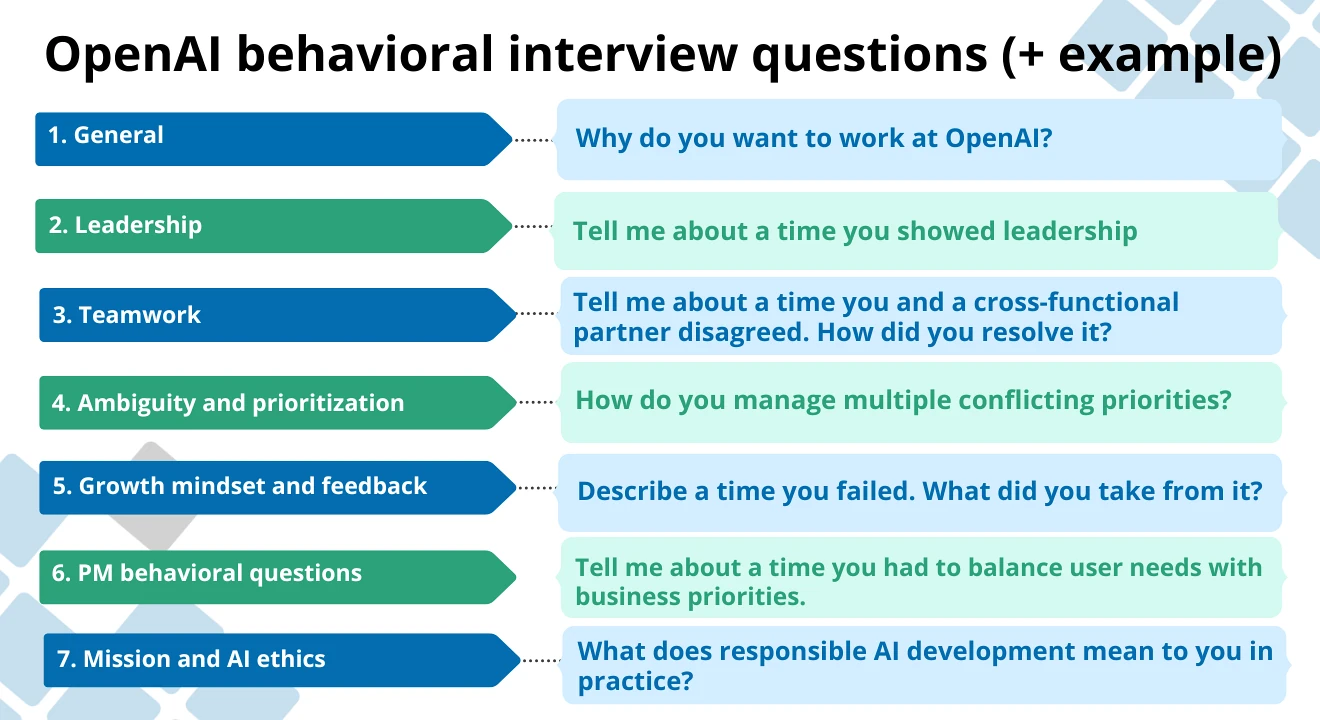
You'll notice from the list that some questions are mission and ethics specific. These come up more frequently at OpenAI than any other tech company and are worth preparing for explicitly.
2.1 General behavioral questions ↑
These questions appear at every stage, including the recruiter call. They establish your baseline motivation and whether you've done serious homework on the company.
Show your willingness to take risks, lessons learned from past mistakes, and other qualities that OpenAI is looking for in a candidate.
Practice demonstrating those values using the questions below.
Example behavioral questions asked at OpenAI: General
- Why do you want to work at OpenAI?
- Tell me about yourself
- Walk me through a project or accomplishment you're most proud of
- What parts of OpenAI's mission statement resonate most with you?
- Where do you see yourself in five years, and how does OpenAI fit into that?
2.2 Leadership questions ↑
OpenAI is looking for employees who are able to motivate their team, resolve conflicts, drive alignment, and build relationships. This is because most roles will involve not only working in teams, but also leading them when appropriate.
This is the time to show that you have drive and empathy, particularly if you're interviewing for a manager role. Some of the leadership skills that OpenAI is looking for in these questions include how you earn trust and take ownership, process and grow from past experiences, support the people around you, and overcome difficult situations.
Example behavioral questions asked at OpenAI: Leadership
- Tell me about a time you showed leadership
- Tell me about a time you solved a complex problem. How did you approach it?
- Tell me about a time you had to come up with a creative solution to a problem with severely incomplete data
- Tell me about a time you took initiative on a project that wasn't explicitly your responsibility
- Walk me through a project you owned end-to-end. What were the key technical decisions?
- Tell me about a technical misjudgment that delayed a project. What did you learn?
- Tell me about a time you made a mistake. How did you handle it?
2.3 Teamwork questions ↑
Many employees at OpenAI have to work in cross-functional teams with other engineers, product managers, data analysts, etc. You’ll need to be able to communicate clearly, work with others efficiently, and build trust and relationships.
Your interviewer will be looking for you to share stories from your past experience that demonstrate a spirit of collaboration and partnership. Give it a try using the following questions.
Example behavioral questions asked at OpenAI: Teamwork
- Tell me about a time you and a cross-functional partner disagreed. How did you resolve it?
- Tell me about a time you had competing ideas within your own team on how to move a project forward
- Describe a time you had to work with someone difficult. What was the outcome?
2.4 Ambiguity and prioritization questions ↑
These questions are particularly common for software engineers and product managers, where the ability to operate without a clear playbook is essential.
Example behavioral questions asked at OpenAI: Ambiguity and prioritization
- How do you manage multiple conflicting priorities?
- Tell me about a time you had to make a decision with incomplete information.
- Tell me about a time you had to bring structure to an unclear or ambiguous situation.
- Describe a time when you had to change direction mid-project. How did you handle it?
2.5 Growth mindset and feedback questions ↑
OpenAI interviewers look for genuine self-awareness, not polished narratives. These questions test whether you can talk honestly about where you've grown and where you still have room to improve.
Example behavioral questions asked at OpenAI: Growth mindset and feedback
- Tell me about the most useful piece of feedback you've ever received
- Describe a time you failed. What did you take from it?
- Tell me about the area where you have the most to learn.
- Tell me about a time you had to learn something new quickly under pressure.
2.6 Product manager behavioral questions ↑
If you're applying for a PM role, you'll also face behavioral questions specific to product management. These probe your product instincts, stakeholder management, and ability to drive impact without direct authority.
Example behavioral questions asked at OpenAI: Product management
- Describe a situation where a product you were managing wasn't performing well. What did you do?
- Tell me about a time you had to balance user needs with business priorities.
- Tell me about a time you introduced a process change that improved team efficiency.
- How did you come up with the most innovative idea you've ever had? How did you implement it?
For more questions and sample answers for PM roles, see our OpenAI product manager interview guide.
2.7 Mission and AI ethics questions ↑
These questions don't have a set-in-stone right answer, but they do have wrong ones. For example, vague platitudes about AI being 'a double-edged sword' or performative concern without substance won't work here.
The goal here is to show you've engaged with OpenAI's specific position on safety, not just AI in general.
Example behavioral questions asked at OpenAI: Mission and AI ethics
- What are your thoughts on AI safety and the risks of advanced AI systems?
- How do you think about the ethical implications of the work you do?
- What does responsible AI development mean to you in practice?
- Tell me about a time you had to weigh technical capability against potential harm or risk.
3. How to answer OpenAI behavioral interview questions ↑
Now that you know what questions to expect, let's look at how to answer them well.
3.1 Technique: IGotAnOffer’s SPSIL method
When answering behavioral questions, you need to focus on your most relevant work stories and communicate them clearly. An effective way to do this is with a structured method.
The STAR method (Situation, Task, Action, Result) is a popular approach for answering behavioral questions because it’s easy to remember. You may have already heard of it.
However, we’ve found that candidates often find it difficult to distinguish the difference between steps two and three, or task and action. Some also forget to include lessons learned in the results step, which is especially crucial when discussing past failures.
So, we’ve developed IGotAnOffer's SPSIL framework (Situation, Problem, Solution, Impact, Lessons) to correct some of the pitfalls we’ve observed when using the STAR method.
Let’s step through our suggested five-step approach:
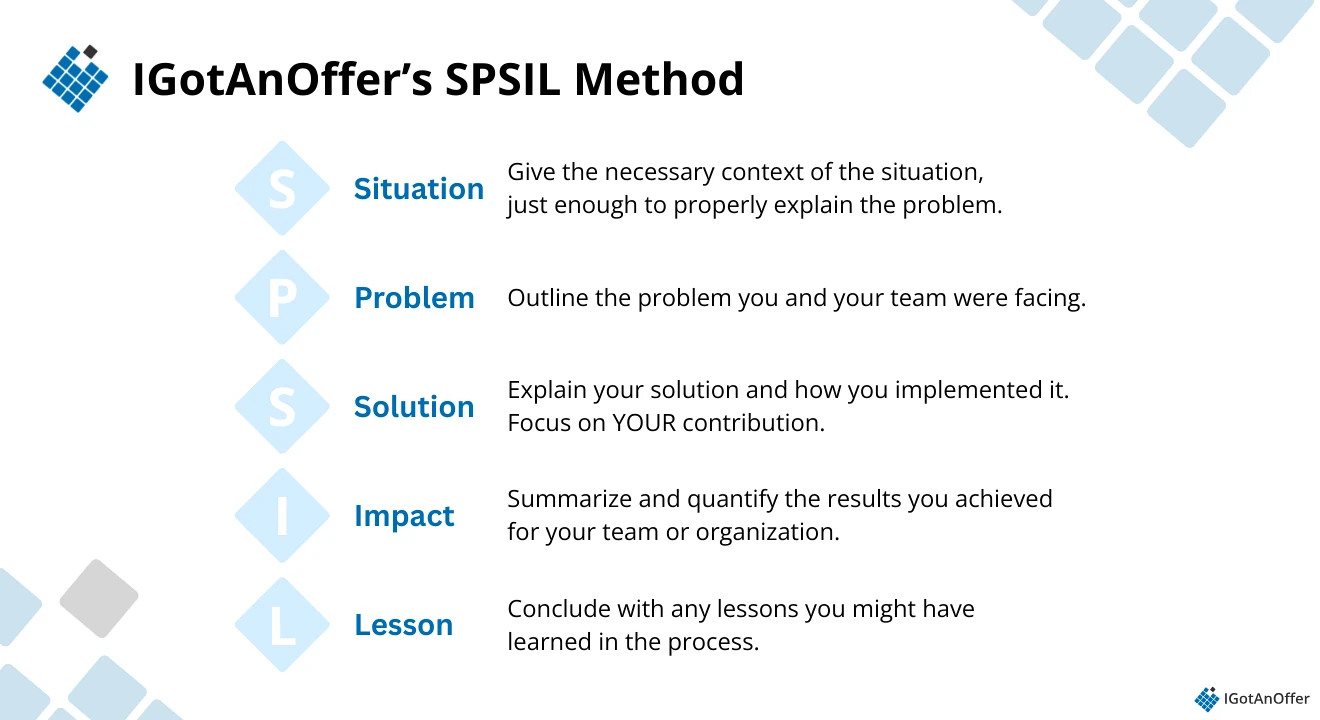
- Situation: Start by giving the necessary context of the situation you were in. Describe your role, the team, the organization, the market, etc. You should only give the minimum context needed to understand the problem and the solution in your story. Nothing more.
- Problem: Outline the problem you and your team were facing.
- Solution: Explain the solution you came up with to solve the problem. Step through how you went about implementing your solution, and focus on your contribution over what the team / larger organization did.
- Impact: Summarize the positive results you achieved for your team, department, and organization. As much as possible, quantify the impact.
- Lessons: Conclude with any lessons you might have learned in the process.
You’ll notice that this method covers very similar themes to the STAR method. We like it because a lot of the candidates we work with find this framework easier to use, as there’s no overlap between any of the steps in your story.
For a deeper dive into this topic, check out our article on why the STAR method isn’t always the best for behavioral interviews and how IGotAnOffer's SPSIL method can be a better option. It was written with product managers in mind, but applies just as well to any role.
Ultimately, you should practice using whatever method you’re the most comfortable with. If you’d like to start practicing right away, jump back to the full list of questions here.
Otherwise, to get a better idea of how our method works, work through the example below.
3.2 Example answer using SPSIL: Tell me about a challenge or conflict you faced at a past job
Now that you know some approaches for answering behavioral questions, let's look at a full example. We’ll use one of OpenAI’s most frequently asked questions.
Try answering the question below following your preferred method. Play both the role of the interviewer and the candidate. Write down your answer, then practice saying it out loud before going through our example response. Once you’ve finished, compare your response to our example to fill in any gaps in your story.
Try this question:
Tell me about a challenge or conflict you faced at a past job
Answer:
We’ll use the IGotAnOffer method described above and answer as if interviewing for a product manager job at OpenAI. You will find our proposed answer to the question below.
Notice that the question asks for a past challenge OR conflict, which lets you choose what you’d like to highlight in your answer. If you choose a past challenge, this would be a good way to show off your leadership and problem-solving skills. However, in this case, we’ve chosen to focus on a past conflict, which we’ll use to display conflict-resolution and collaboration skills.
For a sample answer to the past challenge question, instead, take a look here.
1. Situation
As this question isn’t necessarily about a specific role, it allows you to describe a variety of situations. We’ll use a generic example, but you should, of course, use an example from your own work experience.
You could start by saying:
“In my past job, I was on a product team composed of coworkers from various functional areas of our company. I had recently been hired, so this was my first interaction with the team. Eager to get to know everybody and to contribute to the project, I frequently jumped in with ideas and volunteered to lend a hand in many tasks."
Without giving too much detail, this gives a quick sense of the setting you were in. If relevant, you can add a sentence or two to define your team’s goal, the functional areas present, or the stakeholders. Either way, the scene is set to get into the conflict that will arise when you describe the problem.
2. Problem
After you outline the situation, you can explain the problem by saying:
“I began to notice in our team meetings that one of my coworkers began cutting me off when I presented ideas. Later, when I volunteered to help with a task that concerned his functional area, he neglected to give me the information and resources I needed in order to contribute. This behavior continued, causing a conflict that interfered with our team discussions and slowed down our progress on important tasks.”
Here, you haven’t spent too long discussing the situation and problem, but your answer so far has given the interviewer a clear sense of the setting and conflict you faced.
3. Solution
When describing the solution you came up with to solve the problem, it’s important to step through your thinking. And it’s especially important to focus on YOUR contribution.
You could say something such as:
“I knew any conflict was detrimental to the team’s goals, so I wanted to squash it right away. My first step was to examine my own behavior to understand how it may have sparked the conflict. I determined that my eagerness to contribute to the discussions and project may have overstepped some bounds.
My next step was to meet with my coworker. I approached him and asked to set a meeting for just the two of us. I let him choose the time, so as not to unintentionally interrupt his workflow.
Next, we held our discussion. I politely expressed how his behavior was preventing me from speaking up in meetings and helping with important tasks, then asked if I had overstepped any boundaries in my first few weeks on the team.
He agreed, explaining that my initial eagerness had taken up too much time in the meetings, giving him and others less of an opportunity to present their teams’ work. Also, when I volunteered to help in his functional area, it slowed him down to have to explain the processes to me.
First, I apologized for my initial behavior. After he accepted my apology, I then presented a plan for upcoming meetings to avoid further conflict: I would be more attentive to the time I spent speaking in meetings and would only volunteer for tasks when I was confident I was well-equipped to contribute. In exchange, I requested that he approach me in case further issues arise, instead of closing me off from discussions or projects. He agreed.”
Let’s take a step back and look at what you’ve highlighted with this answer. It emphasizes your ability to admit your own mistakes and resolve them. It also shows your efforts toward clear communication and conflict resolution. A story like this highlights your ability to face issues head-on, before they turn into a larger problem for the team.
4. Impact
After explaining the actions you took, it’s a good idea to quantify how much impact you had.You could say:
“After I met with that coworker, we each adjusted our behavior and avoided further conflict all the way through to the end of that project. We were able to catch up on the delays we were beginning to incur with our communication issues, finishing the project on time and meeting our initial goals.”
5. Lessons
Finally, wrap up your answer by describing any lessons you might have learned.You could say:
“Thankfully, this all happened right at the beginning of my time with that company, and the rest of my time there went smoothly. It taught me to be much more receptive to coworkers’ feedback and work to keep my contributions quick and to the point in meetings. Also, it taught me to address issues as soon as they arise, as we were able to move on from that conflict very quickly instead of allowing it to grow into a larger problem.”
The answer above demonstrates what good looks like: a Situation set up in under 30 seconds, a Problem with clear stakes, a Solution focused on the candidate's specific contribution rather than the team's, a quantified Impact, and a Lessons step that shows genuine reflection rather than a polished recovery narrative.
4. Tips to impress your interviewers ↑
Finally, before we move on to some interview preparation resources, we'd like to give you five helpful tips to keep in mind.
Tip #1: Get used to setting up the situation in 30 seconds or less
Use a timer while you practice to ensure you provide only necessary information. Spending too much time on the Situation step is one of the most common mistakes candidates make.
Tip #2: Stay focused on essential details
Interviewers hear a lot of behavioral stories a day. If you go into unnecessary details, you are likely to lose their attention. Share your stories with a few different people before your interview and ask them what details they would suggest cutting.
Tip #3: Be proud and talk about YOU
This is not the time to be shy about your accomplishments. Concentrate on your impact, not what “the team” did. Not talking about YOU enough is another common mistake we see with a lot of candidates.
Tip #4: Adapt to follow-up questions
Don’t be alarmed if your interviewer asks follow-up questions; this is perfectly normal. Listen carefully to the way your interviewer is asking these questions, as there will often be a subtle clue about the specific skills they’re looking to assess from the next part of your answer.
Tip #5: Explain how failure made you better
When talking about failure, don’t try to hide your mistakes or frame a weakness as a strength. Instead, show what you learned and how you grew from the failure.
5. How to prepare for OpenAI behavioral interview questions ↑
Even with these sample questions and techniques, you’d still need some resources to help you actually prepare. After all, the right preparation will spell the difference between failing your OpenAI interviews and getting an offer.
Here are four steps you can take to prepare for your OpenAI behavioral interview.
5.1 Learn about OpenAI
Most candidates fail to do this. But before investing tens of hours preparing for an interview at OpenAI, you should take some time to make sure it's actually the right company for you.
OpenAI is prestigious, and it's therefore tempting to assume that you should apply without considering things more carefully. However, it's important to remember that prestige alone won't make you happy in your day-to-day work. What will make you happy is what you’ll actually be doing as well as the people you'll be working with.
Here are some resources to get you started:
- OpenAI Charter
- OpenAI research and product blog
- OpenAI's interview guide
- OpenAI careers and culture page
If you know people who work at OpenAI or used to work there, talk to them to understand what the culture is like.
Behavioral interviews are only one part of OpenAI's interview process. For more on what to expect across the full loop and role-specific questions, see the resources below:
- OpenAI interview guide
- How to get a job at OpenAI
- How to answer "Why OpenAI?" interview question (+ example)
- 30+ Common OpenAI Interview Questions + Answers (by role)
- OpenAI Software Engineer Interview (process, questions, prep)
- OpenAI Product Manager Interview (questions, process, prep)
- OpenAI System Design Interviews (questions, process, prep)
- OpenAI Research Scientist Interviews (questions, process, prep)
- OpenAI Forward Deployed Engineer Interview (questions, process, prep)
5.2 Practice by yourself
Once you have a solid grounding in the company, start building your story bank.
First, work out which stories you’d like to tell. Make a list of key moments in your career (e.g. accomplishments, failures, leadership situations, etc.) that you can use to answer one or multiple questions. Take a look at OpenAI’s core values, then find at least one story from your past that exemplifies each one.
After you’ve finished your list, write out a story for each key moment in your career using the structure we've laid out in Section 3. Be sure to emphasize your impact in each of these examples, quantify the results of your actions, and explain the lessons you learned from the experience.
Once you have a bank of stories, go through the questions in Section 2 and make sure you’d be able to answer all of them either by using one of the stories you’ve written directly or by adapting it on the fly. If you identify any gaps, add stories to your bank until you’re comfortable that you can cover all the questions listed in this article.
After you've written everything down, a great way to practice your answers is to interview yourself out loud. This may sound strange, but it will significantly improve the way you communicate during an interview.
Click here to practice with more common behavioral questions and see example answers.
5.3 Practice with peers
Practicing by yourself will only take you so far. By yourself, you can’t simulate thinking on your feet or the pressure of performing in front of a stranger. Plus, there are no unexpected follow-up questions and no feedback.
That’s why many candidates try to practice with friends or peers. If you have friends or peers who can do mock interviews with you, that's an option worth trying. It’s free, but be warned, you may come up against the following problems:
- It's hard to know whether the feedback you're getting is accurate
- They're unlikely to have inside knowledge of what OpenAI interviewers specifically look for
- On peer platforms, the quality of feedback can be inconsistent, and sessions sometimes fall through
For those reasons, many candidates skip peer practice and go straight to working with an expert.
5.4 Practice with experienced OpenAI interviewers
In our experience, practicing with an expert who can give you feedback specific to OpenAI's process in real time makes the biggest difference.
Find an OpenAI interview coach so you can:
- Practice under real interview conditions
- Get accurate feedback from someone who knows the process
- Understand how OpenAI's mission alignment questions are actually evaluated
- Identify which stories to use and how to strengthen them
- Focus your prep time on what actually matters
Landing a job at OpenAI typically means a significant increase in total compensation. In our experience, three or four coaching sessions make a significant difference in your ability to get the job. That's an ROI of well over 100x.
Click here to book mock interviews with OpenAI interview coaches


 Data scientist