

 Back to other articles
  Last updated: August 06, 2026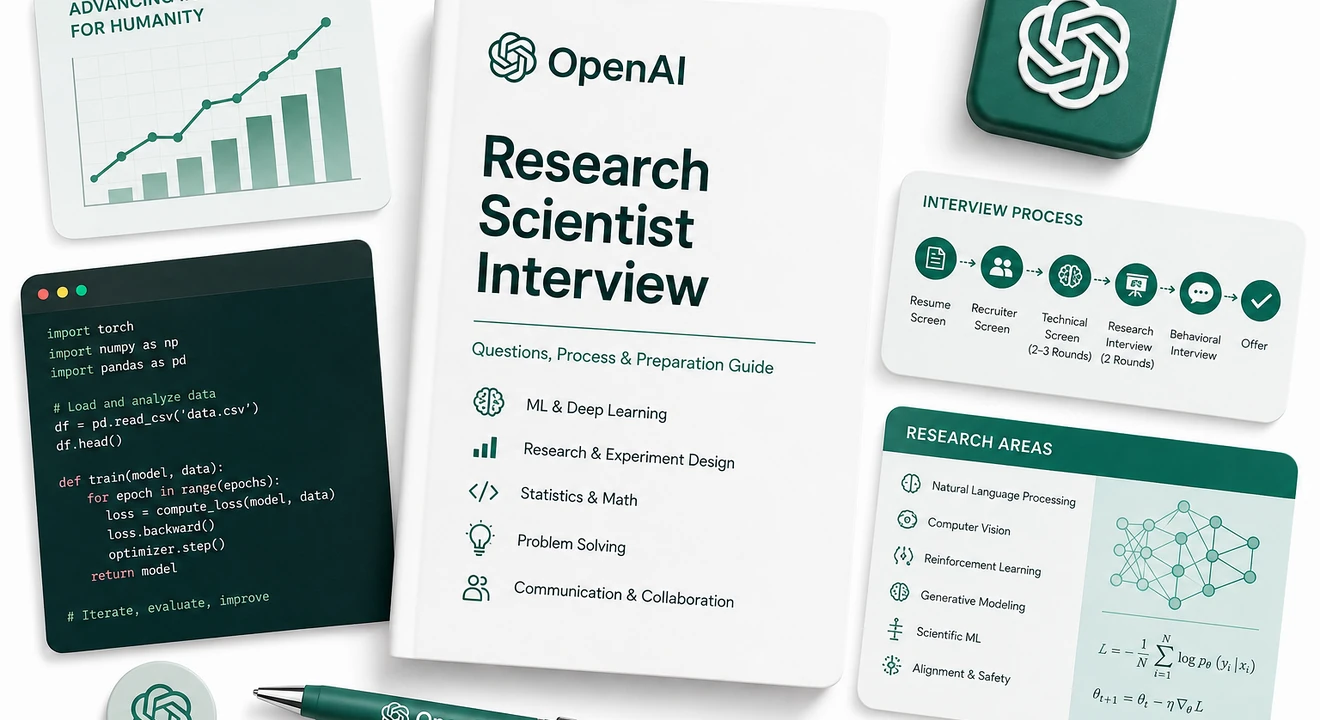

 Interviews
 Research scientist
 Deeply researched
Preparing for OpenAI research scientist interviews could be tough, since so little is confirmed about what actually happens once you're in the room.
OpenAI does have an interview guide, but it describes the company-wide process rather than breaking down what to expect as a research scientist candidate.
Meanwhile, interview reports on Glassdoor for this role are sparse too. Look it up yourself, and you'll mostly find a general category summary instead of a specific candidate account.
What's there points to a process weighted toward machine learning fundamentals and coding, plus a single timed technical assessment with a 2-hour-15-minute limit. Budget dedicated focus time for that assessment instead of fitting it around other work.
This guide covers the role and salary, the interview process, example questions, and how to prepare for each stage.
Here's an overview of what we'll cover:
Find a research scientist interview coach to get a job at OpenAI
1. OpenAI research scientist role and salary ↑
1.1 What does an OpenAI research scientist do?
As a research scientist at OpenAI, you'll develop innovative machine learning techniques and advance your team's research agenda, while collaborating with both cross-functional peers and fellow research scientists in other domains.
OpenAI frames your goal as discovering simple ideas that generalize and hold up at large scale. Your findings feed into a research vision that unifies every team in the organization.
You'll also carry out both of OpenAI's Charter commitments: staying on the cutting edge of AI capabilities and funding the research needed to make AGI safe.
Note that team structures shift as OpenAI grows, so the role you land could span different teams. It could also blend research scientist and research engineer aspects as listed on the careers search page. Be sure to confirm the exact scope of the role you're applying for with your recruiter.
1.2 What is it like to work as a research scientist at OpenAI?
Working as a research scientist at OpenAI, you’ll be expected to figure out your own approach in a way that aligns with OpenAI’s mission in an environment where priorities shift fast.
OpenAI's mission, as outlined in its Charter, shapes hiring, your day-to-day priorities, and how research decisions get made. You can thus expect to work alongside colleagues who take the mission seriously. One OpenAI employee says colleagues "genuinely care about the outcomes in ways that surpass previous technological breakthroughs."
The self-direction quality is what OpenAI calls "find a way," which is one of its four operating principles. You're expected to identify problems and propose your own solutions instead of following a fixed process, and a good idea can come from anyone at any level.
Pace matters just as much. When research breakthroughs or product demands shift, you're expected to reprioritize your own work quickly, sometimes mid-project, instead of waiting for a revised roadmap. OpenAI's careers page frames intensity and resilience as central to the mission.
1.3 How much does an OpenAI research scientist make?
Research scientists at OpenAI earn well above typical tech industry levels, weighted heavily toward equity.
According to Levels.fyi, total compensation for US-based OpenAI research scientists ranges from roughly $771K at L4 to $1.47M at L5. The reported median sits around $880K to $1M, with packages as high as $1.9M.
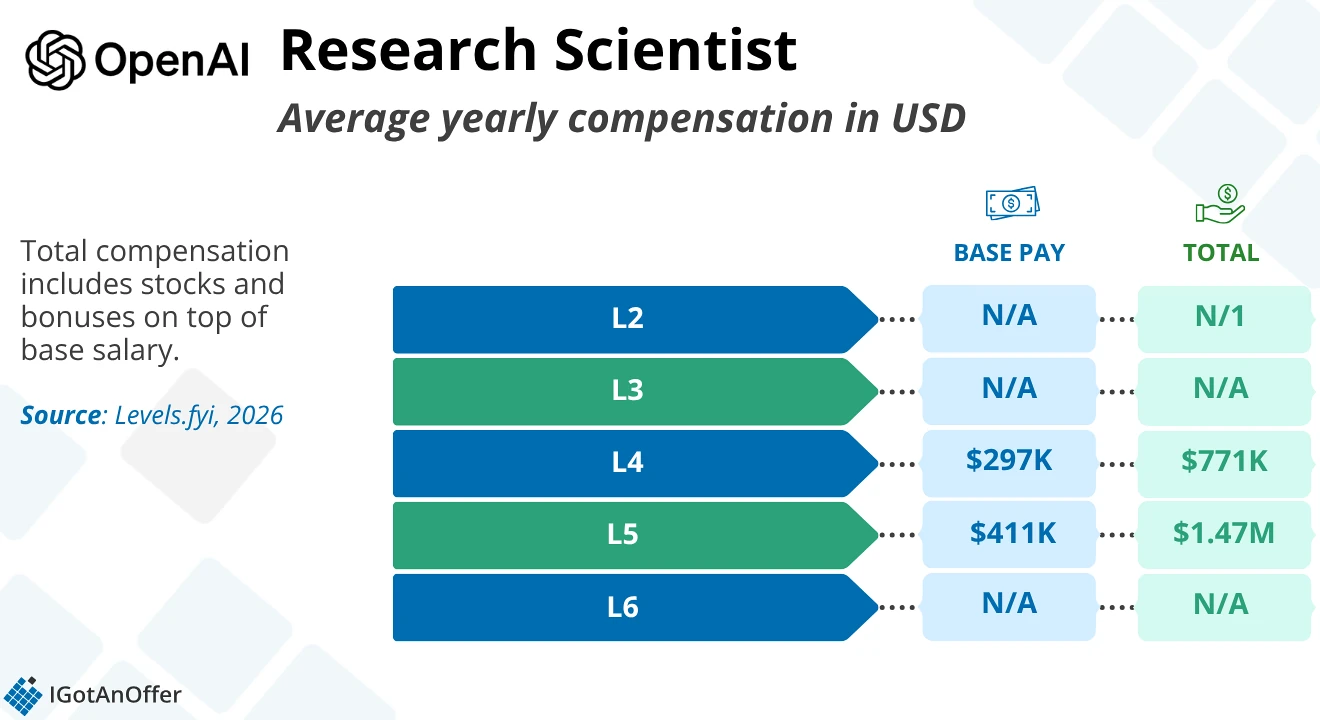
Based on the limited data available, the jump from L4 to L5 appears to come mostly from equity. Base salary barely moves between the two levels.
Negotiation works differently here too. OpenAI runs a flat-salary structure with no target bonus and rare signing bonuses. The company holds firm on its initial number even when you cite competing offers.
We suggest getting a salary negotiation coach to understand what's negotiable in your specific offer.
1.4 What does OpenAI look for in research scientist candidates?
OpenAI looks for two kinds of candidates: people who are already experts in their field, and people who show high potential, like those who learn fast and deliver results in a new domain. The company says their hiring bar isn't credential-driven.
For research scientists specifically, OpenAI looks for a track record of new or improved ideas in machine learning, shown through first-author publications or independent projects.
You're also expected to own a research agenda: choosing which problems matter and running long-term projects on your own, without waiting for a manager or a team lead to hand you a research direction.
If you have experience building high-performance deep learning implementations, that's a plus, but not required.
You'll also need to communicate clearly. Explain technical decisions to engineers, product teams, and safety researchers who don't share your background.
Alignment with OpenAI's mission and values shows up throughout the process. Expect direct questions about AI safety and ethics, and how you respond to critical feedback, beyond an implicit values check.
2. OpenAI research scientist interview process and timeline ↑
OpenAI's research scientist interview process typically takes two to four weeks from application to offer. However, based on candidate reports, it can stretch up to four months in some cases.
The six steps below follow the structure in our general OpenAI interview process guide, adapted with what candidate reports tell us about the research scientist role specifically.
2.1 Resume screen
Recruiters check whether your background matches the role here, with particular weight on research output and publications over a specific school or employer. This step is the most competitive in the process, and most candidates don't get past it.
According to OpenAI's interview guide, this step typically takes about a week, though it can run longer.
At this stage, recruiters are mostly filtering on the signals covered in Section 1.4: a track record of publications or independent projects, plus evidence you can drive your own research direction instead of waiting for one to be assigned.
If you're applying for a research position, expect reviewers to read your publications closely rather than skim them. Quantify your impact where you can: model performance gains, scale of experiments, or adoption of a technique you developed.
To help you put together a resume that stands out, follow the tips below.
Tips for crafting a resume
- Simplify. Avoid overly creative layouts. A simple resume passes through applicant tracking systems and reads quickly for recruiters and hiring managers.
- Verbalize. Start each bullet point under your previous roles with an action word.
- Quantify. Add numbers wherever you can: model performance gains, scale of experiments, or adoption of a technique you developed.
- Summarize. Include a skills section with keywords pulled directly from the job posting.
For detailed steps and examples, see our tech resume guide. If you're looking for expert feedback, book a resume review session with one of our OpenAI resume coaches. They'll help you decide what achievements to focus on and how to fine-tune your bullet points.
2.2 Recruiter call
Once you clear the resume screen, a recruiter will reach out for a 30- to 45-minute call. This round is non-technical. Expect "Tell me about yourself," "Why OpenAI?", and questions about your motivations and career goals.
One candidate described this stage as a “very cozy chat.” You’ll just introduce yourself, then the recruiter walks you through the hiring process and matches you to the job position. Come ready to talk about your research interests so the recruiter can match you to the right team.
Familiarize yourself with OpenAI's recent releases and read its news page and developer blog for updates. Read about anything tied to the team you're interviewing with.
2.3 Hiring manager screen
Step 3 is typically a 20- to 30-minute virtual call. For research roles, be ready to walk through your research and any related publications in more depth than the recruiter call required.
You may also get early technical questions here, basic machine learning concepts, or questions about your background. Use this as a chance to show your communication skills by explaining technical concepts clearly.
2.4 Skills-based assessment
The skills-based assessment is where the process varies most by candidate. Candidate reports describe two different paths:
- A structured technical loop that includes two ML coding rounds (60 minutes each), two general coding rounds (60 minutes each), and a 30-minute hiring manager interview.
- A single timed technical assessment on HackerRank, combining behavioral questions first and technical questions after, with a 2-hour-15-minute limit.
Either way, expect a mix of ML coding and general coding. Confirm the exact format with your recruiter once you're scheduled, since it isn't standardized across teams.
You'll typically reach this stage about a week after your recruiter call, and hear back within about a week of completing it.
2.5 Final interviews
If you clear the assessment, you'll move to final interviews. Expect to spend 4 to 6 hours with 4 to 6 people over 1 to 2 days. It’s virtual by default but could be onsite in San Francisco. These interviews cover four main categories:
- Coding
- System design / ML systems
- Role-related knowledge
- Behavioral
OpenAI describes these interviews as designed to "stretch you beyond your comfort zone." Needing multiple substantive hints from your interviewer is treated as a weak signal at senior levels, so independent problem-solving matters more here than at the earlier stages.
A candidate from 2022 recounts a different structure: five rounds across two phases. An intro plus ML coding round comes first, then a later block of three hours of back-to-back interviews covering coding, ML theory, stats, and broader topics.
Process structure at OpenAI has likely evolved since that report. The range of topics covered still lines up with what candidates describe today.
2.6 Decision
Expect to hear back within about a week of your final interviews, though it's common to wait longer.
Your interviewers debrief together and review your full profile, including your application, skills assessment, and final interview performance. You'll typically get an offer, a rejection, or, less commonly, a request for one more interview to clarify a specific concern.
Feedback on a rejection is often minimal, and your recruiter should give you a timeline for when to expect the final call.
3. Example OpenAI research scientist interview questions ↑
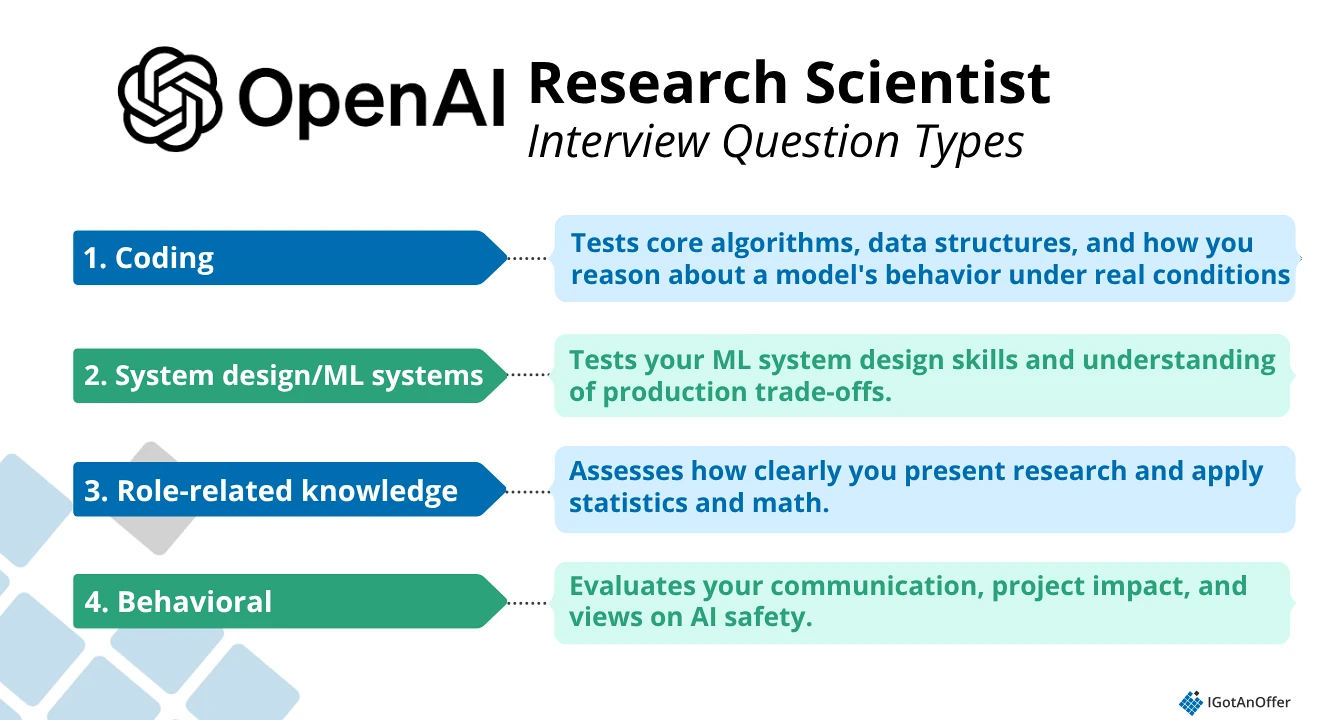 OpenAI research scientist interviews cover four main areas:
You'll meet questions in these categories at different points across the process covered in Section 2. Coding particularly shows up in both the skills-based assessment and the final interviews.
Glassdoor candidate reports for this role are sparse. Rather than leave it at that, we've supplemented them with confirmed questions from OpenAI's interview guide and candidate reports on Glassdoor.
Plus, we used question patterns from our Meta research scientist interview guide, our Anthropic culture interview guide, and our OpenAI behavioral interview guide. Where questions come from other companies, we've indicated the source in parentheses.
Where questions come from other companies, we've indicated the source in parentheses.
3.1 Coding ↑
Coding questions test core algorithms and data structures, along with your ability to reason about a model's behavior under specific conditions. Expect standard DSA and ML coding to show up in your assessment and onsite interviews.
Some candidates report questions that lean toward applied ML over pure LeetCode-style problems.
Talk through your approach before writing anything. Interviewers weigh how you reason through a problem as much as whether the final answer is correct, especially when a question leans toward applied ML instead of a textbook algorithm.
Example OpenAI research scientist interview questions: Coding
ML coding
- Fit a 1-NN (nearest neighbor) into a feedforward neural network
- Given an MNIST dataset and cross-entropy loss, derive the lower and upper bound on the loss function for a single training example, then generalize to a full dataset and describe the expected train and validation error curve
General coding
- Implement a cache with O(1) access
- Design a rate limiter
- Solve graph traversal or dynamic programming problems
- Design a class to perform computations from scratch (Meta)
- Merge two sorted arrays (Meta) (Sample solution)
- Find the number of islands in a matrix using BFS or DFS (Meta) (Sample solution)
- Count the occurrences of a target number in a sorted array (Meta)
- Find the minimum value in a binary search tree (Meta)
- Write a search function to find a specific node in a tree (Meta)
- Given a knight's starting and ending position on an infinite chessboard, find the minimum number of moves required (Meta) (Sample solution)
- Implement a function to return all index pairs in a list that sum to a target (Meta)
- Perform string manipulation tasks, including palindrome checks and prefix trees (Meta)
- Solve a combinatorics or probability problem (Meta)
- Determine the time complexity of a function (Meta)
If you want more coding practice, check out our OpenAI coding interview guide for more candidate-reported questions with worked solutions.
3.2 System design / ML systems ↑
This round tests how you'd design a system at production scale, whether that's traditional infrastructure or an ML pipeline. Expect questions to lean toward the applied ML side, given OpenAI's focus on serving models to hundreds of millions of users.
Answer in a structured way using a framework, but don't lean on it too heavily. State your assumptions about scale and latency up front, then be ready for deep-dive follow-up questions that push on your trade-offs.
Example OpenAI research scientist interview questions: System design / ML systems
- How would you design a distributed training system?
- How do you deploy and monitor a large language model in production?
- How do you deal with train and test time click-through distribution mismatch? (Meta)
- How would you design a recommendation system? (Meta)
- Design a geolocation service (Meta)
- How would you build a pipeline for a recommendation system? (Meta)
- Given a physiological signal, implement a clustering method from scratch to separate signal components by hand movement (Meta)
- How would you estimate relative pose from two different camera frames? (Meta)
- How would you collect data and design the overall system? (Meta)
- Design a system that counts ad click events at a scale of 100 billion events per day, with under 30 seconds of latency for charting results (Meta)
For a deeper walkthrough of how to structure these answers, see our OpenAI system design interviews guide, our machine learning system design guide, and our generative AI system design guide.
3.3 Role-related knowledge ↑
This round checks whether your background actually matches what the team needs.
OpenAI asks two types of questions to test two different things here.
- Research presentation questions check whether you can defend the depth and limitations of your own specialized work.
- In-domain technical questions check whether your statistics and applied math fundamentals hold up independent of your specialty because every research scientist needs these basics regardless of focus area.
For research presentation questions, know your own paper's limitations as well as its results. For technical questions, show your reasoning. Explaining why a concept applies to the scenario in front of you matters more than naming the right statistical concept correctly.
Example OpenAI research scientist interview questions: Role-related knowledge
Research presentations and techniques
- Describe one of your most recent papers (Meta)
- Describe a project you did using a data analytics tool (Meta)
- Talk about IMU preintegration (Meta)
- What is an FIR filter? (Meta)
In-domain technical
- Why does layer normalization work better than batch normalization in transformers?
- How would you debug a model that's overfitting?
- Compute the KL divergence given different random variables
- Walk through your work experience with model distillation
- What is A/B testing? (Meta)
- What is a p-value? (Meta)
- What is a null hypothesis? (Meta)
- Describe the differences between core set selection and random sampling (Meta)
- How do you handle class imbalance? (Meta)
- Explain the law of large numbers (Meta)
- Walk through a problem using Bayes' Theorem (Meta)
- Apply statistics to calculate the expectation of a random variable (Meta)
- A biased coin lands heads 7 out of 10 flips. How would you estimate the probability of heads, and how confident are you in that estimate? (Meta)
For more research presentation and in-domain technical questions like these, see our Meta research scientist interview guide.
3.4 Behavioral ↑
This round mixes standard behavioral questions about your background and past projects with mission-specific ones probing your perspective on AI safety and the responsibility of building powerful models.
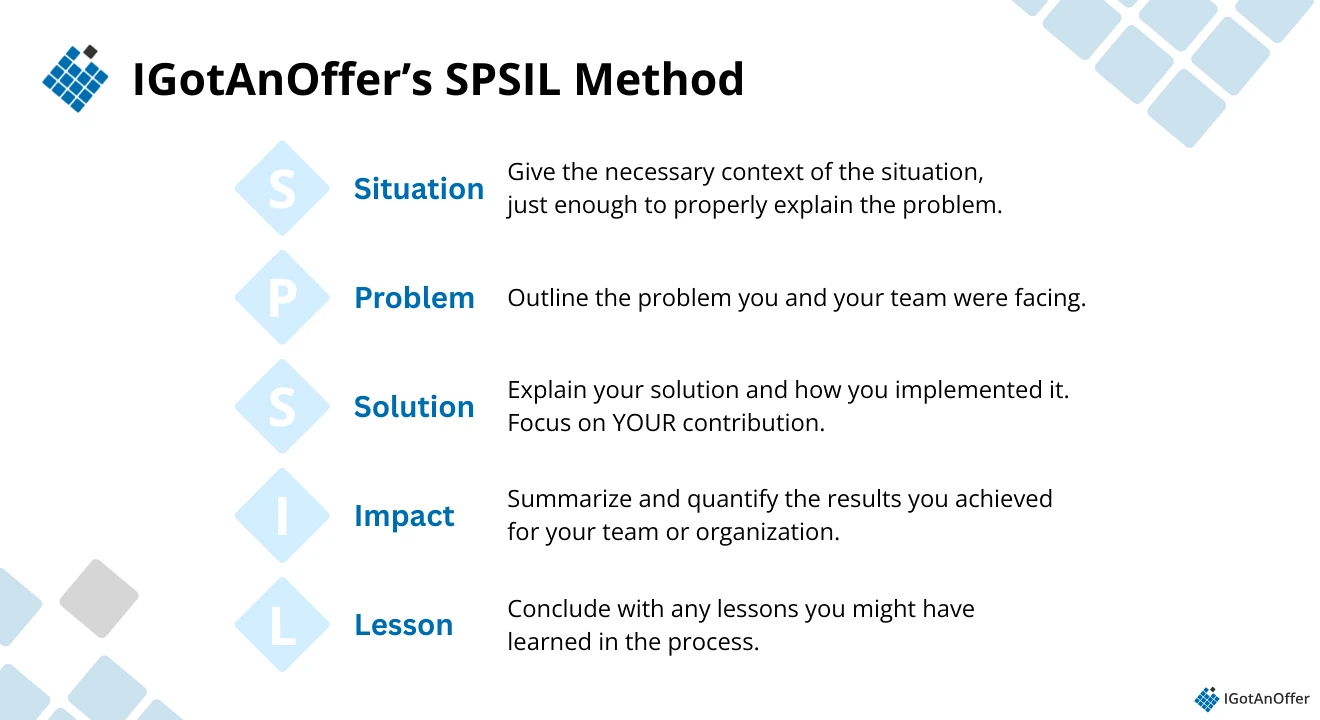
Use a repeatable structure so each answer covers your decisions and impact instead of stopping at the setup. Use the STAR method or IGotAnOffer's very own SPSIL method.
For mission and safety questions, show you have thought through the trade-offs yourself, instead of repeating a talking point you think interviewers want to hear.
Example OpenAI research scientist interview questions: Behavioral
- Why do you want to work at OpenAI?
- What are your long-term career goals?
- What are your thoughts on AI safety and the risks of advanced AI systems?
- How do you think about the ethical implications of the work you do?
- What is the most pressing unsolved problem in AI alignment? (Anthropic)
- How would you balance performance optimization with model interpretability? (Anthropic)
- What is the project that you are most proud of? (Meta)
- What was the most challenging project you've worked on? (Meta)
- What research would you be interested in conducting on this team? (Meta)
- What difficulties did you encounter in your PhD? (Meta)
- How was your PhD, and why did you decide to move to industry? (Meta)
- Who is the most difficult person you've had to collaborate with? (Meta)
- How do you handle conflict? (Meta)
- How do you prioritize multiple tasks? (Meta)
- Tell me about a time when a deliverable didn't work out (Meta)
- What is the biggest criticism you've received in your career?
Learn more in our OpenAI behavioral interview guide. Then get more practice with our general behavioral interview questions guide, which covers a detailed explanation of our recommended framework and sample answers.
4. OpenAI research scientist interviewing tips ↑
You might be a strong researcher, but that alone won't get you through the interview rounds. Interviewing is itself a skill, and OpenAI's process is demanding enough that how you answer matters as much as what you know.
4.1 Structure your answers before you're in the room
For behavioral and research questions, a repeatable structure is important. It prevents you from rambling. Our SPSIL method (Situation, Problem, Solution, Impact, Lessons) works well here:
- Situation: the minimum context needed to understand the problem, nothing more.
- Problem: what you and your team were facing.
- Solution: what you did, focused on your own contribution.
- Impact: the result, quantified wherever possible.
- Lessons: what you took from it, especially when the story involves a failure.
Don’t skip the ‘lessons’ step. It’s exactly what interviewers listen for, especially when a story involves a project that didn't go as planned.
We also have recommended structures for coding and system design questions.
- Coding. Follow the timing-based approach in our coding interview tips guide: clarify the question, plan with your interviewer, then start coding by the 20-minute mark.
- System design questions. Use the four-step framework instead: clarify requirements, sketch a high-level design, deep-dive into components, then bring it all together.
4.2 Prepare 5 to 7 stories of technical impact
Each story should cover the problem, your role, the decisions you made, the trade-offs you considered, and what changed as a result. Vague answers about "improving a model" won't hold up against follow-up questions. You need to be specific, on-point.
Practice condensing the setup to under 30 seconds. Spending too long on context before you get to your decisions is one of the most common ways candidates run out of time in this round.
4.3 Know OpenAI's recent research, beyond its products
Interviewers expect you to have gone through OpenAI's published research and updates. Knowing how to use ChatGPT isn't enough. Be ready to discuss a specific paper or release that connects to the team you're interviewing with.
Pick one or two recent releases relevant to your team and be ready to explain what you'd have done differently. Summarizing what OpenAI published won’t cut it; you’ll need to show your own judgment here.
4.4 Prepare a specific position on AI safety
You don't need to be an alignment researcher to answer well here, but a generic "AI safety is important" answer shows you haven't engaged with the actual trade-offs. Have a specific, thought-out view on a safety or alignment question you can defend even when follow-up questions are fired at you.
Pick one specific tension, like interpretability versus capability, and be ready to explain clearly where you stand. Interviewers are testing whether you've thought through the trade-off. Reciting a talking point falls apart under a follow-up question.
4.5 Practice system design at frontier scale
Practice thinking at OpenAI's actual scale.
OpenAI serves hundreds of millions of people, so the same decisions play out differently. A small delay in response time becomes a real problem, and a slow or expensive step gets very costly once it's multiplied by that many requests.
A common mistake is jumping between ideas without walking the interviewer through one coherent thought process. Before your interview, practice sketching two or three different designs on your own and talking through, out loud, how each one could break.
4.6 Get comfortable with time pressure
Time pressure shows up throughout the process. Some candidates report a single HackerRank test with a 2-hour-15-minute limit, combining behavioral and technical questions in one sitting.
The final interviews run just as tight: 4 to 6 hours of back-to-back rounds, with little room to recover if one goes long. Practice under a strict timer so time pressure doesn't cost you the technical questions.
Time-box your practice sessions the same way, including the behavioral portion. Candidates who prepare only for the coding questions often run short on the earlier behavioral section and rush through it.
4.7 Bring one paper or project you can defend in depth
The role-related knowledge round rewards depth over breadth. Pick one piece of your own research, know its methodology and limitations by heart. When you talk about it, don’t just state the results; explain clearly why you made the choices you did.
Prepare for the follow-up question that targets your weakest assumption, since that's usually where interviewers spend the most time.
5. How to prepare for OpenAI research scientist interviews ↑
5.1 Learn OpenAI's mission and culture
Before investing hours in technical prep, make sure OpenAI's mission-first culture is actually a fit for how you want to work.
Talk to anyone you know who works or has worked at OpenAI. That's the fastest way to understand the culture firsthand.
We also recommend reading the following:
- OpenAI's official interview guide, for its hiring philosophy
- OpenAI's Charter
- OpenAI's news page, for recent research and product updates relevant to the team you're targeting
- OpenAI's research publications
- OpenAI Developer Blog
- OpenAI's Research Scientist job posting, read closely for your target role
5.2 Practice by yourself
Once you know what to expect, work through the question categories above one at a time. Start with our own OpenAI guides, then branch out to general resources for deeper dives.
General OpenAI guides:
Coding:
System design/ML system design:
- OpenAI system design interview
- Machine learning system interview design guide
- Generative AI system design interview guide
Role-related knowledge:
- Khan Academy Statistics and Probability Course
- Brilliant.org statistics courses
- Deep Learning Book, recommended by OpenAI's interview guide
- Spinning Up in Deep RL, also recommended by OpenAI
- Interview presentation tips from NIH's career office, for the research presentation format specifically
Behavioral:
- OpenAI behavioral interview questions
- How to answer "Why OpenAI?"
- Most-asked behavioral interview questions
Practicing for research scientist roles at other AI labs too? A few of our other guides can help you cross-train: borrow research-round prep from Meta, mission and safety framing from Anthropic, and system design practice from the adjacent research engineer track at DeepMind.
- Meta research scientist interview guide
- Anthropic culture interview guide
- Google DeepMind research engineer interview guide, written for the adjacent research engineer track, but the technical prep overlaps closely
5.3 Practice with peers
If you have friends or peers who can do mock interviews with you, that's an option worth trying. It’s free, but be warned, you may come up against the following problems:
- It’s hard to know if the feedback you get is accurate
- They’re unlikely to have insider knowledge of interviews at your target company
- On peer platforms, people often waste your time by not showing up
For those reasons, many candidates skip peer mock interviews and go straight to mock interviews with an expert.
5.4 Practice with experienced interviewers
In our experience, practicing real interviews with experts who can give you company-specific feedback makes a huge difference.
Find an OpenAI research scientist interview coach so you can:
- Test yourself under real interview conditions
- Get accurate feedback from a real expert
- Build your confidence
- Get company-specific insights
- Learn how to tell the right stories, better.
- Save time by focusing your preparation
Landing a job at a big tech company often results in a $50,000 per year or more increase in total compensation. In our experience, three or four coaching sessions worth ~$500 will make a significant difference in your ability to land the job. That’s an ROI of 100x!
Book research scientist mock interviews with OpenAI interviewers.




 Behavioral