Back to other articles

 Last updated: November 10, 2026


 Interviews
 Engineering manager
 Deeply researched
Preparing for an OpenAI engineering manager interview can feel daunting. You’ll need to show that you can lead engineers and make sound technical decisions. You’ll also need to demonstrate that you can collaborate effectively with others to deliver a good experience for users.
In this guide, we cover the role’s key responsibilities, reported salaries, a step-by-step breakdown of the interview process, example interview questions, and preparation tips to help you land an offer.
Here's an overview of what we'll cover:
Practice 1-on-1 with OpenAI interview coaches
1. OpenAI engineering manager role and salary ↑
Before we cover your OpenAI engineering manager interviews, let’s first take a look at the role itself.
1.1 What does an OpenAI engineering manager do?
As an engineering manager at OpenAI, you’ll hire and coach engineers as well as guide their technical work. Depending on the team, you might oversee the development of features for ChatGPT or the infrastructure supporting OpenAI’s products.
For example, if you join ChatGPT Search Infrastructure, your team will build tools that other teams use to test and launch search features. You’ll need to help them do this while keeping the service fast and reliable.
You'll also need to be close enough to the work to earn the trust of senior engineers, review architecture, and guide design choices.
1.2 How much does an OpenAI engineering manager make?
According to recent engineering manager job postings on OpenAI’s careers page, base salaries range from $293K to $445K a year, plus equity, depending on the team and location.
On Levels.fyi, the median total compensation reported by US OpenAI software engineering managers is $1.38M a year. This includes equity as well as salary.
We presume you already know which level you're applying for, but it's worth double-checking with your recruiter, who can confirm which level you're being evaluated for.
Your interview performance can affect the level and compensation you’re offered. An OpenAI interview coach can help you prepare for those conversations.
If you already have an offer, a salary negotiation coach can help you assess the package and plan what to ask for.
Coaches who contributed to this guide




2. OpenAI engineering manager interview process ↑
According to candidate reports on Glassdoor, the OpenAI interview process for EM roles can take anywhere from four weeks to four months.
Here are the typical stages for the OpenAI EM role:
- Resume screen
- Recruiter call
- Hiring manager screen
- Skills-based assessment
- Final interviews
- Decision and offer
2.1 Resume screen ↑
The first step of OpenAI's interview process is the resume screen. After you've submitted your application through OpenAI’s careers page, recruiters and hiring managers will evaluate your resume to see if your experience aligns with the open position.
This is a highly competitive step. To help you put together a targeted resume that stands out, follow the tips below:
Tips for crafting a resume
- Simplify. Avoid overly creative layouts. A simple resume passes through applicant tracking systems and reads quickly for recruiters and hiring managers.
- Verbalize. Start each bullet point under your previous roles with an action word.
- Quantify. Add numbers wherever you can, e.g., the size of the team you managed, improvements in reliability, or the number of users your team’s feature serves.
- Summarize. Include a skills section with keywords pulled directly from the job posting.
For more guidance on how to craft your resume, check out our engineering manager resume guide. If you’d like personalized feedback, you can also book a resume review session with an expert who can help you identify areas for improvement.
2.2 Recruiter call ↑
Your first conversation may be with a recruiter or the hiring manager. They’ll ask about your background and what you’re looking for in your next job.
Prepare a short answer to “Tell me about yourself” and “Why OpenAI?” Focus on the experience that’s relevant to the job, and explain why you want to work on this team.
The recruiter will also expect you to ask questions. Use this opportunity to clarify anything that wasn’t covered in the job posting, such as what to expect in the interview process.
You can also ask, "What does success look like in the first 6-12 months for this role?" or “What's the biggest challenge the team is facing right now?” Their answers can tell you which experience to emphasize in later interviews. For example, if the team needs help developing junior engineers, prepare an example of how you coached someone and helped them grow.
2.3 Hiring manager screen ↑
In some cases, you may also have a hiring manager screen before the skills-based assessment and final interviews.
You can expect questions about:
- Your experience leading engineering teams
- Technical challenges you've tackled
- How you manage people, including how you delegate work and give feedback
2.4 Skills-based assessment ↑
OpenAI uses skills-based assessments, which may include technical tests, pair coding, and take-home projects. You may get more than one assessment depending on the role.
For example, one EM candidate described a system-design assessment that started with databases, APIs, scaling, and load balancing, then moved into geospatial indexing. Be ready to explain both your overall design and the algorithms behind an individual component.
OpenAI’s interview guide says some assessments allow AI tools while others require you to solve problems independently. Your preparation materials should give you instructions on what is permitted, but you can always check with your recruiter if anything is unclear.
2.5 Final interviews ↑
The final interviews typically last four to six hours, during which you’ll meet with four to six interviewers over one or two days. These interviews are virtual by default, but you can also choose to interview at OpenAI’s San Francisco office.
You may also have a management roleplay that simulates a conversation with a direct report. You’ll be expected to handle the situation as you would in a real management setting.
To make your preparation more focused, we've grouped the questions into three categories:
We’ll cover each of these in more detail in Section 3.
2.6 Decision and offer ↑
OpenAI says you should hear back within a week after your final interviews. Your recruiter may ask you for references at this stage. If you haven’t heard anything after a week, contact them for an update.
If you get an offer, read the full package before negotiating. Ask your recruiter to explain the equity terms, including when you’ll own the shares and when you can sell them.
Salary negotiation tips
- Be polite. Remember that the person you're negotiating with is just doing their job. You'll get much farther in your negotiations if you approach the conversation with grace.
- Don't give a number right away. Whenever possible, it's better to wait until you receive an offer to start negotiating. This reduces the risk of giving a number that is lower than what OpenAI otherwise would have paid.
- Do your research. Have a number in mind before the conversation begins, and back it up with data. Research your position and level on Levels.fyi, ask around on professional networking sites like Blind, and factor in the cost of living where you are.
- Start high. If the offer is negotiable, ask for an amount above your target so you have room to compromise.
- Negotiate everything. If you can’t agree on base pay, ask about the other parts of the offer. Could OpenAI increase the stock grant or offer a bonus? You can ask about your location and working arrangements too.
If you'd like help reviewing your offer and planning your negotiation, you can book a session with one of our salary negotiation coaches.
3. OpenAI engineering manager interview questions ↑
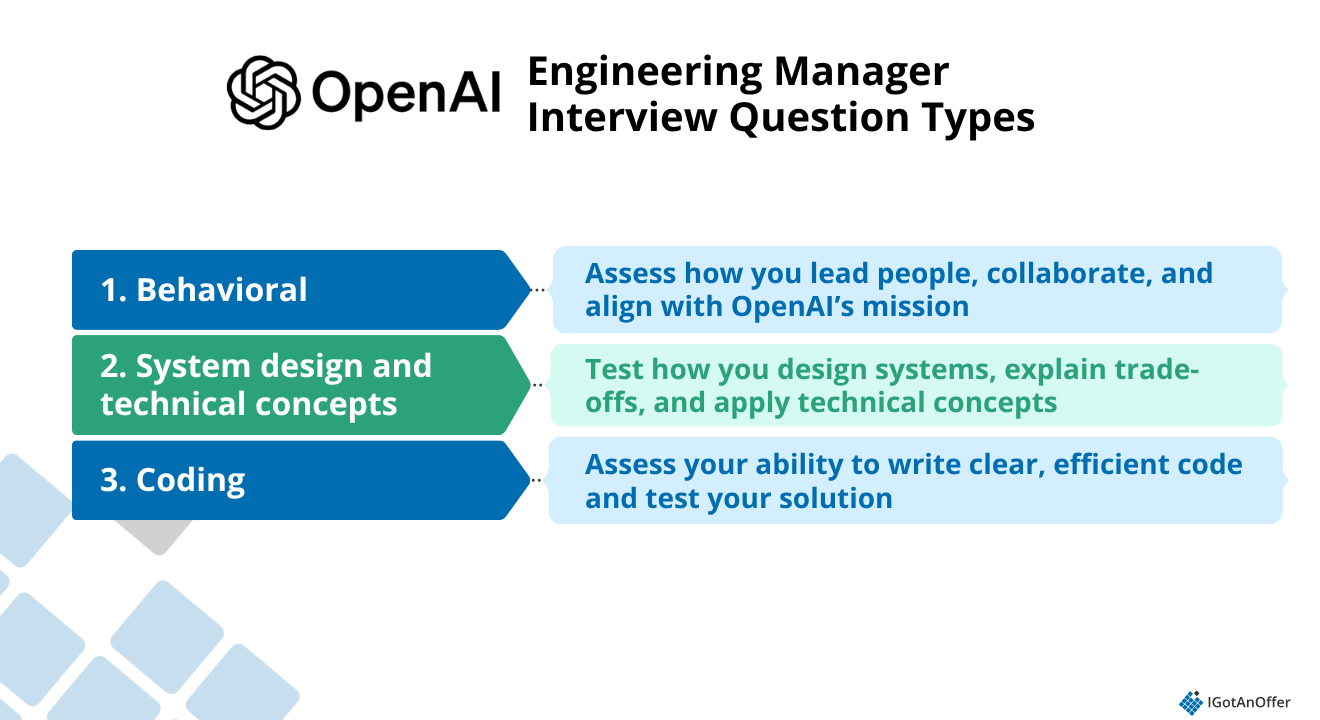
Below, you’ll find 20 practice questions: one adapted from an OpenAI engineering manager interview report and 19 from other OpenAI roles. They cover the topics in our behavioral, system design, and coding interview guides.
Let’s look at what to prepare for in each category:
3.1 Behavioral ↑
OpenAI’s behavioral questions focus on how you lead people, work with others, and align with OpenAI’s mission and values. You can also expect questions about your motivation for joining OpenAI, your views on AI safety, and examples from your past work.
For engineering managers, people leadership is especially important because their impact depends on the work and growth of the engineers they manage. “An EM is not a project manager. They should be about helping people grow,” says Mathew (ex-FAANG engineering manager).
Be ready to discuss how you’ve coached engineers, given feedback, handled difficult situations, and helped team members take on more responsibility.
Example OpenAI engineering manager interview questions: Behavioral
Culture and motivation
- Why do you want to work at OpenAI?
- What are your thoughts on AI safety and the risks of advanced AI systems?
Feedback and learning
- Tell me about the most useful piece of feedback you've ever received.
- Tell me about a technical misjudgment that delayed a project. What did you learn?
Project leadership and collaboration
- Walk me through a project you owned end-to-end. What were the key technical decisions?
- Tell me about a time you and a cross-functional partner disagreed. How did you resolve it?
- How do you manage multiple conflicting priorities?
- Tell me about a time you had to make a decision with incomplete information.
For more help structuring your responses, see our OpenAI behavioral interview guide.
3.2 System design and technical concepts ↑
System design questions test how you would design a service or application. You may need to discuss databases, schemas, APIs, scaling, load balancing, and how different components communicate.
You’ll be expected to choose appropriate components, explain how they work together, and discuss trade-offs, bottlenecks, and potential failure points.
In addition, you may also get technical concept questions that require you to explain core software engineering concepts and apply them to real-world scenarios. These questions are usually narrower in scope, so you may not need to design a full system or write a complete solution.
Example OpenAI engineering manager interview questions: System design and technical concepts
Technical concepts
- Geospatial indexing: Compare an R-tree and a quadtree for indexing geographic data. How does each structure organize the data?
System design
- Design Slack. (Answer outline)
- How would you design a large language model (LLM)-powered enterprise search system? (Answer outline)
- Design an in-memory database. (Answer outline)
- Design GitHub Actions from scratch.
- Design a webhook system.
- Design a web crawler at scale.
For more practice questions and an answer framework, see our OpenAI system design interview guide.
3.3 Coding ↑
Coding questions at OpenAI assess whether you can turn a problem into clear, efficient, well-tested code. Topics you may encounter include caches, key-value stores, and spreadsheet calculations. If your EM process includes coding, you should be able to choose suitable data structures, explain the time and space complexity, and test edge cases.
Example OpenAI engineering manager interview questions: Coding
- Implement an LRU (least recently used) cache with get and put operations. (Solution)
- Implement a time-based key-value store: set includes a timestamp, and get returns the value active at a given time. (Related solution: increasing timestamps)
- Implement a key-value store with serialization and deserialization. Keys and values can contain any characters, including delimiters.
- Implement a GPU (graphics processing unit) credit ledger supporting add, charge, and balance queries. Requests can arrive out of order.
- Implement a simplified spreadsheet API with getCell and setCell, including formula evaluation and dependency tracking.
To practice a step-by-step approach, work through the answer framework in our OpenAI coding interview guide.
4. OpenAI engineering manager interview tips ↑
You might be a fantastic engineering manager, but unfortunately, that won’t necessarily be enough to ace your interviews at OpenAI. Interviewing is a skill in itself that you need to learn.
Let’s look at some key tips to make sure you approach your interviews in the right way.
4.1 Ask clarifying questions
Often, the questions you’ll get will be quite ambiguous. Make sure you ask questions that can help you clarify and understand the problem.
You need to state assumptions explicitly, explain why you’re making them, and check with your interviewer to see if those assumptions are reasonable.
Once you understand the requirements, Mark (ex-FAANG engineering manager) says that you should “Scope the problem to a size that you think you can complete during the interview.”
4.2 Keep your answers focused
Use a framework to keep your answers focused and easy to follow. You can use IGotAnOffer's SPSIL method (Situation, Problem, Solution, Impact, Learning) to structure your answers to behavioral questions.
It’s similar to STAR (Situation, Task, Action, Result) but fixes two common pitfalls candidates often face: (1) candidates often struggle to clearly distinguish between “task” and “action,” and (2) it includes a “learning” step, which STAR often overlooks, even though it’s one of the most important parts of your answer.
For technical rounds, make sure you understand the requirements and state any assumptions before diving into a problem. Summarize your approach before working through your solution. For a consistent answer method, see our coding interview framework and system design framework.
That said, don’t be overly reliant on your script or the framework. Treat it as a guide, and be ready to adapt to open-ended questions, think out loud, and engage with the interviewer. Focus on your most relevant achievements and experiences.
4.3 Be clear about your impact
Come with concrete examples and be ready to go deep on what you specifically did, not just what the team achieved. If a project went wrong, be ready to explain your part in it and what you’d do differently.
4.4 Practice the management roleplay
Practice with a friend who can act as a direct report. Give them a realistic management issue, such as repeatedly missing deadlines, struggling with performance, or having a conflict with another engineer.
During the roleplay, focus on asking questions to understand the underlying issue, giving constructive feedback, and agreeing on clear next steps. Your goal is to show how you'd handle a difficult conversation while supporting the engineer and holding them accountable.
4.5 Adapt to follow-up questions
Don't be alarmed if your interviewer asks follow-up questions. Listen carefully to how your interviewer is asking these questions, as there will often be a clue about the specific thing they're trying to assess.
If an interviewer asks why you chose a particular approach, explain the decision behind it, acknowledge the trade-offs, and adjust your answer if needed.
4.6 Prepare questions for your interviewers
Prepare thoughtful questions about the team, the role, and what working as an engineering manager at OpenAI would look like.
For example, you could ask how much time EMs spend on technical work versus people management, what the team’s biggest challenges are, or what success looks like in the first 6–12 months.
Avoid generic questions. Focus on questions that will help you decide whether the role, team, and scope are a good fit for you.
5. How to prepare for your OpenAI engineering manager interview ↑
Like management, interviewing is a skill. The more deliberately you practice it, the better you'll perform when it matters.
5.1 Learn about OpenAI’s culture
Most candidates fail to do this. But before investing a ton of time preparing for an interview at OpenAI, you should make sure it's actually the right company for you.
OpenAI is prestigious, and so it's tempting to assume that you should apply without considering things more carefully. But it's important to remember that the prestige of a job by itself won't make you happy in your day-to-day work. It's the type of work and the people you work with that will.
If you know anyone who works at OpenAI (or used to), it's a good idea to talk to them to understand what the culture is like.
We recommend checking out these resources to help you learn more about the company:
- OpenAI’s charter
- OpenAI research and product blog
- OpenAI's interview guide
- OpenAI careers and culture page
5.2 Practice by yourself
The first step of your preparation should be to brush up on the different question types and practice answering them by yourself. To get you started, you might want to check out the following guides:
For behavioral questions:
- OpenAI behavioral interview guide
- People management questions in tech interviews
- Grokking the engineering management leadership interview
For system design and technical concepts:
- OpenAI system design interview guide
- System design interview prep guide
- Machine learning system design interview guide
- Generative AI system design interview guide
For coding:
Finally, a great way to improve your communication for behavioral, system design, and coding questions is to interview yourself out loud.
This may sound strange, but it can significantly improve the way you communicate your answers under pressure. Play the role of both the candidate and the interviewer, asking questions and answering them out loud.
However, by yourself, you can't simulate thinking on your feet or the pressure of performing in front of a stranger. Plus, there are no unexpected follow-up questions and no feedback.
That's why many candidates try to practice with friends or peers.
5.3 Practice with peers
If you have friends or peers who can do mock interviews with you, that's an option worth trying. It's free, but be warned, you may come up against the following problems:
- It's hard to know if the feedback you get is accurate
- They're unlikely to have insider knowledge of interviews at your target company
- On peer platforms, people often waste your time by not showing up
For those reasons, many candidates skip peer mock interviews and go straight to mock interviews with an expert.
5.4 Practice with experienced interviewers
In our experience, practicing real interviews with experts who can give you company-specific feedback makes a huge difference.
Find an engineering manager interview coach so you can:
- Test yourself under real interview conditions
- Get accurate feedback from a real expert
- Build your confidence
- Get company-specific insights
- Learn how to tell the right stories, better.
- Save time by focusing your preparation
Landing a job at a big tech company often results in a $50,000 per year or more increase in total compensation. In our experience, three or four coaching sessions worth ~$500 will make a significant difference in your ability to land the job. That's an ROI of 100x!



 AI system design