

 Back to other articles
  Last updated: September 21, 2026

 Interviews
 Software engineer
 Coding
 Deeply researched
OpenAI coding interviews are designed to test whether you can build real systems, not just solve algorithmic puzzles. The questions are practical, the expectations around code quality are high, and working solutions alone are not enough to pass.
To help you prepare, we've put together this guide. We cover what makes OpenAI's coding rounds different from other top tech companies, the topics and questions you're most likely to encounter (sourced from real candidate reports), an effective answer framework, and a step-by-step prep plan.
Whether you're applying for software engineer, engineering manager, or other technical roles at OpenAI, this guide is a solid place to start your coding prep.
- What to expect
- OpenAI coding interview questions
- How to answer OpenAI coding questions
- How to prepare for OpenAI coding interviews
On a time crunch? You might want to check out our last-minute coding interview prep guide first.
Click here to practice 1-on-1 with coding interview coaches
1. What to expect: OpenAI coding interview ↑
OpenAI's coding interviews differ from what you'll find at most other top tech companies. Before diving into questions, it helps to understand when you'll face them and what the format looks like.
1.1 When will you face a coding interview? ↑
If you're applying for an engineering role at OpenAI, you can expect coding to come up at multiple stages of the process.
The typical OpenAI interview process for software engineers follows these steps:
- Recruiter screen: A 30-minute call covering your background, motivation, and fit. No coding here.
- Skills-based assessment: This is where coding first appears. Depending on the team, it may take the form of a live coding session on CoderPad or HackerRank, a take-home project, or a pair coding exercise. Some candidates report getting both a coding screen and a system design screen at this stage, each lasting about an hour.
- Final interview loop: 4 to 6 hours of interviews over 1 to 2 days, typically done virtually. For SWE candidates, this usually includes additional coding rounds, system design, behavioral interviews, and sometimes a code refactoring exercise or technical presentation (for senior roles).
The number and type of coding rounds can vary by team and level. According to OpenAI's official interview guide, the company evaluates engineering candidates on "well-designed solutions, high-quality code, optimal performance, and good test coverage."
One important note: OpenAI uses "member of technical staff" (MTS) as a title for many engineering roles. The interview process and questions for MTS and software engineer positions are essentially the same.
1.2 How coding interviews work at OpenAI ↑
OpenAI's coding rounds look and feel different from traditional FAANG-style interviews. Understanding these differences is essential for effective preparation.
The problems are practical, not theoretical. Instead of classic LeetCode-style puzzles, OpenAI asks you to build small systems and working implementations. Candidates report questions like "Implement a key-value store with serialization" or "Build a spreadsheet with formula evaluation," rather than "Find the kth largest element in an array." The problems resemble things you might actually build at work.
Each round runs longer and deeper. Coding sessions typically last 45 to 60 minutes on CoderPad. Problems often start with a base requirement and then layer on follow-up extensions that increase complexity. Time management matters as many candidates end up writing code for the entire session with little time to spare.
Production quality is a requirement, not a bonus. A working solution that passes test cases is the starting point, not the finish line. Interviewers evaluate your code structure, variable naming, edge case handling, and whether the code is maintainable. According to our analysis of candidate reports, OpenAI specifically looks for:
- Clean structure: Code organized into functions or classes, not written as one long block.
- Clear variable naming: Names that communicate intent. Avoid shorthand like x, temp, or res.
- Explicit edge case handling: Account for empty inputs, nulls, boundary values, and unexpected data without being prompted.
- Test awareness: Proactively writing or discussing test cases, not waiting for the interviewer to ask.
Communication matters throughout. OpenAI evaluates how you reason through problems out loud. Silently coding for 30 minutes and presenting a solution at the end is a weak signal. Interviewers want to see you clarify requirements, explain your approach, discuss trade-offs, and narrate your decisions as you code.
Python is the most practical language choice. While OpenAI coding rounds are generally language-agnostic, many candidates and interview sources recommend Python because the problems are complex enough that a verbose language can cost you time. That said, use whatever language you're fastest and most confident in.
2. OpenAI coding interview questions ↑
We analyzed questions reported by real OpenAI software engineers and MTS candidates on Glassdoor, Blind, Reddit, and other candidate forums. We also drew from our existing OpenAI interview questions guide and OpenAI SWE guide.
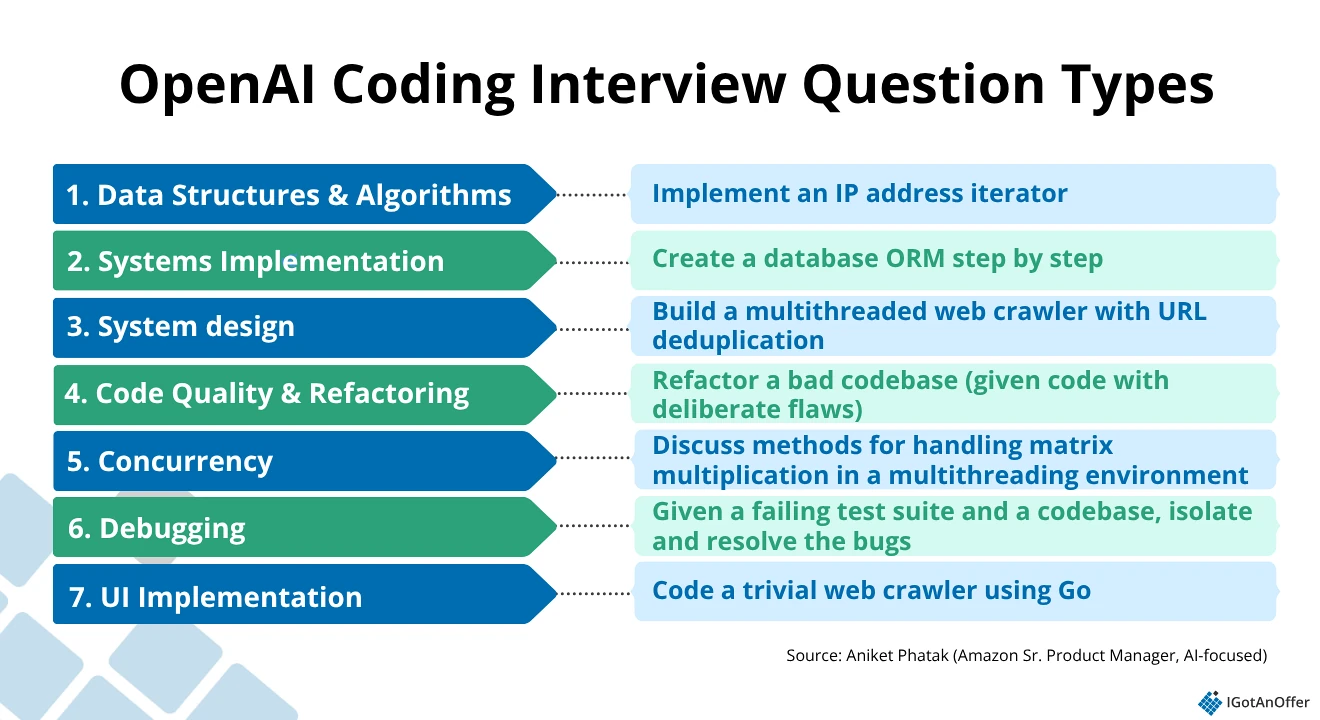
The questions cluster around 7 categories:
- Data Structures & Algorithms
- Systems Implementation
- System design
- Code Quality & Refactoring
- Concurrency
- Debugging
- UI Implementation
Unlike at companies such as Meta or Google, where you can expect a predictable distribution across classic DSA topics (arrays, trees, graphs, etc.), OpenAI's questions lean heavily toward building functional systems and working with realistic constraints.
2.1 Data structures and algorithms ↑
These questions test your ability to implement data structures from scratch and apply core algorithmic concepts. At OpenAI, you won't just be asked to use a hash map or perform a binary search. You'll be asked to build the data structure yourself, with a clean API, proper edge case handling, and often a follow-up that changes the constraints.
The LRU cache is the most commonly reported coding question at OpenAI. It tests hash maps and linked lists together, and interviewers typically extend it with additional requirements once your base implementation is working.
OpenAI coding interview questions: data structures and algorithms
- Implement an LRU cache with get and put operations (Solution)
- Implement a time-based key-value store (set includes a timestamp; get returns the value active at a given time) (Solution)
- Implement a meeting rooms scheduling system (interval overlap detection and resource allocation) (Solution)
- Implement an IP address iterator. (Solution)
- Implement a resumable iterator with state management (pause, resume, skip, reset). (Solution)
- Implement a toy language type system with generic resolution. (Solution)
- Design and implement the core battle logic for a turn-based fight between two teams of monster. (Solution)
The LRU cache is OpenAI's most commonly reported coding question. It tests hash maps and linked lists together. For targeted practice, check out our map interview questions and linked list interview questions guides. For a broader review of fundamentals, see our ultimate data structure interview questions list.
2.2 Systems implementation ↑
This is the category that makes OpenAI's coding interviews distinctive. You're asked to build a small but functional system from scratch, often with multiple interacting components. These problems test API design, state management, and the ability to handle requirements that evolve as the interview progresses.
The questions tend to reflect real engineering challenges at OpenAI. A GPU credit ledger maps to their infrastructure billing. An in-memory database mirrors the kind of storage work their teams do. The problems are longer and more involved than a typical DSA question, and time management is the biggest challenge here.
OpenAI coding interview questions: systems implementation
- Implement a key-value store with serialization and deserialization (keys/values can contain any characters, including delimiters). (Solution)
- Implement a key-value store that persists to disk with fixed-size shards. (Solution)
- Implement a GPU credit ledger supporting add, charge, and balance queries (requests can arrive out of order). (Solution)
- Implement a GPU credit calculator. (Solution)
- Create a database ORM step by step. (Solution)
- Implement an in-memory database with basic SQL operations (tables, inserts, selects with WHERE clauses). (Solution)
- Build an in-memory social network relationship store with time-travel queries. (Solution)
Several of these come with multi-part structures. Your interviewer will start with a base requirement and then layer on extensions. For instance, a key-value store question might begin with basic get/set, then add persistence, then add timestamp-based versioning.
2.3 System design (coding-focused) ↑
Some OpenAI coding questions sit at the boundary between a coding interview and a system design interview. You're still writing working code, but the problem requires you to think about architecture, dependencies between components, and how different parts of a system interact.
The spreadsheet question is a good example. It starts as a straightforward implementation, but the follow-up (make getCell O(1) by proactively propagating updates through the dependency graph) requires you to reason about topological ordering and graph cycles while writing real code.
OpenAI coding interview questions: system design (coding-focused)
- Implement a simplified spreadsheet API with getCell and setCell, including formula evaluation and dependency tracking. (Solution)
- Implement Unix CD command with symbolic link resolution (handle ., .., absolute paths, symlinks, and cycle detection). (Solution)
- Build a multithreaded web crawler with URL deduplication, failure handling, and rate limiting. (Solution)
For more practice with design-oriented problems, see our OpenAI system design interview guide.
2.4 Code quality and refactoring ↑
Rather than building something from scratch, you're given existing code with deliberate flaws and asked to improve it. According to our OpenAI interview process guide, this format is particularly common in the final interview loop for senior roles.
These questions test your ability to work with real codebases, which is what you'll be doing every day at OpenAI. Interviewers are looking for your ability to identify structural problems, propose better abstractions, and improve testability without breaking existing functionality.
OpenAI coding interview questions: code quality and refactoring
- Refactor a bad codebase (given existing code with deliberate flaws; improve structure, readability, and maintainability).
- Refactor a chat service bot system (given code for bots triggered by keywords like "away," "meet," "taco count"; propose an IBotService interface and convert existing logic into classes).
To prepare, practice identifying code smells, applying SOLID principles, and restructuring code for testability. Small open-source projects with open issues on GitHub are good practice material.
2.5 Concurrency ↑
OpenAI's infrastructure runs on massive-scale parallel computation across GPU clusters. Questions in this category test whether you can write correct concurrent code and reason about synchronization, race conditions, and performance trade-offs.
These tend to be harder questions and are more common for mid-level and senior candidates. The multithreaded web crawler question in particular has been reported multiple times across forums.
OpenAI coding interview questions: concurrency
- Build a multithreaded web crawler (coordinate threads, deduplicate URLs, handle failures, implement rate limiting). (Solution)
- Discuss methods for handling matrix multiplication in a multithreading environment and explain how to aggregate results. (Solution)
- Implement a time-based key-value store with thread-safe operations (locking strategies, comparing lock implementations for performance). (Solution)
Note that some concurrency questions also appear in the systems implementation and system design categories above. The multithreaded web crawler, for example, tests both system-building skills and concurrency concepts in a single problem.
2.6 Debugging ↑
Some OpenAI rounds give you broken code and ask you to find and fix the issues. This is distinct from refactoring (where the code works but is poorly structured) because here the code is functionally incorrect. These rounds sometimes involve reviewing code that the interviewer presents as if written by a colleague.
OpenAI coding interview questions: debugging
- Debug an existing function that produces incorrect output (identify the root cause and fix it)
- Given a failing test suite and a codebase, isolate and resolve the bugs
- Review and correct a flawed implementation (e.g., broken LRU cache (Solution), incorrect binary search)
To prepare, practice a structured debugging methodology: reproduce the issue, isolate the failing component, form a hypothesis, apply a fix, and verify.
2.7 UI implementation ↑
Depending on the team you're interviewing with, you may get a frontend or UI-focused coding problem. These are less common than the other categories but do appear in candidate reports, particularly for full-stack or product-facing engineering roles.
OpenAI coding interview questions: UI implementation
- Given a simple mockup, implement that UI (some CSS is already provided and an API to fetch the data also exists)
- Code a trivial web crawler using Go (Solution)
These test your ability to work within existing constraints (provided CSS, existing APIs) and deliver a functional result quickly.
For practice with specific data structures and algorithm topics, check out our guides on arrays, strings, trees, graphs, linked lists, stacks and queues, sorting algorithms, and maps.
3. How to answer OpenAI coding questions ↑
In this section, we'll give you an answer framework for OpenAI coding interviews and an example answer using the framework.
We'll also cover what separates a good candidate from a great one during coding rounds at OpenAI.
3.1 OpenAI coding interview framework
To answer OpenAI coding questions well, you need an approach that consistently shows your interviewer how you think and breaks the problem down into manageable steps.
Here's the step-by-step approach we recommend:
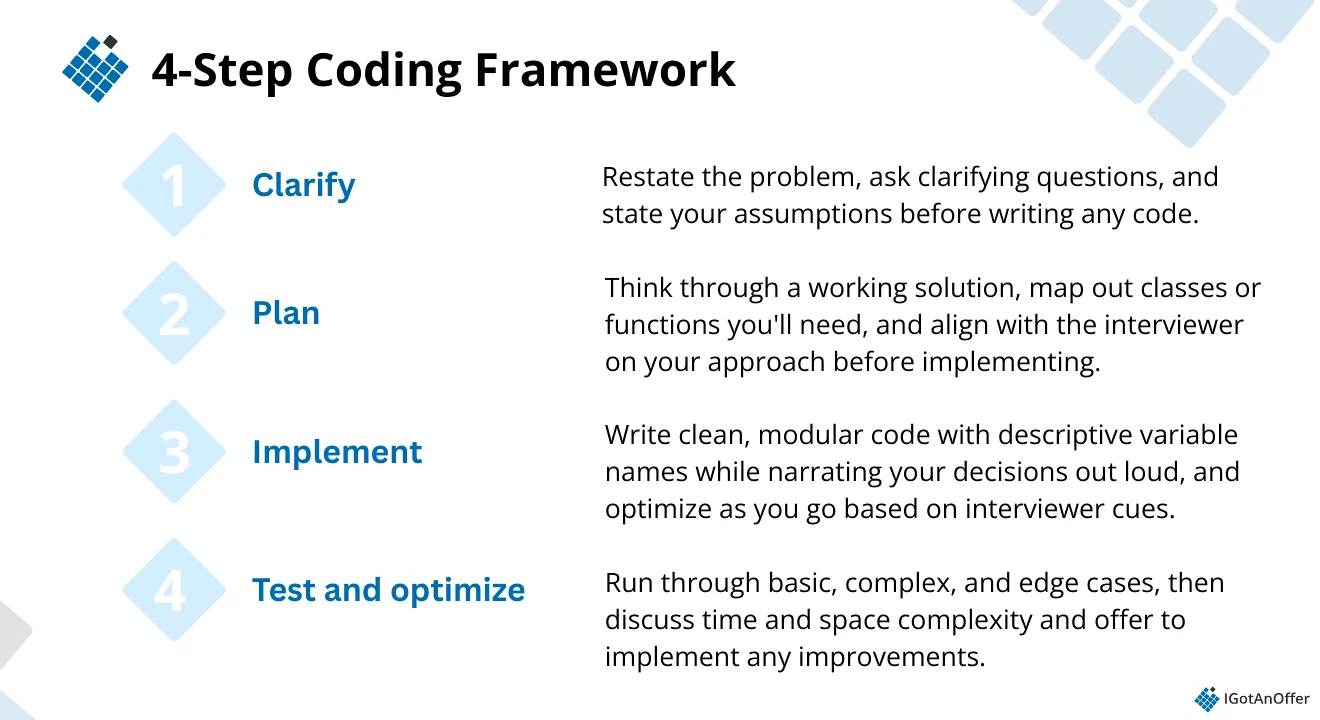
Below, we'll go into each step in detail.
3.1.1 Clarify ↑
Don't start coding immediately. OpenAI's problems are deliberately ambiguous, and interviewers want to see how you handle that ambiguity.
This is a good time to set up a dialogue with your interviewer. They are not just looking for a candidate who can solve a problem, but one who can work effectively in a team of other OpenAI engineers.
Let’s jump into how this will look during the interview.
Understand the question
If the question has been written down for you, take the time to read it thoroughly at least twice, to be sure that you’ve picked up on all the details.
Repeat the question back to the interviewer in your own words, so that they can flag anything that you may have initially misunderstood.
Ask clarifying questions
Pin down the details that aren't stated. For a key-value store question, you might ask: can keys and values contain special characters? Is there a maximum capacity? Should operations be thread-safe? What should happen if a key doesn't exist?
State your assumptions
Before you start building, tell the interviewer what you're assuming about input format, data types, or constraints. This lets them correct you early rather than watching you go down the wrong path for 20 minutes.
3.1.2 Plan ↑
Now that you have a complete understanding of the coding question, it’s time to start making your plan. Here is where you can discuss potential approaches with the interviewer, pick the most appropriate one, and lay out the high-level steps to get there.
Let’s take a look at how this will play out in the interview:
Start with any working solution
Take a few minutes to think through a solution to the problem. It does not need to be optimal at this stage. Map out your solution on the whiteboard or its virtual equivalent, making sure that what you add is comprehensible to both you and the interviewer.
The goal is to find any solution (at least brute-force) and then find improvements. Keep walking through your steps out loud so that the interviewer can guide you.
Map out the structure
For OpenAI's system-building questions, think about what classes or functions you'll need. What methods will you expose? What internal state do you need to maintain?
Align with the interviewer
Explain your plan before implementing it. If you've identified multiple approaches, briefly cover why you chose the one you're going with. Getting alignment here saves costly direction changes mid-implementation.
3.1.3 Implement ↑
Now it’s time for the main event. Write legible, clean code rather than pseudocode, and comment out loud on what you’re doing.
Alternatively, if you have a hard time talking and writing, you can spend a few minutes coding quietly, then stop periodically to explain what you’ve done.
Optimize the solution
Once you’ve talked through your solution with the interviewer, optimize it. Consider any points you may have missed when you first thought of the solution, and what you can do to make it better.
Explain your reasoning thoroughly and keep an eye out for the cues of the interviewer, which will let you know whether or not you’re on the right track. You can prompt them by asking, “How does that sound?” before moving on to coding.
Write the code
Now, write that code! Explain what you’re doing, and make an effort to write clearly—don’t use shorthand variables. Include descriptive variable names, structure the code well, consider boundary conditions or empty inputs, etc.
Make your code modular and eliminate duplicate code. If you realize you’ve forgotten an important function, simply go back and insert it, while clarifying what you’re doing out loud.
3.1.4 Test and optimize ↑
Once you have your code on the board, you’ve got to take the time to run through and test it, then optimize it, given what you’ve found in testing. Start by testing with a simple example, then try breaking your code with edge and corner cases.
Don’t forget to calculate the time and space complexity of your code and discuss how you can improve it. If you find any better solutions while testing and evaluating your code’s complexity, ask the interviewer if they’d like you to implement it.
Here’s how that will play out:
Test run your code
When testing your code, run it through multiple cases, starting with the basic use case, moving into a more complex case, and finally testing for failure and edge cases.
Consider anything that might break your code and what you can do to address it [e.g. test cases like assertEquals (findMax(10,20), 20)].
Optimize your code
Finally, work out the time and space complexity of your code. Explain it in simple terms to your interviewer, and use it as a jump-off point to consider ways you can optimize your code.
If time permits, write out the optimal code and discuss it.
Q&A
These last few minutes of the interview are a good time to ask any questions you might have about the company and what your experience would be like working there.
The interviewer may have additional questions for you as well. If the interviewer has clearly moved on from the coding problem, consider it finished and do not try to rehash any of its finer points.
Now that you’ve seen a breakdown of a coding interview flow, let’s take a look at a full example answer.
3.2 Example OpenAI coding interview answer
To illustrate the framework above, here's a worked example using a real question reported by OpenAI SWE candidates on Glassdoor.
Try this question:
"Implement a time-based key-value store. It should support two operations: set(key, value, timestamp) stores a value with an associated timestamp, and get(key, timestamp) returns the value that was set at or before the given timestamp."
Coding sample answer:
Step 1: Clarify
Understand the question
Candidate: "So I need to build a key-value store where each key can have multiple values, each associated with a different timestamp. When I call get, I should return the most recent value that was set at or before the requested timestamp. Is that right?"
Interviewer: "Exactly."
Ask clarifying questions
Candidate: "A few quick questions. Can I assume timestamps are always positive integers?"
Interviewer: "Yes."
Candidate: "And will set always be called with strictly increasing timestamps for a given key? Or could timestamps arrive out of order?"
Interviewer: "You can assume timestamps are strictly increasing for each key."
Candidate: "What should get return if there's no value at or before the given timestamp?"
Interviewer: "Return an empty string."
State assumptions
Candidate: "I'll assume keys and values are strings, and that we don't need to worry about thread safety for now."
Interviewer: "That's fine."
Step 2: Plan
Find a solution
Candidate: "Since timestamps are strictly increasing per key, each key maps to a sorted list of (timestamp, value) pairs. For get, I need to find the largest timestamp that's less than or equal to the requested one. I could do a linear scan, but binary search would be more efficient."
Explain the approach
Candidate: "So I'll use a dictionary where each key maps to a list of (timestamp, value) tuples. For set, I append to the list. For get, I binary search the list to find the right entry. That gives me O(1) for set and O(log n) for get, where n is the number of entries for that key."
Interviewer: "Sounds good. Go ahead and implement it."
Step 3: Implement
Write the code
Candidate: "I'll start with the class structure and the set method."
class TimeBasedKeyValueStore:
def __init__(self):
self.store = {} # key -> list of (timestamp, value)
def set(self, key, value, timestamp):
if key not in self.store:
self.store[key] = []
self.store[key].append((timestamp, value))
Candidate: "Now for get. I need to binary search for the largest timestamp less than or equal to the target. I'll use Python's bisect module since it handles this cleanly."
def get(self, key, timestamp):
if key not in self.store:
return ""
entries = self.store[key]
# bisect_right gives the insertion point for timestamp
# so the entry we want is at index (insertion_point - 1)
insertion_point = bisect.bisect_right(
entries, (timestamp, chr(127)))
if insertion_point == 0:
return ""
return entries[insertion_point - 1][1]
Candidate: "I'm using chr(127) as the second element of the search tuple so that if there's an exact timestamp match, bisect_right will place it after that entry, and we'll correctly pick it up at insertion_point - 1."
Interviewer: "Why bisect_right instead of bisect_left?"
Candidate: "bisect_right gives me the position after any existing entry with the same timestamp, which means insertion_point - 1 will land on that exact match. If I used bisect_left and there was an exact match, I'd need to handle that case separately."
Step 4: Test and optimize
Test run the code
Candidate: "Let me trace through a few test cases."
store = TimeBasedKeyValueStore()
store.set("foo", "bar", 1)
store.set("foo", "baz", 3)
store.set("foo", "qux", 5)
print(store.get("foo", 3)) # "baz" — exact match
print(store.get("foo", 4)) # "baz" — closest before 4
print(store.get("foo", 5)) # "qux" — exact match
print(store.get("foo", 0)) # "" — nothing at or before 0
print(store.get("bar", 1)) # "" — key doesn't exist
Candidate: "All five cases return what I'd expect. The edge cases are covered: exact matches, gaps between timestamps, timestamps before any entry, and missing keys."
Discuss complexity
Candidate: "Time complexity is O(1) for set since we're just appending to a list. O(log n) for get because of the binary search. Space complexity is O(total number of set calls) since we store every entry."
Interviewer: "Good. Now, what if timestamps could arrive out of order for a given key?"
Handle the follow-up
Candidate: "Then I couldn't just append to the list. I'd need to insert each new entry in sorted order. I could use bisect.insort to maintain the sorted list, which would make set O(n) in the worst case due to the list insertion. Alternatively, I could switch to a balanced BST or a skip list for O(log n) insertions, but that's more complex to implement."
Interviewer: "Which would you choose?"
Candidate: "For an interview, I'd go with bisect.insort since it's straightforward and the performance difference only matters at scale. If this were production code and we expected high write volume, I'd reach for a sorted container like a balanced BST."
Interviewer: "Makes sense. Let's move on."
3.3 Good vs. great OpenAI candidate
To make the cut when interviewing at OpenAI, you have to distinguish yourself from other candidates. Giving a good answer won’t be enough to get an offer. You’ll need to give a great answer if you want to make an impact.
So here are some details that make the difference between an interview that is just ok, and one that will impress your interviewer:
A "good" or "just ok" OpenAI candidate:
- Completely answers the coding questions, but doesn’t interact with the interviewer
- Interacts with their interviewer, but struggles to take hints or change direction when prompted to do so
- Is able to finish the coding problem, but stumbled through their behavioral questions at the start of the interview
- Gets stuck once or twice during the interview and struggles quietly until they are able to move past it
- Offers a complete solution that is difficult to follow
- Comes up with a workable solution after coming to quick conclusions that they haven't verified with the interviewer
- Follows one approach that works, but neglects to examine its tradeoffs or other possible approaches
- Tests the code after being prompted by the interviewer to do so
- Finishes and tests the code by the end of the session, but does not leave time to consider space and time complexity
A "great" OpenAI candidate:
- Is able to change direction and dive deeper into specific aspects when asked
- Has prepared responses to common behavioral questions and can transition smoothly into the coding portion
- Is able to talk through the problem when they get stuck, attack it from multiple angles, and take hints from their interviewer
- Points out the common pitfalls of the programming language they’ve chosen
- Offers a complete solution that is easy to follow, with clearly defined variables and space for corrections
- Considers multiple approaches to the problem and clearly explains why the one they choose is the most efficient
- Works steadily and methodically, only coming to conclusions after having thought and worked through certain aspects
- Proactively tests the code and identifies bugs before the interviewer points them out
- Examines the space and time complexity of the code, offering to optimize certain aspects where applicable.
Ultimately, being a great candidate boils down to having the right mix of technical knowledge and communication skills to both work out the problem and dialogue with the interviewer. For extra tips on coding interviews, take a look at our list of 21 coding tips from ex-interviewers.
You’ll need to prepare for your OpenAI coding interview by brushing up on technical concepts and soft skills like communication. We’ve got a preparation plan to help you do that in our next section.
4. How to prepare for OpenAI coding interviews ↑
As you can see from the information above, there is a lot of ground to cover when it comes to your OpenAI coding interview preparation. So it's best to take a systematic approach to make the most of your practice time. We recommend the three steps below.
4.1 Practice on your own
Before you start practicing interviews, you'll want to make sure you have a strong understanding of the areas OpenAI tests. Once you're confident in the fundamentals, practice your skills by working through practical coding problems.
Here are a few good places to practice:
Unlike traditional FAANG prep, where you might focus on grinding hundreds of LeetCode problems across many DSA categories, OpenAI prep should skew toward building complete implementations. Practice implementing data structures from scratch, building small self-contained systems, and refactoring messy code. These are the problem types that come up most frequently.
Practice in a plain text editor or on CoderPad without autocomplete or IDE features. OpenAI uses CoderPad for live rounds, and HackerRank for some assessments, and candidates who rely heavily on IDE suggestions often struggle with the transition. Time yourself too. OpenAI rounds run 45 to 60 minutes, and candidates consistently report that time is tight.
We also recommend using the coding guides we've linked in this article, as well as our article on how to prepare for FAANG coding interviews (with insights from expert interviewers). If you want to skip straight to solving questions, our ultimate data structure interview questions list is a great place to start.
Some more resources for you:
IGotAnOffer's OpenAI interview guides:
- OpenAI software engineer interview guide
- OpenAI data scientist interview guide
- OpenAI research scientist interview guide
- OpenAI forward deployed engineer guide
- OpenAI interview questions guide
- OpenAI system design interview guide
- OpenAI behavioral interview guide
- OpenAI interview process guide
- How to get a job at OpenAI
IGotAnOffer's coding interview guides:
- How to prepare for FAANG coding interviews
- Ultimate data structure interview questions list
- 21 coding tips from FAANG ex-interviewers
One of the main challenges of coding interviews is that you have to communicate what you're doing as you're doing it. Having to think, code, and explain your reasoning to the interviewer all at the same time is not easy. This is especially true at OpenAI, where interviewers evaluate your communication as closely as your code.
With that in mind, don't let the first interview you do be the real thing. Instead, we recommend getting some mock interviews under your belt.
4.2 Practice with peers
If you have friends or peers who can do coding mock interviews with you, that's an option worth trying. It's free, but be warned, you may come up against the following problems:
- It's hard to know if the feedback you get is accurate
- They're unlikely to have insider knowledge of interviews at your target company
- On peer platforms, people often waste your time by not showing up
For those reasons, many candidates skip peer mock interviews and go straight to mock interviews with an expert.
4.3 Practice with experienced coding interviewers
In our experience, practicing real coding interviews with experts who can give you company-specific feedback makes a huge difference. Knowing what "production-quality code" looks like in the eyes of an OpenAI interviewer is hard to calibrate on your own.
Find an OpenAI coding interview coach so you can:
- Test yourself under real interview conditions
- Get accurate feedback from a real expert
- Build your confidence
- Get company-specific insights
- Save time by focusing your preparation
Mocks are also extremely useful for the other types of interview rounds you'll be facing at OpenAI, such as system design and behavioral.
Landing a software engineering role at OpenAI often results in a $50,000 per year or more increase in total compensation. In our experience, three or four coaching sessions at around $500 make a meaningful difference in your ability to get the offer. That is an ROI of 100x.
Click here to book coding mock interviews with experienced tech interviewers.