

 Back to other articles


 Last updated: September 27, 2026
 Interviews
 Staff software engineer
 System design
 Deeply researched
Staff-level system design interviews demand a completely different level of ownership than mid-level or senior interviews.
More than designing a technically sound solution, you'll be expected to lead the discussion, define the problem, and identify missing requirements with little to NO guidance from the interviewer.
Because the expectations are higher, the preparation is different too.
We've put together this guide to help you prepare. Here, you'll find the key topics covered in staff system design interviews, real example questions, expert tips from FAANG ex-interviewers, and a preparation plan to help you ace your interview.
- What to expect from your staff system design interview
- Types of questions covered in staff system design interviews
- Examples of staff system design questions (by company)
- How to answer staff-level system design questions
- Staff system design interview tips
- How to prepare for staff system design interviews
Click here to practice 1-on-1 with system design ex-interviewers
Let’s get started!
1. What to expect from your staff system design interview↑
1.1 How do staff system design interviews work? ↑
A staff system design interview follows the same general format as most system design interviews. You'll typically have 45 - 60 minutes to work through a broad prompt, such as "Design Instagram".
You’re expected to generate a high-level design, showing the different required system components. You then need to describe how they're connected, and any trade-offs in your approach.
However, at the staff-level, you should be able to to lead the conversation from end-to-end instead of waiting to be prompted by the interviewer.
“It is up to the candidate to initiate and drive an engaging conversation with the interviewer to clarify scope, choose what to prioritize, and manage the time,” says Tarek (ex-Amazon EM)
The goal of the interview is to test how well you design scalable, maintainable systems that can function in a massive, fast-paced environment. Building a technically sound solution is key, but according to Tarek, interviewers are equally interested in your communication skills, time and scope management, problem-solving abilities, and ability to deal with ambiguity.
1.2 Senior vs Staff system design interview performance expectations↑
The rule of thumb for system design interviews is that the more senior you are, the more system design interview sessions you'll need to go through.
The level of complexity expected from your answers also changes.
At the senior level, interviewers expect you to produce a solid design with reasonable guidance. According to Tarek, you should be able to discuss topics such as scalability, reliability, and trade-offs while demonstrating sound technical judgment and ownership of your design decisions.
The same is true at the staff level, but the interviewer becomes more of a collaborator than a proctor. You'll be expected to operate with greater independence, drive the conversation forward, and demonstrate strong judgment when navigating complex, ambiguous problems.
More specifically, Tarek says you'll be assessed on the following competencies:
- Ownership and leadership: Do you take charge of the discussion and drive the design process without relying on constant guidance from the interviewer?
- Problem framing: How effectively do you uncover hidden constraints, clarify ambiguous requirements, and identify the most important problems to solve?
- Technical judgment: Can you defend your architectural decisions and explain the trade-offs behind them?
- Scalability and reliability: How well do you handle non-functional requirements such as scalability, availability, consistency, and fault tolerance?
- Problem solving: Can you identify bottlenecks, evaluate alternatives, and adapt your design as new constraints emerge?
1.3 High-level design (HLD) vs. low-level design (LLD)↑
High-level design and low-level design are the two main aspects of system design. In this section, you'll learn what differentiates the two, their key components, and what you'll be expected to focus on at the staff level.
1.3.1 High-level design or HLD
You could describe HLD as the bird's-eye view or big-picture view of an entire system architecture. With HLD, you would be expected to cover the following:
- Functional requirements: Core features (send message, post tweet, search user, etc.)
- Non-functional requirements: Scale, latency, throughput, availability, consistency
- Traffic estimates and capacity planning: Requests/sec, storage size, growth projections
- Architecture components:
- Load balancers
- Application/API servers
- Databases (SQL vs NoSQL, sharding, replication)
- Caches, queues, CDNs, pub/sub
- Data flows: Read path vs write path, how requests move through the system
- Trade-offs: CAP theorem, eventual vs strong consistency, cost vs scalability
The goal of your interviewer is to assess whether you can design a reliable, scalable system that can operate under real-world constraints.
1.3.2 Low-level design or LLD
LLD goes deeper into the details of how a system works, i.e., how its internal components are structured and interact with one another. With LLD, you would be expected to cover:
- Object-oriented modeling: Classes, objects, interfaces, relationships
- Design patterns: Factory, Strategy, Observer, Singleton, etc.
- APIs and methods: Clear function signatures, parameters, return types
- Data models: Table schemas, indexes, relationships, and query optimization
- Component interactions: Sequence diagrams and how modules communicate
- Edge cases and validations: Error handling, retries, and testing considerations
- Maintainability: Clean abstractions, modularity, extensibility
By asking you to drill down into LLD, interviewers want to see how you would translate a high-level design into a real-world implementation.
You should be able to explain your implementation choices, reason through trade-offs, and account for real-world constraints.
1.3.3 HLD vs. LLD - what will you cover at the staff level?
At the staff level, most of the discussion will focus on HLD. Interviewers want to see whether you can design reliable, scalable systems and reason through the trade-offs behind your decisions.
However, you could also be asked to drill down into LLD. You need to prove that you can bridge high-level architecture with low-level implementation.
To learn more about these two topics and what you’ll be covering at your level, we recommend reading the following deep dives:
Coaches who contributed to this guide
















2. Types of questions asked in staff system design interviews (with examples)↑
Now that you know how staff system design interviews work, let's look at the types of questions you can expect, according to coach Tarek.
A quick note about our expert: Tarek has over 25 years of experience as an engineering leader at Fortune 500 companies, including Amazon, Intel, and Microsoft. Throughout his career, he has coached 200+ engineers across levels.
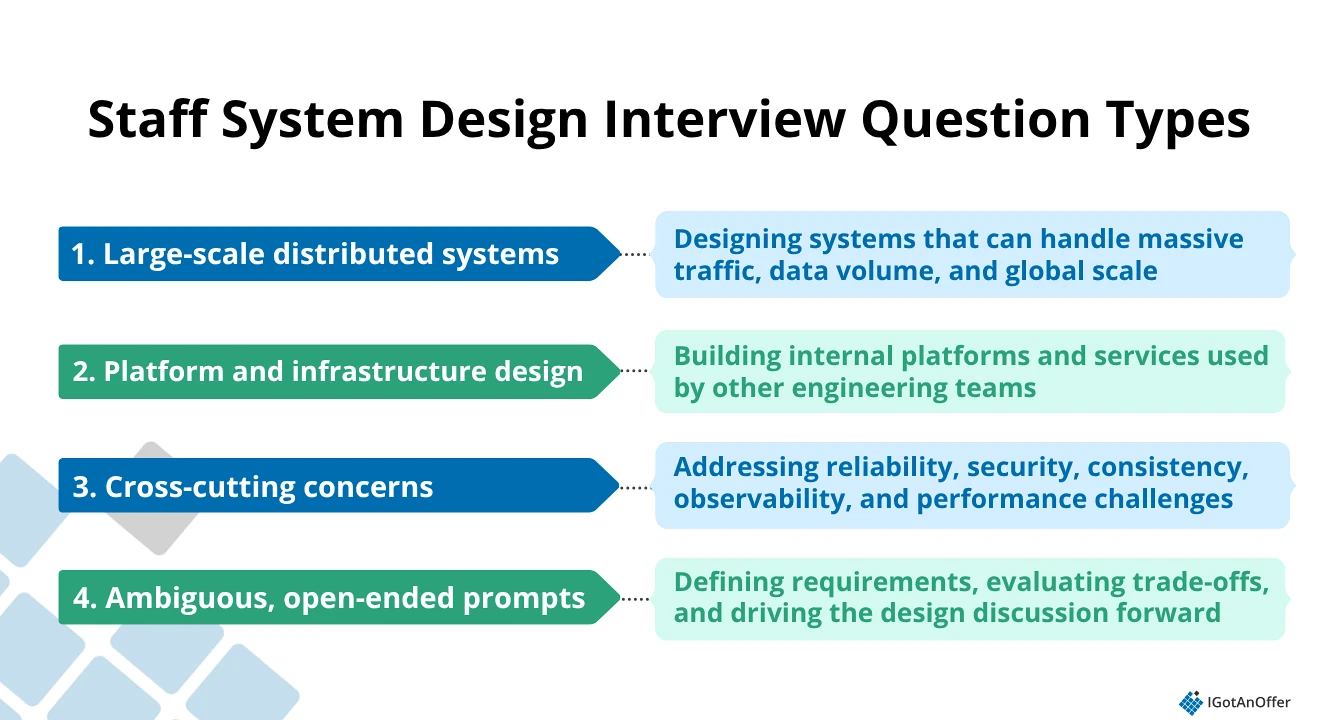
2.1 Large-scale distributed systems
Designing large-scale distributed systems is one of the most common topics in staff system design interviews. Interviewers want to see how you design systems that can operate reliably at a massive scale while balancing performance, consistency, and operational complexity.
Example questions:
- Design a rate limiter
- Design a notification system
- Design a URL shortener at massive scale
- Design a global CDN
2.2 Platform and infrastructure design
At the staff level, you'll often be asked to design systems used internally by other engineers. Interviewers want to see whether you can build solutions that are reliable, maintainable, and easy for teams to adopt and operate.
Example questions:
- Design a feature flag system
- Design an event streaming platform
- Design an internal API gateway
- Design a deployment pipeline
2.3 Cross-cutting concerns
Rather than designing an entire system, some interviewers prefer to zoom in on a specific technical challenge. Here, you'll be evaluated on how deeply you understand topics such as consistency, reliability, security, observability, or performance.
Example questions:
- How would you handle data consistency across services?
- Design a system where strong consistency is required at a global scale
- How would you improve observability in a distributed system?
- How would you design for high availability during regional outages?
2.4 Ambiguous, open-ended prompts
These questions intentionally leave requirements undefined. Staff candidates are expected to identify missing requirements, define the problem space, and drive the conversation forward rather than waiting for the interviewer to provide direction.
Example questions:
- Design Instagram Stories
- Design a recommendation system
- Design a ride-sharing platform
- Design a collaborative document editor
3. Examples of staff system design questions (by company)↑
Now, let’s get into the complete list of system design interview questions asked in real tech interviews across staff engineering roles, according to data from Glassdoor.
The questions below are organized by company to help you find the most relevant ones for your interviews.
Google staff system design interview questions
- Design YouTube (ByteByteGo written solution)
- Design a distributed cache (written solution from Ravi Tandon)
- Design Google Maps (video solution from codeKarl)
- Design a news front page with source aggregation across newspapers
- Design Google Photos
- Design an online booking system for a restaurant
- Design an autocomplete feature with an efficient data structure
- Design a ticketing platform
- Design an elevator
- Design a Boggle solver
- How would you design a system for a robot to learn the layout of a room and traverse it?
- How would you deploy a solution for cloud computing to build in redundancy for the compute cluster?
Check out our Google system design interview guide for more questions and Google-specific insights.
Meta staff system design interview questions
- How would you design Instagram? (Download answer diagram)
- How would you design Twitter/X.com? (video solution)
- How would you design a chat system like WhatsApp? (ByteByteGo written solution)
- Design a live commenting system for posts
- Design Facebook status search
- How would you design an autocomplete service for a search engine?
- Design a travel booking system for Facebook users
- Design Instagram Stories
- How would you build Minesweeper?
- Design a system to prevent ads from foreign actors from interfering in domestic politics
- Design a distributed botnet
- Design a video upload and sharing app
- Design the API layer for Facebook chat
- How would you use a load balancer for memcache servers?
- How would you architect the Facebook newsfeed?
- Implement a typeahead feature
Check out our Meta system design interview questions for more questions and Meta-specific insights.
Amazon staff system design interview questions
- Design Snake / Chess / Tic-Tac-Toe / Poker / Boggle
- Design a parking lot
- Design a TinyURL service
- Design an API that would take and organize order events from a web store
- Design an elevator
- How would you design an electronic voting system?
- Design a deck of cards
- Design a system to optimally fill a truck
- Design a warehouse system for Amazon
- Design an online poker game
- Design a parking payment system
- Design a system to interview candidates
- Design a search engine autocomplete
- Design an airport
- Design the Prime Video home page
- Design a registration system for a restaurant
- Design a food delivery app at a global scale
- Design an inventory system
- Design a news website
- Design a shopping cart system
- Design a system to find friends on social media
- Design a Swiggy delivery system with a focus on optimizing for the shortest route
- Design a temperature identification system with geographically distributed sensors
- Design a ticketing system
- How would you design a system that reads book reviews from other sources and displays them on your online bookstore?
- Design a promotion mechanism which could give 10% cash back on a particular credit card
- How would you build software behind an Amazon pickup location with lockers?
- Design a distributed cache system (video solution)
Check out our Amazon system design interview guide for more questions and Amazon-specific insights.
OpenAI staff system design interview questions
- How would you build an LLM-powered enterprise search system?
- Design an in-memory database
- Design a webhook system.
- How would you design a scalable and efficient system for training a large language model (LLM), considering both computational and data constraints?
- You’re provided with a simple UI for user preferences. Design the server-side system behind it, including API endpoints, data models, and considerations around scalability and reliability.
- How would you design an AI chatbot?
- Design a fault-tolerant, polite web crawling service that can scale to 10M requests per second.
Check out our OpenAI system design interview guide for more questions and OpenAI-specific insights.
Microsoft staff system design interview questions
- How does buffer overflow work?
- How would you design an online portal to sell products?
- Design a new fitness wearable to measure heart rate
- Design a shopping cart
Check out our guide on Microsoft software engineer interviews for more examples.
Uber staff system design interview questions
- Design a heat map for Uber drivers
- Design a system to match rider and driver
- Design TripAdvisor (written answer)
- Design Google Photos (video answer front-end)
- Design YouTube feed with API
- Design a search engine (video answer)
Check out our guide to Uber engineering manager interviews for more company-specific insights and information.
Apple staff system design interview questions
- Design a smart elevator system that optimizes travel efficiency by grouping similar destination requests, prioritizes accessibility needs, incorporates real-time adjustments based on user input, and ensures energy-efficient operations through idle movement minimization.
- Build a blackjack gaming site
- Build Netflix (written answer)
Check out our guide to Apple engineering manager interviews for more company-specific insights and information.
NVIDIA staff system design interview questions
- How would you design a chatbot service that provides users with a variety of information?
- How would you perform API modeling while managing multiple servers?
- Create a memory management system that allocates fixed-size blocks in a constrained environment with limited memory. Avoid using malloc, free, new, or delete; instead, rely on a 'memory' function for both managing memory and allocating space for clients.
- How would you design a memory allocator?
- How would you design an interface for managing and running jobs on various GPUs?
- Here is our system (description provided). How would you design it?
- How would you design a platform like Facebook or Uber?
- How would you design a proximity server?
- How would you design a shared file system that stores files in the cloud?
Check out our guide to NVIDIA software engineer interviews for more questions and NVIDIA-specific insights.
Anthropic staff system design interview questions
- Design the Claude chat service.
- Design a distributed search system for 1 billion documents at 1 million QPS. Cover sharding, caching, and LLM inference scaling.
- Design a batched inference system where 100 requests take the same time as 1. Use a queue to batch requests.
- Design a system that enables a large language model to handle multiple questions in a single thread.
- Design APIs for developers to access Anthropic's AI models securely and efficiently.
- Design a file-sharing / distribution system.
- Design a high-concurrency inference API / parallel processing pipeline
Check out our guide to Anthropic system design interviews for more company-specific information.
4. How to answer staff-level system design questions (framework, cheat sheet)↑
To help you approach system design interviews more systematically, we've included both a proven answer framework and a practical cheat sheet.
4.1 FAANG-level answer framework for any system design interview question
When answering a system design interview question, you’ll want to showcase your creativity but in a structured way. To achieve this, you should practice using a repeatable framework. Below is a quick overview of our recommended 4-step approach.
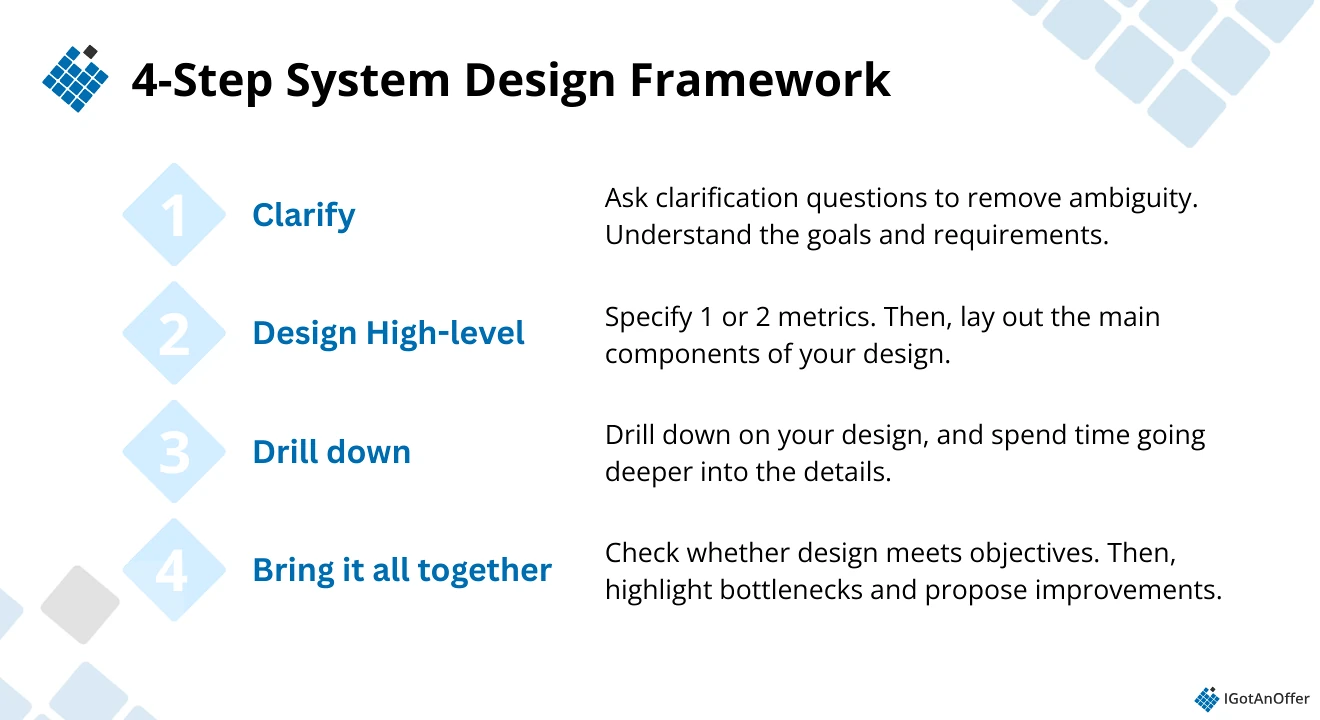
Here is a more detailed walk-through of this answer structure from Ramprasad (ex-Meta engineer and interview coach), including insights and crucial information to cover for each step:
4-Step System Design Answer Framework: Walk-through
System design interview questions are meant to be vague. It appears like they're trying to ask you to boil an ocean when they ask you a question like “Design Twitter” or “Design YouTube.” It’s a whole company; how can one engineer design that?
Think of it this way: the interviewer's responsibility is to give you a question that’s very vague and complicated, while your responsibility as a candidate is to make sure that it is as simplified as possible.
Step 1: Clarifying requirements
So now, how do you simplify the problem? That is the first skill interviewers try to evaluate in a system design interview.
When an interviewer asks you to design a calendar, what do they mean by a calendar? How big of an organization? If it's for a small organization, do you need to worry about each other's calendars or about meeting rooms? It’s how you break down the problem. This is where you say you are “clarifying or simplifying the requirements.”
What does “simplifying the requirements” mean? For any software product, you need to collect information from wherever the sources are, and you need to give it back to the people who are asking for it. In more methodical terms, they call it defining your functional requirements and non-functional requirements.
Depending on your level, I would expect you to come up with these requirements intuitively. As a junior engineer, you might stop at functional requirements. As a staff-plus engineer, fun non-functional requirements are very critical. Interviewers want to know how many you can think of on your own.
So, how do you know whether you got everything right or wrong? You would never know. Because that is not the intention. System design interviews are meant to grade people on a scaling level.
Don't worry about whether you’ve completely defined your functional and non-functional requirements. Getting an agreement on it will help. List down your requirements and confirm them with your interviewers. Or, ask for a direct hint, like, “What are your most important requirements?”
Step 2: High-level design
Next is the high-level design. High-level design for 90% of the products will be the same:
- Client-side, which gives you the information
- Server-side, which collects the information
- Storage layer, which stores the information
Think about your write path and your read paths. Now use your non-functional requirements: at what cadence it is coming through at high frequency, and how much distribution is coming through will determine what kind of storage layer you pick.
Step 3: Drill down on your design (low-level design)
This is the point you ask your interviewer: Is there a particular area you want me to discuss further? That's where you drill down into your low-level design and let your expertise come into play.
If you are applying for a data-focused role, focus on the storage layer. For a backend-focused role, you could discuss transactions per second. For a front-end-focused role, maybe talk about client-side handling. For an ML-focused role, your ranking algorithm, how that's going to be, and how adaptable it should be.
Step 4: Bring it all together
In the last few minutes of your interview, you’ll then want to check whether you’ve met the goals of the design, i.e., the functional and non-functional requirements.
If you have time, you can go into possible bottlenecks or issues, or ways to optimize or scale the system.
Now that you’ve seen how the answer framework can help you structure your solution, let’s take a look at more example questions and answer outlines from the system design coaches on our platform.
Want to see this framework in action? Check out our system design interview prep guide, which includes sample answers to some of the most common system design interview questions.
4.2 System design interview cheat sheet
As we’ve established, your first responsibility during a system design interview is to simplify the problem by clarifying and getting confirmation on the requirements of the design challenge.
To make sure you start on the right track, you need to know the details you need to capture. You’d also want your assumptions and estimations to be realistic enough.
To help you make sure you cover the right information in your answer, check out the system design interview cheatsheet below prepared by coach Mark (ex-Google EM).
Click here to download the system design interview cheatsheet.
5. Staff system design interview tips↑
For this section, we’ve gathered tips from three of our system design interview coaches, Mark, Marvin, and Tarek. Collectively, they’ve conducted hundreds of interviews, both actual and mocks, at Google and Amazon. Here are their tips, based on what they’ve seen on the ground:
5.1 Communicate efficiently
45 minutes is an artificially compressed time, so you need to practice communicating with the interviewer efficiently. What you don’t want is for your interviewer to wonder about what you’re working on.
“What you need to do is keep your mental model of what you’re thinking and their mental model as closely aligned as possible,” Mark says.
Your task is not to get your interviewer to agree with you on everything. Instead, you have to make sure they can follow your thought process.
This won’t come naturally, but you can get used to it with practice.
5.2 Scope the problem
In ~45mins, designing a large-scale system like Spotify is impossible. Mark’s tip is to “scope the problem to a size that you think you can complete during the interview.”
Start by clarifying the requirements with your interviewer and making clear assumptions if details are vague.
Focus on a specific, crucial part of the system, such as the backend architecture or a particular feature (e.g., if you were designing Spotify, this might be the music recommendation engine). Be ready to adjust your scope based on the interviewer's feedback.
5.3 Start drawing ~15mins in
Drawing is an important visual aid to help the interviewer understand your answer. Try to start drawing around a third of the way into the interview.
This timeframe is important to consider. Start drawing too soon, and you might go down a road that doesn’t address the problem. Start too late, say 20 or 30 minutes in, and you may run out of time to finish drawing.
5.4 Start with a simple design
Marvin says that candidates often make the mistake of designing for an unrealistic scale without grounding in problem constraints, and not prioritizing or evolving the design incrementally.
To avoid this, Mark’s advice is to get to a working solution first, then iterate. Don't get sidetracked and add requirements that didn't exist in the question. These will complicate your design. You can always mention something and come back to it later.
5.5 Properly understand the problem
“It’s very tempting for us engineers to hear somebody describe a problem and immediately go into solutions mode,” Mark says. This is natural, as this is what engineers have been trained to do.
However, this prevents you from truly understanding the problem and might even prevent you from catching some wrong assumptions.
So his tip is to imagine you're calling your own APIs and think about specific use cases. This will help you ensure you really understand what the problem is and what the objective is. It can help you catch assumptions you’ll likely make in your instant solution mode.
This will also help you avoid the mistake of glossing over trade-offs, failure scenarios, or state consistency, which is another common mistake Marvin has observed.
5.6 Practice, practice, practice!
There is a knowing and doing gap with system design interviews. Learning the theory and reading prep guides is great, but you need to practice out loud with friends or experts, or at least record yourself and watch yourself back.
Another benefit to practicing that Mark has observed in his clients is increased confidence and lessened stress.
If you do some mock interviews, which are hugely helpful, ideally allow time for a long feedback and conversation afterward.
5.7 Explain your thinking
Give your reasons as to why you're making each choice you do. Why did you choose one particular technology over another one?
As an interviewer himself, Mark says that he wants to understand what's behind a candidate’s thinking in order to assess their level of technical judgment.
“Not only do you understand why you're making a choice and the different aspects of different technology choices, but you're also communicating it to me in a way that I can understand.”
5.8 Get comfortable with the math
For FAANG companies, scale is important in system design interviews. That means you're going to have to do some back-of-the-envelope calculations early on in your design. Get used to calculating queries per second and the storage capacity needed.
5.9 Use the drawing tool efficiently
Your drawing is a visual aid; it doesn't need to look pretty, but you do need to be able to create boxes, shapes, and arrows quickly without having to think much about it.
Try to find out which tool the company you're interviewing with will want you to use and make sure you're comfortable using it.
5.10 Utilize a range of prep resources
There are some great resources out there, so make sure you use them, ideally both written and video content. There will be some differences of opinion, as there is not one catch-all "recipe" for successful system design interviews, that's normal.
For even more tips to impress your interviewer, check out this video with Mark (ex-Google EM).
5.11 Avoid common staff system design mistakes
During staff system design interviews, interviewers are also on the lookout for possible red flags. These are some examples Tarek (ex-Amazon EM) cites:
- Jumping straight to the solution. This is a big no-no. Strong staff candidates anchor themselves first by taking time to understand requirements, constraints, and success metrics before discussing architecture or technologies.
- Using surface-level tradeoff language. Interviewers want to understand how you think. Don't simply say, "We could use SQL or NoSQL." Explain which requirements matter most and why they lead you toward a particular solution.
- Over-engineering the design. Candidates sometimes design for massive scale from the start rather than the actual business need. Focus on a simple solution first, then explain how it could evolve as requirements grow.
- Waiting to be guided by the interviewer. If the interviewer has to repeatedly ask about scaling, tradeoffs, or failure scenarios, you are likely operating at a senior rather than staff level. Strong candidates proactively address these topics before they are prompted.
- Treating the interview like a presentation. Spending 20 minutes talking without checking in shows weak collaboration skills. At the staff level, interviewers expect you to treat them like a stakeholder by regularly checking for alignment and adjusting the discussion based on their feedback.
6. How to prepare for staff system design interviews↑
As you can see from the complex questions above, there is a lot of ground to cover when it comes to system design interview preparation. So it’s best to take a systematic approach to make the most of your practice time.
Below, you’ll find a prep plan with links to free resources.
6.1 Learn the concepts
There is a base level of knowledge required to be able to speak intelligently about system design. You don't need to know EVERYTHING about sharding, load balancing, queues, etc.
However, you will need to understand the high-level function of typical system components.
You'll also want to know how these components relate to each other, and any relevant industry standards or major tradeoffs.
To help you get the foundational knowledge you need, take a look at our 9-part deep dive on system design concepts. Click on the topic to go directly to the article you need.
- Network protocols and proxies
- Databases
- Latency, throughput, and availability
- Load balancing
- Leader election algorithms
- Caching
- Sharding
- Polling, SSE, and WebSockets
- Queues and pub-sub
6.2 Learn an answer framework
As we covered in Section 4, we recommend using an answer framework to structure your answer. Learn more about our recommended framework in our guide on how to answer system design questions.
Make sure to apply this framework (or any framework that works for you) when practicing. Use it on different types of questions in a variety of subjects, so that you learn how to adapt it to different situations and respond to unpredictable questions on the fly.
6.3 Know your target company
If you already have a system design interview scheduled at a specific company, take the time to familiarize yourself with how its entire interview process works.
You also want to know if they have specific requirements for their system design interviews in particular. For example:
- Google system design interviewers prefer that candidates refrain from using specific products (e.g. certain databases, load balancers, etc.). Instead, they require candidates to build from scratch. This is to make sure they know how these components work, rather than resorting to a product that takes care of certain aspects like sharding.
- Meta, on the other hand, might give you the option to choose between a system design and product architecture/design interview. Meta system design interviews are focused on large-scale distributed systems, while product design is for user-facing products, i.e., APIs, data modeling, etc.
Also, include in your research your target company’s engineering challenges. The official company websites of most FAANG companies will typically have a dedicated engineering blog, like Uber and Meta.
To get started with your research, check out our interview guides for engineering roles at some of the world’s top companies.
- Meta software engineer interview guide
- Meta embedded software engineer interview guide
- Meta engineering manager interview guide
- Meta technical program manager interview guide
- Google software engineer interview guide
- Google engineering manager interview guide
- Google technical program manager interview guide
- Google site reliability engineer interview guide
- Amazon software development engineer interview guide
- Amazon software development manager interview guide
- Amazon technical program manager interview guide
- Microsoft software engineer interview guide
- Microsoft engineering manager interview guide
- LinkedIn software engineer interview guide
- Airbnb software engineer interview guide
- Uber engineering manager interview guide
- NVIDIA software engineer interview guide
- NVIDIA site reliability engineer interview guide
- DoorDash engineering manager interview guide
- Netflix engineering manager interview guide
- Apple engineering manager interview guide
- Apple technical program manager interview guide
- Anthropic software engineer interview guide
- OpenAI software engineer interview guide
- Anthropic engineering manager interview guide
- Stripe engineering manager interview guide
You can also read our company and role-specific system design interview guides:
- Amazon system design interview
- Google system design interview
- Meta system design interview
- OpenAI system design interview
- Anthropic system design interview
- System design interview questions for product managers
- System design interview questions for data engineers
If you're targeting AI labs or AI/ML-focused organizations, check out these guides as well:
6.4 Practice answering questions
After learning the concepts and watching mock interview videos, it’s time to practice answering system design questions.
Start with the question list in this article and the framework we’ve recommended to help you structure your answers.
To help you make sure you cover the right information in your answer, coach Mark (ex-Google EM) has kindly prepared a system design interview cheatsheet for your quick reference.
Click here to download the system design interview cheatsheet.
6.4.1 Practice by yourself
A great way to start practicing is to interview yourself out loud. This may sound strange, but it will significantly improve the way you communicate your answers during an interview.
Use a piece of paper and a pen to simulate a whiteboard session, or use a whiteboard if you have one. There are also online whiteboarding tools like Excalidraw, Visual Paradigm, or Sketchboard.me, which are particularly useful for practicing for virtual interviews.
Play the role of both the candidate and the interviewer, asking questions and answering them, just like two people would in an interview. Trust us, it works.
6.4.2 Practice with peers
Once you've done some individual practice, we strongly recommend that you practice with someone else interviewing you.
If you have friends or peers who can do mock interviews with you, that's an option worth trying. It’s free, but be warned, you may come up against the following problems:
- It’s hard to know if the feedback you get is accurate
- They’re unlikely to have insider knowledge of interviews at your target company
- On peer platforms, people often waste your time by not showing up
For those reasons, many candidates skip peer mock interviews and go straight to mock interviews with an expert.
6.5 Practice with experienced system design interviewers
In our experience, practicing real interviews with experts who can give you company-specific feedback makes a huge difference.
Find a system design interview coach so you can:
- Test yourself under real interview conditions
- Get accurate feedback from a real expert
- Build your confidence
- Get company-specific insights
- Save time by focusing your preparation
Landing a job at a big tech company often results in a $50,000 per year or more increase in total compensation. In our experience, three or four coaching sessions worth ~$500 make a significant difference in your ability to land the job. That’s an ROI of 100x
Click here to book system design mock interviews with experienced system design interviewers.