


 Back to other articles



 Last updated: June 30, 2026
 Interviews
 Staff software engineer
 Deeply researched
Staff software engineer roles are rare, so competition is tight. If you manage to score an interview, you can’t coast on your impressive resume alone. You need to show concrete evidence of your experience, skills, and area of expertise, all within the constraints of the interview. That can be tough without thorough preparation.
If, like most senior to staff-level engineers, you haven’t interviewed in some time, getting back into the groove of interviewing will take some work. That’s why we’ve created this guide. It contains everything you need to know to prepare strategically: real reported questions asked at staff software engineer interviews, expert insights from tech interviewers, and a step-by-step prep plan.
- Staff software engineer example interview questions
- What you need to know about the staff software engineer role
- Preparation plan
Click here to book a 1-on-1 session with a software engineer interview expert.
Let’s get started!
1. Staff software engineer example interview questions
As a staff software engineer candidate, you can expect the following types of questions at your interview:
As you may have noticed, they’re not that different from the types of questions at a standard SWE interview. The difference lies in the signals interviewers will be looking for in each round, which we’ll cover in detail below.
Below we’ve listed some example questions we’ve found from our research on Glassdoor, Reddit, and elsewhere. We've categorized the questions and changed the grammar and phrasing in some places to make the questions easier to understand.
1.1 Coding↑
As a staff software engineer, you generally won’t be expected to code in your day-to-day. Nevertheless, you’ll still face at least one coding interview at the full loop stage where you'll need to demonstrate expert coding ability.
Here are the signals interviewers are on the lookout for during a staff SWE coding interview, according to Parag (Meta Director of Engineering):
- End-to-end coding solution. The solution doesn’t need to be the most optimal for the problem, but it has to be end-to-end.
- Readable code. Your code needs to follow best coding practices.
- Unit test. You may not have enough time to write a unit test, but you should proactively walk your code verbally through a few test cases.
Along with demonstrating coding expertise, it's essential that you're able to have a discussion with the interviewer as you go. They'll be evaluating your problem-solving skills, and they need to understand your thought process. Proactive communication is vital here.
The kind of coding questions you’ll get depends on your target company’s practice. For instance, Meta and Google are known for giving medium LeetCode-style DSA questions, while others may give practical coding challenges or a mix of DSA and low-level design (LLD) questions.
Below are some examples of coding questions recently asked at staff software engineer interviews.
Staff software engineer example coding questions
- Implement a function that multiplies a pixel color by RGB percentages (Solution)
- Given the root of a binary tree, return the level order traversal of its nodes' values. (i.e., from left to right, level by level). (Solution)
- Given an array of intervals where intervals[i] = [starti, endi], merge all overlapping intervals, and return an array of the non-overlapping intervals that cover all the intervals in the input. (Solution)
- Find the size of the largest univalue subgraph of a binary tree. (Solution)
- Design an algorithm to sort a dataset that was too large to fit in the RAM of any one server. (Solution)
- Implement a re-entrant lock from just a lock
- Sort a string based on custom sorting
- Get the k-th smallest element give list of sorted arrays (Solution)
- Lowest Common Ancestor of two nodes in a tree given you have the parent pointer.
- Random pick with weight (Solution)
- Leetcode Medium about string palindromes
- Leetcode Medium involving prefix sums and 2D arrays.
- Merge 3 sorted arrays (similar to this)
- Implement pow(x, n), which calculates x raised to the power n (i.e., xn) (Solution)
- Digit subtraction (minus 1) given an input array
- Simplify intervals (express consecutive intervals as a string expression given an array of integers)
- A variation of palindrome question
- String-shifted-groups question
- A variation of K largest (Solution)
- A variation of Maximal Spanning Tree (Solution)
Get more practice questions and best coding interview practices in our ultimate coding interview prep guide.
1.2 System design↑
System design interviews are considered the most crucial part of any staff-level software engineer interview, alongside behavioral interviews. How you perform in both rounds generally influences which level you’ll be considered for.
As a staff-level engineering candidate, expect at least 2 system design rounds in the full loop.
The goal of the interview is to test how well you design scalable, maintainable systems that can function in a massive, fast-paced environment. Building a technically sound solution is key, but according to Tarek (ex-Amazon engineering manager), interviewers are equally interested in your communication skills, time and scope management, problem-solving abilities, and ability to deal with ambiguity.
Within a system design interview, you’ll get the following types of questions testing your proficiency.
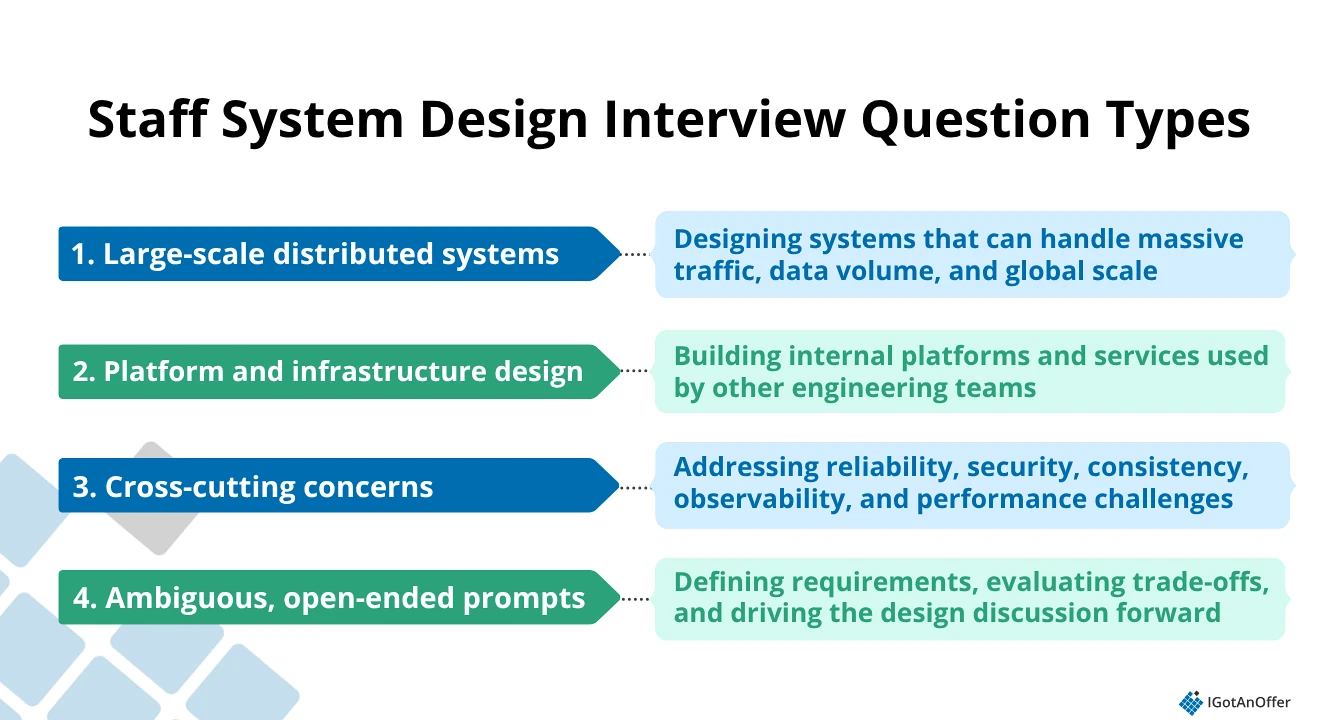
Here’s a breakdown of the signals interviewers look for in a staff SWE system design interview, according to Parag:
- End-to-end design solution. This includes measurable metrics, realistic requirements, and fully explained and interconnected components.
- Deep-dive in 1-2 sub-areas. For example, for ML system design, you could deep dive into the "modeling" sub-area. For general system design, you could talk about distributed queue and dispatch services.
- Proactively provide trade-offs. Only do this for the important choices in the design
- Proactively surface failure modes. Not doing so could show you’re not ready for the staff level.
How you conduct your system design interview matters. At the senior and staff level, Geoff (ex-Google Sr. engineering manager) says you’re required to demonstrate leadership skills during this round. You can achieve this by driving the conversation, coming up with great questions to bound and clarify the problem, and treating your interviewer as a thought partner.
“Candidates fail if they make too many assumptions (even if they are right) without asking enough questions and relegating the interviewer to the role of a notetaker,” Geoff says.
Here are a few real system design prompts from staff software engineer interviews.
Staff software engineer example system design questions
- Design a monitoring system
- Design Google Docs
- Design a ticket reservation system.
- Design a system that solves a problem in your domain, but not at web scale.
- Design the Facebook post privacy functionality.
- Design a translation system for Meta apps.
- Design an auction system like eBay.
- Design a logger system for a pool of apps.
- How would you design a service like Instagram? Both from a product perspective, and from a system design perspective.
Check out our guide to the staff system design interview to learn the best way to approach the interview at your target level. To brush up even further, read the guide relevant to your track: system design interview, ML system design interview, and genAI system design interview.
1.3 Behavioral and leadership ↑
Interviewers use behavioral interviews to assess you based on your past professional experiences. These questions typically start with “Tell me about a time you…”
Expect to be vigorously tested during your behavioral interviews if you’re interviewing for a staff-level role. Aside from culture fit, Geoff (ex-Google Senior EM) says interviewers expect staff engineers to demonstrate the following:
- High EQ (active listening, empathy, transparency, authenticity, vulnerability, etc.)
- Ability to see "more" than just the current challenge in front of them
- Great mentoring/coaching skills regardless of role
- Superb conflict resolution skills
- Great prioritization skills
- Business-critical thinking skills (depending on the role)
Interviewers also want to see whether you have a growth mindset and are open to feedback.
Some stories that will help you demonstrate these qualities are stories of failure (own the failure and show how you’ve learned from it), receiving and addressing feedback, and resolving conflict or driving cross-functional/team alignment without escalating to leadership.
The best way to get your story across without meandering is to find a structure that helps you cover all your bases. The STAR framework is the most popular one, but we recommend IGotAnOffer’s own SPSIL (Situation, Problem, Solution, Impact, Lesson) framework. We believe it works better as it reminds you to talk about what you’ve learned, which is crucial for demonstrating a growth mindset.
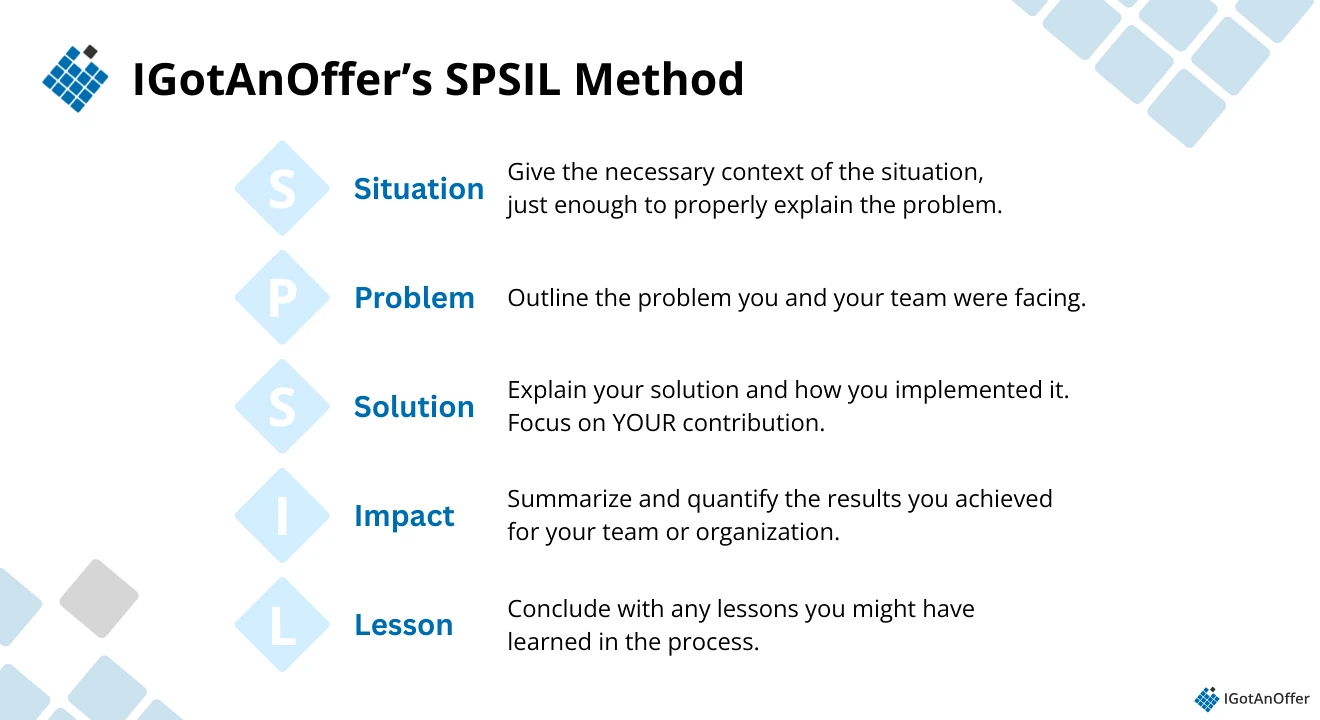
Let’s take a look at some example behavioral questions.
Staff software engineer example behavioral questions
- Describe a situation where you had a tense relationship with somebody you were working with.
- Tell me about the time you experienced a conflict in a project and how it was resolved
- How do you deal with anxiety?
- Tell me about an accomplishment you're really proud of, how you drove it, and what the impact was
- Tell me about a time you failed.
- Share an example where you disagree with your manager's decision.
- Tell me about a time you made a mistake at your job.
Check out our behavioral interview guide to get more practice questions and how to structure your answers using the above-mentioned SPSIL framework.
1.4 Retrospective↑
In some instances, you’ll get retrospective questions at your system design or behavioral interviews. In other cases, it’s a separate round. To be sure, clarify this with your recruiter.
At a system design interview, instead of being asked to design a solution from scratch, you might get asked about a system design you worked on. At a behavioral interview, you could be expected to deep dive into any recent technical project.
Keep in mind that at the staff level, you'll want to pick a project that had a significant scope and impact. The expectation is that the candidate will have a deep and broad knowledge of the project, says Geoff (ex-Google Sr. EM). "You should be able to explain trade-offs, alternatives, and consequences, and demonstrate high EQ by discussing mistakes made, what was learned, how they were mitigated, and what success resulted."
Be ready to talk about not just technical details but also how you worked cross-functionally and got different stakeholders on board.
Most candidates fail the project deep dive/retrospective by spending way too much time introducing the project. Geoff recommends spending a maximum of 3 minutes on the background/intro, and jumping right into the scalability challenges. "Leave enough time for the interviewer to ask questions (they will interrupt) and dive deep, challenging decisions, and watching how a candidate reacts," he says.
Staff software engineer example technical retrospective questions
- Describe a project where you worked across the organization/company and collaborated with other teams.
- What was your role in the project?
- Did you do any technical planning or product roadmapping for it?
- How did you measure the success of your project?
- How did you handle any personal or team conflicts that arose?
Coaches who contributed to this guide
















2. What you need to know about the staff software engineer role↑
Now that you’ve seen the most common types of questions you can expect at a staff SWE interview, you might want to learn more about the role.
In this section, we’ll look at the most important aspects of the role: what a staff SWE does, how much the role pays, what interviewers look for in a staff SWE candidate, and the level of AI fluency expected.
Let’s get into it.
2.1 What does a staff SWE do?
As a staff software engineer, your main responsibility can be summed up as that of being an enabler, i.e., someone who elevates team performance exponentially.
According to Rohan (ex-Meta senior SWE), "This is the level at which your impact becomes less about your individual contributions and more about what you can enable."
Albert (ex-Google software engineer) breaks down what the staff SWE (L6) role entails at Google, which may work similarly at most tech companies:
- Where the EM (engineering manager) track and IC (individual contributor) track split
- Expected to own extremely large and complex projects
- Have impact on their own team and all sister teams
- Expected to work as a multiplier, accelerating the other engineers on their team
2.2 How much does a staff SWE earn?
According to Levels.fyi data, here’s what a staff SWE (L6 or equivalent) earns at the top companies (FAANG, other Big Tech, and top AI labs):
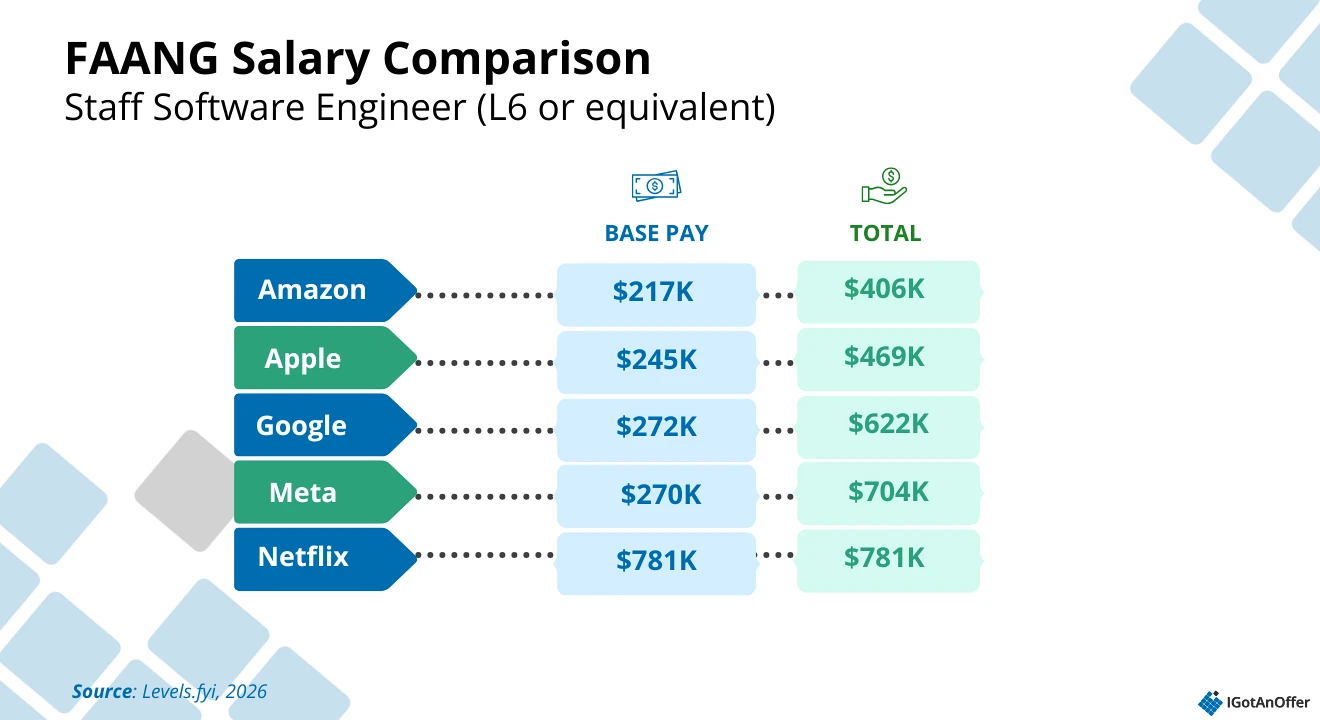
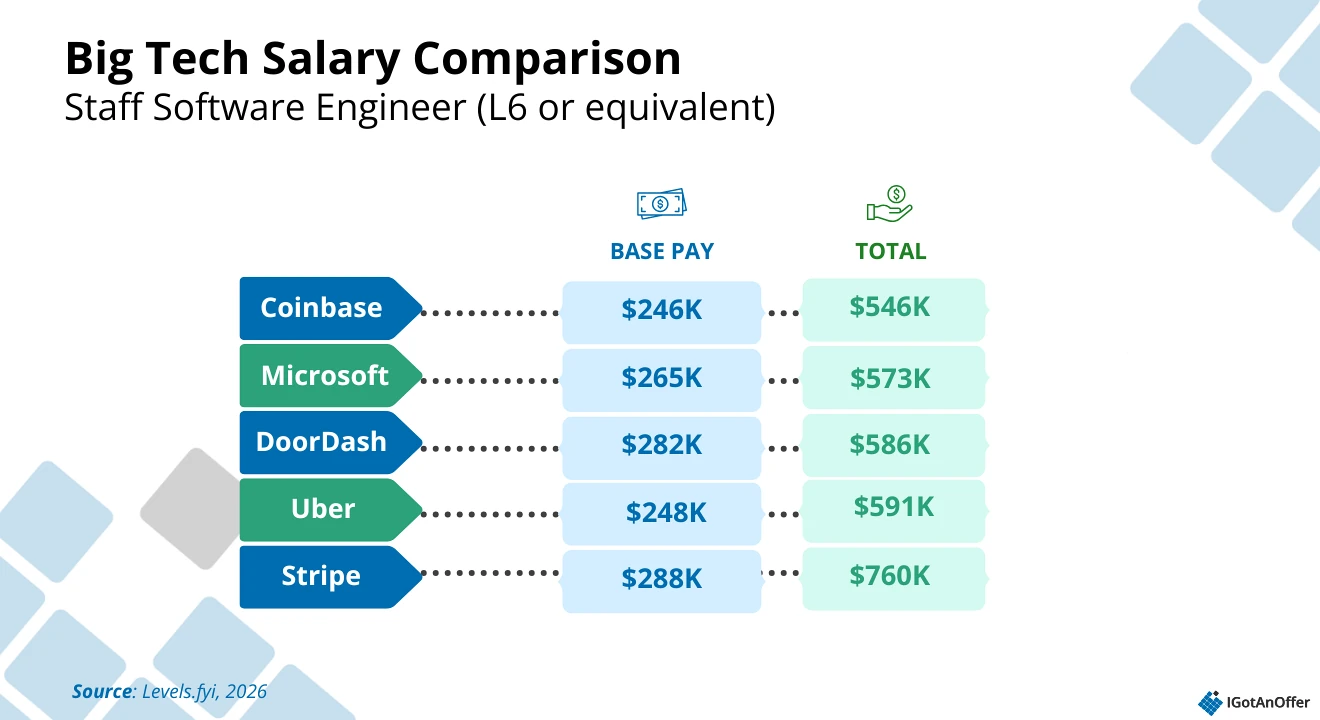
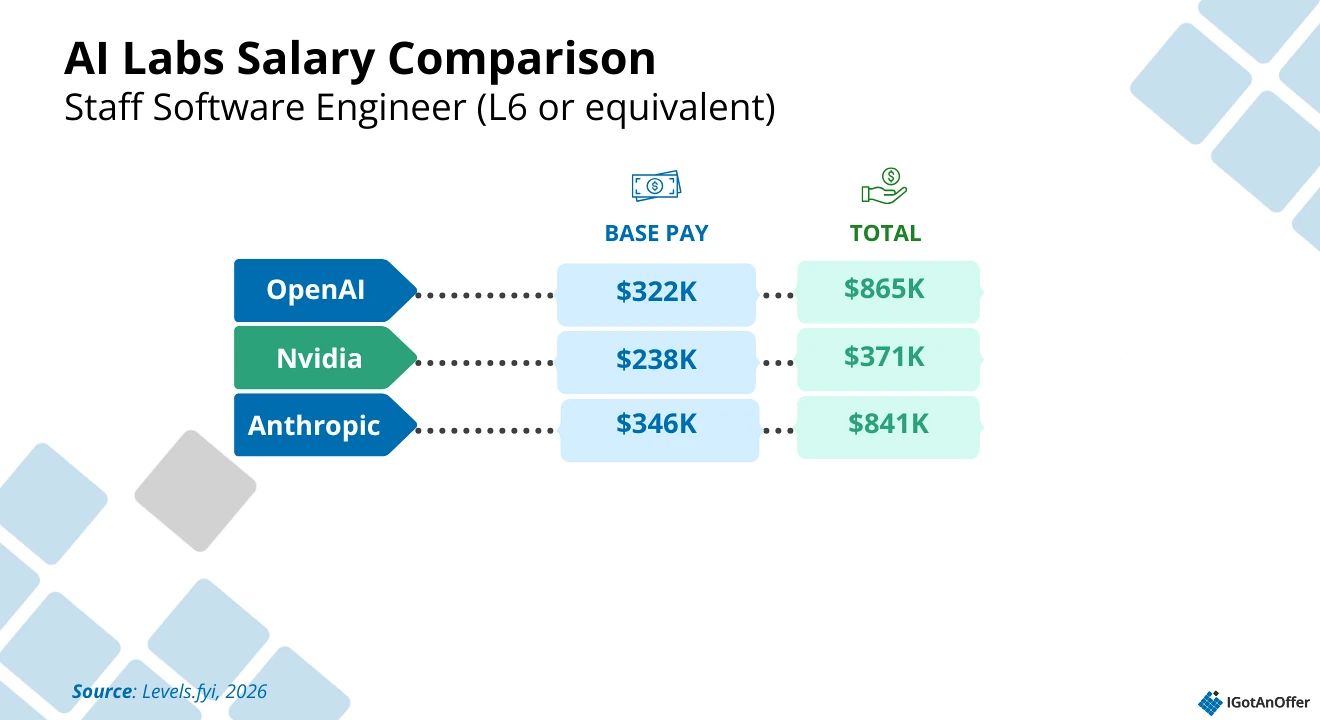
Ultimately, how you do in your interviews will help determine what you’ll be offered. That’s why hiring one of our software engineer interview coaches can provide such a significant return on investment.
And remember, if you’re applying to FAANG or any Big Tech company, there’s a big chance your compensation package is negotiable. So, if you do get an offer, don’t be afraid to ask for more. If you need help negotiating, consider booking one of our salary negotiation coaches to get expert advice.
2.3 What do interviewers look for in a staff engineer?
What interviewers look for in a staff software engineer can be broken down into three dimensions: leadership, execution, and craftsmanship. Parag (Meta Director of Engineering) breaks down each dimension below:
- Leadership. Interviewers want to see how you work with cross-functional partners to unlock new products, capabilities, or improvements. They also want to know if you have the ability to technically align or influence external teams; and whether you have experience in upleveling teams or junior ICs (individual contributors).
- Execution. When testing your execution skills, interviewers are looking at your ability to deliver on goals and evangelize the adoption of certain platforms to increase leverage.
- Craftsmanship. Interviewers want to know whether you have a high level of operational rigor. This means having the ability to minimize operation issues, SEVs, etc. They also want to see if you’re at the forefront of driving innovation that leads to sustained goal delivery, and driving the adoption of the right coding/modeling practices within and outside of your team.
2.4 What level of AI fluency does a Staff SWE need to demonstrate?
Parag says top companies these days usually have an ML track and a separate general track for SWEs. The level of AI fluency differs accordingly.
As a staff SWE candidate on the ML track, you should be able to:
- Design an ML solution to a problem
- Come up with multiple ways to source labelled data for training models
- Show awareness of sequential modeling techniques and attention mechanisms
- Suggest the right evaluation schemes and identify and provide mitigation to common ML failure modes (eg, cold-start, class-imbalance)
If you’re on the general track, you’re expected to:
- Have the ability to identify how the usage of LLMs/agents can help them build solid systems
- Be familiar with how agents interact with tools, the memory layer, and the file system.
- Be familiar with the various failure modes of an agentic system (infinite loops, context bloat, mid-workflow error handling).
3. How to prepare for a staff software engineer interview↑
Now that you know more about the role and the interview process for the staff software engineer role, let’s get into how you can prepare.
It’s no secret that the interview process for the role is tough, and the bar is quite high, especially at top tech companies. Having an impressive resume is not enough; you need to be able to translate your skills and experience in each interview round to stand out.
We've coached more than 22,000 people for interviews since 2018. Below is our four-step prep plan for the staff software engineer interview.
3.1 Know the interview process
When you get an interview for a staff software engineer role, you’ll still be evaluated on your fundamentals. Therefore, expect to undergo the same standard SWE interview process.
The best way to prepare for the staff software engineer interview process is to familiarize yourself with how it works at your target company.
Below, we have a list of our company-specific interview guides, where we walk you through everything you need to know to prepare.
- Meta software engineer interview guide
- Meta E6 engineer interview guide
- Meta embedded software engineer interview guide
- Google software engineer interview guide
- Amazon software development engineer interview guide
- Microsoft software engineer interview guide
- LinkedIn software engineer interview guide
- Airbnb software engineer interview guide
- NVIDIA software engineer interview guide
- Anthropic software engineer interview guide
- OpenAI software engineer interview guide
3.2 Learn more about your target company
Most candidates fail to do this, especially those who are excited about getting into FAANG, emerging AI labs, and other top tech companies.
Before investing tens of hours preparing for an interview, you should take some time to make sure your target company is actually the right one for you.
It’s tempting to ignore this step completely, especially if you’re applying to OpenAI, Anthropic, or Google. But in our experience, the prestige in itself won't make you happy day-to-day. It's the type of work and the people you work with that will.
If you know engineers who work or used to work at your target company, it's a good idea to talk to them to understand what the culture is like. Our company-specific guides offer a good way to start your research.
3.3 Brush up on your knowledge
As we've outlined above, you'll have to prepare for a few different types of questions when preparing for staff software engineer interviews. In this article, we've recommended various deep-dive articles that will help you prepare for each question category. Here's the complete list.
- Coding: Coding interview prep
- System design:
- Behavioral:
- Retrospective:
3.4 Practice mock interviews
Once you’re in command of the various subject matters your interview requires, you’ll want to practice answering questions.
But by yourself, you can’t simulate thinking on your feet or the pressure of performing in front of a stranger. Plus, there are no unexpected follow-up questions and no feedback.
3.4.1 Practice with peers
If you have friends or peers who can do mock interviews with you, that's an option worth trying. It’s free, but be warned, you may come up against the following problems:
- It’s hard to know if the feedback you get is accurate
- They’re unlikely to have insider knowledge of interviews at your target company
- On peer platforms, people often waste your time by not showing up
For those reasons, many candidates skip peer mock interviews and go straight to mock interviews with an expert.
3.4.2 Practice with experienced SWE interviewers
In our experience, practicing real interviews with experts who can give you company-specific feedback makes a huge difference.
Find a software engineer interview coach so you can:
- Test yourself under real interview conditions
- Get accurate feedback from a real expert
- Build your confidence
- Get company-specific insights
- Learn how to tell the right stories, better.
- Save time by focusing your preparation
Landing a job at a big tech company often results in a $50,000 per year or more increase in total compensation. In our experience, three or four coaching sessions worth ~$500 will make a significant difference in your ability to land the job. That’s an ROI of 100x!
Click here to book mock interviews with experienced SWE interviewers




 System design