

 Back to other articles
  Last updated: April 28, 2026

 Interviews
 Behavioral
 Deeply researched
If you're interviewing for a tech role at Apple, be prepared to face challenging behavioral questions during your interview process. The questions may not seem difficult when compared with their technical counterparts, so candidates frequently overlook them.
However, these open-ended behavioral questions are important because interviewers use them to find out if you're a good fit for Apple. So, you'll want to prepare for these questions and use them to distinguish yourself from other candidates.
To help you, we've created this interview prep guide on what you need to know to prepare for Apple's behavioral interview, including example questions, how to answer them, and a practice plan to make sure you land your dream job at Apple.
Here's a brief overview of what we'll cover:
- What is the Apple behavioral interview?
- 38+ Apple behavioral interview questions (by theme)
- Apple behavioral interview questions (by role)
- How to answer Apple behavioral interview questions
- Tips to impress Apple interviewers
- How to prepare for an Apple behavioral interview
Click here to practice 1-on-1 with Apple interviewers.
1. What is the Apple behavioral interview?↑
An Apple behavioral interview is an interview where interviewers ask questions about your past experiences and behaviors to predict how you'll perform in the future.
The questions are designed to assess whether you embody the company's core values: collaboration, creativity, curiosity, and expertise. They’re used to determine whether you're someone who pushes boundaries, obsesses over details, and creates products that delight users.
Typical behavioral questions start with "Tell me about a time you…" and dig into your past experiences with teamwork, problem-solving, innovation, and ownership. They appear at multiple stages of the Apple interview process, even during technical screens. The frequency and type of behavioral questions will vary per role, so be prepared for many.
There is no standard interview template at Apple. Each loop is tailored to the team’s specific requirements. In a behavioral interview, the hiring manager wants to assess both your cultural alignment and whether you’ll thrive in the team/domain you’re joining.
For example, if you're interviewing for a team that works with distributed systems, you could be probed on your experience with large-scale infrastructure challenges. If the role involves user-facing features, you'll face questions about how your attention to detail prevented user-facing issues.
For more information on the process for a specific role, consult one of our comprehensive interview guides below:
- Apple interview process
- Apple product manager interview
- Apple engineering manager interview
- Apple machine learning engineer interview
Of course, knowing when these questions appear is only half the equation. To answer them well, you also need to understand what Apple is evaluating beneath the surface.
1.1 What is Apple looking for in a candidate?
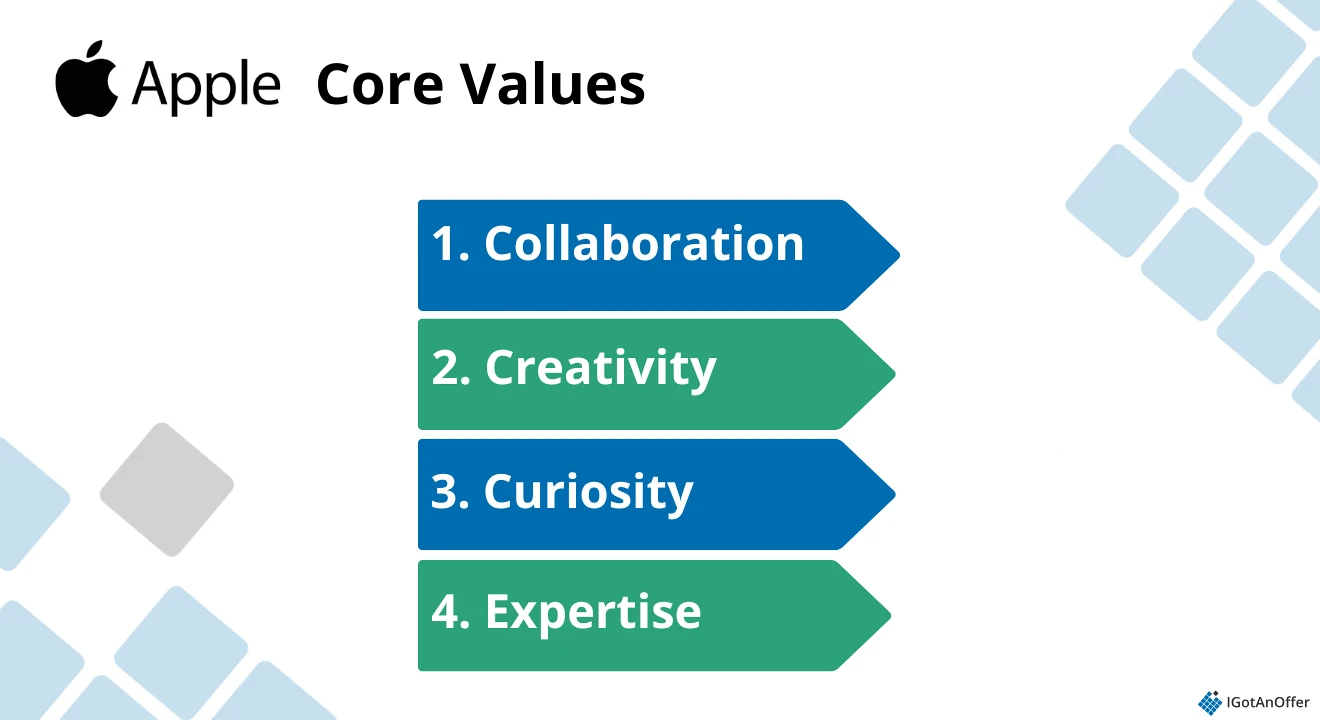
Apple CEO Tim Cook has publicly shared what the company looks for in candidates. He highlights four key traits, and we supplement them with additional core attributes we've gathered, based on our experience working with Apple candidates and ex-interviewers.
Collaboration
"We believe that strong individual contributors are key, but two strong individuals that work together can do amazing work," Cook said.
To assess how you collaborate, interviewers will ask about your experience with cross-functional teams, resolving conflicts, or influencing others without authority. Prepare stories that demonstrate how you share ideas openly and build on others’ contributions. You also want to show that you take full accountability for your work, and step up to fix problems instead of deflecting blame.
Creativity
According to Cook, Apple looks for people who "think differently, that can look at a problem and not be caught up in the dogma of how that problem has always been viewed."
Prepare a story that demonstrates how you approach problems from new angles, challenge conventional thinking, or look for innovative solutions. Show that your commitment to high standards pushes your creative thinking forward.
Curiosity
Apple values candidates who ask probing questions and dig into how things work. They also want to see how you look deeply into the end user’s experience to find out how you can create the best solution for their needs. Demonstrate your curiosity by explaining how you’ve investigated root causes, asked challenging questions, or learned new skills to solve problems.
Expertise
Finally, Apple wants people with deep knowledge in their domains. In behavioral interviews, this means demonstrating technical depth and engaging in meaningful discussions about your work. It also means impeccable attention to detail and caring about quality and precision.
Though not an explicit requirement, it will help significantly if you can demonstrate a genuine connection to Apple’s mission and a deep understanding of what makes their products special.
In the next section, you’ll find some of Apple's top behavioral questions and get an idea of what you're up against.
2. 38+ Apple behavioral interview questions ↑
To help you prepare strategically for Apple’s behavioral questions, we’ve used Glassdoor data and real candidate reports to identify the real questions asked in different Apple interviews.
The questions we've chosen come from our research across various Apple tech roles, including software engineers, product managers, machine learning engineers, data scientists, and engineering managers. You can also skip to the next section if you want to get the specific questions reported for your target role.
The questions are divided into the following categories:
We've added these categories to make the list of questions easier to refer to during prep, starting with the general questions that apply to any job.
Each category tests a different quality that Apple is looking for in its candidates, and the frequency of each question type will vary depending on the role. For instance, interviews for managerial roles will include a higher number of leadership / people management questions.
Note that some questions have been slightly edited for clarity or grammar.
2.1 Apple behavioral questions: General
First up are the general behavioral questions that may come up for any role. Here, your interviewer is looking for an overall view of your past experiences and what you will be like as an employee at Apple. You'll see that regardless of the role, Apple is curious about your resume, your motivations, and why you want to work for them specifically.
These are good questions for you to demonstrate your alignment with Apple's values by showing qualities such as innovation, attention to detail, and customer focus. They want to see that you've learned from past mistakes and that you understand what makes Apple unique.
Another signal that might be worth emphasizing is your willingness to commit, build your reputation over time, and put in the work patiently, according to John (ex-Apple Sr. PM). "If you expect quick wins and fast returns, then you might not fit in Apple’s culture."
Let's take a look at some example questions.
Example general behavioral questions asked at Apple interviews
- Tell us about yourself and what you have been working on lately.
- Tell me about what you did in your last job and what you were responsible for.
- Why do you want to work at Apple? (See sample answers for Amazon.)
- Why this role?
- When did you first gain exposure to Apple products, and what was your impression?
- What three words would you use to describe Apple's products?
- What Apple product would you be?
- Why did you leave your last job?
- Where do you want to be in five years?
- What are you passionate about?
- What do you believe to be your strengths for this role?
- What is your greatest weakness?
- What does success mean to you?
- What is your proudest accomplishment?
- Tell me about a time when you felt appreciated at work.
- Tell me about a challenging moment in your career.
- Tell me about a time you realized you made a mistake.
- Tell me about a time you failed.
- When was the last time you learned something new?
- Tell us a time you had a personal challenge. Describe who was involved and how you overcame it.
2.2 Apple behavioral questions: Teamwork
For many roles at Apple, you’ll have to work in cross-functional teams with engineers, designers, product managers, and other specialists. You'll need to be able to communicate clearly, work with others efficiently, and build trust and relationships across different disciplines.
Your interviewer will be looking for you to share stories from your past experience that demonstrate a spirit of collaboration and the ability to influence others. Give it a try using the following questions.
Example teamwork behavioral questions asked at Apple interviews
- Tell me about how you feel working in a team.
- Tell me about a time you led a cross-functional team.
- Tell me about a time when you had a disagreement with one of your colleagues or managers.
- How do you manage people on teams with whom you may not get along?
- Tell me about a time when you had to convince someone of something without authority over them.
- Have you had experience handling difficult customers?
- If you have 2 clients requesting very different features for the same product, how would you prioritize them?
2.3 Apple behavioral questions: Leadership/people management
In addition to a collaborative nature, Apple is looking for employees who demonstrate leadership when appropriate. This is because most roles will involve not only working in teams, but also leading initiatives and influencing direction.
As a result, you should expect questions about your approach to developing team members, your ability to lead through difficult situations, and how you resolve conflict. Of course, expect these questions to come up more frequently when interviewing for a managerial or leadership position.
If you're applying for a senior role, expect your interviewers to probe you deeply on your experience in solving difficult or ambiguous problems. Be prepared for multiple follow-up questions.
"Think about what you did in those situations and ask yourself, 'What would I do differently now?'" Santosh (Apple Engineering Leader) says. Reflecting on these past experiences before the interview and warming up your mind with those scenarios can really help you perform better at your interview.
Example leadership/people management behavioral questions asked at Apple interviews
- How do you manage people? Walk me through your management philosophy.
- Why do you want to pursue a career in people management? What was your most rewarding experience in people management?
- Describe a time when you had to change your leadership approach for different team members.
- How have you dealt with a problem employee in the past?
Want to dive deeper into leadership and people management questions? Check out our comprehensive people management primer, leadership primer, and our guide on grokking engineering management leadership interviews.
2.4 Apple behavioral questions: Project management
Finally, you may be asked project management questions, which dive into how you handle challenging projects, make decisions under uncertainty, and deliver results. Apple values people who can navigate ambiguity, solve complex technical problems, and maintain high standards throughout the development process.
If you're interviewing for a position that will entail managing and leading projects, then expect questions about your ability to deal with incomplete information, your problem-solving approach, and your experience overcoming obstacles.
Example project management behavioral questions asked at Apple interviews
- Describe a challenging project you worked on and what made it difficult.
- Can you provide an example of a challenging project you successfully completed? How did you overcome obstacles?
- Tell me about a time you came up with a technical solution while working on a project.
- Describe a time when you had to think 'outside of the box' and how you went about it.
- What's one time you didn't have the technical knowledge for a solution and had to bridge the gap?
- Tell me about a time when you had to make a difficult decision with incomplete information. How did you handle it, and what was the outcome?
- How do you handle changes or unexpected obstacles during a project?
- How do you keep yourself organized?
For more guidance on how to answer project management questions, check out our program/project management primer.
3. Apple behavioral interview questions (by role)↑
In this section, we’ve gathered the most common behavioral interview questions that candidates have reported for specific roles via Glassdoor. Click below to skip to the list most relevant to your needs.
3.1 Apple product manager behavioral interview questions↑
Apple product manager: example behavioral questions
- What is your proudest accomplishment?
- Tell me about a challenging moment in your career.
- Tell me about a time you had to convince someone when you had no authority over them.
- Tell me about a time you had to make a decision with a lot of ambiguity.
- Tell me about a time when you had a disagreement with one of your colleagues or managers.
- Tell me about a time you failed.
- Tell me about a time when you felt appreciated at work.
- Can you provide an example of a challenging project you successfully completed?
- Why Apple? (See sample answer from similar Amazon interviews here.)
- Why this role?
- Why product management?
- What are your short- and long-term goals?
- How do you keep yourself organized?
- What skills can you bring that other prospective employees can’t?
- When was the last time you learned something new?
- What three words would you use to describe Apple’s products?
- How much experience do you have with project management?
- How do you handle changes or unexpected obstacles during a project?
- How do you manage people on teams you may not get along with?
- Have you ever had to advocate for a customer, and if so, how?
Check out our guide to the Apple product manager interview to learn more about the entire interview process, including company-specific insights and more example questions.
3.2 Apple software engineer behavioral interview questions↑
Apple software engineer: example behavioral questions
- How would you handle a technical conflict between team members?
- Tell me about a time when you had too many things to do, and you were required to prioritize your tasks.
- What do you think about Apple?
- Why did you leave your last job?
- What have you been working on lately?
- Tell me about a time you dealt with other teams.
- How do you handle ambiguity and unreasonable expectations?
- How would you work within the confines of our team and the legacy project the team owns?
- Tell me about a time you had a disagreement with a teammate.
- How do you approach solving a problem you’ve never seen before?
- Describe a time you had to learn something quickly.
- Why do you want to work at Apple?
- How do you handle feedback or criticism?
- Tell me about a time you failed and what you learned.
- How do you ensure quality and performance in your code?
- What excites you about Apple's products or design philosophy?
Check out our list of software engineer behavioral interview questions for more question examples to practice with.
3.3 Apple engineering manager behavioral interview questions↑
Apple engineering manager: example behavioral questions
- Tell me about a time when you had to make a difficult decision with incomplete information. How did you handle it, and what was the outcome?
- What does success mean to you?
- Why do you want to take this role at Apple specifically?
- Describe a time when you had to change your leadership approach for different team members.
- How do you manage people? Walk me through your management philosophy.
- Why do you want to pursue a career in people management? What was your most rewarding experience in people management?
- How have you dealt with a problem employee in the past?
- If you have 2 clients requesting very different features for the same product, how would you prioritize them?
- What's one time you didn't have the technical knowledge for a solution and had to bridge the gap?
Check out our guide to the Apple engineering manager interview to learn more about the entire interview process, including company-specific insights and more example questions.
3.4 Apple machine learning engineer behavioral interview questions↑
Apple machine learning engineer: example behavioral questions
- Tell me about a time you had a disagreement with a manager or colleague and how you handled it
- What was the biggest technical challenge you've faced as an ML engineer? How did you approach it?
- Tell me about a time you brought a project or team back on track when things were going wrong
- Describe a situation where you had to make a decision with incomplete information. What did you do?
- Tell me about the most important ML project you've worked on. What was your specific contribution?
- Describe a situation where you rebuilt an existing solution into something significantly more efficient.
Check out our guide to the Apple machine learning engineer interview to learn more about the entire interview process, including company-specific insights and more example questions.
3.5 Apple data scientist behavioral interview questions↑
Apple data scientist: example behavioral questions
- Tell me about one of your data science projects and explain the business problem, your modeling approach, the metrics you used, and how you communicated the results to stakeholders.
- How do you evaluate with a human in the loop?
- How did you overcome your biggest hurdle in life?
- What is your favourite part about your last job?
- They asked me to walk through how I handle ambiguity and collaborate across teams
- What inspires you to work at Apple as a Data Scientist?
- Can you walk me through a project you worked on from start to finish?
- Why should we not hire you?
- What is your strength as it relates to analysis?
- What was one issue you've overcome in the workplace or when working on a project?
- Explain a scenario where you found something unexpected in your data.
4. How to answer Apple behavioral interview questions ↑
4.1 Technique
When answering behavioral questions, you should focus on your most relevant achievements and communicate them in a clear way. An easy way to achieve this is to use a step-by-step method to tell your stories.
The STAR method (Situation, Task, Action, Result) is a popular approach for answering behavioral questions because it's easy to remember. You may have already heard of it.
However, we've found that candidates often find it difficult to distinguish the difference between steps two and three, or task and action. Some also forget to include lessons learned in the results step, which is especially crucial when discussing past failures.
So we've developed the IGotAnOffer method to correct some of the pitfalls we've observed when using the STAR method.
4.1.1 The IGotAnOffer SPSIL method
Let's go through our suggested five-step approach:
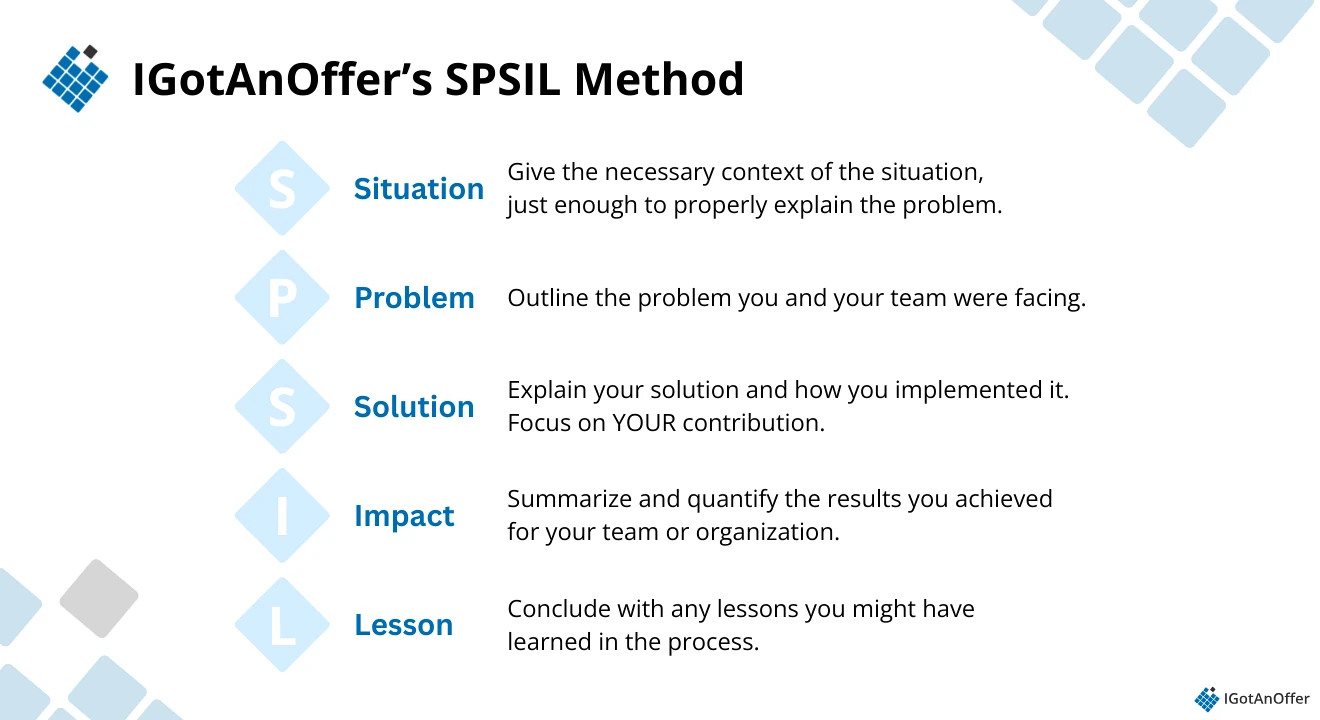
- Situation: Start by giving the necessary context of the situation you were in. Describe your role, the team, the organization, the market, etc. You should only give the minimum context needed to understand the problem and the solution in your story. Nothing more.
- Problem: Outline the problem you and your team were facing.
- Solution: Explain the solution you came up with to solve the problem. Step through how you went about implementing your solution, and focus on your contribution over what the team / larger organization did.
- Impact: Summarize the positive results you achieved for your team, department, and organization. As much as possible, quantify the impact.
- Lessons: Conclude with any lessons you might have learned in the process.
You'll notice that this method covers very similar themes to the STAR method. We like it because a lot of the candidates we work with find this framework easier to use, as there's no overlap between any of the steps in your story.
For a deeper dive into this topic, check out our article on why the STAR method isn't always the best for behavioral interviews and how IGotAnOffer's SPSIL method can be a better option. It was written with product managers in mind, but it applies just as well to any role.
Ultimately, you should practice using whatever method you're the most comfortable with. If you'd like to start practicing right away, jump back to the full list of questions from section 2.
Otherwise, to get a better idea of how our method works, work through the example below.
4.2 Example answer: Tell me about a time when you had to make a difficult decision with incomplete information.
We'll use one of Apple's frequently asked questions that tests both problem-solving skills and the ability to work with ambiguity—two qualities Apple highly values.
First, try answering the question below following your preferred method. Play both the role of the interviewer and the candidate. Write down your answer, then practice saying it out loud before going through our example response. Once you've finished, compare your response to our example to fill in any gaps in your story.
Try this question:
Tell me about a challenge or conflict you faced at a past job.
Answer:
We’ll use the IGotAnOffer SPSIL method described above and answer as if interviewing for a product manager job at Apple. You will find our proposed answer to the question below.
Notice that the question asks for a past challenge OR conflict, which lets you choose what you’d like to highlight in your answer. If you choose a past challenge, this is a good opportunity to show off your leadership and problem-solving skills.
However, in this case, we’ve chosen to focus on a past conflict, which we’ll use to display conflict-resolution and collaboration skills.
Click here for a sample answer to the past challenge question.
1. Situation
As this question isn’t necessarily about a specific role, it allows you to describe a variety of situations. We’ll use a generic example, but you should, of course, use an example from your own work experience.
You could start by saying something like:
“In my past job, I was on a product team composed of coworkers from various functional areas of our company. I had recently been hired, so this was my first interaction with the team. Eager to get to know everybody and to contribute to the project, I frequently jumped in with ideas and volunteered to lend a hand in many tasks.“
Without giving too much detail, this gives a quick sense of the setting you were in. If relevant, you can add a sentence or two to define your team’s goal, the functional areas present, or the stakeholders. Either way, the scene is set to get into the conflict that will arise when you describe the problem.
2. Problem
After you outline the situation, you can explain the problem by saying something like:
“I began to notice in our team meetings that one of my coworkers began cutting me off when I presented ideas. Later, when I volunteered to help with a task that concerned his functional area, he neglected to give me the information and resources I needed in order to contribute. This behavior continued, causing a conflict that interfered with our team discussions and slowed down our progress on important tasks.”
Here, you haven’t spent too long discussing the situation and problem, but your answer so far has given the interviewer a clear sense of the setting and conflict you faced.
3. Solution
When describing the solution you came up with to solve the problem, it’s important to step through your thinking. And it’s especially important to focus on YOUR contribution. You could say something such as:
“I knew any conflict was detrimental to the team’s goals, so I wanted to squash it right away. My first step was to examine my own behavior to understand how it may have sparked the conflict. I determined that my eagerness to contribute to the discussions and project may have overstepped some bounds.
My next step was to meet with my coworker. I approached him and asked to set a meeting for just the two of us. I let him choose the time, so as not to unintentionally interrupt his workflow.
Next, we held our discussion. I politely expressed how his behavior was preventing me from speaking up in meetings and helping with important tasks, then asked if I had overstepped any boundaries in my first few weeks on the team. He agreed, explaining that my initial eagerness had taken up too much time in the meetings, giving him and others less of an opportunity to present their teams’ work. Also, when I volunteered to help in his functional area, it slowed him down to have to explain the processes to me.
First, I apologized for my initial behavior. After he accepted my apology, I then presented a plan for upcoming meetings to avoid further conflict: I would be more attentive to the time I spent speaking in meetings and would only volunteer for tasks when I was confident I was well-equipped to contribute. In exchange, I requested that he approach me in case further issues arise, instead of closing me off from discussions or projects. He agreed.”
Let's take a step back and look at what the answer highlights, which is the ability to make decisions under pressure with limited information. That’s a key trait Apple values.
The answer also demonstrates teamwork and collaboration by assembling a team and dividing work effectively, shows customer focus by prioritizing notification reliability, and exhibits the kind of technical judgment Apple looks for.
4. Impact
After explaining the actions you took, it’s a good idea to quantify how much impact you had. You could say something like:
“After I met with that coworker, we each adjusted our behavior and avoided further conflict all the way through to the end of that project. We were able to catch up on the delays we were beginning to incur with our communication issues, finishing the project on time and meeting our initial goals.”
5. Lessons
Finally, wrap up your answer by describing any lessons you might have learned. You could say:
“Thankfully, this all happened right at the beginning of my time with that company, and the rest of my time there went smoothly. It taught me to be much more receptive to coworkers’ feedback and work to keep my contributions quick and to the point in meetings. Also, it taught me to address issues as soon as they arise, as we were able to move on from that conflict very quickly instead of allowing it to grow into a larger problem.”
5. Tips to impress your interviewer↑
Before we move on to some interview prep resources, we'd like to give you six helpful tips to keep in mind.
Tip #1: Get used to setting up the situation in 30 seconds or less
Use a timer while you practice to ensure you provide only necessary information. Spending too much time on the Situation step is one of the most common mistakes candidates make.
Tip #2: Stay focused on essential details
Interviewers hear a lot of behavioral stories a day. If you go into unnecessary details, you are likely to lose their attention. Share your stories with a few different people before your interview and ask them what details they would suggest cutting.
Tip #3: Be proud and talk about YOU
This is not the time to be shy about your accomplishments. Concentrate on your impact, not what "the team" did. Not talking about YOU enough is another common mistake we see with a lot of candidates.
Tip #4: Adapt to follow-up questions
Don't be alarmed if your interviewer asks follow-up questions; this is perfectly normal. Listen carefully to the way your interviewer is asking these questions, as there will often be a subtle clue about the specific skills they're looking to assess from the next part of your answer.
Tip #5: Explain how failure made you better
When talking about failure, don't try to hide your mistakes or frame a weakness as a strength. Instead, show what you learned and how you grew from the failure.
Tip #6: Emphasize attention to detail
Apple is famous for sweating the small stuff. When telling your stories, don't skip over the details that made your work excellent. Whether it's how you tested edge cases, refined the user experience, or ensured quality in implementation, showing that you care about craftsmanship will resonate with Apple interviewers.
6. How to prepare for an Apple behavioral interview ↑
Even with these sample questions and techniques, you’d still need some resources to help you actually prepare. After all, the right preparation will spell the difference between failing your Apple interviews and getting an offer.
Here are four steps you can take to prepare for your Apple behavioral interview.
6.1 Learn about Apple's culture
Most candidates fail to do this. But before investing tens of hours preparing for an interview at Apple, you should take some time to make sure it's actually the right company for you.
If you know people who work at Apple or used to work there, talk to them to understand what the culture is like. In addition, we would recommend reading the following resources:
- Apple's mission and values (by Apple)
- Apple careers page (by Apple)
- Apple Newsroom (by Apple)
- Apple strategy teardown (by CB Insights)
- Apple diversity and inclusion (by Apple)
6.2 Practice by yourself
Acing a behavioral question is much harder than it looks. You'll stand out if you put in the required work to craft concise and direct answers.
6.2.1 Write down your stories
First, work out which stories you'd like to tell. Make a list of key moments in your career (e.g., accomplishments, failures, team situations, leadership situations, etc.) that you can use to answer one or multiple questions. Take a look at Apple's core values and find at least one story from your past that exemplifies each one.
After you've finished your list, write out a story for each key moment in your career using the structure we've laid out in section 3. Be sure to emphasize your impact in each of these examples, quantify the results of your actions, and explain the lessons you learned from the experience.
Once you have a bank of stories, go through the questions in section 2 and make sure you'd be able to answer all of them either by using one of the stories you've written directly, or by adapting it on the fly. If you identify any gaps, add stories to your bank until you're comfortable you can cover all the questions listed in this article.
Click here to practice with more common behavioral questions and see example answers.
6.2.2 Practice your stories out loud
After you've written everything down, a great way to practice your answers is to interview yourself out loud. This may sound strange, but it will significantly improve the way you communicate during an interview.
You should be able to tell each story naturally, neither missing key details nor memorizing them word-for-word.
Play the role of both the candidate and the interviewer, asking questions and answering them, just like two people would in an interview. Trust us, it works.
6.3 Practice with peers
Practicing by yourself will only take you so far. By yourself, you can't simulate thinking on your feet or the pressure of performing in front of a stranger. Plus, there are no unexpected follow-up questions and no feedback.
That's why many candidates try to practice with friends or peers. If you have friends or peers who can do mock interviews with you, that's an option worth trying. It's free, but be warned, you may come up against the following problems:
- It's hard to know if the feedback you get is accurate
- They're unlikely to have insider knowledge of interviews at your target company
- On peer platforms, people often waste your time by not showing up
For those reasons, many candidates skip peer mock interviews and go straight to mock interviews with an expert.
6.4 Practice with experienced Apple interviewers
In our experience, practicing real interviews with experts who can give you company-specific feedback makes a huge difference.
Find an Apple interview coach so you can:
- Test yourself under real interview conditions
- Get accurate feedback from a real expert
- Build your confidence
- Get company-specific insights
- Learn how to tell the right stories, better
- Save time by focusing your preparation
Landing a job at a big tech company often results in a $50,000 per year or more increase in total compensation. In our experience, three or four coaching sessions worth ~$500 significantly impact your ability to land the job. That's an ROI of 100x!
Click here to practice 1-on-1 mock interviews with ex-Apple interviewers.








 Software engineer, Engineering manager