

 Back to other articles



 Last updated: March 05, 2026
 Interviews
 Product manager
 Product sense
 Deeply researched
If you’re applying for a Meta PM role, you may have heard or read about the company’s new interview round: the Product Sense with AI interview.
This new round tests your ability to integrate AI into product thinking, exercise judgment while working with AI tools, and maintain strategic control as you prototype solutions in real time.
To help you prepare, we put together this guide. Below, you’ll find real Product Sense with AI interview questions reported by candidates from Meta and other AI-focused companies like Google and OpenAI, along with a framework and sample answer by an expert.
Finally, we’ll share the best resources, insider tips, and a step-by-step prep plan to help you walk into your AI product sense interviews with confidence.
- What is the Meta product sense with AI interview?
- How to answer AI product sense questions
- Meta interview grading rubrics
- Tips for answering Meta product sense with AI interview questions
- How to prepare
Let’s get started.
Click here to practice 1-on-1 with ex-Meta PM interviewers
1. Overview: Meta’s product sense with AI interviews
Before we go through how to answer Meta’s Product Sense with AI interview questions, let’s first take a look at what this interview is and how it works.
Note: The updated interview loop currently applies specifically to roles within Meta’s Central Products (CP) org. If you’re interviewing outside CP, the standard PM process remains unchanged as of posting.
1.1 What is the Meta Product Sense with AI interview?
Product Sense with AI is a new round that Meta has reportedly added to its final PM interview loop for Central Products candidates.
During the interview, candidates are given a product sense case and asked to use AI tools to develop and prototype solutions. You are expected to “vibe code,” a term coined by AI researcher Andrej Karpathy in 2025, where you use AI as a collaborative builder to explore and prototype ideas.
So, rather than writing code line by line, you use prompts to direct AI in generating solutions while actively guiding, reviewing, and refining its outputs.
More importantly, you are not graded solely on your ability to create prompts, but on how effectively you guide AI tools and critically evaluate their outputs.
”Most candidates think they’re being graded on how impressive their prompts are. They’re not. Interviewers are evaluating your judgment, specifically how you detect when AI output is generic, risky, or not aligned with Meta’s scale and constraints, and how you course-correct it,” says Audrey, ex-Meta Sr. Product Leader, AI-focused.
1.2 How does the Meta Product Sense with AI fit in the interview loop?
According to Ben Erez (ex-Meta PM) and reports on Blind, Meta has not only introduced a new interview round but also restructured its final PM interview loop.
As mentioned earlier, these changes currently apply to roles within Central Products, Meta’s largest PM organization by headcount. Candidates applying outside this org can still expect the standard three final-round interviews: Product Sense, Analytical Thinking/Product Execution, and Leadership & Drive.
Meanwhile, the new full loop for CP PMs now consists of four interviews:
- Product Sense with AI (Vibe Coding), where candidates define user motivations, target audiences, and product problems, then translate their thinking into prompts to build a working prototype using AI tools.
- Analytical Thinking & Logical Reasoning, which has two parts: 1) a product scenario with analytical questions, and 2) quantitative reasoning exercises based on research materials provided in advance.
- Product Architecture, an open-ended system design interview that evaluates technical judgment, trade-offs, and collaboration with engineering teams; reportedly resembles Stripe’s PM interview format.
- Leadership & Drive, Meta’s behavioral interview, which remains largely unchanged.
You can confirm with your recruiter whether your loop includes the Product Sense with AI round. In any case, whether you’re applying for a CP role or not, you should walk into the interview loop prepared to work with AI.
And, if given the option, always opt in to the AI round, as Meta is increasingly emphasizing AI fluency across PM roles.
For deeper insights into this new interview format, booking mock interviews with ex-Meta interviewers like Audrey can make a big difference. Audrey’s coaching sessions specifically focus on mastering this "vibe coding" style, helping candidates maintain strategic control while directing AI tools.
1.3 What competencies are assessed in Meta’s Product Sense with AI interview?
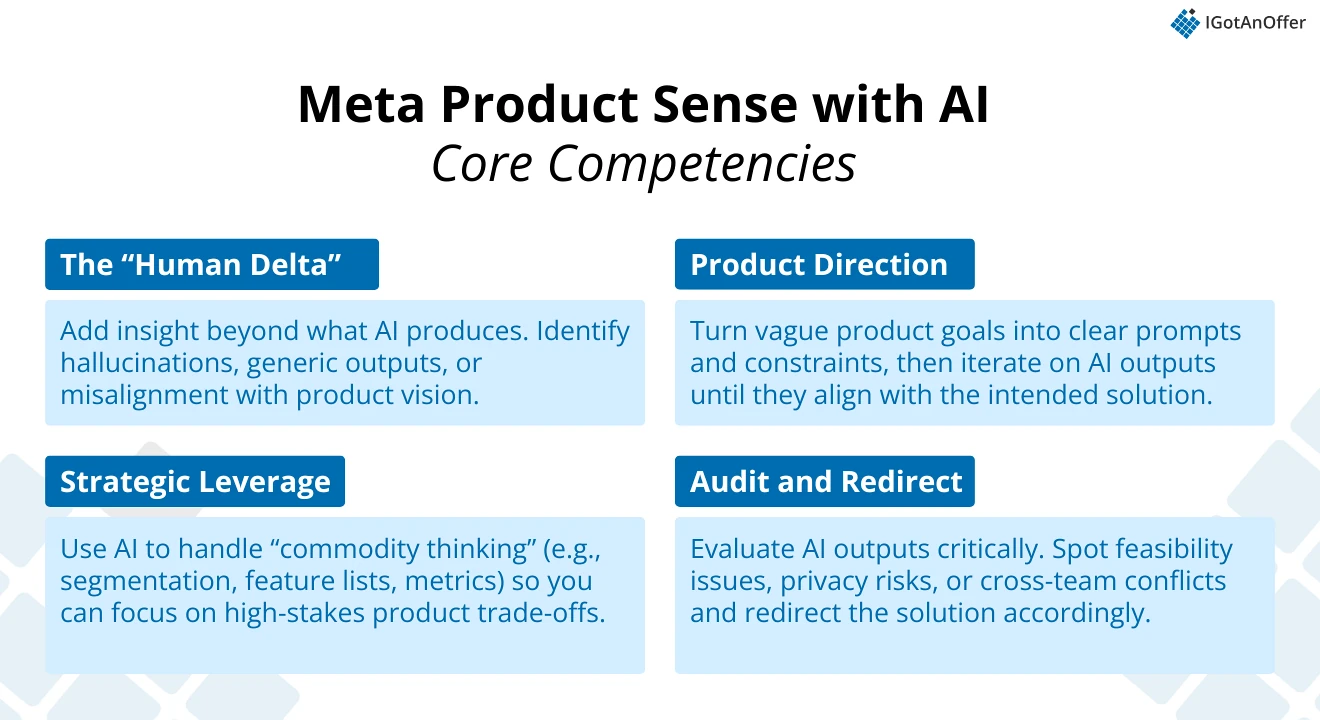
To help you better calibrate your preparation, we asked Audrey (ex-Meta Sr. Product Leader) what interviewers evaluate in the Product Sense with AI interviews. She’s conducted 200+ PM interviews over her 7+ years at Meta and helped build AI and mixed-reality products for the company.
Here’s what she shared:
- The “Human Delta”: Interviewers assess the “delta.” In AI workflows, this is the specific insight you add to what the AI would produce on its own. They look for candidates who can identify hallucinations, generic outputs, or misalignment with the product vision, and clearly explain how and why the solution should be improved. You can practice the Human Delta framework in a 1-on-1 session with Audrey.
- Strategic Leverage: Beyond "AI Fluency," Meta is testing for Leverage. They want to see if you can use AI to handle "commodity thinking" (e.g., baseline segmentation, feature drafting, outlining success metrics, etc.) so you can spend 90% of the interview on high-stakes trade-offs.
- Product Direction: Interviewers assess your ability to translate ambiguous product goals into structured instructions, set clear constraints, and iterate when the AI’s outputs lack depth, clarity, or alignment.
- Audit and Redirect: Interviewers expect you to course-correct the AI. You should be able to spot feasibility issues, policy or privacy risks, and cross-functional friction that AI tools typically overlook, and redirect the solution accordingly. Audrey adds, “If the AI gives you something that looks clean and complete, that's often a trap. Candidates that get hired stress test this, they ask what breaks at scale, where privacy risk emerges, and which trade-offs engineering would push back on.”
Coaches who contributed to this guide










2. How to answer AI product sense questions (framework + sample answer) ↑
Now that you understand what interviewers expect in the Product Sense with AI round, let’s walk through how to approach these questions.
Below, you’ll find a sample framework you can use to structure your answers, along with a sample response from Gal (Principal PM) to a real OpenAI interview question: “What goal would you set for an AI-only social network that OpenAI is building?”
A little background on our coach: Gal is a former Google Senior PM and Microsoft Principal PM who has conducted 200+ PM interviews, most of them at Google.
Right, let’s get into it.
2.1 Sample framework and answer ↑
5-Step AI Product Sense Answer Framework
Step 1: Ask clarifying questions
- Make sure you clearly understand the goals and requirements of the problem
- Set expectations and agree on simplifications
- Make sure you’re on the same page with the interviewer to ensure a meaningful discussion
Step 2: Outline goals
- Pause and think about your goals
- Differentiate between the user goal and the business goal
- Define how the two interact, and link it back to the company's mission
Step 3: Prioritize actions
- Be comprehensive, list multiple actions
- Don’t be too detailed, stick to high-level
- Prioritize based on your main goal
Step 4: Define metrics
- Give 2-3 metrics for each prioritized action
- Find the specific metrics that tell the story of what we want to happen with this action
Step 5: Evaluate
- Take a minute to summarize your answer
- Show how metrics are tied to the original goal
- Discuss the downside of the metrics chosen
- Explain how the metrics balance each other
See Gal’s walkthrough on how to answer the OpenAI interview question using the 5-step framework above: “What goal would you set for an AI-only social network that OpenAI is building?”
2.2 More examples of AI product sense questions (Meta, Google, OpenAI) ↑
Now that you have an idea of how to structure your answers, let’s look at real example questions from Glassdoor shared by PM candidates from Meta, Google, and OpenAI.
Try using the framework we shared above and apply it to each question for more practice.
Examples of AI product sense questions at Meta
- You are a Meta PM for AI chat. How would you define success and goals for it?
- You're the sole PM for Zoom. Imagine that AI is sending transcripts of meeting notes to all invitees, and suddenly, meeting attendance is down. What do you do?
Examples of AI product sense questions at Google
- Design a smart fridge for Google
- Given an AI-powered product facing usability challenges, how would you improve it?
Examples of AI product sense questions at OpenAI
- What’s your favorite AI product, and why?
- What goal would you set for an AI-only social network that OpenAI is building?
- What industry could benefit most from enterprise ChatGPT?
If you’re applying for an AI PM role, you can also check out our AI PM interview guide to see more example questions and the other types of questions you can expect.
3. Meta product interview grading rubrics ↑
At Meta, your performance is evaluated after EACH interview using a standardized product interview grading rubric. Even in the Product Sense with AI round, interviewers still assess the same foundational skills, so understanding this rubric will help you prepare more effectively.
Noah, an ex-Meta product leader, shares a sneak peek of how Meta runs this process.
Interview format
A standard PM loop at Meta consists of five interviews:
- The first round includes one Product Sense and one Analytical Thinking interview
- If a candidate passes both, they move on to a repeat of round one (Product Sense round 2 and Analytical Thinking round 2), plus a Leadership and Drive interview
Learn more about these question types in Meta’s official PM interview loop guide.
Typically, within about 24 hours of each interview, the interviewer submits their feedback in Meta’s interview system. Note that there is no formal debrief after the loop, so interviewers cannot see what others have submitted until they submit their own feedback.
For each grading criterion, interviewers assign one of the following scores and include written feedback explaining their rating:
- Below Expectations
- Meets Expectations
- Strong
- Exceptional
- Unable to evaluate
Example evaluation criteria
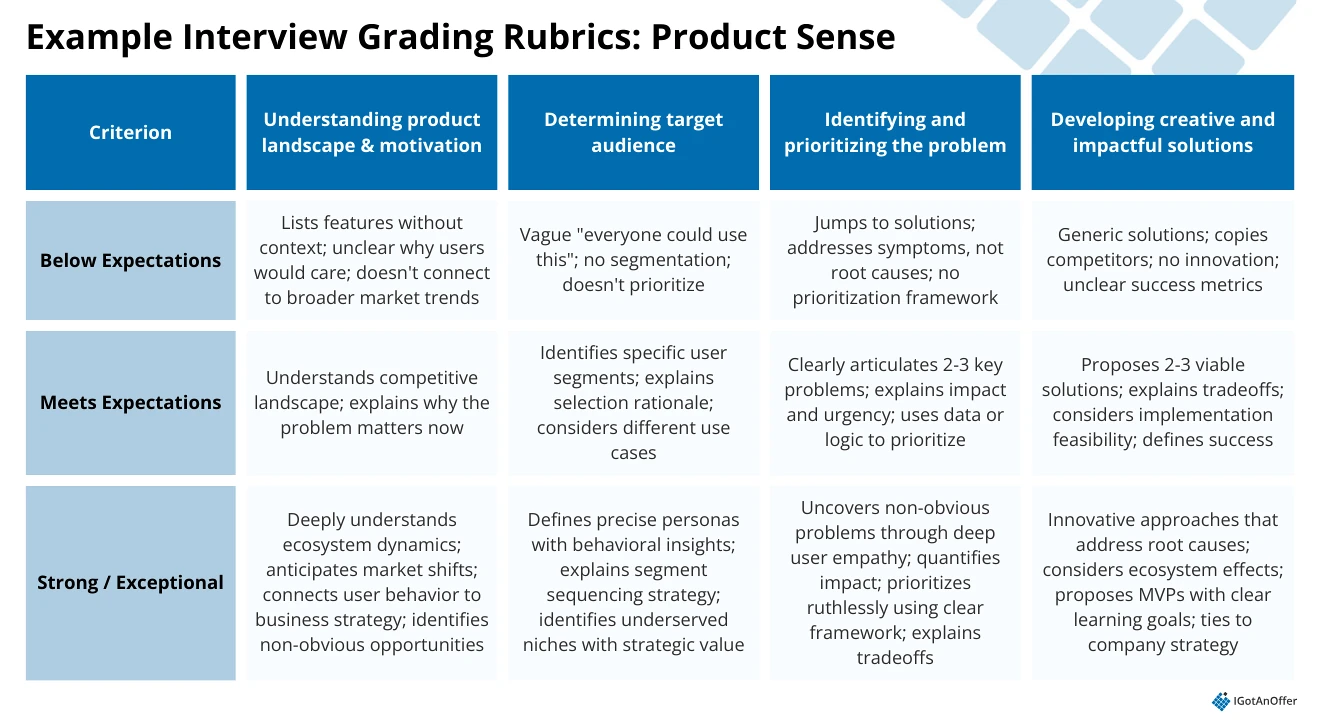
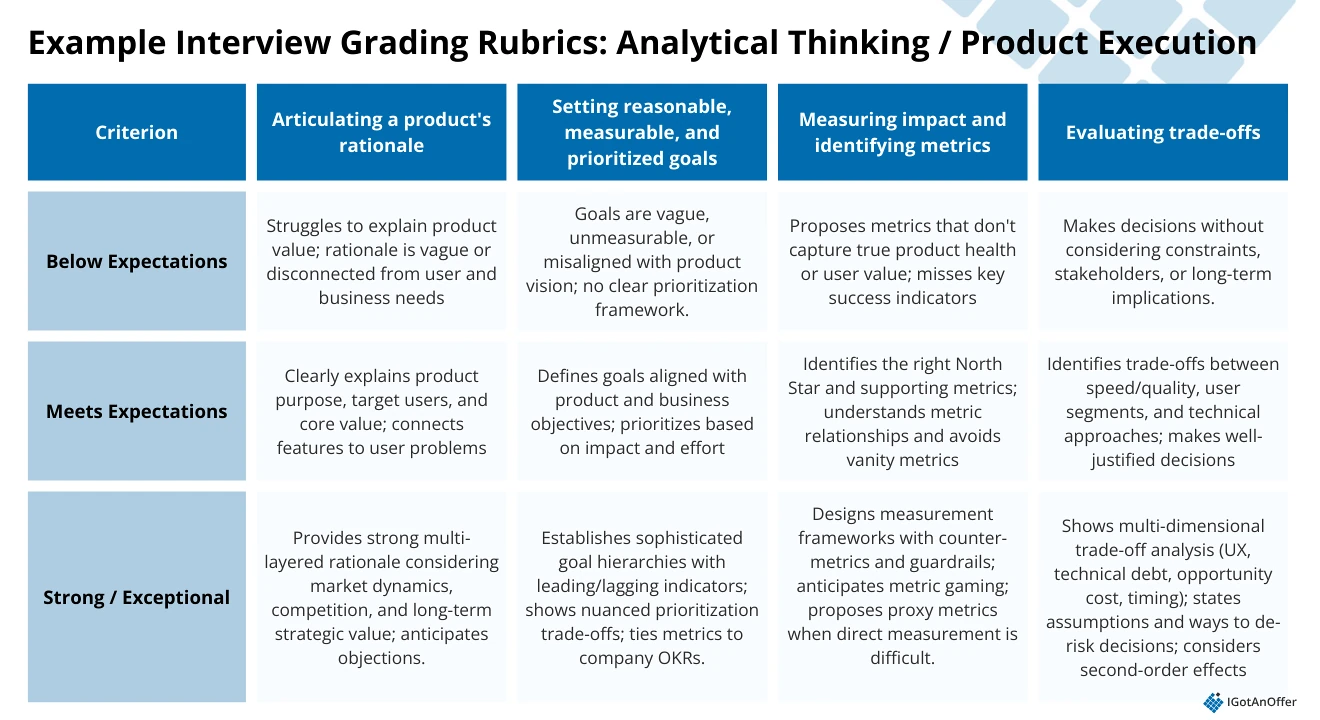
FAANG companies, including Meta, are very secretive about the exact details of their interview grading rubrics. Below is an example set of evaluation criteria for Product Sense and Analytical Thinking (Product Execution) that Noah recommends PM candidates use to guide their prep. You can use this sample rubric to identify potential gaps in your approach and improve your answers before the actual interviews.
Note that these are NOT Meta’s actual interview rubric, but a representative example based on Meta’s PM interview loop guide.
Product Sense
Analytical Thinking / Product Execution
Click here to download the example PM interview grading rubrics (PDF)
In addition to the scores, interviewers also submit a summary note, such as “Soft no,” “Suggest re-evaluate,” or “Strong yes,” which can significantly influence the hiring decision.
Post-evaluation
Once all evaluations have been submitted, there are three possible outcomes:
- You move forward for approval if most interviewers recommend “Hire” or “Strong Hire”
- You may be asked to complete follow-up interviews if feedback is mixed or additional information is needed
- You are rejected if there are multiple “No hire” or “Strong no hire” recommendations
After the post-evaluation stage, candidates who pass the hiring committee move on to leveling and team matching.
4. Tips for answering Meta’s product sense with AI interview questions ↑
To succeed with AI product sense questions, you need to strike a balance between strong product fundamentals and foundational knowledge of AI/ML.
If you're new to the domain and wondering how to focus your AI/ML learning, here are some tips from our AI PM coaches, Mark, Anik, Piyush, and Casey:
4.1 Understand user experience (UX)
Demonstrating a keen sense for UX design and user psychology is important. You should be able to critique AI-generated outputs and propose improvements grounded in user research.
To prepare, practice using AI tools to generate product ideas, flows, or wireframes, then evaluate and refine them. This will help you get comfortable with the “vibe coding” style used in Meta interviews.
4.2 Practice data-driven decision-making
Be prepared for follow-up questions that require data interpretation and making data-driven decisions. You should familiarize yourself with basic metrics for product success (e.g., adoption, engagement, quality, etc.) and have a few methodologies in mind for tackling growth, engagement, and scalability issues.
“Often, I think people don't think enough about retention, and especially at Meta, that's a huge metric, and it's becoming more important at different companies too," says Mark (ex-Meta Sr. PM).
4.3 Learn ML/AI concepts and AI-adjacent skills
You don’t need to learn how to code; you simply need to learn the basic science behind AI. Then, beef up on AI-adjacent skills, including data analysis, experimentation, and product metrics.
“This means understanding core ML concepts: what a model is, how it 'learns' from data (training), and the difference between giving it labeled examples versus letting it find patterns on its own,” says Anik (Amazon GenAI Product Leader).
4.4 Build a portfolio of AI-adjacent projects
Through hands-on AI projects, you can learn how to drive business value with AI. You can initiate these projects at your current job, as a side project, or as a capstone.
Casey (eBay Sr. Technical Product Manager) suggests building a portfolio of AI-adjacent projects to demonstrate applied experience. Some projects you can tackle are recommendation systems, personalization, and automation.
4.5 Learn how to design for uncertainty
When beefing up your AI knowledge, it’s important that you learn to design for failure. In a traditional PM role, software either works or crashes, but AI is always 'sort of right.'
To address this built-in uncertainty, Anik says, “The PM's job is to design the product experience to manage user expectations, clearly communicate when the AI might be wrong, and build reliable backup plans (like a human review) to maintain user trust.”
4.6 Learn prompt engineering
Piyush thinks that Gen AI experience is overrated for AI PMs, as anyone with a strong customer mindset and product thinking can become an effective Gen AI PM. What he does recommend strongly is learning how to do prompt engineering well. One excellent way to practice this is by vibe coding.
5. How to prepare for product sense with AI interviews ↑
We've coached more than 20,000 people for interviews since 2018. There are essentially three activities you can do to practice for interviews. Here’s what we've learned about each of them.
5.1 Learn by yourself
5.1.1 Learn about Meta’s products and AI initiatives
Learning by yourself is an essential first step. As you've probably figured out from the example questions listed above, you can't become a PM at Meta without being familiar with the company's products and its organization. You'll therefore need to do some homework before your interviews.
Here are some resources to help you get started with this:
- Meta AI
- Meta's 6 core values (by Meta)
- How to write a great product strategy (with Meta Director)
- Facebook’s “hacker culture” (by Mark Zuckerberg, via Wired)
- Meta annual reports and strategy presentations (by Meta)
- Meta's approach to tech trends (by CB Insights)
- Meta org culture analysis (by Panmore Institute)
It’s also important to understand Meta’s product ecosystem, user base, and business priorities, as interviewers often expect candidates to reference these during discussions. To help with this, we’ve put together these interview fact sheets that you can reference during prep.
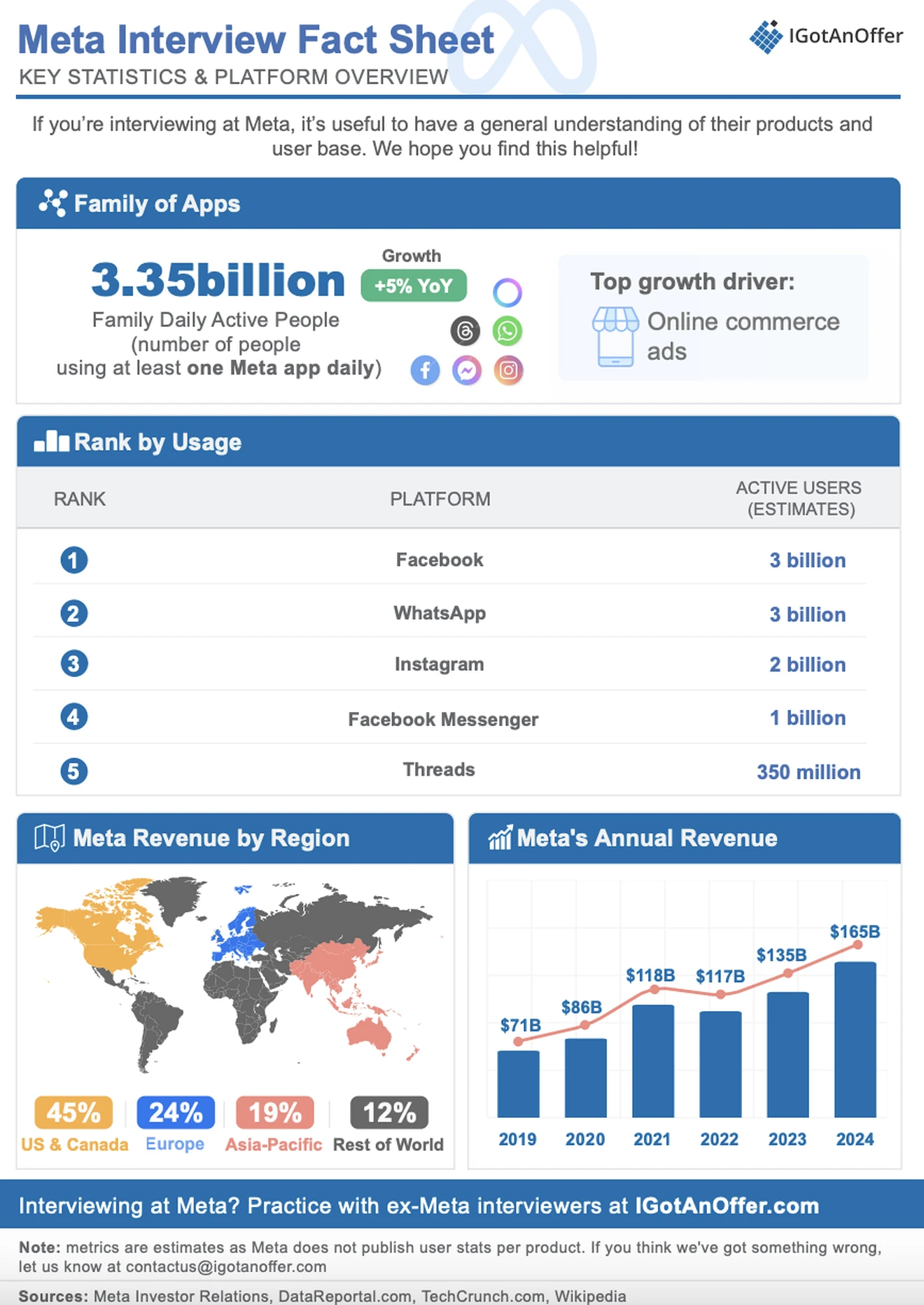
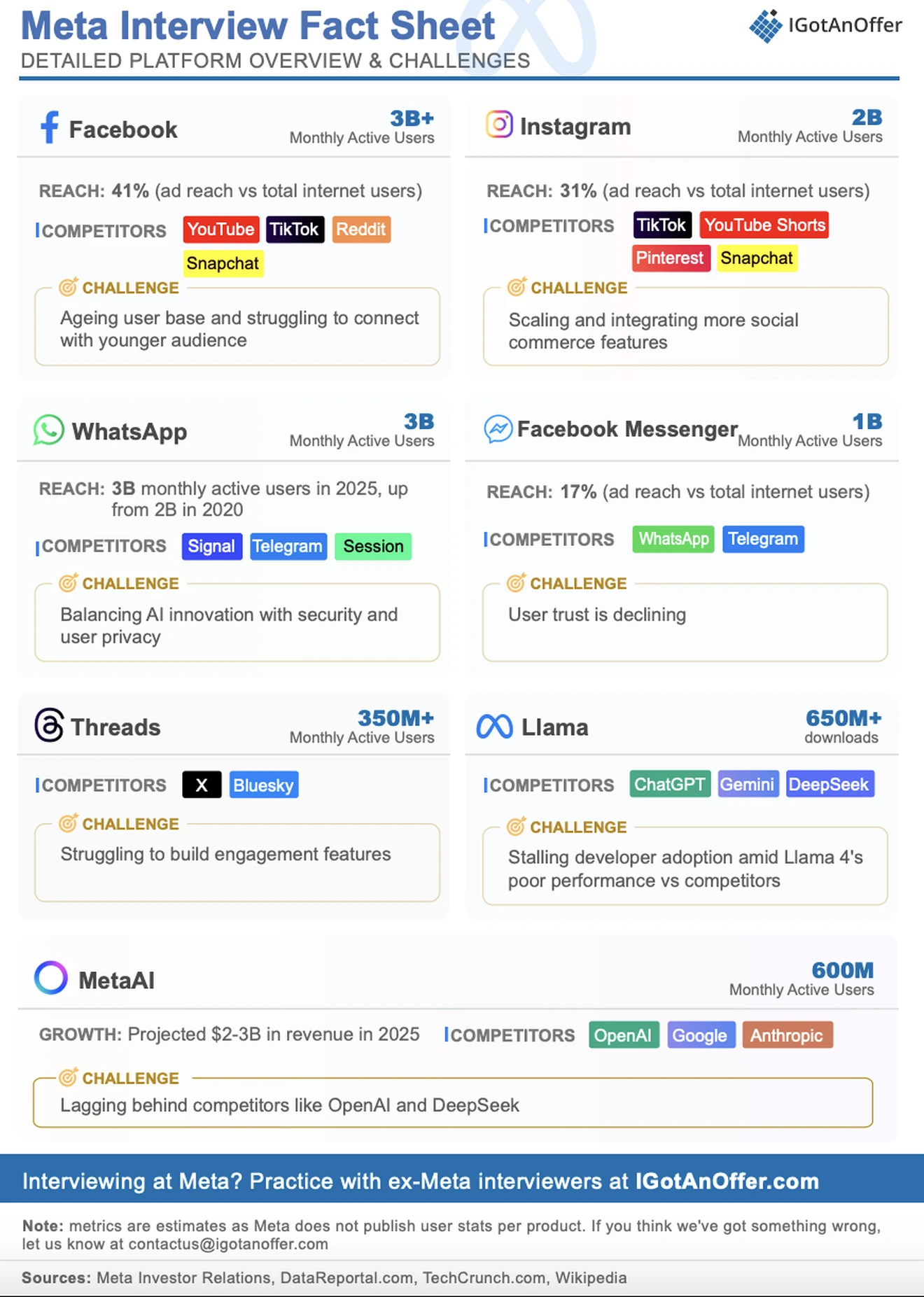
Click here to download the Meta interview fact sheets
5.1.2 Deep dive into AI/ML topics
You should come into your AI product sense interviews with a strong working understanding of AI/ML concepts, as interviewers expect you to reason about how these technologies affect product decisions.
To get started with your AI/ML deep dive, check out these free resources we’ve gathered:
- AI for Everyone (DeepLearning.ai)
- Machine Learning and Artificial Intelligence Training (Google)
- How AI changes product management (Reforge)
- GenAI Prompt Engineering: A Product Manager’s Guide
- Data Analysis for Product Managers (UserPilot)
- Ethics in AI: The New Frontier for Product Managers (ProdPad)
- Your Guide to Product Strategy (OpenAI’s Product Lead)
- How to Create an AI Product Roadmap (Aakash Gupta)
- How to Ace the Vibe Coding Interview (Aakash Gupta)
5.1.3 Deep dive into product management topics
As mentioned in Section 1.2, Meta will ask you questions that fall into certain categories beyond AI product sense. Approaching each question with a predefined method will enable you to build strong interview habits.
Then, when it comes time for your interviews, these habits will reduce your stress and help you to make a great impression.
If you’re just looking for a jumping-off point, you can start learning about the different question types you’ll need to master in the following PM interview guides:
- AI PM interview guide
- Behavioral questions
- Product design questions
- Product improvement questions
- Favorite product question
- Strategy questions
- Estimation questions
- Metric questions
- Prioritization questions
- PM vibe coding interview
- Meta project retrospective interview guide
- Meta analytical thinking/product execution interview guide
- Meta product sense interview guide
- Meta leadership & drive interview guide
We also recommend watching mock interview videos at our IGotAnOffer Product Management YouTube channel so you can see what an excellent answer looks like.
Once you’re in command of the different subject matters, you’ll want to practice answering questions. But by yourself, you can’t simulate thinking on your feet or the pressure of performing in front of a stranger. Plus, there are no unexpected follow-up questions and no feedback.
That’s why many candidates try to practice with friends or peers.
5.2 Practice with peers
If you have friends or peers who can do mock interviews with you, that's an option worth trying. It’s free, but be warned, you may come up against the following problems:
- It’s hard to know if the feedback you get is accurate
- They’re unlikely to have insider knowledge of interviews at your target company
- On peer platforms, people often waste your time by not showing up
For those reasons, many candidates skip peer mock interviews and go straight to mock interviews with an expert.
5.3 Practice with experienced PM interviewers
In our experience, practicing real interviews with experts who can give you company-specific feedback makes a huge difference.
Find a Meta product manager interview coach or AI PM coach so you can:
- Test yourself under real interview conditions
- Get accurate feedback from a real expert
- Build your confidence
- Get company-specific insights
- Learn how to tell the right stories, better.
- Save time by focusing your preparation
Landing a job at a big tech company often results in a $50,000 per year or more increase in total compensation. In our experience, three or four coaching sessions worth ~$500 make a significant difference in your ability to land the job. That’s an ROI of 100x!
Click here to book AI product manager mock interviews with experienced PM interviewers.