

 Back to other articles
  Last updated: January 21, 2026

 Interviews
 Product manager
 Deeply researched
Preparing for a product manager interview at Oracle? You're in the right place.
Oracle's PM interview process can vary quite a bit. Some candidates describe it as smooth and well-organized, while others experience longer timelines or communication gaps. But with the right preparation, you can navigate it confidently.
At IGotAnOffer, we've helped thousands of PMs land roles at top tech companies. Our coaches include former product leaders from Oracle, as well as FAANG companies like Meta, Google, and Amazon, who know exactly what interviewers look for. This guide draws on their insider expertise to give you a strategic advantage.
Below you'll find a detailed overview of what goes on behind Oracle’s product manager interview process, example interview questions sourced from real candidate reports, interview tips on how to answer them, and a preparation plan.
Here's an outline of everything we'll cover:
- Role and salary
- Interview process and timeline
- Example interview questions
- Interview tips
- Preparation plan
Click here to book 1-on-1 interview coaching with an expert PM interviewer.
1. Oracle product manager role and salary ↑
Before we dive into the interview process, let's get to know Oracle and what product managers actually do there.
1.1 About Oracle
Oracle is a global leader in enterprise technology, founded in 1977 and headquartered in Austin, Texas. The company provides cloud infrastructure, database software, enterprise applications, and industry-specific solutions to businesses worldwide.
Oracle is best known for its database management systems, which power many of the world's largest organizations across industries like finance, healthcare, retail, and government.
The company has evolved from its database roots into a comprehensive and integrated cloud provider, with products like Oracle Cloud Infrastructure (OCI) competing directly with Amazon’s AWS, Azure, and Google Cloud.
Oracle's product portfolio includes:
- Oracle Cloud Infrastructure (OCI) for cloud computing and infrastructure services
- Database products, including Oracle Database, MySQL, and NoSQL solutions
- Enterprise applications for ERP, HCM, CX, and supply chain management
- Industry-specific solutions for healthcare, financial services, retail, and more
- Development tools and platforms like Oracle APEX and Oracle JDeveloper
With over 163,321 employees globally (as of October 2025) and an annual revenue exceeding $52 billion in fiscal year 2024, Oracle remains one of the most influential companies in enterprise technology.
1.2 What does an Oracle product manager do?
As a product manager at Oracle, you'll be responsible for defining product vision, strategy, and roadmap across its diverse portfolio of top-notch enterprise technology products.
According to Oracle's job descriptions and documentation, Oracle product managers typically:
- Define strategy and product roadmaps for complex enterprise products, working across cloud services, databases, or industry-specific applications
- Collaborate closely with engineering, design, sales, and customer-facing teams to deliver products that meet enterprise customer needs
- Manage the product development lifecycle from ideation through launch, ensuring products meet specifications and ship on schedule
- Analyze customer needs and translate them into product requirements, particularly for B2B enterprise customers
- Work with technical teams to understand architectural tradeoffs and ensure products integrate well within Oracle's broader ecosystem
Oracle PMs are expected to have strong technical depth, especially given the company's focus on databases, cloud infrastructure, and complex enterprise systems. You'll need to understand technical concepts like APIs, system architecture, database design, and cloud computing fundamentals.
The role also requires balancing enterprise customer requirements with technical feasibility. You’ll often have to manage long sales cycles and complex stakeholder relationships.
1.3 Oracle product manager salary and compensation
Based on data from Levels.fyi, Oracle product managers in the United States earn a median total compensation of approximately $200K per year. Compensation varies significantly by level, ranging from $173K for IC-1 to $502K for IC-6.
Here's the breakdown by level:
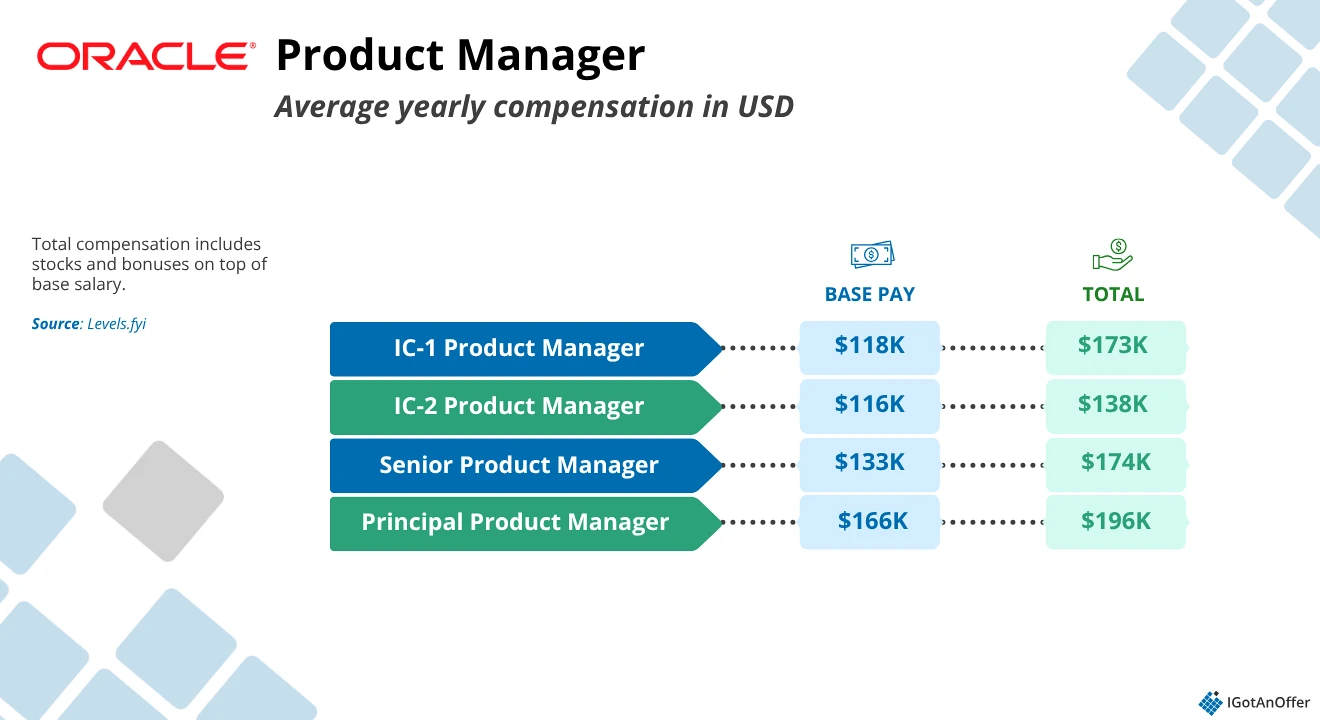
Oracle's compensation is competitive within the enterprise software space, though it’s generally lower than FAANG+ companies like Google, Meta, or newer companies like Stripe and OpenAI.
Oracle offers RSUs (Restricted Stock Units) with two possible vesting schedules:
- Front-loaded schedule: 40% in year 1, 30% in year 2, 20% in year 3, 10% in year 4
- Standard schedule: 25% each year over 4 years
Ultimately, how you do in your interviews will help determine what you’ll be offered. Remember, compensation packages are always negotiable, even at Oracle.
So, if you do get an offer, don’t be afraid to ask for more. If you need help negotiating, consider booking one of our salary negotiation coaches to get expert advice. You can also prepare for it yourself by reading our product manager salary negotiation guide.
2. Oracle PM interview process and timeline ↑
The Oracle PM interview process typically takes 2-8 weeks to complete, though some candidates report longer timelines.
Here’s a quick overview of the steps you may face along the way:
- Resume and application review
- Recruiter screen (30-45 min)
- Hiring manager screen (45-60 min)
- Onsite technical and panel interviews (2-3 rounds, 45-60 min each)
- Final interviews (1 round, 45-60 min)
Oracle’s interview process can vary by role and team, with multiple rounds that may include technical assessments, panel interviews, and culture fit discussions.
While the exact sequence and timing may differ, understanding the typical stages allows you to prepare thoroughly for each step. By knowing what to expect in terms of interview types and skills assessed, you can approach the process with confidence and focus your preparation where it matters most.
Note: If you are interviewing for a product leadership position (VP, Director, Group PM) or senior PM role, check out our guides: product leader interview and senior product manager interview questions to learn more about what questions to expect and how to prepare.
2.1 Resume and application review
First, recruiters will look at your resume and assess if your experience matches the open position. This is the most competitive step in the process, as millions of candidates do not make it past this stage.
You can use this free product manager resume guide to help tailor your resume to the position you’re targeting.
And if you’re looking for expert feedback, you can also get input from our team of ex-FAANG recruiters, who will cover what achievements to focus on (or ignore), how to fine-tune your bullet points, and more.
2.2 Recruiter screen (30-45 min)
If your resume passes the initial review, you'll have a virtual call with a recruiter. This typically lasts 30-45 minutes.
During this call, you should expect the recruiter to ask you some typical resume and behavioral questions. Practice discussing your key experiences, especially those that you’ve included in your application, as well as your most impressive work accomplishments.
They'll be looking to evaluate your fit with Oracle’s culture, your overall qualifications for the role, and whether you have a chance of succeeding in future interview rounds.
At this point, the recruiter will likely give you an outline of the next interview steps. If not, don’t hesitate to ask about the process ahead.
If you pass the recruiter screen, the recruiter will advance you to the next round of interviews.
2.3 Hiring manager interview (45-60 min)
After the recruiter screen, you'll typically have a 45-60 minute interview with the hiring manager or a senior PM on the team.
This interview focuses on your product management experience and approach. Expect deep dives into specific projects from your resume, some behavioral questions about collaboration and leadership, and product sense questions about Oracle products or hypothetical scenarios.
Some candidates report that this round feels conversational, focusing on fit and experience alignment rather than rigorous case studies.
Prepare to answer common PM interview questions. You’ll find more details on the types of questions to expect and how to prepare for them in Section 3.
2.4 Onsite technical and panel interviews (2-3 rounds, 45-60 min each)
If you advance past the hiring manager screen, you'll have multiple interview rounds. Based on candidate reports, this typically includes 3-5 separate interviews, which may take place over several days or weeks rather than in a single onsite loop.
These interviews may include:
- Product management interviews: Testing product sense, execution, and strategic thinking
- Technical interviews: SQL queries, database concepts, OOP principles, system design
- Behavioral interviews: Leadership, collaboration, conflict resolution
- Cross-functional interviews: With engineering, design, or other stakeholders
- Presentation or case study: Some candidates report being asked to prepare and present a product strategy or analysis
Each interview focuses on assessing a specific skill or competency, giving the team a comprehensive view of your abilities and fit for the role.
Note that if you're applying for an AI PM role, you might also get AI-related interview questions. Check out our guide to AI PM interviews to learn more.
2.5 Final interview (1 round, 45-60 min)
Candidates who pass the technical and panel interview rounds are invited to a final interview with a senior team member.
This usually takes the form of a relatively short but in-depth interview that tests any areas the team felt were missing during the onsite rounds, as well as your overall culture fit at Oracle.
Prepare for this interview as you would for the onsite rounds and practice answering the sample questions we provide in Section 3.
Not all candidates are guaranteed this step. It is typically required for senior-level roles, positions involving multiple stakeholders, or cases where the team needs additional input before making a hiring decision. For other roles, the onsite round may serve as the final step before the recruitment team decides whether to extend an offer.
2.6 Decision and offer
After completing all interviews, you should expect to hear back within 1-2 weeks, though timelines vary. This could be due to delays in communication and difficulty getting status updates, but these are typical of any interview process.
If you're selected, you'll receive a verbal offer followed by a written offer letter. The written offer process at Oracle can take several weeks, and background checks may add additional time.
Be prepared to follow up proactively if you don't hear back within the expected timeframe.
3. Oracle product manager example questions ↑
Now that you have an idea of the interview process at Oracle, let’s dive into the four types of interview questions you can expect.
The question categories are very similar to those in Meta’s PM interview process, with the addition of technical questions for some candidates. We've had a couple of candidates reporting that they were given a case, but it seems to be rare.
Here are the categories:
We've analyzed questions reported by former Oracle PM candidates on Glassdoor and Blind, and we’ve categorized the real questions asked for each interview type, listed below. Note that some questions have been edited for clarity or grammar.
3.1 Behavioral questions
Oracle uses behavioral interviews extensively to assess candidates based on past experiences. These questions typically start with "Tell me about a time..." and focus on leadership, collaboration, problem-solving, and communication skills.
Given Oracle's enterprise focus, expect questions about working with complex stakeholders, managing ambiguity, and delivering results in challenging circumstances.
Example behavioral questions asked at Oracle product manager interviews:
General
- Tell me about yourself.
- Why do you want to work at Oracle?
- Why do you want to be a product manager?
- Where do you see yourself in five years?
Situational
- Describe a challenge you faced and how you overcame it.
- Have you ever made a mistake while leading a project? How did you fix it, and what did you learn?
- What career challenges have you overcome?
- Tell me about a disagreement you had at work and how you handled it.
For more practice questions, check out our guide to PM behavioral interview questions, which includes an answer framework and sample answers to the top 8 most commonly asked.
3.2 Product sense questions
Oracle PMs pinpoint which problems are the most important to solve, and then help design solutions for them. This requires a strong product sense.
During product sense interviews, demonstrate your understanding of Oracle's enterprise products and the complex challenges they solve. Your interviewers want to see that you can tackle real problems Oracle faces daily. But more importantly, they want to see how you think through these problems.
Avoid jumping straight to feature ideas. Instead, show systems-level thinking by first understanding the broader context. Think about:
- What enterprise systems does this product integrate with?
- How do different user roles interact with it?
- What are the downstream technical implications?
For example, a seemingly simple feature in Oracle Database might affect performance for thousands of enterprise applications, or a change to OCI's authentication flow could impact security compliance across multiple customer industries.
Demonstrate that you understand how Oracle's products fit within larger enterprise ecosystems. Consider technical architecture constraints, integration dependencies, and how changes ripple through connected systems. In enterprise software, a product decision rarely exists in isolation: it affects procurement processes, implementation timelines, customer training, support documentation, and long-term maintenance costs.
Show familiarity with the specific challenges Oracle's customers face in industries like finance, healthcare, and government, where reliability, security, and compliance aren't nice-to-haves but are requirements.
Product sense questions are often extremely open-ended, and this is intentional. Oracle wants to see how you handle ambiguity and sharpen nebulous problems (skills essential for enterprise product management), too.
When you're asked to "design a product around sports" or a similarly broad question, the first step is clarification. You need to define what the product means, who it's for, and what problem it solves.
This forces structured MECE (mutually exclusive, collectively exhaustive) thinking: breaking down a vague challenge into concrete, mutually exclusive options before proposing solutions. It's exactly what you'll do as an Oracle PM when stakeholders come to you with broad requests like "We need better cloud infrastructure," or "Improve our database performance."
In the questions below, you’ll find a mix of product design, product improvement, and product strategy questions.
Example product sense questions asked at Oracle product manager interviews:
Product design
- Design a scheduler tracker for customers.
- Design a mobile app for the Olympics.
- Build a platform to teach people about a sport you like.
- Design an umbrella for kids.
- Design an API for a restaurant delivery service.
Product improvement
- How would you improve product XYZ?
- What is your favorite product and why? How would you improve it?
- Can you put together a PPT on our product and highlight 3 weaknesses you would want to work on? You’ll have 20 mins to go through this.
Product strategy
- If you were the CEO of Oracle, what are the top three things you would do?
- Name three of your favorite products and pick one to describe how it could expand to a new market.
- You are hired by an airline consortium with a $1 million budget to improve the perception of air travel. What would you do?
- You are hired as the CPO of a small supermarket chain with no online presence and declining revenue. What would you do?
To look at the product sense interview in a bit more detail, check out our comprehensive product sense interview guide. We also recommend studying our product design, product improvement, and product strategy articles to learn how to answer each question type in a structured and impactful way.
3.3 Product execution questions
Once PMs have nailed down a strategy, settled on a product design, and decided which problems to solve, it's time to execute.
Oracle asks execution questions to test how you prioritize important tasks and analyze the success of a product or feature. When answering execution questions, you'll want to demonstrate your analytical and prioritization skills, both crucial for Oracle PMs working on complex enterprise products. Show how you pinpoint the most relevant goals for a product and pick the right metrics to measure them.
Plus, Oracle will want to see how you debug metric changes and set up a plan to address them. Highlight your use of data to solve problems in a targeted and systematic way. For example, if database query performance drops or cloud service adoption declines, explain how you'd investigate root causes and build a data-driven action plan.
Given Oracle's technical depth, don't be afraid to discuss technical tradeoffs when relevant, whether that's database query optimization, API design decisions, or infrastructure scaling considerations.
Remember that in enterprise contexts, success metrics often include business-oriented measures like customer retention, contract renewal rates, and total cost of ownership, not just user engagement metrics you'd see in consumer products.
Below, we’ve listed the real execution questions that past candidates have reported on Glassdoor. You’ll notice product metric and prioritization questions in the mix, so practice a framework to answer these questions with precision.
Example product execution questions asked at Oracle product manager interviews:
Metrics and measurement
- Walk me through how you'll launch a product and measure key metrics.
- How would you assess X feature if you were the product manager on it?
- How would you measure success for OpenAI? What if instrumentation went down? (OpenAI)
- What are the things that Stripe should measure and analyze on a daily basis? (Stripe)
Root cause analysis
- RCA of Payments decline. How would you debug it?
- You are the PM for Oracle's Android app. The app's Play Store rating has dropped drastically from 4.2+ to 2 in India in less than a week's time. It is mostly due to a surge of trolls downrating the app. What is your plan of action?
Prioritization
- How would you prioritize tasks and get things done on a new project?
- How would you prioritize features to build a moderation tool?
- How would you prioritize competing priorities?
- How would you prioritize Sales needs versus Engineering needs?
To learn more, check out our comprehensive guide on how to answer product execution interview questions. This guide focuses on Meta but could apply to any company. We also recommend reading up on product metric and prioritization interviews to round out your knowledge.
3.4 Technical questions
Finally, PMs work closely with engineering teams to make product decisions. To assess whether you can hold meaningful technical discussions, interviewers may ask questions that test your understanding of technical concepts and your ability to communicate them clearly. These questions help determine if you can speak the same language as engineers and make informed tradeoffs during product development.
This is the least common question type for PMs at Oracle. The technical round typically appears for roles on more engineering-heavy teams, such as Oracle Cloud Infrastructure or database platform products. These teams expect PMs to engage deeply in architectural and API-level discussions, so candidates interviewing for those areas may be assigned an interview led by engineers. PM roles in less technical product lines often do not include this round.
If asked a technical question, it is unlikely that you will have to write actual code. Instead, interviewers will test your technical knowledge by asking you to explain a technical concept or to solve a problem using pseudocode.
The first 4 questions below come from real Oracle PM interview reports on Glassdoor. To round out your preparation, we've also included questions from Amazon, Google, and Microsoft PM interviews.
Example technical questions asked at Oracle product manager interviews:
- Explain the workings of an ATM.
- Explain the technical benefits of certain design decisions.
- How do you calculate the sum of integers in a randomly chosen rectangle within a finite grid of numbers?
- Explain the concept of "protocol" to a 4-year-old child.
- How would you decide between launching a growth project or delaying it because of the tech debt it would create? (Coinbase)
- Explain recursion to my grandmother. (Google)
- How does the internet work? (Microsoft)
- What is the difference between C++ and Java? (Microsoft)
- Explain what happens when executing mergesort. (Microsoft)
- What is virtualization? (Amazon)
Learn more about how to answer this question type with our guide on how to answer technical questions in PM interviews. If you need to do a deep dive on system design specifically, read our guide to system design interview questions for PMs.
4. Oracle product manager interview tips↑
You might be an excellent product manager, but that alone won't guarantee success in your Oracle interviews. Interviewing is a skill that requires specific preparation.
Here are key tips to help you approach your Oracle PM interviews effectively.
4.1 Understand Oracle's product portfolio and market position
Before walking into any Oracle interview, you need to genuinely understand what the company builds and where it competes in the market.
Oracle is a massive enterprise technology company with products spanning cloud infrastructure, databases, enterprise applications, and industry-specific solutions. You need to understand:
- Oracle Cloud Infrastructure documentation (overview of OCI products and services)
- Oracle product documentation (technical documentation across all products)
- Oracle's technology blog (latest updates and technical insights)
- Oracle careers page (company culture and values)
- Industry analysts' reports on Oracle (Gartner, Forrester) for competitive positioning
Research Oracle's competitive position, especially versus AWS, Azure, and Google Cloud. Be ready to articulate what differentiates Oracle's offerings—not just in marketing terms, but in ways that matter to enterprise customers.
As Mark, a senior PM formerly of Meta and Google, says: "In product design questions, you're going to literally want to cite the company's mission back at them. If you're interviewing remotely, write it on a post-it note and stick it on your laptop!"
4.2 Demonstrate technical depth
Oracle values PMs with strong technical backgrounds. You’ll be engaging deeply with technical concepts. This doesn't mean you need to be writing production code daily, but you do need enough depth to hold your own in technical discussions with senior engineers.
Be prepared to:
- Write SQL queries or explain database concepts
- Discuss system architecture and design tradeoffs
- Explain APIs and integration patterns
- Understand cloud computing fundamentals
- Demonstrate knowledge of relevant technical domains (if applying for specialized roles)
If your recent experience has been less technical, brush up on technical fundamentals before your interviews. Practice explaining technical concepts in simple terms, as you'll often need to bridge between highly technical teams and business stakeholders.
4.3 Show enterprise product experience
Oracle serves enterprise customers, meaning the products are built for large organizations instead of individual consumers. Enterprise customers usually have bigger budgets, more stakeholders involved in decision-making, and more complex technical and compliance requirements. This creates a different product environment compared to consumer tech.
Here's what makes enterprise-focused companies like Oracle different:
- Long sales cycles: Decisions involve multiple stakeholders and lengthy procurement processes. Be ready to discuss how you've navigated enterprise buying processes and managed expectations across extended timelines.
- Complex requirements: Enterprise customers have specific integration, security, and compliance needs. Show you understand these aren't just checkboxes but core product requirements.
- B2B mindset: Focus on business value, ROI, and operational efficiency rather than engagement metrics. Enterprise buyers care about TCO, support levels, and long-term partnerships.
- Customer relationships: Deep partnerships with key accounts matter more than viral growth. Demonstrate your experience with strategic accounts and long-term customer success.
In your answers, emphasize experience working with enterprise customers, managing complex stakeholder relationships, and understanding business value propositions. If you're coming from consumer tech, think carefully about how your skills translate to enterprise contexts and communicate to your interviewer how you might adapt.
4.4 Emphasize cross-functional collaboration
Oracle PMs work closely with engineering, design, sales, support, and customer-facing teams. The ability to influence without authority is essential in Oracle's matrixed organization.
Demonstrate your ability to:
- Influence without authority: Show how you've driven alignment when you don't control resources.
- Build consensus among diverse stakeholders: Enterprise products have many constituents. Prove you can navigate competing priorities.
- Communicate technical concepts to non-technical audiences: Your sales team needs to understand what you're building and why it matters.
- Navigate organizational complexity: Oracle is a large company. Show you understand how to work in complex environments.
- Manage conflicting priorities across teams: Engineering wants to pay down tech debt. The sales team wants new features yesterday. Show how you balance these tensions.
Use your behavioral answers to showcase these collaboration skills using specific examples.
4.5 Learn a technique for answering behavioral questions
Oracle wants to see structured thinking. Using a consistent framework helps you organize your answers and demonstrate clear reasoning.
The STAR method (Situation, Task, Action, Result) is a popular approach for answering behavioral questions because it's easy to remember. You may have already heard of it.
However, we've found that candidates often find it difficult to distinguish between task and action. Some also forget to include lessons learned in the results step, which is especially crucial when discussing past failures.
So, we at IGotAnOffer developed the SPSIL method (Situation-Problem-Solution-Impact-Lessons) to address some of the pitfalls we've observed:
The IGotAnOffer SPSIL Method:
- Situation: Start by giving the necessary context of the situation you were in. Describe your role, the team, the organization, and the market. Give only the minimum context needed to understand the problem and solution. Nothing more.
- Problem: Outline the problem you and your team were facing. Be specific.
- Solution: Explain the solution you came up with to solve the problem. Step through how you went about implementing your solution, focusing on your contribution over what the team/organization did.
- Impact: Summarize the positive results you achieved for your team, department, and organization. Quantify the impact as much as possible.
- Lessons: Conclude with any lessons you learned in the process.
The 'Lessons' component is particularly important. Oracle wants to see that you extract learning from experiences and apply it forward. Many candidates skip this step, leaving interviewers to wonder if you actually learned anything.
Practice this framework until it becomes natural, but don't let it constrain your thinking. The framework should help you communicate clearly, not force artificial structure.
4.6 Don’t get stuck in a framework
As we just said above, frameworks are extremely helpful. However, some of our successful candidates have mentioned that excessive reliance on frameworks may hinder performance.
During the interview, trust your instinct, and don’t be afraid to deviate from the framework if needed. A framework is there to help you craft a better answer, not make you twist your answer to fit the framework.
4.7 Ask smart, clarifying questions
Some of the questions you will be asked will be quite ambiguous. In those cases, you’ll need to ask clarifying questions to get more information about the problem and to reduce its scope.
Jumping straight in without asking questions first will be a red flag to the interviewer and will hinder your answer.
But don’t just ask any questions; be smart about them.
“Sometimes the strongest signal you send is what you want to know about the problem,” Laura Terheyden, former head of Recruitment at Airbnb, says in this Airbnb interview cheat sheet.
For instance, if you were asked, “What would be your 10-year strategy if you were CEO?” you can respond by asking some questions about the company’s current situation and any business objectives the interviewer may have in mind. This way, you’ll have a better understanding of what the company needs in the coming years and have more information from which to build a strategy.
5. Preparation plan ↑
Like product management itself, interviewing is a skill. The more deliberately you practice it, the better you'll perform when it matters.
Now that you understand the interview process and question types, let's focus on how to prepare effectively. We've coached more than 10,000 people for PM interviews since 2018.
Based on this experience, here's what actually works.
5.1 Learn a consistent method for answering PM interview questions
Oracle asks questions across multiple categories: behavioral, product sense, execution, and technical. Approaching each question type with a clear method will help you build strong interview habits.
When it comes time for your actual interviews, these habits will reduce stress and help you deliver structured, confident answers.
Start with these guides to master different question types:
General PM interview guides
- Behavioral questions
- Product sense interviews
- Product design questions
- Product improvement questions
- Favorite product question
- Strategy questions
- Estimation questions
- Metric questions
- Prioritization questions
- Product execution questions
- AI PM interview questions
Then, try answering the questions yourself and use our PM interview grading rubrics to assess your performance and identify areas for improvement.
5.2 Practice by yourself
Start by practicing alone to build familiarity with question types and develop your answer frameworks. This is essential groundwork.
Focus on:
- Writing out answers to common product manager behavioral questions using the STAR or SPSIL methods
- Working through product sense questions step-by-step
- Solving technical problems (SQL queries, simple algorithms)
- Practicing explanations of your past projects
- Answering out loud to simulate interview conditions
A great way to practice is to interview yourself out loud. Play the role of both the candidate and the interviewer, asking questions and answering them. Record yourself and watch it back. You'll quickly spot verbal tics and areas for improvement.
Practicing by yourself is free and flexible, but it has limitations:
- You can't simulate thinking on your feet under pressure
- There are no unexpected follow-up questions
- You don't get feedback on your answers
- It's easy to develop bad habits without realizing it
Because of these limitations, most candidates supplement solo practice with peer practice or expert coaching.
5.3 Practice with peers
If you have friends or peers who can do mock interviews with you, that's an option worth trying. It’s free, but be warned, you may come up against the following problems:
- It’s hard to know if the feedback you get is accurate
- They’re unlikely to have insider knowledge of interviews at your target company
- On peer platforms, people often waste your time by not showing up
For those reasons, many candidates skip peer mock interviews and go straight to mock interviews with an expert.
5.4 Practice with experienced PM interviewers
In our experience, practicing with experts who can give you company-specific feedback makes the biggest difference in interview performance.
For more tailored prep, consider working with someone who's been on the other side of the table. An experienced PM interview coach can recreate real interview conditions, offer precise feedback, and help you understand what top companies actually look for.
Working with an experienced product manager interview coach can help you:
- Test yourself under realistic interview conditions
- Get accurate feedback from people who know what great answers look like
- Understand what Oracle specifically looks for
- Build genuine confidence (not false confidence)
- Learn how to tell your stories more effectively
- Save time by focusing on what actually matters
- Avoid common mistakes that hurt candidates
Landing a job at a company like Oracle often results in a $50,000+ per year increase in total compensation. In our experience, three or four coaching sessions (roughly $500 total) make a significant difference in your ability to land the job. That's an ROI of 100x or more.
Click here to book product manager mock interviews with experienced PM interviewers.

 Product sense