

 Back to other articles

 Last updated: July 15, 2026
 Interviews
 Product manager
 Deeply researched
If you're aiming for a senior product manager role, knowing the most common interview questions is essential to preparing effectively.
Senior PM interviews go far beyond product knowledge and experience shipping products. Companies look for candidates who can influence without authority, collaborate effectively with cross-functional teams, make strategic decisions, and drive business outcomes.
At many companies like Google, Uber, and Coinbase, strong technical depth is expected, while experience with AI is increasingly becoming a preferred requirement across most top companies.
This guide breaks down the most common senior PM interview questions based on real candidate reports. We’ve also included PM interviewer insights on what interviewers look for in a senior PM and a prep plan that maximizes your chances of success.
Here’s an overview of what we’ll cover:
- What to expect in a senior PM interview
- Most common senior PM interview questions
- What you need to show to qualify as a senior PM
- How to prepare for a senior PM interview
Key takeaways:
-
You'll need to hone in on your ability to lead cross-functional teams and influence without authority, avoid feature dumping, and demonstrate structured insight-driven thinking focused on the user.
-
Expect the same PM questions: behavioral, analytical, product sense, strategy, prioritization, estimation, technical, and fit questions, but be prepared for complex follow-up questions.
-
Be ready to demonstrate AI fluency. Top tech companies want to see how you use AI tools to accelerate prototyping, product specs, and experimentation.
-
How to position yourself as a strong hire? Commit to a hypothesis, prioritize ruthlessly, and own your failures with candor and maturity
-
Your quick senior PM interview prep plan must-haves: practice product cases (build end-to-end narratives, practice deep metrics thinking), do mock interviews with experts to simulate real pressure
Click here to book a 1-on-1 coaching session with a PM interview expert.
Let's get started!
1. What to expect in a senior PM interview
Before we get into the questions, let’s first quickly look at what differentiates a senior PM interview from an entry- or mid-level PM interview.
One major difference is that you’ll be expected to discuss your leadership experience in depth as a senior PM candidate. Interviewers will ask you to discuss in detail how you led a product or feature lifecycle. Or, they’ll ask you about cross-functional collaboration, managing a team member, navigating conflicts, or dealing with stakeholders.
In terms of questions testing product knowledge, you can expect similar questions a mid-level PM gets. But it’s in the way you approach the question that will separate you as a senior PM.
According to Akila (ex-Meta product lead), junior candidates tend to focus more on creative solutioning. Meanwhile, a candidate with more experience will spend more time on user segments and pain points.
“There’s some wisdom to this,” Akila says, “As long as you're focusing on the right problems, you can always iterate on solutions.
In section 3, we’ll dig deeper into what you’ll need to show to qualify as a senior product manager, with insights from our expert PM interview coaches.
2. What types of questions to expect in a senior PM interview
2.1 Senior product manager questions by category↑
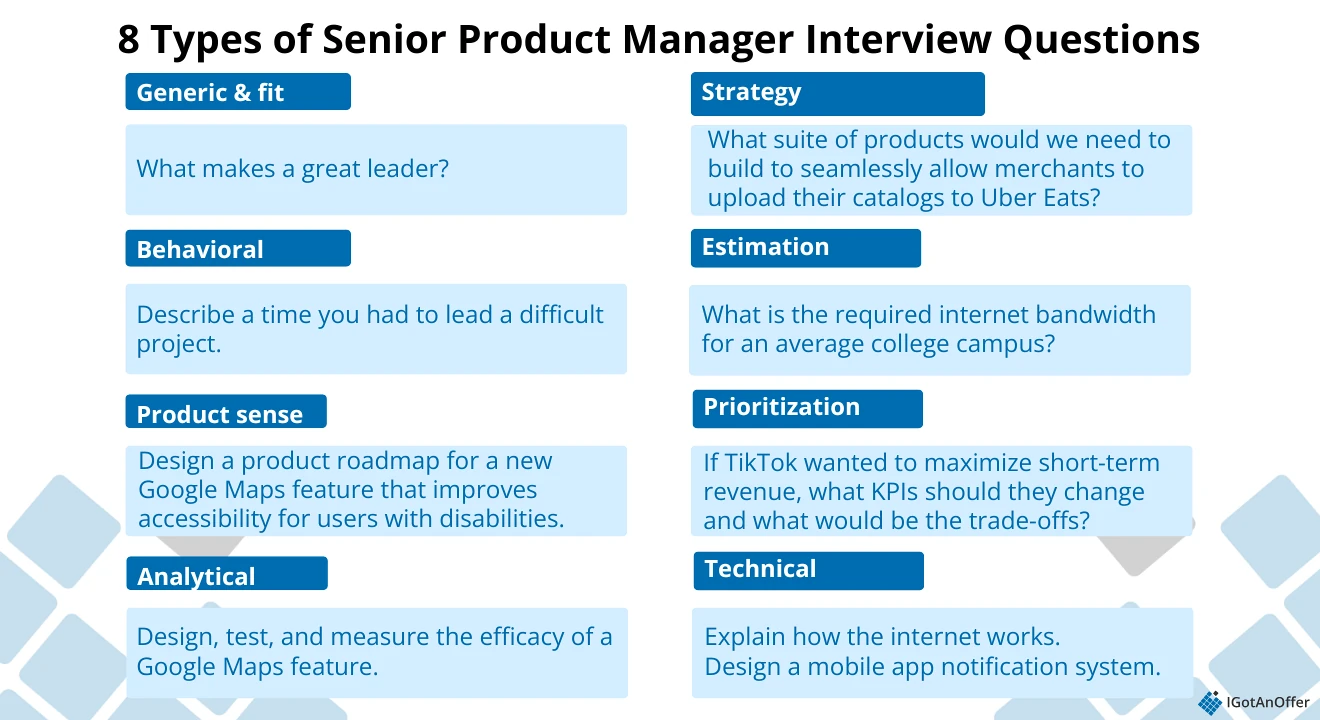
In this section, let’s get into the most common questions you’ll get in your senior PM interviews. These questions have been reported via Glassdoor for the following companies: Google, Meta, Amazon, Microsoft, Apple, Uber, TikTok, DoorDash, and Coinbase.
Based on our analysis of the most recently reported questions online, a senior product manager gets the same question categories as an entry-level or mid-level PM gets. They are as follows:
- Generic and fit
- Behavioral
- Product sense
- Analytical
- Strategy
- Estimation
- Prioritization and trade-offs
- Technical
Note that in most cases, you’ll get product case questions or project retrospectives where you’ll get multiple types of question themes. For instance, you may initially get a product design question, and then your interviewer might follow up with a success metrics or strategy question.
This section was written with insights from one of our PM interview experts, Yue. She has 15+ years of leadership experience at Lyft, Google, and other top companies and startups. She has interviewed hundreds of PMs across all levels (Director+) and authored PM career ladders and various orgs' interviewing and hiring processes.
2.1.1 Generic and fit questions↑
You’ll get asked generic and fit questions at any point in the senior PM interview process. Expect standard questions about your experience and suitability for the role, as well as about your motivation for applying to the company, i.e., "fit" or "cultural fit” questions.
This category of questions is probably the most straightforward, but you still need to prepare for them. Interviewers at top companies expect structured, compelling answers that demonstrate strong motivation and clear thinking. For culture fit, you’ll need to dive into your target company’s culture, like Googleyness, Amazon’s Leadership Principles, or Anthropic’s Culture.
Below are a few examples.
Example senior PM questions: generic and fit
- Tell me about yourself (video answers)
- Why do you want to work at this company? (video answers)
- What are your strengths and weaknesses?
- What makes a great leader?
- How do you handle stress?
- How do you achieve work-life balance?
Learn more about how to answer the "Why this company" question.
2.1.2 Behavioral questions↑
Tech companies use behavioral interviews to assess product managers based on their past experiences. Like generic and fit questions, behavioral questions appear at every stage of the interview process.
Expect plenty of behavioral questions as a senior PM candidate, particularly centered around emergent leadership. According to Yue, your senior PM behavioral interview should cover your experience and ability to:
- Influence without authority across XFN teams
- Align stakeholders around a coherent roadmap
- Drive decision-making in ambiguous or conflicting environments
- Influence across larger parts of the organization
If you want to prove you’re a strong senior PM candidate, you’ll need to provide answers that demonstrate a clear stakeholder management strategy and conflict resolution skills. You also need to have stories showing you can operate in ambiguity without escalation dependency. Finally, you should show an ownership mindset, i.e., confidently saying “this is my outcome” versus saying “my team’s work.”
Meanwhile, you’ll give weak signals if your answers sound defensive, as this shows a lack of ownership in your work. If you also don’t have conflict navigation experience, you likely won’t qualify as a senior PM.
Let’s take a look at some example questions.
Example senior PM questions: behavioral
- How would you handle a situation where your engineering lead strongly disagrees with the product direction you’ve proposed?
- Describe a time you had to lead a difficult project.
- Tell me about a time when you had to deliver bad news.
- Tell me a time when you worked on another person's task.
- How do you deal with pushback from creatives?
Check out our guide on PM behavioral interview questions for a list of common questions asked at top companies, along with an effective answer framework.
2.1.3 Product sense questions↑
Product sense interview questions are designed to evaluate how you work to understand common product challenges and how you identify the best way to approach them. Of all the interview questions you’ll get, they’re the most crucial.
At a more senior level, Yue says that your product sense interviews will be “less about 'coming up with ideas' and more about structured judgment under constraints.”
According to Yue, to show you’re a strong senior PM candidate at a product sense round, you’ll need to demonstrate your ability to come up with a structured decomposition of user + problem space and clear prioritization logic. When proposing a product design or talking about a past project, you show insight-driven thinking (as opposed to focusing solely on feature brainstorming). And finally, you can connect user needs to product bets and outcomes.
On the other hand, if you tend to feature dump, show shallow user understanding, and have no prioritization framework, you’ll show you’re not ready for a senior PM role.
Below are a few product sense example questions. To help you organize your prep, we’ve subcategorized them into two: product design and product improvement.
Example senior PM questions: Product sense
Product design
- Design a product roadmap for a new feature in Google Maps that improves accessibility for users with disabilities.
- Build a product for volunteering.
- Design Uber Eats for packaged meals.
- Build an ATM in an Airport
- Design a search engine for kids
Product improvement
- How would you improve a Facebook feature?
- How would you improve ChatGPT?
- How would you fix the worst post-booking experience for Airbnb?
- Tell me your three favorite products and why. Pick one and walk through how you would improve it.
Read our guides on product design questions and product improvement questions to dive deep into the topics and learn the best approach for each interview.
Coaches who contributed to this guide









2.1.4 Analytical questions↑
Analytical interview questions are also known as metric questions. These questions are designed to assess how you execute solutions.
According to Yue, you’re expected as a senior PM to demonstrate end-to-end execution clarity. This means you can drive delivery end-to-end across design, engineering, data, and GTM (Go to Market) and operate with high autonomy and reliability.
Additionally, if you’re targeting a senior PM role in AI-native environments, additional expectations include the ability to rapidly prototype, test, and iterate using AI tools (e.g., LLM prototyping, mock UX, specs, launching experiments).
Yue says to show you’re a strong senior PM candidate at an analytical round, you’ll need to be able to clearly define MVP (minimum viable product) vs iteration path and demonstrate practical sequencing, i.e., what ships first and why. When deciding, you show awareness of dependencies, risks, and tradeoffs. And finally, you can create a robust measurement plan (success metrics, experiment design).
If you can only come up with a single solution with no iteration plan, show that you don’t look ahead and round corners to proactively unblock, and are not clear on how to validate success, you’re showing interviewers you’re not senior PM material yet.
Below are a few analytical example questions. To help you organize your prep, we’ve subcategorized them into two: metric definition and metric change.
Example senior PM questions: Analytical
Metric definition
- Design, test, and measure the efficacy of a Google Maps feature
- You work at Instagram Direct Messages and you've built Meta AI. Why did you build it? What metrics will you track for success?
Metric change (root cause)
- Google Search is seeing a decline in engagement among teenagers. How would you identify the root cause and propose a strategy to improve usage in this segment?
Read more on metric questions and how to use the GAME framework in our guide on how to crack metric questions in product manager interviews.
2.1.5 Product strategy questions↑
Product strategy questions assess how well you take into account different aspects, such as competition, pricing, marketing, time to market, etc., when making product decisions. They also test your ability to set the product vision and articulate a roadmap to deliver it.
According to Yue, to signal as a strong senior PM candidate, you’ll need to show that you’re capable of anchoring decisions in company goals and business metrics. You also need to demonstrate you can identify opportunity spaces and leverage points, i.e., where impact is highest, and know how to go from strategy to roadmap.
Let’s take a look at some example product strategy questions.
Example senior PM questions: Product strategy
- What suite of products would we need to build to seamlessly allow merchants to upload their catalogs to Uber Eats?
- What is a product that you would build and why? How would you go about funding this product? How would you identify the work needed for this product to be successful?
- If you had to triple revenue at X company, how would you do it?
- You're PM at Lyft. How do you improve quality in the next 6 months
- Describe how you would sunset a product.
Read our guide to answering product strategy interview questions for a deeper dive into the question category.
2.1.6 Estimation questions↑
Estimation or ‘guesstimate’ questions require you to assess market sizes, revenue potential, the number of customers, etc. You’ll need to be comfortable with mental math to ace this interview question.
For senior roles, estimation questions are not as typical so you might not even get them. However, you should still be ready for them. Senior PMs at Google and X (formerly Twitter) reportedly still get estimation questions. In any case, comfort with mental math can help you in other, more crucial questions like metrics and strategy.
Estimation questions did not show up as prominently in our research of more recent senior PM interview questions. So here are a few that have been reported for general PM interviews.
Example senior PM questions: Estimation
- What is the market size for driverless cars in 2026?
- What is the market size for toilet paper in the US?
- What is the storage space required to host all images on Google Street View?
- What is the required internet bandwidth for an average college campus?
Consult our guide to answering estimation interview questions to best prepare yourself for this category.
2.1.7 Prioritization and trade-off questions↑
There are many different features a PM could prioritize on a given product, as well as different conclusions as to which projects are the most impactful.
Interviewers use prioritization and trade-off questions to assess how clearly and consistently you’re able to choose the right opportunities to prioritize. They want to see you exercise a clear prioritization framework and reason through trade-offs.
Example senior PM questions: Prioritization and trade-off
- Describe your role in making tech decisions and priorities
- How would you handle communicating conflicting priorities between 2 different stakeholders?
- If TikTok wanted to maximize short-term revenue, what KPIs should they change and what would be the trade-offs?
To learn more, see our guide to answering product prioritization questions.
2.1.8 Technical questions↑
If you’re targeting a senior platform PM role or any technical team, expect to get technical questions. The number and kinds of technical questions you’ll get will depend on the exact role and company. You might get technical explanation questions, AI ML fundamental questions, or system design challenges.
With technical questions, interviewers are looking to evaluate a senior PM's ability to collaborate effectively with engineering on feasibility and architecture decisions. To qualify, you should be “technically conversational and decision-capable,” according to Yue.
Below are examples of technical questions PMs generally get.
Example senior PM interview questions: Technical
General
- How does Google Calendar work?
- Explain recursion to your grandmother
- What technologies would you use to build a live stream video service?
- Explain the concept of "protocol" to a 4-year-old child
- What is the difference between C++ and Java?
- Explain what happens when executing mergesort
- When are Bayesian methods more appropriate than "Artificial Intelligence" techniques for predictive analytics?
- How would you most efficiently store large images in a database?
- Explain the concept of big O notation
- How would you get authentication to work across domains?
AI/ML
- What’s your criteria in selecting a model?
- How do you evaluate a prompt?
- How do you keep up to date with AI trends?
- What’s your understanding of the RAG (Retrieval-Augmented Generation) framework?
- Are you familiar with RLHF (Reinforcement Learning from Human Feedback)?
- Tell me what you know about DPO (Direct Preference Optimization).
- What’s your understanding of Generative AI?
- What are the essential differences between NN (Neural Networks) vs LLM (Large Language Models)?
- What are the strengths and weaknesses of classic ML models and the implications for the product?
- When will you use rule-based infrastructure vs. NN vs. LLM models?
System design
- Design a real-time messaging system (e.g., Slack or WhatsApp)
- Design a social media feed (e.g., Twitter/X or Instagram)
- Design a video streaming service (e.g., Netflix or YouTube)
- Design a search autocomplete feature
- Design a rate-limiting system for an API
- Design a URL shortening service
Consult our guides on answering technical interview questions and system design questions for PMs to prepare yourself for this category.
2.2 More senior PM interview questions per company↑
The core requirements for senior product managers are similar across top tech companies. However, there are some slight differences in what they focus on when hiring PMs, especially at the senior level.
For instance, Google is keen on PMs with strong technical backgrounds. Amazon clearly makes a distinction between a standard PM and a technical PM. Uber prioritizes hiring PMs with systems-level experience. These differences show up in the types of questions interviewers raise during a senior PM interview.
So if you want to have an idea about the kinds of questions your target company has been asking in recent years, this section is for you. Feel free to click on your target company for the relevant list.
2.2.1 Google senior product manager interview questions↑
- Google Search is seeing a decline in engagement among teenagers. How would you identify the root cause and propose a strategy to improve usage in this segment?
- Design a product roadmap for a new feature in Google Maps that improves accessibility for users with disabilities.
- How would you handle a situation where your engineering lead strongly disagrees with the product direction you’ve proposed?
- You're a PM for Google Maps. You want to expand the product for ski maps.
- Design a product that helps blind people in the kitchen routine.
- Describe how you would sunset a product.
- Design, test, and measure the efficacy of a Google Maps feature.
- How would you design a collaboration app (similar to Google Docs)
Click here to learn more about the Google PM interview process.
2.2.2 Meta senior product manager interview questions↑
- Describe a time you had to lead a difficult project.
- How would you improve a Facebook feature?
- Build a product for volunteering.
- You work at Instagram Direct Messages and you've built Meta AI. Why did you build it? What metrics will you track for success?
- How would you go about building a tool to match doctors to patients?
- Design a gardening solution for Meta. Does a gardening solution make sense for Meta?
- Set a success metric for Instagram Reels.
- Design a mentoring product for Meta.
- What is the top-line metric for Wolt, and how would you define a goal for the upcoming year?
- If engagement of a product dropped and others increased — what would you do? Find the problem if one product failed.
- Design a physical product for Meta.
Click here to learn more about the Meta PM interview process.
2.2.3 Amazon senior product manager interview questions↑
- Describe a time when you had to take a risk or make a decision with incomplete information.
- Tell me about a time when you had to deliver bad news.
- What is the biggest project you have done, and what was its impact?
- Tell me about a time when you solved a problem that had many layers to it.
- Can you walk me through a product you owned from discovery to launch?
- Tell me a time when you worked on another person's task.
- Tell me about a time when you missed a deadline.
- Tell me about a situation when you disagreed with your manager.
- If TikTok wanted to maximize short-term revenue, what KPIs would they change? Would those change for long-term growth? How would you define metrics? What would be the trade-offs? How would those KPIs shape roadmap and investment decisions? How do you build alignment around KPIs that may conflict across orgs?
Click here to learn more about the Amazon PM interview process.
2.2.4 Apple senior product manager interview questions↑
- Tell me about the impact you created.
- How would you handle communicating conflicting priorities between two different stakeholders?
- How do you deal with pushback from creatives?
- How technical are you, on a scale of 1-10?
- How will you measure a feature you build?
- Tell me about a time when you failed. Not when you failed and learned or course corrected but when you actually totally failed.
- Describe a situation with a difficult team member, how did you manage the conflict and what was the outcome?
- In your last job, who was the most difficult person you worked with and why was it difficult to work with them? How did you make that successful?
- What was the most original, out-of-the-box result that happened due to your suggestion and drive?
Click here to learn more about the Apple PM interview process.
2.2.5 Uber senior product manager interview questions↑
- Why Uber?
- Why are you looking for a role?
- What’s a feedback did your manager give you recently?
- Build Uber for kids.
- What suite of products would we need to build to seamlessly allow merchants to upload their catalogs to Uber Eats?
- Tell me one of the features you implemented at one of your stints.
- What's your favorite app - how would you make it better?
- Design Uber Eats for packaged meals.
- Design cash payments for rides.
- How would you migrate restaurant menus into Uber Eats in a scalable way?
Click here to learn more about the Uber PM interview process.
2.2.6 Stripe senior product manager interview questions↑
- Walk me through how you build a product from scratch.
- Build an ATM in an airport.
- What are your three favourite products? Pick one and tell me how you'd adapt it for schools.
Click here to learn more about the Stripe PM interview process.
2.2.7 Coinbase senior product manager interview questions↑
- How would you improve ChatGPT?
- Describe your role in making tech decisions and priorities.
- Tell me about a time when you led a product or feature launch from ideation to execution.
- Tell me about the times you disagreed with someone on your team: once when you were right, and once when you were wrong.
Click here to learn more about the Coinbase PM interview process.
2.2.8 DoorDash senior product manager interview questions↑
- If you had to triple revenue at X company, how would you do it?
- Design TicketMaster.
- How would you fix the worst post-booking experience for Airbnb?
- How would you go about finding out the worst experiences post-booking at American Airlines?
- Choose from Craigslist, Etsy, Rover, etc. How do you 3x revenue in 5 years?
- You're a PM at Lyft. How do you improve quality in the next 6 months?
- Talk about a time you led a risky initiative, a time when you faced pushback from XFN, a time you received negative feedback?
Click here to learn more about the DoorDash PM interview process.
2.2.9 LinkedIn senior product manager interview questions↑
- If you're a founder of a Gen AI startup, what kind of questions would you think about to figure out the startup's strategy and direction?
- Would it be a good idea to create a separate Messenger app for LinkedIn, similar to Facebook Messenger? Why or why not?
- Why is ecosystem so important to LinkedIn?
- What new business should LinkedIn start?
Click here to learn more about the LinkedIn PM interview process.
2.2.10 Microsoft senior product manager interview questions↑
- Design a search engine for kids.
- Design an online learning platform.
- Tell me about a feature that you were in charge of. Tell me about the entire process from beginning to release as a product manager.
- You are a product manager of a supermarket brand, and the CEO decided to build a branch that’s dedicated to disabilities. How would you design it?
- How would you use Copilot in an innovative way?
Click here to learn more about the Microsoft PM interview process.
2.2.11 TikTok senior product manager interview questions↑
- Tell me about your most impactful project.
- Tell me a time when you used data to improve a product.
- An inappropriate video has slipped through the guardrails. What do you do?
- What is a product that you would build and why? How would you go about funding this product? How would you identify the work needed for this product to be successful?
- How can users be prevented from returning or getting RTS (Ready-to-ship) status?
- Imagine you are in the early stages of Uber. How would you design an experiment to validate whether Uber should launch Uber Pool?
Click here to learn more about the TikTok PM interview process.
2.2.12 Spotify senior product manager interview questions↑
- How do you handle ambiguous situations?
- How do you navigate organizational complexity?
- How would you launch a new product in a new market?
- How do you rely on data in organizing projects?
- Tell me about a time you delivered a feature which didn't work as expected.
- How do you measure success?
- How do you deliver feedback to the team and build trust?
- How do you solve problems within the team?
Click here to learn more about the Spotify product manager interview process.
3. What you need to show in interviews to qualify as a senior PM↑
In this section, we’ll dive deeper into how you can separate yourself as a senior product manager at a top tech company, whether that’s FAANG+, an emerging AI lab, or a startup.
We’ll look into the skills companies are looking for in a senior PM and whether you need AI fluency, with insights from PM interview expert Yue.
And then we’ll go into the three signals that distinguish a strong hire from a no-hire, with insights from ex-Meta product leader Audrey.
3.1 What skills and qualities are companies looking for in a senior PM?
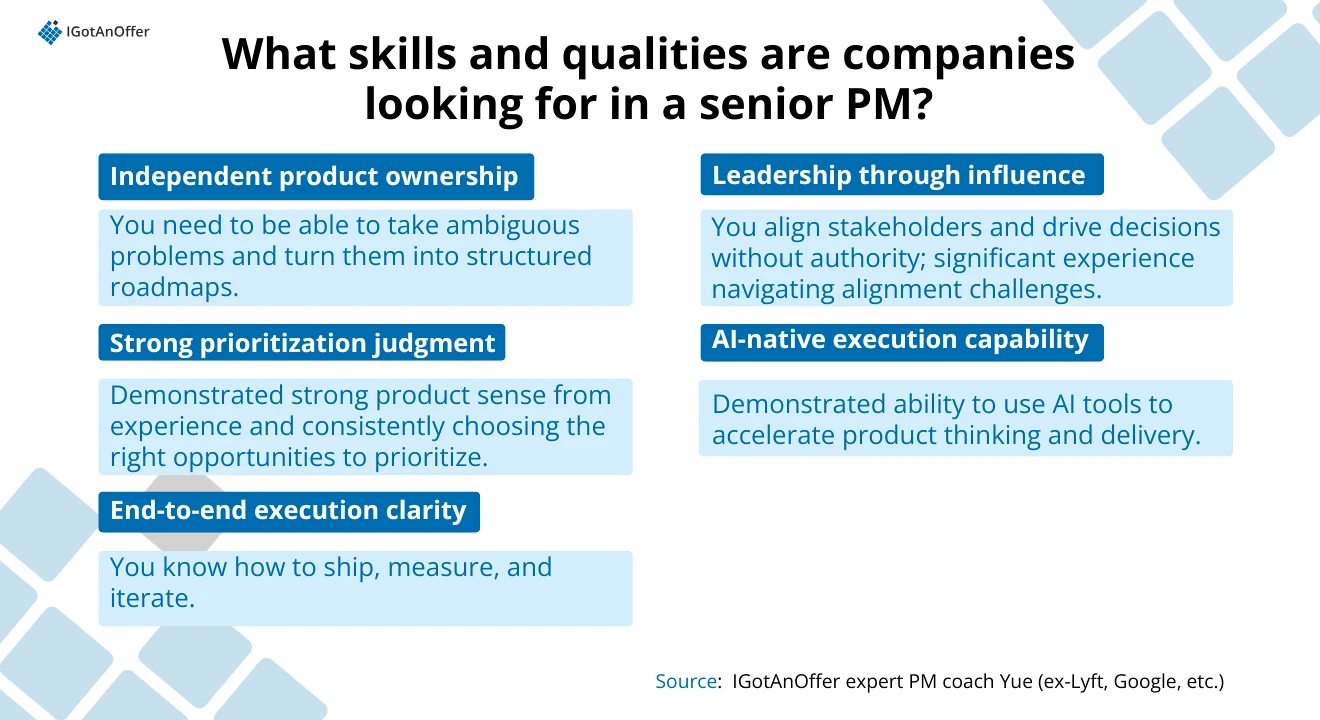
According to Yue, when companies interview senior PM candidates, they are looking for high-level evidence of:
- Independent product ownership
As a senior PM, you won’t just be shipping products. “You need to be able to take ambiguous problems and turn them into structured roadmaps,” Yue says.
- Strong prioritization judgment
At the senior PM level, it's expected that you can demonstrate solid hard skills around product sense and execution.
For Yue, this means “you have demonstrated strong product sense from experience and can consistently choose the right opportunities to prioritize.”
- End-to-end execution clarity
“You know how to ship, measure, and iterate,” Yue says. This means you won’t just offer a single solution but can look further ahead and branch out into other possibilities.
- Leadership through influence
To qualify as a senior PM, you’ll need to show that you can lead and influence even without authority.
To demonstrate this, Yue says you need to prepare stories where “you align stakeholders and drive decisions without formal authority, and have significant experience in navigating difficult alignment challenges.”
- AI-native execution capability
You don’t need to be an ML engineer or an AI expert. But to differentiate yourself, you do need to demonstrate the ability to use AI tools to accelerate product thinking and delivery.
3.2 Do you need AI fluency as a senior PM?
Speaking of AI skills, we asked Yue about the level of AI fluency needed in a senior PM.
“Today’s baseline expectation (especially at modern product orgs) is that a Senior PM should demonstrate AI-native product fluency,” she says.
What does AI-native product fluency mean? According to Yue, it means having:
- The ability to use AI tools to accelerate:
- prototyping (wireframes, mock flows, clickable concepts)
- PRDs and specs
- experimentation ideas and analysis
- An understanding of where AI meaningfully changes product design (i.e., not just “adding AI features”)
- An awareness of LLM constraints (hallucinations, latency, eval, cost tradeoffs)
- The ability to think in terms of human + AI systems, not just traditional software
That being said, for most roles, PMs are not expected to be an ML engineer or an AI expert. But as a senior PM operating in an increasingly AI-first work environment, you are expected to be a builder who uses AI as a default execution multiplier.
3.3 What distinguishes a strong hire vs. no-hire?
In this section, we’ll be talking about the 3 signals that differentiate a strong PM hire from a no-hire.
This is based on Audrey’s experience in interview debrief meetings at Meta, where she has over 7 years of product leadership experience and over 200 interviews under her belt. Still, it’s an excellent guide if you want to stand out as a senior PM candidate at the most competitive tech companies.
Let’s get into the signals.
- Commitment signal
In an interview, Audrey says there’s always one specific moment where she can spot a no-hire immediately. It is when she asks for a target metric number, and the candidate freezes, talks in circles, and says things like ‘I could get some data from the current market and get some cross-functional alignment, and then I'll probably come up with a number.’
According to Audrey, this shows a lack of leadership. “If you can't commit to a hypothesis in an interview, how could a big company like Meta trust you to set a goal for a 50-person engineering org?”
A strong senior PM hire will understand that coming up with the correct number isn’t the point. What matters is if your logic is sound. “You don't talk around the question; you build a bridge to the number,” Audrey says.
- Ruthless prioritization signal
Prioritization is a core competency every PM should have. But, according to Audrey, every PM candidate can say they know how to prioritize simply because they know the RICE framework or Impact vs. Effort. To qualify as a senior PM, you need to show you have the courage to kill good ideas to make sure the great ones have the resources to win.
“When you're willing to kill a good feature to save your North Star, you're showing me you have sound judgment. That's the kind of maturity that gets people hired,” Audrey says.
A no-hire will pick one feature as the highest priority with weak logic and promise the other features in phase 2.
Meanwhile, here’s how a strong hire will answer a prioritization question: ‘To make this product successful, I am explicitly choosing not to build the automated onboarding flow. Even though it's a high-request item, it distracts from our core mission of democratizing production. Instead, we should invest our engineering into the AI editing engine, because if the engine isn't world-class, the onboarding flow won't matter.’
- Ownership signal
Most candidates prepare hero stories for their behavioral interviews. But what interviewers like Audrey actually want to hear are your failure stories. Not scripted ones where you go from failure to lesson like ‘Well, we had a project. It didn't hit its numbers, but I quickly gathered the team, we did a retrospective, and we all learned that communication is key.’
To show you’re ready to be a senior PM, you need to walk your interviewer through a failure and treat it like a professional postmortem. Show where your judgment fell off and own up to it.
“When you show that kind of vulnerability, you aren't showing me that you can fix a roadmap, you're showing me you fixed yourself,” Audrey says.
Companies like Meta need leaders who can lead a team through a crisis and have enough humility to realize that their title actually doesn't make them the smartest person in the room.
Check out the video below to hear directly from Audrey and learn how to better position yourself as a strong PM candidate.
4. How to prepare for a senior PM interview↑
As you can see from the complex questions above, there is a lot of ground to cover when it comes to senior PM interview preparation. So it’s best to take a systematic approach to make the most of your practice time.
Below are links to free resources and a plan to help you prepare for your senior PM interviews.
4.1 Know the PM interview process
The best way to prepare for the PM interview process is to familiarize yourself with how it works.
When you get an interview for a senior PM role, you’ll still be evaluated on your PM fundamentals. Therefore, expect to undergo the same standard PM interview process.
Below, we have a list of our company-specific interview guides, where we walk you through everything you need to know to prepare:
- Google product manager interview guide
- Meta product manager interview guide
- Amazon product manager interview guide
- OpenAI product manager interview guide
- Microsoft product manager interview guide
- LinkedIn product manager interview guide
- Uber product manager interview guide
- Stripe product manager interview guide
- Lyft product manager interview guide
- Apple product manager interview guide
- TikTok product manager interview guide
- Coinbase product manager interview guide
- DataBricks product manager interview guide
- Airbnb product manager interview guide
- DoorDash product manager interview guide
- NVIDIA product manager interview guide
- Spotify product manager interview guide
- Netflix product manager interview guide
- Capital One product manager interview guide
- Oracle product manager interview guide
To brush up on your product fundamentals, get started with our guides below:
- Product sense
- AI product sense
- Product design
- Product improvement
- Product strategy
- Product execution
- Strategy questions
- Product metric questions
- Technical questions
- Estimation questions
- Prioritization questions
- AI PM interview questions
4.2 Learn about your target company’s products
If you’ve already got a target company, make sure you read up on their products. Most companies will have a specific landing page for their products and features, so that’s a great place to start.
Meta
- Meta annual reports and strategy presentations (by Meta)
- Meta's approach to tech trends (by CB Insights)
- How to write a great product strategy (with Meta Director)
- Google’s product management practices
- 42 Rules to Lead by from the Man Who Defined Google's Product Strategy
Amazon
- The product model at Amazon (by Silicon Valley Product Group)
- Amazon’s working backwards method (by Product Plan)
4.4 Practice mock interviews
Once you’re in command of the subject matter, you’ll want to practice answering questions.
Here’s a quick summary of what Yue calls high ROI prep areas, specifically for senior PMs. Use this as a checklist to focus your prep:
- Product case frameworks (problem decomposition + prioritization under constraints) - while related to product work, the product case is its own style of interview question that needs significant practice to perfect
- Metrics thinking (what defines success and why) - aim to practice coming up with executive dashboards to measure high-level company metrics, ways to dig into when metrics are not moving as expected
- End-to-end narratives (problem → insight → decision → execution → impact)
- Behavioral stories mapped to leadership + influence + conflict resolution
- AI-native execution workflows (how you would prototype, test, and iterate quickly)
Start practicing by yourself. Act the part of the interviewer and interviewee. You can also record yourself to assess your performance.
This should just be the first part of your practice. Because by yourself, you can’t simulate thinking on your feet or the pressure of performing in front of a stranger. Plus, there are no unexpected follow-up questions and no feedback.
That’s why many candidates try to practice with friends or peers.
4.4.1 Practice with peers
If you have friends or peers who can do mock interviews with you, that's an option worth trying. It’s free, but be warned, you may come up against the following problems:
- It’s hard to know if the feedback you get is accurate
- They’re unlikely to have insider knowledge of interviews at your target company
- On peer platforms, people often waste your time by not showing up
For those reasons, many candidates skip peer mock interviews and go straight to mock interviews with an expert.
4.4.2 Practice with experienced AI PM interviewers
In our experience, practicing real interviews with experts who can give you company-specific feedback makes a huge difference.
Find a product manager interview coach so you can:
- Test yourself under real interview conditions
- Get accurate feedback from a real expert
- Build your confidence
- Get company-specific insights
- Learn how to tell the right stories, better.
- Save time by focusing your preparation
Landing a job at a big tech company often results in a $50,000 per year or more increase in total compensation. In our experience, three or four coaching sessions worth ~$500 make a significant difference in your ability to land the job. That’s an ROI of 100x!

 System design