

 Back to other articles
  Last updated: August 27, 2026

 Interviews
 Behavioral
 Deeply researched
If you're interviewing for a role at Capital One, be prepared to face challenging behavioral questions during your interview process. As the questions may not seem difficult when compared with technical or case interviews, candidates frequently overlook them.
However, these open-ended behavioral questions are important for interviewers to find out if you're a good fit for Capital One. So you'll want to prepare for these questions and use them to distinguish yourself from other candidates.
To help you, we've created this interview prep guide on what you need to know to prepare for Capital One's behavioral interview questions, including real example questions, how to answer them, and a practice plan to make sure you land your dream job at Capital One.
Here's a brief overview of what we'll cover.
- What is a behavioral interview at Capital One?
- 40+ Capital One behavioral interview questions
- How to answer Capital One behavioral interview questions
- Tips to impress your interviewer
- How to prepare for a Capital One behavioral interview
Click here to practice 1-on-1 with ex-interviewers from Capital One
Capital One's behavioral interviews typically come after the Virtual Job Tryout and recruiter screen. If you haven't passed those earlier stages yet, our process guide and VJT guide will be more useful first.
1. What is a Capital One behavioral interview?↑
Capital One uses behavioral interviews to assess job candidates based on their past experiences. These questions typically start with "Tell me about a time you…" and focus on soft skills, such as leadership, communication, teamwork, problem-solving, etc.
For the purpose of this article, we've also included some resume, HR, and hypothetical questions, such as "What are your strengths and weaknesses?" or "How would you...?" These are typical questions that past candidates have reported getting in their behavioral rounds, so we've added them here to make sure you're ready for anything.
These questions will appear at every step of the interview process at Capital One, from the initial recruiter screen all the way through to the Power Day interviews. They may even appear as icebreakers or transition questions during case interviews. The frequency and type of behavioral questions will vary per role, but be prepared for many.
Since behavioral questions are just one part of the Capital One interview process, you may also want to check out our other Capital One interview guides to familiarize yourself with the entire process.
- Capital One interview process guide: Complete overview of the 8 steps to getting an offer, from screenings to salary negotiation
- Capital One case interview guide: Learn how to ace the case interviews that are central to many Capital One roles
- Capital One product manager interview guide: Comprehensive prep for PM-specific interviews, including product strategy and execution questions
- Capital One business analyst interview guide: Comprehensive prep for BA-specific interviews, including types of questions with examples and answer frameworks
1.1 What is Capital One looking for in a candidate?
An interviewer at Capital One will be looking for candidates who demonstrate their core values and fit with the company's unique culture:
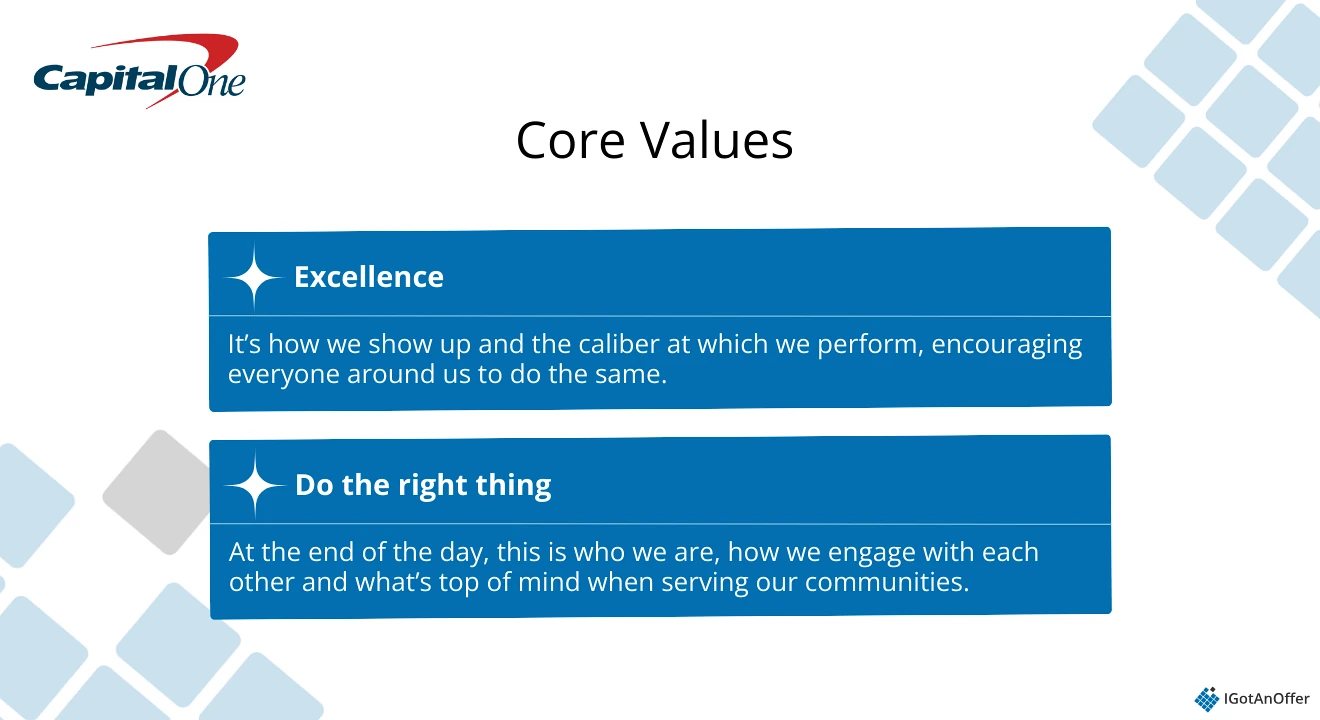
Beyond their core values, Capital One also emphasizes:
- Innovation and technology: Unlike traditional banks, Capital One positions itself as a technology company that does banking. Your interviewer will want to see that you can think creatively, embrace new technologies, and drive innovation.
- Data-driven decision-making: Capital One was founded on the principle of using information and analytics to make better business decisions. Interviewers will look for evidence that you can analyze data, draw insights, and make informed decisions.
In the next section, we've listed some of Capital One's top behavioral questions to give you an idea of what you're up against.
2. 40+ Capital One behavioral interview questions↑

To help you prepare strategically for your job interview, we have used Glassdoor data and other sources to gather real behavioral questions asked in different Capital One interviews. The questions we've chosen reflect what candidates have reported across various roles, including product managers, data analysts, software engineers, and business analysts.
You'll notice that we've divided the questions into the following categories:
We've added these categories to make the list of questions easier to refer to during your prep, starting with the general questions that apply to any job.
Each category tests different core competencies that Capital One looks for in its candidates, and the frequency of each question type will vary depending on the role. For instance, interviews for managerial roles will include a higher number of leadership questions.
Note that some questions have been slightly edited for clarity or grammar.
2.1 Capital One behavioral questions: General
First up are the general behavioral questions that may come up for any role. Here, your interviewer is looking for an overall view of your past experiences and what you will be like as an employee at Capital One. You'll see that regardless of the role, Capital One is curious about your professional background, your motivations, and why you want to work for them specifically.
These are good questions for you to demonstrate your alignment with Capital One's values of ‘Excellence’ and ‘Do the right thing’. They also want to see how you learn and grow from past mistakes, and that you've done your research on Capital One itself.
Practice demonstrating those values using the questions below.
Example general behavioral questions asked at Capital One interviews
- Why Capital One? (See sample answers for Amazon.)
- Tell me about yourself.
- Walk me through your resume.
- Tell me about a challenge or conflict you faced at your past/current job. How did you handle it?
- Tell me about your biggest achievements in your past work.
- Tell me about the last time you failed, and what happened.
- Tell me about the skills that you possess that will help you succeed in this role.
- Why this position? Where do you see your career moving?
- Why are you leaving your former position?
- What are your strengths and weaknesses?
- What sets you apart from the other candidates?
- Why did you pivot to finance?
- Where do you see yourself in the future?
- What type of work environment do you prefer?
- Do you prefer working alone or as part of a team?
- How would you describe your work style?
- How do you keep yourself organized at work?
- How do you cope with pressure, stress, or change?
- Do you have interests outside of work?
- What do you like to do outside of work?
- What's your proudest achievement?
2.2 Capital One behavioral questions: Teamwork
For many roles at Capital One, you’ll have to work in cross-functional teams with other engineers, product managers, data analysts, etc. You'll need to be able to communicate clearly, work efficiently with others, and build trust and relationships.
Your interviewer will be looking for you to share stories from your past experience that demonstrate a spirit of collaboration and partnership. Give it a try using the following questions.
Example teamwork behavioral questions asked at Capital One interviews
- Can you explain a time when you had a different viewpoint from your teammates? How did you handle the disagreement? What actions did you take, and what was the result?
- Describe a time you had to resolve a difficult situation or conflict on the job.
- Tell me about a time you had to resolve a conflict in a team.
- Tell us about a time you had to communicate with stakeholders.
- Can you describe a time you had to negotiate with someone?
- How do you work with difficult people/stakeholders?
2.3 Capital One behavioral questions: Leadership
In addition to a collaborative nature, Capital One is looking for employees who demonstrate leadership. This is because most roles will involve not only working in teams, but also leading them when appropriate.
As a result, you should expect questions about your approach to developing and retaining team members, your ability to lead teams through difficult situations, how you resolve conflict, etc. Of course, expect these questions to come up more frequently when interviewing for a managerial or leadership position.
Example leadership behavioral questions asked at Capital One interviews
- Tell me about a time you demonstrated leadership even though you weren't the formal manager.
- Describe a time you took a leadership role.
- Describe a time you went above and beyond for work.
- Tell us about a time you had to present to a large audience.
- What was a time you challenged the status quo?
For a deeper dive into answering leadership questions effectively, check out our leadership primer for tech interviews. It covers key leadership principles and frameworks that interviewers look for across the tech industry.
2.4 Capital One behavioral questions: Problem-solving
You may also be asked one or multiple problem-solving questions, which dive into how you effectively approach challenges. Capital One's culture emphasizes data-driven decision-making and innovation, so interviewers want to see how you think through problems.
Example problem-solving behavioral questions asked at Capital One interviews
- How do you address a problem and ideate a solution?
- Tell me about a time you managed a difficult situation.
- Describe a situation where you had to handle a customer complaint.
- Describe a time you made a mistake. How did you handle it?
- What is one piece of feedback that a manager gave you at a previous internship that you take with you?
- Tell me about a time you learned something new quickly.
- Describe a time you set a goal for yourself and followed through.
2.5 Capital One behavioral questions: Role-specific
Capital One also asks behavioral questions tailored to specific roles. We’ve gathered some questions specific to these roles:
- Data analyst
- Product manager
- Software engineer
- Business analyst
Here are the most common questions for each major role family:
Example behavioral questions asked at Capital One
Data analyst behavioral questions focus on stakeholder management, project impact, and handling challenges with data:
- Describe a time when you helped someone.
- What's your most proud data project?
- Describe an example where you had to work with different stakeholders and manage their priorities.
Product manager behavioral questions emphasize cross-functional collaboration, tradeoffs, and strategic thinking:
- Why product management at Capital One?
- Describe a time you had to make a tradeoff between business outcomes and technical decisions.
- Describe any challenges that a product you worked on faced.
- Tell me about a time you dealt with difficult stakeholders.
- Tell me about a time when you led different teams from different departments in collaboration during a product launch.
- Tell me about a time when you used strategic thinking to handle a complex business problem.
- Tell me about a time when you had to communicate complex ideas under pressure.
For more on Capital One product management interviews, see our Capital One product manager interview guide.
Software engineer behavioral questions focus on conflict resolution, learning agility, and technical collaboration:
- Tell me about a time you previously handled conflict in the workplace.
- If you and a colleague disagree on how to proceed with a project, what are the reconciliation/compromising steps you would take?
Business analyst behavioral questions focus on leadership, collaboration, and your alignment with Capital One's culture and values.
- Why do you want to work at Capital One?
- Why this role / why Business Analyst at Capital One?
- Tell me about a time you failed. What did you learn?
- Describe a time you overcame a difficult project.
- Tell me about a time you worked with a difficult teammate.
- Describe a time you managed multiple stakeholders.
- Tell me about a time your work made a measurable impact.
- How do you set priorities when critical tasks have similar urgency?
- What are your strengths and weaknesses?
- Name a time when you went out of your way to help someone with no direct benefit to yourself.
- Describe a time you had to make a difficult choice in a leadership role.
- Tell me about a time you made a mistake.
For more on Capital One business analyst interviews, see our Capital One business analyst interview guide.
Business analyst candidates primarily face the general behavioral questions listed in section 2.1, with the role differentiation happening more in case interviews than behavioral interviews. For business analyst case preparation, see our Capital One case interview guide, but if you're targetting a data science role, check our Capital One data scientist interview guide.
For more practice and guidance on behavioral questions, check out this comprehensive guide to the 40+ most asked behavioral interview questions.
3. How to answer Capital One behavioral interview questions↑
Now that you've seen some of Capital One's top questions, let's work on a technique for answering them.
3.1 Technique
When answering behavioral questions, you should focus on your most relevant achievements and communicate them in a clear way. An easy way to achieve this is to use a step-by-step method to tell your stories.
The STAR method (Situation, Task, Action, Result) is a popular approach for answering this type of behavioral question because it's easy to remember. You may have already heard of it.
However, we've found that candidates often find it difficult to distinguish the difference between steps two and three, or task and action. Some also forget to include lessons learned in the results step, which is especially crucial when discussing past failures.
So, we developed the IGotAnOffer SPSIL method to correct some of the pitfalls we've observed when using the STAR method.
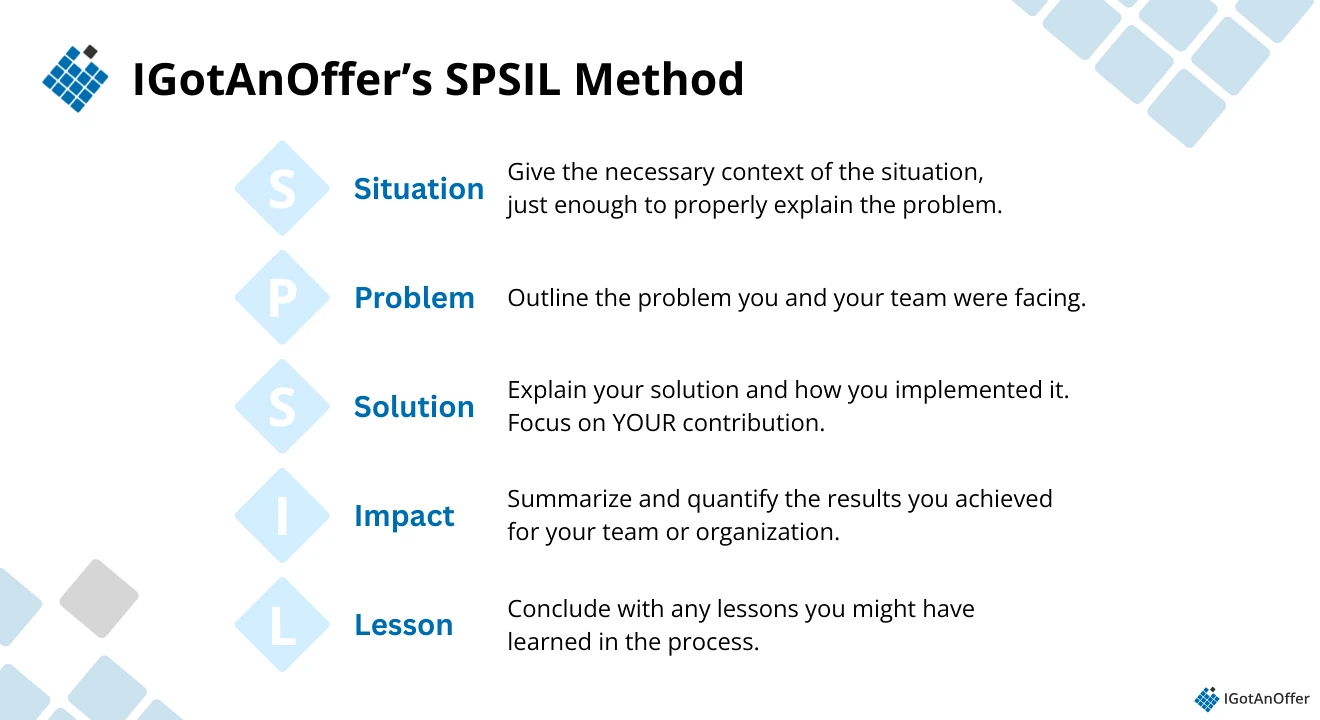
The IGotAnOffer SPSIL method
Let's step through our suggested five-step approach:
- Situation: Start by giving the necessary context of the situation you were in. Describe your role, the team, the organization, the market, etc. You should only give the minimum context needed to understand the problem and the solution in your story. Nothing more.
- Problem: Outline the problem you and your team were facing.
- Solution: Explain the solution you came up with to solve the problem. Step through how you went about implementing your solution, and focus on your contribution over what the team / larger organization did.
- Impact: Summarize the positive results you achieved for your team, department, and organization. As much as possible, quantify the impact.
- Lessons: Conclude with any lessons you might have learned in the process.
You'll notice that this method covers very similar themes to the STAR method. We recommend it because a lot of the candidates we work with find this framework easier to use, as there's no overlap between any of the steps in your story.
For a deeper dive into this topic, check out our article on why the STAR method isn't always the best for behavioral interviews and how IGotAnOffer's SPSIL method can be a better option. It was written with product managers in mind, but it applies just as well to any role.
For examples of behavioral interview answers using this method, take a look at the sample answers below.
3.2 Example answer: Tell me about a time you had to resolve a difficult situation or conflict.
Try answering the question below following your preferred method.
Play both the role of the interviewer and the candidate. Write down your answer, then practice saying it out loud before going through our example response. Once you've finished, compare your response to our example to fill in any gaps in your story.
Try this question:
Tell me about a time you had to resolve a difficult situation or conflict.
Answer:
We'll use the IGotAnOffer method described above and answer as if interviewing for an analyst job at Capital One. You will find our proposed answer to the question below.
1. Situation
You could start by saying something like:
"In my previous role as a financial analyst, I was working with the marketing team on a campaign budget allocation. We had $500,000 to spend across different channels for the quarter."
Without giving too much detail, this gives a quick sense of the setting you were in. If relevant, you can add a sentence or two to define your team's goal or the stakeholders. Either way, the scene is set to get into the conflict that will arise when you describe the problem.
2. Problem
After you outline the situation, you can explain the problem by saying something like:
"The marketing director wanted to allocate 60% of the budget to a brand awareness campaign on social media, while my analysis showed that our highest ROI came from targeted email campaigns to existing customers. We had a meeting where tensions got high—she felt I wasn't respecting her domain expertise, and I was frustrated that data wasn't driving the decision."
Here, you haven't spent too long discussing the situation and problem, but your answer so far has given the interviewer a clear sense of the setting and conflict you faced.
3. Solution
When describing the solution you came up with to solve the problem, it's important to step through your thinking. And it's especially important to focus on YOUR contribution.
You could say something such as:
"I realized I had approached the conversation poorly by leading with 'you're wrong' rather than building shared understanding. I requested a follow-up meeting and came prepared with a proposal: we'd allocate 40% to the brand awareness campaign she wanted, 40% to the high-ROI email campaigns, and reserve 20% as a test budget that we'd split between two experimental channels.
I also acknowledged that my initial analysis hadn't accounted for long-term brand value, which was a fair point she had raised. We agreed to establish clear metrics upfront for each channel and commit to reallocating based on performance after six weeks."
Let's take a step back and look at what you've highlighted with this answer. It emphasizes your ability to admit your own mistakes and resolve them. It also shows your efforts toward clear communication and conflict resolution.
A key aspect of Capital One's culture is data-driven decision-making and collaboration, so that cross-functional teams can work together smoothly. A story like this highlights your ability to face issues head-on, before they turn into a larger problem for the team.
4. Impact
After explaining the actions you took, it's a good idea to quantify how much impact you had.
You could say something like:
"This compromise allowed both of us to pursue our strategies while building in accountability through data. After six weeks, the results showed that email campaigns performed as I'd predicted with 340% ROI, while the brand awareness campaign had strong engagement but weaker conversion than expected.
The marketing director agreed to shift 15% of the budget from brand awareness to email for the remainder of the quarter. More importantly, we established a much stronger working relationship—she started pulling me into planning earlier, and I made sure to acknowledge the non-quantifiable aspects of marketing strategy."
5. Lessons
Finally, wrap up your answer by describing any lessons you might have learned. You could say:
"I learned that being right isn't enough if you can't bring people along with you. Now I approach disagreements by first seeking to understand the other person's perspective and priorities, then finding ways to test assumptions rather than demanding immediate agreement.
I also learned the importance of building relationships before you need them—if I'd invested in understanding her goals earlier, we could have avoided the initial conflict entirely."
3.3 Example answer: Describe a time you went above and beyond for work.
Let's look at another common Capital One behavioral question. This question tests your initiative and ownership, which are key qualities Capital One looks for.
Try this question:
Describe a time you went above and beyond for work.
Answer:
1. Situation
Keep this brief—aim for 30 seconds or less. Include your role, the team or organization, and any essential background information needed to understand the problem you're about to describe.
You could start by saying something like:
"I was an analyst at a regional bank working on monthly risk reports for our commercial lending portfolio. The reports were due on the 5th of each month and typically took about 12 hours to complete."
Without giving too much detail, this gives a quick sense of the setting and your role. The scene is set to introduce the problem you identified.
2. Problem
For a question about going above and beyond, the problem should be something you identified on your own, not something assigned to you. Focus on why this problem mattered to the business or stakeholders, not just how it affected you personally.
Once you outline the situation, you can explain the problem by saying something like:
"I noticed that the senior vice presidents who received these reports often asked follow-up questions about specific borrower segments, which meant I'd spend another 5-10 hours each month creating ad-hoc analyses.
The reports themselves were also fairly static (just numbers in tables), which made it hard for stakeholders to quickly identify concerning trends."
3. Solution
This is the most important part of your answer. Walk through the specific actions YOU took to solve the problem. Use "I" statements rather than "we" to make it clear what you personally contributed.
For "going above and beyond" questions, emphasize the extra effort, skills you learned, or creative approaches you used that weren't part of your job description. You could say something such as:
"I saw an opportunity to add value beyond my core responsibility. Over three weekends, I taught myself data visualization in Tableau and rebuilt our entire reporting system.
I created an interactive dashboard that automatically updated with fresh data and allowed users to drill down into any segment they wanted to explore. I also added automated alerts that flagged any loans showing early warning signs based on criteria I defined with input from our senior credit officer.
I didn't tell anyone I was working on this—I wanted to have a working prototype before proposing it. Once I had it ready, I scheduled a demo with my manager and the SVPs. They were impressed and approved the rollout."
This answer emphasizes your proactive problem-solving and willingness to invest personal time to create value. It aligns with Capital One's emphasis on innovation and using technology to drive better outcomes. You also show your strategic thinking by building first and asking for permission later, a calculated risk that demonstrates confidence and initiative.
4. Impact
Quantify your results as much as possible. Interviewers want to see concrete evidence of the value you created. Include metrics about efficiency gains, cost savings, revenue increases, or other measurable improvements. If possible, mention both immediate impact and longer-term benefits to show the lasting value of your initiative.
You could say something like:
"The new system reduced my monthly reporting time from 12 hours to 2 hours, and ad-hoc analysis requests dropped by about 70% because users could answer their own questions through the dashboard.
More significantly, the early warning alerts helped us identify three loans that required closer monitoring, and we were able to work with those borrowers proactively before they defaulted. Our portfolio's default rate improved by 0.3 percentage points over the next year, which represented about $400,000 in prevented losses.
The system I built became the template for other reporting across the bank, and I was asked to train other analysts on the approach."
This answer demonstrates measurable impact at multiple levels: your personal efficiency, stakeholder satisfaction, and bottom-line business results. Capital One values data-driven impact, and this response delivers exactly that.
5. Lessons
Close by reflecting on what you learned from the experience. This shows self-awareness and demonstrates that you actively grow from your experiences. Good lessons connect back to principles you can apply in future situations, showing the interviewer that you'll bring these insights to Capital One.
You could say:
"This experience taught me the value of investing time in improving systems rather than just completing tasks. It also showed me that sometimes it's worth building something first and seeking permission later—if I'd asked for approval to spend three weekends on this before I had a prototype, I'm not sure I would have gotten it.
Most importantly, I learned that the best way to advance your career is to solve problems that your manager doesn't even know they have yet."
4. Tips to impress your interviewer↑
Finally, before we move on to some interview prep resources, we'd like to give you five helpful tips to keep in mind.
Tip #1: Get used to setting up the situation in 30 seconds or less
Use a timer while you practice to ensure you provide only necessary information. Spending too much time on the Situation step is one of the most common mistakes candidates make.
Tip #2: Stay focused on essential details
Interviewers hear a lot of behavioral stories a day. If you go into unnecessary details, you are likely to lose their attention. Share your stories with a few different people before your interview and ask them what details they would suggest cutting.
Tip #3: Be proud and talk about YOU
This is not the time to be shy about your accomplishments. Concentrate on your impact, not what "the team" did. Not talking about YOU enough is another common mistake we see with a lot of candidates.
Tip #4: Adapt to follow-up questions
Don't be alarmed if your interviewer asks follow-up questions; this is perfectly normal. Listen carefully to the way your interviewer is asking these questions, as there will often be a subtle clue about the specific skills they're looking to assess from the next part of your answer.
Tip #5: Explain how failure made you better
When talking about failure, don't try to hide your mistakes or frame a weakness as a strength. Instead, show what you learned and how you grew from the failure.
5. How to prepare for a Capital One behavioral interview↑
Now that we've been through all the questions and the techniques you can use to answer them, we'd like to offer some resources to help you prepare. Because the right preparation is what will make the difference between failing your interviews and getting an offer.
Here are four steps that you can take to help you prepare for your Capital One behavioral interview.
5.1 Learn about Capital One's culture
Most candidates fail to do this. But before investing tens of hours preparing for an interview at Capital One, you should take some time to make sure it's actually the right company for you.
Don’t apply to Capital One just because it looks impressive on your CV. A big name does not automatically mean you will enjoy the job. What actually matters is the kind of work you will be doing every day and the people you will be doing it with.
Before applying, try to speak with current or former employees to get a real sense of the company culture and whether it suits you. In addition, we would recommend reading the following resources:
- Work & Culture at Capital One (by Capital One)
- Capital One mission and values (by Capital One)
- Capital One strategy teardown (by CB Insights)
5.2 Practice by yourself
Acing a behavioral question is much harder than it looks. You'll stand out if you put in the required work to craft concise and direct answers.
5.2.1 Write down your stories
First, work out which stories you'd like to tell. Make a list of key moments in your career (e.g., accomplishments, failures, team situations, leadership situations, etc.) that you can use to answer one or multiple questions.
Take a look at Capital One's core values and their emphasis on innovation and data-driven decision making, then find at least one story from your past that exemplifies each one.
After you've finished your list, write out a story for each key moment in your career using the structure we've laid out in section 3. Be sure to emphasize your impact in each of these examples, quantify the results of your actions, and explain the lessons you learned from the experience.
Once you have a bank of stories, go through the questions in section 2 and make sure you'd be able to answer all of them either by using one of the stories you've written directly or by adapting it on the fly.
If you identify any gaps, add stories to your bank until you're comfortable you can cover all the questions listed in this article. For reference, we suspect this will require around 10-15 stories for most candidates.
Click here to practice with more common behavioral questions and see example answers
5.2.2 Practice your stories out loud
After you've written everything down, a great way to practice your answers is to interview yourself out loud. This may sound strange, but it will significantly improve the way you communicate during an interview.
You should be able to tell each prepared answer and story from your bank naturally, neither missing key details nor memorizing them word-for-word.
Play the role of both the candidate and the interviewer, asking questions and answering them, just like two people would in an interview. Trust us, it works.
5.3 Practice with peers
Practicing by yourself is a critical step, but it will only take you so far. By yourself, you can't simulate thinking on your feet or the pressure of performing in front of a stranger. Plus, there are no unexpected follow-up questions and no feedback.
One of the main challenges of interviewing at Capital One is communicating your answers clearly in a way that leaves a strong impression.
As a result, we recommend that you also do some mock interviews. This is much closer to the real interview experience. Plus, the feedback you get from an interview partner could help you avoid mistakes that you wouldn't notice on your own.
You can practice with a friend or family member to start. This will help you polish your stories and catch communication mistakes. However, if your interview partner isn't an experienced ex-interviewer, then they won't be able to give you the kind of targeted feedback that will bring your answers up to the next level.
5.4 Practice with experienced Capital One interviewers
In our experience, practicing real interviews with experts who can give you company-specific feedback makes a huge difference.
Find a behavioral interview coach so you can:
- Test yourself under real interview conditions
- Get accurate feedback from a real expert
- Build your confidence
- Get company-specific insights
- Learn how to tell the right stories, better
- Save time by focusing your preparation
Landing a job at a big tech company often results in a $50,000 per year or more increase in total compensation. In our experience, three or four coaching sessions worth ~$500 significantly impact your ability to land the job. That’s an ROI of 100x!
Click here to book mock interview sessions with ex-Capital One interviewers.
 Software engineer