


 Back to other articles




 Last updated: June 25, 2026
 Interviews
 Software engineer
 Deeply researched
To ace the Google L5 interview for engineering roles, you need more than just top-notch problem-solving skills and solid system design knowledge. You need to be able to tie back your Googleyness and leadership answers to experience, or you could get downleveled to L4.
The good news is that the right preparation can make a big difference. To help you face your Google L5 interview with confidence, we’ve put together the ultimate guide below.
This guide includes everything you need to prepare strategically: an overview of the level, what to expect every step of the interview process, and the types of questions you will encounter, along with insights and tips from our Google interview coaching experts. We also include stories from real candidates so you can learn from their experiences.
Here's an overview of what we'll cover:
- Level and salary
- Interview process and timeline
- Example questions
- Interview experience reports
- Preparation plan
Note: This guide is written primarily for L5 software engineering candidates, but most of it will also be relevant if you're an L5 machine learning or data engineering candidate.
Click here to book a 1-on-1 session with an ex-Google interviewer.
Let’s get into it!
1. Google L5: Level and salary
Before we cover your Google L5 interviews, let’s take a look at the level you're applying for.
Google L5 engineers are considered senior-level engineers within the company’s technical career ladder.
Individual contributor levels for engineers at Google start at L2 and go up to L11.
- L2: Intern
- L3: Entry-level engineer
- L4: Mid-level engineer
- L5: Senior engineer
- L6: Staff engineer
- L7: Senior staff engineer
- L8: Principal engineer
- L9: Distinguished engineer
- L10: Google fellow
- L11: Senior Google fellow
Below, we discuss in detail what a Google L5 engineer does and how much engineers at this level earn on average.
1.1 What does a Google L5 engineer do?↑
According to Google’s L5 SWE engineer job listings, L5 software engineer candidates are expected to do the following as part of their responsibilities:
- Lead end-to-end development of projects and/or own and drive project milestones
- Drive your team’s short-term technical vision and roadmap, refining/changing strategies to align with future requirements.
- Mentor junior and mid-level engineers and promote best practices
- Collaborate cross-functionally through design and code reviews
- Improve the overall maintainability, reliability, and complexity of engineering efforts within the team
In general, as an L5 engineer, you’re a robust technical leader. This means you take full ownership of significant technical decisions that impact multiple teams.
While L4 engineers are given well-defined problems to solve, L5 engineers are expected to be highly autonomous problem solvers. You must demonstrate the ability to navigate severe ambiguity and design large-scale distributed systems from scratch, according to Kumar (Google Sr. SWE).
One thing to note about the L5 role at Google is that it is considered a "terminal level". This means engineers can comfortably remain at this level throughout their careers without the pressure to be promoted.
1.2 How much does a Google L5 engineer make?↑
Google’s competitive salary is among the numerous factors that draw high-performing engineers to the company.
Below are the average salaries and compensation for the different L5 engineers at Google. This is based on the reported data from Levels.fyi.
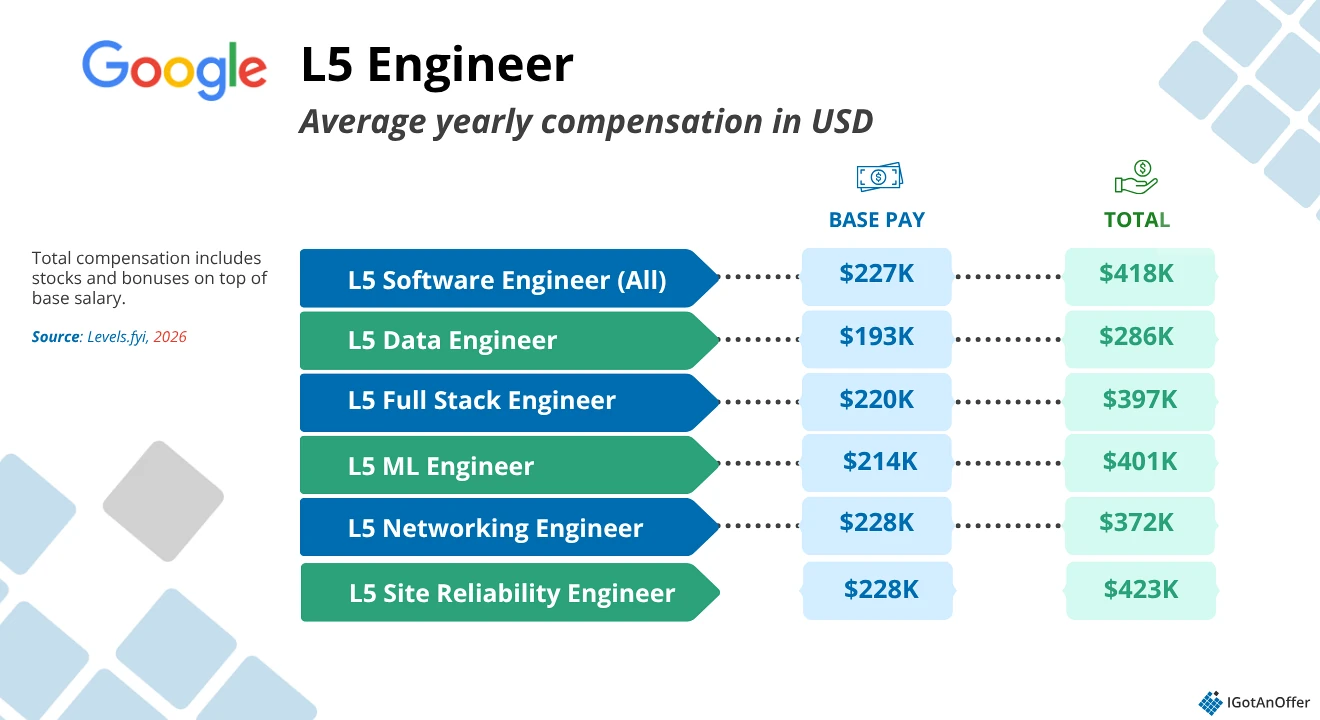
Ultimately, how well you perform in your interviews will determine what you’ll be offered. That’s why hiring one of our ex-Google interview coaches can provide such a significant return on investment.
And remember, compensation packages are always negotiable, even at Google. So, if you do get an offer, don’t be afraid to ask for more.
If you need help negotiating, read our guide to Google salary negotiations for tips and consider booking one of our salary negotiation coaches to get expert advice.
Coaches who contributed to this guide



















2. Google L5 interview process and timeline ↑
2.1 What interviews to expect
What's the interview process and timeline at Google for the L5 engineer role? It usually takes between two weeks and four months and follows these steps:
- Resume screen
- Recruiter screen
- Initial screen: 1 x 30-60 minute interview
- Onsite interviews: 5 x 45-minute interviews
We’ve laid out the process and typical questions for SWE candidates, but if you’re a different type of L5 engineer, the interview process will follow a similar format.
Let's look at each of these steps in more detail below:
2.1.1 Resume screen↑
First, recruiters will review your resume and assess whether your experience matches the open position. This is the most competitive step in the process. Most candidates do not make it past this stage.
You can use this senior software engineer resume guide and browse these Google resume examples to help tailor your resume to the position you’re targeting.
And if you’re looking for expert feedback, you can also get input from our team of ex-Google recruiters, who will cover what achievements to focus on (or ignore), how to fine-tune your bullet points, and more.
2.1.2 Recruiter screen↑
If you pass the resume screen, you'll likely get a call from a recruiter. They'll brief you on the role and the interview process, including how many screenings to expect and what topics to prepare for. They'll also likely ask a few behavioral and resume questions, so be ready to answer such questions.
You may also get an online assessment even before your initial technical screen. If your recruiter assigns you this task, check out our guide to Google online assessments to learn how you can ace this part of the process.
2.1.3 Initial screen↑
The initial screen involves a coding challenge and a Googleyness interview, evaluating your DSA knowledge, culture fit, and experience.
Based on the official Google SWE interview guide, this is how you should approach the technical part of the initial screen,
- Be prepared to write around 20-30 lines of code in your strongest language. Approach all scripting as a coding exercise — this should be clean, rich, robust code.
- You will be asked an open-ended question. Ask clarifying questions, and devise requirements.
- You will be asked to explain it in an algorithm.
- Convert it to a workable code. (Hint: Don't worry about getting it perfect because time is limited. Write what comes, but then refine it later. Also, make sure you consider corner cases and edge cases, production-ready.)
- Optimize the code, follow it with test cases, and find any bugs.
If, like most of us, you're used to writing code in an IDE that automatically does things like auto-indentation, auto-complete, syntax highlighting, etc., writing syntactically correct code in a Google Doc can be quite uncomfortable. So, practice this ahead of the interview!
Finally, in addition to coding questions, you should also be ready to answer a few typical behavioral questions, including "Tell me about yourself," "Why Google?" or "Tell me about a recent project you worked on."
2.1.4 Onsite interviews↑
If you pass the initial screen, you’ve made it to the real test: the “onsite” interviews. These can happen either at a Google headquarters or remotely via Google Meet.
You'll typically do up to 5 45-minute interviews in total, consisting of:
- Coding interviews (3)
- System design interview (1)
- Googleyness interview (1)
Google is currently piloting a “code comprehension” AI-assisted coding round. So one of your coding interviews could involve the use of approved AI tools.
We’ll dig deeper into these in Section 3.
2.2 What exactly Google is looking for↑
At the end of each interview, your interviewer will grade your performance using a standardized feedback form that summarizes the attributes Google looks for in a candidate. That form is constantly evolving, but below we've listed the main components we know of at this time of writing.
A) Questions asked
In the first section of the form, the interviewer fills in the questions they asked you. These questions are then shared with your future interviewers so you don't get asked the same questions twice.
B) Attribute scoring
Each interviewer will assess you on the four main attributes Google looks for when hiring:
- General cognitive ability. This is often referred to as "GCA" by Googlers. The company wants to hire smart engineers who can learn and adapt to new situations. Here, your interviewer will try to understand how you solve hard problems and how you learn. For more information, take a look at our guide to the GCA interview.
- Role-related knowledge and experience. This is often referred to as "RRK" or "RRKE" internally. The company wants to make sure that you have the right experience, domain expertise, and competencies for the position you're applying for. For more information, take a look at our guide to the RRK interview.
- Leadership. Google looks for a particular type of leadership called “emergent leadership.” You'll typically be working in cross-functional teams at Google, and different team members are expected to step up and lead at different times in the lifecycle of a project when their skills are needed. More information on this guide to Google leadership questions.
- Googleyness (i.e., culture fit). The company wants to make sure Google is the right environment for you. Your interviewer will check whether you naturally exhibit the company's values, including: being comfortable with ambiguity, having a bias to action, and a collaborative nature. More information on this guide to Googleyness questions.
Depending on the exact job you're applying for, these attributes might be broken down further.
For instance, "Role-related knowledge and experience" could be broken down into "Security architecture" or "Incident response" for a site reliability engineer role. But the total number of attributes does not usually exceed six or seven.
In this middle section, Google's interviewers typically repeat the questions they asked you, document your answers in detail, and give you a score for each attribute (e.g., "Poor", "Mixed", "Good", "Excellent").
C) Final recommendation
Finally, interviewers will write a summary of your performance and provide an overall recommendation on whether they think Google should be hiring you or not (e.g., "Strong no hire", "No hire", "Leaning no hire", "Leaning hire", "Hire", "Strong hire").
2.3 What happens if your onsite interview goes well?↑
If things go well at your on-site interviews, here is what the final steps of the process look like:
- Interviewers submit feedback. After your onsite interviews, your interviewers will all submit their feedback and grade your answers to their questions.
- Hiring committee recommendation. Their feedback will then be submitted to a hiring committee that will review the feedback along with your resume, internal referrals, and any past work you have submitted. Based on these, the committee should make a recommendation on whether Google should hire you or not.
- Team matching. You meet with various hiring managers to assess fit.
- Senior leader review. The hiring committee's recommendation will then be reviewed and validated by a senior manager.
- Compensation committee recommendation. Once validated by a senior leader, your candidate packet will be sent to a compensation committee, which will decide how much money you’ll be offered.
- Final executive review. Finally, a senior Google executive will review a summary of your candidacy and compensation before the offer is sent to you.
- You get an offer!
Google internal and external transfers
If you're currently a Googler looking into switching roles or ladders within the company, IGotAnOffer's Google interview guides will be useful as you prepare for your internal transfer application. To learn more about the process, check out our guide to Google internal transfers.
Same goes if you're from Amazon and looking to transfer to Google. If you want to find out more about this career move, check out our article on how to move from Amazon to Google.
2.4 What happens if you get rejected by Google?↑
If you get rejected from Google, you can try again, but not immediately after.
Your recruiter should let you know how long you’ll have to wait to reapply, but the advice is generally at least a year. This should give you enough time to work on some skills that may not have met Google’s standards the first time around.
If you’ve reapplied multiple times and cleared phone screens in the past, there’s a big chance you’ll skip the initial screen and go straight to the onsite interviews.
Ready to reapply? Learn why you got rejected from your Google interview and how to plan your next moves.
3. Google L5 example interview questions ↑
As mentioned in Section 2, you'll face five 45-minute interviews at the full loop stage covering:
Let’s take a closer look at each question type.
3.1 Coding↑
Google software engineers solve some of the most difficult problems the company faces with code. It's therefore essential that they have strong problem-solving skills.
This is the part of the interview loop where you want to show that you think in a structured way and write code that's accurate, bug-free, and fast.
In addition to practicing a wide variety of questions on data structure and algorithms, Han (ex-Google Sr. EM) shares the following tips when cracking coding questions:
- Master writing efficient code in one programming language
- Ask clarification questions before diving into the solution
- Clearly outline requirements and assumptions, and communicate them with the interviewer
- Choose the right data structures and algorithms, and explain any trade-offs you make
- Write clean, efficient code with minimal mistakes
- Talk through your thought process as you code to keep the interviewer engaged
- Clearly state the time and space complexity of your solution using Big-O notation
Now, let’s get into some practice questions.
Based on our analysis of 100 software engineer interview questions reported on Glassdoor, here are the most commonly asked coding topics at Google.
These questions are relevant across levels and should also be helpful for your L5 interview prep.
Google coding interview example questions: arrays & strings
- Implement Trie for prefix matching. (Solution)
- Write a function to merge two sorted arrays without using extra space. (Solution)
- Given an array of integers, return all unique triplets [a, b, c] where a + b + c = 0. Ensure no duplicate triplets in the output. (Solution)
- Write a function that prints out every permutation of 1s and 2s that add up to a number n. (Solution)
- Implement a Snapshot Array that supports pre-defined interfaces (note: see link for more details). (Solution)
- In a row of dominoes, A[i] and B[i] represent the top and bottom halves of the i-th domino. (A domino is a tile with two numbers from 1 to 6 - one on each half of the tile.) We may rotate the i-th domino, so that A[i] and B[i] swap values. Return the minimum number of rotations so that all the values in A are the same, or all the values in B are the same. If it cannot be done, return -1. (Solution)
- Your friend is typing his name into a keyboard. Sometimes, when typing a character c, the key might get long pressed, and the character will be typed 1 or more times. You examine the typed characters of the keyboard. Return True if it is possible that it was your friend's name, with some characters (possibly none) being long pressed. (Solution)
- Given a string S and a string T, find the minimum window in S which will contain all the characters in T in complexity O(n). (Solution)
- Given a list of query words, return the number of words that are stretchy. (Solution)
- Given an array of words and a width maxWidth, format the text such that each line has exactly maxWidth characters and is fully (left and right) justified. (Solution)
- Given an encoded string, return its decoded string. (Solution)
- String/template replacement with placeholders. (Solution)
- Given Logs with job id, timestamps and event type as start and end, detect the first timeout that has occurred if the start and end of a job goes beyond a given threshold. (Solution)
- Find who spoke the most words in chat. (Solution)
- 2D array where I had to find the maximum length of consecutive integers as neighbours in the grid (Solution)
- Given an array of all the files and directories and the files and directories that were visited. (Solution)
- Given a single string which has space separated sorted numbers, determine whether a specific target number is present in the string.
- Binary search over sorted numbers in string [CPP]
- Given a string s representing a valid expression, implement a basic calculator to evaluate it, and return the result of the evaluation.
- Given an integer array nums and an integer k, return the k most frequent elements. You may return the answer in any order.
Check out our guides on array interview questions and string interview questions to learn more about the topics.
Google coding interview example questions: graphs & trees
- Implement a cleaning algorithm for a robot vacuum cleaner that doesn't know its position within the room. (Solution)
- Write a code to construct a binary tree that is a mirror of the given binary tree. (Solution)
- Find the lowest common ancestor of two nodes. (Solution)
- Write a function to detect cycles in a directed graph. How would you optimize a database query to improve runtime? (Solution)
- Given a binary tree, find the maximum path sum. The path may start and end at any node in the tree. (Solution)
- We can rotate digits by 180 degrees to form new digits. When 0, 1, 6, 8, 9 are rotated 180 degrees, they become 0, 1, 9, 8, 6, respectively. When 2, 3, 4, 5, and 7 are rotated 180 degrees, they become invalid. A confusing number is a number that, when rotated 180 degrees, becomes a different number with each digit valid. (Note that the rotated number can be greater than the original number.) Given a positive integer N, return the number of confusing numbers between 1 and N inclusive. (Solution)
- Given two words (beginWord and endWord), and a dictionary's word list, find the length of shortest transformation sequence from beginWord to endWord, such that: 1) Only one letter can be changed at a time and, 2) Each transformed word must exist in the word list. (Solution)
- Given a matrix of N rows and M columns. From m[i][j], we can move to m[i+1][j], if m[i+1][j] > m[i][j], or can move to m[i][j+1] if m[i][j+1] > m[i][j]. The task is: print longest path length if we start from (0, 0). (Solution)
- Given a robot cleaner in a room modeled as a grid. Each cell in the grid can be empty or blocked. The robot cleaner with 4 given APIs can move forward, turn left, or turn right. Each turn it made is 90 degrees. When it tries to move into a blocked cell, its bumper sensor detects the obstacle, and it stays on the current cell. Design an algorithm to clean the entire room using only the 4 given APIs shown below. (Solution)
- Sequence ordering → graph problem. (Solution)
- Implement and test the Huffman Coding Algorithm.
Check out our guides on graph interview questions and tree interview questions to learn more about the topics.
Google coding interview example questions: dynamic programming
- Given two strings, text1 and text2, return the length of their longest common subsequence. If there is no common subsequence, return 0. (Solution)
- Find the minimum number of coins needed for change. (Solution)
- Non-overlapping intervals. (Solution)
- Given a matrix and a target, return the number of non-empty submatrices that sum to target. (Solution)
- Given a rows x cols binary matrix filled with 0's and 1's, find the largest rectangle containing only 1's and return its area. (Solution)
- Your car starts at position 0 and speed +1 on an infinite number line. (Your car can go into negative positions.) Your car drives automatically according to a sequence of instructions A (accelerate) and R (reverse)... Now, for some target position, say the length of the shortest sequence of instructions to get there. (Solution)
- Given strings S and T, find the minimum (contiguous) substring W of S, so that T is a subsequence of W. If there is no such window in S that covers all characters in T, return the empty string "". If there are multiple such minimum-length windows, return the one with the left-most starting index. (Solution)
Check out our guide on dynamic programming interview questions to learn more.
Google coding interview example questions: recursion
- Solve the "Generate All Possible Balanced Parentheses" problem recursively. (Solution)
- Reverse a linked list. (Solution)
- A strobogrammatic number is a number that looks the same when rotated 180 degrees (looked at upside down). Find all strobogrammatic numbers that are of length = n. (Solution)
- Given a binary tree, find the length of the longest path where each node in the path has the same value. This path may or may not pass through the root. The length of path between two nodes is represented by the number of edges between them. (Solution)
- Given the root node of a binary search tree, return the sum of values of all nodes with values between L and R (inclusive). The binary search tree is guaranteed to have unique values. (Solution)
Google coding interview example questions: math
- Evaluate reverse polish notation and return result. (Solution)
- How to connect nodes that randomly appear. (Solution)
- A group of two or more people wants to meet and minimize the total travel distance. You are given a 2D grid of values 0 or 1, where each 1 marks the home of someone in the group. The distance is calculated using Manhattan Distance, where distance(p1, p2) = |p2.x - p1.x| + |p2.y - p1.y|. (Solution)
- You are given two non-empty linked lists representing two non-negative integers. The digits are stored in reverse order, and each of their nodes contains a single digit. Add the two numbers and return it as a linked list. (Solution)
Read our Google coding interview guide to learn more about each type of question. Then, we recommend practicing with this list of 47 coding interview examples in addition to those listed above.
3.2 AI-assisted coding
Google has reportedly started rolling out the “Code comprehension” AI-assisted coding rounds. The exact format is still not as widely reported as Meta’s AI coding round, but it makes sense to expect Gemini to be your approved AI assistant for the round.
The AI-assisted coding round tests pretty much the same skills as a standard coding round: problem-solving skills and solid DSA knowledge.
In addition to these skills, interviewers will be looking at your AI fluency: strong prompt engineering, ability to validate AI outputs, and sharp debugging skills.
“The ideal signal is a 'human-led, AI-assisted' workflow where the candidate maintains absolute architectural control rather than blindly accepting generated code,” Kumar (Google Sr. SWE) says.
To be a strong candidate, you'll want to use AI assistance in the following ways:
- As a pair programmer for micro-tasks, while keeping ownership of the overall solution, tradeoffs, and verification
- As a product partner, to dig into the requirements and verify assumptions
- As a tech lead, to analyze the feasibility of the solution
In particular, AI assistance is quite useful for performing coding subtasks.
Here are some use cases where AI might be helpful, including some sample prompts that you can use, according to John (FAANG coaching expert):
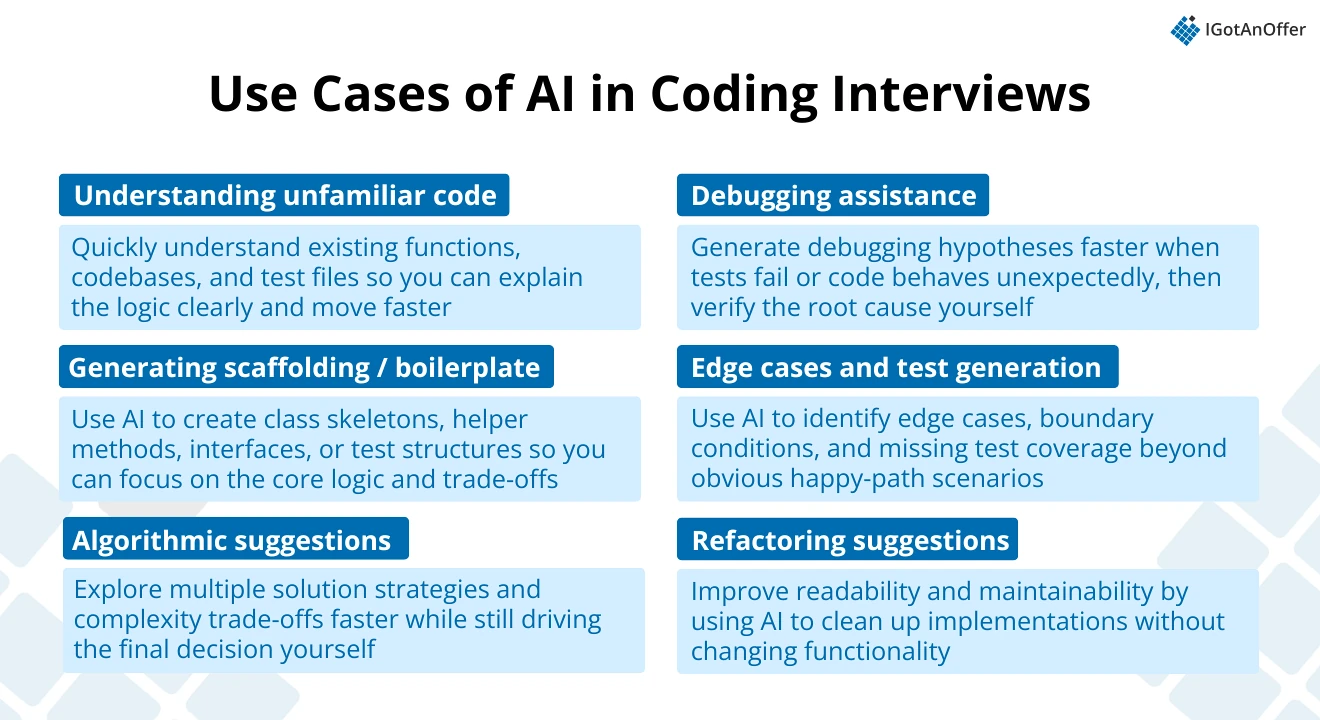
- Understanding unfamiliar code
Sample prompt: “Explain what this function does step by step, including inputs, outputs, and edge cases. Summarize in 5 bullets.”
- Generating scaffolding or boilerplate
Sample prompt: “Create a Python class skeleton for a rate limiter using a token bucket approach, including method stubs and comments.”
- Algorithmic suggestions / alternative approaches
Sample prompt: “Given this problem, list 2–3 possible approaches with time/space complexity.”
- Debugging assistance
Sample prompt: “This test fails with input X. Here’s the code and output. What are the likely causes?” or simply “Why did this test fail?”
- Edge cases and test generation
Sample prompt: “Generate edge cases for this function, especially around nulls, boundaries, and concurrency.”
- Refactoring suggestions
Sample prompt: “Refactor this function to improve readability and maintainability without changing behavior.”
Read our guide to AI-assisted coding rounds to learn more about how they work and how to approach them.
3.3 System design
Many of Google’s products, such as Google Search, Gmail, Google Docs, Android, and YouTube, all have 1bn+ monthly active users. Google engineers, therefore, need to be able to design systems that are highly scalable and performant.
As an L5 engineer candidate, expect a system design round in your interview loop. Google Senior SWE Kumar says this is the most critical hurdle for this level.
The questions you’ll get will likely be about complex distributed systems like collaborative document editing, large-scale search, or real-time analytics pipelines. Expect discussions around sharding, consistency, rate limiting, and trade-offs at scale. Prepare to talk in depth about trade-offs, scalability, data modeling, and operational concerns, communicate clearly across layers, and proactively identify edge cases.
To demonstrate your senior level, you must show ownership and lead the entire design process during your interview, Geoff (ex-Google Senior EM) says. "Demonstrate proficiency by asking great questions to bound and clarify the problem, and to treat the interview as a partnership."
What bad interview habits will result in your failure? Geoff says, "Candidates fail if they make too many assumptions without asking enough questions, treating the interview like a TED talk, and failing to utilize the interviewer as a thought partner."
Here are some examples of system design questions asked at Google L5 interviews, as reported on Glassdoor and other online forums.
Google L5 system design interview example questions
- Design a transaction aggregation system (counts over time windows).
- Design an Image Hosting website.
- Design a distributed cache optimized for the given task.
- Design a TikTok-style Google news feed.
- Design a small image/gifs/video hosting platform that does not require sign-up.
Click here to learn more about Google system design interviews, where you'll find more sample questions, insights from experts, and an efficient answer framework.
3.4 Googleyness and leadership
The last type of interview you can expect as a Google SWE candidate is a Googleyness and leadership round.
During this interview, you may get a mix of behavioral and hypothetical questions, designed to evaluate your alignment with Google’s values, general motivational fit for the role, and leadership experience.
Baked into this round is a past project retrospective. For this type of question, you’re expected to discuss the engineering judgments you made, how you structured a project end-to-end, and how you resolved specific technical disagreements to reach alignment.
To stand out as an L5 candidate, Kumar’s advice is to highlight your experience handling conflicts with teammates and navigating shifting priorities while keeping a user-first perspective.
Google L5 Googleyness and leadership example interview questions
General
- Tell me about yourself
- Why Google?
- Tell me about a recent / interesting project you worked on
- Tell me about a time you had to resolve a conflict in a team
- What is your favorite Google product?
People management
- Tell me about a time you had to handle trade-offs and ambiguity
- Tell me about a time you were part of an organization in transition and how you helped them move forward
- Tell me about a time you led a team through a difficult situation
- Tell me about a time you developed and retained team members
- How would you deal with a team challenge in a balanced way?
- How would you address a skill gap or personality conflict?
- How would you ensure your team is diverse and inclusive?
- How would you organize day-to-day activities?
- How would you convince a team to adopt new technologies?
Project management
- Tell me about a time you demonstrated leadership even though you weren't the formal manager
- Describe a time when you missed a project deadline. How did you manage the situation, and what did you learn from it?
- Tell me about a time you were the end-to-end owner of a project
- Tell me about a time you used data to make a critical decision
- Tell me about a time you used data to measure impact
- How would you handle competing visions on how to deliver a project?
- How would you choose a methodology to manage a project?
- How would you balance flexibility and process in an agile environment?
- How would you handle projects without defined end dates?
- How would you prioritize projects of varying complexity?
- How would you balance process vs. execution in an agile environment?
Check out our guides on Googleyness & leadership and Google behavioral interview questions to learn more.
4. Google L5 interview experience (from real candidates)
Before we get into specific Google L5 stories, let’s look at what a typical Google L5 interview experience is like based on candidate reports online.
4.1 Are Google L5 interviews hard?
According to Glassdoor data, 64% of candidates rate their overall Google interview as a positive experience, while 13% rate it negatively. For software engineers specifically, the negative experience rate is a bit lower at 11%.
Here's how Google compares with other FAANG companies:
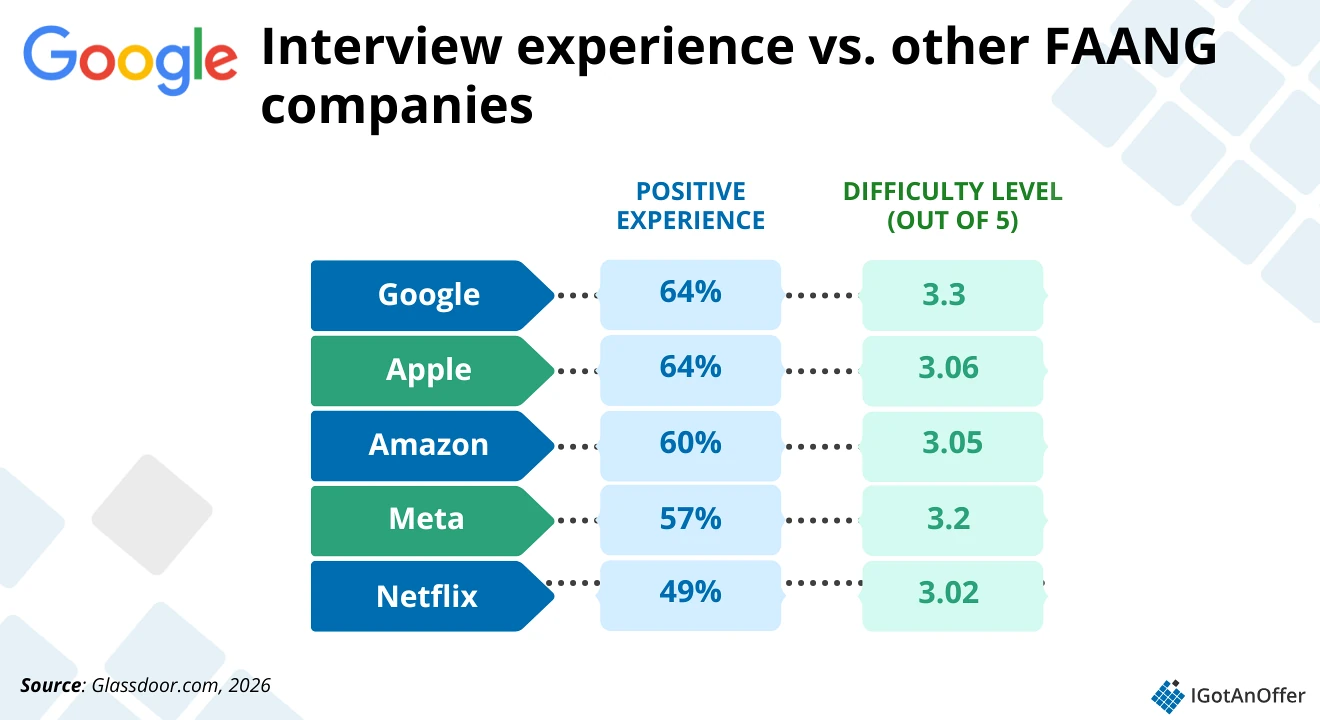
As you can see, Google ranks among the highest in difficulty at 3.3. In fact, according to Business Insider, Google is one of the hardest companies to interview with in the world.
And yet, it also ranks among the highest in positive interview ratings at 64%, tied only with Apple’s rating.
Applying to multiple top tech companies? Click here to find out if you're ready for a FAANG interview.
4.2 Google L5 Interview reviews: positive or negative
Here's a sample of what real candidates are saying about their Google SWE interview experiences on Glassdoor, both positive and negative.
Positive reviews
Challenging but fair questions
“Enjoyed the challenge of the interview and the professionalism of the interviewers.”
“Process was rigorous but fair, with timely communication throughout the entire process.”
“I was asked a fairly standard set of interview questions of medium difficulty — nothing especially unusual or tricky.”
Smooth and structured interview process
“The interview process at Google was thorough, structured, and quite demanding, but overall a positive experience.”
“Great process! Lovely people and tons of insights about the team and work. I enjoyed the process, although the question was a bit arbitrary, LeetCode style. Overall, I had a good discussion and got to meet many people!”
“The interview process was the best I’ve experienced. In terms of communication and feedback, I felt very well informed throughout, and I received personalized feedback, which made the experience stand out.”
Supportive interviewers
“The interviewer was also very friendly and approachable, which made the overall conversation smooth and helped create a genuinely positive interview experience.”
“The interviewer made it pretty clear what he wants from me, nice interactions. The discussion felt free and no one was judging what you say.”
Negative reviews
Long, drawn-out interview process
“The overall process is slow and could vary anywhere between 1 - 3 months.”
“It felt like the whole thing dragged on for about three weeks, which was longer than I expected.”
Unresponsive interviewers
“My coding interview sucked; the interviewer was distracted the whole time and was playing with her pet cat, very unresponsive and unprofessional.”
“Interviewer WAS late to the meeting which made me just end up leaving half way through.”
“Bit of an attitude from one interviewer who seemed checked out and silently taking notes.”
4.3 My Google L5 interview experience (3 stories)
Now that you've seen what a typical Google L5 interview experience looks like, let's get into some real, firsthand accounts and some key takeaways from their experiences.
Below are summaries of 3 candidate stories we gathered from various online sources. We’ve linked to their full accounts, so feel free to read them if you want to get the full scoop:
Experience #1: Anonymous user on r/leetcode
User was working at another FAANG company for 5.5 years. A recruiter reached out to invite them to apply. They chose to delay their Google application by 6 months.
After clearing the initial rounds virtually (DSA and Googleyness), they were invited to an onsite interview.
- Technical round 1: For the DSA/coding round, user got the following problem: ‘Given Logs with job id, timestamps and event type as start and end, detect the first timeout that has occurred if the start and end of a job goes beyond a given threshold.’ They were able to discuss the optimal approach but could not implement it cleanly in time. Feedback: no hire.
- Technical round 2: For the system design round, user was given the design prompt: ‘Design a transaction aggregation system (counts over time windows).’ They missed depth on streaming vs batch, extensibility, and backfills. Feedback: leaning hire.
- Technical round 3: This was coding round 2, where user got a sequence ordering → graph problem. They needed a hint to model as graph and implemented DFS, but their solution had a bug. Feedback: leaning hire.
In the end, user was not able to clear the onsite interview and the recruiter advised them to reapply in 8 months.
Experience #2: Anonymous user on Leetcode
User previously cleared screening rounds at Google, so when they went to interview for the L5 role, they skipped the initial coding rounds.
- Technical round 1: For the first DSA coding round, they got the problem ‘Find who spoke the most words in chat.’ They were able to solve it but could not solve the follow-up question. Feedback: no hire.
- Technical round 2: The second coding round, user got a 2D array question which they solved with BFS. Feedback: Hire.
- Technical round 3: The last coding round was another array problem which user solved using Trie. Feedback: Hire.
- Technical round 4: For the system design round, user was asked to design an image-hosting website. The follow-up question was AI-related. Feedback: Hire.
- Googleyness round: In this round, user was asked about their leadership experience. Feedback: Hire.
After the onsite interviews, user was invited to a team match. After matching with a team straightaway, their candidacy was forwarded to the hiring committee.
However, upon reviewing their onsite interviews, the committee found that the questions they had cleared were incorrect. They were asked to undergo two more rounds of coding. After a No-hire result on the first coding round, user has yet to face the 2nd round, believing that this one would make no difference as they need two Hire results to properly clear the interview.
Experience #3: Arisa on Medium
Arisa applied to a Google SWE role to see if their profile mapped ot L5 or L6. A recruiter followed up 2 weeks later and explained the entire process: 1 phone screen, then 5 onsite rounds consisting of 3 coding rounds, 1 system design round, and 1 Googleyness and leadership round. After clearing the phone screen, they underwent the onsite interview rounds virtually.
- Technical round 1: Arisa described the first coding round as similar to an LC medium question.
- Technical round 2: For the second round, Arisa got a question related to a geometry problem. They took an overly complicated approach and only realized their mistake with 10 minutes left.
- Technical round 3: The final coding round was a graph problem. Arisaw was able to solve it and complete a follow-up extension.
- Technical round 4: For the system design round, Arisa got the design challenge: Architect a platform for hosting images, GIFs, and videos without user sign-up. They described it as the most enjoyable part of the interview.
- Googleyness and leadership round: Arisa described the questions for this round as straightforward questions on failures, how others had impacted their success, and a time I pushed back on a manager’s technical decision.
Three weeks later, the recruiter called with feedback: system design and behavioral were strong; coding did not meet the bar. The recruiter advised them to apply after 1 year.
Check out our article on various Google interview experiences to read more success stories from real Google candidates for various roles and learn their prep strategies.
Key takeaways from real Google L5 interview experiences
- Prepare for follow-ups. Google likes to give tough follow-up questions, especially for senior candidates. In some cases, working through follow-up questions can help you turn around an initially lackluster performance.
- Listen for hints. Interviewers want you to do well, so listen carefully if they’re steering you in a particular direction. Be ready to pivot even with only a few minutes left.
- Consistently great performance is key. You can't slack off at any point during your onsite interviews, especially if you're asked to do additional rounds. You can't get away with a couple of 'leaning hire' results to qualify at Google. To turn your results around, be sure to quickly learn from your mistakes and pivot.
5. Google L5 interview prep ↑
Now that you know what questions to expect, let's focus on how to prepare.
It's no secret that the performance bar at Google is high. Some people even go as far as quitting their jobs to prepare for interviews full-time. This is extreme and not what we recommend doing, but it shows how much effort some candidates are ready to put in.
We've coached more than 22,000 people for interviews since 2018. Below is our five-step prep plan for Google.
5.1 Learn about Google’s culture
Most candidates fail to do this. But before investing tens of hours preparing for an interview at Google, you should take some time to make sure it's actually the right company for you.
Google is prestigious, and it's therefore tempting to ignore that step completely. But in our experience, the prestige in itself won't make you happy day-to-day. It's the type of work and the people you work with that will.
If you know engineers who work at Google or used to work there, it's a good idea to talk to them to understand what the culture is like. In addition, we would recommend reading the following:
- Google's mission statement (by Google)
- Google's values (by Google)
- Google’s company blog (by Google)
- Google strategy teardown (by CBS Insights)
- Google’s (Alphabet’s) Organizational Culture & Its Traits (by Panmore Institute)
5.2 Avoid these common interviewing mistakes
According to Han, these are the most common mistakes candidates make in L5 interviews and how to avoid them:
- Starting to code too quickly. Jumping into code without first clarifying the problem often leads to weak or incorrect answers. Instead, pause, ask questions, and use a structured approach to problem-solving (see our guide on how to get better at coding interviews).
- Faking past experiences. Interviewers can see right through a made-up story. It’s better to be honest and say, “I have not encountered such situations before, but here’s how I would handle it.” Read our guide to Google hypothetical questions to learn how to approach such questions.
- Not communicating with the interviewer. Communicating with the interviewer helps them understand your thought process and gives them the chance to offer hints, clarify the question, or steer you in the right direction.
5.3 Practice by yourself
As we've outlined above, you'll have to prepare for a few different types of questions when preparing for Google L5 interviews. In this article, we've recommended various deep-dive articles that will help you prepare for each question category.
Here's the complete list, plus a few other resources:
- Resources from Google:
- General prep: Google interview prep (5 steps to land a FAANG+ offer)
- Coding:
- System design:
- Googleyness & Leadership:
For more information on the process for a specific engineering role, consult one of our comprehensive interview guides below:
- Google software engineer interview
- Google machine learning engineer interview
- Google data engineer interview
- Google site reliability engineer interview
- Google engineering manager interview
- AI engineer interview questions
Once you’re in command of the subject matter, you’ll want to practice answering questions. But by yourself, you can’t simulate thinking on your feet or the pressure of performing in front of a stranger. Plus, there are no unexpected follow-up questions and no feedback.
That’s why many candidates try to practice with friends or peers.
5.4 Practice with peers
If you have friends or peers who can do mock interviews with you, that's an option worth trying. It’s free, but be warned, you may come up against the following problems:
- It’s hard to know if the feedback you get is accurate
- They’re unlikely to have insider knowledge of interviews at your target company
- On peer platforms, people often waste your time by not showing up
For those reasons, many candidates skip peer mock interviews and go straight to mock interviews with an expert.
5.5 Practice with experienced Google interviewers
In our experience, practicing real interviews with experts who can give you company-specific feedback makes a huge difference.
Find a Google SWE interview coach so you can:
- Test yourself under real interview conditions
- Get accurate feedback from a real expert
- Build your confidence
- Get company-specific insights
- Learn how to tell the right stories, better
- Save time by focusing your preparation
Landing a job at a big tech company often results in a $50,000 per year or more increase in total compensation. In our experience, three or four coaching sessions worth ~$500 make a significant difference in your ability to land the job. That’s an ROI of 100x!
Click here to book mock interviews with experienced Google ex-interviewers.

 Behavioral, People management and Leadership