


 Back to other articles
  Last updated: June 15, 2026

 Interviews
 Product manager, Software engineer
 Deeply researched
Google interviews can be intimidating, no matter what role you're after. If you've got one coming up, you'll want to know what the experience is like and what to expect.
To help you feel more familiar with the process, we talked to 8 real Google candidates about their interview experiences and strategies for success. We've also gathered some insights from candidate reports online to give you a fuller picture of the entire process.
- Typical Google interview experience
- Google interview process & timelines: 7 steps to expect
- My Google interview experience (8 successful candidates)
- Preparation strategies based on Google success stories
Click here to book a 1-on-1 session with an ex-Google interviewer.
1. Typical Google interview experience ↑
Before we get into specific Google success stories, let's look at what a typical Google interview experience is like based on candidate reports online.
1.1 Google interview experience: positive or negative? ↑
According to Glassdoor data, 63% of candidates rate their overall Google interview as a positive experience, while 13% rate it negatively. For software engineers specifically, the positive experience rate rises slightly to 64%.
Here's how Google compares with other FAANG companies:
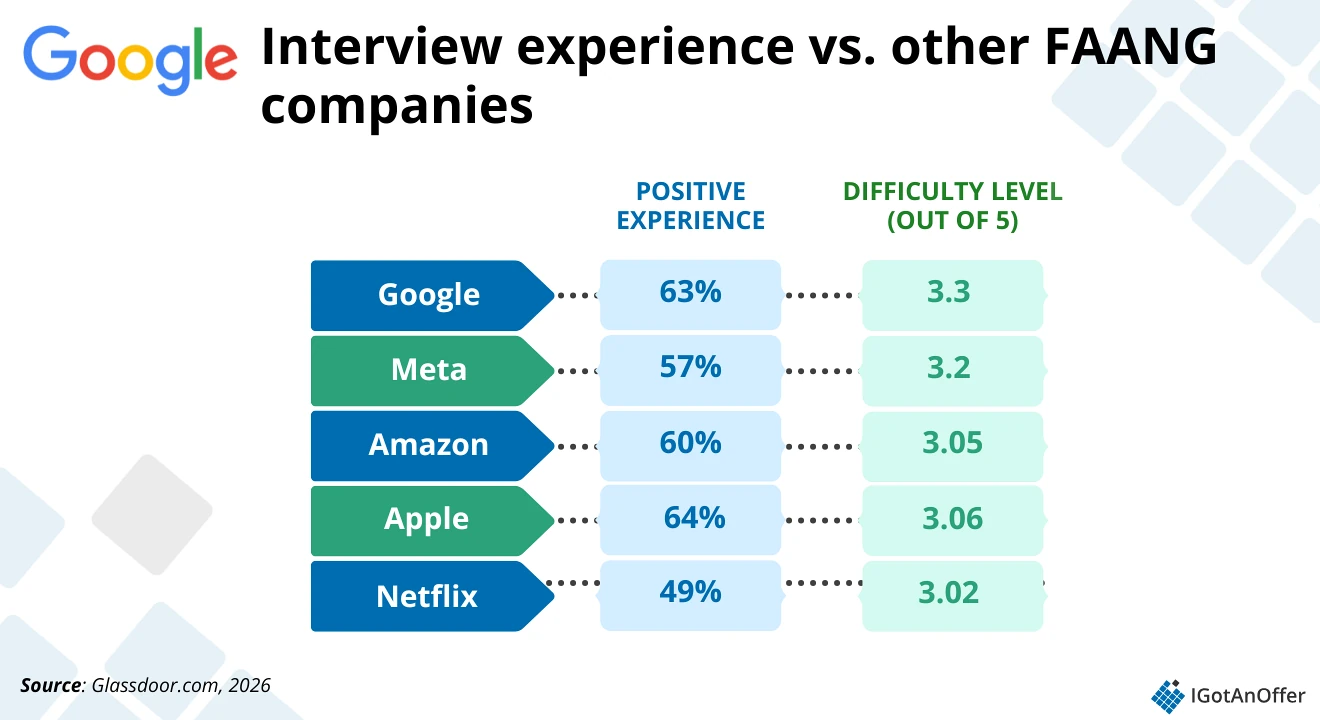
As you can see, Google ranks among the highest in difficulty at 3.3. And yet, it also ranks among the highest in positive interview ratings at 63%, second only to Apple’s 64% rating.
According to Business Insider, Google is one of the hardest companies to interview with in the world. But despite this, 63% of candidates on Glassdoor report a positive interview experience, and only 13% rate it as negative.
Here's a sample of what real candidates are saying about their Google interview experiences online, both positive and negative.
Positive interview experience with Google
- Structured and well-organized process
“Interviewers were friendly and encouraged thinking out loud … Overall, the experience was structured and professional.” Google SWE intern candidate, Glassdoor (2026)
“A well-structured and intellectually challenging interview process that focuses on problem-solving, analytical thinking, and clear communication. Interviewers are professional and approachable, creating a respectful atmosphere while assessing strong alignment with Google’s culture and real-world role expectations.” Google accountant candidate, Glassdoor (2026)
"Great experience and a lot of resource documents to prepare using the interview Gemini tool. Very to the point." Google product management intern candidate, Glassdoor (2026)
“The overall process was professional and communication was clear throughout.” Google software developer candidate, Glassdoor (2026)
- Challenging but fair questions
“Technical questions were challenging, but interviewers were constructive and helpful, it was clear they weren’t trying to trick you.” Google product design engineer candidate, Glassdoor (2026)
“Very hard, incredible questions were asked, and it really examines your skills, whether it's suitable for the company or for you. This is easily the best interview ever yet the hardest I've ever been through.” Google AI developer intern candidate, Glassdoor (2026)
- Helpful and professional interviewers
"The interviewer was friendly and helpful throughout the entire duration. You'll be pushed to think of several different solutions to solve the problem." Google IT Residency Program candidate, Glassdoor (2020)
"The interviewers are really friendly, so keep calm and don't be afraid to ask for help if you get stuck … My recruiter was very quick in sharing the results of the interviews, and most of the time, I got the results just a few hours after the interviews." Google SWE L4 candidate, Medium (2023)
“Great support throughout the process. Constant support for rescheduling and gives you great material to prepare.” Google assistant product manager candidate, Glassdoor (2026)
“The recruiter who navigated me was very nice, and the interviewers were all friendly. I was able to see that they were trying to make me feel comfortable so that I can perform well during the interview.” Google people analyst intern candidate, Glassdoor (2026)
“Interview to first day was over 6 months. In their defense, there was a layoff/freeze in that time, and my recruiter was excellent at keeping me updated. I knew within one week of my formal loop that I was hire-eligible.” Google candidate, Reddit (2025)
Negative interview experience with Google
- Long, drawn-out timelines
"Many delays and waiting times. Outsourced most of their HR staff. For a simple rejection, you wait months. A lengthy process with too much competition and high expectations. The selection process was very poorly conducted in terms of many people going through unnecessary interviews." Google associate product manager intern candidate, Glassdoor (2025)
“Google unnecessarily drags the process out for months. I had a similar experience. My interview process was dragged for months, and at the end, I was offered L3 with no pay bump. Of course, I rejected it.” Google candidate, Reddit (2025)
“The overall process is profoundly broken and takes forever. I'm at Google now and everyone openly talks about how it's horrible, and they won't refer their friends [because] the process is so terrible.” — Google candidate, Reddit (2025)
- Ghosting and poor communication
"Google recruiter ghosting me for 10 days after 3+ rounds." Googlers/Xooglers community, Glassdoor (2024)
“Multiple interviews passed, but in the end, an incompetent interviewer ended the process. There were multiple scheduling errors throughout, poor communication, and overall a lack of respect for my time and effort.” Google senior product manager candidate, Glassdoor (2025)
“Proceeded to the first round interview with an admin. It was not a great experience. She was slightly rude and quite condescending. She had this attitude like she was better than everyone. She was asking hypothetical questions, and I responded with concrete examples of how I handled the exact situation in the past. She said, ‘Okay, but I said hypothetically, how would you handle this? Let me repeat the question.’ She was not interested in hearing concrete examples of how I handled that exact situation.” Google administrative business partner candidate, Glassdoor (2026)
"Just got a "no" from Google after going on months-long interviews. Feeling so crushed. My interviews went well and only positive reviews. My recruiter said she’d pass along my work to other teams, but I can't help but feel so down today after weeks of silence, going through multiple interviews, and having to start all over again." Technology community, Glassdoor
- Lack of feedback
"Overall, a good experience, but wish it wasn't fully virtual — hard to read the interviewers or get a sense for what my role would even look like." Google senior product manager candidate, Glassdoor
1.2 Are Google interviews harder than Meta interviews? ↑
In a nutshell: yes. According to Glassdoor interview reviews, Google interviews are rated as slightly more difficult at roughly 3.3 out of 5 in overall difficulty, while Meta scores at 3.2. This aligns with what tech professionals say anecdotally.
Google is widely considered an engineering-led company and has a reputation for asking novel, difficult questions that often can't be found on standard prep sites.
It also evaluates candidates across four dimensions that require broad preparation beyond pure technical skills: role-related knowledge (RRK), general cognitive ability (GCA), leadership, and Googleyness.
Meta, by contrast, tends to place more emphasis on behavioral and soft skills, which some candidates find more approachable.
1.3 What is the pass rate for Google interviews? ↑
Google is one of the most selective employers in the world. Reported pass rates vary by source.
According to Christian (ex-Google hiring manager and IGotAnOffer coach), the pass rate was only at 0.4% when he was first hired by Google in the mid-2000s.
“When I got hired at Google, [the hiring manager] called me and said, ‘Welcome to the 0.4%.’ … That’s less than 1 out of 100.”
Today’s reported numbers aren’t too far off. According to this LinkedIn post, Google’s pass rates are still estimated somewhere between 0.4% to 0.7%. Pass rates for technical roles like engineering are reported to be even lower, at 0.2% to 0.5%.
Based on general online forum discussions, here are the estimated pass rates at each major stage of the Google application process:
- Resume screen: 1–2% of the entire applicant pool
- Recruiter screen: ~75%
- Phone screen(s): ~25%
- On-site interviews: ~15–20%
- Hiring committee: ~37.5% (3 out of 8) may go on to receive an offer, according to Blind
By the time you get to the hiring committee (HC) stage, passing depends heavily on your on-site interview performance.
2. Google interview process & timelines: 7 steps to expect ↑
Google's interview process takes around 1-2 months on average, though these timelines can vary significantly. Internal processes (such as team matching and the hiring committee review) can extend how long it takes for Google to get back to you.
Here's a quick summary of the estimated timelines for top roles, based on Glassdoor data:
- Software engineer: avg. 34 days
- Product manager: avg. 38 days
- Engineering manager: varies, typically 4–8 weeks
- Technical program manager: varies, typically 4–8 weeks
Below is a summary of the 7 Google interview process steps you can expect.
Step 1: Resume screen
The first step of Google's recruitment process is the resume screen. After you've submitted your application through Google's jobs portal or been contacted directly via email or LinkedIn, recruiters will evaluate your resume to see if your experience aligns with the open position.
Google has published its own tips on what makes a strong resume. In short: align your skills with the job description, be specific about outcomes, emphasize leadership, and keep it concise.
For a deeper dive, check out our guide on how to write a Google resume, which includes 6 examples from successful candidates. Or if you want expert input, consider booking one of our ex-Google resume reviewers.
Note: Google does not require cover letters and admits that they "may or may not be considered." So, unless you have a highly non-traditional profile that needs context, we recommend focusing your energy on your resume.
Step 2: Recruiter call
After your resume is approved, a Google recruiter will reach out to schedule a call. This generally lasts 20–30 minutes and is mostly non-technical.
You should have prepared answers for questions like "Tell me about yourself", "Why Google?", and "Walk me through your resume." The recruiter will also explain how the overall interview process will work.
The recruiter will be your main point of contact throughout the process, so keep the lines of communication open. If you have questions about the timeline, format, or the role, now is the right time to ask.
Step 3: Phone screen(s)
Depending on the role, you'll have one or two phone screens with your hiring manager or a future peer. These typically last 45–60 minutes each over Google Meet.
What to expect by role:
- Product managers: background questions, plus product design, estimation, and strategy questions
- Software engineers: data structure and algorithm questions on a Google Doc or collaborative coding platform, plus a few behavioral questions
- Engineering managers: higher-level coding questions and behavioral questions around people and project management
- Data scientists: background questions, plus SQL, coding, and statistics questions
- Technical program managers: a mix of program management, technical, and leadership questions
- Account managers: primarily behavioral and background questions
In some cases, you may also receive an online assessment, which may include a workstyle survey and/or role-specific exercises. If you're prepared for the depth of questions you'll face at the onsite stage, you'll be well-prepared for the phone screens too.
Step 4: Onsite interviews
The longest and most daunting step is the onsite interview loop. This may take place at a Google office or via video call.
You will face up to 6 back-to-back interview rounds of around 45 minutes each. If you're physically onsite, one round typically takes the form of an informal lunch with a future peer.
Google evaluates all candidates across four core attributes:
- Role-related knowledge and experience (RRK): demonstrating the domain expertise and competencies needed for the role. See our guide to Google RRK questions.
- General cognitive ability (GCA): showing how you think through hard problems and learn new things. See our guides to GCA interviews and Google's hypothetical questions.
- Leadership: specifically "emergent leadership," where you step up and lead when your skills are needed. See our guide to Google leadership questions.
- Googleyness: whether you naturally exhibit Google's values of comfort with ambiguity, bias to action, and a collaborative nature. See our Googleyness guide.
For a breakdown of the exact questions asked by role, see our comprehensive guide to Google interview questions.
Step 5: Hiring committee
After your onsite rounds, each interviewer submits a standardized feedback form rating your performance, including their final recommendation (e.g., "Strong hire," "Hire," "Leaning hire," "No hire," "Strong no hire").
These forms, along with your resume and phone screen notes, are compiled into a packet and sent to a third-party hiring committee (comprised of Googlers who were not present at any of your interviews).
Google uses this committee structure to remove bias from the hiring decision.
Your recruiter will notify you when your packet reaches this stage. The committee typically takes one to two weeks to reach a decision. If you haven't heard back after that window, send a polite check-in to your recruiter.
There are four possible outcomes: a hire decision (with or without team matching), a request for additional interviews, or a rejection.
For more tips on why candidates get rejected and how to improve, check out our guide to Google interview rejection.
Step 6: Team match
If you applied for a role tied to a specific team, you may skip this step. Otherwise, Google goes through a team-matching process to find the right fit for you within the company. This can occur either before or after the hiring committee decision.
During team matching, you may have short calls with hiring managers from a few different teams. Research the teams beforehand, prepare thoughtful questions, and treat these calls as mutual conversations. Remember, you're evaluating them too.
As always, if you're unsure about any aspect of this step, your recruiter is the best person to ask.
Learn more about the Google team matching process in this guide.
Step 7: Salary negotiation
Once you've cleared the six steps above, you'll receive your offer package from Google.
Now it's time to negotiate. A few key tips:
- Don't give a number first: Wait for the company to make an offer before naming a figure.
- Do your research: Use Levels.fyi, Blind, and conversations with current Googlers to benchmark compensation.
- Start high: Open with a number slightly above your target — Google will likely negotiate it down toward your goal.
- Negotiate everything: Base salary, bonuses, equity, vacation, and remote work flexibility are all on the table.
For more tips, check out our Google offer negotiation guide. Or book a salary negotiation coach with ex-FAANG experience to practice and get real-time feedback.
For a more thorough breakdown of every step, read our complete guide to the Google Interview Process & Timeline (7 steps to getting an offer).
3. My Google interview experience (8 successful candidates) ↑
Now that you've seen what a typical Google interview experience looks like, let's get into some real, firsthand accounts.
Here are 8 Google success stories pulled from IGotAnOffer's reviews page. These are all real candidates we've worked with. They've all gone through Google interviews and come out the other side with an offer. Now they're here to share their stories to help out other candidates just like you!
Learn about the different prep strategies and interview techniques that helped these candidates succeed, and get best practices to help you on your Google journey.
Success story #1: Plinio, Google staff software engineer (L6)
"Manoel's coaching was immediately practical, and I was surprised by how aligned it was with how Google evaluates ML interviews."
Plinio got an offer for a staff software engineer (L6) role at Google in September 2025. Here's his account of his preparation and interview experience:
Interview focus
“Manoel and I focused on ML system design … We drilled clear problem framing, data and modeling choices, scalability, and production tradeoffs.”
How IGotAnOffer helped
"Manoel's coaching was immediately practical, and I was surprised by how aligned it was with how Google evaluates ML interviews. He ensured I was comfortable communicating end-to-end ML systems crisply under realistic interview constraints. 10/10 would recommend!"
Success story #2: Will, Google product manager
"Knowing where to start was the hard thing — IGotAnOffer made a major difference there."
Will got an offer for a remote product manager role at Google in June 2022, joining from Microsoft. Here's his account of his preparation and interview experience:
Preparation strategy
"I practiced 2 to 3 hours per day, for 4+ weeks. I used IGotAnOffer study guides, practiced interview questions (wrote out responses), and did mock interviews with multiple people."
The hardest part of the interview
"I had never studied for an interview before, so knowing where to start was the hard thing — IGotAnOffer made a major difference there."
Question that stood out
"The estimation question was something like 'how many screens should we order for a new iPhone' — I missed a couple key market insights that drastically changed my answer, and didn't know enough about manufacturing processes to think about yield rates and other details."
Advice to candidates
"Study hard & find as many people to do mock interviews with as possible!"
Success story #3: Nicolas, Google senior product manager (L6)
"Don't rush to get interviews scheduled. Take time if you feel you're not ready."
Nicolas got an offer for a senior product manager (L6) role at Google in San Francisco in March 2022, joining from PayPal. Here's his account of his preparation and interview experience:
Preparation strategy
"I divided my prep into four stages. 1. I read some books and the structural materials for the interview. 2. I then watched YouTube videos on specific topics. 3. I did 5 mock interviews over a 3-week period. 4. I watched some keynote Google speeches."
The hardest part of the interview
"Overcoming my nerves!"
Question that stood out
"In one interview, I had a lot of creative math questions."
Advice to candidates
"Don't rush to get interviews scheduled. Take time if you feel you're not ready."
Success story #4: Nutan, Google technical program manager (L4)
"Keep your answers concise, and be sure to use certain important key words."
Nutan got an offer for a technical program manager (L4) role at Google in Hyderabad in January 2022, joining from Temenos. Here's his account of his preparation and interview experience:
Preparation strategy
"I prepared for an average of 10 hours a day over six weeks. A key part of my prep was a Coursera course on 'project management by Google'."
The hardest part of the interview
"I found it hard to tell what kind of answer would make the cut for that level I was interviewing."
Question that stood out
"Talk about your biggest failure."
Advice to candidates
"Keep your answers concise, and be sure to use certain important key words."
Success story #5: Benjamin, Google product manager (L4)
"Prepare answer frameworks that work for you, but don't let them become a box you get stuck in."
Benjamin got an offer for a product manager (L4) role at Google in Boston in September 2021, joining from Wayfair, where he had been a PM. Here's his account of his preparation and interview experience:
Preparation strategy
"I'd say I did about 50 hours of prep overall, with a large bulk of that being peer-to-peer mock interviews. First, I concentrated my prep on the first-round interview question categories, and not until I'd passed that did I expand into the categories relevant for the onsite.
Initially, I researched the general question categories by reading the IGAO blog articles and watching some YouTube videos. Then I started to write down a general framework I saw across the board of how to respond. I created my own Google Doc with an answer framework, expectations, questions, links to resources, etc — it ended up being a 15-page document.
When I did mock interviews, I wrote down the feedback and went over it before I did another one. When I thought I was close, I hired a coach to see where I was at — they gave me some good feedback, and I was ready to go."
The hardest part of the interview
"During prep, my learning definitely followed a curve. I was seeing huge improvements in the beginning, but there was a point of deterioration — it's easy to start over-studying, over-analyzing, and I was starting to get stuck in the frameworks. Then, at interview stage, the lack of time was hard. The interviewers would drill down on a particular question before suddenly pivoting into a whole different category. If it wasn't for the coaching session, I wouldn't have been prepared for that rapid-fire situation."
Advice to candidates
"Prepare answer frameworks that work for you, but don't let them become a box you get stuck in. Oh, and put the hours in!"
Success story #6: Mrityunjay, Google technical program manager
"Mock interviews are the best thing you can do to prepare."
Mrityunjay got an offer for a technical program manager role at Google in Waterloo, Canada, in May 2021, joining from Deloitte's Risk Advisory section, where he was headhunted directly by a Google recruiter. Here's his account of his preparation and interview experience:
Preparation strategy
"I started out watching a lot of YouTube videos, mainly by Google employees and recruiters, and also quite a few system design videos. I also read blogs, such as Try Exponent. Then I started practicing with the example questions on the IGotAnOffer blog articles, and once I was feeling more prepared, I did some mock interviewing, first with peers and then with a coach. The feedback from that was a massive help."
The hardest part of the interview
"Probably my lack of practice, and getting into the right mindset for interviewing."
Advice to candidates
"Mock interviews are the best thing you can do to prepare."
Success story #7: Humaira, Google product manager
"Do some mock interviews, and be yourself."
Humaira got an offer for a product manager role at Google in San Francisco in February 2021, joining from Adobe, where she had been on the Creative Cloud enterprise team. Here's her account of her preparation and interview experience:
Preparation strategy
"I mostly learned through reading blogs and watching YouTube videos. I realised that I wasn't using my time at all efficiently and I needed someone to help me better focus my preparation, so I booked some coaching sessions. I had sessions on technical concepts, which helped a ton, and product design, which gave me a good framework."
The hardest part of the interview
"Knowing where to focus my attention during the preparation part."
Advice to candidates
"Do some mock interviews, and be yourself. I struggled with boxing my answers in frameworks I had read in books, and it curbed my enthusiasm and creativity. So I started to follow my gut instead and saw a big improvement in performance."
Success story #8: Samantha, Google product manager II (L5)
"Focus on one area at a time to become comfortable — then double down on making your strong areas really stand out."
Samantha got an offer for a product manager II (L5) role at Google in Los Angeles in October 2020, joining from Tinder, where she had spent four years as a senior PM. Here's her account of her preparation and interview experience:
Preparation strategy
"I created a study guide for myself based on sweeping the internet for best practices, frameworks, interview guides, etc. I watched all of the mock interviews I could find on YouTube, and finally worked with [coach] Bryant to practice and assess the areas I needed to spend more time focusing on."
The hardest part of the interview
"Preparing for the technical interview. I don't have an engineering background, so I spent a lot of time brushing up on data structures, algorithms, and system design."
Advice to candidates
"Create a structured learning plan and schedule. Focus on one area at a time to become comfortable. Watch all of the mock interviews you can and do your own assessment of what makes a good vs. great answer. Improve your weak areas enough to get by, but double down on making your strong areas really stand out. And finally, practice with an experienced coach who can give you great feedback!"
4. Preparation strategies based on Google success stories ↑
If there's one takeaway from our Google success stories, it's that preparation is everything. Keep it disciplined, strategic, and give it consistent effort over time.
Here's a breakdown of the best Google interview practices we've seen from successful candidates:
4.1 Build a rigorous study plan that works for you
Committing to solving the top 100 most-asked Google Leetcode problems is an admirable starting point. But it's just that: a start.
What actually works is designing a study plan that's SMART (Specific, Measurable, Achievable, Relevant, and Time-bound). Successful candidates show there's no one-size-fits-all approach. Whether you're working full-time, between jobs, or caring for a family, your plan needs to fit your life.
Start by identifying your target role and working backward from the onsite interview format. Figure out your current level in each topic area, then allocate your prep time accordingly.
4.2 Cover as much ground as you can
Google is known for asking novel questions and problems you won't find verbatim on any prep site. The way to prepare for this isn't to memorize solutions; it's to internalize the underlying patterns and approaches well enough that you can adapt them under pressure.
Cover as many question categories as possible so that whatever comes your way in the interview, you have a framework to lean on.
For Google specifically, this means being comfortable with dynamic programming, graph algorithms, system design, and behavioral/Googleyness questions.
To help with this, we recommend diving into our role-specific and skill-specific Google guides:
Role-specific guides
- Google Product Manager interview
- Google Associate Product Manager interview
- Google Product Marketing Manager interview
- Google Program Manager interview
- Google Technical Program Manager interview
- Google Software Engineer interview
- Google Engineering Manager interview
- Google Data Scientist interview
- Google Data Engineer interview
- Google Machine Learning Engineer interview
- Google Site Reliability Engineer interview
- Google L4 Engineer interview
- Google Strategy & Operations interview
- Google (Technical) Account Manager interview
Skill-specific guides
- Google Coding interview
- Google System Design interview
- Google Behavioral interview
- Googleyness and Leadership questions
- 23 Google Interview Questions (with Answers)
Already interviewed and wondering how to bounce back from a rejection? Check out our Google interview rejection guide.
4.3 Don't neglect Googleyness
One thing that trips up technically strong candidates at Google is underestimating the Googleyness and behavioral component of the process.
Unlike some companies where culture fit is a soft add-on, Google evaluates it as a formal attribute, on par with technical and cognitive skills. Before your interviews, take the time to understand what Google values: comfort with ambiguity, intellectual curiosity, collaborative nature, and a bias toward taking action.
Prepare specific stories from your past experience that demonstrate each of these qualities, and practice delivering them clearly and concisely.
A useful framework: think of Googleyness as "culture add" rather than "culture fit." The question isn't "Do you conform to Google's norms?" but rather "Will your attitudes and character be a positive addition to how Google works?"
4.4 Work on your confidence
It's easy to focus entirely on technical skills when prepping for Google, but communication and confidence matter just as much. Google's interviewers are also evaluating whether they'd enjoy working with you and whether you can think out loud under pressure.
That's why practicing under real interview conditions is essential, especially if you haven't interviewed in a while.
Start by doing solo practice. Record yourself answering questions, then review the playback critically. Then move on to peer mocks, ideally with someone who has engineering or PM interview experience.
After that, if you want to truly stress-test your readiness, practice with an ex-Google expert. There's no substitute for sitting in front of someone who knows Google's bar, can give you calibrated feedback, and can identify the specific gaps you can't see yourself.
4.5 Maximize paid mock interviews
If you do invest in mock interviews with an expert, make sure you get the most out of them. Here are some ways to do that, based on what we've seen from successful Google candidates:
- Only schedule mocks once you've done your homework. Study on your own first, watch mock interview recordings, and come to your coaching session with specific questions or areas you want to work on.
- Work the feedback into your practice. After each session, go back and incorporate your coach's notes into your answers before your next session. Don't just acknowledge feedback, apply it.
- Interview with multiple coaches. Different interviewers have different styles and expectations. Practicing with two or three different coaches (especially ones who have interviewed at Google specifically) prepares you for the range of experiences you might encounter in the real thing.
Finding the right coach makes a significant difference. Ideally, you find one with direct experience interviewing candidates at Google in your target role.
4.6 Treat every round as part of one long evaluation
In other companies, individual rounds are mostly siloed. But at Google, your entire interview loop feeds into a single hiring committee packet.
This means a weak performance in one round can be offset by a strong performance elsewhere, but it also means there are no throwaway rounds. Go into every session, including the "casual" behavioral and Googleyness rounds, as prepared as you would for your hardest coding interview.
Interviewers debrief together, and even soft impressions ("Did they seem genuinely curious? Collaborative?") can factor into the final recommendation.
4.7 Prepare for the long game
Google's process is long, often six to eight weeks or more from first contact to offer.
Candidates who try to rush their prep often underperform, while those who plan for a sustained, multi-week preparation period consistently do better.
Build in time to ramp up gradually, peak during your interview window, and still have capacity for follow-up studies after a phone screen before the onsite.
Get ready to become a Google success story
We hope you find our article on the Google interview experience and success stories encouraging and helpful. Try some of the best practices from our successful candidates, and see what works for you!
If you want to check out our Google mock interview service, browse our platform's 200+ coaches with experience at Google and other top companies. You can see coaches’ industry, role, hourly availability, and book your online session in a couple of clicks.
Landing a job at a big tech company often results in a $50,000 per year or more increase in total compensation. In our experience, three or four coaching sessions worth ~$500 make a significant difference in your ability to land the job. That’s an ROI of 100x!
Click here to book a mock interview with an experienced ex-Google interviewer.

 Coding, Technical