

 Back to other articles
  Last updated: August 27, 2026

 Interviews
 Deeply researched
The Capital One virtual job tryout (VJT) is an early-stage online assessment given to Capital One job application candidates. It filters candidates before they’re approved to move into the actual interview process.
It may look like a personality quiz, but it carries real weight in Capital One's selection process. Underestimating this early stage could prevent you from making it to the interview stages.
The good news is that the VJT is as predictable as most online assessments, once you know what it entails. It uses a fixed four-section structure; the question formats don't change much by role, and there are clear patterns that Capital One looks for in your responses.
Below you'll find a detailed overview of how the Capital One VJT works, a breakdown of each of its four sections (with example questions), tips on how to approach it, and a preparation plan to help you pass on your first attempt.
Here's an overview of everything we’ll cover:
- Overview of the Capital One Virtual Job Tryout (VJT)
- The 4 sections of the Capital One Virtual Job Tryout (with example questions)
- Tips to ace your Capital One Virtual Job Tryout
- Prep plan
Click here to practice 1-on-1 with ex-Capital One interviewers
1. Overview of the Capital One Virtual Job Tryout (VJT) ↑
Before we walk through the Capital One virtual job tryout in detail, let's cover what it actually is, when you'll encounter it, and which roles you can expect to see it in.
1.1 What is the Capital One Virtual Job Tryout (VJT)?
The Virtual Job Tryout (VJT) is Capital One's online pre-interview assessment.
It’s not a video interview, but a written, multiple-choice test made up of four sections that build a profile of how you're likely to perform on the job.
According to Capital One's careers FAQ, the VJT is designed to "help you demonstrate the skills and knowledge you would bring to the role, while also helping you learn more about the company.”
In practice, it's a candidate filter. Capital One uses it to narrow a large applicant pool down to select candidates who fit the role's expected behaviors and reasoning style.
Here are Capital One VJT’s four sections and what they each measure:
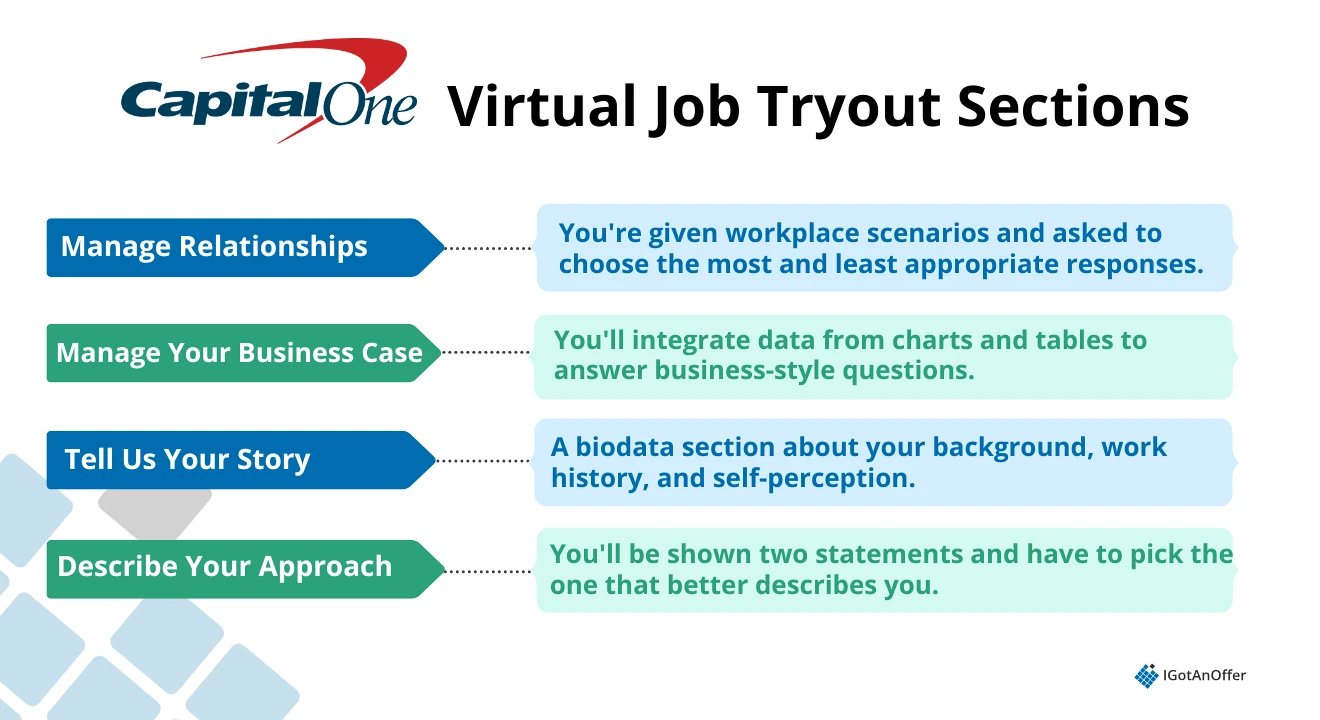
- Manage Relationships is a situational judgment test. You're given workplace scenarios and asked to choose the most and least appropriate responses.
- Manage Your Business Case is a short problem-solving section. You'll integrate data from charts and tables to answer business-style questions.
- Tell Us Your Story is a biodata section about your background, work history, and self-perception.
- Describe Your Approach is a forced-choice personality assessment. You'll be shown two statements and have to pick the one that better describes you.
We'll go deeper into each of these in Section 2.
1.2 How does the Capital One Virtual Job Tryout work?
The whole Capital One VJT assessment takes around 30 to 60 minutes, depending on how quickly you move through it.
It's officially untimed, so no clock appears on screen, but the instructions will state a recommended completion time for each section. Most candidates aim to stay close to those recommendations.
A few quirks of the test interface are worth knowing in advance, since they catch some candidates off guard:
- You cannot move backwards in the Manage Relationships and Manage Your Business Case sections. Once you submit a response, that answer is locked.
- You can only return to the previous question in the Tell Us Your Story and Describe Your Approach sections. Useful if you mis-click, but you can't review the whole section.
- Each section has its own instructions. Read them carefully. The personality section uses forced-choice, meaning there's no neutral option, and many candidates lose time on the first few questions getting used to that format.
- There's no "right" answer in the biodata (Tell Us Your Story) and personality (Describe Your Approach) sections. Capital One scores these against a profile of traits suited to the role, so the goal is to be honest, while presenting the version of yourself that best fits the job description.
Capital One scores each section against a model of what success in the target role looks like. Strong situational judgment, sound data reasoning, and a personality profile aligned to the role all contribute to a passing score.
1.3 When should you expect the Capital One Virtual Job Tryout in the interview process?
The VJT typically sits early in Capital One's interview process.
Some candidates report receiving the VJT immediately after applying, before any human conversation, while others get it after a recruiter screen. The exact placement varies by role and recruiting cycle.
For most consulting-side candidates, the order looks like this:
- Resume screen
- Automated assessment
- Recruiter screen
- Virtual Job Tryout
- Hiring manager pre-screen
- Power Day
You'll usually receive an email invitation via Workday with a 14-day window to complete the test. The link will direct you to your candidate profile on Capital One's careers website, where you'll find a PDF with the assessment link.
1.4 Who can expect a Capital One Virtual Job Tryout?
The VJT is most commonly used for business and consulting-side roles at Capital One, including:
- Business analysts
- Strategy analysts and strategy associates
- Finance rotation program candidates
- Project and process managers
- Product managers (for some PM tracks)
- Risk and operations roles
If you're applying for a Capital One product manager role, expect a VJT focused on managing projects, troubleshooting problems, and working through business cases.
For Capital One business analyst interviews, you'll likely encounter an additional quantitative module, in addition to the standard VJT. We cover this in Section 2.5.
For software engineers, you typically won't take the standard VJT. Capital One typically routes software engineering, cyber, and machine learning candidates through CodeSignal-based coding assessments instead.
If you're applying for a tech role, your best preparation is brushing up on coding fundamentals rather than the situational judgment material covered here.
1.5 How does the Capital One Virtual Job Tryout compare to other online assessments?
If you've taken assessments at other banks, the Capital One VJT will feel familiar in places but different in others. Here's a quick comparison chart to help you calibrate:
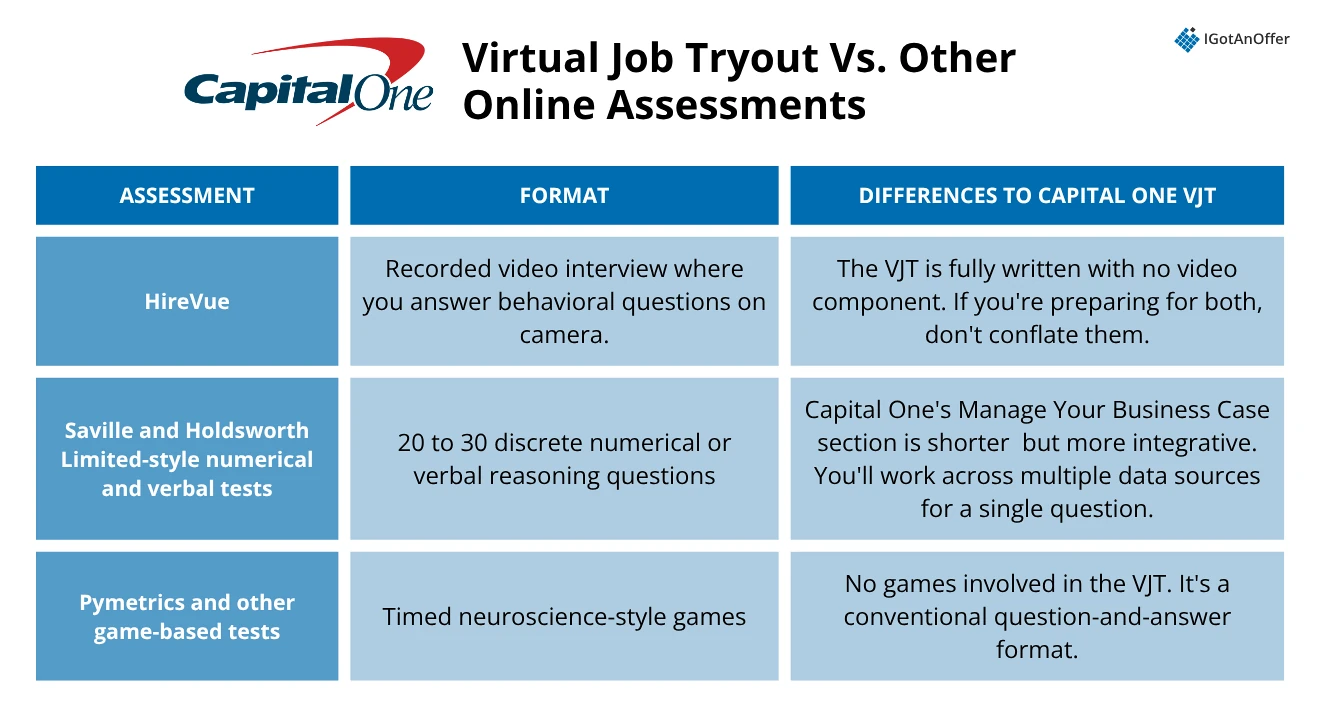
The most important difference: the VJT is a profile-fit test. Capital One is checking whether the version of you that shows up in your answers matches what the role calls for (not whether you can do the math or pick the right answer).
That's why the personality and biodata sections matter so much. They make up 38 of the 50 questions in the standard VJT, so they carry the most weight in your final profile.
Candidates who breeze through them on autopilot end up with trait profiles that don't match the role, even when their situational judgment and business case answers were strong. Take all four sections seriously from the first question.
2. The 4 sections of the Capital One Virtual Job Tryout (with example questions) ↑
Now that you know how the Capital One VJT works, let's break down each of the four sections. For each, we'll cover the format, what Capital One is measuring, and example questions adapted from real candidate reports.
The Capital One VJT has four standard sections that all candidates complete. Business analyst (BA) candidates also take a separate quantitative module on top of these four, which we cover as a bonus at the end.
Here are the four sections of the Capital One VJT, plus a bonus section for Business Analyst (BA) roles:
- Manage Relationships (situational judgment)
- Manage Your Business Case (problem-solving)
- Tell Us Your Story (biodata)
- Describe Your Approach (forced-choice personality)
- BONUS: Business analyst quantitative module (for BA roles)
2.1 Manage Relationships (situational judgment) ↑
The Manage Relationships section opens the Capital One VJT. You'll get around seven scenarios, each describing a workplace situation, followed by four possible responses. Your job is to pick the most appropriate response and the least appropriate response.
The recommended completion time is around eight minutes.
What Capital One is looking for in this section:
- A bias toward proactive communication over passive handoffs
- Accountability for outcomes
- Willingness to adapt your work to your audience
- Practical judgment about when to escalate, collaborate, or act alone
Example Capital One virtual job tryout scenario: Manage relationships (communication)
You've completed a detailed financial report for a project, but the marketing team needs to understand the findings to plan a campaign. The report contains technical financial language that may be difficult for non-finance colleagues to follow. What would you do?
- Send the original report to the marketing team via email and ask them to follow up with your team if anything is unclear.
- Send the original report and tell the marketing team it's their job to interpret the contents.
- Rewrite a short version of the report for a non-technical audience, then set up a meeting with the marketing team to walk them through it.
- Summarize the report into one page by removing the financial sections.
In a question like this, answer C demonstrates strong communication and ownership, so it's the most appropriate. Answer B shows the lowest accountability and effort. Answer A and D each demonstrate partial effort, but neither is the strongest nor the weakest of the four.
Example Capital One virtual job tryout scenario: Manage relationships (teamwork)
You've put together an operations plan with input from several internal stakeholders, but the timeline is tight and they've come back with significant adjustments. The next meeting with the team is in two days. What would you do?
- Email your operations plan to the stakeholders and ask them to make whatever adjustments they think will improve it.
- Explain the tight schedule to the stakeholders and work with them to agree on a list of adjustments that's acceptable and realistic for all parties.
- Make some adjustments to address their concerns, but largely move forward with your original plan since you've already put significant work into it.
- Meet all stakeholders again and ask your manager to postpone the meeting so the most crucial requirements can be discussed in detail.
In this question, B is the most appropriate response. It balances teamwork (working with the stakeholders) with accountability (driving toward a workable solution within the timeline). A is the least appropriate, since it hands off ownership of the plan entirely. C and D each show one of the two qualities but not both.
When you're working through these scenarios, ask yourself two questions for each response:
- Does it solve the immediate problem?
- Does it strengthen the working relationship?
The answer Capital One wants is usually the one that does both.
For more practice with situational judgment thinking, our guide on Capital One behavioral interview questions covers the same competencies in interview format.
2.2 Manage Your Business Case (problem-solving) ↑
The Manage Your Business Case section is the only part of the Capital One VJT that measures problem-solving ability. It's also the shortest with just five multiple-choice questions, but the questions are integrative.
You'll be given several data sources (typically a mix of tables, charts, and short narrative descriptions about a fictional business) and asked to draw conclusions from them.
There's no recommended time specified for this section, but most candidates spend 10 to 15 minutes on it.
What Capital One is looking for in this section:
- Comfort working across multiple data sources at once
- Ability to spot the difference between "true," "partially true," and "false" conclusions
- Basic arithmetic confidence (percentages, totals, weighted averages)
- Patience to verify each answer option rather than jumping to the first plausible one
Example Capital One virtual job tryout scenario: Business case
Based on the data provided about Year 2 employee tenure across four departments (R&D: 602 employees, Marketing: 347, Sales: 399, Finance: 401), and the breakdown of employees with 10+ years tenure (R&D: 42, Marketing: 5, Sales: 12, Finance: 22), what percentage of the company's total employees in Year 2 have 10+ years' tenure?
- 2.3%
- 3.4%
- 4.6%
- 7%
The answer is C. Total long-tenured employees: 42 + 5 + 12 + 22 = 81. Total employees: 602 + 347 + 399 + 401 = 1,749. So 81 / 1,749 = 4.6%.
Example Capital One virtual job tryout scenario: Business case (interpretation)
Based on Year 1 and Year 2 data on code of conduct survey results across four departments, which of the following conclusions is most accurate?
- Between Year 1 and Year 2, proper conduct has been better integrated into day-to-day working standards.
- In Year 2, the finance department's employees had the highest code of conduct survey results.
- In Year 2, more employees in the R&D department have witnessed a colleague breach the code of conduct than in other departments.
- In Year 2, more finance department employees reported that the code was clearer and easier to understand than in Year 1.
The right approach is to systematically test each statement against the data. In a typical version of this question, B is the only conclusion that holds across all four metrics in the table, while the numbers partially or fully contradict A, C, and D.
You don't need advanced math for this section. What you need is the discipline to do the calculation rather than estimating, and the patience to check every answer choice against the data before locking in.
2.3 Tell Us Your Story (biodata) ↑
The Tell Us Your Story section asks 17 questions about your background, work history, and self-perception. Capital One recommends spending around two minutes on it.
There are roughly two types of questions in this section:
- Job performance and behavior questions: for example, "How would your most recent manager rate the quality of your work?" or "How long did you stay in your most recent role?"
- Self-perception questions: for example, "I have leadership abilities" with response options ranging from strongly agree to strongly disagree.
What Capital One is looking for in this section:
- Tenure and stability: candidates who have stayed in roles long enough to deliver meaningful work tend to score better
- Self-awareness: claims that are too high (rating yourself "the very best" at everything) or too low (consistently average) both hurt
- Consistency with the personality section that follows: contradictory answers across the two sections can flag your profile as unreliable
Example Capital One virtual job tryout scenario: Tell Us Your Story (performance)
How long did you stay in your most recent role?
- More than 5 years
- 3 to 5 years
- 1 to 3 years
- Less than 1 year
- I have not held a previous role
There's no right answer here. Longer tenure tends to score better, since Capital One values employees who stay long enough to deliver meaningful work. But shorter histories aren't disqualifying. What matters more is how the rest of your profile holds together around it.
Example Capital One virtual job tryout scenario: Tell Us Your Story (self-perception)
I have leadership abilities.
- Strongly agree
- Agree
- Neither agree nor disagree
- Disagree
- Strongly disagree
The right answer depends on the role.
For roles where leadership matters (PM, strategy, management track), lean toward "agree" or "strongly agree" if it's truthful. For roles focused more on execution and detail (operations, risk, process), "agree" is usually a safer fit than "strongly agree".
Don't oversell traits that aren't central to the job. The safest position is honest but role-aware.
This isn't a section you can really "prepare" for in the traditional sense. The questions are factual or self-reflective, and the right answer is the honest one. But you should be intentional about the version of yourself you're presenting.
A useful exercise: before starting the VJT, read the job description carefully and note the four or five traits Capital One has explicitly listed.
When you reach a self-perception question that touches one of those traits, lean toward the higher end of the scale, provided it's truthful.
2.4 Describe Your Approach (forced-choice personality) ↑
The Describe Your Approach section contains around 21 questions. Each presents two statements about how you work, and you have to choose which one better describes you. There's no neutral option, no "both," no "neither."
This format is called forced choice, and it's deliberately designed to make it harder to game the test.
By forcing you to choose between two often-positive traits (for example, "I prefer to plan ahead" vs. "I adapt quickly to changes"), Capital One can build a more nuanced trait profile than a standard agree/disagree personality test would produce.
The recommended completion time is around two minutes.
What Capital One is looking for in this section:
- A trait profile that maps onto the role you're applying for
- Internal consistency across the section (similar questions should produce aligned answers)
- Authenticity (blatantly trying to game the test usually backfires because the section includes paired questions designed to detect contradictions)
Example Capital One virtual job tryout scenario: Forced-choice question (planning)
Choose the statement that better describes you:
- I always plan my work in detail before starting.
- I prefer to dive in and adjust my approach as I go.
Neither answer is universally "right." Answer A signals forward-thinking and structure, which suits process-heavy roles. B signals adaptability and agility, which suit roles requiring fast pivots. The right answer depends on what the role calls for.
Example Capital One virtual job tryout scenario: Forced-choice question (drive)
Choose the statement that better describes you:
- I work best when contributing as part of a team and helping the group succeed.
- I work best when I'm driving toward an individual goal and personal achievement.
Again, neither answer is universally right. A signals collaboration and team orientation, which fits collaborative analyst and PM roles. B signals drive and individual ambition, which fits senior management tracks, sales, and roles judged on personal performance.
Read the job description in advance. If the role emphasizes "fast-paced," "ambiguous," or "rapidly changing," lean toward adaptability when forced to choose. If it emphasizes "rigorous," "process-driven," or "detail-oriented," lean toward planning and rule-following.
When two desirable traits are pitted against each other, ask which one matters more for the specific job.
2.5 Bonus: Business analyst quantitative module (for business analyst roles) ↑
If you're applying for a business analyst role, you'll likely take an additional quantitative module in addition to the four standard sections.
This module is delivered separately (often via the Listen Platform) and includes around 7 to 11 quantitative problems with no time limit. The questions usually rely on data provided in an Excel sheet attached to the email invitation.
What Capital One is looking for in this section:
- Structured problem-solving: can you break a messy problem into clear steps before reaching for a calculator?
- Comfort working with raw data in Excel: includes filtering, sorting, and basic formulas
- Sound assumptions when the problem is ambiguous, and the ability to flag those assumptions clearly
- A defensible final answer: your work should hold up if a hiring manager walks through it with you
These problems reward structured problem-solving over speed. Before you start calculating, write out the formula or approach you'll use, then plug in the numbers. The math itself is usually simple; the difficulty is choosing the right setup.
Show your working clearly when the platform allows. Some hiring managers walk through your steps with you in later rounds, so a defensible answer with visible logic matters more than the fastest path to a number.
Example Capital One virtual job tryout scenario: Business analyst quantitative
- Ali and Sophie are musicians playing weekly shows at a local venue. Over four weeks, the venue sold 900 tickets to their shows. The venue's customer survey reports that 60% of fans came once, 30% came twice, 6% came three times, and 4% came four times. How many unique people have seen an Ali and Sophie show during this period?
- You change your business model and add another employee. Calculate how many weeks it would take for the investment you've made (labor hours, infrastructure changes, training hours, reduced production in the first few weeks) to pay off and turn a profit.
- Two bikers leave from two different locations, heading to the same destination. Calculate which biker arrives first and in how many hours. The bikers' speeds change throughout the journey.
- During a season, a volleyball team won 75% of their first 112 games and 25% of their remaining games that season. If the team had an overall win rate of 60% for the season, how many total games did the team play?
For more practice, our Capital One case interview guide covers the structured-thinking approach you'll want to apply here. Meanwhile, our Capital One business analyst interview guide and Capital One data scientist interview guide include additional sample questions.
3. Tips for acing the Capital One Virtual Job Tryout ↑
The Capital One VJT may look like a personality quiz, but it's a calibrated assessment that builds a full candidate profile across judgment, reasoning, and personality fit. Capital One scores that profile against the target role, and a weak match ends your application here.
Below are eight tips to help you go in prepared.
3.1 Learn Capital One's culture and values
Capital One's culture is distinct from that of a traditional bank. The company positions itself as a tech firm that does banking, emphasizes data-driven decision-making, and values intellectual curiosity over deference to hierarchy. You'll therefore need to do some homework before your interviews.
Read the following before sitting down for the VJT:
- About Capital One on the official site
- Capital One careers and the role-specific landing pages
- Working at Capital One
- The job description for your target role, twice
When you're answering personality and situational judgment questions, the underlying question is: would this person fit how Capital One works? The closer your answers reflect a data-driven, collaborative, customer-focused mindset, the better your profile maps to the role.
3.2 Treat it like a real interview
The biggest mistake candidates make is dashing through the VJT during a lunch break or on their phone. The test is officially untimed, but your performance is measured against the role profile, and a careless answer in the personality section can knock you out of the running.
Block out a quiet hour. Treat the VJT with the same respect you'd give a live interview. Your performance determines whether or not you’ll move on to the later stages. If you don’t pass the VJT, it ends your chances of landing the job at all.
3.3 Read the job description before you start
Most of the VJT's scoring depends on whether your answers fit the role you're applying for. So, know what the role values.
Pull up the job ad and write down the four or five traits of the role that Capital One has called out. Common ones for business or consulting-side roles include data-driven thinking, customer focus, intellectual curiosity, collaboration, and accountability.
Keep that list visible while you take the test, especially during the personality and biodata sections.
3.4 Stay consistent across the Tell Us Your Story and Describe Your Approach sections
Capital One's scoring model can flag inconsistencies between your biodata and personality responses.
If you say in section 2.3 that you have strong leadership abilities, then choose "I prefer to follow others' direction" in section 2.4, that contradiction will be noted as a red flag.
This doesn't mean every answer has to be identical. It means your answers should add up to one coherent profile, not contradict each other. Decide which version of yourself you'll present before you start, and stay in character throughout the test.
3.5 Take note of the recommended completion times
Every section has a recommended completion time printed in its instructions. Capital One's scoring model expects you to operate in roughly that window. Spending 30 minutes on the personality section signals overthinking, while finishing it in 30 seconds signals carelessness.
A reasonable target for the whole test is 30 to 50 minutes. If you're running well under or well over, recalibrate.
3.6 Read every scenario carefully (you can't go back)
In the Manage Relationships and Manage Your Business Case sections, once you submit a response, that answer is locked. There's no review screen, no chance to change your mind. Read each scenario at least twice before clicking your answer, and don't move on until you're confident.
Unlike timed standardized tests, there's no benefit to rushing here.
3.7 Don't overthink the "least appropriate" choice
Capital One is testing basic professional judgment, so the least appropriate response is typically the one that's most obviously wrong: poor communication, low accountability, or outright disrespect.
Trust that instinct rather than talking yourself into a milder option because you assume the test must be trickier than it looks.
3.8 Brush up on data interpretation before sitting down
The Manage Your Business Case section can be challenging for candidates who haven't worked with data tables recently. The math is simple, but combining information across multiple sources is where most candidates lose points.
In the hour before you start, do a few practice problems involving percentages, weighted averages, and reading multi-row tables. Sites like the Khan Academy data and statistics modules are free and useful.
4. How to prepare for the Capital One Virtual Job Tryout ↑
There's no way to memorize answers for the Capital One VJT, since the test is calibrated to the role you're applying for, but there are ways to prepare. Below is a structured plan to get you started.
4.1 Practice by yourself
The Capital One VJT can feel intimidating as your first online assessment, but you can prepare effectively by taking a structured approach. Start with our guides below to build the underlying skills the VJT measures.
General
- Capital One interview process
- Capital One case interview guide
- Capital One behavioral interview questions
- Capital One Power Day interview guide
Behavioral and situational judgment (for the Manage Relationships section)
- Behavioral interview questions and answers
- Tell me about a time you had a conflict
- Tell me about a time you failed
Quantitative (for the Manage Your Business Case section and the BA quantitative module)
Role-specific
- Capital One product manager interview guide
- Capital One business analyst interview guide
- Capital One software engineer interview guide
4.1.1 Practice situational judgment scenarios
Situational judgment tests (SJT) reward a specific kind of thinking: proactive, communicative, accountable, and balanced between assertiveness and collaboration. If you've never taken one, the patterns are worth learning.
For each scenario, ask yourself two questions:
- Which response solves the immediate problem and strengthens the working relationship
- Which response makes things worse, either by avoiding the issue or damaging trust
The "most appropriate" answer usually does both jobs at once. The "least appropriate" answer is typically the one that's most clearly inappropriate: poor communication, low accountability, or outright disrespect.
Run through 10 practice SJT questions before your test. Free samples are widely available online, and the problem-solving muscle they build is the same one Capital One is measuring.
4.1.2 Refresh your data interpretation skills
The Manage Your Business Case section is the most "test-like" part of the VJT, and it's the easiest to prepare for. You need fluency with:
- Reading tables with multiple rows and columns
- Calculating percentages of a whole
- Weighted averages, especially when categories are unequal in size
- Comparing two time periods to spot real changes vs. noise
- Cross-checking conclusions against multiple data sources
Spend 30 to 60 minutes the day before your VJT working through practice problems. Khan Academy's statistics and probability modules are a solid free option, and SHL publishes free numerical reasoning samples that mirror the table-based reasoning you'll see in the VJT.
4.1.3 Decide your "personality stance"
Before you sit down, decide where you'll lean on the forced-choice questions. Based on the role's listed traits, are you the planner or the adapter, the team-first contributor or the individual driver, the detail-oriented analyst or the big-picture thinker?
There's no universally right answer. Pick the version of yourself that fits the role, and stay in character across both sections 3 and 4. Capital One's scoring model flags inconsistencies, so the picture you paint in the biodata section should hang together with your forced-choice answers.
4.2 Practice with experienced Capital One interviewers
In our experience, candidates who practice with ex-Capital One interviewers go into Power Day significantly more prepared than those who self-study. They know how Capital One's case interviews are scored, what behavioral signals interviewers actually look for, and where the common pitfalls are.
Find a Capital One interview coach so you can:
- Test yourself under real interview conditions
- Get accurate feedback from someone who has been on the other side of the table at Capital One
- Build your confidence
- Get company-specific insights
- Save time by focusing your preparation on what actually matters
Click here to book a mock interview with an ex-Capital One interviewer.
 Data scientist


 Case
Case