Back to other articles

 Last updated: October 29, 2026

 Interviews
 Software engineer
 Coding
 Deeply researched
Preparing for an Apple software engineer interview can feel daunting. You’ll need to show that you can build reliable software within the company’s demanding engineering culture, with its tight deadlines and strong emphasis on quality and attention to detail. You’ll also need to demonstrate that you can collaborate effectively with others to deliver a good experience for users.
Depending on the team and level, you’ll get rigorously tested on coding, system design, and technical concepts. You will also be asked behavioral questions to assess your past experience and how you work with others.
This guide covers what you can expect from Apple’s software engineer interview process, according to candidate reports on Glassdoor and Reddit. We have compiled 35 sample questions, insights from Apple engineering leader Santosh, and a step-by-step plan to help you prepare.
Here's an overview of what we'll cover:
Practice 1-on-1 with software engineer interview coaches
1. Apple software engineer role and salary ↑
Before we cover your Apple software engineer interviews, let’s first look at the role itself.
1.1 What does an Apple software engineer do?
As a software engineer at Apple, you’ll design and build software for its devices, apps, and services. Your exact responsibilities will depend on the team you join.
If you join one of Apple’s software and services teams, you’ll be part of a team that builds operating systems, developer frameworks, and services such as iCloud and Apple Music. The work differs from one team to another: as an iOS engineer, you might work on improving an app’s interface or performance, while as a systems engineer, you might work on kernels, drivers, or networking.
If you join as an SWE in a distributed systems role, you may be tasked to help maintain the software once it’s in production. This can involve providing on-call support, testing, and troubleshooting issues.
Whichever team you join, you can expect the work to be cross-functional. Software engineers coordinate with teams such as hardware, firmware, and design so the parts of a product work well together.
As an Apple engineer, you’ll need to abide by Apple’s emphasis on craftsmanship. This means paying attention to details in both implementation and the user experience, even when deadlines are tight.
1.2 How much does an Apple software engineer make?
According to Levels.fyi, $353K is the median annual total compensation for Apple software engineers in the United States. The table below shows average compensation by level, including base pay and total pay with stock and bonuses.
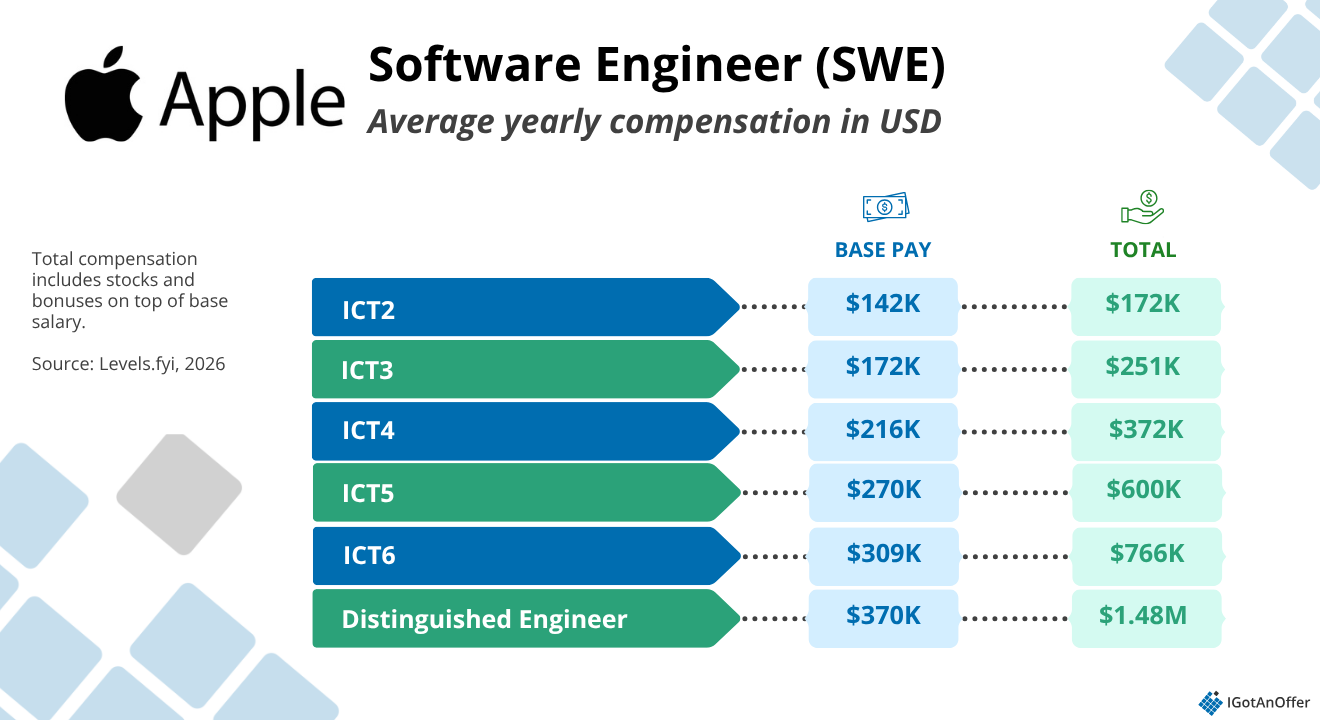
We presume you already know which level you're applying for, but it's worth double-checking with your recruiter, who can confirm which level you're being evaluated for.
Ultimately, how you do in your interviews will help determine whether you get an offer, which is why hiring one of our software engineer interview coaches can provide a significant return on investment.
If you do get an offer, ask your recruiter whether any part of the package is open to discussion. Our Apple salary negotiation guide can help you prepare, and you can book one of our salary negotiation coaches for personalized advice.
Coaches who contributed to this guide





2. Apple software engineer interview process ↑
The Apple interview process varies by team. In the SWE reports we reviewed, candidates described processes lasting four weeks to three months. These are individual experiences, so it’s best to ask your recruiter about the timeline and rounds for your position.
Here’s an overview of the stages you may encounter. Some teams combine steps or skip an optional assignment or final interview:
- Resume screen
- Recruiter call
- Hiring manager screen
- Technical screens and take-home assignment
- On-site interviews
- Final interview and decision
- Salary negotiation
2.1 Resume screen ↑
The first step of Apple's interview process is the resume screen. After you've submitted your application through the Apple jobs portal or been contacted directly via email or LinkedIn, recruiters and hiring managers will evaluate your resume to see if your experience aligns with the open position.
This is a highly competitive step. To help you put together a targeted resume that stands out, follow the tips below:
Tips on crafting a resume
- Simplify. Avoid overly creative layouts. A simple resume passes through applicant tracking systems and reads quickly for recruiters and hiring managers.
- Verbalize. Start each bullet point under your previous roles with an action word.
- Quantify. Add numbers wherever you can, e.g., latency reductions, improvements in reliability, or the number of users your feature serves.
- Summarize. Include a skills section with keywords pulled directly from the job posting.
For more guidance on how to craft your resume, check out our software engineer resume guide. If you’d like personalized feedback, you can also book a resume review session with an expert who can help you identify areas for improvement.
2.2 Recruiter call ↑
You’ll usually start by speaking with a recruiter about your experience, interest in Apple, and fit for the team.
Before the call, practice giving a short introduction that explains how your experience, field of knowledge, and interests make you a perfect fit for the job. Liking Apple is a starting point, but that alone won’t cut it. You need to be specific about what interests you in the team’s products or engineering problems.
The recruiter will also expect you to ask questions. Use this opportunity to clarify anything that wasn’t covered in the job posting, such as what to expect in the interview process.
You can also ask, "What does success look like in the first 6-12 months for this role?" or “What's the biggest challenge the team is facing right now?” Their answers will help you understand the team’s immediate needs and choose relevant examples to discuss in later interviews.
After a successful recruiter call, you’ll usually move on to the hiring manager screen. If you’ve already spoken with the hiring manager, your recruiter should let you know which stage comes next.
2.3 Hiring manager screen ↑
In some cases, you can skip the recruiter screen and head straight to a hiring manager screen.
The hiring manager screen can take different formats depending on the team:
- Resume and past project retrospective. You may get questions confirming details in your resume, or you may get asked to walk through one or two projects and discuss your contribution, the architecture, alternatives you considered, and the trade-offs you made.
- Tools and technology discussion. Expect questions about technologies and tools you’ve listed in your resume that are relevant to the role, such as Swift, SwiftUI, object-oriented programming, or profiling.
2.4 Technical screens and take-home assignment ↑
The number and format of Apple’s technical screens vary by team. Some formats you may encounter:
- Live coding exercise. You’ll be asked to solve an algorithm problem or implement a feature while explaining your approach. For example, a candidate on Reddit described a CoderPad exercise involving classes and data storage, followed by questions about inheritance, async/await, and error handling.
- Live code refactoring/review. Instead of being asked to build from scratch, you’ll be given existing code and asked to review or improve it. For example, a candidate was asked to modify an existing C++ game.
- Take-home coding task. Some teams give you an assignment to complete outside the interview. You’ll need to confirm the deadline, expected time commitment, permitted tools, and whether you’ll be expected to discuss your output in an interview
2.5 On-site interviews ↑
The on-site interview loop is the most extensive stage of the Apple process. You’ll meet several interviewers, either at Apple’s offices or over video, for a mix of technical and behavioral discussions.
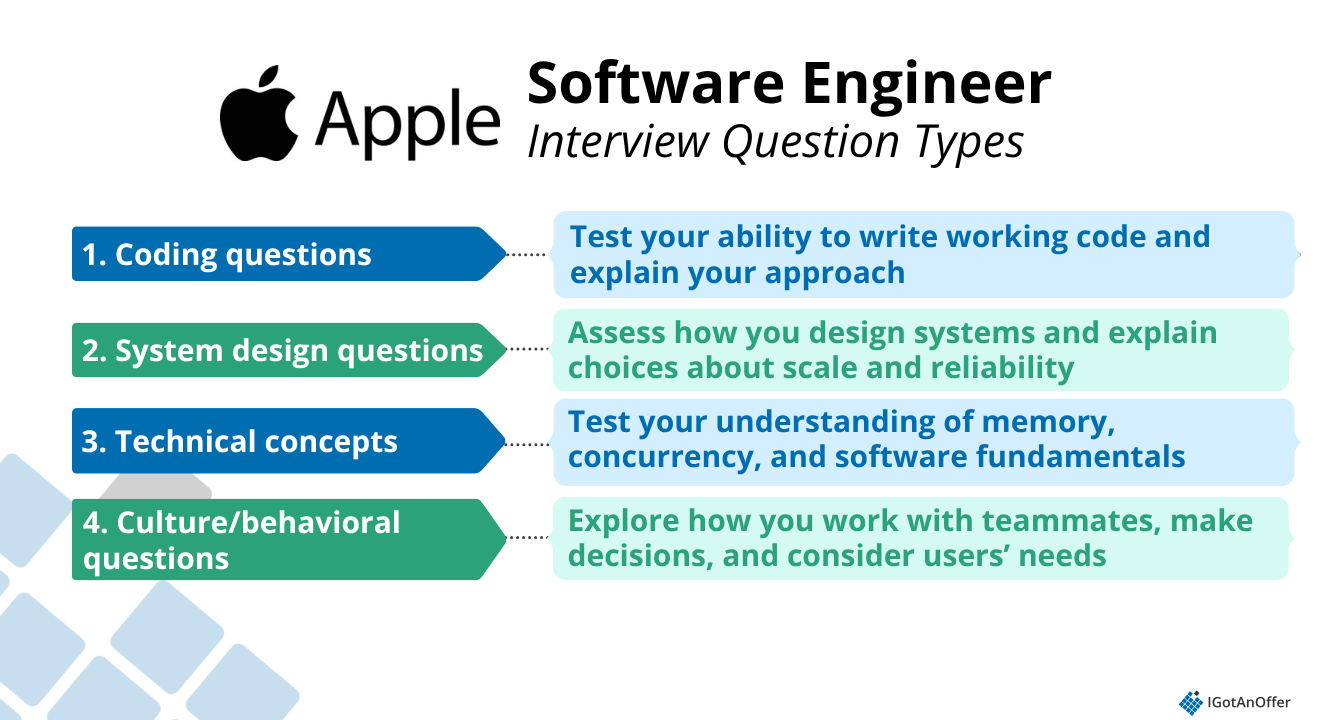
The number of interview rounds depends on your team and level. Based on candidate reports, you can expect loops of four or five interviews covering these four areas:
One interview round can feature a mix of these question categories. You might get asked to write code and explain a concept behind your solution, and then discuss a past project with the same interviewer.
We’ll discuss each interview question type in detail in Section 3 below.
Your recruiter should give you the exact details of your interview schedule before the loop. Learn the formats and review the team-specific topics so you’ll know what to practice and how much time to set aside for the interviews.
2.6 Final interview and decision ↑
After the loop, the hiring manager gathers the interviewers’ feedback and recommendations to make the hiring decision.
If the hiring team is still on the fence, they may decide to schedule you for one more conversation with a senior team member about your experience or fit. Ask your recruiter what the extra conversation will cover. You can then prepare the relevant project examples or review any technical topics they mention.
Before you finish, ask your recruiter when you’re likely to hear back. Follow up if that date passes, and let them know if you have another offer with a deadline.
2.7 Salary negotiation ↑
If you receive an offer, take some time to review it before you respond.
Review the base salary, stock grant and vesting schedule, and any bonuses included. Compare the package with offers for similar jobs in the same location before asking your recruiter what can be negotiated.
Salary negotiation tips
- Be polite. Remember that the person you're negotiating with is just doing their job. You'll get much farther in your negotiations if you approach the conversation with grace.
- Don't give a number right away. Whenever possible, it's better to wait until you receive an offer to start negotiating. This reduces the risk of giving a number that is lower than what Apple otherwise would have paid.
- Do your research. Have a number in mind before the conversation begins, and back it up with data. Research your position and level on Levels.fyi, ask around on professional networking sites like Blind, and factor in the cost of living where you are.
- Start high. If the offer is negotiable, ask for more than your target to leave room for discussion. Be prepared to explain how your experience and market data support the amount you’re asking for.
- Negotiate everything. Look at the complete offer, including base pay, stock grants, bonuses, where you’ll be working, and the work arrangements. If the salary is fixed, ask your recruiter if there is any room to negotiate some of those other terms.
If you'd like help reviewing your offer and planning your negotiation, you can book a session with one of our salary negotiation coaches.
3. Apple software engineer interview questions ↑
Below are 35 questions reported by Apple software engineer candidates on Glassdoor, from interviews dated 2022–2026. We've edited some wording for clarity and grouped the questions by the main skill they test.
You won’t necessarily get these exact questions, but they give you somewhere to start practicing. Don’t forget to check the job description and if there are any specialist topics in there, such as C++ locks or Swift concurrency, make sure to focus on those as well.
3.1 Coding questions ↑
Apple coding questions test your ability to turn a problem into working code and explain your approach in a structured manner. Expect practical implementation tasks as well as data structure and algorithm questions.
The most commonly reported coding topics include strings, arrays, trees, bit manipulation, caching, and object-oriented programming. You should be able to choose suitable data structures and explain your solution’s time and space complexity. You’ll need to test your solution as well, including edge cases.
Before you start coding, check that you and your interviewer understand the problem in the same way. What inputs should the code accept, and what should it return? Ask about constraints and edge cases too, then talk through your approach before you write the code.
Example Apple software engineer interview questions: Coding questions
- Find the first unique character in a string. (Related solution: returns an index)
- Implement an LRU cache in Python. (Solution)
- Implement a binary search tree iterator whose next() method returns the next element, or NULL when the traversal is finished. (Related solution: add NULL handling)
- Given an array of integers, return the length of the longest increasing subsequence. (Solution)
- Solve Minimum Window Substring (LeetCode 76). (Solution)
- Set Matrix Zeroes (LeetCode 73). (Solution)
- Reverse the bits of a 32-bit integer. (Solution)
- Implement a circular buffer in C. (Example implementation)
- Implement a mutex in C++. (Related lock implementation)
- Implement the logic for a spreadsheet API that calculates cell formulas, including formulas that reference another cell. (Related solution: sum formulas only)
- You are given an integer array nums. You are initially positioned at the array's first index, and each element in the array represents your maximum jump length at that position. Return true if you can reach the last index, or false otherwise. (Solution)
- Determine whether a sentence is a palindrome, ignoring punctuation and case. (Related solution: ignores non-alphanumeric characters)
For more practice questions, see our coding interview examples. Some linked solutions answer a slightly different question, as noted beside each link. Check those differences before using the solution to practice.
3.2 System design questions ↑
Apple’s system design questions cover applications, databases, and services such as file storage and notifications. For each question, you’ll be asked to design a system and you’ll need to choose the components and explain how they work together. You should also be able to discuss what could go wrong and how you’d handle it.
Don’t assume the requirements. Ask how many users the system has to serve and which features matter most. You can then discuss the trade-offs in your design, such as how to keep it responsive as traffic grows.
Example Apple software engineer interview questions: System design questions
- Design a tic-tac-toe game with a front-end interface.
- Design the architecture of a basic notes app.
- Given a system with a number of tasks and priorities, design a scheduler that assigns priority to the tasks.
- Design an application that finds the shortest distance between two campus locations. Which data structure or database would you use, and why?
- How would you design a database for a convention? Are you familiar with primary and foreign keys?
- How would you design a scalable file-storage system like iCloud?
- Design a notification system that sends external notifications and notifications between internal systems.
- Design a top-songs feature for a platform like Apple Music that updates its trending songs every hour.
For a worked example by an expert, watch “Design Slack” with ex-Apple EM Saravanan.
For a detailed breakdown of how to approach these questions, see our system design interview guide. If you're applying for a Staff-level role, you can also check out our Staff system design interview guide for advice on preparing at that level.
3.3 Technical concepts ↑
Technical concept questions test your understanding of core software engineering concepts and whether you can apply them to real-world problems. You don’t necessarily need to write a solution or design a whole application here. An interviewer could ask you to explain concurrency, for instance, then ask when you’ve used it and what made it difficult.
Example Apple software engineer interview questions: Technical concepts
- Describe what happens when a command is entered in a Linux terminal. (Related explanation: a simple shell)
- Explain B-trees and their implementation. (Reference: PostgreSQL B-trees)
- Explain Swift concurrency and actor isolation. (Explanation: Swift concurrency)
- Explain the difference between the stack and the heap. (Explanation: stack and heap in Rust)
- How do you ensure quality and performance in your code? (Related reference: code review)
- What is an API? (Explanation)
- What is object-oriented programming? (Explanation)
3.4 Culture/behavioral questions ↑
At a behavioral interview, interviewers ask questions about your past experiences and behaviors to predict how you'll perform in the future.
These questions assess your alignment with Apple’s core values: collaboration, creativity, curiosity, and expertise. Prepare examples of how you’ve worked with others, solved problems, and learned something new. Explain what you did and what came of it.
For senior roles, Santosh (Apple engineering leader) recommends preparing to explain difficult or ambiguous situations in detail: why you made your decisions, what you learned, and what you’d change.
You should also prepare for questions about why you want the job. Go beyond saying that you like Apple’s products: explain what you’d like to work on and why that interests you.
Below are some examples of behavioral questions you could get. We’ve linked to a few example answers to give you an idea of what an excellent answer looks like.
Example Apple software engineer interview questions: Culture/behavioral questions
- Why do you want to work at Apple?
- Tell me about yourself.
- Describe a technical challenge you faced on a project and how you solved it.
- Tell me about a disagreement with a teammate and how you resolved it.
- Tell me about a project you are proud of.
- How would you get up to speed when joining a new team?
- Tell me about a time you regretted something you did. What would you do differently?
- What excites you about Apple's products or design philosophy?
For more help preparing, see our Apple behavioral interview guide.
4. Apple software engineer interviewing tips ↑
You might be a fantastic software engineer, but unfortunately, that won’t necessarily be enough to ace your interviews at Apple. Interviewing is a skill in itself that you need to learn.
Let’s look at some key tips to make sure you approach your interviews in the right way.
4.1 Ask clarifying questions
Often, the questions you’ll get will be quite ambiguous. Make sure you ask questions that can help you clarify and understand the problem.
Be upfront if you encounter topics you have little experience with, but don’t give up on tackling them. Apple isn’t just testing your technical skills but your ability to deal with problems you’re not familiar with.
4.2 Treat the interview like a conversation
Apple wants to know if you have excellent communication skills. So make sure you approach the interview like a conversation.
Santosh (Apple engineering leader) emphasizes that Apple interviewers listen closely to how you explain your solutions. So work on discussing your reasoning as you work. If an interviewer asks why you chose a particular approach, explain the decision behind it before moving on.
Be sure to practice explaining technical decisions in a way that’s clear and easy for everyone to understand.
4.3 Think out loud
You need to walk your interviewer through your thought process before you actually start coding. Keep talking while coding so your interviewer can understand how you think.
Your interviewer may also give you hints about whether you’re on the right track or not. Be alert for these hints, and adjust your approach when the interviewer gives you one. This shows you’re eager to learn and listen well to feedback.
4.4 State and check assumptions
You need to state assumptions explicitly, explain why you’re making them, and check with your interviewer to see if those assumptions are reasonable.
4.5 Present multiple possible solutions
Present multiple possible solutions if you can. Apple wants to know your reasoning for choosing a certain solution.
For example, in the notification-service question in Section 3.2, you could compare sending messages as requests come in vs putting them in a queue. If there are too many requests to send at once, a queue lets the service work through the backlog. But some messages will have to wait. Would that delay be acceptable for this service? Explain your choice and what you’d do in case of failure.
4.6 Connect your decisions to excellent user experience
Apple places a strong emphasis on user experience, so keep the person using the product in mind when proposing a solution. Familiarize yourself with Apple’s design guidelines before the interview, and consider how your choices would make the product clear and easy to use. Be ready to explain how you balance those needs with technical constraints.
4.7 Communicate efficiently using a clear structure
Demonstrating clear and efficient communication skills matters as much as technical ability across every round. Using a framework can help you keep your responses focused and easy to follow. You can use IGotAnOffer's SPSIL method (Situation, Problem, Solution, Impact, Learning) to structure your answers to behavioral questions.
It’s similar to STAR but fixes two common pitfalls candidates often face: (1) candidates often struggle to clearly distinguish between “task” and “action,” and (2) it includes a “learning” step, which STAR often overlooks, even though it’s one of the most important parts of your answer.
For technical rounds, make sure you understand the requirements and state any assumptions before diving into a problem. Summarize your approach before working through your solution. For a consistent answer method, see our coding interview framework and system design framework.
5. How to prepare for your Apple SWE interview ↑
Now that you know what questions to expect, let's focus on how to prepare. Below is our four-step prep plan for Apple SWE interviews.
5.1 Learn about Apple's culture
Most candidates fail to do this. But before investing a ton of time preparing for an interview at Apple, you should make sure it's actually the right company for you.
Apple is prestigious, and so it's tempting to assume that you should apply without considering things more carefully. But it's important to remember that the prestige of a job by itself won't make you happy in your day-to-day work. It's the type of work and the people you work with that will.
If you know anyone who works at Apple (or used to), it's a good idea to talk to them to understand what the culture is like.
We recommend checking out these resources to help you learn more about the company:
- Apple’s shared values
- Apple’s software and services teams
- Benefits and life at Apple
- Apple’s Human Interface Guidelines
In addition, read Apple’s latest annual report to understand its business priorities and risks. Pick a priority relevant to your prospective team and ask how it affects their work. For example, if the report highlights growth in services, you could ask a cloud services team how that growth changes its capacity and reliability needs:
5.2 Practice by yourself
As we've outlined above, you may encounter four main question categories at Apple: coding, system design, technical concepts, and culture/behavioral. The first step in your preparation should be to build a solid foundation in each area and practice answering questions independently.
Below are some useful resources to help you prepare for each question type.
For coding questions:
Practice writing and running code in the environment your recruiter recommends. Focus especially on data structures, object-oriented programming, concurrency, and debugging:
- Coding interview prep guide
- Coding interview examples
- Arrays interview questions
- Strings interview questions
- Linked lists interview questions
- Stacks and queues interview questions
- Trees interview questions
- Graphs interview questions
- Heaps interview questions
For system design questions:
For technical concepts:
Review the fundamentals and languages relevant to your team with these resources:
- Swift concurrency and actor isolation
- APIs: definition and examples
- Object-oriented programming concepts
Try explaining the questions in Section 3.3 to a friend or colleague. If they can’t follow your answer, ask which parts are unclear and work on refining your explanation. If needed, you can use a short code sample to illustrate concurrency, or sketch an API you’ve worked with to explain how applications communicate.
For culture/behavioral questions:
- How to answer “Why Apple?”
- Apple behavioral interview questions
- Common software engineer behavioral questions
A great complement to written practice is answering questions out loud. It sounds unusual, but it will significantly improve how you communicate under pressure during the real interview.
5.3 Practice with peers
If you have friends or colleagues who can do mock interviews with you, that is a worthwhile option to explore. The experience of performing in front of another person is genuinely useful and is free. That said, peer practice does have its limitations:
- It’s hard to know whether the feedback you receive is accurate.
- Your peers are unlikely to have any inside knowledge of Apple's specific interview style.
- On peer platforms, people often waste your time by not showing up
For those reasons, many candidates move straight to practicing with an expert.
5.4 Practice with experienced Apple interview coaches
In our experience, practicing real interviews with experts who can give you company-specific feedback makes a huge difference.
Find an Apple SWE interview coach so you can:
- Test yourself under real interview conditions
- Get accurate feedback from a real expert
- Build your confidence
- Get company-specific insights
- Learn how to tell the right stories, better
- Save time by keeping your preparation focused
To put the cost in perspective, spending $500 on coaching would pay for itself 100 times over if it helped you secure an extra $50,000 in annual compensation.
Click here to book Apple software engineer mock interviews with experienced interviewers.