

 Back to other articles

 Last updated: October 05, 2026
 Interviews
 Product manager
 Deeply researched
PM interview grading rubrics are rarely made public. Most companies keep their evaluation criteria confidential, which can make it difficult to know how you'll be evaluated and where to focus your preparation.
To give you a better idea of how PM interviews are scored, we've worked with Noah, an ex-Meta product leader, to put together example grading rubrics for three common PM interview questions: product sense, product execution, and leadership / behavioral.
Note that these aren't official rubrics from Meta or any other company. However, they'll give you a useful baseline for understanding how your performance may be evaluated.
In this guide, we'll break down each rubric and show you how to use them to assess your own answers. We'll also point you toward useful resources to help you ace your PM interviews.
- How are PM interviews being evaluated?
- Product sense interview grading rubrics
- Product execution interview grading rubrics
- Leadership / behavioral interview grading rubrics
- How to use the interview grading rubric
- How to prepare for your PM interviews
Click here to practice 1-on-1 with FAANG ex-PM interviewers
1. How are PM interviews being evaluated?
Your performance will typically be evaluated as soon as each interview ends. Your interviewer will record feedback, assessing you against predefined criteria for the skills the interview was designed to test.
The expectations may also depend on the level you're interviewing for. Generally, the more senior the role, the higher the bar across the relevant competencies.
Based on this assessment, your interviewer assigns a rating for each criterion and provides written feedback to support it. The exact scoring system varies by company.
At Meta, for example, interviewers use the following ratings:
- Below Expectations
- Meets Expectations
- Strong
- Exceptional
- Unable to evaluate
Interviewers typically submit their feedback within about 24 hours. Along with these ratings, they provide an overall recommendation, such as “Strong Hire,” “Hire,” or “Leaning No.” They can't see what other interviewers have submitted and don't make the final hiring decision themselves.
Once all interviews are complete, a hiring committee reviews the feedback from your entire loop and decides whether you move forward, complete a follow-up interview, or are rejected.
But what if you perform really well in some interviews and poorly in another? In some cases, an exceptional performance in one area may compensate for a borderline performance in another. However, you'll still need to meet the minimum bar for the core competencies assessed in each interview.
Right, now that you know how PM interviews are evaluated, let's look at a few example grading rubrics.
Coaches who contributed to this guide





2. Product sense interview grading rubrics ↑
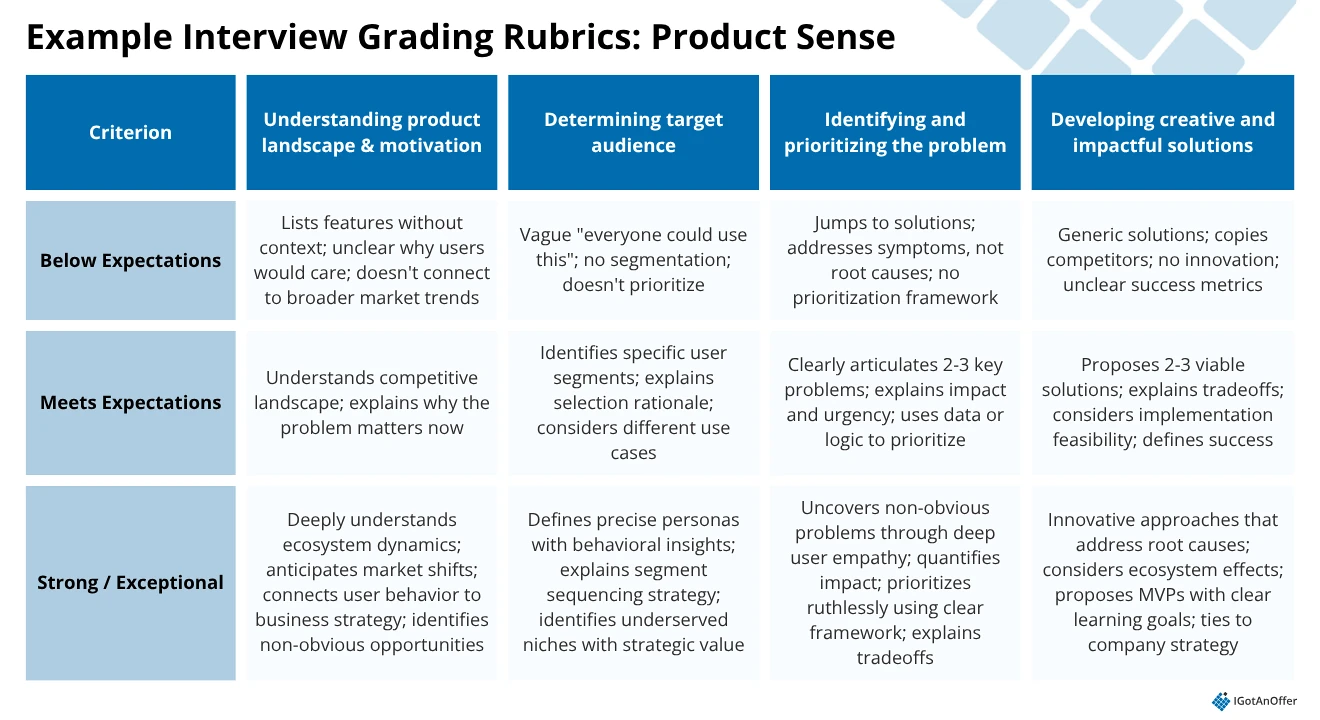
Product sense interviews are designed to evaluate how you work to understand common product challenges and how you identify the best way to approach them.
Many experienced PMs consider product sense one of the most important parts of the PM interview process because it helps top tech companies assess your ability to ideate, design, and improve products.
“Product sense interviews are very reflective of what the PM job is about, which very generically is about figuring out what to build and why,” says Khalid, ex-Meta and DoorDash PM interviewer.
That’s why product sense interviews are part of the PM hiring process at many top companies, including Meta, Stripe, Airbnb, Coinbase, DoorDash, Lyft, Anthropic, OpenAI, and Uber. Google has a similar question type called the Product Vision interview.
During these interviews, you’ll typically be assessed on skills such as structured thinking and communication, user empathy, analytical thinking, and your ability to take a methodical, reasoned approach to product problems, with bonus points for creativity.
Below is an example product sense grading rubric created by Noah to show how your performance may be evaluated.
3. Product execution interview grading rubrics ↑
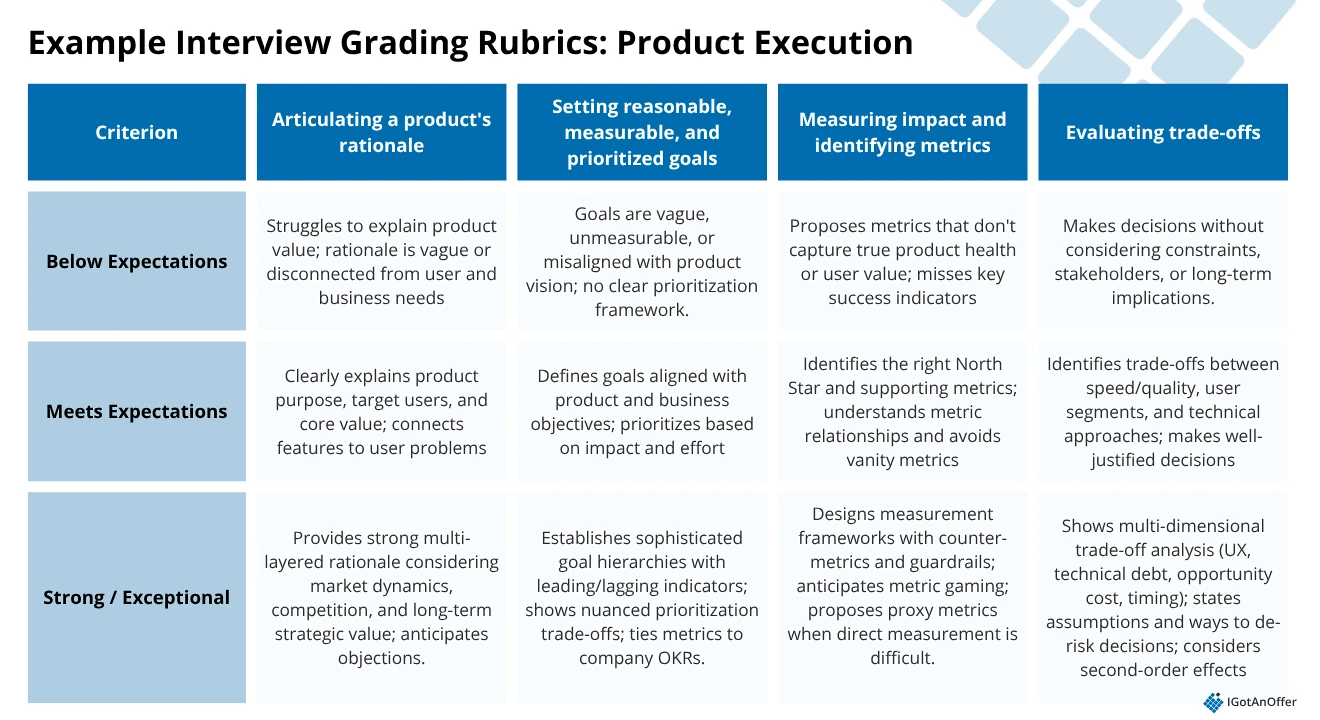
Product managers are responsible for deciding how to measure the success of a product and troubleshooting any unforeseen issues. This requires strong execution skills and the ability to make sound decisions using the data available.
You’ll therefore face metrics questions, along with questions that test how you prioritize and approach trade-offs.
Product execution interviews can go by different names depending on the company. Meta, for example, calls this ‘Analytical Thinking,’ while Google uses ‘Product Analysis’ questions.
Let’s look at an example product execution grading rubric that Noah recommends candidates use to assess their own performance.
4. Leadership / behavioral interview grading rubrics ↑
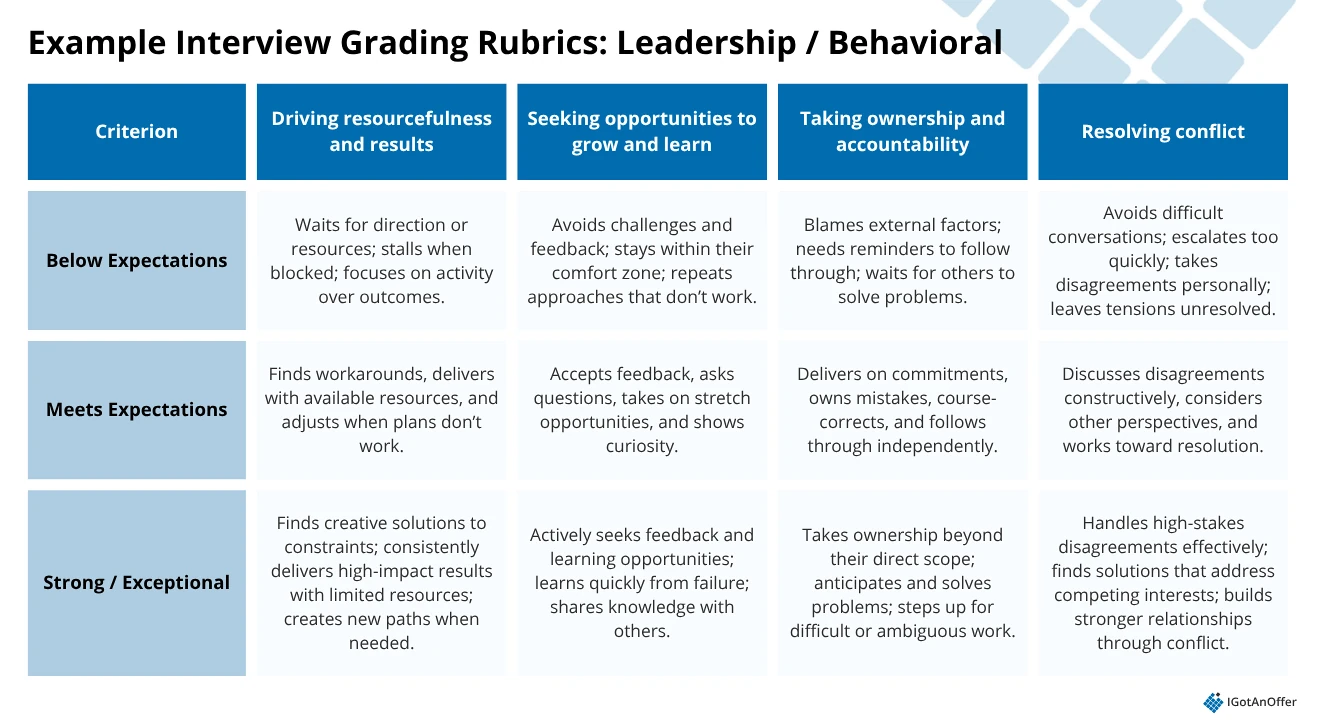
Product managers work closely with engineers, designers, data scientists, and other stakeholders to move products forward. Because you often need to influence people without having direct authority over them, interviewers want to understand how you lead, collaborate, and take ownership.
To assess these skills, interviewers may ask a mix of behavioral and hypothetical questions. They’ll want to hear about your experience working with cross-functional teams, overcoming obstacles, resolving conflict, and driving results.
You may also be asked about times you’ve dealt with unexpected changes, learned from mistakes, taken ownership when things went wrong, or handled disagreements within a team. These questions help interviewers understand how you respond when things don’t go according to plan.
To see how these skills may be evaluated, take a look at the example Leadership & Drive grading rubric Noah created below.
Click here to download the example PM interview grading rubrics (PDF)
5. How to use the interview grading rubrics to assess your answers ↑
Most candidates rely on gut feeling when assessing their answers to interview questions. While that can be useful, it doesn’t always tell you exactly where you need to improve. If you want to be more objective, you can use the grading rubrics above to evaluate your performance.
Here’s how to do that:
Step 1: Record your answer
Choose a practice question and set a timer for 25 minutes. This gives you enough time to work through the question in depth while still putting you under the time pressure of an actual PM interview.
Record your answer without pausing, looking up information, or starting over if you make a mistake. Once the time is up, watch the recording and move on to grading your answer.
Step 2: Grade your answer
Go through the rubric one criterion at a time. For each one, compare your answer with the descriptions for Below Expectations, Meets Expectations, and Strong/Exceptional, then choose the rating that best describes your performance.
For example, if you’re grading the target audience criterion of a Product Sense answer:
- Below Expectations: You give a broad target audience without segmenting or prioritizing users
- Meets Expectations: You identify specific user segments and explain why you chose them
- Strong/Exceptional: You define precise personas, show a deeper understanding of their behavior, and explain how you would prioritize different segments
Do this for every criterion in the rubric. You’ll then have a breakdown of which parts of your answer were strong and which need improvement.
Step 3: Identify what you need to improve
Once you’ve graded your answer, look at the criteria where you scored Below Expectations or Meets Expectations. For each one, check what the rubric says you would need to demonstrate to earn a higher rating. This gives you a specific list of things to improve.
For example, suppose you scored Meets Expectations for evaluating trade-offs. According to Noah’s rubric, this means you identified relevant trade-offs and made a reasoned decision. To reach Strong/Exceptional, you would need to take the analysis further by considering several dimensions of the decision, stating your assumptions, suggesting ways to reduce risk, and considering second-order effects.
Those are now the specific areas you can focus on in your next attempt.
Step 4: Practice, practice, practice
Answer the same question again, this time applying the improvements you identified in Step 3.
Then grade your new answer using the same rubric. Compare the two attempts to see whether your ratings improved and where you still need more practice.
6. How to prepare for PM interviews ↑
Now that you know how PM interviews are evaluated and how to assess your own answers, let’s look at how you can prepare for the interviews themselves.
6.1 Research your target company
Different companies handle the PM interview process differently.
For example, Amazon heavily emphasizes their 16 Leadership Principles during their interviews, and Uber uses "jam sessions" (which are kind of like brainstorming sessions) to evaluate their PM candidates.
To help you, we've put together the free company guides below, which go into detail on each company's interview process and how to best prepare for it.
- Google product manager interview guide
- Meta product manager interview guide
- Amazon product manager interview guide
- OpenAI product manager interview guide
- Microsoft product manager interview guide
- LinkedIn product manager interview guide
- Uber product manager interview guide
- Stripe product manager interview guide
- Lyft product manager interview guide
- Apple product manager interview guide
- TikTok product manager interview guide
- Coinbase product manager interview guide
- Airbnb product manager interview guide
- DoorDash product manager interview guide
- Nvidia product manager interview guide
- Spotify product manager interview guide
- Netflix product manager interview guide
- Capital One product manager interview guide
- Oracle product manager interview guide
- Databricks product manager interview guide
- Anthropic product manager interview guide
6.2 Brush up on your product fundamentals
To ace your PM interviews, you’ll need to demonstrate a strong user focus and product knowledge. Build your interview muscles by practicing with the resources below:
- Product sense
- AI product sense
- Product design
- Product improvement
- Product strategy
- Product execution
- Product metric questions
- Technical questions
- Estimation questions
- Prioritization questions
- PM vibe coding interview
- AI PM interview guide
We also recommend watching mock interview videos at our IGotAnOffer Product Management YouTube channel so you can see what an excellent answer looks like.
6.3 Practice by yourself and with peers
Once you’re familiar with the different question types, start practicing your answers. You can use the grading rubrics in this guide to assess your performance and identify specific areas you need to improve.
Do know that practicing by yourself has its limitations. You can’t simulate thinking on your feet or the pressure of performing in front of a stranger. Plus, there are no unexpected follow-up questions and no feedback.
That’s why many candidates try to practice with friends or peers. If that’s an option available to you, it’s worth trying. It’s free, but be warned, you may come up against the following problems:
- It’s hard to know if the feedback you get is accurate
- They’re unlikely to have insider knowledge of interviews at your target company
- On peer platforms, people often waste your time by not showing up
For those reasons, many candidates skip peer mock interviews and go straight to mock interviews with an expert.
6.4 Practice with experienced PM interviewers
In our experience, practicing real interviews with product manager interview coaches makes a huge difference, as it allows you to:
- Test yourself under real interview conditions
- Get accurate feedback from a real expert
- Build your confidence
- Get company-specific insights
- Learn how to tell the right stories, better.
- Save time by focusing your preparation
Once you’re familiar with the different question types, start practicing your answers. You can use the grading rubrics in this guide to assess your performance and identify specific areas you need to improve.
Click here to book product manager mock interviews with experienced PM interviewers.





 Behavioral