


 Back to other articles

 Last updated: September 18, 2026
 Interviews
 Investment banker
 Deeply researched
To ace your investment banking interview questions, you need to prove that you have the technical knowledge, commercial awareness, and work ethic required to succeed in a demanding, client-facing environment.
That’s why we’ve created this guide. Learn the most important investment banking interview questions and how to answer them effectively. Discover practical frameworks and preparation strategies to help you demonstrate your technical skills, market knowledge, and motivation in every interview round.
Here’s an overview of what we’ll cover:
- Top 12 investment banking interview questions
- More example questions
- Answer techniques
- How to prepare for investment banking interviews
Click here to practice mock interviews with ex-investment bankers
Let’s get into it.
1. Top 12 investment banking interview questions↑
We analyzed 100+ Glassdoor interview reports from top firms, including Goldman Sachs, J.P. Morgan, Morgan Stanley, Barclays, and Bank of America, to find common questions asked at investment banking interviews.
You'll encounter variations of these 12 questions throughout the interview process, from HireVue interviews to Superday rounds. We'll show you why interviewers ask them, how to answer them effectively, and include sample answers to each question.
- Why do you want to work in investment banking?
- Why this firm? (Why Goldman / J.P. Morgan / Morgan Stanley?)
- Walk me through your resume
- Tell me about yourself
- Walk me through the three financial statements (and how they're connected)
- Walk me through the impact of a $10 increase in depreciation across all three statements
- How would you value Company X?
- Walk me through a discounted cash flow (DCF) analysis
- How do you calculate EBITDA and free cash flow?
- What's a deal you've been following recently?
- What market trend, macroeconomic event, or piece of financial news are you paying attention to?
- How many tennis balls (or quarters) can fit inside this room (or a Tesla/Boeing 747)?
Let’s dive in.
1.1 Why do you want to work in investment banking?↑
Your interviewers will want to know what led you to choose this industry (beyond the high salary).
They also want to see whether you’ve taken time to understand the reality of the job and whether you’re mentally prepared for the pace, pressure, and expectations that come with it.
If you’ve had internships or are transitioning from other fields, you should be prepared to explain why you want to do investment banking rather than one of those.
The WORST possible answer is making it sound like you’re already planning your exit, says Kent (ex-Blackstone managing director). Instead, focus on specific aspects of the role you genuinely enjoy and have already been exposed to through your work or studies.
How to answer
- Cite a specific moment or experience that sparked your interest in investment banking (e.g., a childhood memory, exposure to financial models, deal work, or working with a finance team)
- Lay out the steps you took to explore or transition into the field
- Explain how the role aligns with your long-term goals and how your strengths translate to the role
For another expert answer walk-through, watch this short video with coach Kent M. (ex-Blackstone Managing Director) on how he would answer this question:
1.2 Why X company?↑
This is one of the most common questions asked in investment banking interviews, and it is likely to come up at every firm you apply to.
Interviewers want to know that you’re genuinely motivated to work specifically at their bank, not just chasing a paycheck. They’re also testing how well you’ve researched the firm.
As you’ll be doing quite a bit of research and analysis on the job, showing a nuanced understanding of the firm in your answer is a good sign to the interviewer that you have the right skills and motivation for the position.
Kent says that your answer should be specific enough that you couldn't simply reuse it for 30 other firms.
How to answer
- Give two to three concise reasons why you want to join the firm, team, and role.
- Make your answer personal by tying it to your own experiences or interactions with the company.
- Mention one or two recent deals the firm has worked on and explain why they interest you.
- Research the firm's sector focus and be prepared to discuss it. For example, know whether it is a generalist firm or has particular strengths in industries such as technology, healthcare, or energy.
- Avoid generic answers that could apply to any bank. Interviewers want to see that you've done your research and have a genuine interest in their firm.
Let’s take a look at a strong example answer for an analyst role at Goldman Sachs.
Sample answer: Why X Company?
“I want to work at Goldman Sachs for three main reasons.
First, I want to take part in industry-shaping deals, something that I could only do while working for the industry leader in investment banking. I came to this conclusion while researching the leading investment banks, and I was impressed that Goldman had a record M&A year in 2021, earning more in fees than both J.P. Morgan and Morgan Stanley.
Second, as you know, I’m interested in M&A, particularly around activism defense, which is one of Goldman’s strengths. I was inspired by the Allergan vs Valeant deal when we studied it in university, and seeing Goldman’s continued involvement in situations like Sony–Third Point confirmed that this is the right environment for me.
And finally, I’ve had a few conversations with Krish Dixit and Sonia Sanders, associates in the Chicago office, both of whom gave me a great impression of the firm as a whole. Krish in particular encouraged me to apply to the investment banking division, as we share a similar educational background, and he was complimentary of the opportunities he’s been given to succeed.”
Check out our guide to answering the “Why this firm?” interview question for tips and more sample answers for different companies.
1.3 Walk me through your resume↑
Many interviewers will use this question (along with “Tell me about yourself”) as an icebreaker. That makes this a particularly crucial question, as it establishes the interviewer’s first impression and sets the stage for the rest of the interview.
You should know your resume inside and out and be ready to answer follow-up questions on any experience you include. “Bring specific examples of your responsibilities and highlight how they relate to the role you’re applying for,” says Kent.
How to answer
There are four ways you can answer this question:
- Chronologically, where you show your career progression, is the most straightforward to use
- Skills-based, where you highlight relevant competencies, focused on what you can bring to the role
- Project-based approach, where you showcase tangible achievements
- Narrative arc, which is an improved version of the chronological approach, but instead of just going from A to B to C, you make sure to tell your story in a way that is 1) more engaging and 2) best sells you for the role
For the sample answer below, we’ll use a skills-based approach in which you highlight the competencies you bring to the role.
Sample answer: Walk me through your resume
"My career has been built around strong project management and leadership skills. Starting as a business analyst at YumFoods, I demonstrated proficiency in organizing teams and resources, leading to successful project deliveries and a promotion to project manager.
In this role, I refined my abilities in stakeholder communication and risk assessment, ensuring project objectives aligned with business goals.
My transition to WeSellCars.com as an operations manager allowed me to further elevate my skills in team management and strategic planning. I implemented a more streamlined operations process that resulted in a 30% improvement in project timelines.
Currently, as a program manager at Z-bay e-commerce platform, I lead cross-functional teams and manage complex, multimillion-dollar projects. My ability to effectively navigate project complexities has been instrumental in consistently exceeding client expectations and fostering long-term relationships."
Check out our guide on how to answer the “Walk me through your resume” interview question to learn more about the four methods. Then, see Kent's IB Fit Questions Masterclass for more tips on answering this question.
1.4 Tell me about yourself↑
As we mentioned above, ice-breaker questions like this one set the tone for the entire interview. Interviewers will often follow up on any experience or detail you mention, so be prepared to elaborate on your experience.
According to Kent, being too vague and general is a common mistake candidates make when answering this question. Most people default to broad statements like “I’m interested in finance / investment banking,” instead of connecting their past experience to the role.
You don’t necessarily have to focus on your academic and professional credentials here. “Be more personal and talk about specific interests that apply directly to the potential job and then elaborate more towards the end of the interview,” says Kent.
How to answer
- Start with a brief overview of your background.
- Highlight one or two experiences that sparked your interest in finance or investment banking.
- Show your career progression and how the skills you've built so far connect to the role you're applying for.
- Include specific interests or experiences that make your story memorable.
- Keep your answer concise and be prepared to elaborate on any point the interviewer picks up on.
See how to answer the "Tell me about yourself" interview question in ex-Blackstone MD Kent's video below.
1.5 Walk me through the three financial statements (and how they're connected)↑
This accounting question is almost guaranteed to come up in any investment banking interview. A good way to prepare is to learn one or two clear examples that show how information flows between the income statement, cash flow statement, and balance sheet.
How to answer
- Briefly explain the purpose of each statement.
- Show how net income flows from the income statement to the cash flow statement and balance sheet.
- Explain how non-cash items, such as depreciation, are adjusted on the cash flow statement.
- Highlight how changes in cash and retained earnings link the statements together.
- Use a simple example to demonstrate how information flows across all three statements.
Here’s a nice video overview of how to approach this type of question:
You'll also find our investment banking interview cheat sheet helpful in preparing for this type of question, because it uses arrows to illustrate multiple "paths" that run through the three main financial statements.
1.6 Walk me through the impact of a $10 increase in depreciation across all three statements↑
Interviewers ask this question to understand whether you can clearly explain how a single change moves through all three statements and what it means for the company’s financial health.
When answering this question, we recommend starting with the income statement, then moving to the cash flow statement, and finishing with the balance sheet.
This order follows the natural flow of information among the three statements:
Net income (Income Statement) → Cash (Cash Flow Statement) → Assets and Equity (Balance Sheet)
How to answer
- Start with the income statement and explain how the increase in depreciation affects pre-tax income, taxes, and net income.
- Move to the cash flow statement and explain why depreciation is added back as a non-cash expense.
- Calculate the net change in cash after accounting for the tax impact.
- Finish with the balance sheet by explaining the impact on cash, PP&E, and retained earnings.
- Make sure the balance sheet still balances at the end of your explanation.
Below is an example of how you can approach this question.
Sample answer: How does a $10 increase in depreciation affect the three statements?
“Starting with the income statement, depreciation goes up by $10, which reduces pre-tax income by $10. Assuming a 20% tax rate, net income decreases by $8.
On the cash flow statement, net income is down by $8 under cash flow from operations. However, because depreciation is a non-cash expense, you add back the $10 increase in depreciation. That means cash flow from operations increases by $2. There are no changes to cash flow from investing or financing, so the net change in cash increases by $2.
On the balance sheet, cash increases by $2 under assets, while PP&E decreases by $10 due to the higher depreciation. Total assets are therefore down by $8.
Finally, on the liabilities and equity side, retained earnings decrease by $8 because of the lower net income, and the balance sheet balances.”
You can learn more about how a $10 depreciation flows through the three financial statements in the video below.
1.7 How would you value Company X?↑
With this type of question, your interviewer would ask how you would value a specific company, rather than about the general valuation methods. You'll need to identify the most appropriate approach based on the company's industry, business model, and financial profile.
The interviewer may or may not give you additional details or data about the company.
How to answer
- Start by identifying the company's industry and business model.
- Explain which valuation methodology you would use and why.
- Discuss any relevant valuation multiples.
- If appropriate, mention alternative valuation methods and their limitations.
- Focus on your reasoning, not just the final answer.
Let’s look at a sample answer to this question.
Sample answer: How would you value Morgan Stanley?
“First, I’d start by understanding the type of business we’re valuing, because the approach can change depending on the industry. For example, if the company is a bank like Morgan Stanley, traditional metrics such as EBITDA or free cash flow are less meaningful since banks generate value through interest income and their balance sheets are marked to market.
In that case, I would rely primarily on a Comparable Companies analysis using industry-specific multiples. For banks, the most common metric is Price-to-Book Value, since book value closely reflects the fair value of their assets and liabilities.
I’d identify a set of comparable banks with similar business models, geographies, and risk profiles, analyze their trading multiples, and apply the appropriate range to the target company. I would also look at Comparable Transactions to see how similar institutions were valued in recent M&A deals, since those multiples often include control premiums.
If additional information were available, I might also consider a dividend discount model or residual income model, which can be more appropriate for financial institutions than a standard DCF.
After reviewing these methods, I’d triangulate a valuation range and explain which approach I would weight most heavily and why.”
Learn more in our IB valuation interview questions guide.
1.8 Walk me through a discounted cash flow (DCF) analysis↑
This is one of the most common technical investment banking interview questions, so you should be thoroughly prepared for it before your interviews.
DCF stands for discounted cash flow. It is a valuation method used to estimate a company’s value based on the cash flows it is expected to generate in the future. The idea is that money received in the future is worth less than money received today, so future cash flows need to be discounted back to their present value.
To calculate DCF:
DCF = C1 / (1+r)^1 + C2 / (1+r)^2 + … + Cn / (1+r)^n
Note: C = cash flow, r = discount rate. In a DCF analysis, WACC is usually used as the discount rate.
How to answer
- Estimate the company’s future free cash flows, usually 5–10 years into the future.
- Estimate the company’s terminal value.
- Discount both the projected cash flows and terminal value back to present value using WACC
- Add the discounted cash flows and discounted terminal value together.
- The result gives you the company’s enterprise value.
Sample answer: Walk me through a DCF
“Sure. A DCF values a company by estimating the cash it will generate in the future and converting those cash flows into today’s value.
I would start by projecting the company’s unlevered free cash flows for roughly 5 to 10 years. These cash flows represent the money the business generates after operating expenses and required reinvestment.
Next, I estimate the terminal value, which captures the value of the business beyond the explicit forecast period. This is usually done using either the Gordon Growth method or an exit multiple.
Once I have both the forecasted cash flows and the terminal value, I discount them back to present value using the weighted average cost of capital, since WACC reflects the risk of the business and the returns required by both debt and equity investors.
Finally, I add the discounted cash flows and the discounted terminal value together to get the enterprise value. From there, I can move to equity value by subtracting net debt and making any other necessary adjustments.
So in summary, a DCF values a company based on its ability to generate cash in the future, adjusted for risk through the discount rate.”
To learn more about each step of performing a DCF analysis, check out this full guide.
1.9 How do you calculate / adjust EBITDA and free cash flow?↑
EBITDA (Earnings Before Interest, Taxes, Depreciation, and Amortization) and free cash flow are widely used in investment banking for valuation, financial modeling, and M&A analysis. Interviewers use questions like these to assess your understanding of these metrics and how they connect to the three financial statements.
As a result, you may be asked to calculate EBITDA from revenue, explain common EBITDA adjustments, or walk through how to get from EBITDA to free cash flow. These questions come up most often in Goldman Sachs interviews, though they occasionally appear at other firms as well.
How to answer
- First, clarify which metric the interviewer wants you to calculate (e.g., EBITDA, adjusted EBITDA, FCFF, or FCFE).
- State the formula before diving into the numbers.
- Explain any adjustments being made, such as adding back depreciation or excluding one-time expenses.
- Walk through each step of the calculation in a logical order.
- For free cash flow questions, explain how taxes, working capital, and capital expenditures affect the result.
- Be prepared to explain the reasoning behind each adjustment.
You can learn more about the relationship between EBITDA and cash flow in this short video:
1.10 What's a deal you've been following recently?↑
Keeping up with major transactions is a core part of working in investment banking, so firms often ask candidates about recent deals they've been following. This helps them assess your commercial awareness, interest in the industry, and ability to think critically about real-world transactions.
Kent says one of the biggest mistakes candidates make when answering this question is being too vague. You should come prepared to talk about a specific deal you've researched.
You don't need to have all the facts about the transaction. However, “you should understand why they're looking at the deal, why they've worked on it, what they did with it, and why it was such an interesting deal,” says Kent.
How to answer
- Choose a recent deal and be prepared to discuss it in detail.
- Explain the companies involved and the basic structure of the transaction.
- Discuss why the deal happened and what each party hoped to achieve.
- Highlight what makes the deal interesting, unusual, or strategically important.
- Share your own perspective on the transaction and any potential risks or challenges.
Learn more about how to answer this question in ex-Blackstone MD Kent’s IB Fit Masterclass below (skip to 31:06).
1.11 What market trend, macroeconomic event, or piece of financial news are you paying attention to?↑
This question tests your macroeconomic awareness. Firms want to see that you understand how the broader economic climate directly impacts corporate balance sheets and deal flow. This means keeping up-to-date on shifting interest rates, geopolitical tensions, or industry-wide technological shifts.
Similar to the deal question, the biggest mistake candidates make here is being too broad with their answers. You should come prepared to talk about a specific trend and connect it to its impact on investment banking activity.
How to answer
- Identify a specific trend or event by choosing a clear macroeconomic theme (e.g., shifts in central bank policies, cross-border trade dynamics, or major regulatory changes).
- Discuss how this trend affects corporate earnings, borrowing costs, or strategic decision-making for businesses.
- Explain what this means for the M&A landscape, IPO volumes, or debt capital markets.
- Share your own outlook on whether this trend will accelerate or cool down over the next 12 months, and why.
Sample answer: What market trend, macroeconomic event, or piece of financial news are you paying attention to?
“A major trend I’m following is the expansion of the private credit market, specifically the recent surge in traditional banks executing Significant Risk Transfers (SRTs) with private funds.
Because of stricter regulatory capital requirements, traditional commercial banks are under intense pressure to clear risk off their balance sheets. Through SRTs, banks are essentially paying private credit funds to absorb the default risk of their loan portfolios. This frees up bank capital, while private credit gets access to high-quality corporate debt.
For investment banking, this has two major impacts. First, it’s shifting deal volumes away from traditional leveraged-loan syndication, as private debt funds now have the capital to finance massive deals entirely on their own. Second, it has created a lucrative advisory niche: investment banks are now actively advising regional banks on how to structure these complex SRTs, and helping corporate clients navigate direct relationships with private credit.
Over the next 12 months, I expect this trend to accelerate. Even if interest rates fluctuate, regulatory scrutiny on bank balance sheets isn't going away. Private credit is no longer just a temporary alternative. It is becoming a permanent pillar of corporate capital architecture.”
1.12 How many tennis balls / quarters can fit inside this room / Tesla / Boeing 747?↑
Some firms, especially Goldman Sachs, include brainteasers like this to test candidates’ logical thinking and problem-solving skills. This is a typical market sizing brainteaser, but you may also get logical and probability questions, as well as scenario-based questions.
According to Justin (ex-Goldman Sachs investment banker), there is no one “correct” answer to these problems. Rather, interviewers want to see whether you can “break ambiguous problems into logical components, make reasonable assumptions, and communicate clearly while thinking in real time.”
How to answer
Justin recommends learning this 5-step repeatable framework for structuring your answers to brainteasers:
5-step framework for answering IB brainteasers:
- Clarify the objective: Restate the question and confirm what you're solving for.
- Break it into drivers: Identify the key variables or inputs that will shape your estimate.
- State your assumptions: Use simple, reasonable assumptions and explain them clearly.
- Calculate cleanly: Work through the math step by step and talk through your logic.
- Sanity check the answer: Check whether your result makes sense and note which assumptions matter most.
Let’s answer this question using the framework above.
Example answer: How many tennis balls fit in a Tesla?
Step 1: Clarify the Objective
“First, I want to make sure I’m defining the scope correctly. We are estimating how many standard tennis balls can fit inside a standard Tesla sedan (like a Model 3), assuming the car is empty (no passengers) but the interior fixtures (seats, steering wheel, console) remain intact.
Are we including the trunk and the "frunk" (front trunk), or just the main passenger cabin? For this calculation, I will assume we are filling the entire available cargo and cabin space to maximize the count.”
Step 2: Break the Problem into Drivers
“To solve this, we need to determine the total available volume of the Tesla and divide it by the effective volume of a single tennis ball.
The core equation is:
Number of Tennis Balls = Total Interior Volume of Tesla / Effective Volume of a Tennis Ball
To get there, we need to look at total cargo and cabin capacity, the dimensions of a single ball, and a packing factor to account for the empty air gaps between spheres.”
Step 3: State Assumptions Clearly
“Let's establish some clean, round numbers for our variables:
- Tesla Volume: A mid-size sedan has a total interior and cargo volume of roughly 3 cubic meters. Since 1 meter is 100 cm, 1 cubic meter equals 1,000,000 cubic centimeters. That gives us a total volume of 3,000,000 cubic centimeters.
- Tennis Ball Dimensions: A standard tennis ball has a diameter of roughly 7 cm.
- Packing Efficiency Shortcut: Instead of calculating the volume of a sphere and applying a 64% packing density, I’m going to assume each ball occupies the space of a cube with 7 cm sides. Treating the spheres as cubes inherently bakes in the empty space between them.
- Effective Ball Volume: 7 x 7 x 7 equals 343 cubic centimeters. Let’s round this to 350 cubic centimeters to keep the upcoming division clean.”
Step 4: Calculate Cleanly and Narrate
“Now, dividing the total volume of the car by the effective volume of one ball: 3,000,000 cubic centimeters divided by 350 cubic centimeters per ball.
To simplify this in my head, I’ll drop a zero from both sides, which gives me 300,000 divided by 35.
- I know 35 x 2 = 70.
- 70 x 4 = 280 (so 35 x 8 = 280).
- Therefore, 35 x 8,000 = 280,000.
- That leaves us with 20,000 remaining. 35 goes into 200 just under 6 times, so 35 goes into 20,000 roughly 570 times.
Adding those together gives us approximately 8,570 balls. I will round this to a baseline of 8,500 to 9,000 tennis balls.”
Step 5: Sanity Check the Result
“Let's sanity check this. A standard case contains 24 cans of 3, which equals 72 balls. 9,000 balls divided by 72 is roughly 125 cases of tennis balls. Visualizing a Tesla with the seats down, stacking 125 medium-sized cardboard shipping boxes into the cabin and trunks feels tight, but entirely plausible.
The most sensitive variable here is Tesla's volume. If we were to remove the rear and passenger seats entirely, we could likely increase the available volume by 25% to 30%, pushing our estimate past 11,000. Given that variability, I would provide a final reasonable range of 9,000 to 12,000 tennis balls.”
Learn more in our guide to investment banking brainteasers.
Coaches who contributed to this guide










2. More investment banking interview questions (categorized)↑
Now that we’ve covered the 12 most critical questions asked in investment banking interviews, let's look at a more comprehensive list.
As we’ve established, landing an IB offer requires a dual mastery of technical precision and behavioral fit. Hence, we focus on the following five categories:
- Behavioral and fit questions
- Technical questions
- Economy/market awareness questions
- Situational judgment questions
- Brainteasers
Right, let’s dive in!
2.1 Behavioral and fit questions↑
These are general and scenario-based questions that test whether you have the motivation, temperament, and interpersonal skills needed to handle the demands of investment banking. And, if you would fit within their team and culture.
Examples of IB behavioral and fit interview questions
General
- What are your strengths and weaknesses?
- What are your career goals?
- What would your co-workers or manager say about you?
- Tell me about a time you handled team conflict. How did you solve it?
- Tell me about a time you demonstrated leadership
- Tell me about a time you failed and how you handled it
- Tell me about a time you faced a challenge / complex problem and how you solved it
- Tell me about a time you faced an ethical dilemma
- Tell me about a time you used data / analysis to make a recommendation
- Tell me about a time you had to work under pressure
Scenario-based
- You have a deliverable due tomorrow, but are missing a critical component, and your team is asleep. What do you do?
- You are working on a major client deal, and the client makes a request that violates firm policy. What would you do, and who would you escalate it to?
- What would you do if a major client’s request were illegal?
See our IB behavioral and fit guide for more practice questions with sample answers and a proven method for answering these questions.
2.2 Technical questions↑
Technical questions in IB interviews assess whether you have a good understanding of core financial concepts and the fundamental skills analysts need to perform effectively.
These questions can be divided into valuation, accounting, and a few other (less common) question sub-types:
- Valuation questions test your ability to determine the value of a business.
- Accounting questions assess your understanding of financial statements and core accounting principles.
- Other technical questions touch on topics such as leverage ratios, beta, interest rate impacts, or other finance concepts that don’t neatly fall under valuation or accounting.
Examples of IB technical interview questions
Valuation questions
- What are the main methods of valuing a company?
- What is enterprise value?
- Walk me through a DCF
- How do you calculate WACC?
- When would you use (or not use) DCF instead of other valuation methods?
- How do you calculate cost of debt and cost of equity? How do they impact a company’s value?
- Determine if an acquisition is accretive or dilutive.
- How would you value an apple tree?
- When would you not use a DCF to value a company?
- Give me a scenario where a DCF provides more insight than a multiples-based valuation.
- How would a DCF analysis differ for a biotechnology company?
- How would an increase in the corporate tax rate affect a DCF valuation?
- What is your view on price-to-earnings (P/E) versus enterprise value to earnings before interest, taxes, depreciation, and amortization (EV/EBITDA)?
- What happens to the value of a company if its cost of equity increases?
- What is the difference between enterprise value and market capitalization?
- How do you calculate the market capitalization of a company?
- Walk me from equity value to enterprise value.
- Why do we use earnings before interest, taxes, depreciation, and amortization (EBITDA)?
- What is the effect of a stock split on a company’s price-to-earnings (P/E) ratio?
- How do leasing rules under International Financial Reporting Standard 16 (IFRS 16) affect a DCF?
Accounting questions
- Walk me through the financial statements.
- Explain minority interest in layman’s terms.
- How does X affect the financial statements?
- How does goodwill impairment impact the financial statements?
- How do you go from earnings before interest, taxes, depreciation, and amortization (EBITDA) to free cash flow (FCF)?
- How do you calculate levered/unlevered free cash flow?
- Walk me through how purchasing $100 of assets affects the financial statements by the end of the year.
- What is the impact of an increase in accounts payable (AP) on cash flow?
- Walk me through a profit and loss (P&L) statement.
- Walk me through a balance sheet.
- Explain minority interest in simple terms.
- Explain the treasury stock method.
- Walk me through a $10 increase in depreciation and amortization (D&A).
- Explain the post-merger impact on the financial statements of two companies.
- What leverage ratios would you use to evaluate the risk on a company’s balance sheet?
- How do changes in interest rates affect corporate balance sheets?
Other technical questions
- What is an LBO, and what are its value drivers?
- Build an LBO model.
- Would a financial sponsor and a strategic buyer pay the same price for a company if synergies were removed?
- If a buyer trading at 25x price-to-earnings (P/E) acquires a seller trading at 20x P/E, is the transaction accretive or dilutive?
- How do you calculate beta?
- What metrics would you examine to determine whether a company can repay a new loan?
- How are interest rates correlated with real estate investment trusts (REITs)?
- How would you build a sum-of-the-parts (SOTP) valuation for a drug launch?
- What does it mean for cash to have a price-to-earnings (P/E) ratio?
See our IB technical questions guide for more tips and sample answers to some of the questions above. Then, refer to our guides on IB accounting questions and IB valuation questions for a deeper dive into the question types.
2.3 Economy / market awareness questions↑
This category assesses your understanding of the broader economy, financial markets, current deals, and industry dynamics that are relevant to the team and firm you’re applying to.
They could be subdivided into four sub-categories:
- Economy questions – test your awareness of current events, macro trends, and how economic shifts affect companies, valuations, and markets relevant to your target team
- Deals questions – evaluate whether you understand real M&A or capital markets transactions and the key drivers behind them
- Industry questions – assess your familiarity with the investment banking landscape, what different teams do, and how your target firm is positioned relative to competitors
- Investing questions – gauge your ability to think like an investor by forming a thesis, evaluating opportunities, and explaining how you’d allocate capital
Examples of IB market / awareness interview questions
Economy
- Name one story in the news and describe why it’s important to you.
- Tell us about a recent news story and why it sparked your attention.
- What is happening in the current market that has caught your interest, and why?
- What is your opinion of the market right now?
- What do you think is the biggest challenge facing the financial market in the next 5 years?
- Describe how a world event can impact markets.
- Describe the effect of global circumstances on financial markets.
- What are three key themes that UK markets will be focused on over the coming year?
- How would you explain the local economy in layman’s terms?
- How do you expect current trade policy and Federal Reserve policy to impact markets over the next 12 months?
- How will the bond market react to the interest rate drop?
- What do you think the Federal Reserve will do with interest rates?
- What is your view of the European debt crisis?
- What is the difference between monetary and fiscal policy?
- What do you think of quantitative easing?
- What is the trend of the Asia equity market in the last two years?
- Name a major current event happening in the world right now, and explain how it affects the markets relevant to this business.
Deals
- Tell me about a recent M&A transaction and what you thought about it.
- Tell us about a recent private equity deal.
- Tell me about a recent deal you’ve been paying attention to.
- Tell me about a recent deal that the company worked on and what you know about it.
- Tell me about one of the deals on your résumé.
Industry
- What is something you recently heard about our company, and why is it important?
- What makes our bank different from other banks?
- What is investment banking?
- What technology will be trendy in the next 6–12 months?
- How can an investment bank add value?
Investing
- What are the requirements for a good investment?
- Pitch a stock.
- Describe SolarCity’s business model.
- Discuss a stock you’ve been following.
- Pitch me a stock where you would invest $1,000,000.
- What are the requirements for making a good investment?
- What stock would you long and which would you hedge?
2.4 Situational judgment questions↑
Situational judgment questions are hypothetical questions that assess how you would handle realistic scenarios you may encounter on the job. They evaluate your judgment, ethics, communication style, and ability to stay composed under pressure.
Examples of IB situational judgment interview questions
- The person sitting in front of you during a test begins cheating. How would you handle the situation, and would you respond immediately or wait until afterward?
- You have a deliverable due tomorrow, but are missing a critical component, and your team is asleep. What do you do?
- You are working on a major client deal, and the client makes a request that violates firm policy. What would you do, and who would you escalate it to?
- What would you do if a major client’s request were illegal?
- If you had several urgent tasks to complete but not enough time, how would you prioritize them?
- You gave your manager a piece of work and later realized you made a mistake. What would you do?
- Your previous manager asks you for confidential information about a project you’re working on, claiming it’s needed for an important decision. How do you respond?
- Your team is facing activist pressure because one business segment is underperforming. How would you approach this challenge?
- If part of a company is facing severe headwinds, what steps would you take as an advisor?
- A client or teammate is struggling to understand complex information you need to present. How would you prepare, and how would you communicate it effectively?
- You are asked to support a live deal on the same day as an important personal commitment (e.g., a family event). What do you prioritize, and why?
2.5 Brainteasers↑
Finally, brainteasers measure your logical thinking and problem-solving skills. These curveball questions often come in the form of estimation or market sizing questions.
Example IB brainteaser interview questions
Market sizing / estimation
- Size the market of the gum industry in the United States.
- How many people do you think speak Bengali in Japan?
- How many cigarettes are sold in the United States each year?
- How would you estimate how many iPhones T-Mobile should order for the next release?
- How many light bulbs are there in New York?
Others
- Which number is closest to 272: 600, 700, or 800?
- If you look at a clock and the time is 9:45, what is the angle between the hour and minute hands?
- What is the angle between the hands at 3:15?
- If a piggy bank deposits $100 per year, how much would you pay for it?
To dive deeper into the topic, check out our IB brainteasers interview guide.
Click here to download IGotAnOffer’s complete list of 150+ IB interview questions
3. Techniques for answering investment banking interview questions↑
Each question category requires a different answer structure. To help you tackle any question, we'll cover the most effective answer frameworks for a few of the question types, including our own approach as well as techniques shared by experts on our platform.
3.1 How to answer general behavioral questions
For general questions, you’ll need to craft your own individualized responses in advance, since these focus on your motivation and fit rather than a specific scenario. Your answers should sound genuine and not overly structured or rehearsed.
Kent (ex-Blackstone managing director) recommends using the SPEC (Specific, Personal, Employer-facing, Concise) framework to keep your answers focused, memorable, and relevant to the role.
Here’s an overview of the framework:

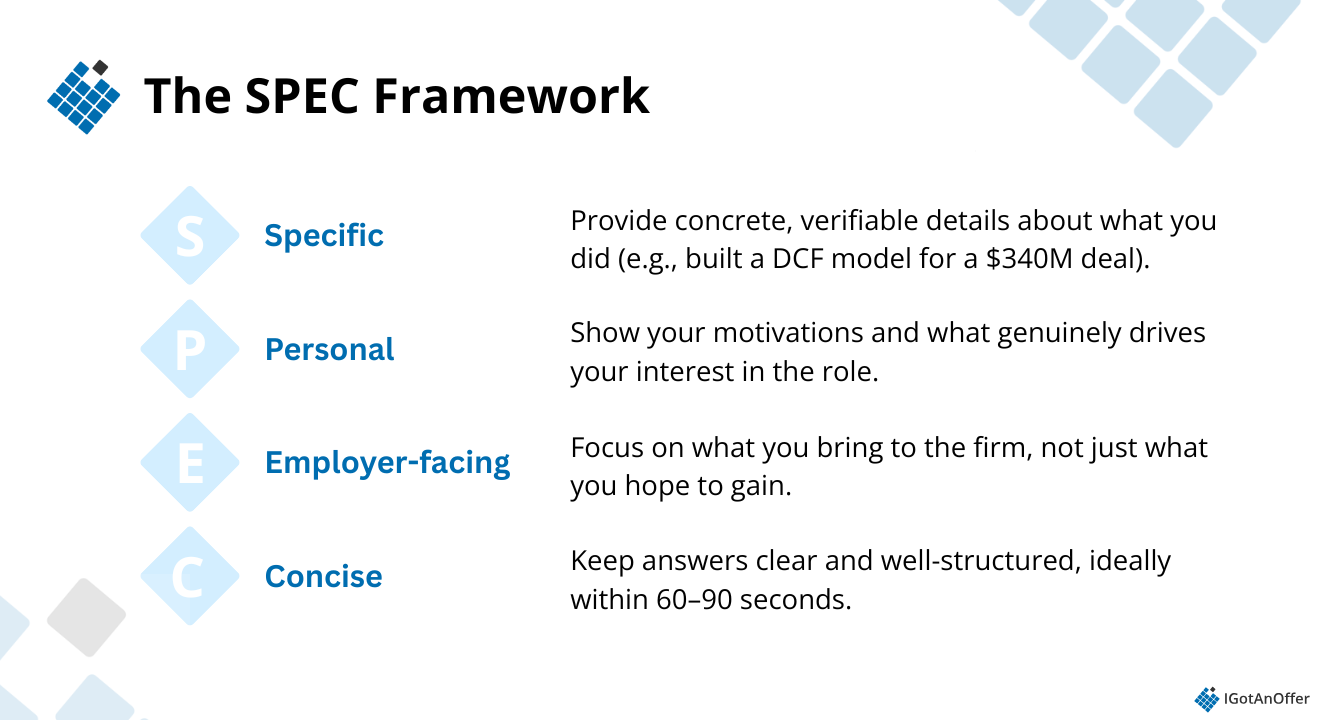
- Specific: Avoid vague statements like “I worked on a deal.” Instead, give concrete, verifiable details about what you did. For example, “I built a DCF model for a $340 million healthcare acquisition.”
- Personal: Your answer should reflect your own experiences and motivations. Go beyond technical skills and include what genuinely drives your interest. For instance, a personal connection to an industry can help your answer resonate more with the interviewer.
- Employer-facing: Focus on what you bring to the firm, not just what you hope to gain. Strong answers clearly show how your skills and experience will add value in the role.
- Concise: Keep your answers focused and structured. Aim for around 60 to 90 seconds so you can communicate clearly while leaving time for follow-up questions.
3.2 How to answer scenario-based behavioral questions
For scenario-based behavioral questions, you'll need to use a repeatable framework. This will help you relay your most relevant achievements and communicate them clearly.
We recommend using IGAO's SPSIL framework rather than the traditional STAR framework. SPSIL offers a better flow for structuring answers and addresses some of the common issues candidates run into with STAR, which we explain in more detail below.
3.2.1 STAR method
The STAR method (Situation, Task, Action, Result) is a popular approach for answering behavioral questions because it’s easy to remember. You’ll see it’s recommended by many articles you can find on Google (they tend to copy each other!).
However, the STAR method has two problems:
- We’ve found that candidates often find it difficult to distinguish the difference between steps two and three, or task and action.
- It ignores the importance of talking about WHAT YOU LEARNED, which is often the most important part of your answer.
To correct those two faults, we actually developed our own (very slightly different) framework that many of our candidates have used successfully over the years: IGotAnOffer’s SPSIL method.
3.2.2 IGotAnOffer’s SPSIL method
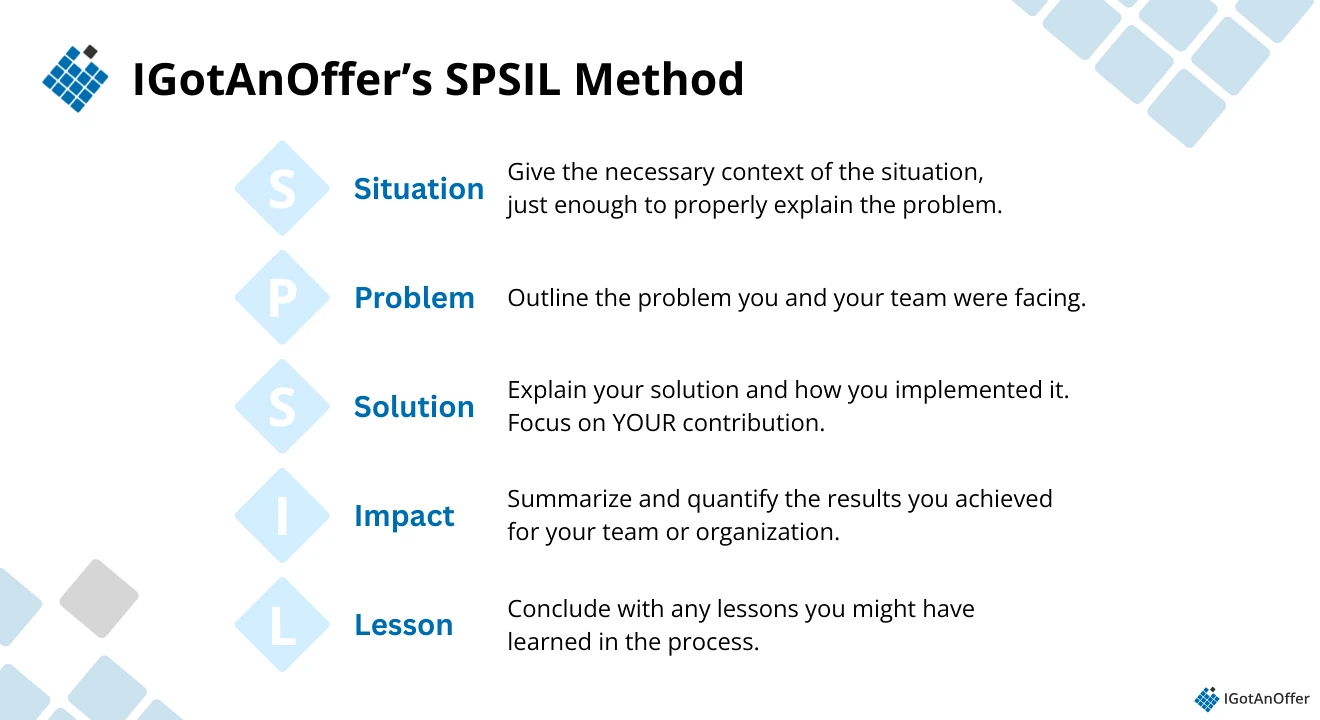
IGotAnOffer’s SPSIL (Situation, Problem, Solution, Impact, Lessons) method has a less catchy name, but it corrects both of the STAR method’s faults. Here’s an overview:
- Situation: Start by giving the necessary context of the situation you were in. Describe your role, the team, the organization, the market, etc. You should only give the minimum context needed to understand the problem and the solution in your story. Nothing more.
- Problem: Outline the problem you and your team were facing.
- Solution: Explain the solution you came up with to solve the problem. Step through how you went about implementing your solution, and focus on your contribution over what the team / larger organization did.
- Impact: Summarize the positive results you achieved for your team, department, and organization. As much as possible, quantify the impact.
- Lessons: Conclude with any lessons you might have learned in the process.
3.3 How to answer situational judgment questions
Situational judgment questions are less predictable than behavioral questions, since you are given hypothetical statements rather than drawing from past experiences.
If you encounter these types of questions, here are a few tips you can use to structure your response:
- Take a moment before responding. Pause briefly to gather your thoughts so you can answer clearly and confidently.
- Ask clarifying questions. Extract the key details you need and make sure you understand what the scenario is really asking.
- State your assumptions. Because these questions are intentionally vague, outline any reasonable assumptions you’re making before offering your approach.
- Show your work. Talk through your thought process so the interviewer can follow your reasoning step by step.
- Consider the risks and trade-offs. Acknowledge potential downsides, explain how you would mitigate them, and show that you can weigh competing priorities with sound judgment.
- Reference lessons you’ve learned from others. When appropriate, draw on effective practices you’ve seen from managers or teammates and explain how you would apply those insights to the scenario.
- Tie it back to the role and the firm’s values. Connect your approach to what the job requires and link your reasoning to values the firm emphasizes, such as integrity, teamwork, ownership, or client focus.
3.4 How to answer IB brainteaser questions
Most of the brainteaser questions you’ll encounter in investment banking interviews are created on the spot. Meaning, there’s no way for you to memorize answers.
A great workaround for this, according to Justin (ex-Goldman Sachs Investment Banker), is to learn a repeatable framework for structuring your answers. Here’s the 5-step framework that he recommends:
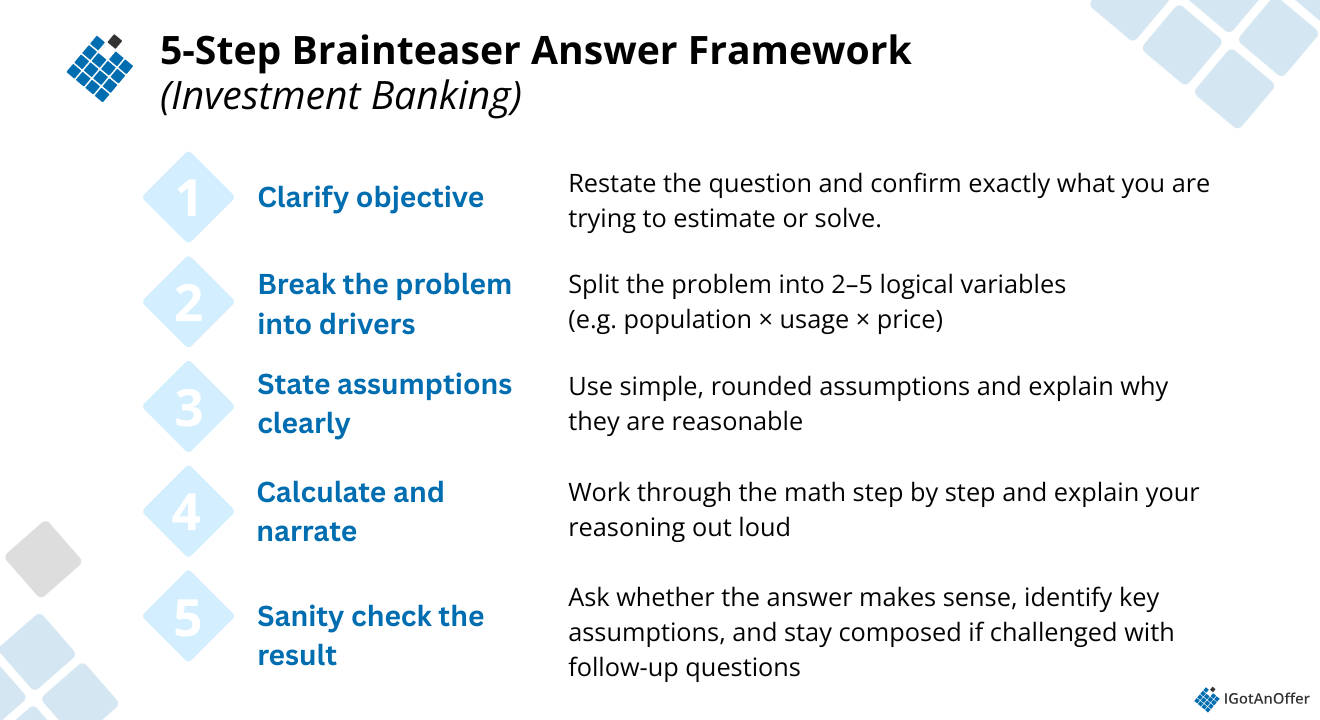
Step 1: Clarify the objective
Restate the question and confirm exactly what you are trying to estimate or solve. Ask clarifying questions if the prompt is vague or missing important details.
Step 2: Break the problem into drivers
Break the problem into 2 to 5 logical variables or inputs. For example, a market sizing question might be broken down into: population × penetration rate × usage frequency × price.
Step 3: State assumptions clearly
Use simple, rounded assumptions and explain why they are reasonable. Interviewers care more about the quality of your assumptions and reasoning than about giving perfectly precise answers.
Step 4: Calculate cleanly and narrate your thinking
Work through the calculation step by step, keeping your units consistent and explaining your logic out loud so the interviewer can follow your reasoning and guide you if needed.
Step 5: Sanity check the result
Before giving your final answer, ask whether the result makes sense in the real world. Identify which assumptions have the biggest impact on the estimate and explain how changing them would affect the answer.
Be prepared for follow-up questions where the interviewer changes a constraint or challenges one of your assumptions. Stay composed, adapt your reasoning, and continue working through the problem logically.
We've coached more than 20,000 people for interviews since 2018. There are essentially three activities you can do to practice for interviews. Here’s what we've learned about each of them.
4. How to prepare for investment banking interviews↑
We've coached more than 20,000 people for interviews since 2018. There are essentially three activities you can do to practice for interviews. Here’s what we've learned about each of them.
4.1 Learn by yourself
Learning by yourself is an essential first step. We recommend kickstarting your prep with the questions in this guide. And then go through the following resources when you’re ready to dive deep:
General
- Investment banking interview prep guide
- 15 investment banking interview tips
- Investment banking interview cheat sheet
- Investment banking HireVue interview guide
- Investment banking Superday interview guide
- Investment banking interview process
Skills-specific
- Investment banking behavioral & fit questions guide
- How to answer “Why X company?” question
- Investment banking technical questions guide
- Investment banking interview accounting questions guide
- Investment banking valuation interview questions guide
- Investment banking brainteasers guide
- How to network your way into investment banking (by ex-Merrill Lynch director Mike)
- How to make your LinkedIn profile more visible to IB recruiters (by ex-Merrill Lynch director Mike)
- Investment Banking Fit Questions Masterclass (by ex-Blackstone MD Kent)
Company-specific
Goldman Sachs
- Goldman Sachs interview prep guide
- Goldman Sachs behavioral interview guide
- Goldman Sachs HireVue interview guide
J.P. Morgan
- J.P. Morgan interview prep guide
- J.P. Morgan behavioral interview guide
- J.P. Morgan HireVue interview guide
Morgan Stanley
- Morgan Stanley interview prep guide
- Morgan Stanley behavioral interview prep guide
- Morgan Stanley HireVue interview guide
BlackRock
-
How to pass BlackRock intern interview + 5 Qs you MUST prep for (by ex-BlackRock analyst Nikita)
We also recommend watching mock interview videos at our IGotAnOffer Finance YouTube channel so you can see what an excellent answer looks like.
If you're also exploring a career in private equity, check out our private equity mock interview with an ex-Morgan Stanley analyst, which includes strong sample answers to common intern- and associate-level interview questions.
Once you’re in command of the different subject matters, you’ll want to practice answering questions. But by yourself, you can’t simulate thinking on your feet or the pressure of performing in front of a stranger. Plus, there are no unexpected follow-up questions and no feedback.
That’s why many candidates try to practice with friends or peers.
4.2 Practice with peers
If you have friends or peers who can do mock interviews with you, that's an option worth trying. It’s free, but be warned, you may come up against the following problems:
- It’s hard to know if the feedback you get is accurate
- They’re unlikely to have insider knowledge of interviews at your target company
- On peer platforms, people often waste your time by not showing up
For those reasons, many candidates skip peer mock interviews and go straight to mock interviews with an expert.
4.3 Practice with experienced engineering manager interviewers
In our experience, practicing real interviews with experts who can give you company-specific feedback makes a huge difference.
Find an investment banking interview coach so you can:
- Test yourself under real interview conditions
- Get accurate feedback from a real expert
- Build your confidence
- Get company-specific insights
- Learn how to tell the right stories, better.
- Save time by focusing your preparation
Landing a job at a big tech company often results in a $50,000 per year or more increase in total compensation. In our experience, three or four coaching sessions worth ~$500 make a significant difference in your ability to land the job. That’s an ROI of 100x!
Click here to book investment banking mock interviews with experienced interviewers.

 Behavioral